PART 1
I had always been Daddy’s girl. There was nothing I couldn’t tell him, no secret I felt I needed to hide.
But my father had secrets of his own, things he carried quietly through the years and never shared with me.
“What’s it like there?” I asked once.
Dad had been born and raised in Hawaii. At twenty, he left the islands behind, settled in Oregon, and eventually met my mother.
He missed his birthplace more than he ever admitted. Yet, as the years passed, Hawaii became a subject nobody dared bring up during family dinners.
I could never understand why she took his homesickness so personally.
Dad would only tell me, “Try to understand your mother, Annie. If you knew the whole story, you wouldn’t be angry with her.”
I wish I had asked what he was trying to tell me.
Two weeks ago, my father was killed in a car accident.
He never made it home.
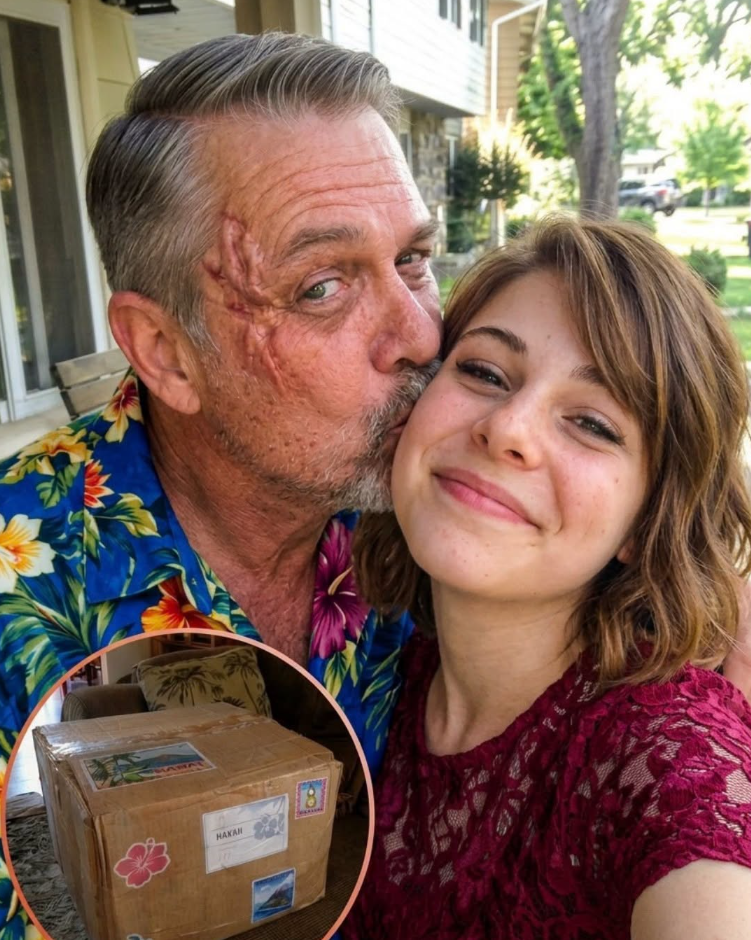
We were still trying to comprehend the emptiness his death had left behind when a mail carrier brought an enormous package to our front door.
Dad’s name was written on the label. The Honolulu postmark was dated three days before the accident.
There was no return address.
I brought the package into the kitchen, hoping to identify the sender and explain that Dad was no longer alive.
But the moment Mom saw it, her face turned deathly pale.
“Leave it, Annie.”
“Mom?”
“Please.” Her fingers tightened around my wrist. “Throw it away. Let’s pretend it never came.”
I gently freed my hand.
I couldn’t throw away something that someone had taken the trouble to send my father. Somewhere in Hawaii, a person might still be expecting an answer that he would never be able to give.
So I slowly pulled the tape away.
And when I finally looked inside, my hand flew to my mouth.
“Oh God,” I whispered, staring into the box, “what are we supposed to do with this?”
PART 2: THE SECRET MY FATHER CARRIED ACROSS THE OCEAN
Inside the package was a small wooden box, a bundle of letters tied with a blue ribbon, and a photograph.
But it was the photograph that made my knees weaken.
My father stood on a Hawaiian beach, barefoot in the sand, smiling with an expression I had rarely seen in the photographs from his younger years.
Beside him stood a beautiful young woman with long dark hair.
She was holding a baby.
On the back of the photograph, someone had written three words in faded blue ink.
Our little Leilani.
I looked from the photograph to my mother.
She had backed away from the kitchen counter, one hand pressed against her chest.
“Mom, who is this?”
She didn’t answer.
“Is that Dad?”
Her eyes filled with tears.
“Annie, please. Put it away.”
I turned the photograph over again.
My father’s handwriting was unmistakable. I had seen it on birthday cards, grocery lists, and the little notes he used to tuck inside my lunchbox.
He had written those words.
Our little Leilani.
The word our made my stomach twist.
“Mom, did Dad have another family?”
She gripped the back of a chair.
For several seconds, the only sound in the kitchen was the refrigerator humming.
Then she whispered, “Before us.”
I stared at her.
“Before us?”
She nodded, but she couldn’t meet my eyes.
I looked back into the package.
The wooden box was made from dark polished wood. Its lid had been carved with a delicate flower. Beneath it lay a cream-colored envelope addressed to my father.
I recognized the name written on the front.
To Daniel.
My father’s name.
Underneath, in smaller handwriting, were the words:
If you still want to know the truth.
I opened the envelope.
Inside was a letter dated just four days before the accident.
Daniel,
I don’t know whether this package will reach you, or whether you’ll have the courage to open it if it does.
For years, I believed you had chosen to forget us. I thought you had built a new life and decided the old one wasn’t worth remembering.
But I found the letters.
All of them.
And now I know you never stopped trying.
I’m sorry it took me so long to discover what really happened.
If you can come home, please come.
Leilani wants to meet you.
And I think you’ve waited long enough.
—Malia
I read it twice.
Then a third time.
My father had never stopped trying.
Trying to do what?
I lifted my eyes toward Mom.
She was crying silently.
“Who is Malia?”
Mom closed her eyes.
“Someone your father loved.”
The words hit me harder than I expected.
I had spent thirty-one years believing my parents’ marriage was the beginning of their story.
Now I was holding proof that it had begun long after another story had already been torn apart.
“Was Leilani his daughter?”
Mom’s shoulders shook.
“Yes.”
I sat down.
The photograph trembled between my fingers.
Somewhere in Hawaii, I had a sister.
A sister I had never known existed.
And my mother had known about her.
“How long?” I asked.
Mom looked confused.
“How long have you known?”
She wiped her face with a trembling hand.
“Since before you were born.”
I felt something inside me crack.
“Thirty-one years?”
“Annie—”
“Thirty-one years, Mom?”
She lowered herself into the chair opposite me.
“I know how this looks.”
“No,” I said quietly. “I don’t think you do.”
I spread the letters across the table.
Some envelopes were yellow with age. Others were newer. A few had been returned unopened.
Every one of them was addressed to my father.
And every one carried the same return address in Hawaii.
I opened the oldest.
The date was almost thirty-five years ago.
Daniel,
Leilani took her first steps yesterday. She kept looking toward the door, and I couldn’t stop thinking about how you should have been here.
I don’t understand why you haven’t written.
You promised you would come back.
Please tell me what happened.
—Malia
I looked at Mom.
“Did Dad know about these letters?”
She shook her head.
Not a firm denial.
A frightened, uncertain movement.
“Mom.”
She began to sob.
“I thought I was protecting our family.”
I pushed my chair back.
“What did you do?”
She covered her mouth.
And suddenly, I understood why Dad had never returned to Hawaii.
It wasn’t because he had forgotten.
It wasn’t because he didn’t love the place he came from.
Someone had made sure he believed there was nothing waiting for him there.
And that someone was sitting across from me.
I wanted to shout.
Instead, I asked the question that frightened me most.
“Did you keep him from his daughter?”
Mom looked at me through her tears.
“Not at first.”
Those three words changed everything.
I waited.
She stared down at the old photograph.
“When I met your father, he was already brokenhearted. He had come to Oregon for work. He told me about Malia and their little girl. He told me he was saving money to go back.”
“Then why didn’t he?”
“Because he received a letter.”
I leaned forward.
“What letter?”
Mom’s voice became barely audible.
“A letter saying Malia was marrying someone else. That Leilani would be raised by another man. That Daniel should never contact them again.”
“Who sent it?”
“Your father believed it came from Malia.”
I looked at the bundle on the table.
“But it didn’t?”
Mom shook her head.
“I don’t know who wrote it.”
I studied her expression.
She was telling me part of the truth.
I could feel it.
“And what happened after you married him?”
She took a long, uneven breath.
“Sometimes letters came from Hawaii. I knew how much they hurt him. I knew how hard he was trying to move on.”
My throat tightened.
“So you hid them.”
Her silence answered.
I looked down at the envelopes.
Thirty-five years of missed birthdays.
Thirty-five years of questions.
Thirty-five years of a daughter wondering why her father had abandoned her.
“How could you?”
Mom began crying harder.
“I was afraid, Annie. I was afraid he’d leave us. Every time Hawaii came up, I could see how much he wanted to go back.”
“He wanted to see his child.”
“I know.”
“He had a daughter.”
“I know!”
Her voice broke on the last word.
I stood so quickly that my chair scraped against the floor.
For a moment, I couldn’t bear to look at her.
Then I noticed something I had missed.
At the bottom of the package was another envelope.
This one wasn’t addressed to Dad.
It was addressed to me.
For Annie, if Daniel cannot come.
My hands went cold.
Whoever had sent this package knew about me.
And they had prepared for the possibility that my father might never open it.
I tore the envelope carefully.
Inside was a single sheet of paper.
Dear Annie,
You don’t know me, but I know about you.
Your father told me he had a daughter in Oregon. He said you were kind, stubborn, and brave.
He said you were the best thing that had ever happened to him.
I don’t want to hurt you or your mother.
But there is something you deserve to know.
Your father contacted me six months ago.
We had been speaking every week.
He was planning to come home.
And he asked me to send this package because he was finally ready to tell you everything.
I stopped breathing for a moment.
Dad had been speaking to Malia.
For six months.
He had been planning to return to Hawaii.
And he had wanted me to know.
I kept reading.
He told me he didn’t want another year to pass without meeting Leilani as the woman she had become.
He also told me he couldn’t leave Oregon without making peace with the truth.
He said he would tell you himself.
If he hasn’t, please understand that he was trying.
With love,
Malia
I sat down again.
My father had been preparing to change everything.
Then a car accident had taken away his chance.
And now the truth had arrived without him.
I looked at my mother.
“Did you know he was planning to go?”
She shook her head.
But something about her expression made me hesitate.
“Mom?”
She stared at the table.
“He told me he wanted to visit Hawaii.”
“When?”
“The morning of the accident.”
My heart began pounding.
“What did you say?”
She didn’t answer.
“Mom, what did you say to him?”
She began to cry again.
And when she finally spoke, her voice was so small that I almost didn’t hear it.
“I told him that if he went, he shouldn’t bother coming back.”
PART 3: THE LETTER HE NEVER GOT TO GIVE ME
For a long time, I couldn’t speak.
The kitchen felt smaller than it ever had.
I looked around at the familiar room, the yellow curtains Mom had sewn, the chipped blue mug Dad used every morning, the wooden clock he’d repaired three times because he refused to replace it.
Everything looked the same.
But nothing felt the same anymore.
My father had eaten breakfast in this kitchen on the morning he died.
He had sat across from the woman he’d loved for more than three decades.
And she had told him not to come home if he went to see his daughter.
“Was he angry?” I asked.
Mom stared at her hands.
“No.”
That hurt more than I expected.
“What did he say?”
“He said he wasn’t asking me to choose between the life we built and the life he left behind.”
She swallowed.
“He said he only wanted to stop hurting people by staying silent.”
I closed my eyes.
That sounded exactly like Dad.
He was never a man who raised his voice.
When I was little and broke a window with a baseball, he hadn’t shouted. He’d helped me sweep up the glass and then made me work beside him until I’d earned enough to pay for the repair.
When I failed my driving test, he’d bought me ice cream and told me that being disappointed didn’t mean being defeated.
He believed almost anything could be repaired if someone was willing to do the work.
Apparently, he had spent the final months of his life trying to repair something that had been broken before I was born.
“Where was he going when the accident happened?” I asked.
Mom looked up.
“To the bank.”
I frowned.
“The bank?”
“He wanted to withdraw money for the trip. He said he had to buy his ticket before he lost his nerve.”
I remembered the police officer explaining that Dad’s car had been struck at an intersection during heavy rain.
I’d imagined him driving home from an ordinary errand.
I hadn’t known he was making plans for a journey he’d waited decades to take.
I turned back to the package.
The wooden box still sat unopened.
I lifted its lid.
Inside were a small silver bracelet, a dried white flower wrapped in tissue, and a folded piece of paper.
The bracelet was tiny, the sort a baby might wear.
Its silver surface was scratched, but I could still make out an engraved name.
Leilani.
Underneath was a date.
I touched the letters gently.
My sister’s birthday.
The flower was brittle with age. Beneath it was a note in Dad’s handwriting.
The first plumeria Malia gave me. I promised I’d keep it until I came home.
I felt tears gathering again.
Then I unfolded the final paper.
It was a photocopy of a letter.
The original had apparently been written by my father.
The date was six months earlier.
Dear Leilani,
I don’t know how to begin apologizing for a lifetime.
I was twenty when I left Hawaii. I thought I was going away for a few months to earn enough money to give you and your mother a better life.
I never imagined that leaving would become the greatest regret of my existence.
For years, I believed your mother had chosen another future for you. I was told that you had a father who could give you the stability I couldn’t.
I was young, proud, and too easily convinced that staying away was the kindest thing I could do.
I should have fought harder.
I should have called.
I should have gotten on a plane and looked you in the eyes.
Whatever I believed, the responsibility was mine.
I cannot give you back the birthdays, school plays, graduations, or ordinary afternoons I missed.
But if you will let me, I would like to know you now.
I have another daughter. Her name is Annie.
She has your stubbornness, though she doesn’t know where it comes from.
I hope one day you might meet.
I don’t expect forgiveness.
I only hope there is still time.
Love,
Dad
I pressed the letter against my chest.
He had written to her.
He had finally found the courage.
“Did she answer?” I whispered.
Mom looked confused.
“Who?”
“Leilani.”
I searched through the package again.
At the very bottom, beneath the packing paper, was a photograph taken much more recently.
A woman in her mid-thirties stood on a beach at sunset.
She had dark, shoulder-length hair, a warm smile, and eyes I recognized immediately.
My father’s eyes.
Beside her stood a little boy, perhaps six years old, holding a bright red bucket.
On the back, someone had written:
Leilani and Noah. Your daughter and grandson.
My father had been a grandfather.
I traced the child’s face with my thumb.
He had the same crooked smile Dad wore whenever he was trying not to laugh.
There was a phone number written beneath the names.
I stared at it.
Then I picked up my phone.
Mom reached across the table.
“Annie, wait.”
I pulled away.
“No.”
“Please, just give me a little time.”
“You’ve had thirty-one years.”
She flinched.
I regretted the sharpness of my words, but I couldn’t take them back.
I stepped into the hallway and dialed the number.
It rang four times.
A woman answered.
“Hello?”
Her voice was gentle, with a slight island accent.
I swallowed.
“Is this Malia?”
There was a pause.
“Yes.”
“My name is Annie.”
Silence.
Then a small gasp.
“Daniel’s Annie?”
I closed my eyes.
“Yes.”
“Oh, sweetheart.”
Those two words nearly undid me.
I leaned against the wall.
“I’m calling about the package.”
“Did he receive it?”
I couldn’t answer immediately.
“Annie?”
My voice broke.
“My dad died two weeks ago.”
On the other end of the line, I heard a sharp intake of breath.
Then nothing.
I wondered whether the call had disconnected.
“Malia?”
A faint sound came through the speaker.
She was crying.
“No,” she whispered. “No, he was supposed to come home.”
I sank onto the hallway floor.
“I’m so sorry.”
“He promised he’d come.”
“I know.”
“We were going to meet him at the airport.”
Her words broke apart.
“Leilani bought him a lei. Noah made a welcome sign.”
I covered my eyes.
My father had spent thirty-five years imagining his return to Hawaii.
And somewhere across the ocean, a little boy had been preparing a sign to welcome a grandfather he’d never met.
I heard Malia struggling to compose herself.
“Annie, does your mother know?”
“Yes.”
Another silence.
Then she said something I hadn’t expected.
“Please don’t hate her.”
I lifted my head.
“What?”
“Your mother made terrible choices. But your father asked me not to let this destroy your family.”
I looked toward the kitchen.
Mom was still sitting at the table, staring at the photographs.
“Did Dad know she hid the letters?”
“Yes.”
The answer stunned me.
“How?”
“He found some of them last winter.”
I pressed my hand against the wall.
“He found them?”
“She had kept them in a box in the attic. He discovered them while looking for old Christmas decorations.”
I remembered that day.
Dad had been unusually quiet at dinner.
When I’d asked if he was feeling well, he’d smiled and said he was just tired.
Now I knew why.
“What did he do?”
“He called me.”
Malia paused.
“I hadn’t heard his voice in thirty-five years.”
PART 2
I could hear her trying to steady her breathing.
“He told me he had found letters he’d never seen. He said he needed to know whether I’d really asked him to stay away.”
“And had you?”
“No, Annie.”
Her voice grew firmer.
“I never told him to abandon his daughter.”
I felt cold.
“Then who sent the letter saying you were marrying someone else?”
Malia sighed.
“My mother.”
I stared at the floor.
“Your mother?”
“She never approved of Daniel. She thought he was too young and too poor. When he left for Oregon, she believed he wouldn’t return. She wanted me to marry a man whose family owned a business on the island.”
“Did you?”
“No.”
She paused.
“I never married anyone.”
I closed my eyes.
The tragedy of it was almost unbearable.
A young father had left to earn money.
A young mother had waited for him.
And the people around them, each convinced they knew what was best, had torn their family apart.
“My mother sent him a letter pretending it was from me,” Malia continued. “She admitted it years later, when she was dying. By then, I believed Daniel had ignored every letter I sent.”
“And my mother hid them.”
“Yes.”
I pressed my forehead against my knees.
For thirty-five years, two people had lived with the same wound.
Each believed the other had chosen to leave.
“Did Dad forgive my mother?” I asked.
Malia took a long breath.
“He told me forgiveness wasn’t something he could decide in a single afternoon.”
I nodded, though she couldn’t see me.
“He said he still loved her. He said she had been a good mother to you. But he also said loving someone didn’t mean pretending they hadn’t hurt you.”
I wiped my cheeks.
“That sounds like him.”
Malia gave a sad little laugh.
“He still sounded like the boy I knew.”
For a while, neither of us spoke.
Then she asked, “Would you like to talk to Leilani?”
My heart started racing.
I looked down at the photograph in my lap.
The woman with my father’s eyes.
My sister.
“Does she know about me?”
“Yes. Daniel told her.”
“Does she want to talk to me?”
Malia’s voice softened.
“She’s been hoping you would call.”
I swallowed.
“Yes.”
There was a rustling sound.
A door opened somewhere in the background.
Then another woman came on the line.
“Hello?”
I couldn’t speak.
“Annie?”
“Yes.”
A shaky breath.
“I’m Leilani.”
I pressed my hand over my mouth.
For thirty-one years, I’d believed I was an only child.
Now my sister was speaking to me from an island I’d never visited.
“Hi,” I managed.
She laughed nervously.
“Hi.”
Neither of us seemed to know what to say.
Then she whispered, “I’m sorry about Dad.”
That was when I began to cry.
Not because she called him Dad.
But because I realized how much it must have cost her to use that word.
“He talked about you,” I said.
“He talked about you, too.”
“Really?”
“All the time.”
I wiped my face.
“What did he say?”
She laughed through her tears.
“He said you were impossible to beat at cards. That you always stole the crispy potatoes off his plate. That when you were little, you made him check under your bed for monsters even after you were old enough to know there weren’t any.”
I started laughing and crying at the same time.
“He really told you that?”
“He said you were his greatest joy.”
I closed my eyes.
Then Leilani added something that made my heart ache.
“He told me he wished he could have been the same father to me.”
I held the phone tightly.
“I wish he could have, too.”
We talked for almost an hour.
She told me about growing up in Honolulu, about the little bookstore where she worked, and about Noah, her son, who loved dinosaurs and insisted that every sunset looked different.
I told her about Oregon.
About Dad’s terrible singing.
About how he always burned pancakes but claimed the black edges made them taste better.
She laughed.
“He used to do that when he was young.”
I froze.
“What?”
“Burn pancakes. He told me he learned to cook them from his grandmother.”
I smiled through my tears.
There he was.
My father.
Not just the man who raised me, but the young man he had been before I existed.
For the first time, I understood that parents have entire lives their children never see.
And sometimes, those hidden years contain both their deepest happiness and their greatest pain.
Before we hung up, Leilani asked me a question.
“Annie, would you ever consider coming to Hawaii?”
I looked toward the kitchen.
Mom sat motionless beneath the yellow curtains.
I thought about Dad’s photograph of the beach.
The warm rain.
The smell of the ocean.
And the journey he had never completed.
“Yes,” I whispered. “I think I need to.”
PART 4: THE JOURNEY HE NEVER FINISHED
I didn’t book the flight immediately.
For three days, I barely slept.
I moved through Dad’s house, touching ordinary things as though they might disappear.
His jacket still hung beside the back door.
His reading glasses rested on the living room table.
A half-finished crossword lay beside his favorite chair.
I kept expecting to hear him calling from the garage.
Instead, the house was quiet.
Mom and I spoke only when necessary.
She tried several times to explain herself.
Each time, I told her I wasn’t ready.
On the fourth morning, I found her sitting in Dad’s study.
She was holding an old shoebox.
“I need to show you something,” she said.
I almost walked away.
But then I saw what was inside.
Airline brochures.
Travel guides.
A folded map of Oahu.
And a small notebook filled with Dad’s handwriting.
I sat beside her.
“He kept these?” I asked.
Mom nodded.
“For years.”
I opened the notebook.
The first pages contained practical notes.
Places he wanted to visit.
People he hoped to find.
Addresses that had been crossed out and rewritten.
Then, near the middle, I found a page titled:
Things I want Annie to see.
My throat tightened.
Underneath, Dad had written:
The beach where I learned to swim.
The mountain trail Grandpa used to take me on.
The house where I grew up.
The little bakery that sells the best sweet bread in the world.
And at the bottom:
I want her to understand why I loved this place. And I want her to know that loving Hawaii never meant loving her less.
I couldn’t stop the tears.
Mom watched me silently.
Then she whispered, “I was so afraid he would go back and realize he’d chosen the wrong life.”
I looked at her.
“He didn’t choose the wrong life, Mom. He loved us.”
“I know that now.”
“He always loved us.”
She nodded.
“But he loved them, too.”
Mom began to cry.
For the first time, I saw something beyond her fear.
I saw the shame she’d been carrying.
It didn’t erase what she’d done.
It didn’t restore the years Leilani had lost.
But it reminded me that people could be deeply wrong without being incapable of regret.
“Why didn’t you tell me?” I asked.
Mom stared at the notebook.
“At first, I told myself I would explain when you were older. Then every year that passed made the truth harder to say.”
She swallowed.
“Eventually, I became afraid that telling you would mean losing you.”
I looked at her for a long moment.
“You almost did.”
She nodded.
“I know.”
I closed the notebook.
“I’m going to Hawaii.”
Mom wiped her face.
“I thought you might.”
“I want to meet Leilani.”
“You should.”
“And Malia.”
Mom’s expression tightened, but she nodded again.
Then I asked the question I’d been avoiding.
“Do you want to come?”
She looked at me in disbelief.
“Annie, I don’t think they’d want me there.”
“Maybe not.”
I took a breath.
“But I think Dad would have wanted us to stop hiding.”
Mom looked toward the window.
For a long time, she said nothing.
Finally, she whispered, “If they’ll allow it, I’ll come.”
I called Malia that afternoon.
She was quiet when I explained.
Then she said, “Annie, I won’t pretend seeing your mother will be easy.”
“I understand.”
“But if she’s coming to tell the truth, I won’t turn her away.”
A week later, Mom and I boarded a plane to Honolulu.
I carried Dad’s notebook in my handbag.
Mom carried the wooden box.
Neither of us spoke much during the flight.
When the plane descended over the island, I pressed my forehead against the window.
The ocean stretched beneath us, impossibly blue.
Green mountains rose beyond the shoreline.
White waves curled against the sand.
I thought of Dad at twenty, leaving this place with a suitcase and the belief that he’d return in a few months.
I wondered whether he’d looked back at the island through an airplane window the way I was looking at it now.
When we stepped outside the airport, warm air wrapped around me.
It smelled of flowers, rain, and salt.
I stopped walking.
Mom turned.
“Annie?”
I began to cry.
Because suddenly, I understood.
“The rain is warm,” I whispered.
Dad had been right.
The ocean was somewhere beyond the buildings, but I could already smell it.
He had described this place to me so many times.
And now I was standing in the world he’d carried inside him for thirty-five years.
Leilani was waiting near the arrivals area.
I recognized her immediately.
She wore a pale blue dress and held a small flower lei in her hands.
Beside her stood Malia, her dark hair now threaded with silver.
A little boy in a green shirt clutched a handmade sign.
WELCOME, ANNIE.
I stopped.
Leilani stared at me.
Then her face crumpled.
“Oh, Annie.”
We crossed the distance between us at the same time.
When she wrapped her arms around me, I felt something I couldn’t explain.
She was a stranger.
And she was my family.
We held each other for a long time.
“I’m so glad you’re here,” she whispered.
“Me too.”
When we finally stepped apart, I looked into her eyes.
Dad’s eyes.
The same deep brown.
The same little crease at the corners when she smiled.
I began crying again.
Leilani laughed through her tears.
“I know. I saw it in the mirror this morning, too.”
Malia stepped forward.
For a moment, she simply looked at me.
Then she touched my cheek.
“You have his smile.”
I couldn’t speak.
She pulled me into a gentle embrace.
“Thank you for coming.”
Behind us, Mom stood frozen.
Malia noticed her.
The warmth in her expression faded into something more complicated.
Mom stepped forward slowly.
“Malia.”
“Claire.”
Hearing my mother’s name in Malia’s voice was strange.
It was as though two separate chapters of Dad’s life had finally been brought into the same room.
Mom’s hands trembled.
“I don’t expect you to forgive me.”
Malia said nothing.
“I took years from you. From Leilani. From Daniel.”
Her voice broke.
“I was wrong.”
Malia looked at her for a long time.
Then she said quietly, “Yes. You were.”
Mom lowered her eyes.
“I’m sorry.”
Malia’s eyes filled with tears.
“I waited for him for years, Claire. I thought every letter he didn’t answer meant he cared a little less.”
Mom covered her mouth.
“And my daughter grew up believing her father didn’t want her.”
“I know.”
“No,” Malia whispered. “You don’t.”
The words hung between them.
I wanted to intervene.
But I didn’t.
Some pain needed to be spoken aloud.
Finally, Malia took a slow breath.
“I can’t forgive you today.”
Mom nodded.
“I understand.”
“But I won’t let this become another thirty-five years of silence.”
Mom began to cry.
And Malia, despite everything, reached for her hand.
Not in forgiveness.
Not yet.
But in acknowledgment that the truth had finally arrived.
Noah tugged on my sleeve.
“Are you my aunt?”
I looked down at him.
He had Dad’s crooked smile.
“Yes,” I whispered.
He considered that for a moment.
Then he held out a small plastic dinosaur.
“Grandpa Daniel said you liked animals.”
I knelt beside him.
“He told you about me?”
Noah nodded seriously.
“He said you were really good at finding things.”
I laughed.
“Did he?”
“Yeah. He said you always found his hidden Christmas presents.”
I covered my mouth.
Dad had told this little boy about me.
A boy he’d never met.
A grandson he’d never held.
And somehow, across thousands of miles, he had already begun connecting us.
Noah placed the dinosaur in my hand.
“You can borrow this.”
I hugged him.
“Thank you.”
PART 3
Then he looked up at Leilani.
“Mommy, where’s Grandpa?”
Leilani knelt beside him.
“Remember what we talked about, sweetheart?”
“He went to heaven.”
Leilani nodded.
The little boy thought for a moment.
Then he looked at the empty space beside us.
“Can we still show him the beach?”
I began crying again.
Leilani pulled him close.
“Yes,” she whispered. “We can.”
PART 5: THE BEACH WHERE EVERYTHING BEGAN
The next morning, Leilani took us to the beach in Dad’s photograph.
It was smaller than I’d imagined.
There were no towering hotels, no crowded tourist shops, and no rows of rented umbrellas.
Just a quiet stretch of sand, dark volcanic rocks, and palm trees bending gently toward the ocean.
The waves rolled in with a steady rhythm.
Malia told me that Dad had spent much of his childhood there.
“He used to race the waves,” she said. “He was convinced he could outrun the ocean.”
I smiled.
“That sounds like him.”
“He was always laughing.”
She looked toward the water.
“Even when he had nothing, he could make an ordinary afternoon feel like an adventure.”
I thought of all the Saturday mornings Dad had taken me fishing in Oregon.
We rarely caught anything.
He always said the point wasn’t the fish.
The point was being together.
I realized he had probably learned that lesson here.
Leilani spread a blanket beneath a palm tree.
Noah immediately ran toward the water with his red bucket.
Mom sat a little distance away, giving us space.
I took Dad’s notebook from my bag.
“There are things he wanted me to see,” I told Leilani.
She leaned closer.
I showed her the list.
She smiled when she saw the bakery.
“Oh, he remembered that place?”
“Apparently, they have the best sweet bread in the world.”
She laughed.
“They do.”
Then she grew quiet.
“I wish he’d come.”
I looked at her.
“Me too.”
She watched the waves.
“For a long time, I thought meeting him wouldn’t matter anymore.”
I waited.
“I told myself I didn’t need him. I had Mom. I had friends. I built a good life.”
She picked up a handful of sand and let it slip through her fingers.
“But when he called, and I heard his voice, I felt like a little girl again.”
My eyes filled.
“What did he say?”
She smiled sadly.
“He said, ‘Hello, Leilani. It’s your dad.’”
I covered my mouth.
“And I was so angry,” she continued. “I wanted to scream at him. I wanted to ask where he’d been every time I needed him.”
“Did you?”
“Yes.”
She looked at me.
“And he listened.”
I smiled through my tears.
“He was good at that.”
“He didn’t make excuses. He didn’t tell me to forget the past. He just said he was sorry.”
Leilani wiped her cheeks.
“Then he asked whether he could call again.”
“And you said yes?”
“Not immediately.”
She laughed softly.
“I made him wait three days.”
I laughed, too.
“He must have been miserable.”
“He told me later he checked his phone every ten minutes.”
That sounded exactly like Dad.
“He called every Sunday after that,” she said. “Sometimes we talked for hours. Sometimes we just sat there while Noah showed him toys.”
She looked toward her son.
“He was learning how to be a grandfather.”
I swallowed.
“He would have been wonderful.”
“I think so.”
For a while, we watched the ocean together.
Then I reached into my bag and took out a small envelope.
Inside was a photograph of Dad and me when I was seven.
We were sitting on the porch of our Oregon house.
I had a missing front tooth.
Dad was laughing at something I’d said.
I handed it to her.
“I want you to have this.”
Leilani studied it.
Her eyes filled with tears.
“He looks so happy.”
“He was.”
I took her hand.
“And I need you to know something.”
She looked at me.
“He never made me feel like I wasn’t enough. Not once. But I know now that he carried sadness, too.”
Leilani nodded.
“I used to think that if he loved another family, it meant he couldn’t have loved me.”
I squeezed her fingers.
“He loved you.”
She began to cry.
“He just didn’t know how to find his way back.”
We sat together until the sun climbed higher.
Later, Malia brought out the wooden box.
She placed it on the blanket between us.
“I want to tell you something about this,” she said.
She lifted the little silver bracelet.
“When Leilani was born, Daniel bought this from a small jewelry shop. He spent nearly everything he had saved.”
Leilani smiled through her tears.
“Mom told me.”
“He was so proud,” Malia continued. “He kept saying she had the strongest grip he’d ever felt.”
I laughed.
Dad used to say the same thing about me.
Malia touched the dried plumeria.
“And this flower was from the first afternoon he told me he loved me.”
She looked toward the ocean.
“I gave it to him as a joke. I told him that if he was serious, he had to keep it forever.”
My chest tightened.
“And he did.”
Malia nodded.
“When he left for Oregon, he took it with him.”
I looked at the fragile flower.
For decades, it had traveled through the years with my father.
A tiny piece of Hawaii hidden among the ordinary belongings of a man who never stopped missing home.
Malia carefully returned it to the box.
Then she looked at Mom.
“Claire, there’s something I want to ask you.”
Mom stiffened.
“Of course.”
“Did Daniel know you were afraid?”
Mom’s eyes filled.
“Yes.”
“Did he ever stop loving you?”
Mom shook her head.
“No.”
Malia nodded slowly.
“Then I hope, for his sake, you find a way to live honestly from now on.”
Mom began to cry.
“I want to.”
Malia looked at her.
“Wanting is the beginning. The rest is what you do next.”
Mom lowered her head.
“I understand.”
I watched them, two women who had loved the same man in different chapters of his life.
Neither had been given the ending she expected.
Neither could recover what had been lost.
But perhaps they could stop passing that loss on to the people who came after them.
That afternoon, we gathered at the water’s edge.
I had brought a small portion of Dad’s ashes with me.
Mom held the container in both hands.
Her fingers trembled.
Leilani stood beside her.
Malia held Noah’s hand.
The ocean stretched endlessly before us.
I opened Dad’s notebook one last time.
Near the final page, I had found a sentence he had written shortly before the accident.
If I make it home, I want both my daughters to know that my heart was never divided between them. It only grew larger.
I read it aloud.
Leilani began to cry.
Mom covered her face.
Even Malia turned away to wipe her eyes.
Then Leilani reached for my hand.
Together, we stepped toward the water.
The waves washed gently over our feet.
Mom came beside us.
For a moment, the three of us stood in silence.
Then Mom whispered, “I’m sorry, Daniel.”
She looked at Leilani.
“I’m sorry I stole so much time from you.”
Leilani’s eyes filled.
“I can’t give you forgiveness just because you ask for it.”
Mom nodded.
“I know.”
“But I don’t want to carry hatred for the rest of my life.”
She took a slow breath.
“So maybe we can start there.”
Mom began to sob.
Leilani reached for her hand.
And for the first time, I saw the possibility of something different.
Not a perfect family.
Not a happy ending that erased every wound.
But a family willing to face the truth.
We said goodbye to Dad beside the ocean he’d loved since childhood.
We released his ashes into the water, watching the gentle waves carry them away.
I stood there long after everyone else had stepped back.
I imagined him at twenty, standing on that same beach with the whole world ahead of him.
I imagined the young father who believed leaving for a few months would give his daughter a better future.
And I imagined the older man who sat at our kitchen table in Oregon, holding a faded photograph and wondering whether he would ever see his home again.
I wished he could have stood beside us.
I wished he could have met Noah.
I wished he could have hugged Leilani and told her everything he’d tried to put into letters.
But most of all, I wished I’d asked him about the photograph sooner.
Perhaps he would have told me.
Perhaps I could have helped him find his way home while he was still alive.
That regret will always stay with me.
But so will what happened next.
Before we left the beach, Noah came running toward us.
He held two seashells in his small hands.
One was white.
The other was pale pink.
He gave the white one to Leilani.
Then he handed the pink one to me.
“These are for Grandpa’s daughters,” he announced.
I knelt beside him.
“Thank you, Noah.”
He looked toward the water.
“Do you think Grandpa likes it here?”
I followed his gaze.
The sun was beginning to lower.
Golden light spread across the waves.
A warm breeze moved through the palm trees.
I thought of Dad’s voice.
The rain is warm.
You can smell the ocean before you see it.
I smiled through my tears.
“Yes, sweetheart,” I whispered. “I think he does.”
We stayed in Hawaii for another week.
Leilani showed me the places Dad had written about in his notebook.
We visited the bakery, where the sweet bread was every bit as good as he’d promised.
We walked the mountain trail he’d loved as a boy.
And we stood outside the small house where he’d grown up, listening to Malia tell stories about a young man who had once believed he could outrun the waves.
Mom came with us.
Some days were uncomfortable.
Some conversations ended in tears.
But nobody walked away from the truth.
Before we returned to Oregon, Leilani and I promised we would speak every Sunday.
Just as Dad had spoken to her.
We began sending each other photographs, sharing memories, and telling stories that filled the missing spaces in our father’s life.
Noah started calling me Aunt Annie.
And Mom, slowly, began doing something I had never seen her do before.
She listened without trying to defend herself.
A month after we came home, I found her at the kitchen table.
She was holding the faded photograph of Dad’s beach.
The same photograph he used to turn over in his hands.
She looked up when I entered.
“Annie,” she said softly, “do you think your father ever forgave me?”
I sat beside her.
“I don’t know, Mom.”
She nodded, tears gathering in her eyes.
“I wish I’d given him the chance to tell me.”
I took her hand.
“So do I.”
For a while, we sat together in silence.
Then I turned the photograph over.
On the back, beneath an old date, Dad had written something I had never noticed.
The ink was faint.
The words were small.
But they were still readable.
Home is not always the place you live. Sometimes it’s the place your heart keeps trying to return to.
I traced the sentence with my finger.
Then I placed the photograph back on the table.
Dad had spent thirty-five years believing he had to choose between the people he loved.
In the end, he had been trying to bring those separate pieces of his life together.
He didn’t get the chance.
But we did.
And every Sunday, when my phone rings and I hear my sister’s voice from Hawaii, I remember the last thing my father wrote in his notebook.
My heart was never divided between them. It only grew larger.
I used to believe my father had kept Hawaii a secret because he wanted to forget it.
Now I know he kept it close because he could never let it go.
He left the island at twenty and never returned while he was alive.
But his final journey brought his two daughters together.
And in a way none of us could have imagined, he finally came home.
THE END