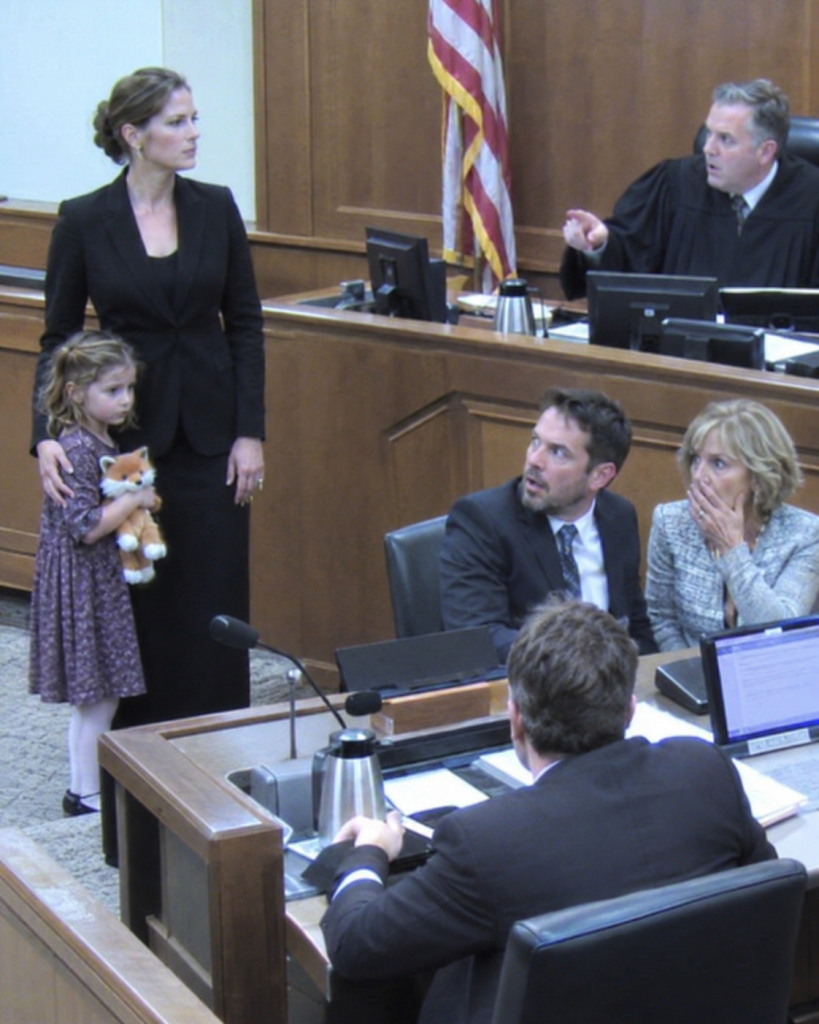
Celeste had spent months using my Army background against me, convinced my silence meant weakness and my simple black suit meant I had nothing left to fight with.
Then the judge entered, looked directly at me, and said, “Good morning, Colonel.”
Celeste went pale.
She thought my military past would destroy my case. She had no idea what the evidence was about to destroy.
The morning my former mother-in-law smiled at me across the courthouse hallway, she looked like a woman waiting for fireworks.
Not the pretty kind people watch over a lake in July. The kind that blow open walls.
Celeste Grady stood near courtroom four in a cream-colored suit, her silver hair sprayed into a shape that could have survived a hurricane. She held a leather purse under one arm and wore the same satisfied smile she had worn at my wedding, at my baby shower, and later, across my kitchen table when my marriage finally cracked in half.
Beside her, my ex-husband Weston stared at his phone like the screen might save him from having to look at me.
Our daughter, Iris, stood close to my leg, one small hand tucked into mine. She was six, wearing a navy cardigan over a yellow dress she had chosen herself because she said it made her feel brave.
Her hair was braided down her back. In her other hand, she held a tiny stuffed fox with one glass eye scratched from years of being carried everywhere.
The courthouse smelled like coffee, floor polish, damp wool coats, and nervous sweat. Every sound felt too sharp.
Heels clicking. Papers sliding from folders. Someone whispering into a phone. A child crying somewhere down the hall.
Celeste glanced at Iris, then back at me.
Then she leaned in just enough for half the hallway to hear.
“You never stood a chance against this family.”
I did not answer.
That bothered her more than anything I could have said.
Celeste had spent years poking at me, testing me, trying to find the exact sentence that would make me crack in public.
She called me cold. She called me unnatural. She told Weston that no woman who had lived under military rules could possibly raise a soft-hearted child.
What she never understood was that silence is not always fear.
Sometimes silence is discipline.
I bent slightly and touched Iris’s shoulder.
“You okay, bird?”
She nodded, but her fingers tightened around mine.
“Are they going to take me away?”
The question hit harder than Celeste’s whisper.
I crouched in front of her, ignoring the people passing us, ignoring Weston’s attorney watching from the bench, ignoring Celeste pretending not to listen.
“No,” I said quietly. “Grown-ups are going to talk. The judge is going to listen. And whatever happens today, you and I are walking out together.”
Iris studied my face the way children do when they are searching for the truth behind the words.
Then she nodded.
Weston finally looked up.
For one second, I saw the man I used to love.
Not the man with the expensive attorney and the stiff shoulders. Not the man who had signed a custody petition accusing me of being emotionally distant, controlling, and unfit for primary parenting.
Just Weston, standing there with guilt around his eyes, looking like he wanted to say something but had forgotten how.
Celeste noticed him looking at me.
Her smile tightened.
“Don’t start,” she murmured to him. “We’re almost done.”
Almost done.
That was what she thought this was.
A final humiliation. A clean victory. A legal stamp on the story she had told everyone for months: that I was too rigid, too absent, too military, too damaged, too much of everything to be a mother.
She thought my quietness meant I had no defense.
She thought my simple black suit meant I had no power.
She thought the thin folder in my hand held nothing but school forms and desperate hopes.
The courtroom doors opened.
The bailiff stepped out and called our case.
My attorney, Maren Holt, touched my elbow lightly.
“Ready?”
I nodded.
Inside, the courtroom was colder than the hallway. Morning light spilled through tall windows and landed across polished wood benches.
A flag stood near the judge’s bench. The seal of the state hung on the wall. Everything looked official, ordinary, and terrifying.
Iris sat with Maren’s assistant in the front row after the judge’s clerk gently explained that children did not need to sit through every detail.
Iris looked back at me once. I gave her the smallest smile I could manage.
Then I walked to the table on the left.
Weston sat across the aisle. His attorney, Mr. Valen, arranged his papers with the confidence of a man who believed the ending had already been purchased.
Celeste sat directly behind them, spine straight, chin lifted.
When I glanced over, she mouthed three words.
When I glanced over, she mouthed three words.
“You are done.”
The clerk called the room to order.
Everyone stood.
The judge entered in a black robe, carrying a file under one arm. He moved with calm, deliberate steps. He placed the folder on the bench, adjusted his glasses, and looked over the room.
His eyes passed over Weston.
Then Celeste.
Then they landed on me.
For the first time that morning, his expression changed.
Only slightly.
Recognition.
A pause.
A quiet nod.
Then, in a voice clear enough to reach every corner of the courtroom, he said, “Good morning, Colonel.”
The room went so silent I could hear Celeste’s bracelet slide down her wrist.
Weston turned his head slowly toward me.
His attorney stopped moving.
And Celeste Grady, who had spent years telling everyone I was nothing but a stiff, joyless woman with a government paycheck, stared at me like she had just realized she had been standing on thin ice the whole time.
Before Celeste ever hated me in a courtroom, she disliked me in a kitchen.
That was where it started.
Not with screaming. Not with divorce papers. Not with custody threats.
It started with a roast chicken on a Sunday afternoon, five years after I left full-time active service and tried to build a normal life in a quiet Ohio suburb where people waved from driveways and argued about lawn care on neighborhood apps.
Weston had invited me to his parents’ house three months after we started dating.
I remember the smell of rosemary, butter, and lemon from the oven. I remember Celeste’s white cabinets, the glass bowl of fake green apples on the island, the spotless counters that made me afraid to set down my purse.
Weston had squeezed my hand before opening the front door.
“She can be a lot,” he whispered. “But she means well.”
That sentence should have warned me.
Celeste hugged me with both arms and no warmth.
“You’re very composed,” she said, looking me up and down. “Weston said you were Army. I suppose that explains it.”
I smiled politely.
“It explains some things.”
“Oh, I’m sure.”
At dinner, she asked questions that sounded friendly until they landed.
“Did you move around constantly?”
“Did you ever have time for relationships?”
“Were you one of those women who barked orders at men all day?”
Weston laughed nervously after every question, as if humor could sand down the edges. His father, Nolan, mostly stayed quiet, eating in slow bites and watching football highlights on mute.
I answered calmly. I kept things simple.
I did not talk about command decisions, casualty notifications, emergency logistics, military families, or the young soldiers who had shown up at my office looking terrified and left standing a little straighter.
I had learned a long time ago that some people ask about your past only so they can decide which version of you to dislike.
Celeste decided quickly.
In her mind, I was not feminine enough. Not needy enough. Not impressed enough by her china cabinet, her country club friends, or the way she still folded Weston’s laundry when he visited.
But Weston was different when we were alone.
At least then, he was.
Part 2: My Ex-Husband Tried to Take Our Daughter—Until the Judge Opened the Sealed File
But Weston was different when we were alone.
At least then, he was.
In the beginning, he admired my discipline. He liked that I could solve problems without panicking, that I remembered birthdays, that I never forgot a promise. When his car broke down on the highway, I was the one who drove forty minutes in the rain to pick him up. When his father underwent surgery, I spent three nights helping Nolan recover because Celeste said hospitals made her anxious.
Weston used to kiss my forehead and tell me I was the strongest woman he had ever known.
Then we got married.
And slowly, that strength became something he resented.
He wanted me to ask his mother for approval before making decisions about our home. He wanted me to apologize whenever Celeste insulted me. He wanted me to stop correcting him when he made promises he had no intention of keeping.
Most of all, he wanted me to become a woman his mother could control.
When I refused, he started calling me difficult.
When I stopped arguing, he called me emotionally unavailable.
And when I gave birth to Iris, Celeste found a new reason to hate me.
She wanted to be the first person to hold her granddaughter. She wanted to choose Iris’s nursery colors, her clothes, her pediatrician, and eventually her school.
I let her help with some things.
But I drew a line when she tried to make decisions that belonged to Weston and me.
That was when she began telling everyone I was an unfit mother.
At first, the accusations were small.
I was too strict because I insisted Iris wash her hands before dinner. I was too cold because I didn’t allow a three-year-old to eat candy for breakfast. I was too controlling because I kept a consistent bedtime.
Then the stories grew.
Celeste told relatives that Iris cried whenever I entered a room. She claimed I frightened my daughter with my military voice. She even suggested that my years in the Army had left me incapable of expressing love.
None of it was true.
But Weston never defended me.
Instead, he would pull me aside after his mother left and say, “Why do you have to make everything a battle?”
“I don’t,” I told him. “I just refuse to let her raise our daughter.”
“She’s trying to help.”
“Then she can help without undermining me.”
He looked away.
That was how every conversation ended.
With Weston looking away.
By the time Iris turned four, I understood that I was no longer married to a man who stood beside me.
I was married to a man who stood wherever his mother told him to stand.
The final break came on a rainy Thursday evening.
I had returned home after a long day of consulting work, expecting to find Weston helping Iris with her bedtime routine.
Instead, I found my daughter sitting on the staircase in her pajamas, hugging her stuffed fox.
Her cheeks were wet.
“Bird, what’s wrong?”
She looked up at me.
“Grandma says you’re going to send me away.”
For a moment, I couldn’t breathe.
I knelt beside her.
“Who told you that?”
“Grandma. She said the Army took you away from people before, and one day you’ll leave me too.”
My hands went cold.
I had never told Iris about the hardest parts of my service. She knew I had been a soldier. She knew I had traveled for work. She knew I had helped people.
She did not know about the nights I spent worrying whether everyone under my command would make it home.
And she certainly did not deserve to have those years twisted into a weapon against her.
I carried her to bed, read her favorite story twice, and stayed until she fell asleep.
Then I walked downstairs.
Weston sat on the couch with his mother.
Neither of them looked surprised to see me.
“Did you tell our daughter I was going to abandon her?” I asked.
Celeste sighed dramatically.
“I was explaining that your career has always come before family.”
“You told a four-year-old that her mother would leave her.”
“I told her the truth.”
“No. You told her a lie because you wanted her afraid of me.”
Weston stood up.
“Can we not do this tonight?”
I turned toward him.
“Your mother just frightened our daughter into believing I’m going to disappear. I want you to tell her that what she said was wrong.”
Celeste crossed her arms.
“Don’t order my son around in my presence.”
I ignored her.
“Weston?”
He looked at his mother.
Then at me.
And finally, he said the words that ended our marriage.
“Maybe Iris would be better off living with someone who has more time for her.”
I stared at him.
I had spent years defending him to people who warned me about his dependence on Celeste. I had defended him when he failed to stand up for me, when he let his mother insult me, and when he treated my patience as an unlimited resource.
But standing in that living room, I finally understood something.
Weston did not want a wife who challenged his mother.
He wanted a wife who would accept being defeated.
I went upstairs, packed a suitcase for Iris and myself, and left that night.
I did not scream.
I did not throw anything.
I simply took my daughter and went somewhere we could sleep without being frightened.
Three days later, I filed for divorce.
Weston initially agreed to a reasonable parenting schedule. We would share major decisions, alternate weekends, and keep Iris’s routine as stable as possible.
Then Celeste hired a lawyer.
Within two weeks, everything changed.
Weston stopped answering ordinary messages. He began documenting every disagreement as evidence that I was hostile. Celeste contacted parents at Iris’s preschool and asked whether they had noticed my supposed emotional problems.
Then came the petition.
Weston wanted primary custody.
His attorney claimed I was rigid, emotionally detached, and unable to provide the nurturing environment a young child required.
They submitted photographs of my neatly organized home, screenshots of messages in which I insisted on following the agreed parenting schedule, and statements from relatives who had never spent more than an afternoon with me.
They even described my military career as a potential psychological concern.
Celeste was convinced the judge would see me as a woman who knew how to follow orders but didn’t know how to love a child.
What she didn’t know was that I had spent months preparing a response.
And the most important evidence had nothing to do with my military record.
It had everything to do with what she and Weston had done to Iris.
“Good morning, Colonel.”
The judge’s greeting still hung in the air.
Judge Harrison looked at me for another moment before turning to the attorneys.
“Please be seated.”
Everyone sat.
Celeste leaned forward, whispering urgently to Weston.
“What does he mean by that?”
Weston didn’t answer.
His attorney, Mr. Valen, recovered first.
“Your Honor, before we begin, we would like to clarify that the respondent’s military background is not directly relevant to the custody determination.”
Judge Harrison adjusted his glasses.
“Agreed, Mr. Valen. This court will consider the evidence relevant to the child’s best interests. Neither military service nor a civilian career automatically makes someone a better or worse parent.”
He glanced toward me.
“Colonel, I understand you are representing yourself today?”
“No, Your Honor. Attorney Maren Holt represents me.”
Maren rose.
“Yes, Your Honor. We are prepared to proceed.”
Celeste relaxed slightly.
She clearly believed the judge’s greeting had been a meaningless courtesy.
She was about to discover otherwise.
Judge Harrison opened the file before him.
“Before we hear opening statements, I need to address a motion submitted to this court yesterday afternoon. Ms. Holt requested permission to introduce additional evidence concerning the circumstances surrounding the petitioner’s request for primary custody.”
Mr. Valen stood.
“We object to any last-minute attempt to introduce material that has not been properly established.”
Maren remained calm.
“The materials were disclosed to opposing counsel within the applicable deadline, Your Honor. We have the original records, supporting affidavits, and the corresponding digital files.”
The judge examined a document.
“Your objection is noted. I will hear the motion.”
Celeste’s expression changed.
Only slightly.
But I noticed.
I had learned to recognize the smallest signs of panic long before I ever became a mother.
Judge Harrison continued.
“Ms. Holt, explain the relevance of these materials.”
Maren stood beside our table.
“Your Honor, the petitioner has portrayed my client as an emotionally unstable mother whose military background supposedly prevents her from providing appropriate care. However, the evidence indicates that several allegations were deliberately manufactured to influence this custody proceeding.”
Weston shifted in his seat.
His attorney placed a hand on his arm.
Maren continued.
“We intend to establish that the petitioner and his mother discussed creating a misleading record against my client, encouraged the child to express fear of her mother, and attempted to conceal information about the child’s emotional well-being.”
Celeste shot to her feet.
“That’s a lie!”
The judge struck his gavel.
“Mrs. Grady, you will sit down and remain silent unless you are asked to speak.”
She sat.
Her face had turned bright red.
For the first time since I had known her, Celeste Grady looked less like a queen and more like a woman who had realized that the room no longer belonged to her.
Judge Harrison reviewed the motion and allowed the relevant evidence to be presented, subject to the usual objections and authentication requirements.
Maren approached the evidence display.
“The first exhibit is a series of messages exchanged between Mr. Grady and his mother during the weeks before the custody petition was filed.”
Mr. Valen objected.
Maren addressed the court.
“The messages were obtained from an account belonging to my client and preserved in their original form. We have also provided the associated records to the opposing counsel. We can establish their authenticity through the appropriate witness.”
Judge Harrison nodded.
“Proceed.”
The first message appeared on the screen.
It was from Celeste to Weston.
If we want the judge to believe she’s emotionally unavailable, we need more than your word.
The next message was from Weston.
What am I supposed to do? She hasn’t done anything wrong.
A third message followed.
Celeste’s response.
Then give him something he can use.
I watched Weston lower his head.
Maren continued.
Another message appeared.
Make sure you document every time she disagrees with you. Every time she insists on the schedule. Every time she refuses to let you change plans. We need to show a pattern of controlling behavior.
Then came Weston’s reply.
She’s just trying to keep things stable for Iris.
Celeste answered almost immediately.
Stop defending her. You’re the father. If you want your daughter, you need to start acting like it.
A murmur spread through the courtroom.
Judge Harrison raised his hand.
“Order.”
I didn’t look at Celeste.
I watched Weston.
His shoulders had begun to shake.
Not with anger.
With the realization that the woman he had spent his life obeying had left a trail of evidence behind her.
Maren moved to the next exhibit.
“This is a recording made during a supervised family meeting arranged several weeks before the petition was filed. The recording was lawfully obtained, disclosed, and preserved. We have the original file and a transcript. We are prepared to establish its authenticity.”
Mr. Valen rose again.
“Your Honor, we object to the characterization of this recording.”
“The objection is noted,” the judge said. “The court will determine its weight after hearing the foundation and considering the applicable rules.”
Maren called the witness who had arranged the meeting.
The witness testified under oath and authenticated the circumstances of the recording.
After hearing the foundation and the parties’ arguments, the judge permitted the relevant portion to be played.
Celeste’s voice filled the courtroom.
“Iris, sweetheart, don’t you think you’d be happier if you lived with Daddy?”
A little girl’s voice followed.
“But I like being with Mommy.”
“Of course you do. But Mommy is very strict, isn’t she?”
There was a pause.
Then Iris spoke again.
“Mommy helps me with my reading.”
Celeste’s voice grew softer.
“But doesn’t she make you scared sometimes?”
“No.”
“Are you sure?”
“Mommy never scares me.”
The recording continued.
Celeste’s voice became sharper.
“If you tell the judge that you want to live with Daddy, Grandma will make sure you get everything you want. You can have a pony. You can have a big bedroom. You can even have a puppy.”
A pause.
“But if you keep saying you want Mommy, things are going to be very difficult.”
The recording ended.
No one moved.
I could hear my own heartbeat.
I had known Celeste was manipulating Iris.
But hearing my daughter defend me in that small, uncertain voice brought back every night she had climbed into my bed and asked whether I would ever leave her.
Judge Harrison removed his glasses.
“Mrs. Grady, did you make those statements?”
Celeste stood.
“Your Honor, I was trying to help my granddaughter understand her options.”
“That was not my question.”
She swallowed.
“I may have said something similar.”
“Did you tell the child that things would become difficult if she continued expressing a preference for her mother?”
Celeste looked at Weston.
He stared at the table.
“I was trying to protect her.”
“From what?”
Celeste hesitated.
“From an unstable environment.”
Judge Harrison’s expression hardened.
“Do you have professional qualifications that would allow you to assess the mother’s mental health?”
“No, Your Honor, but I’ve known her for years.”
“That was not my question either.”
Celeste fell silent.
For once, her usual confidence had deserted her.
Then Maren presented the evidence that changed everything.
It was not another recording.
It was a financial document.
A series of payments from an account belonging to Celeste’s family business to a private investigator who had been hired to examine my personal life.
The investigator’s report contained photographs of me dropping Iris off at school, picking her up from after-school activities, grocery shopping, and attending a pediatric appointment.
There was nothing alarming in any of them.
In fact, the records showed that I had maintained a consistent routine for Iris throughout the separation.
But the report included something else.
An email from Celeste.
We need something that makes her look dangerous. If you can’t find it, find someone who will talk.
The investigator had refused to fabricate evidence.
He had also preserved the email.
Maren explained that the investigator had agreed to testify and that the original correspondence and payment records had been authenticated.
Mr. Valen objected to the implications of the document, but the judge allowed the relevant material to be considered after hearing the arguments.
Celeste stared at the screen as if she could force the words to disappear.
Then she turned toward Weston.
“You said nobody would find that.”
The words escaped before she could stop them.
The courtroom went silent.
Weston closed his eyes.
Judge Harrison leaned forward.
“Mr. Grady, I strongly recommend that you speak carefully and truthfully from this point forward.”
Weston nodded.
“Yes, Your Honor.”
Maren returned to her seat.
She had not raised her voice once.
She hadn’t needed to.
The evidence was doing the talking.
But we weren’t finished.
Mr. Valen tried to recover control of the hearing by focusing on my military career.
He argued that my former assignments had required travel and long hours, and that my disciplined personality might make it difficult for me to respond to Iris’s emotional needs.
Maren objected to the speculation.
Judge Harrison sustained the objection where appropriate and reminded counsel to focus on evidence rather than stereotypes.
Then Maren called me to testify.
I walked to the witness stand, raised my right hand, and swore to tell the truth.
Mr. Valen approached with a folder.
“Colonel, you served in the United States Army for many years, correct?”
“Yes.”
“Your service required you to follow strict procedures and maintain discipline?”
“Yes.”
“And you believe in rules?”
“I believe in appropriate boundaries, consistency, and accountability.”
“Would you describe yourself as a strict person?”
“I would describe myself as a responsible parent.”
He paused.
“That wasn’t the question.”
“It’s the answer most relevant to this hearing.”
Judge Harrison looked up, but he didn’t interrupt.
Mr. Valen changed direction.
“Isn’t it true that you sometimes use a firm tone when speaking to your daughter?”
“Yes.”
“So you admit that you can be intimidating.”
“No. I admit that I sometimes speak firmly when a situation requires it. There is a difference between setting a boundary and frightening a child.”
“Your military training taught you to suppress emotion, didn’t it?”
“My military training taught me to remain functional under pressure. It did not teach me to stop loving people.”
For the first time, someone in the gallery made a quiet sound of approval.
Mr. Valen frowned.
“Wouldn’t you agree that children need warmth, not orders?”
“Absolutely.”
“Then why did you insist on maintaining a strict schedule during visitation?”
“Because my daughter had already experienced enough disruption. She needed predictable meals, regular sleep, consistent school attendance, and parents who kept their promises.”
He glanced at his notes.
“And you refused several requests by Mr. Grady to change that schedule?”
“I refused changes that would have disrupted Iris’s routine without a reasonable explanation. I agreed to every adjustment that was appropriate and properly arranged.”
“Isn’t that controlling?”
“No. That’s parenting.”
He closed his folder with unnecessary force.
“Nothing further.”
Maren stood.
“Colonel, why didn’t you tell this court about your military accomplishments in your initial statement?”
I considered the question.
“Because my daughter’s custody case isn’t a military award ceremony.”
“Then why did the petitioner repeatedly reference your service as evidence against you?”
“That is a question for the petitioner.”
A few people shifted in their seats.
Maren nodded.
“One final question. What do you want the court to understand about you as Iris’s mother?”
I looked directly at the judge.
“I want the court to understand that I am not perfect. I get tired. I make mistakes. Sometimes I have to remind myself to slow down and listen instead of immediately trying to solve a problem.”
My voice caught slightly.
“But I have never asked my daughter to choose between her parents. I have never told her that loving her father means betraying me. And I have never used her fears to win an argument.”
I took a breath.
“I know how to lead people in difficult circumstances. But Iris isn’t one of my soldiers. She’s my little girl. She doesn’t owe me obedience. She deserves patience, safety, honesty, and love.”
The courtroom remained quiet.
I continued.
“If the court decides that Weston can provide a safe and loving home, I will support Iris having a relationship with him. She deserves her father.”
Weston lifted his head.
For the first time that morning, he looked at me without anger or defensiveness.
He looked ashamed.
“But I will not agree to a custody arrangement that rewards people for frightening her, manipulating her, or treating her as a prize to be won. She is six years old. She should be worrying about spelling tests and scraped knees, not whether her mother will disappear.”
I looked at the judge.
“That’s why I’m here, Your Honor. Not because I want to defeat my former family. Because I want my daughter to grow up knowing that love doesn’t come with threats.”
Maren sat down.
Judge Harrison thanked me for my testimony.
Then he turned to Weston.
“Mr. Grady, I would like to hear from you.”
Weston stood slowly.
Mr. Valen leaned toward him and whispered something.
Weston shook his head.
“No,” he said quietly. “I need to answer.”
He walked to the witness stand.
After being sworn in, he sat with his hands clasped tightly in front of him.
Judge Harrison asked him a simple question.
“Do you believe your daughter is afraid of her mother?”
Weston stared at the table.
“I don’t know what she believes anymore.”
“That is not an answer.”
Weston swallowed.
“My mother told me that if I didn’t fight for primary custody, I would lose Iris completely.”
I felt my stomach tighten.
“She said my wife would move away. That she would use her military connections to make sure I never saw my daughter again.”
He looked toward Celeste.
“She told me the messages we sent were normal. That everyone documented disagreements during a custody dispute.”
Judge Harrison asked, “Did you believe those claims?”
“At first.”
“And later?”
Weston’s eyes filled with tears.
“Later, I knew they weren’t true.”
Celeste rose from her seat.
“Weston, don’t you dare—”
“Sit down, Mrs. Grady!” the judge ordered.
Weston flinched, then continued.
“I knew Iris wasn’t afraid of her mother. I knew she was happy with her. I knew my wife had been taking care of her every day.”
He looked at me.
“And I let my mother convince me that being a father meant winning.”
His voice broke.
“I was afraid of disappointing her. I was afraid she’d stop loving me if I didn’t do what she wanted.”
He wiped his face.
“So I let her hurt the person who had never asked me to choose between them.”
For the first time in years, Weston was telling the truth without checking his mother’s reaction.
It was painful to hear.
But it was also the first honest thing he had done since our separation.
Judge Harrison listened carefully.
Then he asked, “Do you still believe the allegations in your custody petition are accurate?”
Weston shook his head.
“No, Your Honor.”
“Do you wish to continue pursuing primary custody on that basis?”
“No.”
Celeste made a strangled sound behind him.
Weston didn’t turn around.
“I want to be Iris’s father,” he said. “But I don’t want her to be afraid of losing her mother because of me.”
Judge Harrison thanked him and instructed him to return to his seat.
The hearing continued for another hour.
Maren presented school attendance records, medical appointment summaries, messages showing my consistent communication with Weston, and statements from Iris’s teachers.
The evidence established a pattern of stable parenting.
There were no findings that I had neglected Iris, abused her, or posed a danger to her.
Instead, the record showed that I had consistently supported her relationship with her father while maintaining reasonable boundaries around her care.
Celeste’s claims had collapsed under the weight of the facts.
But she had one final outburst left in her.
When Judge Harrison announced a brief recess before delivering his decision, Celeste hurried toward me.
“You planned this,” she hissed. “You used your rank to get to him. You knew he would favor you.”
I looked at her.
“No, Celeste. I told the truth.”
“You think you’ve won?”
“No.”
She blinked, apparently confused.
I continued.
“I think Iris deserves better than all of us have given her.”
Her mouth tightened.
“You’ve turned my son against me.”
I glanced toward Weston, who stood several feet away with his attorney.
“No. You asked him to choose between obedience to you and being a good father. He finally made his own decision.”
Celeste’s eyes glistened with fury.
“You’re going to regret humiliating me.”
I held her gaze.
“I didn’t humiliate you. I brought evidence to court. What you did with that evidence is your responsibility.”
Then I walked away.
For the first time in years, I didn’t feel the need to explain myself to her.
When court resumed, everyone stood as Judge Harrison returned.
He reviewed his notes before speaking.
“This court has considered the testimony, the documentary evidence, and the parties’ arguments. The central question is not which parent is more impressive, more forceful, or more persuasive. The question is what arrangement serves the child’s best interests.”
He looked toward Weston.
“The evidence does not support the allegations that the mother is emotionally unfit or that her military background makes her incapable of providing appropriate care.”
Then he turned toward me.
“The evidence instead demonstrates that the mother has maintained a stable home and has consistently attempted to protect the child’s routine and emotional well-being.”
My hands tightened together beneath the table.
Judge Harrison continued.
“The court is particularly concerned by the evidence of pressure placed upon the child to influence her statements about custody. A child should never be made to believe that love is conditional upon choosing one parent over another.”
Celeste stared straight ahead.
“Based on the evidence presented, the petitioner’s request for primary custody on the grounds alleged is denied.”
A breath escaped my chest.
Not a sob.
Not quite a laugh.
Just the breath I’d been holding for months.
The judge continued.
“The mother will remain the child’s primary residential parent. The father will have a structured parenting schedule, subject to appropriate safeguards and any further orders necessary to protect the child’s emotional well-being.”
Weston nodded slowly.
He didn’t object.
Judge Harrison then addressed the evidence concerning Celeste.
“Mrs. Grady is not a party to this custody determination, and the court is not issuing a separate custody order against her. However, the evidence concerning her conduct will be considered in determining whether additional safeguards are appropriate. Any future contact with the child must comply with the parents’ lawful arrangements and any orders entered by this court.”
Celeste finally broke.
“This is ridiculous! I’ve done everything for that family!”
The judge’s expression turned cold.
“You have done enough speaking for one morning, Mrs. Grady.”
She fell silent.
He looked at both parties.
“Mr. Grady, you are expected to comply fully with the parenting schedule and to refrain from involving your daughter in disputes between adults. Any future concerns about parenting should be brought to the court through appropriate channels, not through pressure on the child.”
“Yes, Your Honor,” Weston said.
The judge signed the order.
The hearing was over.
I sat perfectly still for several seconds.
Maren touched my shoulder.
“It’s done,” she whispered.
I looked at the judge’s bench.
For months, I had prepared myself for the possibility of losing the most important thing in my life.
Now I had been given the chance to take my daughter home without having to wonder whether a lie would separate us.
I closed my eyes.
And for the first time since the petition had arrived, I let myself cry.
Iris was waiting in the courthouse hallway.
The moment she saw me, she ran toward me, her little stuffed fox bouncing against her chest.
“Mommy!”
I dropped to my knees and opened my arms.
She crashed into me so hard that I nearly lost my balance.
“Did we win?” she whispered against my shoulder.
I held her tightly.
“We’re going home, bird.”
She pulled back.
“Together?”
“Together.”
Her face crumpled with relief.
She buried her face against my neck, and I held her until her breathing slowed.
A few feet away, Weston stood with his attorney.
He approached carefully.
“Iris?”
She turned her head but remained in my arms.
He crouched a short distance away.
“Hey, sweetheart.”
She didn’t answer.
He looked at me.
“Can I talk to her?”
I nodded.
Weston lowered himself to one knee.
“I’m sorry, Iris.”
She looked down at her stuffed fox.
“For what?” she asked.
“For letting people tell you things that weren’t true. For making you worry that you might lose Mommy.”
Her eyes lifted toward him.
“Grandma said Mommy didn’t love me because she was in the Army.”
Weston’s face crumpled.
“She was wrong.”
“Mommy does love me.”
“Yes,” he whispered. “She does.”
Iris thought about that for a moment.
Then she asked, “Do you love me too?”
Weston began to cry.
“More than anything.”
“Then why did you let Grandma say those things?”
He opened his mouth.
No answer came.
Because there wasn’t an answer that could make a six-year-old understand the cowardice of a grown man.
Finally, he said, “I made a terrible mistake. And I’m going to spend a long time trying to make it right.”
Iris didn’t rush into his arms.
She didn’t tell him it was okay.
She simply reached for my hand.
And I understood that forgiveness, if it ever came, would have to happen at her pace.
Not his.
Weston stood.
“I know I don’t deserve it,” he said to me, “but I hope someday you’ll let me be a better father.”
I studied the man I had once promised to love forever.
“I hope you become one,” I said. “For Iris’s sake.”
He nodded.
Then he stepped aside and let us leave.
It was the first time he had ever done that without asking his mother for permission.
The weeks after the hearing were quieter than I expected.
There were no dramatic phone calls from lawyers. No late-night arguments. No messages accusing me of destroying the family.
Celeste disappeared from our lives for a while.
Through relatives, I heard that she was telling people the judge had been biased because he recognized my military service.
I didn’t respond.
I had learned that some people would rather invent a conspiracy than accept responsibility.
Weston began attending counseling.
He also began following the parenting schedule without complaint.
At first, Iris was hesitant during his visits. She would ask whether I would still be there when she returned. I reassured her every time.
I never told her to forgive her father.
I never told her to hate her grandmother.
I told her that adults were responsible for their own choices and that she was allowed to love people without agreeing with everything they did.
Slowly, she began to relax.
Weston stopped asking her questions about my home. He stopped sending his mother photographs of Iris without my agreement. He began making decisions based on what Iris needed rather than what Celeste demanded.
It wasn’t a miracle.
Trust didn’t return because a judge had signed a document.
It returned in small moments.
A phone call Weston answered when Iris wanted to show him a drawing.
A school event he attended without bringing his mother.
A Saturday morning when he arrived on time, brought the book Iris had asked for, and didn’t complain when she wanted me to help her with her shoes before leaving.
Small things.
The things a child remembers.
One afternoon, about three months after the hearing, Weston called me.
“I need to tell you something,” he said.
I stood by the kitchen window, watching Iris draw at the table.
“All right.”
“My mother wants to see Iris.”
I closed my eyes briefly.
“Does Iris want to see her?”
“She hasn’t decided.”
“Then we shouldn’t force her.”
“I know.”
His voice sounded tired.
“Mom says you’re keeping Iris from her.”
“I’m following the boundaries we agreed to. Your mother can demonstrate that she understands them before we discuss any contact.”
“I know,” he repeated. “I’m not calling to argue.”
That surprised me enough to remain silent.
“I’m calling because I want to apologize,” he continued. “Not because I expect you to forgive me. Not because I want you to change the custody order. I just need to say it.”
I waited.
“I knew my mother was crossing lines,” he said. “I knew you weren’t the person she described. But admitting that would have meant standing up to her. And I was too weak to do it.”
He swallowed.
“I made you fight for something you should never have had to prove. I made our daughter afraid. I let my mother turn a family problem into a war.”
I looked at Iris.
She was carefully coloring the ears of her stuffed fox on the page.
“I can’t undo that,” Weston said. “But I can stop making the same choices.”
For a long moment, I said nothing.
Then I answered.
“That’s where you start.”
We ended the call without discussing reconciliation or the past.
Our marriage was over.
But our responsibility to Iris was not.
And for the first time, I believed Weston understood the difference.
Six months later, Iris turned seven.
We celebrated at a small park near our home.
There were balloons, cupcakes, paper plates, and a crooked birthday banner that refused to stay attached to the picnic shelter.
Iris wore a yellow sundress and a flower crown she had made with her teacher.
Weston arrived carrying a wrapped present and a small cake.
He came alone.
I noticed.
So did Iris.
“Daddy!”
She ran to him.
He lifted her into his arms, laughing as she wrapped her legs around his waist.
For a moment, I stood back and watched them.
There was still pain between Weston and me. There were things I would never forget and wounds that would take years to heal.
But I no longer needed to make him the villain in every part of our daughter’s life.
I only needed him to become the father she deserved.
Later, while Iris played with her friends, Weston approached me near the picnic tables.
“My mother called yesterday,” he said.
I waited.
“She wanted me to bring Iris to her house without telling you.”
My stomach tightened.
“What did you say?”
“I told her no.”
I studied his face.
He continued.
“I told her that if she wanted to rebuild a relationship with Iris, she would have to accept boundaries. She couldn’t ask me to hide things from you. She couldn’t tell Iris that one parent was better than the other. And she couldn’t use gifts or promises to pressure her.”
“And?”
“She said I was choosing you over her.”
He gave a sad, humorless smile.
“For the first time, I told her that this wasn’t about choosing you. It was about choosing what was right for my daughter.”
I didn’t know what to say.
So I simply nodded.
He looked toward Iris.
“She deserves a childhood without all this.”
“Yes,” I said. “She does.”
We stood in silence for a moment.
Then Weston spoke again.
“I don’t expect us to become friends. I know what I did. But I hope, someday, we can stand in the same room without remembering the worst parts of our marriage.”
I looked at him.
“That depends on what you do next.”
He nodded.
“Fair enough.”
Then Iris came running toward us, holding a cupcake in each hand.
“Mommy! Daddy! You both have to sing!”
Weston looked at me.
I raised an eyebrow.
“Don’t make me do a solo.”
For the first time in a very long time, he laughed without looking around to see whether his mother approved.
We sang.
Badly.
Loudly.
And Iris laughed so hard that frosting landed on her nose.
For those few minutes, there was no courtroom, no custody petition, no accusation, and no family trying to decide who deserved to love a child.
There was only a little girl turning seven.
And two adults finally learning that loving her meant putting her first.
A year after the hearing, an envelope arrived at my house.
The handwriting was unmistakable.
Celeste Grady.
I left it on the kitchen counter for several hours before opening it.
Inside was a single sheet of paper.
I know you believe I tried to take Iris away from you.
I believed you were too hard, too distant, and too independent to give her the kind of childhood she deserved.
I thought I was protecting my granddaughter.
I also believed that because I had raised a son, I knew what was best for everyone in his family.
I was wrong about some things.
I am sorry for the pain this situation has caused.
I read the letter twice.
Then I placed it back in the envelope.
There was no mention of the recording.
No acknowledgment of the pressure she had placed on Iris.
No explanation for the investigator’s email.
And no direct apology to the little girl whose trust she had damaged.
It was a beginning, perhaps.
But it wasn’t enough.
I didn’t respond.
Not out of revenge.
Not because I wanted to punish her.
Because forgiveness could not be demanded simply because someone had finally begun to feel uncomfortable with the consequences of their actions.
If Celeste wanted a relationship with Iris, she would have to earn it.
And if Iris decided she wasn’t ready, that decision would be respected.
For once, the adults would have to wait.
On the second anniversary of the custody hearing, I took Iris to a small lake outside town.
It was a bright autumn afternoon. The trees had turned gold and red, and the water reflected the sky in long, trembling strips.
We sat on a wooden bench with hot chocolate in paper cups.
Iris was eight now.
Her braids had become a little longer. Her stuffed fox was missing another patch of fur. She still carried it everywhere, although she insisted she was too old to need it.
She watched a group of ducks paddle across the water.
Then she turned toward me.
“Mommy?”
“Yes, bird?”
“Do you remember when I thought the judge was going to take me away?”
I felt the old ache return, but I kept my voice gentle.
“I remember.”
“I was really scared.”
“I know.”
She looked down at her cup.
“Grandma said you were going to leave me because you were in the Army.”
I waited.
“But you didn’t.”
“No,” I said. “I didn’t.”
“How come?”
I set my cup down.
“Because loving someone isn’t just about saying you love them. It’s about showing up. It’s about telling the truth. It’s about making sure they feel safe, even when things are difficult.”
She thought about that.
Then she leaned against my arm.
“You’re good at showing up.”
I kissed the top of her head.
“I try.”
She smiled.
“You’re still kind of strict about bedtime, though.”
I laughed.
“Some things are nonnegotiable.”
She groaned dramatically, and we both laughed.
As the sun began to lower over the lake, I thought about the woman I had been when I first met Weston.
I had believed that if I stayed calm enough, patient enough, and understanding enough, I could hold a family together.
I had mistaken endurance for love.
I had mistaken silence for peace.
And I had mistaken the ability to survive a difficult situation for an obligation to remain in it.
The Army had taught me to recognize a mission, assess the risks, and make decisions when the pressure was high.
Motherhood taught me something different.
Sometimes the bravest thing you can do is leave a place where love has become a weapon.
Sometimes protecting your child means refusing to fight on someone else’s terms.
And sometimes the most important victory is not proving that you were right.
It’s making sure the people you love are no longer afraid.
I looked down at Iris.
She was watching the ducks again, humming softly to herself, completely unaware of how much her simple happiness meant to me.
I had walked into that courthouse carrying a thin folder, a heavy heart, and the hand of a little girl who was afraid her mother might disappear.
I walked out with a court order.
But the order wasn’t what saved us.
The truth mattered.
The evidence mattered.
The judge’s decision mattered.
Yet the real victory came afterward, in the ordinary mornings when Iris woke up without fear, in the school nights when she could concentrate on her homework, and in the growing confidence with which she learned that adults were responsible for their own behavior.
Celeste had once whispered that I never stood a chance against her family.
She had believed that money, influence, and a carefully constructed story could determine the future of my daughter.
She had been wrong.
Not because I was a colonel.
Not because a judge recognized me.
And not because I had discovered some secret power that made me untouchable.
She had been wrong because the truth did not belong to her.
It belonged to the facts, to the evidence, and to the little girl who deserved to be heard.
I took Iris’s hand.
“Ready to go home?”
She slipped her fingers between mine.
“Ready, Mommy.”
We walked toward the parking lot beneath the fading autumn light.
No courtroom awaited us.
No one was demanding that we prove our love.
And for the first time in a very long time, home felt exactly like what it was supposed to be.
A place where my daughter was safe.
A place where she was loved.
A place where nobody would ever make her choose.
The End.