I asked my rich sister-in-law to watch my toddler for just one hour so I could attend a mandatory military briefing.
She refused, calling my son a “filthy little rat,” but my husband left him there anyway.
When I arrived at the pool party at her mansion, I found my son crying, locked inside a glass greenhouse under the burning sun, while guests drank champagne and laughed at him.
I didn’t scream.
I calmly walked through everyone, lifted a metal patio chair, and shattered the glass.
When the music stopped and everyone stared at me in horror, I turned to my sister-in-law and showed her exactly what I learned in a combat zone.
“Play the voicemail again, Daniel,” I said, and my voice came out low enough to make the bedroom feel colder than the air-conditioning.
It was the voice I used when panic was a luxury nobody could afford.
Daniel sighed like I had interrupted his morning on purpose and tapped the screen.
His sister Victoria filled the room through the speaker, sweet and sharp in that polished way some rich people use when they think cruelty sounds better with perfect manners.
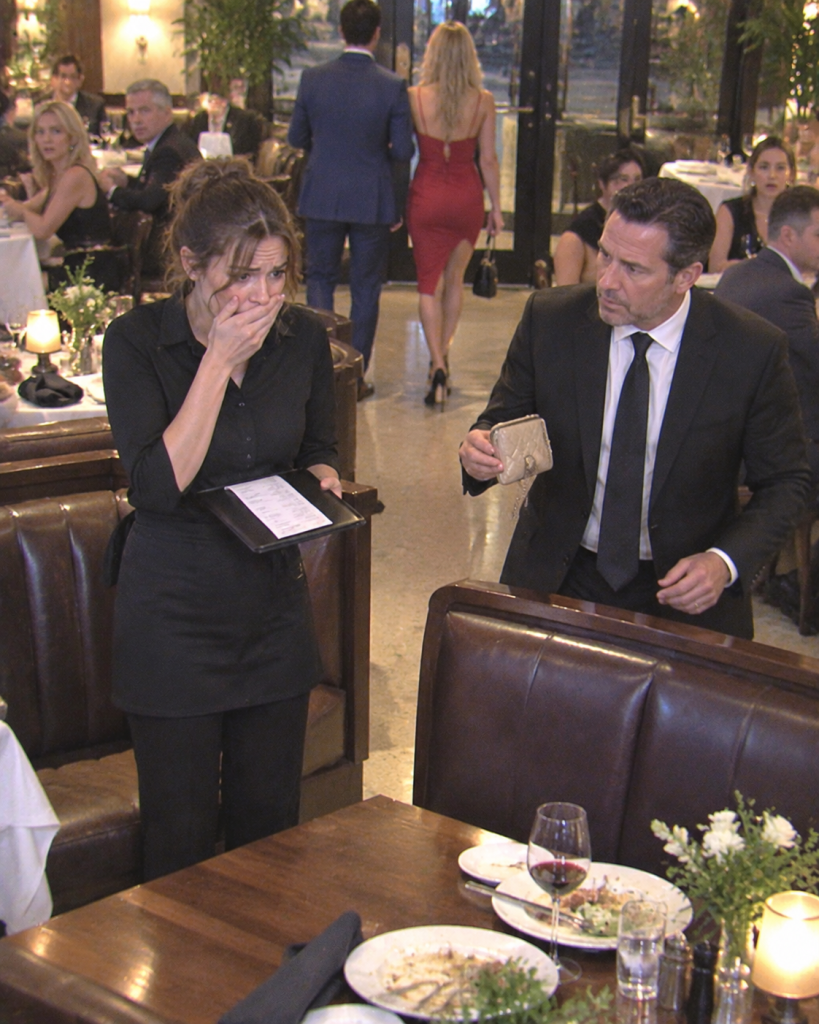
“Daniel, honey, don’t bring that filthy little rat of yours to my house today. I am not letting some sticky, screaming toddler ruin the look of my pool terrace. Leave him home.”
The bedroom smelled like fresh coffee, clean diapers, and the expensive lotion Daniel kept on his dresser.
Jack sat on the carpet in his dinosaur pajamas, one plastic T. rex pressed to his chest, watching his father with those wide three-year-old eyes that still believed adults meant safety.
He did not understand that his aunt had just talked about him like something to be swept off a floor.
“Daniel,” I said carefully, “your sister called our son a filthy little rat. He is not safe with her.”
He lifted the diaper bag onto his shoulder over a tailored suit jacket and gave me the patient little smile he saved for moments when he wanted me to feel dramatic.
“Relax, Audrey. Victoria is just being Victoria. I’ll be there with him. You go do your little Army thing on base.”
Your little Army thing.
That was what he called the work that had taught me to breathe evenly while people screamed, to read a room before it turned, to notice heat and exits and silence before anyone else realized silence had changed shape.
Daniel and I had been married six years.
I had trusted him with deployment paperwork, emergency contacts, medical forms, the daycare pickup code, and the tiny sleeping body of our son when I came home too tired to remember where I put my boots.
That morning, he used that trust like a shortcut.
At 9:10 a.m., Daniel left the house with Jack.
At 9:47, I scanned my ID at the military installation gate.
At 10:06, I signed the mandatory briefing roster with my full name and service number.
Everything had a time.
Everything had a record.
Safety is not a feeling. It is a chain of decisions, and people who love you do not snap the first link because it inconveniences them.
The briefing room had gray carpet, stale coffee, two officers at the front, and a screen full of schedule blocks.
A folder sat open in front of me.
My pen was lined up with the edge of the page.
My phone was face down beside my wrist.
Halfway through one slide, my stomach tightened.
It was not a thought.
It was my body recognizing danger before my mind had finished catching up.
I checked my phone under the table without moving my face.
Daniel had posted a photo.
Sunglasses.
Perfect shirt.
Drink in hand.
Behind him were Victoria’s white mansion, a glittering pool, servers with champagne trays, and the kind of backyard designed to make ordinary people feel like they should apologize for touching the furniture.
Jack was nowhere in the frame.
I called Daniel.Play the voicemail
No answer.
I texted, Where is my son?
Three dots appeared.
Then disappeared.
Then appeared again.
He’s fine. Don’t start.
That was all.
At 10:14 a.m., I requested release for a family emergency.
At 10:16, I signed out.
At 10:17, I was in the parking lot with my keys biting into my palm hard enough to leave marks.
The drive should have taken forty minutes.
I made it in twenty-eight.
I do not remember the radio.
I do not remember the street names.
I remember white sun flashing across the windshield, heat rising off the pavement, and my own breathing staying so controlled it scared me more than panic would have.
Victoria’s house did not look like a home.
It looked like a place built so nobody with tired hands would ever leave fingerprints.
Wrought-iron gate.
Perfect lawn.
Shining cars.
A small American flag near the front porch, barely moving in the hot air.
I did not ring the bell.
I climbed the gate with the old muscle memory of carrying weight heavier than my own body under pressure.
I dropped on the other side, stayed low near the hedges, and moved toward the music.
Mother and soldier.
Both awake.
Exits.
Shade.
Obstacles.
Distracted adults.
Heat risk.
Child location.
Music floated from hidden speakers between planters.
A woman laughed with her head tilted back.
A man lifted a champagne glass.
Two guests looked toward the far end of the yard with loose, lazy smiles, the kind people wear when they think money can turn cruelty into entertainment.
I followed their eyes.
Then I saw him.
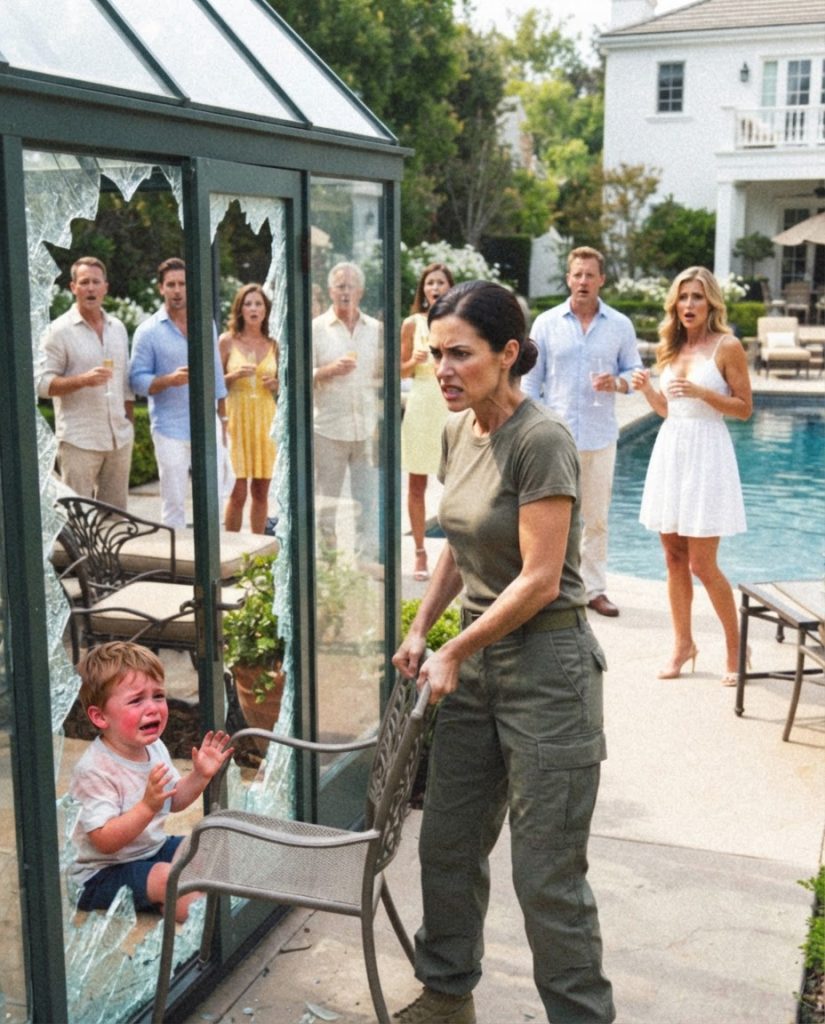
At the back of the garden, past the pool terrace and the white umbrellas, stood Victoria’s glass orchid greenhouse.
Closed.
No open vents.
No shade.
Late-morning sun hammering straight through every panel.
And inside, with both palms pressed to the glass, was my son.
Jack was crying without sound.
His shirt clung to his chest.
His curls were wet against his forehead.
His face was red, his eyes swollen, his small hand slapping the glass over and over in the same place, leaving foggy prints that disappeared almost as soon as they formed.
This was not different parenting.
This was not a misunderstanding.
This was not one rich woman being dramatic.
This was neglect.
This was confinement.
This was heat.
This was my three-year-old learning that a yard full of adults could watch him suffer and keep drinking.
The pool terrace froze around me in pieces.
A champagne flute stopped halfway to a painted mouth.
A server held a tilted tray without realizing one glass was sliding.
Daniel stood near the pool laughing at something on his phone.
Victoria wore a perfect white dress and oversized sunglasses, smiling toward the greenhouse like she had placed a decoration there instead of a child.
Nobody moved.
I did.
I crossed the patio without running.
Running warns the wrong people too early.
I walked straight to a metal patio chair, wrapped both hands around its hot frame, and lifted it off the stone.
The legs scraped loud enough to cut through the music.
Daniel finally saw me.
“Audrey,” he said, his smile breaking. “Don’t make a scene.”
Victoria lowered her sunglasses just enough to look annoyed.
“What are you doing here?”
I did not answer her.
I looked at Jack.
He lifted one trembling hand behind the glass, and I could not hear him, but I read the word on his mouth.
Mommy.
For one ugly heartbeat, I wanted to turn that chair on every adult who had stood there smiling.
I wanted the pool terrace to remember my anger in a language even Victoria could understand.
I did not.
I set my feet.
Measured the angle.
Turned my torso.
The metal chair cut through the bright air and slammed into the greenhouse panel.
The first hit opened a crack.
The second killed the music.
The third wiped Victoria’s smile clean off her face.
Glass began to give in front of me, spiderwebbing across Jack’s red, terrified reflection.
Everyone understood too late that I had not come to argue.
I had come for my son.
I raised the chair one more time, looked at Victoria through the broken shine, and said—
“Move away from the glass.”
My voice did not rise, but half the terrace stepped back anyway.
Victoria did not.
She stood there with one hand still on her sunglasses, like she was deciding whether I was a problem or just an embarrassment.
Daniel reached for my arm.
I looked at his hand before he touched me, and he stopped.
That was the first smart thing he had done all morning.
Jack slid down inside the greenhouse, his little knees folding under him.
His dinosaur fell against the glass, its plastic claws tapping once before everything went still.
That sound did what Victoria’s voice had not done.
It made Daniel’s face empty.
“Audrey,” he whispered, “I thought she only put him in there for a minute.”
A minute is what careless people call danger when they want forgiveness before they earn it.
Then one of the white-shirted servers stepped forward, pale and shaking, and held out a phone.
“Ma’am,” he said, barely above the dead music, “I recorded when she locked the door. It was 9:38.”
Victoria turned so fast her champagne sloshed over her wrist.
“Delete that,” she snapped.
The server’s eyes filled, but he did not lower the phone.
Behind him, another guest covered her mouth and stared at the greenhouse like she was finally seeing a child instead of party gossip.
Daniel sat down hard on the edge of a lounge chair, his hands loose between his knees, the color draining from his face.
I tightened my grip on the chair and looked from the phone to my husband to the tiny body behind the cracked glass.
Then Victoria said the one thing she never should have said.
“He was ruining my party.”
That was when I turned fully toward her and answered—
PART 2
“Then your party was never more important than my son’s life.”
Victoria’s lips parted.
For the first time that morning, she had nothing polished to say.
I dropped the chair.
It landed on the stone with a heavy metallic crash.
Then I stepped toward the greenhouse.
“Jack.”
His head lifted.
“Mommy?”
“I’m here.”
I crouched beside the broken panel and carefully reached through the opening.
“Come to Mommy.”
He didn’t move.
That broke something inside me more completely than any scream could have.
He was afraid of the broken glass.
Afraid of the adults.
Afraid of the place where he had been locked.
So I took off my jacket, wrapped it around my forearm, cleared the remaining sharp pieces away, and reached for him.
“You’re safe now, baby.”
His little fingers finally grabbed mine.
The moment I pulled him through, he collapsed against my chest.
His whole body was hot.
Too hot.
He buried his face against my neck and started sobbing.
“I want home.”
“I know.”
I carried him away from the greenhouse.
One of the guests immediately called 911.
Another brought a bottle of water.
Victoria snapped, “Nobody called the police!”
The guest looked at her in disbelief.
“I already did.”
Victoria’s face changed.
“Do you have any idea who I am?”
The woman shook her head.
“I know exactly who you are.”
She looked at Jack.
“And I know what I saw.”
Within minutes, the party was gone.
The champagne glasses remained on the tables, half full and abandoned.
Music was still frozen in the speakers.
The laughter had disappeared.
And then the first police cruiser pulled through Victoria’s gates.
Daniel stood up.
“Audrey, please.”
I looked at him.
He looked smaller than he had an hour earlier.
“I didn’t know she was going to lock him in there.”
“You knew she hated having him around.”
“I thought she was just angry.”
“You heard her call him a filthy little rat.”
His eyes dropped.
“You still brought him.”
He had no answer.
The officer approached me first.
“Ma’am, is that your son?”
“Yes.”
“Is he injured?”
“I don’t know yet. He’s overheated and he’s been crying.”
The officer looked toward the greenhouse.
“Who locked him inside?”
Every face turned toward Victoria.
She immediately raised both hands.
“This is being completely exaggerated. He was only inside for a few minutes.”
The server stepped forward.
“Thirty-six minutes.”
Victoria stared at him.
“What?”
He swallowed.
“I checked the time when you locked the door.”
He held out his phone.
“I recorded it.”
The officer took the phone.
Victoria’s expression hardened.
“You work for me.”
The server’s voice trembled.
“Not anymore.”
That was the moment I knew this wasn’t going to disappear behind money.
The police photographed the greenhouse.
They photographed the broken glass.
They photographed Jack’s damp clothes.
They photographed the lock.
And then they took statements from everyone who had been there.
The server gave them the video.
Another guest gave them her recording.
And Daniel handed over the voicemail.
I watched him do it.
For once, he didn’t protect his sister.
Maybe guilt had finally become heavier than loyalty.
At the hospital, doctors examined Jack for heat exhaustion and dehydration.
I sat beside his bed for nearly two hours, holding his tiny hand while an IV ran slowly into his arm.
He finally fell asleep.
His dinosaur was tucked beneath his chin.
A nurse looked at me gently.
“He’s going to be okay.”
I closed my eyes.
For the first time since I had seen him behind that glass, I allowed myself to breathe.
Daniel arrived later.
He stood in the doorway.
“I called a lawyer.”
I didn’t look at him.
“For what?”
“Us.”
“There is no ‘us’ right now.”
He swallowed.
“Audrey, I made a terrible mistake.”
“No.”
I finally looked at him.
“You made a choice.”
His face tightened.
“You chose your sister’s party over your son.”
“I didn’t think—”
“Exactly.”
Silence filled the room.
Then he whispered, “Can you ever forgive me?”
I looked at Jack.
At the tiny fingers wrapped around the dinosaur.
At the marks on his cheeks where his tears had dried.
“I might forgive you someday.”
Daniel’s eyes lifted.
“But I will never trust you with him the way I did this morning.”
His shoulders fell.
The next morning, a family court attorney met me at the hospital.
She reviewed the photographs, the recordings, the voicemail, the police report, and the timeline I had written down.
She looked at me for a long moment.
“You have something most people don’t have in situations like this.”
“What?”
“Proof.”
I nodded.
“Everything has a time.”
She gave me a quiet smile.
“Exactly.”
Three days later, Victoria’s attorney called.
They wanted to settle privately.
They offered money.
A large amount.
I refused.
They offered to pay for Jack’s medical bills.
I told them I didn’t need their money.
They offered an apology.
I told them an apology couldn’t erase thirty-six minutes behind locked glass.
And then they offered one final thing.
“No criminal complaint.”
I laughed.
Not because it was funny.
Because they still didn’t understand.
“You think this is about money?”
The attorney went silent.
“This is about my son knowing that when he cries for help, someone comes.”
The criminal case moved forward.
Victoria was charged.
The party guests became witnesses.
The server became the person who changed everything.
And Daniel?
He moved into a small apartment.
The court ordered supervised visitation while the investigation continued.
He cried the first time he saw Jack.
Jack didn’t run to him.
He stayed beside me.
That hurt Daniel more than any sentence I could have given him.
Months passed.
The greenhouse was dismantled.
Victoria sold the mansion.
The pool parties stopped.
The photographs disappeared from social media.
People who had once laughed at her jokes stopped returning her calls.
But I never celebrated her downfall.
Because revenge was never what I wanted.
I wanted my son alive.
I wanted him safe.
I wanted him to grow up believing that home was the place where someone would always come when he called.
One evening, months later, Jack and I sat on our front porch.
He was wearing the same dinosaur pajamas he had worn that morning.
He looked at me and held up his plastic T. rex.
“Mommy?”
“Yes, baby?”
“You’re gonna come if I call you?”
My throat tightened.
I pulled him into my arms.
“Every time.”
He smiled against my shoulder.
“Even if you’re busy?”
“Especially if I’m busy.”
He was quiet for a moment.
Then he whispered, “I knew you would come.”
I closed my eyes.
That sentence was worth more than every courtroom victory, every apology, and every dollar Victoria had ever offered.
Because he had been three years old when he learned something that no child should ever have to learn.
And I was determined to make sure it was not the lesson he remembered.
He would remember something else.
That his mother came.
That she never stopped looking for him.
And that no mansion, no party, no family name, and no amount of money would ever be more important than getting her child home.