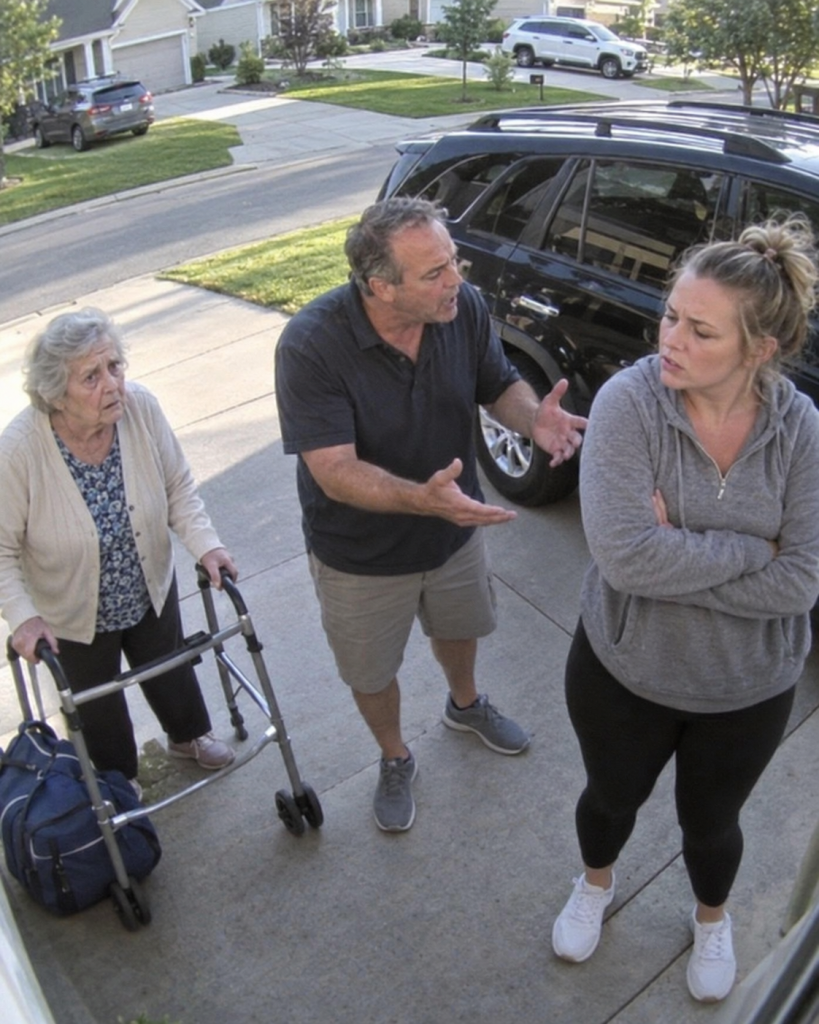
My wife looked at my eighty-two-year-old mother standing in the hallway with her hospital bag and said, “Not my problem.” For a second, even the house seemed to stop breathing. My mother’s appointment was in forty minutes.
My car was in the shop. And Vanessa was holding the keys to the SUV I had paid for, insured, maintained, and parked in our driveway while she stood there in yoga clothes, sipping iced coffee like my mother’s fear was an inconvenience.
I kept my voice calm. “She needs to get to the hospital.”
Vanessa rolled her eyes. “Then call someone. I have brunch with the girls.”
My mother lowered her eyes. That hurt more than the words.
She had been up since five, dressed in her best blue cardigan, pretending she was not nervous about the specialist visit we had waited three months to get. She had made Vanessa banana bread the night before because Vanessa had once mentioned liking it. She had even packed an extra slice in foil, in case my wife wanted breakfast.
Vanessa did not look at the bag in Mom’s hands. She only looked at me. “You always make your mother’s problems my problem.”
I felt something old and patient inside me finally crack. Not loudly. Cleanly.
I nodded once. “Okay.”
Vanessa blinked. She had expected begging. Maybe arguing. Maybe me reminding her that when her boutique nearly failed, my mother quietly paid three months of our mortgage so I could cover Vanessa’s payroll.
But I did not remind her.
I simply took out my phone and called our neighbor, Mr. Bellamy, a retired paramedic who lived two doors down. He answered on the second ring.
“David?” he said.
“I need a ride for Mom to the hospital,” I said. “My car’s in the shop.”
“I’ll be there in two minutes.”
Vanessa scoffed. “Dramatic.”
My mother touched my sleeve. “I don’t want to cause trouble.”
“You didn’t,” I said.
Vanessa grabbed her designer purse and walked past us. “Lock up when you leave. And don’t use my card for hospital parking again.”
My mother flinched. That sentence told me something I had ignored for too long. Vanessa did not dislike inconvenience. She disliked my mother.
At the hospital, Mom’s doctor adjusted her treatment plan, gave us hopeful news, and told her stress needed to be reduced. Mom smiled politely, but in the waiting room, she said one sentence that changed everything.
“David, I think it’s time Harold reviews the trust.”
Harold was her lawyer.
I looked at her. She opened her purse and pulled out a folded bank statement with Vanessa’s name highlighted three times.
“I was hoping I was wrong,” Mom whispered. “But after today, I don’t think I am.”
The next morning, Vanessa called me thirty-eight times before lunch. I did not answer until the thirty-ninth.
Part 2: The Aftermath
When I finally answered on the thirty-ninth call, Vanessa’s voice didn’t just sound angry; it sounded unhinged, vibrating with a frantic, shrill panic that I had never heard from her before.
“Where the hell have you been?!” she shrieked, the sound of slamming doors echoing in the background. “I’ve been locked out! My key fob isn’t working, the smart lock is giving me an error message, and my entire wardrobe for the charity gala tonight is inside the house! Answer me right now, David! What did you do to the locks?!”
I was sitting at the kitchen table in my mother’s quiet, sunlit suburban home, holding a cup of hot chamomile tea that Mom had brewed for me. Outside, the autumn leaves were falling steadily against the windowpane. I looked across the table at my mother, who was calmly reading a gardening magazine, looking decades lighter than she had yesterday.
I spoke into the phone in a voice so quiet it forced Vanessa to stop screaming just to hear me.
“You aren’t locked out, Vanessa,” I said evenly. “You’re locked out of my house.”
A stunned silence stretched across the line. When Vanessa spoke again, her voice dropped an octave, dripping with disbelief and arrogant disdain.
“Your house? Are you out of your absolute mind? Our house, David. My name is on the deed. My credit helped secure the loan. You cannot just lock me out of my own home over a petty disagreement about your mother! Open this door right now, or I swear to God I am calling the police and having you dragged out in handcuffs!”
“Call them,” I replied, my tone terrifyingly steady. “Tell them you’re trying to enter a residence where you no longer legally reside.”
“What are you talking about?” she hissed.
“I’m talking about the postnuptial agreement you forced me to sign three years ago,” I said, letting every word sink in like lead. “Remember? When your boutique was expanding, and you insisted that your business assets and personal properties must remain strictly protected under your sole ownership? You had your high-priced lawyer draft a clause stating that any real estate acquired prior to our marriage or restructured during it under specific provisions remains under individual control. Well, Vanessa… the house was in my name before we wed. And when we refinanced two years ago to pay off your boutique’s debt using my mother’s private loan, my lawyer quietly filed an addendum protecting the primary asset from marital attachment in the event of financial abandonment or emotional abuse. You signed it on page fourteen, right beneath your insistence that my family’s financial footprint never taint your credit score.”
The silence on the other end was absolute. I could hear the faint, rapid intake of her breath.
“You… you planned this?” she whispered, the venom momentarily replaced by a cold sliver of fear.
“No, Vanessa,” I said softly. “You planned it. Every single day you treated my mother like a burden, every time you counted her money while cursing her existence, you laid the bricks for this wall. I just finally decided to stop tearing it down for you.”
“David, please,” she choked out, her tone shifting instantly into a trembling, pathetic whine. The fierce, untouchable socialite melted away, revealing the terrified, deeply insecure woman underneath who realized her safety net had just vanished. “I was stressed. The boutique audit has been a nightmare, the girls at brunch were getting on my nerves, and… and I didn’t mean what I said about your mom. I’ll apologize to her. We can go to dinner. Just… please let me get my dresses. The gala is in four hours, and my reputation—!”
“Your dresses are currently being packed into three large contractor bags and placed on the front porch,” I interrupted, my voice devoid of any warmth or hesitation. “Mr. Bellamy is watching them right now. Your designer bags, your jewelry, and your iced coffee maker are right beside them. If you aren’t gone by the time I drive back over there to hand you your official notice of separation, I’m having the remaining items donated to the local women’s shelter.”
“You can’t do this to me!” she shrieked, the mask shattering completely. “I am your wife!”
“And she is my mother,” I said, and ended the call.
Part 3: The Inheritance of Grace
Two weeks later, the house felt entirely different. The oppressive, sterile tension that Vanessa had cultivated like a toxic garden was gone, replaced by the soft hum of classical music, the scent of baking bread, and the easy, unhurried laughter of a household at peace.
Harold, my mother’s attorney, sat at our dining room table with a thick leather-bound folio spread out before him. Sunlight poured through the bay windows, glinting off his silver-rimmed glasses as he looked up at me and Mom.
“Well, Mrs. Sterling,” Harold said, closing the final document with a soft thud. “The restructuring of the family trust is complete. As per your instructions, all liquid assets, properties, and corporate holdings formerly tied to joint marital liabilities have been permanently severed and placed under David’s exclusive, generational protection. Furthermore, any future claims by former spouses or secondary beneficiaries have been explicitly legally barred.”
Mom nodded, her expression serene as she signed her name in neat, elegant cursive.
“Thank you, Harold. I always knew I could count on you.”
“It has been my honor, ma’am,” Harold said, packing his briefcase. He paused at the door, offering me a warm, knowing look. “You handled a very difficult situation with remarkable clarity, David. Your father would have been proud.”
After Harold left, the house fell into a gentle, comfortable quiet. I walked over to the kitchen counter where Mom was arranging a fresh bouquet of autumn chrysanthemums in a crystal vase.
“You know,” I said, leaning against the counter and watching her hands move with practiced grace, “when you pulled out that bank statement in the hospital waiting room, I thought I knew the worst of it. But Harold told me today that Vanessa wasn’t just tracking your accounts… she had been trying to inquire about transferring the deed of this house into her name three months ago.”
Mom didn’t stop arranging the flowers. She simply selected a brilliant yellow bloom, trimmed the stem, and placed it gently in the center.
“Greed is a very loud thing, David,” she said softly, not looking up. “It makes people shout in hallways, slam doors, and demand things they never earned. But grace… grace is quiet. It watches, it listens, and when the time comes, it locks the door and lets the storm rage outside.”
She turned to me then, her eyes bright, clear, and entirely free of the shadows that had weighed her down for years. She reached out and patted my cheek, her skin warm and steady.
“Now,” she smiled, her voice carrying a playful, familiar warmth. “The specialist said I need to reduce my stress, which officially means I am no longer allowed to worry about anything in this world—except whether or not you’re going to eat the rest of that banana bread I baked this morning.”
I smiled back, feeling a profound, unshakeable weight lift entirely from my shoulders.
“Lead the way, Mom,” I said. “I think I can handle that.”