The first time my eight-year-old son Noah saw the red dress, he stopped so suddenly that I nearly walked straight into him.
“Mom.”
He was pointing toward a tiny dress hanging in the window of a little shop down the street.
It was bright red, with a full skirt and a small bow tied neatly around the waist.
I looked at the dress, then at my son.
“Yes?”
He kept staring at it.
“Lucy needs that.”
I smiled.
“Needs?”
Noah thought about the word for a moment.
“Okay,” he admitted. “Wants.”
I laughed.
“She hasn’t even seen it.”
He gave me the most serious expression an eight-year-old can make.
“She’d like it, Mom.”
“How do you know?”
He looked at me as if I had just asked the most obvious question in the world.
“Because she’d look like a princess.”
And that was Noah.
He had always been the kind of child who noticed things adults often overlooked.
Especially when it came to Lucy.
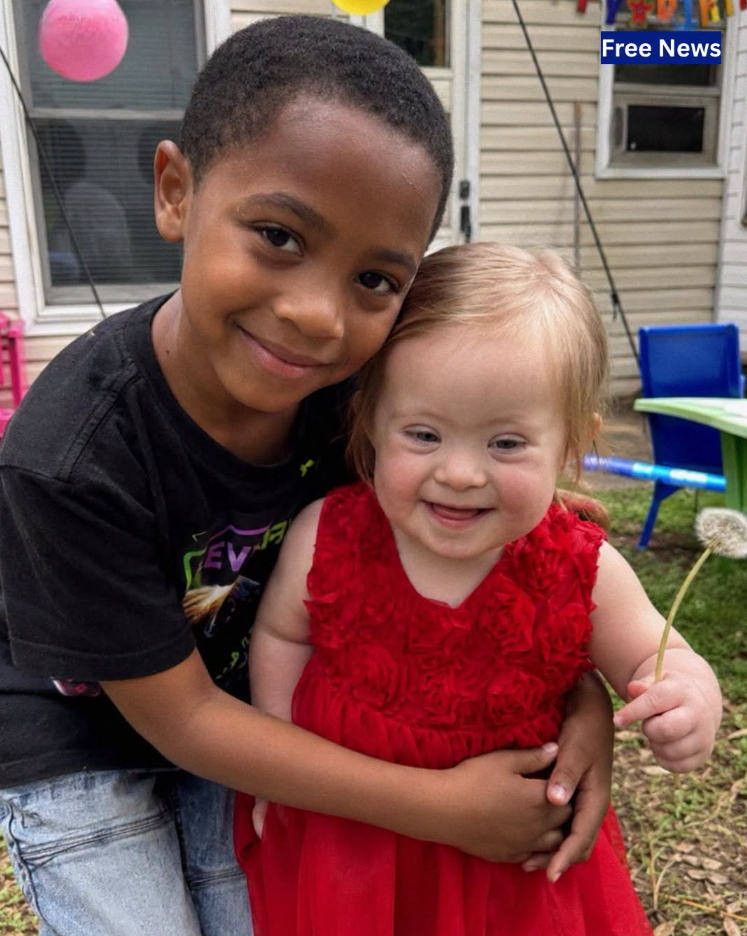
Lucy lived next door with her mother, Hannah. She was almost two years old and had Down syndrome.
From the time Lucy was old enough to recognize Noah walking through the gate, she had adored him.
He brought her dandelions.
He drew terrible pictures of dogs for her.
He made ridiculous noises just to make her laugh.
And Lucy always laughed.
Her laugh could turn an ordinary afternoon into something warmer.
Hannah was raising her alone, and I knew money was tight.
A few weeks before Lucy’s second birthday, Hannah and I were sitting outside drinking coffee while Lucy stacked plastic cups on the patio.
“I don’t think I’m really doing a party this year,” Hannah admitted.
She glanced toward Lucy.
“Just cake at home. Maybe some balloons.”
I knew what she meant before she finished.
“We’ve had extra appointments lately,” she continued. “Everything costs something.”
I nodded.
There was nothing judgmental in her voice. Just exhaustion.
Later that day, Noah asked me why Lucy wasn’t having a “real birthday.”
I tried to explain it in the simplest way I could.
“Hannah has other things she needs to pay for right now, sweetie.”
Noah looked toward the house next door.
“Like helping Lucy learn stuff?”
“Exactly.”
He nodded once.
Then he went quiet.
I didn’t think much of it.
I should have.
Over the next three weeks, Noah became strangely careful with money.
The first time I offered him five dollars for an after-school snack, he pushed it back toward me.
“I’m good, Mom.”
That immediately caught my attention.
Noah had never once in his life been “good” when French fries were available.
“You sure?”
He nodded.
I tried again.
“Want an extra dollar for later?”
This time he grinned when I handed it to him.
Then he started asking his dad whether there were small jobs he could do around the house.
One afternoon, he asked Cyril if he could rake leaves for money.
“You live here,” my husband reminded him.
“I know, Dad.”
Cyril looked at me.
“I respect the confidence.”
Soon Noah was knocking on Mrs. Reynolds’ door, asking whether she needed leaves collected.
Then he asked another neighbor.
And another.
He started keeping dollar bills in an old pencil case underneath his bed.
I assumed he was saving for a toy.
Maybe a new video game.
Maybe a bike accessory.
Something eight-year-olds normally save money for.
Then one afternoon, I found the lunch money.
Three crumpled bills sat on his dresser beside a school cafeteria receipt from several days earlier.
I stared at it.
That evening, after Noah finished his homework, I sat beside him.
“Noah, what did you eat for lunch today?”
He kept looking at his homework.
“School food.”
“What kind?”
Silence.
I waited.
“Noah.”
He finally looked up.
Then his eyes moved toward the hallway.
“Have you been skipping lunch?”
He didn’t answer.
He stood up and walked toward his room.
I followed.
Noah reached underneath his bed and pulled out the old pencil case.
He emptied it onto his comforter.
Dollar bills and coins spilled out.
Then he counted them carefully.
Thirty-eight dollars.
I looked at him.
Then at the money.
Then back at him.
“You’ve been skipping lunch?”
He lowered his head.
Not every day, he told me.
But often enough.
“Why?”
He didn’t answer.
Instead, he opened his closet.
And that’s when I saw it.
Hanging from the closet handle inside a clear garment bag was the red dress.
The exact dress from the shop window.
For several seconds, I couldn’t speak.
“You bought it?”
Noah’s face finally brightened.
“I got the last one.”
I stared at him.
“You bought that with your lunch money?”
He nodded.
“Buddy…”
I sat down beside him.
“You stopped eating lunch so you could buy Lucy a dress?”
“Not every day, Mom.”
“That’s not the point.”
“But Lucy’s birthday is tomorrow.”
I felt two emotions at once.
Pride.
And worry.
I pulled him close.
“Listen to me. Wanting to give Lucy something beautiful is wonderful.”
His face brightened again.
“But hiding that you’re hungry is not.”
His smile disappeared.
“I needed the money, Mom.”
“Then you ask us.”
“You might’ve said no.”
“Then you ask if you can earn it.”
“I did rake leaves.”
“I know.”
He paused.
Then added quietly:
“Mrs. Reynolds pays terrible.”
I couldn’t help laughing.
Even then.
Even with my heart breaking a little.
I pulled him into my arms.
“You never skip food to prove you care about somebody. Okay?”
He sighed against my shoulder.
“Okay.”
That evening, my mother-in-law stopped by.
She happened to be in the kitchen when Noah came downstairs carrying the garment bag.
“Look what I got Lucy.”
My mother-in-law smiled at first.
Then I explained how he had paid for it.
Her expression changed.
“You skipped lunches for that?”
Noah nodded.
She laughed.
Then she looked at the dress again.
“Sweetheart, that’s a waste of money.”
Noah stopped smiling.
I stared at her.
“Excuse me?”
She shrugged.
“Lucy is two.”
Then she added something that made the entire room go quiet.
“And with everything going on with her, she probably doesn’t even understand what a birthday is.”
Noah looked at her.
She continued.
“If you’re going to save that hard, buy something for yourself. Lucy won’t know the difference.”
Noah’s voice was quiet when he answered.
But it didn’t shake.
“She understands when someone’s nice to her, Grandma.”
My mother-in-law stared at him.
For once, she had no immediate answer.
Cyril had just walked in from the garage and had heard enough.
“Mom.”
She lifted her hands.
“Oh, don’t make this into something ugly. I’m being practical.”
Cyril walked over to Noah.
He crouched beside him and touched the plastic covering the dress.
“Good color, buddy.”
He smiled.
“Lucy is going to spin in it.”
Noah nodded.
My mother-in-law sighed.
“You people hear what you want.”
I looked toward the door.
“I think we’re done for tonight.”
She stared at me.
“You want me to leave over a dress?”
“No,” I said.
I looked at her.
“I want you to leave because my eight-year-old understands kindness better than you apparently do tonight.”
That ended the conversation.
The following afternoon, Hannah held the tiniest birthday party I had ever attended.
There were seven of us.
A grocery-store cake.
Six balloons.
And a little girl who had no idea how much effort had gone into making her birthday special.
Noah arrived carrying the red dress in both hands.
“This is for Lucy.”
Hannah blinked.
“For her?”
“Open it.”
She opened the package.
The moment she saw the dress, she looked at me.
“Adele, this is too much.”
“Noah bought it.”
My son immediately corrected me.
“I earned most of it.”
I raised an eyebrow.
He quickly added:
“And I won’t skip lunch again.”
Cyril coughed to hide a laugh.
Hannah knelt in front of Noah.
“You bought this for her?”
Noah gave a firm nod.
Hannah smiled.
“I think she’ll like it.”
She was right.
Twenty minutes later, Hannah brought Lucy outside wearing the red dress.
The moment Lucy realized the skirt moved, she grabbed both sides and spun.
She stumbled sideways, caught herself against Hannah’s knees, and then immediately wanted to do it again.
Noah laughed so hard he had to sit down.
Lucy squealed.
The red fabric flew around her little legs.
Hannah wiped tears from her face.
And then I noticed someone standing near the fence.
My mother-in-law.
She had come after all.
She watched Lucy spinning.
For once, she said nothing.
That night, after the party, I found Noah sleeping peacefully in his room.
Cyril came up behind me.
“Proud?”
“Very.”
Then I sighed.
“Still furious about the lunches.”
“Same.”
We went to bed.
Neither of us had any idea what would happen the following morning.
At 6:30 a.m., we were barely awake when Noah came charging into our bedroom.
“Mom! Dad!”
I sat up.
“What happened?”
“Come outside!”
Something about his voice made Cyril get out of bed immediately.
I followed them down the hallway.
Then through the front door.
And stopped.
Our entire front lawn was covered with lunchboxes.
Dozens of them.
At least fifty.
Maybe more.
There were dinosaur lunchboxes.
Superhero lunchboxes.
Bright plastic ones.
Old metal ones.
Brand-new insulated bags.
They stretched from our porch almost all the way to the sidewalk.
For several seconds, nobody said anything.
Noah slowly turned toward us.
“Are these mine?”
“I have absolutely no idea,” I said.
Cyril stepped onto the porch.
“What in the…”
Then Noah noticed the biggest lunchbox.
It sat alone in the middle of the lawn.
It was an old, battered metal lunchbox, large enough to hold a small toolbox.
A white card had been taped across the top.
It said:
OPEN THIS FIRST
“Noah, wait,” I said.
He was already kneeling.
The clasp snapped open.
He lifted the lid.
And froze.
“Noah?”
He didn’t answer.
Then he scrambled backward so quickly that he nearly tripped over one of the smaller lunchboxes.
The color drained from his face.
“Mom…”
I rushed toward him.
Inside the largest lunchbox were thick bundles of cash.
There was also a woman’s work identification badge.
A key with a bright plastic tag.
And a wedding photograph.
Noah stared into the box.
Then looked at me.
“Mom…”
His voice was barely audible.
“Somebody left all their stuff here.”
He pointed toward the cash.
“Call the cops.”
Before I could say anything, a woman’s voice came from the sidewalk.
“Please don’t!”
I spun around.
A woman in her thirties was hurrying toward us, waving both hands.
I noticed immediately that she had Down syndrome.
She stopped near the edge of the lawn and looked at the open lunchbox.
Then she looked at Noah.
“Please don’t!”
Noah pointed at the box.
“Why is your money in my yard?”
The woman stopped.
Then she looked inside the lunchbox.
She laughed nervously.
“Because apparently I did a terrible job making this look less criminal.”
Cyril covered his mouth, trying not to laugh.
Behind her stood several adults.
And Hannah.
And Lucy.
Still wearing the red dress.
Noah narrowed his eyes.
“You put all that money there?”
“With supervision,” the woman said.
Then she smiled.
“Apparently eight-year-olds are very suspicious accountants.”
The woman crouched beside the lunchbox.
“That’s me.”
She pointed toward the work badge.
“I’m Tessa.”
Noah looked at her suspiciously.
Then at the cash.
Then at the key.
Then at the wedding photograph.
“They’re all yours?”
“Yep.”
She smiled.
“All mine.”
Hannah stepped forward.
“The lunchboxes came from families at the community center.”
Noah looked around the lawn.
“But why?”
Hannah took a breath.
“Because I posted a picture of Lucy in her dress last night.”
Noah looked at her.
“I told them what you did.”
He looked down.
Hannah continued.
“I told them about the money you earned.”
Then she smiled.
“And I told them your mom made you promise never to skip lunch again.”
Noah looked slightly embarrassed.
Tessa pointed toward the dozens of lunchboxes.
“Somebody said that if one kid could give up his lunches to make another child happy, maybe the rest of us could finish something we’d already started.”
She looked around.
“So we did.”
Twenty minutes later, we were inside the neighborhood community center.
The lunchboxes had been collected from families connected to a program they were trying to fund.
Tessa explained that the program was designed to bring children with Down syndrome together with siblings and friends.
There would be art.
Music.
Games.
Movement.
Activities.
And most importantly, a place where children could simply enjoy being children.
The lunchboxes had become a symbol of what had happened.
One contained dance shoes.
Another held gardening gloves.
Another contained an old library card and three pens.
Then Tessa opened the battered metal lunchbox again.
She picked up the work badge.
“I’ve worked at the same bakery for seven years.”
Then she lifted the key.
“My apartment.”
Finally, she picked up the wedding photograph.
“And that’s my husband.”
Noah studied the photograph.
“You’re married?”
“Yep.”
Tessa sighed dramatically.
“He snores.”
Noah nodded seriously.
“So does Dad.”
Cyril immediately looked offended.
“Betrayal!”
Everyone laughed.
But then Noah looked again at the badge, the key, and the photograph.
Tessa noticed.
She touched each one.
“When I was little, people had lots of ideas about what I might never do.”
Noah listened.
“Work.”
She tapped the badge.
“Have my own place.”
She touched the key.
“Get married.”
She held up the photograph.
Her voice softened.
“Turns out people don’t always know as much about somebody else’s future as they think they do.”
Across the room, Lucy grabbed the skirt of her red dress.
Then she spun.
Again.
And again.
My mother-in-law was standing quietly near the doorway.
She watched Lucy laugh.
Noah noticed her.
“See?”
She looked at him.
“See what?”
He pointed toward Lucy.
“She understood, Grandma.”
My mother-in-law looked at Lucy again.
I almost corrected Noah.
But then I realized what he meant.
He wasn’t saying Lucy understood birthdays the way adults did.
He meant she understood kindness.
She understood happiness.
And maybe, in that moment, so did my mother-in-law.
She gave a small nod.
Hannah stood beside me, twisting a tissue between her fingers.
“The money really was tight,” she said.
I looked at her.
“But that wasn’t the whole reason I kept the birthday small.”
She looked toward Lucy.
“I spend so much time asking what helps her.”
Her voice became quieter.
“What should she practice? What appointment matters? What will make something easier later?”
She swallowed.
“I forgot to ask what she’d just enjoy.”
I looked across the room.
Noah was opening a new lunchbox someone had given him.
Inside was a sandwich, fruit, juice, and a cookie.
He frowned.
“It’s just lunch.”
Tessa smiled.
“Exactly.”
Cyril crouched beside him.
“Buddy, next time you decide to save the world, tell us before you stop eating.”
Noah looked around the room.
“I wasn’t saving the world, Dad.”
Cyril looked at the crowd.
“Apparently nobody told them.”
Everyone laughed again.
Later, someone offered Lucy a piece of cake.
My mother-in-law started to say something.
“She probably doesn’t…”
Then she stopped.
She looked at Hannah.
“Can she have some?”
Hannah smiled.
“Absolutely.”
It was only a small question.
But somehow, it felt bigger than any apology.
By evening, the lawn was empty again.
The lunchboxes had gone home.
There were no cameras.
No speeches.
No crowd.
Just our porch, a warm breeze, and Noah sitting outside eating his sandwich from the new lunchbox.
Lucy sat beside him.
She was still wearing the red dress.
She reached for his food.
Noah pulled it away.
“Lucy. Mine.”
She reached again.
He sighed dramatically, like an exhausted old man.
Then he tore off a small piece of his sandwich and handed it to her.
I raised an eyebrow.
Noah immediately took an enormous bite of his own sandwich.
With his mouth full, he looked at me.
“I’m eating too, Mom.”
I smiled.
Lucy smeared jelly across the front of her beautiful red dress.
My hand moved automatically toward the stain.
Then I stopped.
She was laughing.
Noah was laughing.
And the dress was doing exactly what he had bought it to do.
It wasn’t sitting perfectly clean in a closet.
It wasn’t hanging untouched in a garment bag.
It was being worn.
It was being enjoyed.
It was making a little girl happy.
So I left the stain alone.
And as I watched the two children sitting together on our porch, I realized something.
Sometimes kindness doesn’t arrive with a grand speech or an expensive gift.
Sometimes it begins with an eight-year-old boy giving up his lunch money because he thinks another child deserves to feel like a princess.
And sometimes, one small act of kindness can spread much farther than anyone ever expected.