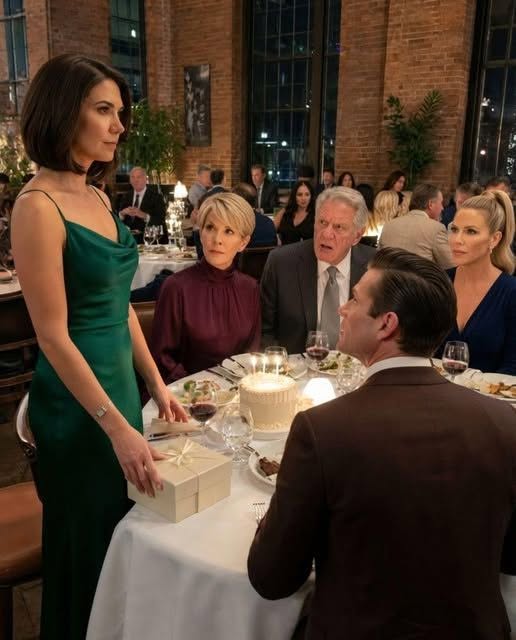
Then she embraced her father-in-law while the ballroom erupted in laughter.
I said nothing.
I simply turned around and walked out.
But the moment she opened that envelope, everything she believed about her new family collapsed.
Emma held her glass high as she wrapped both arms around Richard Vale, her new father-in-law. Some guests applauded. Others avoided looking at me, wearing the uncomfortable expressions people reserve for someone being humiliated in public.
I had raised Emma alone after her mother died.
I packed her lunches, struggled to braid her hair, attended every school event, sold my lake cabin to pay for her education, and never missed a birthday.
Yet beneath the glittering chandeliers, she treated twenty-six years of sacrifice as though it meant nothing.
Richard kissed her forehead with exaggerated affection.
“You’re a Vale now,” he declared. “You will never have to live an ordinary life again.”
His son Blake stood beside her, smiling smugly. During our first meeting, he had barely asked anything about me—except how much property I owned.
Emma glanced at the cream envelope I had placed in her hands moments earlier.
“My father says this is our wedding present,” she told the guests. “Perhaps he finally discovered a way to be useful.”
The room filled with laughter again.
I did not argue or defend myself.
I fastened my jacket and calmly said, “Open it before you finish your speech.”
Richard’s smile faltered.
The envelope was far too thin to contain the document he expected: the deed to Hawthorne Orchard, sixty acres of land that had belonged to Emma’s mother.
For months, Richard had talked about replacing the orchard with expensive villas.
Emma repeatedly insisted the development would guarantee her future.
My answer never changed.
The orchard was not for sale.
Then, three weeks before the wedding, my attorney contacted me about a purchase agreement carrying my signature.
There was only one problem.
I had never signed it.
Emma watched as I walked toward the ballroom doors.
“That’s all?” she called after me. “You’re leaving because I finally told everyone the truth?”
I stopped without turning around.
“No,” I replied. “I’m leaving because you are finally about to learn it.”
Rain shimmered across the hotel steps as I reached my car. Behind me, the ballroom doors closed.
Then Emma ripped open the envelope.
The first document was a forensic report proving that my signature had been forged.
The second traced a payment of $180,000 from the fraudulent orchard deal directly into Richard’s collapsing development company.
The third was a photograph captured by the security camera inside my office.
It showed Emma handing Blake my spare key.
At the bottom of the envelope was a handwritten message.
*You did not find a better father. You chose the man who taught you how to steal from the one who raised you.*
Before I could start the engine, my phone rang.
It was the hotel’s security director.
“Mr. Mercer,” he said urgently, “Richard Vale has ordered his driver to bring the car to the entrance.”
I looked toward the circular driveway as two unmarked vehicles slowly pulled in.
“Do not worry,” I replied.
“He will not be leaving.”
The first man out of the unmarked car wore a gray suit.
Detective Harris.
I recognized him from the two statements I had given that week. He glanced toward my car, then turned toward the hotel entrance as Richard came through the doors.
Blake followed him.
Neither man had brought Emma.
Richard spotted the detective and stopped so abruptly that Blake nearly walked into him.
“Richard Vale?” Harris asked.
“There’s been a misunderstanding.”
The detective had not mentioned a crime yet.
Richard was already explaining one.
I stepped out of my car.
Three days earlier, investigators had told me they were seeking arrest warrants. That afternoon, Harris had called to confirm they had been signed.
I had told him where the Vales would be.
The timing belonged to the police.
The envelope belonged to me.
“Turn around, please,” Harris said.
Richard looked past him and saw me standing in the rain.
For the first time since we had met, he had nothing polished to say.
“You did this?”
“I reported a forged signature.”
“You have no idea what you’re destroying.”
Behind him, a second detective approached Blake.
My new son-in-law stepped backward.
“My father handles the business.”
Harris looked at him.
“Then you can explain your part with an attorney present.”
The hotel doors opened again.
Emma stood beneath the awning, holding the documents against her wedding dress.
She had lost one earring.
“Blake?”
He turned toward her.
For one foolish second, I expected him to go to her. To ask whether she was all right. To behave like the husband he had become less than two hours earlier.
Instead, he pointed.
“She gave me the key.”
Emma went still.
Blake kept talking.
“She said her father had agreed. She said the paperwork was just a formality.”
“Blake,” Richard snapped.
But his son had found someone else to blame, and he was not letting go.
“She wanted this as much as we did.”
Emma looked down at the photograph.
Then at her husband.
“You told me you only needed the old survey.”
Blake said nothing.
“You said the boundary measurements were in his desk.”
“Emma, stop talking.”
The order came out sharp.
Familiar.
Something in her expression changed.
Harris stepped between them.
“Mrs. Vale, another investigator will need to speak with you.”
She flinched at the name.
Twenty minutes earlier, she had announced it as though she had won a prize.
Now she looked as though someone had fastened it around her throat.
Richard made one last attempt.
“Mercer. Be reasonable. Call your lawyer. We can unwind this privately.”
“The buyer already tried that.”
His mouth tightened.
That was when Emma looked at me.
“What buyer?”
I had wondered which part of the lie would break first.
There it was.
“The people who paid the hundred and eighty thousand dollars,” I said.
She shook her head.
“That was construction financing.”
“No. It was an advance against a sale I never authorized.”
Richard turned away.
Emma stared at his back.
“Tell him.”
He did not move.
“Richard. Tell him that isn’t true.”
The detective guided him toward the car.
Richard ducked his head before anyone could photograph his face.
He did not look at Emma again.
The hotel gave us a small meeting room away from the ballroom.
Through the wall, I could hear someone dragging chairs across the floor.
The celebration was being dismantled.
Emma sat opposite me. Between us lay the photograph, the forensic report, and the financial records my attorney had obtained from the buyer’s counsel.
Her hands rested in her lap.
“I didn’t forge your signature.”
“I believe you.”
She looked up quickly.
Then I added, “That isn’t the only question.”
Her eyes dropped.
Sixteen days before the wedding, I had called her.
I told her someone had submitted an agreement with my name on it. I asked whether Blake had taken anything from my office.
She said no.
When I asked about the key, she accused me of spying on her.
When I asked her to come to my attorney’s office, she hung up.
Now she traced the edge of the photograph with one fingernail.
“He said you were getting confused.”
I sat back.
“About what?”
“About what you’d promised. He said you agreed when he spoke to you alone, then changed your mind because you couldn’t bear losing control.”
“Did you believe that?”
She opened her mouth.
Closed it.
Finally, she whispered, “It was easier.”
That answer hurt more than another lie would have.
A knock came at the door.
My attorney, Helen Ward, entered carrying a folder.
She had advised me to stay home that evening.
I had told her I wanted my daughter to receive the evidence from me before she received questions from the police.
Helen sat beside me.
“Emma, the detectives want an interview. You should have independent counsel before giving a formal statement.”
Emma stared at her.
“Am I going to be arrested?”
“I can’t promise you what will happen. I represent your father.”
“But I didn’t know about the money.”
Helen’s voice remained steady.
“Then tell your own attorney exactly what you did know.”
Emma looked at me.
“Dad?”
There it was.
The word she had discarded in front of two hundred people.
I wanted to reach for it.
I wanted to tell her I would handle everything, the way I had handled school fees, broken bicycles, and the night her college roommate left her stranded three hours from home.
Instead, I kept my hands on the table.
“I won’t lie for you.”
Tears slid down her face.
“I wasn’t asking—”
“You haven’t decided what you’re asking yet.”
For a moment, no one spoke.
Then her phone lit up.
A message appeared across the screen.
Emma read it.
Her breathing changed.
Helen noticed first.
“What is it?”
Emma turned the phone toward us.
The message was from Blake.
Tell them your father approved everything. If you change your story now, they’ll think you planned it. We need to stay together on this.
Helen leaned forward.
“Don’t answer. Preserve that message.”
Emma looked at me.
“He told me they couldn’t touch the orchard without the deed.”
“They couldn’t legally buy it without a valid transfer,” Helen said. “That didn’t stop them from taking someone’s money.”
Emma began scrolling.
Slowly at first.
Then faster.
“Oh, God.”
“What?” I asked.
She stopped on a conversation dated six weeks earlier.
Blake had sent her a photograph of a document.
Beneath it, Emma had written:
That doesn’t look like Dad’s signature.
The next message came from Blake.
It’s a temporary copy for the financing people. He’ll sign the original at the wedding once you ask in front of everyone.
I read it twice.
Then I looked at my daughter.
“You knew.”
She started shaking her head.
“I thought they were preparing something for you to sign later.”
“You knew they were showing people a signature that wasn’t mine.”
Her shoulders folded inward.
“Yes.”
The room became very quiet.
Outside, someone laughed in the hallway, then abruptly stopped.
I stood.
Emma reached across the table.
“Please don’t leave.”
“When I called you, you could have told me.”
“I know.”
“When I asked you about the key, you could have told me.”
“I know.”
“And tonight, you stood up there and made me the joke.”
She covered her mouth.
I picked up my coat.
Helen remained beside her.
At the door, I stopped.
“Give your attorney the entire conversation, Emma.”
She nodded.
“Even the parts that make you look bad.”
I went home alone.
The house was exactly as I had left it.
A coffee cup beside the sink.
My good shoes missing from their usual place by the back door.
A photograph of Emma at seven, grinning through two missing teeth while her mother held an apple just beyond her reach.
I stood in front of that picture for a long time.
Then I took off my wedding jacket.
I did not throw anything.
I did not pour a drink.
I sat at the kitchen table until morning.
At eight, Helen called.
“The orchard is still yours.”
I closed my eyes.
For three weeks, we had been challenging the agreement, notifying the people involved, and trying to establish exactly what had been submitted in my name.
The first message that had reached Helen came from a buyer’s attorney asking her to confirm closing instructions.
That one routine question had exposed everything.
“What about the advance?” I asked.
“The buyer’s pursuing recovery from the Vales. You never received it. We have the records.”
“And Emma?”
“She has a lawyer now.”
I looked at the empty chair across from me.
“Good.”
Helen hesitated.
“There’s something else. The buyer provided the complete correspondence yesterday. You need to see it.”
Richard had not simply promised to develop Hawthorne Orchard.
He had promised another company that he could deliver it.
The documents spread across Helen’s desk showed the arrangement in plain language.
His company would secure the land.
The buyer would fund the project.
Richard would receive a substantial payment when the sale closed.
The hundred and eighty thousand dollars had been released early after Richard submitted the forged agreement and claimed I had approved an accelerated payment to his company for preliminary work.
He spent most of it within days.
Overdue payroll.
Loan payments.
A contractor threatening to sue.
Money from a deal that did not exist had kept his business standing long enough to find the next deal.
Or the next victim.
But it was an email attachment that made my hands go cold.
A presentation.
On the cover was a photograph of my orchard.
Inside were drawings of villas, a private entrance, and a clubhouse where my wife’s packing shed stood.
The final page described me.
Widowed owner. Daughter is sole prospective heir. Family cooperation expected following marriage.
I pushed the page away.
“He put her in the sales pitch.”
Helen said nothing.
I stared at the word marriage.
Richard had called it welcoming Emma into the family.
On paper, it was a way to obtain sixty acres.
“Does she know?”
“Her attorney has requested copies.”
I looked toward the window.
For months, I had believed Blake’s interest in my property was bad manners.
I had underestimated him.
Emma came to the house four days later.
She called first.
That small courtesy nearly broke me.
My daughter had never asked permission to come home.
I met her on the porch.
She wore jeans and a gray sweater. Her wedding ring was gone.
“I’m staying with a friend,” she said.
I nodded.
“May I sit?”
We sat with an empty chair between us.
For a while, she watched the driveway.
Then she said, “I gave them my phone.”
“The detectives?”
“My attorney arranged it. The messages. The photos. Everything.”
I waited.
“Blake told me you were going to give us the orchard as a surprise. Then he said you’d changed your mind. Richard said if I made the wedding about finally joining a family that supported me, you’d feel embarrassed enough to sign.”
I turned toward her.
“That speech?”
“They suggested it.”
She wiped her face.
“But I said it. I chose the words.”
I looked away again.
There was no comfort in learning she had been coached.
Someone had handed my daughter a weapon.
She had still aimed it.
“He came to see me yesterday,” she said.
“Blake?”
“After he was released on bond.”
“What did he want?”
“He brought flowers.”
A bitter little laugh escaped her.
“He said his lawyer thought we could clear everything up if I explained that you’d made a verbal promise.”
“And?”
“I asked whether he married me for the orchard.”
She pressed both hands together.
“He said, ‘Don’t be childish. People marry for all kinds of reasons.’”
Wind moved through the trees beside the house.
“He didn’t even bother denying it,” she whispered.
I wanted to hate him enough to make her innocent.
I couldn’t.
Emma reached into her bag.
She took out an envelope.
For a moment, neither of us moved.
“This is my statement,” she said. “My attorney has it. She said I could give you a copy.”
I did not open it.
“What does it say?”
“That I gave Blake the key. That I saw the signature and knew it wasn’t yours. That I lied when you asked me.”
Her voice faltered.
“And that you never agreed to sell.”
I looked at her.
“Will it get you in trouble?”
“Maybe.”
She left the envelope on the chair between us.
“I signed it anyway.”
The Vales fought.
Of course they did.
Richard called the transaction a failed family arrangement.
Blake claimed he had relied on Emma.
Their attorney suggested I had encouraged the project, then withdrawn my consent because I resented my daughter’s marriage.
By then, investigators had more than my word.
They had the original documents.
The office footage showing Blake returning alone after Emma handed him the key.
The messages.
The buyer’s records.
And, eventually, the person who had put my signature on the agreement.
Richard’s project coordinator.
She had copied it from an old letter Blake photographed in my office.
At first, she said she believed I had authorized it.
Then investigators showed her an email she had sent Richard.
I’m not comfortable doing this without confirmation from the owner.
His reply was five words.
My son has it handled.
Once she hired an attorney, she handed over the rest.
Every draft.
Every instruction.
Every request to make the signature look more natural.
Richard had spent his career making other people carry the risk.
This time, one of them had kept the emails.
Emma did not escape consequences.
Her attorney arranged for her to cooperate, and months later she entered a plea to a lesser charge arising from her knowing part in the scheme.
She received probation and community service.
There were legal bills.
There was a marriage to end.
There were people who stopped returning her calls, including several who had laughed the loudest at her wedding.
I did not pay to make it disappear.
She did not ask me to.
She moved into a small apartment above a pharmacy and took extra shifts at work.
Sometimes she called.
Sometimes I answered.
Other days, I watched her name on the screen until it stopped ringing.
Healing did not arrive because she had finally told the truth.
The truth merely made it possible to begin.
Six weeks after the wedding, she sent me a message.
I corrected what I said about you.
Attached was a copy of an email sent to the wedding guests.
No excuses.
No mention of being swept away by the Vales.
She wrote that I had raised her, supported her, and told the truth. She wrote that she had humiliated me while concealing information about an attempt to take my property.
The final line read:
If you repeated what I said that night, please repeat this correction.
I read it at the kitchen table.
Then I put down the phone.
For the first time in weeks, I could breathe without feeling something sharp beneath my ribs.
Blake asked to meet me before his case was resolved.
The request came through attorneys.
Helen advised against it.
I agreed.
So he wrote a letter instead.
Three pages.
He mentioned stress, his father’s expectations, and the devastating effect the charges were having on his future.
Near the bottom, he finally mentioned Emma.
For her sake, I hope you’ll tell the court this was a misunderstanding.
I handed the letter back to Helen.
“Keep it with the others.”
Richard’s company collapsed before his sentencing.
The villas disappeared from its website.
The office closed.
The cars were collected.
When Richard finally admitted his role in court, he spoke so quietly that the judge told him to repeat himself.
I remembered his voice carrying across the ballroom.
You’re a Vale now.
He had been much louder when he believed no one could make him answer.
Both men received prison sentences.
I attended.
Emma did too.
She sat several rows away from me.
When Blake was led out, he turned toward her.
She did not wave.
She did not cry.
She watched until the door closed.
Then she lowered her head.
Outside the courthouse, she caught up with me.
“I’m sorry,” she said.
She had said it before.
This time, she added nothing.
I nodded.
That was all I could give her that day.
The next spring, a late frost threatened the orchard.
I was checking equipment in the packing shed when a car pulled into the drive.
Emma stepped out wearing work boots.
She held up her phone.
“The weather report said tonight.”
I looked at the boots.
They were already muddy.
“I helped at the community garden this morning,” she explained. “I didn’t buy them for a performance.”
Despite myself, I almost smiled.
Almost.
“There are hoses behind the shed,” I said.
She set down her bag.
We worked until dark.
She did not mention the wedding.
She did not ask whether I had forgiven her.
When I showed her how to check a valve, she listened. When she got it wrong, she tried again.
At nine, I brought out sandwiches.
We ate sitting on overturned crates.
“My mother loved this place,” she said.
“Yes.”
“I used to think you kept it because you couldn’t let her go.”
I looked across the rows.
“Partly.”
She turned toward me.
I had spent so long defending the orchard that I had forgotten there were things I could admit.
“But it’s also a business,” I said. “People work here. We grow something. Your mother and I built a life around that.”
Emma looked toward the packing shed.
“I let them talk about it like it was empty land.”
“Yes.”
She swallowed.
“I’m trying to understand what I was willing to destroy.”
I finished my sandwich.
Then I handed her the thermos.
We stayed until the temperature began to rise.
She came back the following Saturday.
And the Saturday after that.
Some visits were awkward.
On others, we argued.
Once, she complained that I still treated her like someone I couldn’t trust.
I put down the pruning shears.
“Emma.”
She looked at me.
Then lowered her eyes.
“I know.”
She stayed and finished the row.
That mattered more than any apology.
By harvest, she knew the names of the seasonal workers. She could spot damaged fruit before it reached the sorting table. She stopped describing the orchard as something she would own one day.
She called it my place.
When customers asked whether she was my daughter, she waited for me to answer.
“Yes,” I said.
Each time, a little more easily.
Nearly a year after the wedding, I invited her to dinner.
After we ate, I placed a cream envelope beside her plate.
She stared at it.
“Dad?”
“Open it.”
Her hands trembled.
Inside was a photograph of her at seven, standing between her mother and me beneath the orchard trees.
And a key.
She lifted it carefully.
“The back door?”
“I changed the locks last year.”
“I know.”
“This one fits.”
Her face crumpled.
I let her cry.
Then she looked up.
“Does this mean you trust me?”
“It means I’m willing to keep trying.”
She closed her fingers around the key.
“I won’t give it to anyone.”
“I know what you’re promising,” I said. “Make sure you do.”
She nodded.
A minute later, she stood to clear the dishes.
At the sink, she paused in front of the old photograph.
“I used to be proud that you were my dad.”
I waited.
“When I was little, I told everyone you could fix anything.”
I looked down at my hands.
“They were smaller problems then.”
She turned around.
“I know you can’t fix this for me.”
“No.”
“But can I come for dinner next Sunday?”
I pulled her chair back toward the table.
“Six o’clock.”
She smiled through her tears.
After she left, I checked the back door out of habit.
Locked.
A few seconds later, someone knocked.
I opened it.
Emma stood on the step holding her key.
“Forgot my phone,” she said.
“You could have used that.”
She glanced down at it.
Then back at me.
“I know. But I thought I’d ask.”
I stepped aside.
“Come in, sweetheart.”