The detail read, “Patient in emergency surgery; Agnes notified at 6:14 p.m. and stated Chloe was with her.”
Chloe’s face changed before Agnes could invent another explanation.
Leo read the line again.
Then he looked at Chloe.
“You were there when the hospital called?”
Chloe folded her arms, but the bravado had vanished.
“I don’t remember some random phone call.”
Agnes snapped, “Because there wasn’t one. That nurse probably wrote it wrong.”
I leaned against the wall, one hand pressed over my incision.
Until that moment, part of me had still wondered whether neglect could somehow be explained by ignorance.
Now Agnes had given me something worse than neglect.
She had given me a lie.
Leo turned the discharge sheet toward me.
“Can we call the hospital?”
I nodded.
That was my choice, not his.
I pulled my phone from my coat pocket and dialed the surgical ward number printed on my paperwork.
Agnes moved toward me.
“You don’t need to drag strangers into a family disagreement.”
Leo stepped between us.
“Don’t come near her.”
His voice wasn’t loud.
That made Agnes stop faster than shouting would have.
A nurse answered after several rings.
I gave my name, date of birth, and patient number, then explained that I needed clarification about an emergency-contact note.
The nurse placed me on hold.
Nobody spoke while the music played through my phone speaker.
Even Chloe stopped pretending to eat.
When the nurse returned, she identified herself as Marissa, one of the nurses who had been working during my surgery.
“I remember you,” she said gently.
I swallowed.
“Did someone call my mother-in-law?”
“Yes.”
Agnes immediately shook her head.
I continued.
“Was my sister-in-law with her?”
Marissa hesitated.
“I can read the note after you authorize me to discuss your own contact record on speaker.”
“I authorize it.”
Paper rustled on her end.
“At 6:14 p.m., I reached Agnes using the secondary emergency-contact number in your chart.”
Leo stared at his mother.
Marissa continued.
“She stated that Chloe was beside her and could hear the conversation.”
Chloe whispered, “Mom.”
Agnes shot her a warning look.
Marissa’s voice remained clinical.
“I explained that you were being taken into emergency surgery because of significant internal bleeding.”
My stomach tightened.
Leo closed his eyes for a second.
“What did they say?” I asked.
Another pause.
“The note says Agnes declined to come to the hospital.”
Agnes exploded.
“That’s a lie!”
Leo held up one hand without looking at her.
Marissa continued.
“She said your husband was overseas and that there was no reason for anyone else to come because the doctors were already handling it.”
Chloe sat down slowly.
I remembered the empty chair beside my hospital bed.
For two days, I had looked at that chair and assumed nobody knew enough to understand how serious things had been.
That assumption disappeared.
“Anything else?” I asked.
Marissa sounded uncomfortable now.
“Yes.”
The room seemed to shrink around that word.
“She asked us not to call again unless you died or needed someone to sign something.”
Leo’s face went completely still.
Agnes pointed toward the phone.
“She misunderstood me.”
Marissa heard her.
“Ma’am, I documented the statement immediately because it was unusual.”
Nobody answered.
I thanked Marissa and ended the call.
For several seconds, all I could hear was my own breathing.
Then Chloe tried to save herself.
“I didn’t know it was that serious.”
I looked at her.
“You just heard the nurse say she explained the internal bleeding.”
Chloe’s eyes filled, but I felt strangely detached from it.
“I thought Mom would handle it.”
Agnes turned on her.
“Don’t you dare start blaming me.”
That was the first crack between them.
Leo noticed it too.
But he didn’t use it.
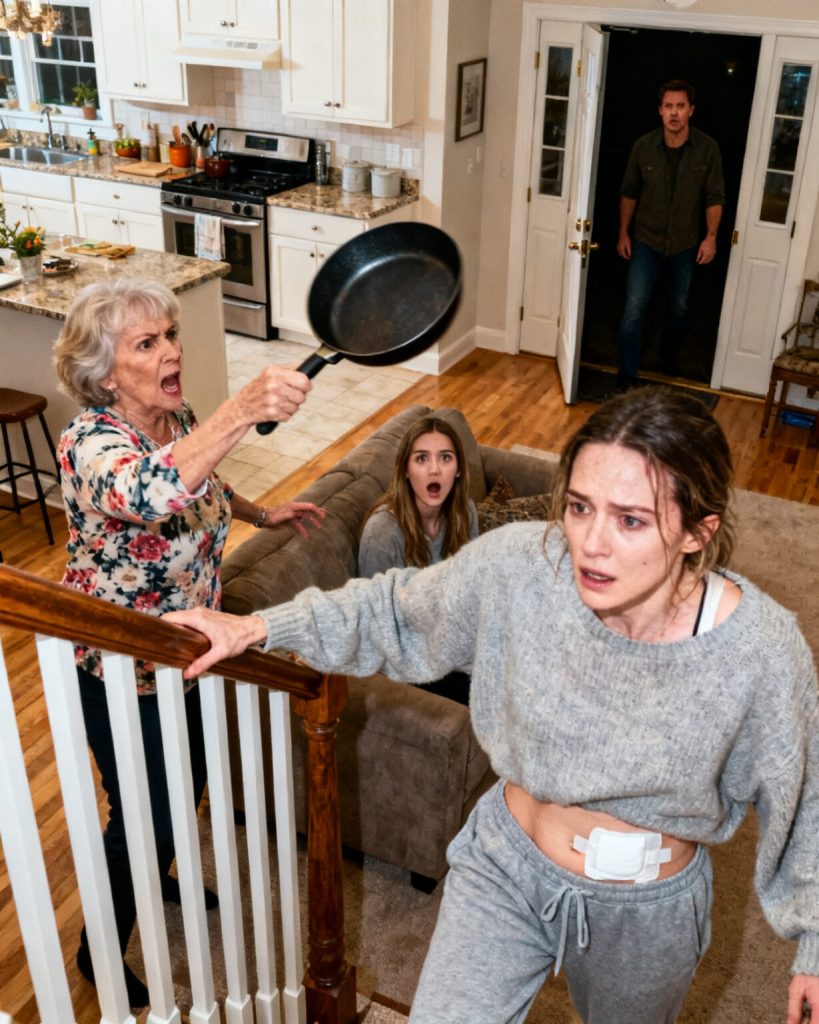
Instead, he bent down and picked up the cast-iron skillet from the floor.
The edge had gouged the wooden doorframe inches from where my head had been.
His hand tightened around the handle.
“You knew she was in emergency surgery,” he said.
Agnes lifted her chin.
“She came home, didn’t she?”
Leo stared at her.
I don’t think anything she could have said afterward would have repaired that sentence.
He placed the skillet carefully on the entry table.
Then he took out his phone.
Agnes’s confidence returned for half a second.
“Who are you calling?”
“First, I’m photographing the damage.”
He took pictures of the doorframe, the skillet, and the papers scattered across the floor.
Then he looked at me.
“Do you want to report what happened?”
It mattered that he asked.
He didn’t decide for me.
I thought about the pan flying toward my face.
I thought about Chloe immediately blaming me for making Agnes throw it.
“Yes,” I said.
Agnes laughed once, sharply.
“You would call the police on your husband’s mother?”
I met her eyes.
“You threw cast iron at my head two days after surgery.”
Her expression changed when she realized I wasn’t debating the description anymore.
I was naming what happened.
Leo called the non-emergency number and reported the incident while I went upstairs.
He offered to come with me.
I told him no.
I needed to pack my own bags.
Every step pulled painfully at my abdomen.
My bedroom looked exactly as I’d left it before collapsing.
A half-folded sweater sat on the chair.
My passport was in the desk drawer.
The sight of ordinary things almost undid me.
I started with documents.
Passport.
Birth certificate.
Insurance information.
Bank records.
Then clothes that didn’t press against my incision.
Leo appeared at the doorway ten minutes later but stayed outside the room.
“An officer is coming to take statements.”
I nodded and kept folding.
“I’m sorry,” he said.
I stopped.
There were a hundred apologies he could have meant.
“For what?”
His eyes dropped.
“For believing them every time you told me something was wrong.”
That surprised me.
Because I hadn’t expected him to remember those conversations accurately.
I had complained in softened language for years.
Your mom expects a lot when you’re gone.
Chloe doesn’t really help around the house.
I feel like I’m responsible for everyone.
Leo had answered with the same reassurance each time.
They love you. They’re just difficult.
Now he looked sick hearing his own excuses repeated back to him.
“I made it easy for them,” he said.
“Yes.”
I didn’t rescue him from that answer.
He nodded once.
“I know.”
Then he noticed my suitcases.
“You’re leaving.”
“I told them I was.”
“I thought you meant them.”
“No.”
That seemed to hurt him more than anything Agnes had said.
I zipped the first suitcase.
“I can’t recover here.”
“I can make them leave.”
“Maybe you can.”
I looked toward the hallway.
“But that doesn’t make this house safe for me tonight.”
Leo didn’t argue.
That was the first useful thing he did for our marriage that day.
He carried the suitcase downstairs without asking me to reconsider.
The responding officer arrived shortly afterward.
Agnes transformed the moment she saw the uniform.
Her voice softened.
Her shoulders dropped.
She described herself as a frightened mother defending her home from an unstable daughter-in-law.
Then the officer looked at the dent in the doorframe.
He looked at the skillet.
He looked at my hospital dressing.
And finally, he asked Leo where he had been standing.
“In the foyer,” Leo said.
“Did you see the throw?”
“Yes.”
Agnes interrupted.
“He’s confused. He just flew internationally. He’s exhausted.”
Leo didn’t even look at her.
“I watched my mother throw that skillet at my wife.”
The officer wrote it down.
Chloe tried another version.
“She wasn’t aiming at her.”
The officer turned toward her.
“Then what was she aiming at?”
Chloe opened her mouth.
Nothing came out.
Agnes finally understood that neither daughter nor son could talk the incident back into being ordinary.
The officer took separate statements and photographed the damage.
He explained the next procedural steps to me without promising an instant outcome.
That mattered too.
Nothing about the situation suddenly became simple because someone in authority had arrived.
I still hurt.
I still had nowhere permanent to go.
My marriage was still cracked open.
But the story Agnes had controlled for years was no longer the only record.
Before the officer left, he gave me an incident number.
I slipped the card into my discharge envelope.
Agnes watched me do it.
For once, she didn’t have a comment.
Leo then told Agnes and Chloe he was arranging a hotel for them that night.
Agnes laughed as though he’d made a joke.
“You are not throwing your mother out for her.”
Leo shook his head.
“This isn’t about choosing women.”
He pointed toward the damaged doorframe.
“You threw a weapon at someone recovering from emergency surgery.”
“This is my home.”
“It is the home you were allowed to live in.”
His voice remained steady.
“And that arrangement is ending.”
Agnes stared at him.
Chloe looked frightened now.
Not for me.
For herself.
“Where are we supposed to go?” she asked.
The question was almost surreal.
Forty-eight hours earlier, I had nearly bled to death while they decided visiting me was inconvenient.
Now they expected me to feel responsible for their lodging.
Leo said he would pay for several hotel nights while they arranged something else.
I interrupted him.
“That’s between you and them.”
He looked at me.
I continued.
“But don’t use our joint money without telling me.”
That landed differently.
For years, I had treated Leo’s income as something I shouldn’t question because he earned more.
Yet our household had been supporting two adults who treated me like unpaid labor.
Leo nodded.
“You’re right.”
We opened our banking app together.
There were recurring transfers I recognized and others I had never noticed.
Leo had been sending Agnes money every month for personal expenses beyond the household bills.
Chloe had a card attached to one of his accounts.
Neither arrangement was criminal.
That wasn’t the point.
The point was how thoroughly their comfort depended on a system I had been expected to maintain silently.
Leo froze the extra card while I watched.
Agnes heard the notification on Chloe’s phone.
“What did you do?”
Leo answered without looking up.
“Changed what I’m willing to finance.”
Chloe’s face hardened.
“So she comes home acting crazy and suddenly we’re homeless?”
I picked up my second suitcase.
“No, Chloe.”
“You watched me collapse and did nothing.”
I steadied myself before continuing.
“You knew I went into emergency surgery. Then when I returned, you watched your mother throw a skillet at my head.”
She looked away.
“This isn’t sudden.”
My ride had waited outside through everything.
When I finally stepped onto the porch, Leo followed with my bags.
He asked where I was going.
“A furnished rental near the hospital.”
“I’ll come with you.”
“No.”
He stopped.
I expected him to protest.
Instead, he set the suitcases beside the car.
“What do you need from me?”
The answer came easier than I expected.
“Actions I don’t have to supervise.”
He nodded.
I added one more thing.
“And don’t ask me to forgive anyone while I’m still learning how close I came to dying.”
“I won’t.”
I left him standing in the driveway.
For the next week, recovery reduced my world to medication alarms, short walks, bland food, and sleep.
Leo didn’t flood me with apologies.
He sent practical updates instead.
Agnes and Chloe had moved into a hotel.
He had started the formal process required to end their residence at the house.
He removed Chloe’s access to his accounts.
He changed the locks after receiving legal guidance about when he could do so.
He also sent me every financial statement connected to the household.
I hadn’t asked for all of that.
But I noticed he was finally doing work instead of asking me how to manage the consequences.
Agnes sent me one message.
It said, “You destroyed this family.”
I took a screenshot.
Then I blocked her.
Chloe sent nothing.
The hospital incident remained documented, and I cooperated when I was contacted for follow-up about the skillet.
I didn’t build my recovery around whether Agnes would face the harshest possible consequence.
For once, her outcome wasn’t the center of my life.
Three weeks after surgery, Leo came to the rental with groceries I had requested.
He left them on the counter and didn’t assume he was staying.
Before he went, he placed something beside my discharge envelope.
It was a new emergency-contact form.
His name was first.
My closest friend was second.
Agnes’s name was gone.
I stared at it longer than I expected.
“I should have seen what was happening,” Leo said.
“Yes.”
He accepted the answer.
“I don’t know whether we’re going to be okay,” I told him.
“I know.”
That was where we left it.
Not forgiven.
Not divorced.
Not magically repaired because he finally confronted his mother.
He had years of neglect to account for, and I had a body that still reminded me what silence had cost.
But something fundamental had changed.
I no longer needed Leo to choose me over his family.
I had already chosen myself.
Months later, the scar beneath my sweater had faded from angry red to a thin pale line.
The damaged doorframe was repaired too, though Leo kept the photograph from that afternoon with the incident records.
I never went back to being the person who cooked because everyone else expected hunger to become my emergency.
Agnes and Chloe found another place to live.
Their relationship with Leo became his responsibility to manage, not mine.
And Leo learned that supporting people financially did not entitle them to control the person keeping his home together.
Whether our marriage survives is still something we’re deciding through ordinary days, not dramatic promises.
But when I remember that skillet flying toward me, I don’t remember Agnes’s face first anymore.
I remember stepping into that car with two suitcases beside me.
I remember the hospital envelope in my lap.
Inside it were the records proving they had known.
Beside it was the incident number proving I had finally spoken.
And for the first time in years, I was going somewhere because I had decided to go.