It is a strange, devastating thing to watch the woman you love break in slow motion. There is no shattered glass, no sudden scream, no dramatic gasp for air. There is only the quiet folding of an apron, the lowering of tired shoulders, and a silence so profound it rings in your ears. This is not just a story about a ruined birthday party. This is the chronicle of my own coup d’état—the day I stopped absorbing the blows aimed at my family and decided, finally, to strike back.
Everything began on a Friday evening in late October. The Chicago wind was already carrying the bitter, damp threat of winter. I had just walked through the front door, my back screaming in agony. For five years, I had driven a cab twelve hours a day, my L4 vertebra grinding into dust. The pain was a jagged wire running from my spine down to my left knee.
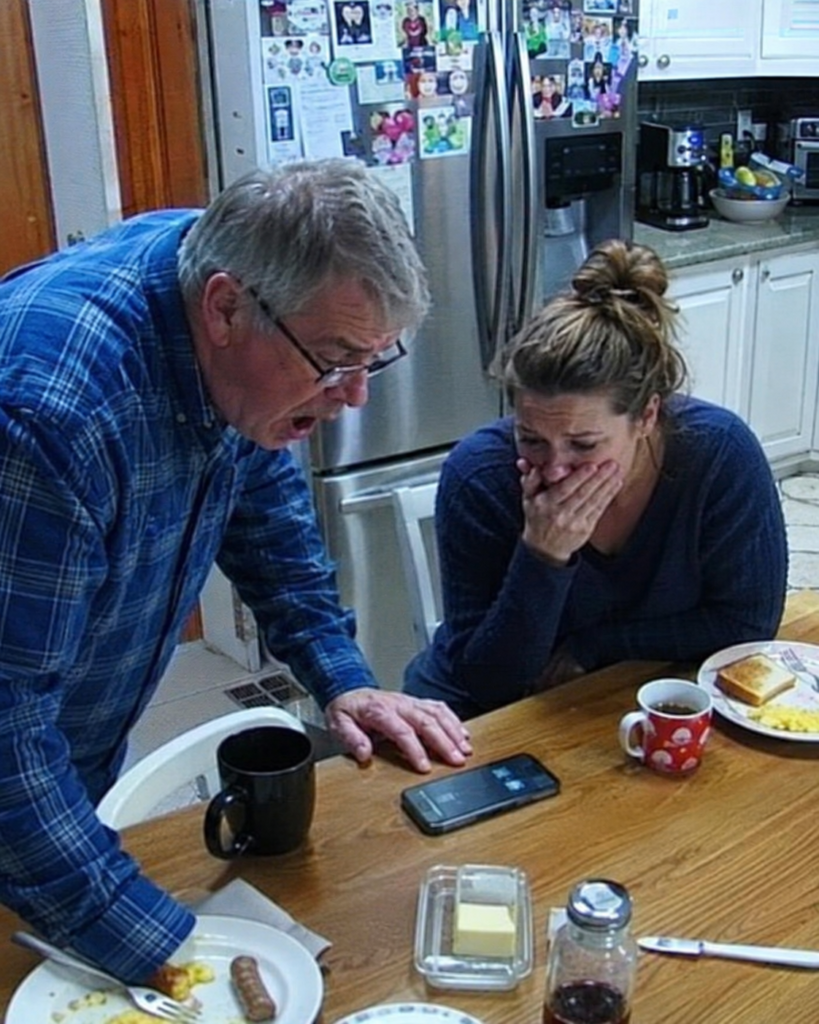
My wife, Gloria, was at the kitchen table. In front of her sat an empty glass jar and a stack of pharmacy receipts. For eight months, she had been saving her small restaurant tips to replace the faulty, dangerous convection oven at Gloria’s Corner, her small neighborhood diner. But an hour before I got home, the pharmacy had called. My new pain medication and spinal injections weren’t covered by our insurance. Without a second thought, Gloria had emptied the oven fund to pay for my relief.
She looked up, offering me a tired, beautiful smile, just as the front door swung open again.
Tiffany walked in.
She didn’t knock. My daughter-in-law rarely did. She moved with the brisk, manicured energy of a woman who always assumed the world was operating on her schedule. Behind her trailed my son, Kevin, his eyes glued to his smartphone.
Gloria unfolded the sheet. It wasn’t a menu. It was a numbered list.
Thirty-eight separate dishes.
“For how many people?” Gloria asked quietly.
“About seventy-five,” Tiffany answered, inspecting her fingernails. “The party starts at three.”
“Tiffany said Mom could handle it,” Kevin shrugged, looking back at his screen.
Tiffany offered a polished smile. “It’s Kayla’s eighteenth birthday. You run a restaurant. This shouldn’t be that difficult for you.”
Gloria folded the paper carefully, her calloused thumbs running over the crease. “Okay.”
She had been saying okay for decades. Okay when Kevin needed expensive braces. Okay when my work hours evaporated. For Gloria, okay never meant a task was easy. It meant she had already accepted the burden.
We spent the next four hours driving to three different grocery stores, swiping our credit card into agonizing debt. By midnight, our small kitchen was transformed into a professional workspace. I peeled vegetables and washed heavy skillets while Gloria moved with military precision.
But at 3:15 AM, disaster struck.
The old, overworked oven gave a violent hiss. A loud pop echoed through the kitchen, followed instantly by a plume of thick, acrid black smoke.
“Hank!” Gloria screamed.
Flames licked up the back wall of the oven. Without thinking, Gloria grabbed a damp heavy towel and shoved her arm into the blazing cavity to smother the fire before it could reach the gas line. She suffocated the flames, but as she yanked her hand back, the heavy iron door swung shut, trapping her arm against the searing hot metal rack.
She cried out—a sound that shattered my heart. I rushed over, pulling her back. The skin across her index and middle fingers was instantly blistered, an angry, raised red line of ruined flesh. Worse, resting at the bottom of the charred oven was her mother’s vintage copper roasting pan, now warped and melted beyond repair. The heirloom was destroyed.
“Let me take you to the hospital,” I pleaded, wrapping her hand in ice and gauze. Blood and clear fluid were already seeping through.
“No,” she gasped, tears streaming down her face as she looked at the ruined copper pan. “The soufflé needs attention. The beef needs to sear. I can’t stop.”
I wanted to shake her. To let the party fail. But even with her hand wrapped in thick white gauze, clumsy and throbbing with excruciating pain, she returned to the stove. By 6:00 AM, she had cooked all thirty-eight dishes, plus a pot of tomato soup—Kevin’s childhood favorite—with a small note that read: For Kevin.
As the sun rose, she slumped against the counter, her bandaged hand trembling violently. We had survived the night. But as I looked out the kitchen window toward the street, a massive, sleek black truck with silver lettering pulled up to our curb.
Rosewood Fine Catering.
I felt a cold dread coil in my gut. The nightmare hadn’t ended; it was just arriving.
Morning light conquered the shadows in our backyard as we carried the heavy aluminum trays outside. Our yard was simple—a concrete patio and a chain-link fence—but Gloria had turned it into something warm, draping white linens over borrowed tables.
By 2:30 PM, the food was laid out. The rich smells of roasted chicken, garlic, and fresh bread drifted through the brisk autumn air. Gloria stood by the kitchen door, pale as a ghost, her bloody bandage hidden beneath her sleeve.
The first cars arrived. Tiffany walked in first, holding her phone high to record the decorations. Kevin followed, still texting. Guests poured in—seventy-five people dressed in designer coats, laughing and chatting.
Then, the heavy iron gate swung open, and the men in black uniforms marched in.
There were six of them, carrying massive, gleaming silver chafing dishes, tiered platters of caviar, and crystal champagne flutes. They wore aprons stamped with the Rosewood logo—the most expensive, exclusive steakhouse in downtown Chicago.
I stepped forward. “Excuse me, what is this?”
Tiffany spun around, clapping her hands. “Oh, right on time!” She turned to the caterers. “Just set it up right there in the center. You’ll have to move all this… other stuff.”
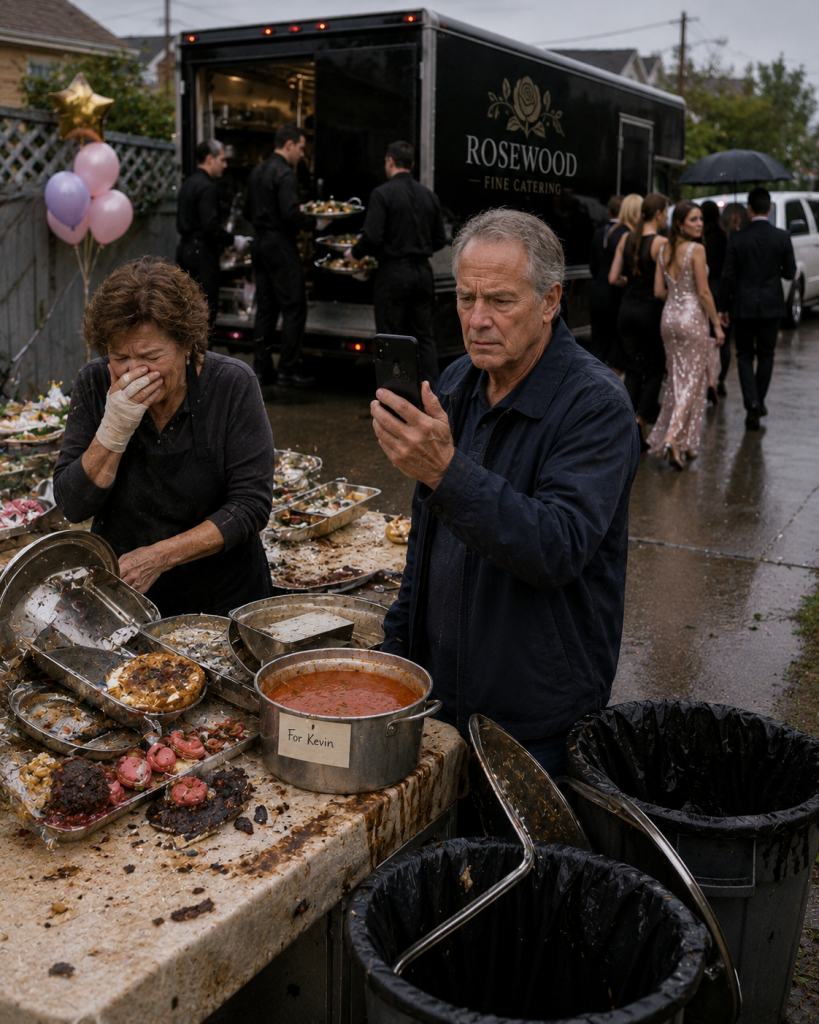
Before I could speak, two waiters began violently shoving Gloria’s thirty-eight homemade dishes to the side. They pushed the Beef Wellington, the macaroni, and the peach cobbler onto a rickety, un-tableclothed card table near the trash cans. Gravy sloshed. A tray of macarons fell into the grass.
“Hey!” I shouted, my voice cracking.
Tiffany tapped a crystal glass with a spoon. The yard fell silent.
“Thank you all for coming!” Tiffany announced cheerfully, her eyes purposely skipping over Gloria. “I know the invitation said the party was here, but this was just the meeting spot! I ordered some real appetizers from Rosewood to start us off. In twenty minutes, our limousines will arrive to take us all to Rosewood’s private VIP dining room for the actual celebration! Kayla only turns eighteen once. She deserves something elegant.”
The sentence landed like a bomb.
Nobody spoke. Seventy-five pairs of eyes shifted from the extravagant Rosewood spread to the rickety table holding Gloria’s exiled food.
Tiffany turned to Gloria, offering a devastatingly casual smile. “You can keep everything you made, Mom. Stick it in the fridge. Don’t let it go to waste.”
Within moments, the guests began eating the caviar and drinking the champagne. No one touched Gloria’s food. When the black limousines honked out front, they all filed out. Kevin passed close enough for me to grab his collar. I didn’t. He just followed his wife, a silent accomplice to his mother’s public execution.
Kayla hesitated near the gate, looking at her grandmother, but her friends pulled her away. The gate clicked shut.
Gloria stood frozen in the doorway. She slowly walked over to the rickety table, looking at the smashed macarons and the cold pot of tomato soup. She covered her face with her uninjured hand, her shoulders shaking in silent, suffocating sobs.
I didn’t offer platitudes. I walked inside, grabbed my phone, and went back out. I photographed everything. The ruined food. The empty yard. The note for Kevin.
I opened Facebook and typed with cold, crystalline purpose.
My wife spent our last dollar and stayed awake all night cooking 38 dishes for a family birthday. Her oven caught fire. She suffered severe burns to her hand, destroying a family heirloom, just to make it perfect. Today, a catering truck was brought in to replace her food, and the party was moved to a luxury restaurant. Her food was shoved next to the trash. If you’re nearby and hungry, our gate is open. Children eat free. Nobody should bleed for a meal only to watch it grow cold.
I posted the pictures and set my phone down.
Ten minutes passed in silence. Then, a massive shadow fell across the concrete. I looked up. A man in a tailored suit, holding a professional camera, stood at the open gate, followed by a crowd of at least twenty people spilling onto the sidewalk.
“Is this the Coleman house?” the man asked, his voice booming over the low murmur of the wind. He possessed a commanding presence, dressed in a tailored charcoal overcoat that seemed out of place in our working-class neighborhood.
“It is,” I said, stepping forward, instinctively squaring my aching shoulders.
“I’m Marcus Vance,” he said, extending a hand. I recognized the name immediately, a cold shock of adrenaline cutting through my fatigue. He was Chicago’s most ruthless, influential food critic and blogger. A single review from him could make a restaurant a staple or shut its doors forever. “A neighbor shared your post in a local community group. I happen to live just three blocks over on Elm. May we?”
He gestured behind him. A crowd of at least twenty people—families, teenagers, a few couples holding umbrellas—were spilling onto the cracked sidewalk, their eyes darting toward the steaming tables in our yard.
I looked back at Gloria. She was still clutching her wounded hand against her chest, her eyes wide with disbelief. I turned back to the critic and pushed the heavy iron gate all the way open.
“Welcome to Gloria’s Corner,” I said.
Within an hour, our modest backyard transformed into a massive, roaring festival. Neighbors, strangers, and loyal customers from the diner poured in, drawn by the viral post and the intoxicating scent of roasted meats and caramelized sugar. Marcus Vance didn’t just casually eat; he conducted a symphony of culinary investigation. He set up a portable ring light right there on the concrete patio. I watched, breathless, as he took his first bite of the exiled Beef Wellington.
He closed his eyes. The yard seemed to hold its collective breath.
“The pastry,” Marcus whispered to his phone camera, broadcasting live to his two million followers, “is a masterclass in lamination. But the duxelles… the depth of the earthiness here is staggering. This isn’t just food, Chicago. This is soul. This is raw, bleeding survival on a plate.”
Miss Doy, leaning heavily on her wooden cane, immediately took charge of the chaotic buffet line, swatting away anyone who tried to take too much of the dairy-free macaroni before the children had eaten. Two mechanics from the auto shop down the street carried heavy trays of dirty plates into the kitchen, washing them in the sink without being asked. The yard was packed with people laughing, eating, and treating Gloria like the absolute royalty she was.
For the first time that entire day, true, vibrant color returned to my wife’s pale cheeks. She stood behind the carving station, explaining her recipes, bathing in the genuine, unpretentious gratitude of strangers.
I slipped away into the quiet, dark space of the hallway. The contrast between the roaring warmth outside and the cold silence of the house was jarring. I pulled my phone from my pocket and dialed the customer service number for my bank.
I waited through five minutes of agonizing, static-filled hold music, rubbing the throbbing knot at the base of my spine. Finally, a sterile, automated-sounding voice clicked on the line.
“Thank you for calling. How can I help you today?”
For three years, eight hundred dollars had automatically left our checking account on the first of every month to help Kevin and Tiffany with their “mortgage.” It was a lifeline that had mutated into a toxic entitlement. We bled so they could drink champagne.
“I need to permanently cancel a recurring transfer to Kevin Coleman,” I stated, my voice devoid of any hesitation.
“Let me pull up that account, sir. One moment.” Keys clacked over the line. “Alright, I see the monthly transfer of eight hundred dollars. You wish to terminate this agreement?”
“Immediately. Today.”
“Done, sir. The transfer is canceled. Is there anything else?”
“No,” I said softly. “That’s everything.”
I hung up. The click of the call ending felt like the snapping of a heavy, rusted iron chain around my neck. I felt a profound, terrifying sense of liberation.
Hours later, at 8:45 PM, the backyard was still buzzing with the last dozen guests polishing off the final crumbs of the peach cobbler. The wind had picked up, bringing the sharp bite of impending rain. My phone vibrated violently against my thigh.
Kevin.
I stepped into the dark, oil-stained cavern of our garage, pulling the door shut behind me to block out the party’s noise. I swiped to answer.
“Hello.”
“Dad!” Kevin’s voice was high-pitched, frantic, bordering on hysterical. In the background, I could hear the muted clinking of crystal glasses and the low, panicked whispers of a chaotic dining room. “Dad, you need to send me money right now. Log into your banking app and transfer it immediately.”
“Why would I do that, Kevin?” I asked, leaning my aching back against the cold hood of my sedan.
“Tiffany’s card was just declined! We’re at Rosewood. The bill is over three thousand dollars, Dad. She tried to put it on her platinum card to show off to her parents, and it declined! The manager is standing right here at the table. Everyone is staring at us. Tiffany is locked in the bathroom having a panic attack. The bank says our checking account is overdrawn because your transfer didn’t hit this morning!”
I closed my eyes. The cosmic poetry of it all was almost too heavy to hold. I felt a cold, hard smile pull at the corners of my mouth. Karma had not just knocked on their door; it had kicked it completely off its hinges.
“That sounds like a very elegant problem, Kevin,” I whispered into the receiver.
“Dad, please! Stop making a point! We are utterly humiliated! My in-laws are furious and refusing to pay. Just send the eight hundred. I’ll pay you back, I swear.”
“Your mother burned her flesh to the bone last night,” I said, my voice dropping to a lethal, quiet cadence. “She destroyed her mother’s copper pan to ensure your wife’s insane demands were met. You let hired thugs shove her food next to the garbage. You walked out of this yard without even looking at her face.”
“I’m sorry! I’ll apologize tomorrow! I’ll buy her a new pan! Just send the money!”
“You aren’t sorry for what you did, Kevin. You’re just sorry you can’t pay the check.”
“Dad, please, they’re going to call the police—”
“Wash the dishes, Kevin. I hear Rosewood has a very nice, state-of-the-art kitchen.”
I pulled the phone away from my ear, ignoring his frantic, screaming pleas, and pressed the red button. I didn’t just hang up; I powered the device down completely, plunging the screen into darkness.
I walked back out to the yard. The food was entirely gone. Marcus Vance was bowing slightly, kissing Gloria’s uninjured hand, promising to write a Sunday feature on her diner that would change our lives. The night was a complete, unmitigated triumph.
But as the final guests trickled out and the sky finally broke, unleashing freezing sheets of October rain, headlights swept violently across our driveway. The tires of a yellow city taxi skidded on the wet asphalt, stopping inches from the curb.
The back door flew open. A girl stepped out into the pouring rain. She was wearing a ruined, expensive silk party dress, the thin fabric clinging to her shivering frame. She wasn’t holding an umbrella.
Kayla.
She stood frozen under the glow of the streetlamp, her chest heaving, mascara running down her face in dark, jagged streams, looking like a ghost returning to a graveyard.
She didn’t run to the porch to escape the freezing downpour. She just stood in the center of the driveway, letting the icy rain soak her hair, her teeth chattering so violently I could hear it over the storm.
Gloria dropped the trash bag she was holding. The maternal instinct overrode her physical pain and the day’s bitter betrayal in a fraction of a second.
“Kayla!” Gloria screamed, running out into the rain, heedless of the bandage on her hand getting soaked. “Sweetheart, what are you doing? You’re freezing!”
Gloria wrapped her good arm around our granddaughter’s shoulders and physically pulled her inside the warm, bright kitchen. I quickly grabbed a thick, dry towel from the linen closet and draped it over Kayla’s shaking shoulders. She was hyperventilating, her small hands gripping the edges of the towel with white-knuckled desperation.
“I’m sorry,” Kayla choked out, collapsing into one of the wooden kitchen chairs. She couldn’t catch her breath, gasping between violent sobs. “Grandma, I’m so, so sorry.”
“It’s okay, baby, you’re here now,” Gloria soothed, running her uninjured hand through Kayla’s wet hair. “You’re safe.”
“It’s not okay!” Kayla screamed, slamming her hands down on her knees. She looked up, her eyes wide with a horrifying, world-shattering realization. “I didn’t know about your hand. Nobody told me you got hurt. I thought you were just tired. But at the restaurant… at Rosewood…”
She swallowed hard, her entire body trembling as she recounted the nightmare. “Mom was drinking her third glass of champagne. She was laughing with her friends from the country club. And I heard her say… I heard her say, ‘Thank God we left that dump. If I had to eat food cooked by a woman with a bleeding, oozing bandage on her hand, I would have vomited on the table.’”
The kitchen went dead silent. Only the rhythmic ticking of the wall clock and the drumming of the rain against the windowpane remained. The sheer, unadulterated malice of Tiffany’s words hung in the air like a cloud of toxic gas.
“She laughed about it,” Kayla wept, pulling her knees to her chest. “She laughed at your pain. The whole table laughed. I stood up, threw my cloth napkin right in her face, and walked out. I didn’t even take my coat. I hate her. I hate what they did to you.”
Gloria didn’t speak. She didn’t offer a platitude or tell the girl not to hate her mother. Instead, she walked over to the stove.
The caterers had shoved it aside, and the neighborhood crowd had overlooked it in favor of the heavier meats. The only thing left from the entire thirty-eight dish fiasco was the small, covered ceramic pot. Gloria turned on the burner, heating the rich red liquid. She poured it into a deep bowl, set it on a saucer, and placed it gently in front of Kayla.
Kayla looked down at the steaming tomato soup. Then, she looked at the small, slightly damp note Gloria set beside it: For Kevin.
Kayla picked up the spoon with trembling hands. She ate the soup mixed with her own salty tears, tasting the deep, unconditional love her father had so casually abandoned.
Two weeks passed. The fallout from that night was nuclear, reshaping the geography of our entire family.
Kevin and Tiffany had been forced to call Tiffany’s wealthy, image-obsessed parents to bail them out at Rosewood. It resulted in a humiliating, screaming match in the restaurant’s pristine marble lobby, ending with Tiffany’s father paying the bill but formally cutting them off from any future financial assistance.
Meanwhile, Marcus Vance’s article about Gloria hit the internet on a Sunday morning. The headline read: The Greatest Feast in Chicago Was Left by the Trash. By Tuesday, there was a line of people wrapping around the block at Gloria’s Corner. The smell of success, of roasting garlic and fresh bread, permeated the diner’s worn walls. We were busier than we had been in a decade.
Kayla had moved out of her parents’ house that very weekend. She packed her bags, moved into her college dorm a semester early, and categorically refused to answer any of her mother’s frantic texts.
On a quiet Tuesday morning, while a gentle autumn sun warmed the porch, a heavy knock sounded at our front door.
I opened it. Kevin stood on the welcome mat. He looked ten years older than the man who had stood in our yard two weeks prior. He had dark, bruised bags under his eyes, his expensive suit was terribly wrinkled, and he looked entirely broken.
“Can I come in, Dad?” his voice was a raspy whisper.
I stepped aside, my face an unreadable mask. Gloria was at the diner, managing the lunch rush, so the house was hollow and echoing. Kevin walked into the kitchen and stood awkwardly by the island, not daring to pull out a chair.
“I don’t know how to fix this,” Kevin said, staring blankly at the floorboards. “Tiffany and I are barely speaking. She sleeps in the guest room. Kayla won’t even return my texts. I know I messed up, Dad. I know the list was insane. I just… I didn’t want to fight with Tiffany. It was just easier to let Mom take the hit. It’s always been easier.”
“It’s always been easier for you,” I agreed coldly, leaning against the sink.
“I want to apologize to her. I need to make it right.”
“Words are cheap, Kevin. Especially yours. Your words bounce.”
I walked over to the junk drawer, pulled out my smartphone, and opened my photo gallery. I found the picture I had taken on the afternoon of the party, just before I posted it online. I slid the phone across the smooth counter toward him.
Kevin looked down.
It was a high-resolution photograph of the rickety, wobbly card table near the trash cans. In the center, pushed carelessly aside by the Rosewood caterers, was a single, beautiful ceramic bowl of hot tomato soup. Resting against the bowl was Gloria’s handwritten note: For Kevin. Opposite the bowl, in the background, was an empty, abandoned metal folding chair.
Kevin stared at the image. I watched the blood rapidly drain from his face, leaving his skin the color of old parchment.
“She made that at six in the morning, with third-degree burns weeping through her bandages,” I said, my voice thick with an emotion I had suppressed for years. “Because she remembered that when you were a little boy, it was the only thing that made you feel better. She made it specifically for you. And you let hired thugs shove it next to the garbage while you walked out the door, staring at your goddamn phone.”
Kevin’s breath hitched. He tried to speak, his mouth opening and closing, but no words came out. His chest collapsed inward, his shoulders shaking. A ragged, ugly, guttural sob tore from his throat. He fell to his knees right there on the cold kitchen linoleum. He buried his face in his hands, weeping with the absolute, crushing weight of the love he had destroyed.
I didn’t bend down to comfort him. I didn’t offer a hand to pull him up. I let him feel the agonizing heat of the burn.
“Love doesn’t disappear, Kevin,” I said quietly, looking down at the weeping shell of my son. “But it changes its shape. We are done being your safety net. We are done being invisible to the people we bled for.”
It took months for the thick ice to finally thaw. The dynamic of our family was permanently fractured, but in the ruined spaces, something much healthier began to grow.
Tiffany never came back to our house. The shame was too immense. But Kevin started showing up on Sunday mornings. Not to ask for money, not to demand favors, but to work. He showed up in stained jeans to mow our lawn. He spent three hours fixing the leaky sink in the downstairs bathroom. He started going to the diner on Saturday afternoons, sitting silently in the back prep room, chopping mountains of onions and celery for his mother, desperate to earn back the sacred ground he had surrendered.
Kayla visits us every Wednesday evening. She stands beside her grandmother at the newly repaired commercial stove, her apron covered in flour, learning how to make the perfect, unburned peach cobbler. Her laughter fills the kitchen, a sound that heals the lingering phantom pains in Gloria’s scarred hand.
For most of my life, I believed that silence and passive sacrifice were the only glue that held a family together. I believed a father’s job was to swallow his pride to keep the peace. I was utterly wrong. Silence only breeds monsters. Silence allows entitlement to rot the roots of a home.
Sometimes, you have to let the oven catch fire. Sometimes, you have to let the credit card decline. Because respect isn’t a gift you blindly hand out to your blood; it is the absolute, non-negotiable price of a seat at our table. And for the first time in years, the seats at our table are finally full of people who deserve to be there.