Veronica Hale did not answer.
For several seconds, no one did.
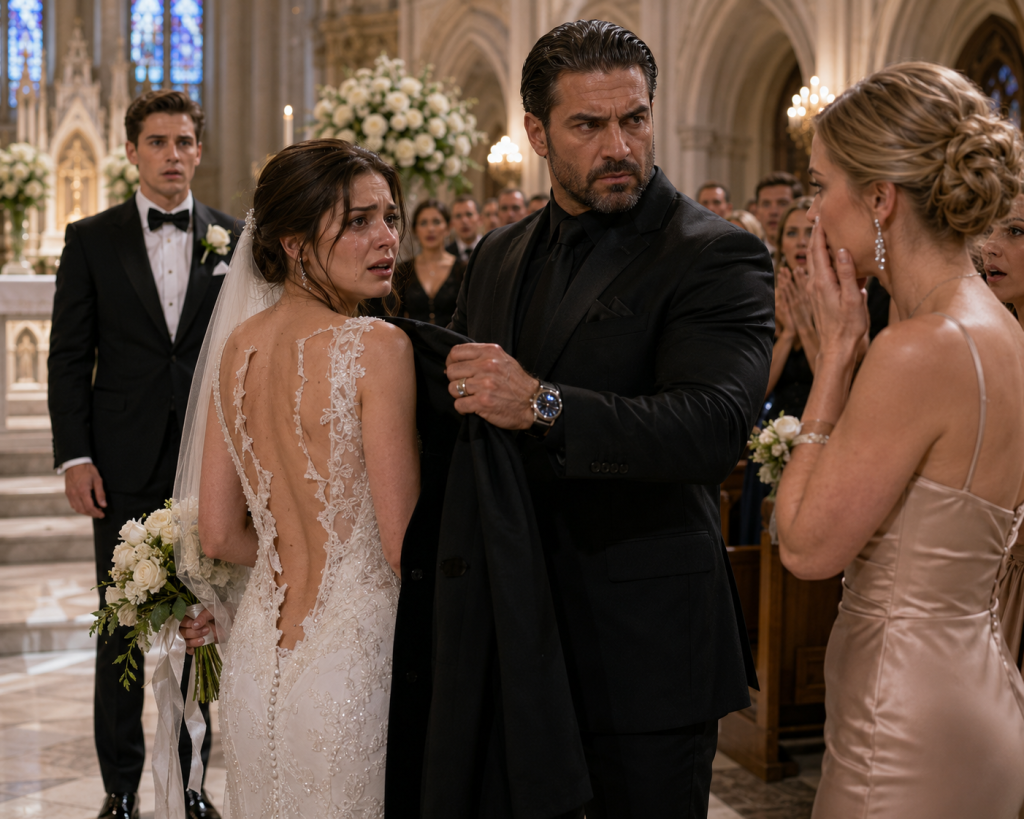
The question hung beneath the vaulted ceiling, colder than the winter light pressing against the cathedral windows. Candle flames trembled in their glass holders. Somewhere near the back, a child shifted and was immediately hushed. I could hear my own breathing, quick and uneven, beneath the weight of Dante Moretti’s coat.
“Who touched her dress?” he asked again.
He did not raise his voice. He did not need to.
Veronica’s fingers tightened around her bouquet until the white ribbon creased beneath her nails. Beside her, the other bridesmaids exchanged nervous glances. Only minutes ago, they had looked pleased, almost giddy, as if my humiliation were an amusing accident. Now they looked like children who had knocked over a priceless vase and suddenly realized an adult had seen everything.
Nathan finally moved.
Not toward me.
Toward Dante.
“Dante,” he said, his voice low and strained, “this is a private family matter.”
I turned to him slowly.
A private family matter.
The words struck harder than the laughter had. My dress had been ruined in front of hundreds of people. I had stood trembling beneath a cathedral ceiling, waiting for the man who claimed to love me to protect my dignity, and he had watched as if I were a problem he hoped would solve itself.
Dante glanced at Nathan, and for a moment the air seemed to sharpen.
“A bride standing exposed in front of a full church is not a family matter,” Dante said. “It is a failure of everyone who saw and did nothing.”
Nathan’s jaw clenched. His mother, Evelyn Whitmore, rose halfway from the front pew, diamonds flashing at her throat.
“This is highly inappropriate,” she said.
Dante turned his head just slightly. “I agree.”
Evelyn’s mouth closed.
I looked down at the bouquet in my hands. White roses. Baby’s breath. Silk ribbon. They suddenly felt absurd, something meant for a different woman in a different life.
My fingers were still shaking.
Dante noticed.
“Do you want to continue?” he asked me quietly.
The question was simple. Almost gentle.
No one had asked me that all day.
Not when Evelyn’s assistant changed the seating arrangement because my aunt from Queens did not belong near the Whitmore investors. Not when Veronica insisted on “helping” me into my gown though I had not asked for help. Not when Nathan avoided my eyes after his father pulled him aside in the vestry. Not when the back of my dress tore open and the cathedral filled with whispers.
Do you want to continue?
I looked toward the altar.
Nathan stood where my future had been waiting for me, handsome and distant and deeply uncomfortable. The carved angels above him seemed to watch with blank, stone pity. He took one step forward, then stopped again when his mother’s hand touched his sleeve.
That small movement told me everything.
I had spent two years making excuses for Nathan Whitmore.
He was busy. He was under pressure. He loved me in private, where no one could question why a man from one of Manhattan’s oldest families wanted to marry a woman who made wedding dresses in a narrow shop above a bakery. He loved me when we ate takeout on the floor of my apartment, when he loosened his tie and laughed at my stories, when he said I was the only person who saw him as himself and not as a Whitmore.
But love that only stood upright in private could not carry a marriage.
“I don’t know,” I whispered.
Dante nodded once, as though that answer deserved as much respect as any other.
Then he turned to the priest. “Father, is there somewhere Mrs. Whitmore-to-be can have a moment?”
The priest, who looked as though he wished the marble floor would open and spare him from managing Manhattan’s wealthiest families, nodded quickly. “The sacristy. Through that side door.”
“I’ll take her,” Veronica said suddenly.
The room stilled again.
Her voice was bright, but too bright, like a glass about to crack. She stepped forward, concern arranged carefully across her face.
“Lena, sweetheart, come with me. We can fix this. It’s only a seam.”
Only a seam.
I stared at her.
Dante stepped between us before I could move. “No.”
Veronica blinked. “Excuse me?”
“She goes with someone she trusts.”
A bitter laugh almost escaped me. Someone I trusted. In that cathedral, surrounded by Nathan’s family, his friends, his world, I could not think of a single person who fit those words.
Then a woman rose from the third pew on the bride’s side.
My sister, Mara.
She had arrived late because her train from Boston had been delayed. I had barely seen her before the ceremony, only enough to receive a hurried kiss on the cheek and the scent of peppermint from the gum she always chewed when anxious. She stood now in a forest-green dress, her dark hair pinned messily at the back of her head, her eyes bright with fury and concern.
“I’ll go with her,” she said.
Relief moved through me so quickly my knees nearly gave way.
Dante shifted aside, allowing Mara to reach me. She came straight to me, took the bouquet from my trembling hands, and replaced it with her own steady fingers.
“Come on,” she murmured. “Breathe, Len.”
The sound of my childhood nickname almost undid me.
Mara wrapped one arm around my waist, careful of the torn gown beneath Dante’s coat, and guided me toward the side door. I kept my eyes on the marble floor. I could feel every gaze following me, but the coat shielded me, and Mara’s hand kept me upright.
Just before we reached the door, Nathan called my name.
“Lena.”
I stopped.
For one foolish, fragile moment, I hoped he would say something that could change everything. That he was sorry. That he should have come to me. That he did not care what anyone thought. That he would walk out with me, away from all of this.
Instead, he said, “Let’s not make a scene.”
The words settled like ash.
Mara’s hand tightened on mine.
I did not turn around.
“The scene already happened,” I said, and my voice, though quiet, carried. “You just missed your chance to stand in it with me.”
Then I walked through the side door and let it close behind me.
The sacristy smelled of beeswax, old wood, and lilies. Heavy cabinets lined one wall, their polished doors reflecting the dim light. A small crucifix hung above a table stacked with folded linens. The room was narrow, quiet, and mercifully empty.
The moment the door closed, my strength left me.
Mara caught me before I sank to the floor.
“Hey,” she said, lowering me into a wooden chair. “Look at me. You’re safe. You’re covered. It’s over.”
“It’s not over,” I whispered.
“No,” she admitted. “But that part is.”
I pressed my hands to my face. Dante’s coat slipped slightly around my shoulders, and Mara tugged it back into place with surprising tenderness.
“I should have known,” I said. “Veronica hated me from the beginning.”
“Veronica hates anyone who enters a room and doesn’t immediately ask for her approval.”
A shaky laugh escaped me, then turned into something perilously close to a sob.
Mara knelt in front of me. “Did you see her do it?”
“No. But she was behind me in the bridal suite. She said there was a loose thread.”
Mara’s face hardened. “With scissors?”
“I didn’t see.”
“Of course you didn’t. You were busy trying not to faint because five women were telling you your lipstick was too warm and your hair was too simple.”
I looked at her. “You noticed?”
“I noticed everything. I was late, not blind.”
A soft knock sounded.
Mara stood instantly, placing herself between me and the door. “Who is it?”
“Dante.”
Mara glanced at me.
I nodded, though I did not know why. Perhaps because he had done the one thing everyone else should have done without being asked.
Mara opened the door only halfway.
Dante stood outside with his hands visible at his sides, his expression unreadable. Beyond him, the hallway was empty.
“I’m not coming in unless she says I may,” he said.
Mara looked over her shoulder.
“It’s okay,” I said.
He entered but remained near the door, giving the small room as much space as possible. Without his coat, his black suit jacket looked severe, and the white shirt beneath it only made him seem more imposing. Yet his eyes were not hard when they found mine.
“I asked the priest to keep everyone seated for a few minutes,” he said. “Your fiancé is speaking with his mother.”
Of course he was.
Mara let out a quiet, humorless sound. “That tracks.”
Dante’s gaze shifted to her. “You’re her sister?”
“Mara,” she said.
“Dante Moretti.”
“I know.”
“Most people do,” he said, without pride.
I looked down. The torn gown gaped beneath the coat. My careful stitches, my beadwork, my hidden seams—weeks of labor undone in one small, cruel act.
“I made this dress,” I said, mostly to myself.
Dante’s expression changed.
Only slightly, but I saw it. Not pity. Not surprise. Something more attentive.
“You made it yourself?”
I nodded. “I own a small bridal studio. I thought…” I swallowed. “I thought if I walked into this cathedral looking perfect, nobody would be able to say I didn’t belong here.”
Mara’s eyes softened.
Dante was quiet for a moment. Then he said, “People who need you to prove you belong have already decided you don’t. The dress was never the problem.”
I looked at him sharply.
The words were too honest for the day, and perhaps too true.
Before I could respond, another knock came at the door. Not soft this time. Impatient.
Mara opened it.
Nathan stood there, pale and rigid. His mother hovered behind him, her mouth pressed into a thin line. Veronica stood farther back, arms crossed, her face arranged in a wounded expression that might have fooled me once.
“Lena,” Nathan said. “Can we talk?”
Mara did not move from the doorway. “She’s been waiting for you to talk since the aisle.”
Nathan flinched. “This is between me and my bride.”
“Bride?” Mara repeated. “Interesting word choice.”
I stood slowly. Dante moved as though to help, then stopped himself, leaving the choice to me. I appreciated that more than I wanted to.
“I’ll talk to Nathan,” I said.
Mara hesitated. “Len—”
“It’s all right.”
Dante opened the door wider but stepped outside, placing himself in the hallway near enough to be present and far enough to give privacy. Mara remained just inside the room, refusing to leave entirely. I did not ask her to.
Nathan entered and looked at the floor before he looked at me.
“I’m sorry,” he said.
The words were there. At last.
But they arrived tired and late, like guests who had missed the ceremony.
“For the dress?” I asked. “Or for not moving?”
His mouth tightened. “I froze.”
“Why?”
“Because everyone was staring.”
“At me,” I said.
“I know.”
“No, Nathan. They were staring at me. And you stood there worrying about what they would think of you.”
He closed his eyes briefly. “That’s not fair.”
“It’s true.”
His face changed then. The polished calm he wore in boardrooms and charity galas slipped, revealing the man I knew from my apartment floor, the man who held paper cartons of noodles and admitted he hated half the life he was expected to live.
“My mother told me this morning that if anything went wrong, I needed to keep my composure,” he said. “That there would be journalists, donors, family friends—”
“This morning?” I interrupted.
He looked at me.
“What else did your mother say this morning?”
Nathan’s silence answered before he did.
Mara crossed her arms. “Oh, this should be good.”
“Nathan,” I said.
He exhaled slowly. “She said there were concerns.”
“About what?”
“About you.”
The room seemed to narrow.
“My background?” I asked.
He winced.
“My family? My shop? The fact that I don’t have a trust fund or a summer house in Maine?”
“It wasn’t like that.”
“It has always been like that.”
He rubbed a hand over his face. “She said someone had brought information to her. About your father.”
My breath caught.
Mara went still.
My father had been dead for eleven years, but his name still had the power to open old rooms inside me. He had been a quiet man who repaired clocks, who smelled of metal polish and coffee, who used to press his ear to antique watches and tell me every broken thing had a rhythm if you listened long enough. His death had been sudden, a heart attack in his workshop, though Mara had always insisted he looked frightened the week before he died.
“What information?” I asked.
Nathan glanced at Mara, then back at me. “She said your father owed money to dangerous people. That there may have been connections to fraud. She didn’t want scandal attached to the family.”
For a moment, I could not speak.
Then Mara laughed, but there was no humor in it. “That’s convenient.”
Nathan frowned. “What?”
“Our father barely remembered to charge people full price for repairs,” she said. “He once fixed a neighbor’s grandfather clock for a tray of lasagna. Fraud?”
“I’m telling you what she said.”
“Did you believe it?” I asked.
Nathan looked trapped.
That was answer enough.
A strange calm settled over me. It was not peace. It was the stillness that comes when something inside finally stops begging to be chosen.
“You knew this before the ceremony,” I said.
“I didn’t know what to think.”
“So you chose to think nothing until it became impossible.”
He took a step toward me. “Lena, I love you.”
I wanted those words to hurt more. I wanted them to open me. Instead, they brushed against a door that had already closed.
“Love should make a person braver,” I said. “Not smaller.”
His face crumpled slightly.
Behind him, Evelyn Whitmore appeared in the doorway, no longer willing to wait.
“This has gone far enough,” she said. “Lena, darling, I am deeply sorry for what happened to your gown, but we cannot allow one unfortunate incident to derail an entire wedding. The guests are waiting.”
I stared at her.
“An unfortunate incident?”
“Yes,” she said, with the careful patience of someone explaining etiquette to a servant. “A humiliating one, certainly, but these things can be managed.”
“These things?” Mara said.
Evelyn ignored her. “We can have someone pin the dress. Perhaps a shawl. You will walk carefully. The photographer can avoid certain angles.”
I almost laughed.
Not because it was funny.
Because the woman truly believed the problem was the angle.
Dante’s voice came from behind her. “Mrs. Whitmore.”
Evelyn stiffened but did not turn.
He stood in the hallway, his gaze fixed on her with unnerving calm. “The bride asked who touched her dress.”
“No,” Evelyn said coolly. “You asked that.”
“I did. She deserves the answer.”
Veronica stepped forward. “This is ridiculous. No one touched her dress. It probably tore because the fabric was cheap.”
Mara moved so fast I nearly grabbed her, but she stopped herself, breathing hard.
I looked at Veronica.
Her face was flushed now, and beneath the insult, I saw something else. Fear. Not of Dante exactly. Not even of me. Fear that whatever she had planned was beginning to slip out of her control.
“The fabric came from Maison Arquette,” I said quietly. “French silk satin. You told me you loved it when you helped me unpack it.”
Veronica’s eyes flickered.
Evelyn turned toward her. “Veronica.”
“What?” Veronica said. “I did. That doesn’t mean anything.”
Dante looked down at her hands. “Where are your gloves?”
She blinked. “My what?”
“You wore gloves when you arrived. White satin. I saw them on your hands when you greeted Mrs. Whitmore.”
A silence followed.
Veronica’s mouth opened, then closed.
“I took them off,” she said. “Obviously.”
“Where?”
“I don’t remember.”
Mara looked at me.
The bridal suite.
I remembered Veronica wearing gloves. Everyone had complimented them. Vintage, she had said. Delicate. Something borrowed.
Something to keep fingerprints off scissors.
A sick certainty moved through me.
“I want to go to the bridal suite,” I said.
Nathan frowned. “Lena, now?”
“Yes. Now.”
Evelyn’s face sharpened. “Absolutely not. We are not turning this ceremony into an investigation.”
“It already is one,” Mara said.
Dante stepped aside, clearing the hallway. “I’ll escort you.”
Evelyn’s eyes flashed. “You will do no such thing. This is not your concern.”
Dante looked at me, not at her. “Is it?”
I met his gaze.
I did not know him. Not really. He had been a name at dinner parties, a shadow in articles, a man people lowered their voices around. But in that moment, he was the only person besides Mara who had asked what I wanted and waited for the answer.
“Yes,” I said. “For now.”
Something unreadable crossed his face. Then he nodded.
We walked through the side hallway in a strange procession: me wrapped in Dante’s coat, Mara carrying the ruined train of my gown, Dante a few steps ahead, Nathan behind me, and Evelyn and Veronica following because pride would not allow them to be left out.
The bridal suite was in the old rectory wing, a room with tall windows, faded wallpaper, and an antique mirror cloudy with age. When we entered, the room still carried the perfume and powder of the morning. Champagne glasses stood on a side table. A tray of untouched strawberries sagged beneath melting sugar. My garment bag lay open on the chaise.
The room looked exactly as we had left it.
Almost.
Mara went straight to the vanity. “Where were you standing?”
I pointed to the center of the room. “Here. Veronica was behind me.”
Dante remained near the door. He did not search through drawers or touch anything. His restraint made everyone else’s agitation more obvious.
Nathan stood by the window, his face drawn.
Veronica hovered near the chaise. “This is humiliating.”
I looked at her. “Yes. It is.”
She flushed.
Mara crouched near the dressing screen. “Len.”
I moved toward her.
Behind the carved wooden foot of the screen, half-hidden beneath a fold of discarded tissue paper, lay a pair of white satin gloves.
Veronica went pale.
Mara picked them up carefully with two fingers. A tiny smear of darker thread clung to one cuff.
My thread.
I knew it instantly. Not white. Pearl ivory, imported from Italy because I had been ridiculous enough to care about the undertone matching the lace.
“There,” Mara said softly.
Veronica gave a breathless laugh. “Those could belong to anyone.”
“They’re monogrammed,” Dante said.
Everyone looked.
Mara turned the cuff over.
V.H.
Veronica’s shoulders stiffened. Then she lifted her chin, gathering herself. “Fine. They’re mine. I must have dropped them.”
“Near the dressing screen?” I asked.
“I don’t know.”
Dante’s attention moved to the sewing table in the corner. It was the table I had used for last-minute adjustments. My emergency kit lay open, needles tucked into felt, pins in a velvet cushion, thread spools arranged by shade.
And one empty space.
My embroidery scissors were missing.
They were small, gold-handled, shaped like a crane. My father had given them to me when I was sixteen after I altered my first dress for a paying customer. I had carried them for years.
My throat tightened. “My scissors.”
Mara looked up. “What?”
“They’re gone.”
Nathan stepped closer. “Could you have misplaced them?”
I turned to him with such disbelief that he looked away.
Evelyn spoke sharply. “This is becoming absurd. Gloves on the floor do not prove—”
A small metallic sound interrupted her.
It came from Veronica’s bouquet.
Everyone turned.
The champagne roses in her hand had shifted, loosened by the pressure of her fingers. Something gold flashed between the stems and fell to the carpet.
My scissors landed open at her feet.
No one breathed.
Veronica stared at them as though they had betrayed her.
Mara’s voice went cold. “Still absurd?”
Veronica looked at Nathan first.
Not Evelyn.
Nathan.
And in that glance, quick and desperate, something passed between them that I did not understand.
My stomach dropped.
“Nathan?” I said.
He did not answer.
Veronica bent quickly, reaching for the scissors, but Dante’s voice stopped her.
“Leave them.”
She froze.
His tone was not loud, but it carried the same quiet authority that had silenced the cathedral.
Veronica straightened slowly. Her face had lost all color. “I didn’t mean for it to go that far.”
The confession entered the room softly.
It was almost worse than denial.
Mara closed her eyes briefly, as if restraining herself.
I stared at Veronica. “How far did you mean for it to go?”
Veronica swallowed. “I only wanted the seam to loosen a little. Enough for a delay. Enough for…” She looked toward Evelyn, then away.
“Enough for what?” I asked.
Nathan spoke before she could. “Lena, let’s discuss this privately.”
The old reflex in me almost obeyed. For two years, I had let Nathan decide when things should be private. Private meant quieter. Private meant later. Private meant never in front of his mother. Private meant swallowing questions until they dissolved into apologies I had never owed.
“No,” I said. “We discuss it now.”
Evelyn’s face had gone marble-still.
Veronica’s eyes filled with tears. Whether they were real, I could not tell. “They told me the wedding needed to be paused.”
“They?” Mara demanded.
Veronica looked at Nathan again.
This time, he looked back.
A silence opened between them, and suddenly I saw things I had ignored because trusting Nathan had been easier than examining the shadows around him.
Veronica was not just a bridesmaid. She was Evelyn’s goddaughter. Nathan’s childhood friend. The woman everyone had assumed he would marry before he brought me to a Whitmore gala in a navy dress I had made myself and announced I was the one.
Veronica had smiled that night too.
Sweetly.
With teeth.
“They told you?” I repeated. “Who?”
Nathan said my name, pleading now. “Lena.”
I stepped back.
Dante’s coat shifted around my shoulders, heavy and warm, reminding me that someone else had covered what Nathan allowed to be exposed.
“Did you know?” I asked him.
“No,” he said quickly.
But the word came too quickly.
“Did you know she was going to damage my dress?”
“No.”
“Did you know your mother wanted the ceremony delayed?”
He looked at Evelyn.
There it was again. That pause. That thread pulling him toward obedience.
“I knew she had concerns,” he said.
Mara let out a breath. “That’s Whitmore for yes.”
Evelyn’s composure cracked at last. “Enough. I will not be spoken to like this by people who have no understanding of what is at stake.”
“At stake?” I asked.
She turned to me, eyes bright and cold. “You have no idea what marrying into this family means. You think love is enough because you have never had anything to lose.”
The words hit their mark. She knew they would.
For a second, I saw my mother crying at the kitchen table after my father died. I saw overdue bills stacked beside cereal bowls. I saw Mara packing textbooks into a canvas bag because she had won a scholarship and still felt guilty for leaving me behind. I saw myself at twenty-one, taking hems and alterations until midnight because rent did not care about grief.
I had lost plenty.
But I had also built plenty.
“My life is not empty just because you don’t value what’s in it,” I said.
Evelyn’s expression faltered, not with remorse, but with surprise that I had answered at all.
Dante’s eyes moved to me briefly. Approval did not show on his face, but something warmer did.
Nathan stepped forward. “Mom, stop.”
The word sounded small. Too late, but not meaningless.
Evelyn looked at her son with a mixture of anger and disappointment. “You don’t understand.”
“I understand that you brought some story about her father to me on our wedding day.”
“It was not a story.”
Mara’s head lifted. “What does that mean?”
Evelyn hesitated.
For the first time since I had known her, Evelyn Whitmore seemed uncertain.
Dante noticed too. His gaze sharpened.
“What did you hear about her father?” he asked.
Evelyn looked at him. “This does not concern you.”
“Perhaps not,” he said. “But I’m curious now.”
The way he said it changed the room. Not threatening. Not dramatic. Simply interested, which somehow unsettled Evelyn more than anger would have.
She drew herself upright. “Years ago, Lena’s father was involved with a man named Gabriel Ross.”
Mara frowned. “Who?”
Dante went very still.
I saw it.
So did Evelyn.
Her eyes narrowed slightly, as if she had not meant to reveal quite that much.
“Dante?” I asked.
He did not answer immediately.
The name had done something to him. It had pulled a curtain behind his eyes.
“Gabriel Ross has been dead for years,” he said.
Evelyn’s mouth tightened. “Then you know of him.”
“I knew him.”
The admission changed everything again.
The room seemed smaller now, the air threaded with histories none of us had brought to the wedding but all of us had somehow carried there.
“My father fixed clocks,” I said. “He didn’t know people like that.”
Dante looked at me. His voice softened. “Maybe he did.”
My heart began to pound.
Mara stepped closer to me. “No. Dad wasn’t involved in anything dangerous.”
Dante did not argue. “I didn’t say dangerous.”
“Then what are you saying?”
He looked at the scissors on the floor, then at the torn gown beneath his coat. “I’m saying this may not have started with the dress.”
Nathan looked between us. “What does that mean?”
But Dante was watching Evelyn.
And Evelyn was watching Dante with the expression of someone realizing she had opened the wrong locked door.
Veronica suddenly wiped her cheeks. “I didn’t know anything about her father. I swear. Evelyn said there might be a legal issue. She said if the ceremony was delayed, Nathan would have time to decide. She said no one would get hurt.”
My laugh came out broken. “No one?”
“I didn’t think the dress would tear like that,” Veronica whispered. “I cut one inner seam. Just one. I thought it would loosen before you walked out.”
“You thought I would be embarrassed privately instead of publicly,” I said.
She looked down.
“That was supposed to be better?”
“I was angry,” Veronica said, her voice cracking. “Everyone knew Nathan was supposed to marry someone like me.”
Nathan stared at her. “Veronica.”
She turned on him, tears bright now with something sharper than guilt. “Don’t. You knew. Maybe not about the dress, but you knew your mother wanted out. You knew I still loved you. You let all of us orbit around this wedding while you pretended you were strong enough to choose her.”
His face went white.
I looked at him, waiting for him to deny it.
He did not.
Something inside me finally became quiet.
Not numb. Clear.
I bent and picked up my scissors.
No one stopped me.
The gold handles were warm from the carpet, the blades still parted. A tiny piece of pearl thread clung to the tip. I closed them carefully and held them in my palm.
“My father gave me these,” I said. “He told me never to use a sharp thing carelessly, because cutting is easier than mending.”
My eyes lifted to Veronica.
“You cut my dress because you were angry. Evelyn let you because she was afraid of scandal. Nathan stayed still because he was afraid of choosing. Every one of you made a decision, and somehow I was the one left standing in the aisle ashamed.”
Nathan’s eyes shone. “Lena, please.”
I looked at him for a long moment.
I remembered the first time we met. He had come into my studio with a torn sleeve after catching it on a cab door, apologizing as if the jacket had feelings. He had made me laugh. He had looked at my sketches with genuine wonder. He had returned two days later with coffee, then again with lunch, then again with no excuse at all.
That man had been real.
But so was this one.
“I loved you,” I said.
He swallowed. “Loved?”
The single word trembled.
I did not answer directly.
Instead, I removed the engagement ring from my finger.
The diamond caught the weak afternoon light, throwing a small, bright fracture across the wall. Evelyn’s eyes flicked to it automatically, as though even now she could calculate its worth.
I placed it on the vanity.
“I’m not walking back down that aisle to marry a man who had to be reminded I was a person before I was a problem.”
Nathan looked as if I had struck him.
Mara’s shoulders lowered, the first sign of relief she had shown all day.
Evelyn stepped forward. “You need to think carefully. A broken engagement of this visibility will not be simple for you.”
Dante spoke before I could. “She has thought carefully.”
Evelyn turned on him. “You have interfered enough.”
“I disagree.”
“This family has endured far worse than gossip, Mr. Moretti.”
His gaze did not move. “Then you’ll endure this.”
The simplicity of it left Evelyn without a response.
For a moment, no one knew what to do next. The wedding waited beyond the walls. Hundreds of guests sat beneath white roses, wondering whether tragedy, scandal, or some revised ceremony would emerge from the old rectory wing. My life had split along with the back of my gown, and there was no seamstress in the world who could make it look untouched.
But standing there in Dante’s coat, holding my father’s scissors, I realized I did not want untouched.
I wanted true.
“I’m going home,” I said.
Mara nodded immediately. “Good.”
Nathan stepped toward me. “Please let me drive you.”
“No.”
“I need to talk to you.”
“You had the aisle.”
He stopped.
The words were not cruel. They were final.
Dante opened the door. “There’s a side exit through the garden.”
Evelyn gave a sharp laugh. “Of course you know that.”
He looked at her. “I make a habit of knowing exits.”
Mara snorted despite herself, then quickly covered it with a cough.
I almost smiled. Almost.
We left Nathan, Evelyn, and Veronica in the bridal suite with the abandoned ring glittering on the vanity between them like a verdict.
The corridor to the garden was narrow and cold. My ruined gown whispered against the stone floor. Mara walked beside me, still holding the train, though there was no need now to keep it pristine. Dante went ahead, speaking quietly to a staff member who appeared around a corner and then vanished without question.
Outside, the winter air struck my face.
The cathedral garden was small and enclosed, boxed in by stone walls and bare-limbed trees. Snow had fallen lightly the night before, dusting the hedges and the iron benches. Beyond the gate, Manhattan moved as if nothing had happened. Horns sounded. A bus sighed at the curb. Somewhere nearby, a street vendor called out to passersby.
Life, indifferent and enormous, continued.
I stepped onto the path and finally began to cry.
Not beautifully. Not softly. I cried the way grief really comes when pride has run out, with one hand pressed to my mouth and my shoulders shaking under a coat that did not belong to me.
Mara wrapped both arms around me.
“I’ve got you,” she whispered. “I’ve got you.”
For a long time, I let her.
Dante stood near the gate, facing away, giving me the dignity of not being watched. That small courtesy made my tears come harder.
When I could breathe again, Mara helped me sit on a bench. She crouched before me, gathering the torn edges of the gown and examining them with a professional seriousness that made me want to laugh and cry at once.
“You could fix it,” she said.
I wiped my face. “Mara.”
“I don’t mean for him. I mean for you. Not today. Maybe never. I’m just saying she didn’t destroy it completely.”
I looked down at the ruined satin. The cut was ugly, but clean. A seam could be rebuilt. Lace could be layered. The back could be redesigned into something different. Not the same, but perhaps stronger in places.
“Maybe,” I said.
Dante approached then, carefully. “My car is around the corner. It can take you wherever you want to go.”
Mara looked ready to object on principle.
I looked at him. “Why are you doing this?”
He seemed to expect the question.
“My mother was a seamstress,” he said.
That was not what I had expected.
“She made evening gowns in a basement shop in Brooklyn. Women with names like Whitmore came in and spoke to her like she was furniture. She smiled anyway, because rent was due and pride didn’t pay invoices.” He glanced at the torn dress. “Once, a client accused her of ruining a gown the woman had damaged herself. My mother apologized for something she didn’t do. I was twelve. I never forgot what her face looked like.”
The garden was quiet around us.
“She would have liked your dress,” he added.
The words entered gently, bypassing every defense I had left.
“Thank you,” I said.
He nodded.
Mara stood. “Where exactly is this car?”
“Parked near the clergy entrance.”
“And the driver?”
“Has worked for me for fifteen years and knows when not to ask questions.”
Mara studied him for a moment. “Fine. But I’m riding with her.”
“I assumed you were.”
We moved toward the gate.
Just before Dante opened it, a voice called from behind us.
“Lena.”
Nathan stood at the garden door, coatless in the cold. He looked younger somehow, stripped of the altar, the tuxedo, the family gaze. For the first time all day, he appeared not like a Whitmore heir, but like a man who had lost something because he had not held it when it mattered.
Mara muttered, “Unbelievable.”
I touched her arm. “It’s okay.”
Nathan came down the path slowly, stopping several feet away.
“I know you don’t owe me anything,” he said.
“You’re right.”
He flinched but nodded. “I should have come to you. I should have walked down that aisle the second I saw your face change. I should have told my mother no weeks ago. Months ago.” He looked at the ground. “Maybe years ago.”
The honesty hurt more than excuses would have.
“I don’t know how to be separate from them,” he said. “That isn’t your fault. And it shouldn’t have become your burden.”
My fingers curled around the closed scissors in my hand.
“I wanted you to choose me,” I said.
“I did.”
“No,” I said softly. “You wanted choosing me to be easy.”
His eyes filled.
He nodded once, as if accepting a sentence he had earned.
“I found something,” he said.
Dante’s posture changed almost imperceptibly.
Nathan reached into his jacket and removed a folded envelope. “After you left the bridal suite, my mother told Veronica to destroy this. I took it.”
Evelyn appeared in the doorway behind him. “Nathan.”
Her voice was sharp with panic.
Real panic.
Not social discomfort. Not anger.
Fear.
Nathan did not look back.
He held the envelope out to me.
My name was written on the front in unfamiliar black ink.
Lena Hart.
Not Lena Whitmore.
My hand trembled as I took it.
The envelope was old, the paper thick and yellowed at the edges. It had been sealed once with wax, then opened and resealed poorly. In the lower corner was a symbol pressed faintly into the paper: a small clock face surrounded by laurel leaves.
Mara inhaled sharply.
“What?” I asked.
She pointed. “That mark. Dad had it on the inside of his workbench.”
The garden seemed to fall silent.
Dante stared at the symbol.
“What is it?” I asked him.
For a moment, he did not answer.
Then he said, “It belonged to Gabriel Ross.”
Evelyn stepped into the snow-dusted garden, her composure finally gone. “Give that to me.”
No one moved.
Nathan turned to face his mother. “What is in it?”
Evelyn’s eyes flashed with something desperate. “Something that should have stayed buried.”
My heart beat so loudly I could barely hear the traffic beyond the wall.
I slid one finger beneath the loosened seal and opened the envelope.
Inside was a single photograph.
It was faded, creased down the middle, and taken in front of a workshop I recognized immediately.
My father’s shop.
He stood younger than I remembered him, one hand on the shoulder of a dark-haired man I did not know. Gabriel Ross, perhaps. Beside them was Evelyn Whitmore, elegant even then, her smile tense and careful.
And in her arms, wrapped in a pale blanket, was a baby.
On the back, written in my father’s handwriting, were six words that made the world tilt beneath my feet.
Lena must never know the truth.
END OF PART 2 – LIKE, SHARE AND COMMENT “”THE ENTIRE STORY”” IF YOU WANT TO READ THE FULL STORY