PART 3 — FINAL PART
I did not sleep that night.
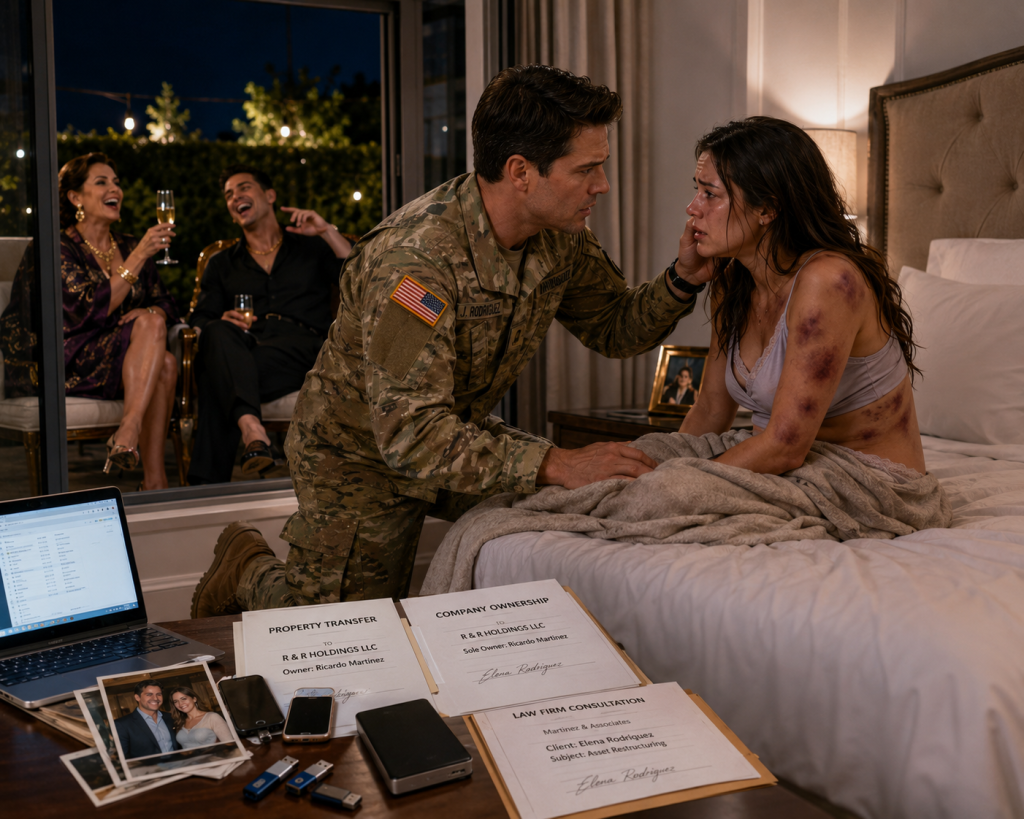
The house around me seemed to breathe in slow, guilty creaks. Every sound felt sharper than it should have—the old wood settling beneath the hallway carpet, the distant murmur of laughter from the garden, the soft, broken rhythm of Elena trying to cry quietly beside me.
I sat on the edge of the bed with my elbows on my knees and my hands locked together, staring at the floorboards as if they might offer a strategy.
In deployment, fear had always announced itself clearly. It came with alarms, dust, orders shouted over radios, the knowledge that danger had a direction and a shape. But this was different. This fear had been waiting inside my own home. It had sat at my table, worn my clothes, touched my wife’s life with threats and signatures and smiles.
Elena shifted under the blanket.
I turned immediately.
She was watching me with eyes that looked too tired for someone her age. There was shame there too, though she had done nothing to deserve it. That hurt more than anything.
“I thought you would hate me,” she whispered.
I moved closer slowly, careful not to startle her. “Elena, look at me.”
Her eyes flickered toward mine.
“I don’t hate you.”
Her lips trembled, but she said nothing.
“I’m angry,” I said, keeping my voice low. “But not at you.”
She closed her eyes as if my words had loosened something inside her. A tear slid down her temple and disappeared into her hair.
“They said you would think I betrayed you,” she said. “Victoria kept saying a good wife would protect the family. Ricardo said if I told anyone, they’d make it look like I stole everything while you were away.”
I felt the old soldier in me rise—the part trained to catalog facts, identify threats, make decisions under pressure. But another part of me, the husband, wanted only to pull her into my arms and undo every moment she had faced alone.
I chose both.
“We’re going to do this properly,” I said. “No shouting. No confrontation tonight. No giving them time to destroy anything.”
Elena opened her eyes. “What can we do? They have papers. Lawyers. Your mother knows people.”
“She doesn’t know all the people I know.”
A faint question crossed her face.
I reached for my phone from the nightstand and scrolled through contacts until I found a name I had not called in months.
Major Daniel Harris.
He had been my commanding officer during the first half of my deployment. Before the military, he had spent seven years as a prosecutor. He had a calm voice, a hard stare, and a personal hatred for people who preyed on the vulnerable.
It was past two in the morning, but he answered on the third ring.
“Morales,” he said, instantly alert. “You home?”
“Yes, sir.”
Something in my silence must have reached him.
“What happened?”
I looked at Elena, who watched me with fragile hope.
“I need advice,” I said. “Legal advice. And I need to know who I can trust.”
By sunrise, the plan had taken shape.
Major Harris could not represent us directly, but by six-thirty he had sent the number of an attorney named Nora Whitcomb, a former military legal advocate who specialized in fraud and coercion cases involving service members’ families. He also told me something that became the first small light in the darkness.
“Do not confront them,” he had said. “Do not accuse them where they can hear you. Secure copies of everything. Photograph injuries. Save messages. Record your own timeline. And most importantly, get your wife somewhere safe before they realize you know.”
The phrase somewhere safe felt impossible inside a house that had once been mine.
Elena slept for less than an hour before waking with a gasp. I was at the desk, organizing files onto an encrypted drive.
“It’s all right,” I said quickly. “I’m here.”
She sat up, clutching the blanket. Her eyes moved to the closed bedroom door.
“They usually come in around breakfast,” she said.
My hand stilled over the keyboard. “They come into our bedroom?”
Her silence answered me.
A quiet, clean anger passed through me—not the kind that burns everything in its path, but the kind that sharpens into purpose.
“Not today.”
At eight, a knock landed on the bedroom door.
Not polite. Not hesitant.
A command disguised as a courtesy.
“Elena?” Victoria called. “Breakfast is getting cold. Ricardo has an appointment and needs you downstairs.”
Elena’s hands twisted in the blanket.
I stood and opened the door before she could answer.
My mother stood there in a silk blouse the color of pearl, her hair arranged perfectly, a cup of coffee in her hand. She looked past me toward Elena with the casual entitlement of someone inspecting property.
Then her eyes returned to mine.
“You’re up early,” she said.
“So are you.”
Her smile came smoothly. “I wanted to make sure Elena wasn’t upsetting herself again.”
Behind her, Ricardo leaned against the hallway wall in my leather jacket, scrolling on his phone.
“Morning, hero,” he said without looking up.
I studied them both.
The night before, I had imagined a dozen versions of this moment. In some of them, I shouted. In others, I dragged the truth into the hallway and made them face what they had done.
But Elena was behind me, still shaking.
So I smiled faintly.
“We’ll be down in a minute,” I said.
Victoria’s expression shifted, almost imperceptibly. She had expected confusion from me, maybe emotional exhaustion. She had not expected calm.
“Of course,” she said. “Take your time.”
Ricardo pushed off the wall. “Don’t take too long. Big day.”
I looked at him. “For you?”
He grinned. “For all of us.”
They walked away together, their footsteps fading down the hall.
I closed the door and turned back to Elena.
She was staring at me as if I had just walked across a frozen lake without breaking the ice.
“How did you do that?” she asked.
“Practice.”
Her mouth curved faintly. It was not a smile yet, but it was the memory of one.
That was enough to keep me moving.
At breakfast, the table looked like a scene staged for strangers. Fresh fruit. Toast in a silver rack. A vase of lilies. Victoria had always believed appearances were a kind of weapon. If everything looked elegant enough, people forgot to ask what was rotting underneath.
Elena sat beside me, her hands folded in her lap.
Ricardo poured himself orange juice from the crystal pitcher Elena’s grandmother had given us when we married.
“So,” he said, “now that you’re back, we need to talk about practical matters.”
I buttered a piece of toast. “Practical matters?”
“The business,” Victoria said. “It’s become complicated in your absence.”
“I noticed.”
Elena’s foot brushed mine under the table, a tiny warning.
Victoria lifted her cup. “You were away serving your country. Admirable, of course. But life continued here. Decisions had to be made.”
Ricardo leaned back. “Elena got overwhelmed. She’s not really built for pressure.”
The knife in my hand paused.
Elena lowered her gaze.
I set the knife down carefully.
“She kept the business alive for three years before I deployed,” I said. “She handled suppliers, payroll, client contracts, taxes, and most of the expansion. She’s built for more pressure than most people will ever see.”
The room fell still.
Victoria’s cup stopped halfway to her mouth.
Ricardo’s smile stiffened.
Elena looked at me. For the first time since I had come home, something like color returned to her face.
“I didn’t mean—” Ricardo began.
“Yes,” I said evenly. “You did.”
Victoria placed her cup down with a soft clink. “There’s no need to be sensitive. We’re family.”
The word landed on the table like something counterfeit.
I nodded once. “Family should be careful with each other.”
Breakfast ended soon after.
By ten o’clock, I had called Nora Whitcomb. By ten-thirty, she had already asked us to come to her office. The only question was how to get Elena out without alarming Victoria and Ricardo.
Unexpectedly, the answer came from someone I had almost forgotten.
At eleven, the doorbell rang.
Victoria frowned from the sitting room. “Are we expecting someone?”
Ricardo looked up from the couch.
I opened the front door.
A woman in her sixties stood on the porch wearing a navy cardigan and carrying a covered dish. Her gray hair was pinned loosely at the back of her head, and her eyes were kind but bright in the way of people who noticed everything.
“Mrs. Alvarez,” I said, surprised.
Our neighbor smiled. “I heard you were home.”
She hugged me with the warmth of someone who had known me since I was a boy, then lowered her voice.
“And I need to speak with you.”
I felt the change immediately.
Behind me, Victoria appeared in the hallway.
“Marisol,” she said, her tone sweetened too quickly. “What a surprise.”
Mrs. Alvarez did not look at her. She looked past me, toward the stairs.
“Is Elena here?”
“She’s resting,” Victoria said.
“I’d like to see her.”
Ricardo walked in from the sitting room. “Not a good time.”
Mrs. Alvarez turned to him slowly. “That jacket belongs to his father.”
Silence opened between us.
My father had died twelve years ago. The jacket Ricardo wore had been one of the few things I kept from him, patched at the inner lining, worn soft from years of use. I had bought my own leather jacket later, but that one—my father’s—had stayed in the hall closet.
Ricardo glanced down.
“Just borrowed it,” he muttered.
I stepped closer. “Take it off.”
His eyes flashed. “It’s just a jacket.”
“No,” I said. “It isn’t.”
For a moment, I thought he might argue. Then he peeled it off and tossed it onto a chair.
Mrs. Alvarez watched him with open disappointment.
Victoria gave a brittle laugh. “Everyone is so dramatic today.”
Mrs. Alvarez finally looked at her. “Some things deserve drama.”
The old woman’s presence shifted the house. Victoria could intimidate Elena behind closed doors, but Mrs. Alvarez was not isolated, not frightened, not dependent on anyone in this room.
I took the covered dish from her.
“Elena and I were about to step out,” I said.
Victoria’s head snapped toward me. “Step out where?”
“Doctor,” I answered.
It was not a lie. Nora had already advised medical documentation, and an appointment had been arranged through a clinic that worked with military families.
Victoria’s eyes narrowed. “I’ll come.”
“No,” I said.
A single word. Quiet. Final.
Ricardo stood straighter.
Victoria smiled, but her hands betrayed her. Her fingers tightened against the back of a chair.
“Elena isn’t well enough to go anywhere without support,” she said.
“I’m her husband.”
“And I’m your mother.”
Mrs. Alvarez stepped between us slightly, as if she had been waiting her whole life to stand in that exact place.
“Then you’ll want what is best for them both,” she said.
Victoria said nothing.
Within fifteen minutes, Elena and I were in my truck. Mrs. Alvarez insisted on riding with us.
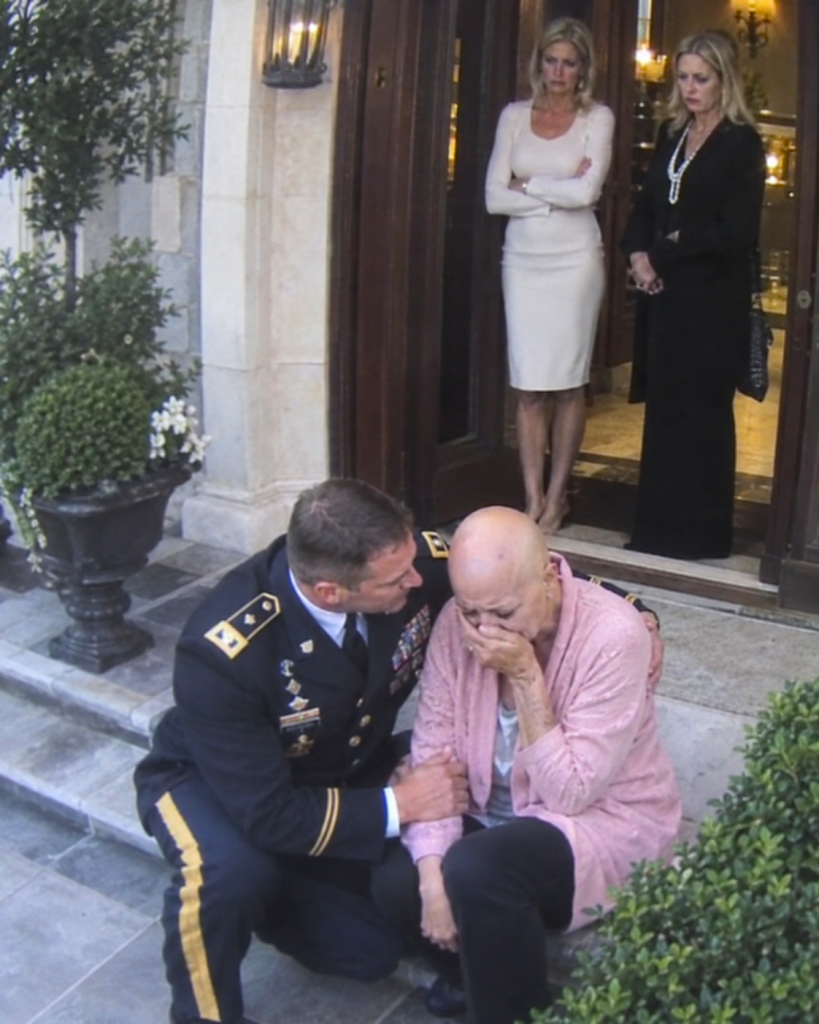
Only when we turned the corner and the house disappeared from view did Elena break down.
She covered her face with both hands. Her shoulders shook silently.
Mrs. Alvarez reached from the back seat and rested a hand gently on her shoulder.
“I tried to tell someone,” Elena whispered. “But I didn’t know how.”
“I know,” Mrs. Alvarez said.
Elena lowered her hands.
The older woman looked at me through the rearview mirror.
“I heard things,” she said quietly. “Not everything. But enough to worry. I saw Ricardo bringing men to the house. I saw your mother taking boxes from your office. I saw Elena in the garden one morning with bruises on her wrist. When I asked, she told me she had fallen.”
Elena’s eyes filled again.
Mrs. Alvarez squeezed her shoulder. “I didn’t believe her. But I also knew fear when I saw it.”
“Why didn’t you call the police?” I asked before I could stop myself.
Her face tightened with grief, not defensiveness.
“I almost did. Twice. But I had no proof, and Elena begged me not to interfere. So I did the next best thing I could think of.”
She reached into her purse and pulled out a small envelope.
“I kept notes.”
At the next red light, she handed it to me.
Inside were handwritten pages dated across six months. Times. Vehicle descriptions. Names she had overheard. Notes about shouting, visitors, moving boxes, and one entry that made my throat tighten.
April 18. Elena crying beside the old lemon tree. Victoria told her: “A signature is easier than a scandal.”
I gripped the steering wheel harder.
Elena read the entry over my shoulder, then turned to Mrs. Alvarez.
“You wrote it all down?”
“I used to be a school secretary,” the older woman said. “Documentation is a habit.”
For the first time, Elena gave a small, broken laugh.
It sounded like a window opening.
Nora Whitcomb’s office occupied the second floor of a brick building downtown. There were no marble floors, no intimidating reception area, no polished performance of importance. Just clean walls, shelves full of case files, and a woman in a charcoal blazer whose expression sharpened with every document we laid before her.
She listened without interrupting.
Then she asked Elena if she wanted a break.
Elena shook her head. Her hands trembled around a paper cup of water, but her voice grew steadier as she spoke.
She told Nora about the first week after I deployed, when Victoria moved in “to help.” She told her about Ricardo arriving soon after, claiming the business needed a man present while I was gone. She told her about the pressure, the isolation, the threats to ruin my career, the forged signatures, the legal papers they pushed across the dining table again and again.
Nora took notes.
Not once did she look shocked.
That steadiness helped Elena keep going.
When Elena finished, Nora sat back.
“What they’re relying on,” she said, “is your fear. Fear makes people quiet. Silence lets paperwork look legitimate.”
She tapped the folder.
“But coercion changes everything. Forgery changes everything. Misuse of powers of attorney, fraudulent transfers, intimidation—these are not family disagreements. These are legal matters.”
I leaned forward. “Can we get everything back?”
Nora met my eyes. “We can fight for that. And based on what I’m seeing, we have a strong start. But the first priority is safety and preservation of evidence.”
Elena looked down. “If they know we came here—”
“They will know soon enough,” Nora said gently. “That’s why we move before they do.”
The next hours passed in a blur of action.
At the clinic, a physician documented Elena’s injuries with quiet professionalism. A counselor sat with her afterward, not pressing, not prying, simply giving her room to breathe. Nora filed emergency motions to freeze the company assets pending investigation. Major Harris connected us with military legal assistance, who confirmed that several documents dated during my deployment bore signatures that could not possibly have been witnessed as claimed.
Then came the first unexpected discovery.
One of the property transfers listed a notary named Celeste Marquez.
Nora frowned when she saw it.
“I know that name,” she said.
“Is that bad?” I asked.
“It’s interesting.”
She pulled another file from her cabinet and flipped through it. Her finger stopped on a page.
“Celeste Marquez lost her notary commission eight months ago.”
Elena stared. “Then how could she notarize those papers?”
“She couldn’t,” Nora said.
The room went very quiet.
Nora looked at me, then at Elena.
“This may unravel faster than they expect.”
But the second discovery was the one none of us saw coming.
Nora asked if we still had access to our business email archive. I did. Ricardo had changed passwords on several accounts, but not all of them. He had overlooked the old administrative email Elena had created years earlier when the business was still operating out of our garage.
While Nora’s assistant searched through archived correspondence, Elena sat beside me in a small conference room, wrapped in a borrowed cardigan. Outside the window, the afternoon sun touched the tops of downtown buildings, turning their glass edges gold.
“I used to love this time of day,” she said.
I looked at her.
“At the shop,” she continued. “Remember? Around five, the light would come through the front window and hit the display shelves. You said it made everything look expensive.”
I smiled faintly. “It did.”
“You made signs by hand because we couldn’t afford printed ones.”
“And you told customers they were artisanal.”
She looked at me then, really looked at me, and for a moment we were not sitting in a lawyer’s office surrounded by evidence. We were younger again, covered in dust and hope, building something nobody else believed in.
Her fingers moved toward mine on the table.
I took her hand carefully.
She did not flinch.
That simple thing nearly undid me.
The door opened.
Nora’s assistant, a young man named Eli, stepped in holding a printed email.
“You need to see this.”
Nora followed him, her expression unreadable.
“What is it?” I asked.
Eli placed the email on the table.
It was from a bank officer to Ricardo. Attached was an internal note about the new company account.
The message itself was short.
Mr. Morales, as discussed with Ms. Victoria Morales, deposits from the transferred business will remain flagged until final ownership verification is complete. Also, the beneficiary designation on the insurance policy cannot be changed without additional confirmation from the service member.
My eyes stopped on one phrase.
“The insurance policy?” I said.
Nora’s gaze sharpened.
Elena looked confused. “What insurance policy?”
I knew immediately.
Before deployment, we had updated my life insurance and survivor benefits. Elena was the primary beneficiary. We had done it together at the kitchen table, joking grimly about paperwork neither of us wanted to think about.
Nora turned to the next page.
There it was.
A request to change beneficiary information.
From Elena to Victoria.
Except Elena had never made that request.
My chair scraped back.
Nora raised a hand gently. “Breathe.”
But my chest felt too tight.
It had not only been about the business. Not only the house. Not only the savings.
They had tried to position themselves to profit if I did not come home.
Elena read the paper and went pale.
“No,” she whispered. “I didn’t sign that. I never saw that.”
“I know,” I said.
But the room had shifted again. The betrayal had found another layer.
Nora’s voice softened. “This is serious. It also gives investigators a much clearer picture of intent.”
Elena pressed her hand to her mouth. “They were planning all of this before he even left.”
Nora looked at the papers. “Maybe.”
That word carried weight.
“Maybe?” I asked.
She hesitated. “There’s something else. The earliest legal consultation we found was scheduled two weeks before your deployment.”
I stared at her.
Before.
Before the goodbye dinner. Before my mother hugged me at the airport with tears in her eyes. Before Ricardo clapped me on the back and told me not to worry about things at home.
Elena turned toward me, stricken. “I didn’t know.”
“I know,” I said again, but this time the words felt like an anchor I was throwing into deep water.
Nora folded the email.
“We are going to give this to the authorities,” she said. “Tonight.”
By the time we returned to the house, it was nearly dusk. We did not go alone. Mrs. Alvarez followed in her car. Two officers waited nearby, not to stage a dramatic raid, but to keep the peace while Elena collected essentials. Nora had advised us to avoid escalation. Evidence, not emotion, would carry the day.
Still, my heart pounded when I opened the front door.
Victoria stood in the foyer.
She had been waiting.
Ricardo stood behind her, phone in hand, his face dark with irritation.
“Where have you been?” Victoria demanded.
I stepped inside but did not move away from the open door.
“Elena is packing a bag,” I said.
Victoria looked past me at Elena, who stood on the porch beside Mrs. Alvarez.
“No,” she said sharply. “She is not.”
Elena flinched, but she did not step back.
I saw the effort it took. Her fingers curled around the strap of her purse. Her chin trembled. Then she lifted it.
“I am,” she said.
One sentence.
Two words.
But the hallway changed.
Ricardo laughed once, ugly and uncertain. “This is ridiculous. You’re letting her manipulate you?”
Elena looked at him.
For months, he had controlled the rooms she moved through. He had turned her fear into obedience. But now, standing in the doorway with the evening light behind her and witnesses within earshot, she seemed to see him clearly for the first time.
“No,” she said quietly. “I’m done letting you do that.”
Victoria’s face hardened. “Careful, Elena.”
Mrs. Alvarez stepped onto the porch. “She is being careful.”
The officers became visible near the walkway.
Ricardo’s posture changed.
Victoria noticed them too. Her voice lowered. “You brought police to your mother’s house?”
“My house,” I said.
Her eyes flashed. “After everything I sacrificed for you?”
The words struck an old bruise in me.
For years, Victoria had told the story of motherhood as if it were a debt I could never repay. She had raised us alone after my father died, yes. She had worked hard, yes. But somewhere along the way, love had become leverage, and gratitude had become a chain.
“I was grateful,” I said. “For a long time, I confused that with permission.”
Her expression flickered.
Maybe it was anger. Maybe surprise.
Maybe, for the first time, she understood I was no longer the boy who apologized for needing things.
Elena moved past us with Mrs. Alvarez at her side.
I stayed in the hallway while she went upstairs. I heard drawers opening, hangers moving, soft footsteps crossing the bedroom floor.
Victoria watched me as if trying to find the old weakness.
“You have no idea what she’s done,” she said.
“I know what she survived.”
Ricardo scoffed. “You always were easy to fool.”
I turned to him.
He had my father’s jaw, my mother’s pride, and none of the tenderness I remembered from childhood. But for one brief second, I saw him at nine years old, chasing me through sprinklers, laughing so hard he fell into the grass. I had loved that boy. Maybe part of me had spent years pretending that boy still existed.
“What happened to you?” I asked.
Ricardo blinked.
The question seemed to land somewhere he had not guarded.
Then his mouth tightened. “I got tired of being second.”
The answer was so small compared to the damage he had caused.
“Second to what?” I asked.
“To you,” he snapped. “The soldier. The responsible one. The son who made everyone proud. Even dead, Dad left you everything that mattered. His jacket. His tools. His stories. I got whatever was left.”
Victoria’s face changed.
“Ricardo,” she warned.
But he was already speaking too quickly.
“You left,” he said to me. “You always leave. And everyone waits for you like you’re some kind of saint. I stayed. I listened to her complain. I watched Elena run that business like she owned the world. And I thought, why not me? Why shouldn’t I have something?”
The house went quiet around his confession—not complete, not legal, not enough by itself, perhaps, but real.
Then Elena appeared at the top of the stairs holding a small suitcase.
She had heard him.
Her face was pale, but her voice did not shake.
“You could have asked for help,” she said.
Ricardo looked up at her.
For once, he had no clever answer.
Victoria did.
“She would have refused,” she said coldly. “You both would have. You were building a life and forgetting the family who raised you.”
I looked at my mother.
There it was. Not need. Not desperation. Resentment wearing the mask of justice.
“We didn’t forget you,” I said. “We invited you to every holiday. We paid off your medical bills. Elena drove you to appointments. We offered Ricardo work three times.”
“And always on your terms,” Victoria said.
“My terms were honesty.”
She looked away first.
Elena came down the stairs. When she reached me, she held something out.
My father’s jacket.
“I found it in Ricardo’s room,” she said.
I took it.
Inside the lining, where my father had once patched a tear, something crinkled beneath my fingers.
I frowned.
The patch had loosened, probably from years of wear. A folded piece of paper was tucked inside.
I pulled it free carefully.
Victoria’s face drained of color.
I noticed.
So did Elena.
The paper was old, yellowed at the creases. My father’s handwriting covered one side in blue ink.
For Mateo, when he is old enough to understand.
My throat closed around my own name.
Ricardo stared. “What is that?”
Victoria whispered, “No.”
I unfolded it.
The letter was brief.
My son,
If this jacket has found its way to you, then I hope it carries more warmth than sorrow. I have made mistakes, but loving you and Ricardo was never one of them. You are different boys, and I fear the world will compare you unfairly. Do not let it. Lead with kindness. Watch over your brother, but do not carry what he must learn to carry himself.
There is a small account in my name at Harbor Community Bank. It is not much, but it is meant for both of you when you are grown, divided equally. Your mother knows. I hope it helps you build something honest.
Be good to the people who love you. That will matter more than any inheritance.
Dad
No one moved.
Even the officers at the walkway seemed to fade into the background.
Ricardo stared at the letter as if the floor had disappeared beneath him.
“Both of us?” he said.
I looked at Victoria.
Her lips parted, but no words came.
I understood before she answered.
“You never told us.”
She closed her eyes.
Ricardo’s voice cracked. “You said he left everything to Mateo.”
Victoria’s face hardened, but it was a fragile hardness now. “It was a small account. It would not have changed anything.”
“It would have changed me,” Ricardo said.
The words broke something open in the room.
For years, he had lived inside a lie. It did not excuse him. It did not erase what he had done to Elena, to me, to our life. But it explained the shape of the bitterness that had grown in him. A seed planted by silence. Watered by comparison. Harvested in greed.
Elena looked at the letter, then at Victoria.
“Why?” she asked softly.
Victoria’s eyes glistened, though no tears fell.
“Because your father trusted you more,” she said to me. “Even in death, he trusted you. Everyone trusted you. I was tired of being the one left with bills, grief, children, and no praise. I told myself I would use the money for the family. Then it was gone. And after that… it was easier to keep the story.”
Ricardo stepped back as if she had struck him.
“You made me hate him.”
Victoria looked at him then, and something like regret crossed her face too late to save anyone.
“No,” she said faintly. “I gave you reasons. You chose what to do with them.”
That was the first true thing she had said all day.
Ricardo sank onto the bottom stair.
For a moment, he looked less like a villain and more like a man who had finally reached the end of a road he had pretended was leading somewhere grand.
One of the officers stepped forward gently.
“Ma’am,” he said to Elena, “are you ready to leave?”
Elena looked at me.
I held out my hand.
This time, she took it without hesitation.
We left the house under a violet evening sky.
Behind us, Victoria remained in the foyer, surrounded by all the beautiful things she had mistaken for victory.
The legal process did not move like thunder.
It moved like weather.
Slow at first, then steady, then impossible to ignore.
Within a week, the emergency asset freeze was granted. Ricardo’s company accounts were locked pending investigation. The forged notary stamps became a key thread. Celeste Marquez, when contacted, confirmed she had never notarized the documents and had no connection to the transfers. The bank officer cooperated. The insurance beneficiary change request became part of the inquiry.
Elena gave her statement twice—once with Nora beside her, once with me waiting outside because she wanted to prove to herself she could speak alone.
When she emerged, her face was drained, but her eyes were clear.
“I did it,” she said.
I stood.
“Yes,” I answered. “You did.”
She walked into my arms then. Not carefully. Not fearfully.
Fully.
And I held her in the hallway of a county office while people passed around us carrying folders and coffee and their own private storms.
Justice did not arrive all at once, but it arrived.
Ricardo eventually accepted responsibility through a negotiated plea that included restitution, cooperation, and supervised conditions. Victoria’s case became more complicated. Her attorney tried to frame everything as a family business dispute, but the paper trail told another story. So did Mrs. Alvarez’s notes. So did the medical documentation. So did Ricardo, whose anger toward our mother transformed into something exhausted and honest during his cooperation.
The house was returned to us after months of hearings. The business took longer. Some accounts were damaged beyond repair. Some clients had left. Some suppliers had lost trust.
But not everything was gone.
One morning, Elena and I stood inside the old storefront we had once rented before expanding. The windows were dusty. The shelves were empty. The sign above the door had faded.
It should have looked like failure.
Instead, Elena walked to the center of the room and turned slowly, studying the light.
“It still comes through at five,” she said.
I looked at the front windows.
She was right.
Golden light spilled across the floorboards, catching dust in the air until the whole place seemed filled with tiny sparks.
“We could start small again,” I said.
She looked at me. “Are you afraid?”
“Yes.”
She smiled gently. “Good. Me too.”
I laughed, and the sound surprised me.
We reopened three months later.
Not with a grand celebration. Not with speeches or balloons or a ribbon-cutting ceremony. Just coffee, pastries from the bakery down the street, and a handwritten sign Elena placed in the window.
OPEN AGAIN.
Mrs. Alvarez was our first customer.
She bought a candle she did not need, a notebook she said was too pretty to write in, and a small wooden frame that had been sitting near the register.
“What will you put in it?” Elena asked.
Mrs. Alvarez smiled at both of us.
“The first receipt,” she said. “Proof of resurrection.”
Elena laughed.
It became a tradition after that. Every week, someone from the neighborhood came in with a story. People we barely knew told us they had heard what happened—not the gossip version, not the cruel version, but the version where Elena survived, where we rebuilt, where help came from unexpected places.
A veteran from my unit stopped by with his daughter. A former client placed a large order and paid in advance “because trust should be invested back where it belongs.” The clinic counselor recommended Elena join a support group. She went once reluctantly, then again willingly, then kept going because, as she told me, “It helps to sit in a room where nobody asks why you didn’t leave sooner.”
The first time she stayed late at the shop alone, I waited across the street in my truck, pretending to answer emails.
After twenty minutes, my phone buzzed.
I can see you.
I looked up.
Elena stood in the window with one eyebrow raised.
A second message arrived.
Go home, soldier.
I smiled so hard my face hurt.
But the final unexpected turn came nearly a year after my return.
It was early spring. Rain tapped against the shop windows, soft and steady. Elena was arranging new inventory near the front while I repaired a loose shelf in the back room.
The bell above the door rang.
I heard Elena greet someone, then fall silent.
Something in that silence drew me out.
Ricardo stood just inside the doorway.
He looked thinner. Older. His hair was shorter, his clothes plain. No expensive watch. No stolen jacket. No grin.
Elena’s hand rested on the counter.
I moved beside her.
Ricardo lifted both palms slightly. “I’m not here to cause trouble.”
Neither of us answered.
He swallowed. “I know I’m not welcome.”
“That’s true,” I said.
He nodded as if he had expected nothing else.
Rainwater dripped from his coat onto the mat.
“I found something,” he said. “During the restitution review. It was in one of Mom’s storage boxes.”
He placed a small envelope on the counter.
My name was written across it in Victoria’s handwriting.
I did not touch it.
Ricardo looked at Elena. “I also came to apologize. Not because it fixes anything. I know it doesn’t. But because I need to say it while looking at you.”
Elena’s fingers tightened.
Ricardo’s eyes filled, but he did not look away.
“What I did was wrong,” he said. “I blamed everyone for the life I didn’t have. I told myself you were standing in my way, but you weren’t. You were just living. And I hurt you because it was easier than admitting I was empty.”
Elena was quiet for a long moment.
The rain filled the silence.
Then she said, “I’m glad you understand that now.”
His face crumpled slightly with relief.
But she continued.
“I hope you become someone better. I really do. But forgiveness is not a door you get to open from the outside.”
Ricardo bowed his head.
“No,” he said. “I know.”
He looked at me next.
“I used to think Dad chose you,” he said. “Then I read his letter again. He was asking you not to carry me. I hated that at first. Now I think maybe he knew both of us better than we did.”
I said nothing.
Ricardo turned to leave, then paused.
“Mom’s sick,” he said.
The words landed quietly.
Elena looked at me.
“How sick?” I asked.
“Heart,” he said. “Maybe stress. Maybe years of pretending she was made of stone. I don’t know. She’s at St. Anne’s.”
I looked toward the rain-blurred window.
Ricardo opened the door.
“Whatever you decide, I understand.”
He left the envelope behind.
For several minutes, Elena and I stood without speaking.
Then she touched my arm.
“You don’t have to go,” she said.
“I know.”
“And you don’t have to stay away.”
I looked at her.
Her face held no pressure, no judgment. Only the quiet wisdom of someone who had learned that healing was not the same thing as forgetting.
I opened the envelope.
Inside was a bank statement from Harbor Community Bank, dated many years earlier, showing the account my father had mentioned. Attached to it was a note from Victoria.
Mateo,
I told myself I took this because I needed it. Then I told myself I hid it because I was ashamed. The truth is uglier. I wanted to decide what love owed me.
Your father saw things in you boys that I was too tired and bitter to protect. I turned grief into a weapon and called it survival.
I do not ask you to forgive me. I am writing because there is one thing left I can return.
The land near San Isidro was never mine to sell. Your father inherited it from his mother. I kept the deed hidden because it had no value then. It may now.
It belongs to you and Ricardo equally.
I am sorry for the years I made smaller.
Mother
Beneath the note was a copy of an old deed.
San Isidro.
I had heard the name as a child. My father used to talk about a piece of land with almond trees, a dry creek, and a view of the hills. He called it “the quiet place.” I had thought it was just another story.
Nora confirmed it within days.
The land was real.
And because of new development nearby, it was worth far more than anyone had expected.
Ricardo wanted to sell immediately and divide the proceeds. I understood why. He had restitution to pay. A life to rebuild. Debts beyond money.
But Elena surprised us both.
“What if we don’t sell all of it?” she asked during the meeting.
Nora looked up from the documents. “What are you thinking?”
Elena glanced at me, then at Ricardo.
“There’s enough land for more than one future.”
That sentence became the beginning of something none of us could have predicted.
Part of the land was sold to cover restitution, legal debts, and taxes. Ricardo’s share went largely toward repaying what he had taken. Our share helped restore the business fully and secure the house.
But the remaining parcel—the part with the almond trees and the dry creek—we kept.
Elena had the idea first.
A retreat house.
Not a shelter. Not a clinic. Something softer. A quiet place for military families recovering from separation, trauma, financial abuse, caregiving exhaustion, or the silent fractures that often happen behind respectable doors.
Mrs. Alvarez helped name it.
Casa Esperanza.
House of Hope.
It took two years to open.
Two years of permits, fundraising, repairs, arguments over paint colors, donated furniture, volunteer weekends, and moments when the project seemed too ambitious for people still learning how to sleep peacefully through the night.
Ricardo helped build the first garden beds as part of his community service. At first, Elena kept her distance. Then one afternoon, I found them outside near the almond trees, kneeling several feet apart in the dirt, planting lavender.
They were not laughing.
They were not healed in some magical, impossible way.
But they were both there.
That was something.
Victoria visited Casa Esperanza only once.
By then, she had moved into a small assisted living apartment. Her health had improved enough for short outings, though pride still walked beside her like a cane she refused to admit she needed.
She arrived in a beige coat, her hair carefully styled, her jewelry simple.
Elena met her on the porch.
I stood a few steps behind, unsure whether to protect, witness, or retreat.
Victoria looked at the house, the garden beds, the winding path toward the almond trees.
“Your father would have liked this,” she said to me.
I nodded.
Her eyes moved to Elena.
For a long time, she seemed unable to speak.
Then she said, “I cannot undo what I did to you.”
Elena’s face remained calm, though I saw the emotion gather in her hands.
“No,” she said. “You can’t.”
Victoria accepted that with a small nod.
“I am sorry,” she said.
The apology was not dramatic. No collapse. No sweeping confession. Just three words, years late, standing in the sunlight.
Elena looked toward the garden, where wind moved through the lavender.
“I believe you’re sorry,” she said. “I’m still learning what to do with that.”
Victoria closed her eyes briefly.
“That is more than I deserve.”
Elena did not argue.
But before Victoria left, Elena handed her a small paper bag.
Inside was a jar of almond honey from the first local beekeeper who had partnered with Casa Esperanza.
Victoria looked at it, confused.
“For your tea,” Elena said.
Victoria’s mouth trembled.
She held the jar like something fragile.
The day Casa Esperanza opened, the sky was impossibly blue.
Families arrived slowly. A young mother with two children clinging to her legs. A retired sergeant and his husband carrying folding chairs. A widow who said she did not need support, then cried when Mrs. Alvarez handed her lemonade. A couple who had not held hands when they arrived but were doing so by sunset.
Elena stood beneath the almond trees in a pale yellow dress.
The wind lifted strands of hair from her face. She looked stronger than she had before—not because life had spared her, but because she had discovered a strength no one could steal.
I walked up beside her.
“Do you remember the night I came home?” I asked.
She looked at me gently. “Every day.”
“I thought the story ended there.”
“At the worst part?”
I nodded.
She took my hand.
“Maybe that’s why we have to keep telling it,” she said. “So people know the worst part isn’t always the ending.”
Across the yard, Ricardo was helping a little boy hang paper lanterns from a low branch. Mrs. Alvarez was directing volunteers with the authority of a general. Nora Whitcomb stood near the porch, drinking coffee and pretending not to be emotional.
Near the entrance, a framed letter hung on the wall.
My father’s letter.
Below it was a small brass plaque with words Elena had chosen.
Lead with kindness. Build something honest.
As the sun began to set, the light came through the almond trees and scattered across the porch in golden pieces.
Elena leaned her head against my shoulder.
For six months, I had dreamed of coming home.
I had imagined the embrace, the relief, the familiar rooms waiting unchanged.
But home, I had learned, was not a place untouched by pain. It was not walls, papers, signatures, or even memories.
Home was the hand that reached for yours again after fear.
Home was the neighbor who kept notes because silence worried her.
Home was the truth folded inside an old jacket.
Home was rebuilding from dust with someone who still believed light could enter through broken places.
And as laughter rose beneath the trees, as Elena’s fingers laced through mine, as the house of hope filled with people beginning again, I understood something I had not known when I first walked through that front door.
They had stolen many things.
But they had not stolen our future.
THE END