PART 2
For a moment, I forgot how to breathe.
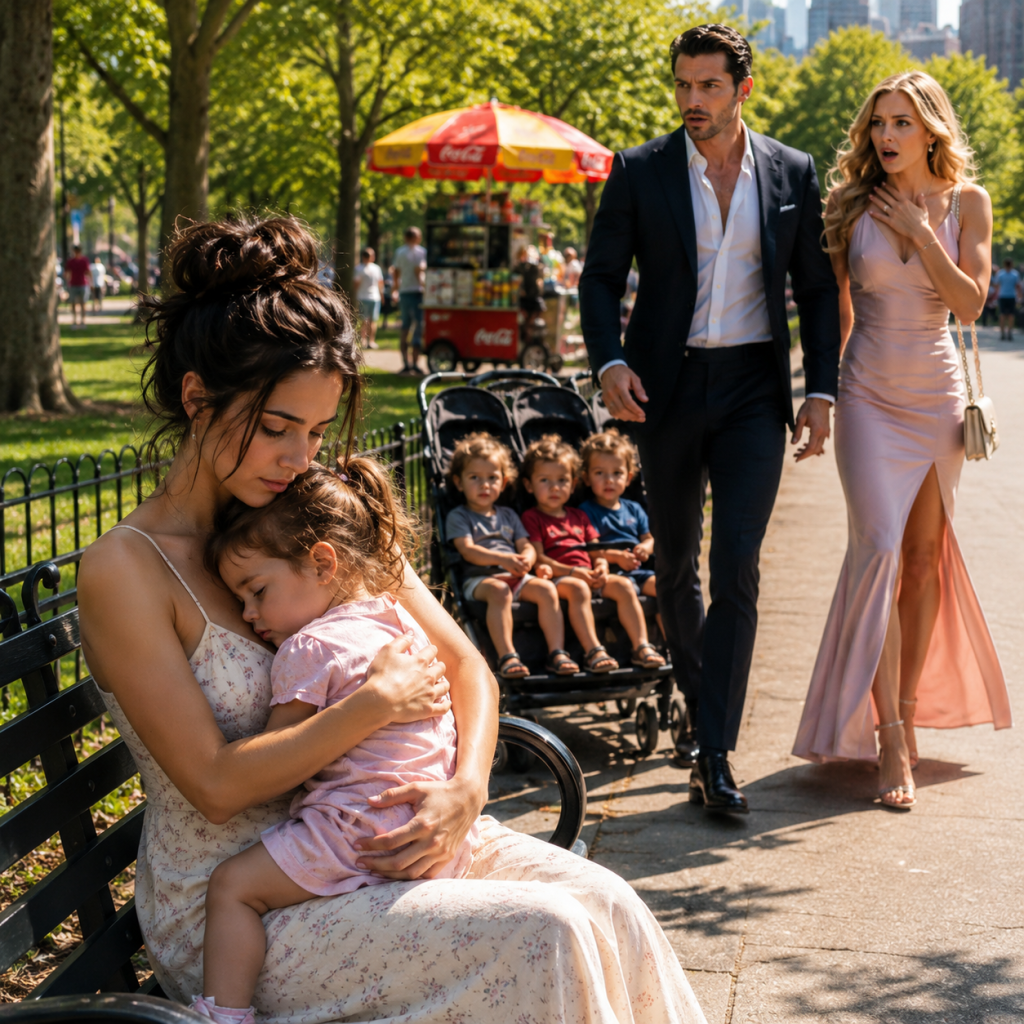
Maya was already halfway across the park, pushing that enormous stroller through the crowd with the desperate urgency of someone fleeing a storm only she could see. People stepped aside, startled by her speed, but she did not look back.
Not once.
“Adrian?” Camille’s voice sharpened beside me. “What are you doing?”
I had started walking.
Then walking became running.
“Adrian!”
Her heels clicked after me for a few seconds before stopping. I did not turn around. The lake wind cut across my face, carrying the scent of grass, roasted nuts, traffic, and the ordinary lives of strangers. I moved past families on picnic blankets, past tourists taking photos, past children chasing bubbles that flashed like tiny rainbows in the sun.
But I only saw Maya.
Four years gone, and I still knew the way she moved when she was frightened. Shoulders tight. Chin lifted. Never asking anyone to save her.
She reached the edge of the path near Michigan Avenue and tried to angle the stroller toward the crosswalk.
“Maya!”
Her name left my mouth rougher than I intended.
She froze.
Not fully. Just enough for the stroller wheels to pause against a crack in the pavement. The little girl with my gray eyes twisted around in her seat and looked at me again, curious now. Not scared. Curious.
That nearly destroyed me.
Maya turned slowly.
The years between us stood there too, silent and heavy.
“Don’t come closer,” she said.
I stopped at once.
The command in her voice was quiet, but firm. I had heard men with guns speak less clearly.
“Maya,” I said, “are they mine?”
Her face changed. It was not surprise. It was pain.
The serious little boy gripped a blue dinosaur. The third child continued lining up toy cars, yellow, red, yellow, red, as if the world had not just tilted beneath all of us.
Maya swallowed. “This isn’t the place.”
“Then tell me where.”
“No.”
“Maya.”
“No, Adrian.”
The sound of my name in her voice was almost unbearable. Once, she had said it laughing into my shirt at midnight, whispering it over coffee, breathing it like a promise when the world felt small enough to belong to us. Now it sounded like a door closing.
A horn blared on the street.
The children flinched.
I stepped back instinctively, hands open. “I’m not here to scare you.”
Her eyes flicked over my shoulder.
I turned.
Two of my security men stood near the path, far enough away to pretend they were not watching, close enough to prove otherwise. I had forgotten them. That was the problem with the life I lived. Even when I wanted to be only a man, my world arrived behind me in dark suits.
I lifted one hand, a silent order.
They moved farther back.
Maya noticed.
“You still do that,” she said.
“Do what?”
“Move people like pieces on a board.”
The words landed cleanly.
“I’m trying not to.”
She laughed once, without humor. “You don’t get credit for trying when people have spent years being afraid of what you might do.”
I glanced at the children. “Have they been afraid of me?”
Her expression softened for half a second before she guarded it again. “They don’t know you.”
The little girl waved at me.
A tiny, fearless wave.
My chest tightened.
“What are their names?” I asked.
Maya looked down, as if the names themselves were precious things she was reluctant to place in my hands.
“Lila,” she said, touching the girl’s shoulder. “Noah.” The serious boy looked away shyly. “And Oliver.”
Oliver placed another toy car in line and whispered, “Red one goes next.”
I almost smiled. It hurt too much.
“They’re three?” I asked.
“Almost four.”
Almost four.
The math was a quiet blade.
Before I could speak again, Camille appeared beside me, breathing fast, her expression composed only because she had spent her life being observed.
“Adrian,” she said carefully, “what is happening?”
Maya looked at Camille’s ring, then at me.
I hated myself for the flicker of hurt that crossed her face before she hid it.
Camille turned toward Maya with polite confusion. “I’m sorry. Do we know each other?”
“No,” Maya said. “We don’t.”
Camille’s gaze moved to the stroller. To the children. To Lila’s gray eyes.
Understanding did not arrive all at once. It crept in, cold and unwelcome.
“Adrian,” Camille whispered.
I could not answer her.
Maya tightened both hands around the stroller handle. “I need to go.”
“Please,” I said. “Ten minutes. Somewhere public. Coffee shop. Hotel lobby. Police station, if that makes you feel safer. Anywhere.”
Her mouth trembled at the word safer, and I knew then that whatever story I had told myself about letting her go had not protected her the way I once believed.
It had only left her alone.
The crosswalk signal changed.
Maya looked at it, then at the children. Lila had begun tugging at her shoe. Noah watched me like he was trying to memorize whether I belonged in his world. Oliver hummed softly over his cars.
Finally, Maya said, “There’s a library two blocks from here. Children’s floor. Twenty minutes.”
“I’ll be there.”
“No security inside.”
I nodded.
“No Camille.”
Camille inhaled sharply.
I turned to her, but Maya spoke first.
“I’m not being cruel,” she said, still looking at me. “I’m protecting my children from confusion.”
My children.
The words struck like thunder, even in her careful voice.
Camille stepped back. “Adrian, we need to talk.”
“We will.”
“Now.”
I looked at her then. Really looked.
Camille was beautiful, intelligent, and polished into something almost unbreakable. Our engagement had been practical from the beginning, arranged through overlapping business interests and family expectations. We liked each other. We respected each other. But love had never been the foundation.
She knew that.
So did I.
“I can’t,” I said.
Her eyes shone, not with tears exactly, but with wounded pride. “You’re choosing a stranger’s children over your fiancée?”
I looked toward Lila, who was now trying to put her shoe back on upside down.
“They may not be strangers.”
Camille’s face went still.
Maya did not wait for the rest. She pushed the stroller across the street and disappeared into the afternoon crowd.
Twenty minutes later, I entered the children’s floor of the Harold Washington Library alone.
It was bright, warm, and filled with murals of animals reading books. Soft carpet swallowed my footsteps. Children whispered too loudly. Parents negotiated over snacks, bathroom breaks, and leaving “just one more story.”
It was the least dangerous room I had entered in years.
And somehow, I felt entirely unprepared.
Maya sat at a small round table near the windows. Noah and Oliver were building a tower of foam blocks while Lila flipped through a picture book upside down. Maya had chosen a seat with a clear view of the entrance and two exits nearby.
That detail hurt me because it was exactly what I would have taught her to do.
I approached slowly.
“Thank you for coming,” I said.
“I almost didn’t.”
“I know.”
She looked tired. Not just from motherhood. From carrying secrets alone.
I sat across from her, keeping my hands visible on the table.
For several minutes, neither of us spoke. The children filled the silence with tiny sounds: the thump of blocks, the rustle of pages, Oliver’s quiet counting.
Then Noah came over and set the blue dinosaur beside my hand.
“His name is Captain,” he said.
I stared at him, startled.
Maya’s eyes widened. “Noah, sweetheart—”
“It’s okay,” I said softly.
Noah studied my face. “You sad?”
I had negotiated with mayors, judges, bankers, and men whose smiles could empty a room. None of them had ever undone me with two words.
“A little,” I admitted.
Noah considered that, then picked up Captain again. “Mommy says breathe slow.”
Maya looked down.
I did breathe. Slowly.
Noah returned to his blocks.
“He’s sensitive,” Maya said, her voice low. “Lila is fearless. Oliver notices patterns before people.”
I watched them. Every movement felt like evidence of a life I had missed. First steps. First words. Fevers. Birthdays. Tiny socks lost in dryers. Nightmares soothed by someone else’s arms.
“Why didn’t you tell me?” I asked.
She looked at me with exhausted disbelief. “You told me never to contact you again.”
The memory rose with humiliating clarity.
Rain on the windshield. Maya standing outside my car, crying but refusing to beg. My grandfather’s warning still ringing in my ears: End it cleanly, or she becomes leverage. Make her hate you if you have to.
So I had.
I had called her a distraction. A mistake. A weakness I had outgrown.
I had watched her face collapse and told myself cruelty could be mercy if it kept her alive.
“I was trying to protect you,” I said.
“I know.”
Those two words stunned me.
Maya folded her hands tightly. “I didn’t know then. But later, I understood enough. Your grandfather had men watching my apartment. My boss suddenly asked if I had ‘powerful trouble.’ A black car sat outside the diner three nights in a row. I got the message.”
My blood chilled. “My grandfather did that?”
“You didn’t know?”
“No.”
She searched my face, and I saw the dangerous thing there: she believed me, but belief did not erase damage.
“I found out I was pregnant five weeks after you left,” she said. “I called the old number. Disconnected. I went to your office. Security wouldn’t let me past the lobby. I wrote a letter.”
“I never got a letter.”
“I figured.”
“Where did you send it?”
“To the Vale Foundation office. It was the only address I trusted.”
I closed my eyes briefly.
The foundation had been controlled then by my grandfather’s oldest adviser, Vincent Bell. A man who filed secrets more carefully than tax returns.
“What happened after?” I asked.
Maya’s eyes drifted toward the children.
“I got scared. Then I got sick. Then I learned it was triplets, and fear became something I didn’t have time for. I moved in with my aunt in Pilsen. I worked when I could. I stopped watching the news when your name appeared because I couldn’t afford to fall apart.”
I wanted to apologize, but an apology felt too small for the missing years between us.
“I should have found you.”
“Yes,” she said simply. “You should have.”
No anger. That made it worse.
Lila wandered over then, holding the upside-down book.
“Read?” she asked me.
I looked at Maya.
She hesitated, then nodded once.
Lila climbed onto the chair beside me rather than my lap, which felt fair. She pushed the book toward me. It was about a bear who could not find his hat.
I read the first page.
My voice sounded strange to my own ears, too careful, too low. Lila listened with serious attention, correcting me when I called a rabbit a bunny.
“Rabbit,” she said firmly.
“Rabbit,” I repeated.
Maya’s expression softened despite herself.
For ten minutes, I read to my daughter.
That was the first true thing I had done all day.
When the story ended, Lila took the book back and returned to her brothers, as if she had tested me and found me temporarily acceptable.
Maya exhaled. “They don’t know who you are.”
“I understand.”
“No, Adrian. They don’t know they have a father. Not in the way other children do. I told them families can be different. That love counts more than empty chairs.”
I nodded, throat tight. “That was kind.”
“It was necessary.”
“What do you need from me?”
She looked surprised by the question.
“Nothing.”
“Maya.”
“I mean it. We’ve survived.”
“I don’t want you to survive because of my absence anymore.”
Her eyes flickered.
“That sounds noble,” she said. “But you have a life. A fiancée. A family name that still makes people lower their voices. I have three children who need routine, naps, snacks, doctors, and a mother who does not panic every time a stranger looks too long at them.”
“I won’t take them from you.”
“I know.”
“You do?”
Her gaze hardened. “Because I would never let you.”
There she was. The woman I had loved. Not delicate. Not helpless. Afraid, yes, but never weak.
“I want to know them,” I said. “Slowly. However you decide.”
Maya looked at the children again. Noah had placed a foam block on his head. Oliver was unimpressed. Lila laughed so hard she hiccupped.
“They deserve truth,” she said. “But not chaos.”
“Then we keep chaos away.”
A sad smile touched her face. “That has never been your family’s talent.”
“No,” I admitted. “But it can be mine.”
Before she could answer, her phone buzzed on the table. She glanced at the screen and went still.
“What is it?” I asked.
“Nothing.”
But she turned the phone face down too quickly.
“Maya.”
She closed her eyes for a moment. “My aunt. She’s watching the kids tonight while I work. She wants to know where we are.”
“You work tonight?”
“I work most nights.”
“Where?”
“A catering kitchen.”
I thought of Camille discussing lakefront weddings, string quartets, and imported flowers while Maya counted shifts around childcare. The contrast made me feel ashamed in a way no public accusation ever could.
“I can help financially.”
Her face closed immediately. “No.”
“For the children.”
“I said no.”
“I’m not trying to buy forgiveness.”
“Good, because it isn’t for sale.”
The quiet between us sharpened.
Then Oliver began to cry.
Not loudly. Just a sudden overwhelmed sob when his tower collapsed. Maya was on her feet instantly, crouching beside him. She gathered the blocks, murmuring comfort, naming colors, bringing order back one small piece at a time.
I watched her.
This was what love had looked like while I was becoming powerful: a woman on library carpet, soothing a child over fallen blocks with patience she had probably had to grow from nothing.
When Oliver calmed, Maya checked the time.
“We need to go.”
“Can I see them again?”
She adjusted Lila’s shoe. “I don’t know.”
The answer hurt, but it was honest.
“I’ll wait for your decision.”
She gave me a look. “You don’t wait well.”
“I’ll learn.”
We left the library separately. She insisted. I watched from across the street as she loaded the children into an old gray minivan with a dent near the back wheel. A woman with silver-streaked hair embraced her tightly before helping buckle the car seats.
Maya’s aunt, I guessed.
The aunt looked directly across the street at me.
Not afraid.
Warning.
I deserved that too.
When the minivan drove away, I remained on the sidewalk until it vanished.
Only then did I return to the hotel where Camille waited.
She sat in the suite by the window, engagement ring bright against a glass of untouched water.
“Are they yours?” she asked.
“I believe so.”
Her jaw tightened, but her voice remained controlled. “Believe?”
“I’ll confirm it. But yes.”
She nodded slowly, as if receiving business news instead of watching her future fracture. “Did you know?”
“No.”
“Would you have told me if you had?”
“Yes.”
She looked at me then, and for the first time since our engagement, I saw real sadness beneath her perfect composure.
“I wanted this to work,” she said.
“So did I.”
“No, Adrian. You wanted it to make sense.”
I could not argue.
Camille twisted the ring gently around her finger. “My father will be furious.”
“I’ll handle your father.”
“That is exactly the problem.” Her laugh was soft and tired. “Everyone handles everyone. Deals are made, appearances managed, statements prepared. And somewhere in the middle, a woman has been raising your children alone.”
There was no accusation in her tone. Only clarity.
“I’m sorry,” I said.
“I know.”
She stood and removed the ring.
I did not move.
She placed it on the table between us. The diamond caught the light one last time, cold and brilliant.
“I won’t compete with children,” she said. “And I won’t marry a man who just discovered his heart belongs to a life he abandoned, whether he meant to or not.”
“Camille—”
“Don’t make this sentimental. I like you too much for that.”
A small, painful smile passed between us.
“I’ll speak to my family,” she said. “You speak to yours.”
“My grandfather is retired.”
Her eyes sharpened. “Men like Salvatore Vale don’t retire. They wait.”
After she left, the suite felt enormous and empty.
I called my assistant and canceled every meeting. Then I called the one man I trusted more than blood.
“Rafael,” I said when he answered, “find Vincent Bell.”
There was a pause.
“Vincent disappeared two years ago.”
“Find him anyway.”
“What happened?”
I looked at the city lights beginning to glow beyond the glass.
“Maya had children.”
Another pause, heavier this time.
“Yours?”
“Yes.”
Rafael swore softly, then caught himself. “Does your grandfather know?”
“I don’t know.”
“That worries me.”
“It should.”
After hanging up, I stood alone with the weight of two lives pressing against me: the one I had inherited and the one I had just discovered.
By morning, everything had changed.
Camille’s family released a polite statement about a mutual decision to postpone wedding plans. My phone erupted with messages from board members, cousins, journalists, and acquaintances who smelled scandal before they knew its shape.
I ignored all of them.
At noon, Maya texted.
One line.
The children are at the museum tomorrow morning. Public place. One hour.
I read it three times.
Then I typed, Thank you.
I erased everything else.
The next morning, I arrived at the children’s museum with no security visible and no suit. Jeans, sweater, baseball cap. I looked almost ordinary, though the mirror had not believed me.
Maya noticed immediately.
“Disguise?” she asked.
“Effort.”
She almost smiled.
The children were delighted by the water tables. Lila splashed with total commitment. Noah carefully floated plastic boats. Oliver studied the gears that made fountains spin.
I stayed near Maya at first, afraid to step too close to a life where I had not earned space.
Then Noah held up a boat. “You push?”
I looked to Maya.
She nodded.
So I pushed the boat.
It drifted badly, bumped the wall, and tipped over.
Noah sighed. “Not like that.”
Maya covered her mouth, hiding a laugh.
For one hour, I learned tiny things.
Lila liked strawberries but hated blueberries because they “tricked her.” Noah wanted every animal to have a blanket. Oliver disliked loud hand dryers and could count backward from twenty. Maya carried crackers in three separate containers because sharing, apparently, became complicated when everyone wanted the same blue lid.
These details felt more valuable than anything I owned.
When the hour ended, none of us wanted to say so.
Outside, the children ate snacks on a bench. Maya stood beside me, arms folded against the breeze.
“Camille?” she asked.
“It’s over.”
She looked at me quickly. “Because of me?”
“Because the truth arrived.”
“That sounds like something you practiced.”
“Only in my head.”
She shook her head, but there was a trace of warmth now.
“I don’t want to step into your world again,” she said. “Not the way it was.”
“I don’t want that either.”
“Then what do you want?”
The answer came slowly because the old Adrian would have said something certain, something commanding. The man standing beside Maya knew certainty had cost enough already.
“I want to become someone they’re safe knowing,” I said. “And someone you don’t have to run from.”
Maya looked away.
The wind lifted loose strands of hair across her cheek. I resisted the old instinct to brush them back.
“My aunt says people can change,” she said. “But she also says change is proved by calendars, not speeches.”
“I like your aunt.”
“She doesn’t like you.”
“That seems reasonable.”
This time, Maya did smile.
Small. Brief. Real.
My phone buzzed.
I ignored it.
It buzzed again.
Maya glanced at my pocket. “Answer. It might be important.”
I checked the screen.
Rafael.
I stepped a few feet away. “Tell me.”
“We found Vincent.”
“Where?”
“Not far. Evanston. Assisted living facility under his sister’s name.”
“Is he talking?”
Rafael’s voice lowered. “He says he’ll talk only to you. And only if Maya Brooks is present.”
I turned slowly toward Maya.
She was kneeling before Oliver, tying his shoe while Lila tried to feed a cracker to a pigeon and Noah explained why pigeons did not need crackers.
“What does Vincent want with Maya?”
“He said she deserves the letter.”
My body went cold. “What letter?”
Rafael hesitated.
“The one she sent you four years ago.”
I closed my eyes.
“He kept it?”
“Yes. But Adrian, that’s not all.”
I gripped the phone harder.
“Say it.”
Rafael exhaled. “Vincent claims your grandfather ordered him to intercept it. And then someone sent Maya a reply.”
My eyes opened.
I looked at Maya, at the guarded strength in her posture, at the children who had my eyes and her courage.
“I never replied,” I said.
“I know.”
Across the courtyard, Maya stood and noticed my expression.
“What happened?” she called.
I lowered the phone slowly.
For the first time in years, fear did not come from danger.
It came from the possibility that one forged letter had stolen four years from all of us.
And from the question I could no longer avoid: what exactly had Maya been told in my name?
END OF PART 2 – LIKE, SHARE AND COMMENT “THE ENTIRE STORY” IF YOU WANT TO READ THE FULL STORY