PART 2
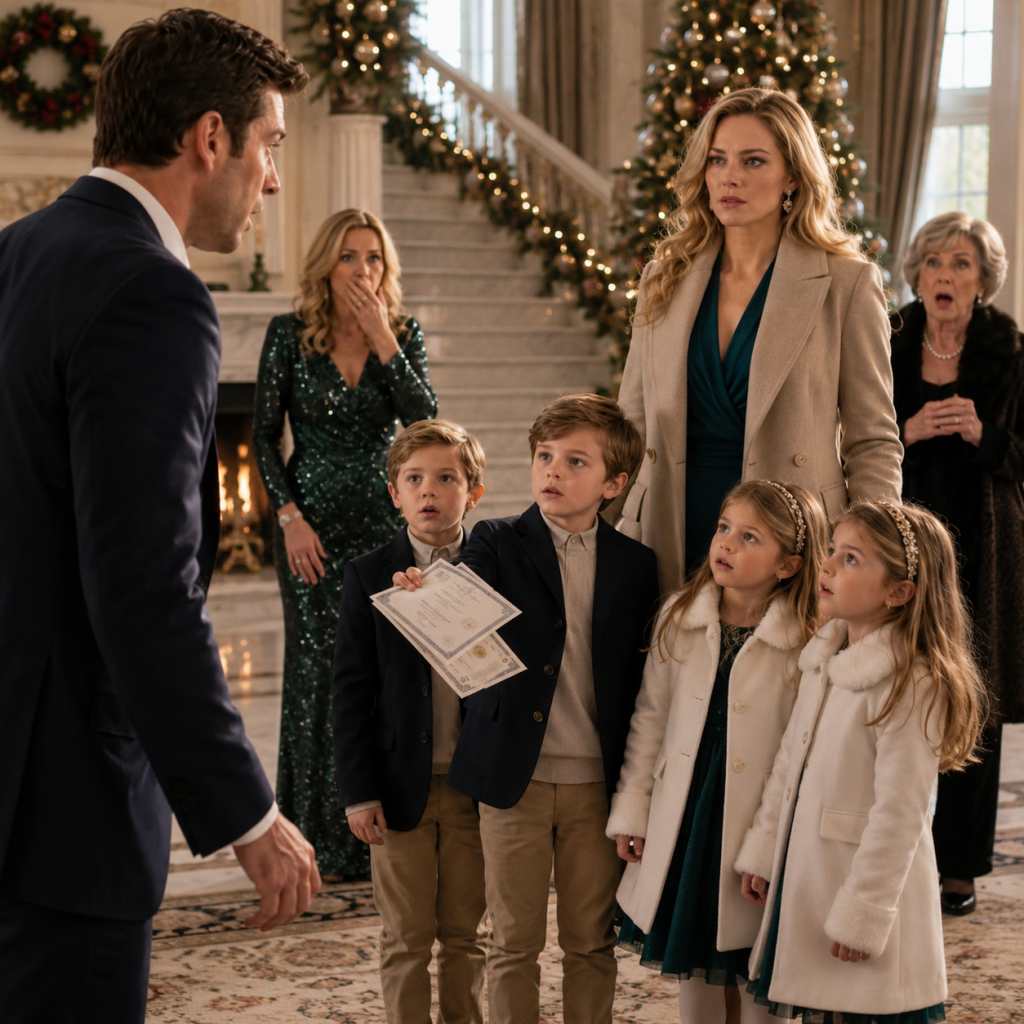
The birth certificates trembled slightly in Noah’s hands, though he did not understand why the room had gone so quiet.
He was seven, nearly eight, with serious brown eyes and the careful politeness of a child who had learned to read grown-up emotions before grown-ups spoke them aloud. His brother, Caleb, stood just behind him, clutching a candy cane he had taken from the entry table. The girls, Sophie and Emma, leaned against my coat, suddenly shy beneath the weight of every adult stare.
Marcus looked as if Christmas morning had turned into a question he had no idea how to answer.
His mother, Evelyn Reynolds, stood frozen near the fireplace. The broken wine glass glittered at her feet, red spreading across the polished wood like a fallen ornament.
The blonde woman beside Marcus released his arm.
“Marcus,” she whispered again, softer this time. “Tell me you know what this is.”
His mouth opened.
Nothing came out.
I took the folded papers gently from Noah before the silence could frighten him.
“Thank you, sweetheart,” I said.
He looked up at Marcus. “Are you our dad?”
The question landed with a quietness far heavier than shouting could have been.
Marcus looked at him then—not at me, not at the documents, but at the boy whose face reflected his own childhood photographs hanging in the hallway.
“I…” His voice broke. “I don’t know.”
I felt Noah’s fingers tighten around mine.
That was enough.
I knelt beside him and turned his shoulders toward me. “Remember what we talked about in the helicopter?”
He nodded, though his chin quivered. “That today might feel confusing.”
“And what else?”
“That we’re safe.”
“Yes,” I whispered. “Always.”
Evelyn suddenly moved. “Children, come away from the door. It’s freezing.”
Her voice shook, but not unkindly.
She grabbed a towel from the sideboard, wiped quickly at the spilled wine, then gestured toward the living room as though manners were the only rope she could hold onto.
“Please,” she said. “Come in properly.”
That small gesture nearly undid me.
For eight years, I had imagined this family as one solid wall, all of them standing behind Marcus, all of them believing whatever story he chose to tell. But Evelyn looked at my children as if she had just discovered four stars missing from her sky.
The room slowly shifted back into motion.
An uncle cleared his throat. A cousin took the children’s coats. Someone turned down the Christmas music. The blonde woman stepped away from Marcus and folded her arms over her red dress, her diamond earrings catching the light.
I recognized her from a magazine profile Rachel had sent me.
Isabelle Hart.
Philanthropy director. Old Denver family. Elegant. Careful. The kind of woman Marcus would choose when he wanted the world to believe he had finally become respectable.
The ring box remained in his hand.
Closed now.
Forgotten.
Evelyn looked at me, then at the four children. “Their names?”
“Noah, Caleb, Sophie, and Emma,” I said. “They were born on March twelfth, seven years ago.”
Her lips parted. “Four?”
“Quadruplets.”
A sound moved through the room—not gossip exactly, but the collective breath of people realizing the story they had been told no longer fit.
Marcus finally found his voice.
“This is impossible.”
I turned to him. “It’s documented.”
“You never told me.”
“I tried.”
His face hardened, because that was easier than shame. “No, you didn’t.”
I reached into my handbag and removed a thin folder, not the whole file, only enough. “Certified letters. Returned. Emails. Screenshots of unanswered messages. A voicemail transcript from your former assistant confirming your office had been instructed not to forward anything from me.”
Marcus stared at the folder but did not touch it.
Isabelle did.
She stepped forward with careful grace. “May I?”
I handed it to her.
She read the first page. Then the second. Her expression changed by degrees, not dramatically, but honestly. Confusion gave way to recognition, and recognition to something that looked painfully close to disappointment.
“Marcus,” she said, “this says she contacted you before the divorce was finalized.”
He swallowed. “Documents can be arranged.”
I almost laughed, but the children were watching.
Instead, I said, “So can stories.”
Caleb tugged my sleeve. “Mommy, is dinner soon?”
The innocence of it cracked the tension just enough for Evelyn to blink herself back into the present.
“Yes,” she said quickly. “Yes, darling. Dinner is almost ready.”
Darling.
The word slipped out naturally, and then she seemed startled by it.
Sophie looked toward the Christmas tree, enormous and silver-white beside the windows. “Can we see the ornaments?”
Evelyn’s face softened with wonder. “Of course.”
I hesitated.
She noticed. “I won’t take them out of your sight.”
That sentence told me more than any apology could have.
I nodded.
The children moved toward the tree with Evelyn, cautious at first, then brighter as she showed them a tiny wooden sled, a glass angel, a painted train Marcus had apparently made in first grade. Noah held the ornament carefully, studying it.
“He made this?” he asked.
Evelyn looked back at Marcus. “Yes.”
Noah turned the little train over in his palm. “I like building things too.”
Marcus flinched.
For the first time since I entered the house, I saw something reach him. Not fear of exposure. Not irritation at being challenged. Something quieter. Something human.
Then his uncle asked too loudly, “So, Aurelia, what exactly are you expecting today?”
My old name sounded strange in his mouth. I had been Aurelia Bennett when I married Marcus. I was Aurelia Vale now, after rebuilding myself piece by piece.
“I’m not expecting a scene,” I said. “I came because Marcus invited me.”
Marcus shot me a look.
I held it calmly. “He said the family wanted to see me one last time.”
Isabelle closed the folder. “One last time before what?”
No one answered.
That was when I noticed the envelopes on the console table.
Cream cardstock. Gold calligraphy. Isabelle and Marcus. A Christmas announcement.
Not only a proposal, then.
An engagement reveal.
A public beginning built on a private omission.
Evelyn noticed where I was looking and seemed to age several years in one breath.
“I didn’t know,” she said.
I believed her.
Maybe not because she deserved belief, but because her eyes had filled with the kind of grief that cannot be rehearsed.
Marcus moved toward the study. “Aurelia, we need to talk.”
“No,” I said.
He stopped.
“We can talk after lunch, with the children occupied and another adult present.”
His eyes narrowed. “You don’t trust me?”
“I learned not to.”
The words were not loud. They did not need to be.
Isabelle looked away.
Dinner was served in a dining room that seemed designed for holiday photographs. Garland draped the mantel. Candles burned between crystal glasses. Snow pressed softly against the tall windows, turning the mountains beyond into pale shadows.
The children sat beside me at one end. Evelyn placed herself near them, as though afraid they might vanish if left too far away.
Marcus sat opposite me.
Isabelle sat beside him but did not touch his hand.
At first, conversation stumbled over itself. Someone asked the children about school. Sophie announced she loved reading but hated peas. Caleb said he wanted to be a pilot or a pancake chef. Emma, the quietest of the four, told Evelyn that helicopters were loud but clouds were pretty from above.
“And Noah?” Evelyn asked gently.
Noah glanced at Marcus. “I like science. And drawing buildings.”
A strange stillness crossed Marcus’s face. “Buildings?”
Noah nodded. “Mom says I use too much tape.”
“You do,” Caleb said. “You taped my dinosaur to a bridge.”
“It was structural,” Noah replied.
A few people laughed. The sound eased something in the room, though not enough to erase what waited beneath.
Marcus studied Noah with an expression I could not read.
I remembered Marcus at twenty-seven, staying up late sketching impossible houses on napkins. Back then, I had loved watching his mind work. He could look at an empty lot and see light, angles, windows, lives unfolding inside walls not yet built.
I had fallen in love with that version of him.
I had not known how easily ambition could become hunger.
Halfway through dinner, Isabelle set down her fork.
“Aurelia,” she said carefully, “did Marcus know there were four babies?”
The table went silent again.
I dabbed Emma’s mouth with a napkin before answering. “He knew I was pregnant. I told him the first ultrasound suggested more than one. By the time I knew it was four, he was gone.”
Marcus looked down.
His mother’s fork clattered against her plate.
“You knew?” Evelyn whispered.
Marcus’s jaw tightened. “I knew she claimed she was pregnant.”
“Claimed?” Evelyn repeated.
“I was under pressure. The marriage was already—”
“The marriage was quiet,” I said. “Lonely, yes. Strained, yes. But not over until you left.”
He looked at me then, and for a second I saw the old Marcus—the one who hated being seen clearly.
“I was scared,” he said.
The admission surprised everyone, including him.
I waited.
He rubbed his thumb along the edge of his glass. “I had debts. Business problems. Investors circling. A family felt impossible.”
The children had grown quiet. I wished they were in another room, but I also knew families are sometimes shaped by truths no one planned to tell at the perfect time.
“So you chose disappearance,” I said.
His eyes lifted. “I chose survival.”
“No,” I replied. “I did.”
Evelyn pressed a hand to her mouth.
Marcus looked away first.
After dinner, Evelyn took the children to the den to watch a Christmas movie. My cousin-by-marriage, Claire, went with them at my request. She gave me a small nod, silently promising to stay.
The rest of us moved into the study.
The study was all dark wood and leather chairs, with shelves of old legal books no one seemed to read. A fire burned low behind a brass screen. Outside, the helicopter sat in the snow like a machine from another life.
I stood near the window. Marcus stood near the desk. Isabelle remained by the door, one hand on the folder I had given her.
“Why come this way?” Marcus asked. “The helicopter. The certificates. The timing.”
I took a breath. “Because quiet didn’t work with you. Private messages didn’t work. Legal notices didn’t work. I needed witnesses, but I did not come to humiliate you.”
He looked skeptical.
“I came because you invited me here to make a point. I decided to make a different one.”
Isabelle glanced at him. “What point were you planning to make?”
Marcus said nothing.
That silence answered.
She closed her eyes briefly.
I almost felt sorry for her. Not because she had been innocent in every way; few adults in complicated relationships ever are. But because she had dressed this morning expecting a future, and now stood surrounded by the evidence of a past Marcus had edited.
“What do you want?” he asked.
“First, acknowledgment. The children deserve truth without confusion.”
He nodded once, stiffly.
“Second, we arrange proper legal steps. Paternity, support, medical history, and boundaries.”
His pride flickered at the word support. “You don’t need my money.”
“No,” I said. “They are entitled to responsibility.”
Isabelle looked at me then, and something like respect passed between us.
“And third?” Marcus asked.
I hesitated.
Because the third thing was the one I had not planned to say aloud until I saw him with Noah’s ornament in his hand.
“Third, I want to know why my attorney discovered your company name attached to a trust document involving my children.”
Marcus went still.
Isabelle turned sharply. “What trust document?”
I removed a second paper from my handbag.
Unlike the birth certificates, this one was not warm from a child’s backpack. It was cold, formal, and deeply troubling.
“A month ago,” I said, “my attorney flagged an attempted filing in Travis County. It listed my children as beneficiaries of something called the Reynolds Family Continuity Trust.”
Evelyn, who had just entered the doorway unnoticed, gasped softly.
Marcus looked past me. “Mother.”
She stepped inside. “What is she talking about?”
I handed her a copy.
Her eyes moved over the page, and her face drained of color.
“I didn’t authorize this,” she said.
Marcus’s expression shifted too quickly.
There.
A crack.
Isabelle saw it. “Marcus?”
He took the paper from his mother. “This was preliminary.”
“Preliminary for what?” I asked.
He exhaled hard. “You arrived with a helicopter and four children, Aurelia. Don’t act like I’m the only one who planned something.”
“My plan was disclosure. Yours appears to involve my children’s names without my consent.”
Evelyn lowered herself into a chair. “This trust includes my house.”
The room sharpened around us.
“What?” Isabelle said.
Evelyn read aloud, voice trembling. “Primary residential asset to be transferred upon execution to Reynolds Family Continuity Trust, trustee Marcus Hale Reynolds…”
I looked at Marcus.
Hale.
I had almost forgotten his middle name.
But the document had not.
Marcus reached for the page. Evelyn held it away.
“Mother, it was to protect the property.”
“From whom?”
He did not answer.
Isabelle’s voice became very quiet. “From creditors?”
The fire crackled.
Marcus sank slowly into the chair behind the desk. The performance was gone now. No charming host. No wronged fiancé. No confident man holding a ring box.
Only Marcus.
Tired. Cornered. Afraid.
“My firm is under review,” he said.
Isabelle inhaled. “By whom?”
“A private lender. Two former investors. Maybe the state board, eventually.”
Evelyn gripped the document. “And you were going to use the children?”
“No,” he said quickly. “Their names made the trust look stable. Family-centered. Long-term.”
My voice turned cold despite my effort to keep it steady. “You used children you abandoned as decoration for a financial shelter.”
He flinched.
“It wasn’t filed,” he said. “It didn’t go through.”
“Because my attorney caught it.”
He looked at me then, and for once there was no argument left in him.
A soft knock interrupted us.
Claire appeared at the door. “Aurelia? Emma is asking for you.”
I moved immediately.
In the den, the children sat beneath a plaid blanket, the movie glowing blue across their faces. Emma’s eyes were sleepy and worried.
“Mommy,” she whispered when I knelt beside her, “is everyone mad because of us?”
My heart broke cleanly.
“No, baby,” I said, pulling her close. “Never because of you.”
“Then why?”
I brushed a curl from her cheek. “Because grown-ups sometimes make choices they should have explained a long time ago.”
Noah watched me carefully. “Is he really our dad?”
I looked at all four of them.
This was the moment I had feared for years—not because of the answer, but because of everything the answer might ask of them.
“Yes,” I said softly. “Marcus is your biological father.”
Caleb frowned. “Does that mean we have to live here?”
“No,” I said, and kissed his forehead. “Home is still home.”
Sophie leaned against me. “Does he like us?”
I closed my eyes for half a second.
“I think he doesn’t know you yet,” I said. “And liking someone properly takes knowing them.”
Noah looked toward the hallway. “Do we have to like him?”
“No,” I said. “You only have to be honest about how you feel.”
He nodded, relieved by the permission.
When I returned to the study, Marcus was standing by the mantel, staring at a framed photograph of himself as a little boy. Evelyn sat rigidly in the chair. Isabelle had removed her engagement ring from her right-hand pocket—perhaps the place she had expected him to put it—and set the unopened box on the desk.
“I need air,” Isabelle said.
No one stopped her.
Through the window, I watched her step onto the porch without a coat, arms wrapped around herself as snow drifted around her hair.
Evelyn spoke first.
“I believed you,” she said to Marcus.
He bowed his head.
“You told me Aurelia left because she wanted a different life. You told me there was no child.”
“I told myself that too,” he said.
Evelyn’s eyes filled. “That is not an answer.”
“No,” he whispered. “It isn’t.”
Then he looked at me.
“I saw one email,” he said.
The room seemed to contract.
I stayed perfectly still.
“When?” I asked.
“After I left. Before the divorce finalized. You wrote that you had a high-risk pregnancy and needed to talk.”
I remembered sending it from a hospital bed after the specialist appointment. I had waited three days for a reply. None came.
“What did you do?” I asked.
“I deleted it.”
Evelyn made a small sound.
Marcus’s face twisted—not dramatically, but with the discomfort of a man finally standing inside his own memory.
“I was drowning,” he said. “That’s not an excuse. It’s just true. I thought if I opened the door even a little, everything would collapse. So I deleted it and told myself you were exaggerating.”
“And after they were born?”
“I didn’t know.”
I believed that part.
It did not absolve the first part.
But truth, even ugly truth, changed the shape of the room.
“You missed birthdays,” I said. “Fevers. First steps. First words. Four kindergarten backpacks by the door. You missed Caleb singing to the dog because he thought she was lonely. You missed Sophie refusing to sleep unless every stuffed animal had a blanket. You missed Emma learning to read quietly because she wanted to surprise me. You missed Noah drawing houses with five bedrooms because he said everyone should have space.”
Marcus pressed his hand over his eyes.
I had not meant to make him cry.
Maybe I had meant to make him understand.
There is a difference.
Evelyn stood. “I want to know my grandchildren.”
Her voice shook, but her spine was straight.
I looked at her. “That will be up to time, consistency, and what is healthy for them.”
“I understand.”
Marcus looked at me. “And me?”
I did not answer quickly.
Outside, Isabelle stood alone in the snow.
Inside, my children laughed suddenly at something in the movie, their voices rising through the house like bells.
“You can begin,” I said. “That’s all. Beginning is not the same as being trusted.”
He nodded.
For the first time that day, he did not argue.
The afternoon softened after that, not into forgiveness, but into something more cautious. Evelyn brought out cookies. The children decorated them at the kitchen island while Marcus stood at a distance, unsure how close he was allowed to come.
Caleb noticed him watching.
“Do you want a cookie?” he asked.
Marcus looked startled. “Sure.”
Caleb held up one covered in crooked green frosting. “This one is a tree, but it fell over.”
Marcus accepted it with both hands. “It’s a good tree.”
“It’s structurally weak,” Noah said from his stool.
Marcus almost smiled. “I know a little about that.”
Noah studied him. “Mom says weak things can be fixed if you find the problem.”
Marcus looked at me across the kitchen.
“Your mom is smart,” he said.
Noah nodded seriously. “She is the smartest.”
I turned away before my face gave too much away.
Near sunset, Isabelle came back inside. Her cheeks were pink from cold, her expression composed but altered. She asked to speak with me alone.
We stepped into the small breakfast room, where poinsettias lined the windows and the sky outside had turned lavender over the mountains.
“I owe you an apology,” she said.
“You didn’t abandon me.”
“No,” she replied. “But I believed a convenient version of you.”
I said nothing.
She folded her hands. “Marcus told me you were unstable after the divorce. He said you might appear someday making claims. I should have questioned why he was preparing me to distrust someone I’d never met.”
That honesty surprised me.
“Thank you for saying that,” I said.
She looked toward the kitchen, where Marcus was helping Emma place sprinkles on a cookie. He looked awkward, careful, almost tender.
“I loved who I thought he was,” Isabelle said. “Maybe part of him is that person. Maybe part of him wants to be. But wanting isn’t enough.”
“No,” I said. “It isn’t.”
She gave a faint, sad smile. “You’ve learned that already.”
“I learned it the expensive way.”
A little laugh escaped her, then faded.
“There’s something else,” she said.
From a pocket in her dress, she removed a folded slip of paper.
“I found this tucked inside the ring box after I came in from the porch. It isn’t addressed to me.”
She handed it to me.
My name was written across the outside.
Aurelia.
Not in Marcus’s handwriting.
My fingers went cold.
“Where did this come from?”
“I don’t know,” Isabelle said. “But the box was in Marcus’s possession all morning.”
I unfolded the note.
The message inside contained only one sentence.
Ask Marcus what happened at St. Agnes the night the quadruplets were born.
The room tilted slightly.
St. Agnes.
The hospital in Austin where I had delivered four premature babies after thirty-one hours of labor, terrified and alone except for nurses who spoke gently and a doctor who held my hand when the fourth tiny cry finally filled the room.
No one here should have known that name.
I looked through the doorway at Marcus.
He was laughing softly now as Sophie tried to put a gumdrop star on top of a cookie too small to hold it.
For one impossible second, he looked like he belonged in that scene.
Then he lifted his eyes and saw the paper in my hand.
The color left his face.
END OF PART 2 – LIKE, SHARE AND COMMENT “THE ENTIRE STORY” IF YOU WANT TO READ THE FULL STORY