Part 2
The words remained on my screen.
You’re looking at the wrong woman.
I read them once.
Then again.
Outside my hospital room, a cart rattled past. Somewhere down the corridor, a newborn began to cry. Morning light spread across the polished floor in pale strips, touching the edge of Oliver’s bassinet.
Sophia’s reflection still glowed in the photograph.
Her bare shoulder.
Her dark hair.
William’s watch on the bedside table.
Everything about the image seemed designed to confirm the betrayal I had already begun to suspect.
And yet the anonymous sender was telling me that Sophia was not the center of it.
I typed one question.
Who are you?
The message showed as delivered.
No reply came.
I waited five minutes.
Then ten.
By the time the nurse returned to check my blood pressure, the number had disappeared from the messaging application entirely.
I said nothing.
For most of my life, silence had been mistaken for weakness.
At Sterling dinners, I listened while men twice my age explained markets I understood better than they did. At charity boards, I let society wives speak over me because correcting them publicly would have created unnecessary enemies. During my marriage, I learned to absorb William’s absences, his impatience, and his carefully rationed affection without giving him the satisfaction of seeing how deeply they cut.
But silence was not surrender.
Silence was where I arranged the pieces.
The black folder beside my bed had begun as a collection of small humiliations.
A copy of William’s first unexplained hotel charge.
A private investigator’s report documenting late-night visits to Sophia’s apartment.
Bank transfers from a Hawthorne subsidiary to an anonymous consulting company registered in Delaware.
A draft custody petition prepared three months before Oliver’s birth.
And one document more dangerous than all the others.
A copy of an amendment to the Sterling-Hawthorne merger agreement.
The amendment bore my signature.
I had never signed it.
According to its terms, if William and I divorced within ten years of marriage, control of my voting shares in Sterling Biotech would temporarily transfer to a marital trust administered by Hawthorne Capital.
William had not merely been planning to leave me.
He had been preparing to take my family’s company with him.
At the hospital, I added the photograph of Sophia to the folder.
Then I added the anonymous warning.
Twelve days later, I carried both into Hawthorne Tower.
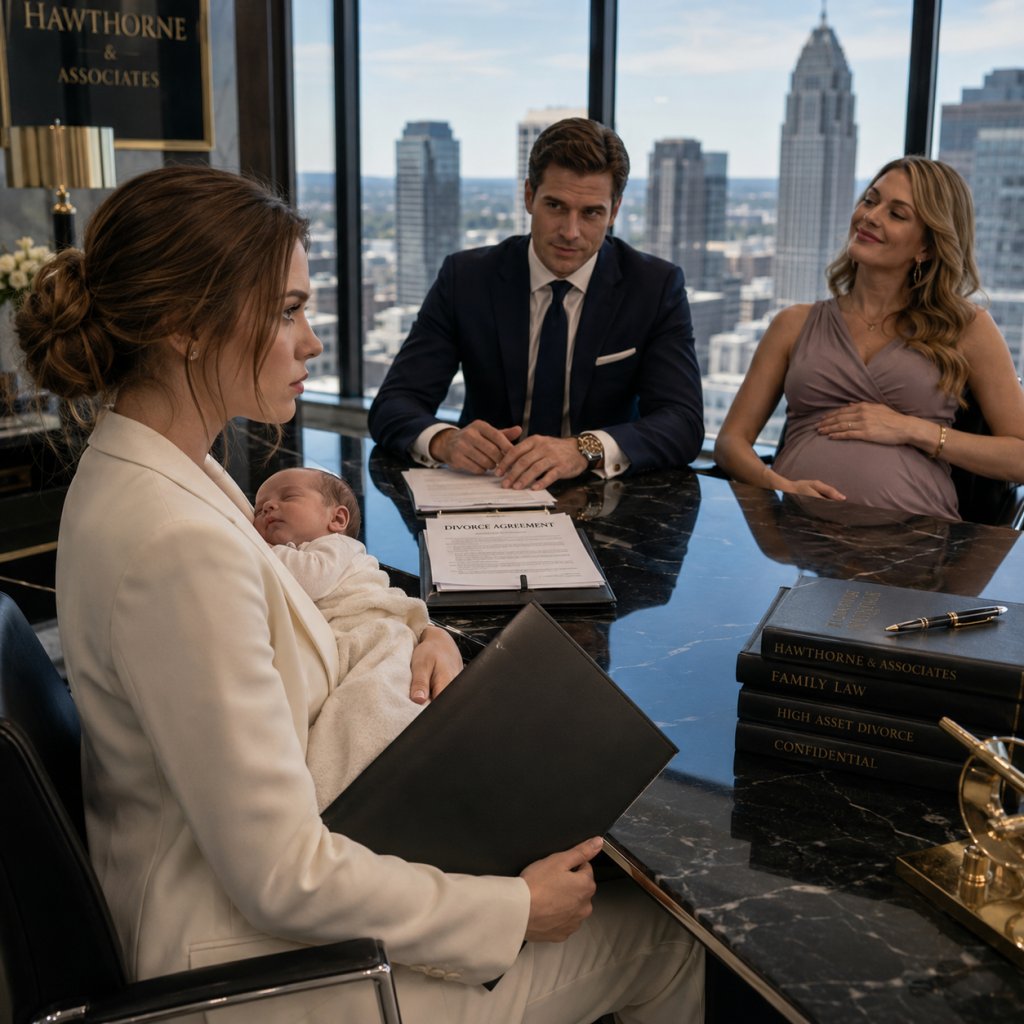
William’s attorney, Charles Voss, sat at the head of the conference table. He had silver hair, cold blue eyes, and the patient expression of a man accustomed to ending other people’s lives politely.
To his right sat two junior attorneys.
To his left sat William and Sophia.
Sophia wore cream silk and pearls.
She had always understood the power of looking harmless.
William gestured toward the papers.
“The terms are generous.”
I adjusted Oliver against my chest.
“How generous?”
“You’ll retain the Manhattan apartment, the lake property in Vermont, and a settlement of thirty million dollars.”
One of the junior attorneys looked impressed.
I almost smiled.
Thirty million dollars was a large amount of money to anyone who did not understand that William was attempting to seize assets worth nearly eleven billion.
“And custody?” I asked.
William folded his hands.
“Joint, eventually.”
“Eventually?”
“You’re recovering. The first few months can be emotionally difficult.”
Charles Voss spoke before I could answer.
“Mr. Hawthorne is suggesting a temporary arrangement in which the child remains primarily with him and an approved team of caregivers.”
I looked at William.
“You want to remove a twelve-day-old baby from his mother.”
His jaw tightened.
“No one is removing anyone. You need rest.”
“I needed you twelve days ago.”
Sophia shifted beside him.
William’s expression cooled.
“This is exactly why we wanted a private meeting.”
“You mean without witnesses.”
“We are trying to protect your dignity.”
“Were you protecting my dignity in the penthouse?”
For the first time, Sophia’s smile disappeared.
William glanced at her, then back at me.
“I don’t know what you’re talking about.”
I placed my phone on the table and opened the photograph.
No one spoke.
Sophia recovered first.
She lowered her eyes and placed one hand over her belly.
“I’m sorry,” she whispered.
William’s face remained strangely calm.
That was the first moment I understood the anonymous message had been right.
A man caught unexpectedly would have denied, deflected, attacked, or panicked.
William did none of those things.
He looked relieved.
The photograph was not an exposure.
It was part of the plan.
Charles Voss cleared his throat.
“Private conduct has no bearing on the proposed financial terms.”
“It has bearing on the custody terms.”
“Not necessarily.”
I reached beneath Oliver’s blanket and touched the black folder.
William noticed.
His mouth curved.
“Is that your evidence?”
“It’s a folder.”
Sophia gave a small laugh.
One of the junior attorneys quickly lowered his face.
William leaned back.
“Charlotte, I know you’ve always enjoyed feeling prepared, but this doesn’t need to become theatrical.”
“No,” I said. “It doesn’t.”
I opened the folder.
The room quieted.
I removed the forged amendment and placed it in front of Charles Voss.
His expression did not change.
William’s did.
Only slightly.
A tightening at the corner of his mouth.
“Where did you get that?” he asked.
“It was filed with the Delaware Court of Chancery six weeks ago.”
Charles glanced down at the document.
“Mrs. Hawthorne, this amendment was executed properly.”
“Not by me.”
“Your signature was witnessed.”
“By whom?”
He turned the page.
“Margaret Sterling.”
My mother.
For one second, the room seemed to lose all depth.
I had examined the signature page repeatedly. I had seen the witness line but assumed the name had been that of a legal assistant.
I took the document back.
There it was.
Margaret Anne Sterling.
My mother’s full legal signature.
Elegant.
Unmistakable.
William watched me discover it.
He had wanted this moment.
That was why he had waited.
“My mother did not sign this,” I said.
“She did,” William replied.
“Then she was deceived.”
“She understood the agreement.”
My hands remained still only because Oliver was sleeping against me.
“Why would she transfer control of Sterling voting shares to Hawthorne Capital?”
William gave me a look almost resembling pity.
“Because she knew you were not capable of managing them.”
The words struck more deeply than I expected.
Not because I believed them.
Because they sounded like my mother.
Margaret Sterling had spent my childhood preparing me to represent the family while quietly doubting whether I could ever lead it. She approved my dresses, corrected my posture, chose my schools, and praised my charitable instincts.
But every time I asked to sit in on executive meetings, she told me there would be time later.
Every time I proposed an acquisition, she handed it to an older man to present.
Every time financial journalists called me the future of the Sterling empire, my mother smiled and said the family had many capable advisers.
William had been different.
At least in the beginning.
He listened.
He asked questions.
He told me I saw patterns other people missed.
I had mistaken his attention for respect.
Perhaps he had only been studying me.
Sophia placed her hand on William’s arm.
The gesture was subtle.
Possessive.
He allowed it.
“The board meets Friday,” he said. “Once the divorce is filed, the trust activates.”
“You planned this before Oliver was born.”
“We planned for every possibility.”
“Including leaving me alone in labor?”
His eyes flickered.
For a fraction of a second, I saw irritation.
Not guilt.
Irritation that I had mentioned something emotional in a room where he wanted only power.
“You had excellent medical care.”
I looked down at our son.
Oliver slept with one tiny fist pressed beneath his chin.
“He will know what you are.”
William’s voice became quiet.
“Only if you remain stable enough to tell him.”
The warning was unmistakable.
Charles Voss slid another document across the table.
A psychological evaluation.
My name appeared at the top.
The report described anxiety, depressive episodes, paranoid ideation, and possible postpartum instability.
It was signed by Dr. Elaine Mercer.
My obstetrician.
I stared at the signature.
Two weeks before Oliver’s birth, Dr. Mercer had asked whether I felt supported at home.
I had admitted that William traveled frequently.
She asked whether I was sleeping.
I said not well.
She asked whether I felt anxious.
I said sometimes.
Ordinary answers from a pregnant woman had been reshaped into a psychiatric weapon.
“You’ve been planning to declare me unfit,” I said.
William did not deny it.
Sophia’s hand moved across her belly.
I studied her face.
She appeared composed, but a pulse moved rapidly at the base of her throat.
She was afraid.
Not of me.
Of him.
The realization came quietly.
Sophia was not sitting beside William like a victorious mistress.
She was sitting beside him like an employee who had been ordered to play one.
I closed the folder.
“I’ll sign.”
Everyone paused.
William frowned.
“What?”
“I said I’ll sign.”
Charles Voss leaned forward.
“You understand the proposed custody provisions?”
“Perfectly.”
William searched my face.
He had expected resistance.
Anger.
Perhaps a scene dramatic enough to support the psychiatric report.
My surrender unsettled him more than any accusation could have.
“I want one change,” I said.
Charles lifted his pen.
“What change?”
“The signing must occur at Sterling House tomorrow at noon.”
William’s suspicion deepened.
“Why?”
“Because my father’s trust requires documents involving my inherited shares to be executed on Sterling property before a Sterling-appointed notary.”
“That provision was waived.”
“Then you have nothing to lose by indulging me.”
Charles and William exchanged a look.
The attorney answered.
“We can arrange it.”
I stood carefully.
William’s eyes moved to the folder beneath my arm.
“You’re leaving that?”
“No.”
He smiled again, but it did not reach his eyes.
“You always did like props.”
I adjusted Oliver’s blanket.
“And you always mistook what you could see for everything that existed.”
Then I left.
The elevator doors closed behind me.
I held myself upright until the floor numbers began to descend.
Thirty-five.
Thirty-four.
Thirty-three.
My reflection stared back from the mirrored walls.
Pale face.
Dark circles.
A sleeping infant.
No visible army.
No obvious power.
Exactly what William expected.
I took out my phone and called my father.
He answered on the fourth ring.
“Charlotte.”
His voice was formal.
It had been formal for years.
“I need to know whether Mother signed an amendment transferring my Sterling shares to a Hawthorne trust.”
Silence.
Then, “Where are you?”
“In Hawthorne Tower.”
“You should not be there alone.”
“Did she sign it?”
Another silence.
My father exhaled.
“Yes.”
The elevator continued downward.
I tightened my grip on the phone.
“Why?”
“She believed it would preserve the merger.”
“By giving William control of my shares?”
“Temporary control.”
“You knew.”
“I knew there were discussions.”
“Did you approve?”
“No.”
“Did you stop her?”
“No.”
The answer hurt more than William’s betrayal.
My father had always defended his silences as neutrality.
But neutrality in a family like ours was simply permission granted to the more ruthless person.
“Come to Sterling House,” I said.
“Charlotte—”
“Tomorrow. Eleven in the morning.”
“What are you planning?”
“I’m asking you to choose whether you are my father or merely another man who watched.”
I ended the call before he could answer.
The elevator doors opened into the private lobby.
My driver waited outside.
I did not return to the Manhattan apartment.
Instead, I took Oliver to a small townhouse in Brooklyn owned through a Sterling charitable foundation. Only three people knew it existed.
One was my father.
One was the foundation director.
The third was Rebecca Lane.
Rebecca had been my roommate at university, my maid of honor, and, for seven years, general counsel of Sterling Biotech.
She arrived twenty minutes after I called, wearing jeans beneath a camel coat and carrying two laptops.
When she saw Oliver, her expression softened.
“When did he get this small?”
“He was born that way.”
“You know what I mean.”
She washed her hands, took him carefully, and looked down at his face.
“He has your mouth.”
“Everyone says he looks like William.”
“Everyone says what powerful men pay them to notice.”
I almost laughed.
Almost.
Then I showed her the forged amendment.
Rebecca’s warmth vanished.
She read each page slowly.
“This was filed?”
“Six weeks ago.”
“And your mother witnessed it?”
“Apparently.”
“She never told me.”
“She never tells lawyers what she thinks she can control privately.”
Rebecca turned to the signature page.
“This amendment is dangerous, but it may not be valid.”
“Why?”
“Your father’s trust language. Any transfer of voting control requires confirmation by the independent Sterling protector.”
“Who is that now?”
Rebecca looked up.
“You.”
I stared at her.
“No.”
“Yes.”
“My father was protector.”
“Until his seventy-fifth birthday.”
“That was last month.”
“Exactly.”
I felt something shift.
“My mother signed before his birthday.”
“But the trust did not activate upon signing. It activates upon divorce. By then, you are the protector.”
“William knows that.”
“He should.”
“Then why proceed?”
Rebecca handed Oliver back and opened her laptop.
“Because either he believes you don’t know, or he believes you won’t remain protector long enough to object.”
The psychiatric report returned to my mind.
Temporary instability.
Emergency custody.
Potential incapacity.
If I were declared incompetent, the successor protector would take over.
“Who is next in line?” I asked.
Rebecca typed quickly.
Then stopped.
Her face changed.
“Your mother.”
Of course.
Margaret Sterling had not merely witnessed the amendment.
She had positioned herself to validate it.
The betrayal spread outward like ink in water.
William.
Sophia.
Dr. Mercer.
My mother.
Perhaps my father.
I opened the black folder again.
“What about the anonymous message?”
Rebecca examined the photograph.
“Metadata?”
“Stripped.”
“Number?”
“Gone.”
I showed her the words.
You’re looking at the wrong woman.
Rebecca studied them.
“Maybe it means Sophia isn’t William’s only affair.”
“Or not his affair at all.”
“You saw the photograph.”
“I saw a room designed to be photographed.”
Rebecca looked at me.
“Explain.”
“William didn’t react like he’d been caught. Sophia looked frightened in the meeting. And the photograph arrived while I was in labor, before anyone outside the hospital should have known he was absent.”
“So someone wanted you to discover them.”
“Yes.”
“Who?”
“That’s what I need to know before tomorrow.”
We spent the next six hours tracing companies, medical records, travel schedules, and internal Hawthorne communications.
At three in the morning, Oliver woke.
I fed him while Rebecca sat across the kitchen table surrounded by documents.
There was something strangely peaceful about the moment.
My son’s warm weight against me.
The low hum of the refrigerator.
Rain tapping the windows.
And between us, evidence of a conspiracy designed to erase me.
Rebecca broke the silence.
“Sophia’s pregnancy timeline doesn’t work.”
I looked up.
“What?”
“She is supposedly twenty-two weeks pregnant.”
“That’s what she told the press.”
“According to Hawthorne travel records, she spent eight weeks in Singapore during the presumed conception window.”
“With William.”
“No. William was in London and Boston.”
“They could have met privately.”
“Perhaps. But Sophia’s insurance billed a fertility clinic three times during that period.”
My body went still.
“Which clinic?”
“Hawthorne Reproductive Health.”
The name felt like a door opening into darkness.
The Hawthorne family owned hospitals, insurance companies, pharmaceutical interests, and fertility centers across the country.
“Maybe she froze eggs.”
“Maybe.”
Rebecca turned the screen toward me.
A patient authorization form appeared.
Most of the information was redacted.
But one line remained visible.
Gestational carrier assessment.
“Sophia is a surrogate,” I whispered.
“That’s what it looks like.”
“For whom?”
Rebecca clicked another file.
“The intended parents’ names are sealed.”
I remembered the anonymous warning.
Wrong woman.
Sophia was pregnant.
But perhaps the child was not hers.
And perhaps William was not replacing me with a mistress.
Perhaps he was creating something else entirely.
At eight in the morning, Rebecca left to obtain an emergency court order preventing any transfer of my Sterling shares.
I slept for forty minutes.
Then my phone rang.
Sophia.
I answered without speaking.
Her breath came quickly.
“I need to see you.”
“Does William know you’re calling?”
“No.”
“Then why are you?”
A pause.
“Because he lied to me too.”
I looked at Oliver asleep beside me.
“About the child?”
Sophia began to cry.
Not elegantly.
Not performatively.
The sound was raw.
“Please,” she said. “He checks my phone. I don’t have long.”
“Where?”
“St. Agnes Church. Tenth Street. One hour.”
The line ended.
I considered calling Rebecca.
Then decided against it.
Not because I distrusted her.
Because every new person brought another possibility of surveillance.
I left Oliver with a retired neonatal nurse hired through the foundation and traveled to the church in an unmarked car.
St. Agnes was nearly empty.
Candles flickered beneath stone saints. Morning light filtered through stained glass, painting the floor in red and blue.
Sophia sat in the last pew.
No silk.
No pearls.
She wore a gray coat and no makeup. Without the polished office image, she looked younger.
And much more afraid.
I sat two seats away.
“You have ten minutes.”
She kept her eyes on the altar.
“The penthouse photograph was staged.”
“I know.”
Her head turned sharply.
“William told me to be there. He left his watch. He positioned the glasses. A photographer was in the building across the street.”
“Why?”
“To make you believe we were together.”
“You are together.”
“No.”
“Then why sit beside him at the divorce meeting with your hand on your stomach?”
“Because he said he would take the baby if I refused.”
The church seemed to contract around us.
“Whose baby is it?”
She looked down at her belly.
“I don’t know.”
I felt cold.
“You don’t know?”
“The clinic said I was carrying an embryo for a private Hawthorne client. The compensation was enough to pay for my mother’s treatment.”
“You agreed to be a surrogate?”
“Yes.”
“For William?”
“I didn’t know he was involved until after the transfer.”
“Why pretend to be his mistress?”
“Because he told me the intended mother had become unstable. He said public confusion would protect the child from a custody dispute.”
The lie was elegant.
William had turned each woman into evidence against the other.
“What did he promise you?”
“A house. Medical care. Employment after the birth.”
“And now?”
“Now he says I will sign away the child and leave the country.”
“That was always the agreement.”
“Not this child.”
I studied her.
“What does that mean?”
Sophia reached inside her coat and handed me a folded laboratory report.
The paper trembled in her fingers.
I opened it.
Prenatal genetic screening.
Fetal sex: male.
Biological father: William James Hawthorne.
Biological mother—
The name had been blacked out.
“Who is the mother?” I asked.
“I accessed the clinic file last week. The name was sealed, but I found a specimen number.”
She handed me another page.
The code meant nothing to me.
Then I saw the collection date.
Nine years earlier.
Three months before my wedding.
“I don’t understand.”
“The embryo was created before you and William were married.”
“So?”
Sophia’s eyes filled with tears.
“He told me it was yours.”
I stared at her.
“I never underwent fertility treatment.”
“I know.”
“How?”
“Because I found the original consent form.”
She pulled a final document from her coat.
The intended mother’s name appeared clearly.
Margaret Anne Sterling.
My mother.
For several seconds, I could not breathe.
“That’s impossible.”
“The egg was recorded as hers.”
“My mother was fifty-seven nine years ago.”
“The specimen may have been frozen earlier.”
I read the document again.
Intended father: William James Hawthorne.
Intended mother: Margaret Anne Sterling.
It was not medically impossible.
But it was monstrous.
And it made no legal sense.
Unless the purpose was never parenthood.
Unless the purpose was inheritance.
My grandfather’s trust passed through the Sterling bloodline.
A biological child of my mother would be my sibling.
A direct Sterling heir.
And if I were declared unfit, disinherited, or dead, that child could become the next beneficiary.
William was not merely divorcing me.
He and my mother were creating my replacement.
A child tied to both dynasties.
A child they could control from birth.
I looked at Sophia.
“Does William know you took these?”
“No.”
“Does my mother know you contacted me?”
Her face drained of color.
A soft click sounded behind us.
The church doors had closed.
Three men in dark coats stood near the entrance.
Sophia gripped the edge of the pew.
“They followed me.”
One of the men began walking down the aisle.
I recognized him from Hawthorne security.
Daniel Cross.
William’s personal protection officer.
“Mrs. Hawthorne,” he called. “Your husband is concerned.”
I stood.
“Sophia is having a medical emergency.”
Daniel continued forward.
“We have a physician outside.”
“Of course you do.”
Sophia whispered, “They’ll sedate me.”
I took her hand.
“Can you run?”
“Not far.”
The side sacristy door stood twenty feet away.
Daniel accelerated.
I pulled Sophia from the pew.
We reached the sacristy just as he entered the row behind us.
A priest looked up from a desk.
“What is happening?”
“Call the police,” I said.
Daniel stopped at the threshold.
His smile was respectful.
“This is a private family matter.”
The priest rose.
“Then take it outside.”
For one precious second, Daniel hesitated.
I saw the rear exit.
We ran.
Sophia moved awkwardly, one hand supporting her belly. We emerged into a narrow alley where a black sedan waited with its engine running.
Not mine.
The rear door opened.
My father sat inside.
“Get in,” he said.
I froze.
“How did you know?”
“No time.”
Daniel appeared behind us.
My father’s driver stepped out holding a gun beneath his coat.
Daniel stopped.
Sophia and I climbed into the sedan.
The car pulled away.
My father looked older than he had the day before. His silver tie was crooked. His hands shook slightly.
“You were followed from the townhouse,” he said.
“You had me followed?”
“I had you protected.”
“There is a difference.”
“Not today.”
Sophia pressed herself against the far door.
My father looked at her belly, then at the papers in my hand.
“You found out.”
I heard the truth in his voice.
“You knew about the embryo.”
His eyes closed briefly.
“Yes.”
The word filled the car.
“How long?”
“Since your mother began treatment.”
“Treatment?”
“She wanted another child.”
“With my husband?”
“No.”
I held up the consent form.
“Then explain this.”
“The document is false.”
“Sophia is carrying a child genetically linked to William and Mother.”
My father looked toward the window.
“That child is not William’s.”
“The test says it is.”
“The test says the genetic material belongs to William James Hawthorne.”
I waited.
He turned back to me.
“The man you married was not born William James Hawthorne.”
The car seemed suddenly too small.
Sophia stared at him.
My father spoke carefully, each word weighted.
“The real William died when he was nineteen.”
I laughed once, because the alternative was screaming.
“That’s absurd.”
“It was concealed. A sailing accident in Greece. The Hawthornes were facing a banking investigation and could not afford the loss of their heir.”
“So they replaced him?”
“With whom?”
My father’s face broke in a way I had never seen.
“With your mother’s son.”
I stopped breathing.
“My what?”
“Your half brother.”
The city moved past the windows.
People crossed streets.
Taxis turned corners.
The world continued as though my life had not just split open.
“My mother had a son before she married you?”
“Yes.”
“With whom?”
“Richard Hawthorne.”
William’s father.
The answer was so vast that my mind rejected it.
Margaret Sterling and Richard Hawthorne had created a child years before my birth.
That child had later assumed the identity of Richard’s dead legitimate son.
Then married me.
His half sister.
“No,” I whispered.
My father’s eyes filled with shame.
“I did not know they intended for him to marry you.”
“You expect me to believe that?”
“I learned the truth after the engagement.”
“And you allowed it.”
“Your mother said the marriage would unite the families and that no biological children would ever be conceived.”
I thought of Oliver.
My twelve-day-old son.
The room vanished around me.
“Oliver.”
My father leaned forward.
“Charlotte—”
“Is William my brother?”
“Biologically, yes.”
Sophia made a strangled sound.
I pressed both hands over my mouth.
Every memory became unbearable.
Our wedding.
Our bed.
My pregnancy.
Oliver’s face.
“No.”
My father reached for me.
I recoiled.
“You knew.”
“I tried to stop the pregnancy.”
I stared at him.
“What did you say?”
His silence answered.
The falls.
The medication changes.
The physician who repeatedly suggested procedures I did not need.
The night I woke bleeding after a charity dinner.
“You tried to make me lose my child.”
“I tried to protect you from what this would become.”
“You tried to kill my son.”
“No. Charlotte, listen to me. Oliver is not William’s biological child.”
Everything stopped again.
My father took a sealed envelope from his coat.
Inside was a DNA report.
Maternal match: Charlotte Sterling Hawthorne.
Paternal match: excluded.
“Then whose child is he?”
“I don’t know.”
I looked at Sophia.
She appeared as stunned as I felt.
My father continued.
“The fertility clinic manipulated multiple samples. Your obstetric records were altered. Your mother controlled the physicians.”
“I conceived naturally.”
“Did you?”
I thought back.
A private anniversary trip.
Champagne.
A night I remembered only in fragments.
William telling me the next morning that I had fallen asleep early.
Weeks later, the pregnancy test.
My joy.
His strange, distant reaction.
I gripped the DNA report.
“Why would Mother arrange for me to carry another man’s child?”
“To create an heir who was Sterling by blood but not biologically Hawthorne.”
“Why?”
My father looked at Sophia’s belly.
“Because the two boys were meant to be raised as rivals.”
The explanation came slowly.
My son, tied to me and an unknown father.
Sophia’s child, tied to my mother and the genetic identity of William Hawthorne.
Two heirs.
Two branches.
Two claims to both dynasties.
A succession war designed before either child took a breath.
“My mother planned all of this?”
“She planned more than this.”
The car turned sharply into an underground garage beneath Sterling House.
Armed security closed the gates behind us.
At eleven fifty-five, I entered the grand library carrying Oliver.
Sophia walked beside me.
My father followed.
Rebecca stood near the fireplace with two federal agents and an emergency injunction freezing the Sterling voting shares.
William arrived at noon with Charles Voss.
My mother entered one minute later.
She wore emerald silk.
Calm.
Perfect.
Her eyes moved from me to Sophia, then to my father.
“So,” she said, “someone finally lost their nerve.”
William stopped when he saw the federal agents.
“What is this?”
Rebecca handed Charles the injunction.
“The transfer is frozen pending fraud review.”
William looked at me.
“You think this changes anything?”
“No,” I said. “This does.”
I placed the genetic documents on the table.
For the first time in my life, my mother’s composure cracked.
Only slightly.
But I saw it.
William saw it too.
He picked up the report identifying Margaret as the biological mother of Sophia’s child.
His face emptied.
“You told me the embryo was Charlotte’s.”
My mother looked at him with contempt.
“You were told what you needed to know.”
Sophia stepped backward.
William turned on her.
“You stole this?”
“She gave it to me,” I said.
He looked at the DNA report concerning Oliver.
His eyes moved across the page.
Then he stared at me.
“Oliver isn’t mine?”
“No.”
Something like relief passed over his face.
That relief destroyed the last fragment of mercy I might have had.
I opened the black folder and removed the final document.
The one I had carried since the hospital.
A sealed codicil to my grandfather’s trust.
Margaret’s eyes fixed on it.
“Where did you get that?”
“Grandfather left it with his private attorney.”
“That document was revoked.”
“No. You hid it.”
Rebecca began reading aloud.
“In the event that any Sterling beneficiary conspires to manipulate bloodline succession through fraud, coercion, concealed parentage, or unauthorized reproductive procedures, all controlling interests shall transfer immediately to the first direct descendant born free of such conspiracy.”
Silence followed.
William frowned.
“What does that mean?”
I looked down at Oliver.
“It means neither my mother nor I control the Sterling empire.”
My mother’s face went pale.
Rebecca continued.
“The controlling interests pass to Oliver.”
William laughed.
“He’s twelve days old.”
“Which is why his legal guardian controls them until he turns thirty.”
My mother’s gaze snapped to me.
“You.”
“No.”
Everyone looked at me.
I turned the final page.
The guardian designation had been completed by my grandfather years earlier.
Not with my name.
Not with my father’s.
Not with Rebecca’s.
The name written there was one I had never seen before.
Eleanor Grace Sterling.
My mother whispered it.
“No.”
The library doors opened.
A woman entered wearing a dark coat.
She appeared to be in her early forties, with my mother’s eyes and my grandfather’s unmistakable posture.
Behind her stood the anonymous nurse who had held my hand during labor.
The woman looked at Oliver.
Then at me.
“My name is Eleanor,” she said. “I am Margaret’s eldest daughter.”
My mother staggered backward.
Eleanor stepped closer and placed a photograph on the table.
It showed my mother decades earlier, holding two newborn girls.
Twins.
One was me.
The other had been erased from every Sterling record.
Eleanor met my eyes.
“You were never the first Charlotte Sterling,” she said.
Then the nurse behind her removed her hospital badge and looked at my son.
“And Oliver,” she added quietly, “was not the only baby born that night.”