PART 1 — The Present She Wouldn’t Open
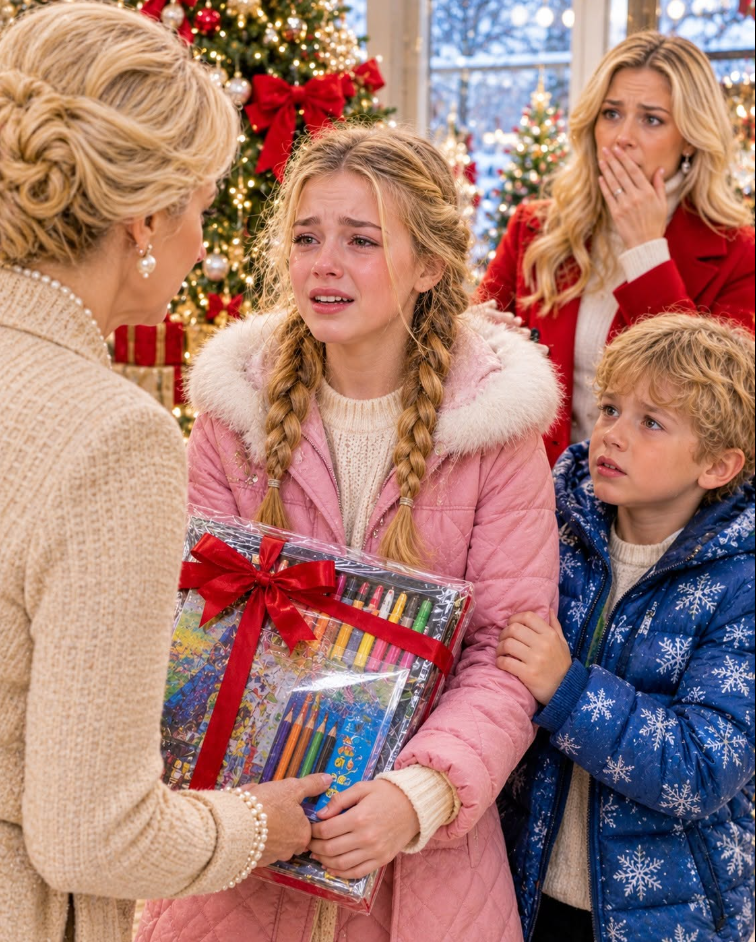
Two days after Christmas, while most children were still exploring their new toys, my eleven-year-old daughter approached a department store’s customer service counter outside Pittsburgh, Pennsylvania. In her arms was the wooden art case she had wanted for almost five months. She asked a woman she had never met whether she could exchange it for food. Initially, I thought she meant sweets or a snack she had noticed while we were shopping. Then the employee gently asked what she hoped to buy, and Lily began listing groceries. “Bread, milk, eggs, and maybe some chicken nuggets for my little brother, if there’s enough money left.”
I am Natalie Bennett. At thirty-nine, I thought my husband, Andrew, and I had created the secure, comfortable home we had imagined when we married thirteen years before. Andrew coordinated purchasing for a construction supply business. I worked in corporate training for a healthcare organization, sometimes traveling around Pennsylvania and nearby states. Our four-bedroom house stood outside Pittsburgh. Lily was in fifth grade, and six-year-old Oliver was beginning to read. We were not rich, but our earnings covered our needs comfortably, and we regularly saved for unexpected expenses. Or so I thought.
The employee’s name was Patricia. She gently slid the case back across the counter. “Why don’t you and your mom talk about it first, sweetheart? You can always come back if you decide you really want to return it.” Before I could answer, Oliver pulled at my coat. “Can we get the big box of crackers, Mommy? The little boxes don’t last very long when you’re gone.” Until then, I had been trying to make sense of one child’s unexpected request. Now both children were telling me something, and neither seemed to realize how alarming it sounded.
I led them toward a bench beside the entrance. We had come to the store with an ordinary shopping list, yet I could no longer think about the errands we had intended to finish. Lily still had the unopened art collection, the present she had spent months wanting. Oliver’s question about crackers lingered beside her explanation about my upcoming trip. There was food in our kitchen. I knew there was food in our kitchen. What I did not understand was why my children spoke as though my departure would change that.
Sitting with them, I asked Lily what her brother meant. She lowered her gaze to her winter boots and remained silent for several moments. I watched her searching for words, not with the impatience I might once have felt, but with a growing sense that the answer required something difficult from her. She looked less like a child deciding how to explain herself than someone trying to work out how to tell the truth without causing trouble.
I had been away before. My work trips were part of our family’s routine, something Andrew and I had arranged around our jobs. From hotel rooms, I had spoken to the children and heard the familiar reports of school, homework, and home. I had believed those conversations told me what I needed to know. Now, beside the store entrance, I was waiting for my daughter to explain the part of that routine I had never seen.
The art case remained unopened between everything I thought I knew and whatever Lily was struggling to say. Its paints and pencils should have represented hours of drawing, not the number of meals their price might purchase. I had assumed that reassuring her would settle the matter. Instead, Oliver’s request and her mention of Cleveland had made reassurance feel inadequate. I needed to listen before I told either child that there was nothing to worry about.
At last, Lily whispered, “There’s always lots of food when you’re home, Mom. It’s different when you’re not.” I reached for my phone to call Andrew, but she quickly caught my hand. “Please don’t tell Daddy I said anything. He gets upset when I complain about the food.” I stopped. Never before had I seen my daughter frightened by the possibility of an ordinary conversation between her parents. Whatever explanation waited at home, I could not dismiss what was sitting beside me on that bench.
We completed our shopping, though I bought far more than planned. When Lily quietly asked about keeping another loaf in the freezer, I purchased two. At home, Andrew was downstairs working on the model railway that had gradually taken over most of our recreation room during the previous three years. Trains had fascinated him since childhood, and I had supported his hobby. I had helped select shelves, given him accessories for birthdays, and listened while he explained distinctions between engines that looked almost identical to me. I believed marriage should leave space for individual pleasures.
He came upstairs, noticed the grocery bags, and lifted his eyebrows. “Planning to feed the whole neighborhood? We’ve already got enough food to get through next week.” I sent the children upstairs with their coats, then described the incident at the store. He seemed amused until he recognized that I was seriously concerned. “Natalie, she’s eleven. Kids exaggerate things. If there’s no macaroni and cheese, suddenly there’s nothing in the entire house they can eat.” I asked, “Then why would she want to give up something she’s been asking for since summer?”
Rather than answer, Andrew opened the refrigerator. Vegetables, dairy products, leftover Christmas turkey, and containers of dessert filled its shelves. “Does that look like a family that can’t afford groceries?” For an instant, I questioned my interpretation. He reminded me of the pictures he sent during my trips: pancakes, pasta, carefully arranged dinners. Then he offered another explanation. “Maybe she just wants her mother around more. You missed her school art exhibition, remember? She’s probably trying to tell you something without knowing how.” His words found the guilt I already carried. Without Lily’s frightened expression that morning, I might have believed him.
After he returned downstairs, I took the art case to Lily’s bedroom, planning to assure her she could keep it. Moving things on her desk, I spotted crackers beneath a chair. Nearby sat the old floral backpack she had stopped using after third grade. Inside were fruit cups, cereal bars, pretzels, raisins, and unopened snacks I recognized from school lunches. Lily appeared as I lifted it. “Mom, please don’t throw those away.” I promised I would not, then asked why she kept groceries upstairs when there was room in the kitchen.
Perched on the edge of her bed, she explained the arrangement with an uncomfortable seriousness. Oliver knew about the backpack and could take food whenever she was unavailable. “Sometimes Daddy says dinner will be ready later, but then he gets busy downstairs. Oliver gets hungry, so I tell him he can take something from my bag.” She had begun collecting the food shortly before Thanksgiving. Sitting beside her, I remembered six weeks of packed suitcases, cheerful hotel calls, and sincere thanks to my husband for managing everything. Throughout those weeks, my daughter had been quietly stocking supplies for her brother.
That afternoon, I took both children to a family restaurant across town. The menus had snowflakes on them, and Oliver immediately chose blueberry pancakes. Lily checked the prices before selecting grilled cheese, then asked whether juice would make lunch too expensive. I told her she could have whatever she wanted. She chose water. Once the waitress left, I explained that she did not need to protect anyone’s feelings, that telling me what happened would not get her into trouble. Slowly, she described evenings when Andrew forgot groceries, disappeared into his railway work, or left them to find dinner in the cupboards.
Sometimes they ate dry cereal or crackers and cheese. Sometimes Andrew ordered pizza. Once, he brought home a restaurant meal for himself, believing they had already eaten. When Lily told him otherwise, he instructed her to make sandwiches. “There were only four pieces of bread left,” she recalled. “I gave Oliver two, and I had one. I kept the other one because sometimes he’s still hungry after his sandwich.” Across the table, Oliver poured syrup over his pancakes. He had no idea how carefully his sister had been dividing what was available.
There was more. Lily had received forty-two dollars for her September birthday and saved it for drawing supplies. When Andrew refused to purchase things Oliver wanted because they were not on his list, she sometimes paid instead. “How much money do you have left, honey?” I asked. “Three dollars.” I thought of airport coffee, a blouse in my closet, all the conveniences I bought without considering them. My daughter had spent thirty-nine dollars making sure her little brother had apples and yogurt. I had never imagined her birthday savings were becoming part of our household budget.
When I asked why she had not called, she said, “Daddy said everything costs more now, and that’s why you have to work so much. I thought if I told you we needed more money for food, you’d have to go away even more.” I reached for her hand. “Lily, listen carefully. We have enough money to buy groceries. You never need to spend your own money feeding this family, and you can call me whenever something is wrong, no matter where I am or what I’m doing.” She nodded, though she did not look entirely persuaded.
Oliver looked up from his pancakes and asked about chicken for dinner. “Real chicken that Mommy makes?” he added. I promised it. Driving home, I remembered Lily proudly telling me she had found his pajamas, made his snacks, and organized his school things. I had praised my dependable helper without recognizing the difference between enjoying responsibility and believing nobody else would take it. That night, after the children were asleep, I opened our household banking account. I needed to understand why they had been rationing food—and whether the answer was hidden in transactions I had trusted Andrew never to make.
PART 2 — The Money Beneath the Miniature Town
Every Friday, Andrew and I put $230 into an account reserved for groceries, toiletries, cleaning supplies, and everyday household purchases. Our mortgage, utilities, and other major bills came from elsewhere. We also each had our own spending allowance. Since Andrew handled much of the shopping when I traveled, I had rarely studied individual transactions. That night, I went through them carefully. Beginning in mid-November, money had repeatedly moved out of the household account and into his personal one. There were six transfers, the smallest $140 and the largest $185.
I found him downstairs fitting a miniature station beside the tracks. Boxes I did not recognize sat beneath his workbench. Near his tools lay a receipt dated December 3 for a locomotive costing $329.95. That was the same week Lily had used her birthday money for groceries. “Andrew, did you purchase this with money from our household account?” He looked at the receipt and grew uncomfortable. “I borrowed a little from that account. I was going to straighten everything out after the holidays.” I held out my phone. “Nine hundred and sixty dollars isn’t a little. That’s most of our household budget for six weeks.”
“She offered to pay. I never asked her to.” His answer left the responsibility exactly where it should never have been. “She’s eleven years old, Andrew. You were supposed to tell her to put her money away.” He insisted they had breakfast, school lunches, and things available at home. Then he opened Facebook and showed me his Christmas photographs: our decorated dining room, the children in matching pajamas, himself beside the dinner I had bought and cooked. His caption celebrated caring for his family. His mother’s comment praised his devotion as a father.
Beside us stood the miniature town he had arranged with such extraordinary care. Its houses glowed, its sidewalks were orderly, and every building had its place. He had invested attention and money in making that imaginary community function while ignoring his children’s basic needs upstairs. The missing money mattered, but something else frightened me more. Even after hearing about Lily’s savings and the food in her backpack, he appeared more interested in excusing himself than understanding what she had experienced. I could not find that understanding anywhere in our conversation.
The next morning, his mother, Margaret, arrived with homemade Christmas cookies. A retired elementary school secretary, she loved the children, though she often defended Andrew when we disagreed. He had evidently contacted her before breakfast. “Natalie, I understand you’re concerned, but raising two children while working full-time isn’t easy. Andrew has quite a lot to manage when you’re traveling.” I acknowledged that parenting was demanding. Then I asked whether he had told her what Lily had attempted to do with her Christmas present. Margaret’s confused expression made the answer clear.
We sat at the kitchen table. I showed her the records and repeated what the children had told me. Andrew interrupted repeatedly, insisting that my account was unfair. His mother grew quieter as she studied the numbers. Before she responded, Oliver appeared, saw the cookie tin, and asked excitedly if he could have some. “Of course, darling,” Margaret replied. He turned toward Lily. “Can we save some in your food backpack for Monday?” Margaret looked at her granddaughter. “What food backpack?” Andrew immediately told Oliver to go upstairs.
I asked him to stay and went to Lily’s room for the bag. Whatever Andrew had told his mother, she had not heard enough to understand why my son associated cookies with an emergency supply. I brought the old floral backpack into the kitchen and placed it on the table. These were not figures on a banking screen or competing versions of an argument. They were the things Lily had gathered because she did not trust that dinner would arrive when her brother needed it.
I emptied the backpack onto the table. Margaret picked up a packet of crackers and examined it, struggling to reconcile what she held with what she had believed about her son’s home. Fruit cups, bars, pretzels, and raisins lay where we usually ate together. The contents had seemed so small in Lily’s bedroom. Spread before her grandmother, they revealed the responsibility my daughter had been carrying. Andrew’s explanations had filled the kitchen moments earlier. Now his mother was looking directly at the evidence of what those explanations had left out.
Margaret remembered a dinner during one of my November trips. After eating at her house, Lily had requested two containers of leftovers, saying she wanted enough for herself and Oliver the following evening. Andrew had discouraged her, telling his mother there was plenty at home. Another time, Lily had asked for the remaining rolls. Margaret had thought nothing of either request then. Now she asked, “Lily, sweetheart, were you worried there wouldn’t be enough dinner at home?” Lily glanced anxiously at Andrew before nodding. Her grandmother’s eyes filled with tears.
Turning to her son, Margaret asked whether he had received enough money for groceries. After trying to explain, he admitted that he had. “Then I don’t understand,” she said. “How could you spend hundreds of dollars on your collection while your little girl was asking me to pack food for her brother?” He had no adequate reply. A few minutes later, Lily asked the question that settled everything for me. “Grandma, will I still be allowed to come to your house when Mommy goes away?” She was checking whether a dependable dinner would remain available. I held her close and promised change.
Andrew was angry when I told him he would not be the children’s sole caregiver during my trips for the foreseeable future. He asked whether I planned to leave my job. When I said I would arrange reliable childcare, he laughed as though I would soon discover I could not cope without him. That afternoon, I spoke to my supervisor. A colleague would cover Cleveland’s upcoming training sessions while I joined remotely. My longtime friend Rebecca, who lived nearby, helped me identify trustworthy childcare options.
Margaret offered to help whenever she could. I appreciated that, but explained that I wanted a dependable arrangement, not an expectation that she would inherit the responsibilities Andrew had neglected. I saved our banking statements, secured my personal accounts, and contacted the bank about restructuring our household finances. Money intended for the children needed to remain available for them. I also arranged a family-law consultation and appointments with their pediatrician. None of those steps could erase what had happened, but I could no longer rely on reassurance where safeguards were needed.
Andrew accused me of humiliating him. I reminded him that Lily had offered a stranger her most treasured Christmas gift because she feared her brother would not have enough to eat. “She’s the one who should never have been placed in that position. I’m not going to ignore what happened just to make this easier for you.” His embarrassment could not become another reason for silence. For weeks, our daughter had worried about protecting him, protecting me, and protecting Oliver. Someone needed to protect her without first considering whether doing so made the adults uncomfortable.
Eventually, I told Andrew I thought we should live apart while deciding whether our marriage could recover. We argued for a long time before he called his older brother and arranged to stay there. Before leaving, he hugged Oliver and told Lily he loved her. She remained unusually quiet. I did not mistake that silence for agreement or relief. She had already shown me how much could remain unspoken beneath the ordinary appearance of our family. I knew I would need to listen without assuming I understood.
At dinner that evening, we ate chicken, mashed potatoes, and roasted carrots. Lily suddenly asked whether her father had gone because she told me about the groceries. I set down my fork. “Your daddy and I are dealing with grown-up problems, honey. You didn’t create those problems by telling me about them. You helped me understand something I needed to know.” She had spent weeks trying to prevent problems for everyone else. Even now, with food on her plate and her brother beside her, she was wondering whether telling the truth had harmed our family.
The practical arrangements mattered, but I could see they did not answer every fear she carried. I had changed the coming week, contacted people who could help, and made sure groceries were available. Lily could not simply set down her worries because I had begun correcting the circumstances that created them. She had learned to plan around uncertainty. Now she was still watching the consequences of speaking, trying to determine whether the changes were safe and whether she bore responsibility for them.
After dinner, I carried the art collection into the living room and suggested opening it together. Lily traced the plastic with her fingers. “Could we wait a little longer, Mom?” I answered, “Of course. Is there a reason you want to wait?” She looked toward the kitchen. “I just think we should keep it new, in case we need to take it back.” The groceries, the childcare arrangements, and the financial safeguards had not changed what the case meant to her. It was still something she might have to exchange for the family’s needs.
I had thought uncovering the missing money would expose the heart of the problem. Instead, that unopened gift showed me how far beyond the bank account the damage reached. Replacing dollars would be straightforward compared with restoring the certainty a child should never have lost. Lily was still keeping her escape plan wrapped in plastic. I could make sure there was dinner tomorrow, but I did not yet know what it would take for my daughter to believe she could finally open her present.
PART 3 — Learning to Let Her Be a Child
During the first week of January, Lily’s art teacher, Mrs. Sullivan, contacted me about an after-school program for children particularly interested in drawing and painting. She described Lily as exceptionally talented. But when she had mentioned the opportunity, Lily had worried that attending might interfere with caring for Oliver. Even at school, where her imagination should have had room to grow, she was measuring what she wanted against what she thought the family required. I recognized the same calculation that had kept the plastic on her Christmas present.
After sitting quietly beside me, she asked, “Mom, will you still think I’m a good daughter if I don’t help as much anymore?” I put my arms around her. I remembered all my praise for her maturity, all the times I had thanked her for making life easier for Andrew. Without intending to, I had helped her connect being loved with being useful. What I thought were compliments had become part of the responsibility she carried. She needed to know that putting it down would not cost her my affection.
Over the following weeks, both children saw a family counselor. They began learning that asking for help was allowed and that their parents’ duties were not theirs to carry. Oliver slowly stopped checking Lily’s face before requesting more food. Lily began going upstairs at night without first inspecting the refrigerator. Those changes were ordinary enough that I might once have overlooked them. Now I understood what they meant. The children were beginning to trust that their needs would be noticed without Lily constantly monitoring whether something might go wrong.
Andrew started selling valuable pieces from his railway collection. When he called to say he intended to repay the missing money, I told him that mattered, but that reimbursement alone would not repair everything. The amount could be counted. The worry Lily had carried could not. Neither could Oliver’s habit of turning to his sister when he was hungry. I wanted Andrew to understand that returning money was a first step toward accepting responsibility, not a way to close the subject before he had faced what happened.
Several days later, he visited and gave Lily an envelope holding thirty-nine dollars. “This belongs to you,” he told her. “I should never have allowed you to spend your birthday money on things I was responsible for buying.” Before accepting it, she looked at me. “Are you still upset because I told Mommy?” He lowered himself beside her chair. “No, honey. You did the right thing. I’m sorry I ever made you feel that you couldn’t talk to her.” For once, his apology did not immediately turn into a defense of his behavior.
I did not know whether Andrew and I would reconcile. Still, I was grateful that Lily had heard him acknowledge his responsibility without asking her to excuse him. She needed those words from him, not merely my reassurance about what he should have understood. The envelope returned what she had spent. His apology addressed something the money could not: her fear that speaking honestly had been wrong. I could appreciate that moment without deciding what it meant for the future of our marriage.
The next Saturday, I went into Lily’s bedroom and found pieces of clear plastic scattered over her desk. For so long, the covering had seemed almost more important than the paints it protected. She had kept the art collection ready to return, unwilling to turn something valuable into something used. Now the wrapping was no longer intact. I looked from the plastic to the desk and understood that she had made a decision no arrangement, conversation, or bank transfer could make on her behalf.
Her wooden art case stood open. Lily was painting a snow-covered farmhouse with her new watercolors. “Mom, do you think we could get some more watercolor paper next time we go shopping?” I smiled and said we certainly could. She was asking for something that would let her continue creating, not calculating what she could surrender. For the first time since Christmas, the gift was simply hers. She did not have to preserve its price or protect it for everyone else. She could use the paints for the reason she had wanted them.
Several weeks later, I prepared for my first overnight work trip since Christmas. Margaret would stay at our house, Rebecca was nearby if needed, and the children had a clear schedule covering school, homework, meals, and art club. Even so, while I closed my suitcase, Lily asked whether her grandmother knew what Oliver liked for dinner. I assured her that everything had been arranged. Kissing her forehead, I reminded her that her responsibilities were the ordinary responsibilities of a girl her age. Looking after her brother’s meals was not one of them.
On Monday evening, I sat in my Cleveland hotel room until our usual calling time. Oliver answered with excitement: Grandma had cooked spaghetti, and he had eaten three meatballs. Margaret moved the camera toward Lily, who was at the dining table among pencils and sheets of paper. For the next ten minutes, my daughter described a horse picture she was preparing for the spring school exhibition. She explained the difficulty of drawing its moving mane and her wish to make the background resemble an early summer morning.
She did not mention groceries. She did not report on her brother’s dinner or tell me whether Margaret needed help. She talked about her drawing, the movement she wanted to capture, and the picture she hoped to finish. After we said goodnight, I cried alone in the unfamiliar room. Nothing remarkable had happened during the call. That was what made it overwhelming. My daughter had spent ten minutes sharing something she loved without treating the conversation as an opportunity to reassure me that she was managing the household.
By April, Andrew had repaid the full $960 and continued attending counseling. With professional guidance, we developed a temporary parenting arrangement that let him see the children while showing he could consistently meet their needs. We remained separated. I hoped he would keep becoming a more dependable father, but I no longer believed the survival of our marriage should take priority over the children’s well-being. What happened next needed to rest on what he reliably did, not the appearance of a happy family or promises that everything would improve.
One Saturday afternoon, I brought Lily and Oliver back to the department store. Patricia recognized my daughter almost at once. “Well, hello there! Did you ever decide what to do with that beautiful art collection?” Lily smiled. “I kept it! I’m in art club now, and one of my pictures is going to be in our school exhibition.” She showed Patricia a photograph of the completed horse drawing. Patricia admired it with genuine enthusiasm. This time, Lily stood at the counter explaining what her gift had helped her make, not what it might buy.
Before we left, I quietly thanked Patricia for how she had treated my daughter that December morning. “Sometimes children tell us something important without knowing how to explain it,” she said. “I’m glad you listened to her.” I thought about how close I had come to explaining Lily’s fear away. The refrigerator had been full. Andrew had pictures. My own guilt about traveling had made his explanation easy to hear. But Lily’s words and the way she had caught my hand had mattered more than the reassuring version I wanted to accept.
Later, in the arts and crafts section, Lily found colored pencils she wanted to buy with her savings. She described the pictures she could make with them. Not once did she ask whether spending the money would leave enough for groceries. Her savings belonged to her again, just as her Christmas present did. I listened to her plans without praising her for being sensible, helpful, or unusually mature. She was interested in colors and drawings. There was no household problem hidden inside the purchase, and she did not need to create a practical reason to enjoy it.
That evening, while I prepared dinner, Oliver called from the living room. “Lily! I’m hungry!” I stopped chopping vegetables. A few months earlier, she would have put down whatever she was doing, searched the kitchen, and found food for him before returning to her own activity. This time, she stayed at the dining table with her picture of spring flowers. “Go ask Mommy, Ollie!” He ran into the kitchen. I sliced an apple and set it on his favorite blue plate. From the other room came the sound of Lily humming as she colored.
Anyone looking through our kitchen window would have seen an ordinary evening: a mother making dinner, a boy eating a snack, and his sister drawing. To me, it was worth more than an expensive Christmas present. Lily was learning that generosity did not require giving up her own happiness. Loving her brother did not make her responsible for raising him. The people who loved her were supposed to give her the security she had tried to create with cafeteria snacks, birthday money, and an unopened art case.
I once believed a good childhood meant making sure my children had everything they needed. Now I knew it also meant protecting them from the belief that care had to be earned by caring for everyone else. At eleven, Lily deserved colored pencils bought with birthday savings, worries about finishing a school drawing, and dreams about pictures she might someday create. She deserved to open Christmas presents without calculating their value as groceries. Above all, she deserved to be a cherished little girl, not the person quietly holding our home together. She was beginning to trust that freedom. Whether Andrew could become someone who helped protect it—and what that would mean for our family—remained unanswered.