PART 1 — What Happened Behind My Back
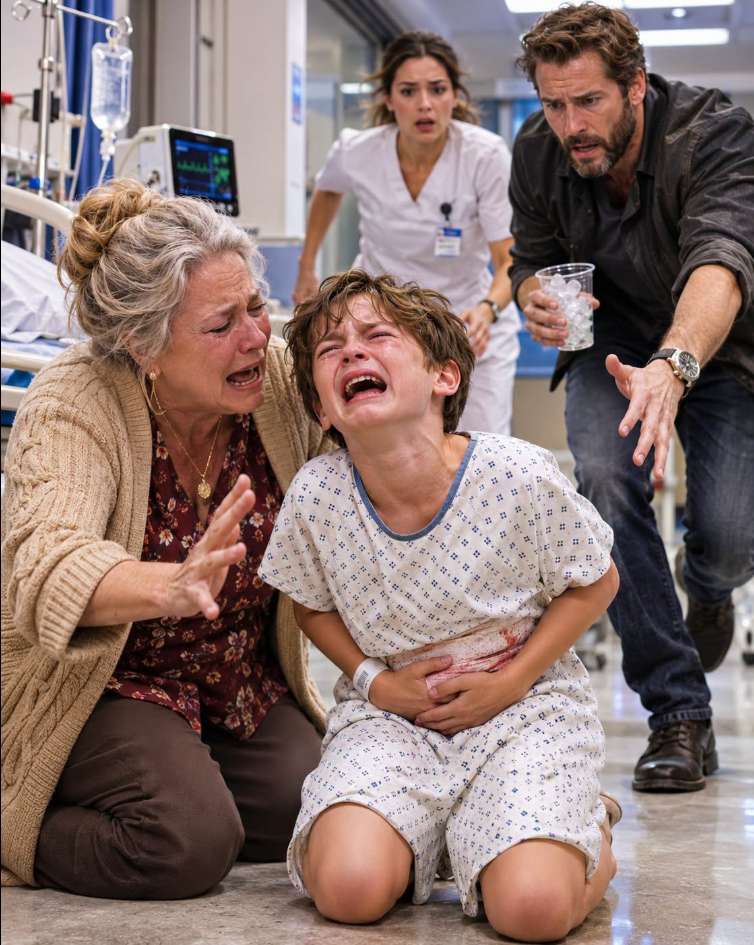
“Get up, Ethan! Stop pretending you’re invalid! At your age, your father was already working a paper route, and you can’t even get out of bed!” Those were the words my mother, Evelyn Miller, was shouting as she dragged my thirteen-year-old son from his hospital bed less than forty-eight hours after emergency surgery. I was coming back along the corridor carrying a cup of ice chips when Ethan dropped to his knees on the linoleum. Both hands went straight to his abdomen. The scream that followed has never left me; even now, I can hear it whenever I shut my eyes. “Grandma, please… it hurts so bad.” My mother struck him across the face. “Stop crying like a little girl!”
My son was gentle, reserved, and sensitive in a way I should have understood more carefully. Drawing animals made him happy. His finest sketches often went to his grandmother, although she repeatedly dismissed him as “too soft.” Then, one Thursday in October, he woke in terrible abdominal pain. We went to Nationwide Children’s Hospital, where the doctors found a perforated appendix and a serious infection throughout his abdomen. Emergency surgery could not wait. Afterward, Dr. Grant told me the operation had been difficult. Ethan would need intravenous antibiotics and careful observation. He was not to attempt standing without physical help from the nursing staff.
On Saturday morning, I went down to the nurses’ station for a few minutes to ask about the timing of his pain medication. Coming back, I heard shouting carrying through the hallway. When I rounded the corner, Evelyn had Ethan by the upper arm. She was pulling him upright, hauling him away from the bed, and all but throwing him onto the floor. Then she slapped him. I ran toward the room as a nurse called from the doorway, “Ma’am, let go of that child right now!” Before I could get to him, Ethan raised his head. A narrow streak of blood ran from his split lower lip.
He didn’t reach for me or ask me to help. Instead, he whispered, “Dad, I’m sorry… please don’t tell Grandma I told on her.” Those words broke something inside me. My son was on a hospital floor, hurting after abdominal surgery, and his first thought was that he might be in trouble for letting me see what had happened. In that instant, I understood that the hospital was not where this had begun. There was a history behind his apology, behind his terror, behind the instinct to protect his grandmother from consequences while he was the one suffering. I had no idea yet how many years of that history I had failed to recognize.
By the time I got close enough, my mother had lifted her hand again. She was preparing to hit him a second time. I caught her wrist before it could come down. “Don’t you ever touch him again.” Evelyn looked at me in astonishment, as though my stopping her was the shocking part of what had happened. “Arthur, let go of me. That boy needs discipline.” I could barely believe what I was hearing. “He just came out of surgery!” She answered without hesitation: “Which is precisely why he needs to get moving! They’re turning him into a cripple!”
Charge Nurse Brenda, an experienced pediatric nurse in her fifties, was already kneeling beside Ethan. Her attention went to him, not to my mother’s excuses. “Ethan, sweetheart, don’t try to sit up. Stay still—we’ve got you.” She reached for the emergency call button on the wall and pressed it. Within moments, the room filled with doctors, orderlies, and two uniformed hospital security officers. I remained beside the bed, trembling from head to foot. Everything was happening around me, but all I could see was my son on the floor and the pain my own mother had inflicted on him.
Dr. Grant examined Ethan’s surgical area with care. His face changed as he assessed the damage: an internal suture appeared to have torn, and the surgical drain had been partly dislodged. He ordered an immediate stat CT scan. Evelyn moved forward. “Doctor, don’t make a federal case out of this. I was only trying to get him on his feet.” Brenda stepped directly into her path. “Ma’am, you need to leave this room immediately.” My mother bristled. “I am his grandmother!” Brenda did not move. “And he is my patient.”
Security took Evelyn off the floor. Even then, her concern was not for the child she had hurt. Just before she entered the elevator, she turned back and called, “You’re going to regret humiliating me in front of strangers.” I gave her no answer. My attention stayed with Ethan, who was crying without making a sound, the hospital sheet clenched tightly between his fists. “I’m sorry, Dad,” he whispered. I looked at him, unable to understand why he believed any of this belonged on his shoulders. “Why on earth are you apologizing to me?” His reply was almost unbearable. “Because I made Grandma mad.”
Something in my chest seemed to break completely. He was injured, frightened, and still convinced that another person’s violence was the consequence of something he had done wrong. Later that afternoon, the surgeons confirmed that he needed another procedure. The fall had caused internal damage that had to be repaired. I asked the medical team to photograph every injury and document everything they found. I also requested an immediate meeting with the hospital social worker. Whatever explanations my mother might offer afterward, I wanted a clear record of what had happened to my son.
That evening, I went to a Columbus Police Department precinct and made a formal assault report. The hospital administration preserved Ethan’s medical records and the security footage from the hallway. My phone began ringing over and over as my mother tried to reach me. Her first messages were tearful. Later ones became vicious. She accused me of destroying our family over a “manipulative, dramatic kid.” I kept every voicemail. Her anger no longer distracted me from what mattered. Ethan needed protection, and I could not allow her account of events to replace the facts the medical staff and I had witnessed.
On Sunday morning, my younger sister, Claire, called from Cincinnati. “Arthur, I need to ask you something,” she said quietly. “Did Mom really hit Ethan?” I described what had happened, from the hospital bed to the injuries and the second surgery. For several long seconds, she said nothing. Then she began to cry. “She used to do the exact same thing to me when we were kids.” I felt cold all over. “What are you talking about?” Until that moment, I had believed I understood the childhood we had shared. Her next words showed me how much I had never known.
“She’d yank my hair, lock me in the laundry room, and hit me whenever I cried. Afterward, she forced me to tell Dad I’d tripped on the stairs. You never knew because she always treated you differently.” Her confession brought back memories I had pushed aside or explained away. There were mornings Ethan pleaded not to go to his grandmother’s house. There were stomachaches that appeared before visits. There was the way he apologized for things that were not his fault, sometimes before anyone had even accused him. I had seen those signs separately. Hearing Claire speak made them come together in a way I could no longer avoid.
Two days later, after Ethan had stabilized following his second operation, a pediatric psychologist met with him. When their conversation ended, she asked whether we could look through the spiral sketchbook in his backpack. It was the drawing pad he guarded so closely, the one he never wanted anyone else to touch. I knew how important drawing was to him. I had not understood that those pages might contain things he had been too afraid to say aloud. Between the familiar wolves, red-tailed hawks, and imagined characters were drawings that made it difficult for me to breathe.
On one page, a woman held a small boy tightly by the arm. Beneath the picture, written neatly in pencil, were the words: If Dad asks, I have to say I fell. Another drawing showed our house. Behind a closed bedroom door, a boy was crying. These were not the kinds of pictures I had imagined finding among Ethan’s animals and fantasy figures. They showed fear I should have noticed outside the sketchbook, fear that had existed in the ordinary places where I had assumed he was safe. The pages held a record of something he had not felt able to tell me.
The most devastating discovery was hidden inside the back cover: a folded letter addressed to me. Before I opened it, the psychologist asked me to sit down. The first line read: Dad, if anything ever happens to me while I’m with Grandma, please don’t believe her when she says it was my fault. I had already seen my mother hurt him. I had heard my sister describe what she had endured. Even so, I was not prepared for what my son had written. As I unfolded the letter and continued reading, the last four years of our lives began to change before my eyes.
PART 2 — The Truth He Had Been Afraid to Tell
The letter was in Ethan’s familiar handwriting, small and slightly slanted. I recognized the faint traces left behind where he had rubbed out words and tried again. I had seen that same writing countless times while helping him with middle school assignments. Now it was carrying a message I wished he had never needed to put on paper. In the upper-right corner, he had written a date. It was from six months before his surgery. He had been carrying these words for half a year while I continued believing that his grandmother’s help made his life easier.
Dad, I know you work really hard and Grandma helps out so we can afford groceries and keep the house. That’s why I never wanted to make trouble for you. Still, sometimes I’m scared to stay with her. When she gets mad, she squeezes my arms until they bruise and tells me I’m weak just like my mom. She says if I tell you, you’ll have to quit your job to watch me and it’ll be my fault if we go broke. I stopped reading long enough to make myself breathe. Across from me, Dr. Sarah Jenkins, the child psychologist, remained quiet. She gave me the space to take in what my son had believed he needed to endure.
Then I made myself go on. The day I hurt my wrist, Grandma told me to stop whining. When I asked her to call you, she locked me out on the back patio until I stopped crying. Later she told you it was an accident. I didn’t want to lie to you, Dad. I was just scared you’d be mad at me too. I could remember that afternoon clearly. Ethan’s eyes had been red and swollen when he came home, and he kept his injured wrist tucked into the sleeve of his hoodie. My mother told me he had fallen while playing in the yard. I believed her without challenging the explanation.
Worse, I could remember what I had said to him: “You need to listen to your grandmother. She only wants what’s best for you.” The memory was almost impossible to bear. He had been frightened of disappointing me, and I had answered that fear by reinforcing the authority of the person hurting him. I had thought I was supporting an adult who helped our family. Reading his words, I saw what that reassurance must have meant to a child who had already been threatened into silence. He had needed me to ask more questions, and I had accepted the easiest answer.
The last paragraph hurt more than anything that came before it. I don’t want you to stop loving Grandma because of me. I love her too when she’s in a good mood. Sometimes she makes cinnamon rice pudding and lets me pick a movie. I wish she could be like that all the time. I’m sorry I’m not as tough as you want me to be. I covered my face with my hands. For years, I had congratulated myself on having such a polite, well-behaved son. Now I understood that what I had mistaken for calmness had often been fear. His silence had not meant that everything was all right.
Dr. Jenkins waited while I cried. When she finally spoke, her voice was gentle. “Mr. Miller, I need you to understand something. Ethan didn’t hide this to deceive you. He was trying to protect the stability of his family.” I could think of only one answer. “I should have seen it.” She did not tell me that the past could be made different. Instead, she brought me back to the responsibility still in front of me. “You can’t change yesterday, Arthur. What matters now is that you listen to him and protect him. That’s what he needs most.”
That afternoon, I returned to Ethan’s room. He was resting against his pillows, looking at the autumn rain running down the window. I moved a chair beside the bed and sat with him. “I found your letter, buddy.” Panic widened his eyes immediately. “Are you mad at me?” The question sent a sharp ache through my chest. Even after everything that had happened, he was afraid that telling the truth would make him the one in trouble. “No, son. Never.” He asked, “Is Grandma mad?” I answered, “It doesn’t matter what Grandma thinks.”
He lowered his gaze to his hands. “I didn’t want you guys to fight.” I took one of those hands carefully in mine. There were things I needed him to hear plainly, without any room left for the excuses he had been taught to make. “Listen to me carefully. You did nothing wrong. It was never your job to endure pain so I could keep working. I’m the adult. Protecting you was always my responsibility.” His lower lip started trembling. “You always said she helped us so much.” He was right. I had said that repeatedly, never realizing the burden those words were placing on him.
“And I made a terrible mistake thinking that helping with groceries or rides gave anyone the right to hurt you.” Then he asked something I have never been able to forget. “Even though she’s your mom… are you going to believe me?” I leaned toward him and wrapped my arms carefully around his shoulders, making sure not to press against his surgical incisions. There was no answer I could give him that would undo the years before that moment. There was only the truth he should never have needed to question: “I believe you, son. And you will never again have to prove to me that you deserve to be safe.”
For the first time since his operation, Ethan cried without putting a hand over his mouth to silence himself. I did not ask him to stop or try to hurry him through it. I held him and let him cry for as long as he needed. He had spent too much time making himself quiet. In that hospital bed, after another surgery and after finally letting me see what he had hidden, he did not have to protect anyone from the sound of his pain. My arms stayed around his shoulders, careful of the wounds that were still healing.
The weeks afterward demanded every bit of resolve I had. Ethan remained hospitalized longer than the doctors had originally expected. The second procedure repaired the damage, but the infection brought on by the fall required a longer course of intravenous antibiotics. While the medical team worked to get him well, my mother began telling relatives a completely different version of events. She said Ethan had tried to climb out of bed alone and lost his balance. According to her, I was blaming her because the hospital needed someone to hold responsible. In her version, the harm she had caused became something done to her.
Before long, relatives were calling constantly. My Uncle Frank was first. “Arthur, your mother is nearly seventy years old. Are you seriously pressing criminal charges over a slap?” I answered, “It wasn’t just a slap, Frank.” He dismissed the concern. “Kids today are wrapped in bubble wrap.” I made myself state what had happened as plainly as possible. “My son’s abdomen had just been stitched back together after emergency surgery. She dragged him onto the floor.” He replied, “She’s still your mother.” I drew a slow breath before answering. “And Ethan is my son.”
There was silence on the line. I offered, “If you want, we can sit down and look at the surgical report and the hallway video together.” Frank did not raise the subject again. Other family members argued that we should settle it “quietly inside the family.” I told them that abuse does not become acceptable because the people involved are related or because it takes place where outsiders cannot see it. Some aunts and cousins stopped speaking to me. For the first time, their disapproval did not change my decision. The cost of keeping everyone comfortable had already fallen on Ethan for far too long.
Claire took a week away from work and drove from Cincinnati to help when we returned home. One evening, as we made coffee in my kitchen, she spoke about something she had carried for more than thirty years. “When we were kids, I genuinely believed Mom treated me that way because there was something defective about me.” I looked at her, helpless in the face of what she had lived with. “I had no idea.” Claire answered, “I know. Still, I remember whenever I cried, you used to whisper at me not to make her angry.” Shame moved through me as I understood what she was saying.
She was not trying to hurt me. She was helping me recognize the pattern that had shaped our family. My mother used intimidation to keep control. The rest of us learned to move carefully around her anger. When somebody was hurt, the expectation was that the injured person would restore the peace, rather than that the person responsible would stop causing harm. I had carried that understanding into adulthood without calling it what it was. That night in the kitchen, I finally saw how many years I had spent confusing fear with respect, and how easily that confusion had become part of my son’s life.
The investigation continued. Once Ethan was well enough, trained forensic interviewers spoke with him at the child advocacy center. Franklin County prosecutors gathered his account, the surgical records, statements from the nurses, and the security footage. Child Protective Services began a separate safety review and issued an immediate no-contact order preventing my mother from approaching him. Evelyn responded with fury. In one voicemail, she said, “Arthur, I sacrificed my life for you kids. I raised you, fed you, and made sure you never went without. Is this how you repay me? Letting a spoiled boy destroy his own grandmother?” I listened once, saved the recording, and did not answer.
Three weeks later, she sent another message: If Ethan hadn’t been so dramatic, none of this would have happened. That was when I stopped waiting for an apology. I could no longer pretend she was merely too upset to recognize what she had done. In her understanding, the terrible thing was not that she had injured her grandson. The terrible thing was that, this time, someone had refused to excuse it. Her messages left me with the same truth again and again: she was still making a child responsible for her behavior, even while he was recovering from its consequences.
Months passed before the case reached a formal court hearing. Claire sat beside me in the gallery. Ethan did not have to confront his grandmother in the courtroom; his testimony was submitted through protected forensic procedures for minors. Evelyn arrived in a crisp white blouse and the navy blazer she wore to church on Sundays. Her lawyer pointed to her age, her previously clean record, and all the years she had helped care for her grandson. The prosecutors presented the surgical photographs, Dr. Grant’s medical testimony, and Brenda’s eyewitness account. The evidence described what her explanations kept trying to turn into ordinary discipline.
When questioned, my mother continued insisting that discipline was all she had intended. The prosecutor read Ethan’s plea for her to stop. For a moment, Evelyn lowered her eyes. I watched her, wondering whether she had finally heard what he had been saying—whether, beneath all the anger about being exposed, there might at last be some recognition of his suffering. Then she raised her chin. “I raised three children that exact way,” she said firmly. “Not one of them died from it.”
PART 3 — The Line I Finally Drew
Her answer filled me with a sorrow I still struggle to describe. It was not surprise. By then, I knew how fiercely she would defend herself. It was the realization that even there, standing before a judge, she could not acknowledge my son’s pain. She spoke as though survival settled the question of whether the treatment had been acceptable. The court convicted her of misdemeanor child endangering, ordered restitution for Ethan’s second operation and therapy expenses, placed her on probation, and entered a long-term protective order prohibiting all contact. The ruling established consequences she had spent a lifetime expecting other people to prevent.
Leaving the courtroom did not feel like a victory. Nothing the judge ordered could restore the years Ethan had spent watching his grandmother’s moods and trying not to upset her. The decision could not remove the fear he had carried or undo the times I had failed to understand it. What it did provide was a firm boundary, one I should have established long before anyone in a courtroom had to do it for me. Outside, in the courthouse lobby, I noticed my mother sitting alone on a bench beneath a tall window.
For a moment, I remembered other versions of her: the woman who walked me to the bus stop, baked Thanksgiving pies, and sat beside me when I had a fever, dabbing my forehead. Those memories were real. So was what she had done to Ethan. Recognizing that she had sometimes been loving did not erase the cruelty, and I could no longer use one truth to hide the other. She looked up as I came closer. “Are you satisfied now, Arthur?” I did not respond immediately. “You took my grandson away from me,” she continued bitterly. “You humiliated me in front of the entire family.”
“Mom, Ethan ended up back on an operating table because you hurt him.” Her reply was familiar. “I only wanted to make him strong.” I held her gaze. “My son was already strong. Strong enough to endure years of your cruelty and still draw birthday cards for you every single year.” Her lips trembled a little. “Everything I ever did was for this family.” I asked the question that mattered. “Then tell me one thing. Can you admit you hurt him—without making a single excuse?” I waited while the silence lengthened between us.
At last, she said, “One day that boy will grow up and understand what raising children actually takes.” I knew then that we were saying goodbye. “Maybe one day he’ll decide he wants to talk to you,” I told her quietly. “If he does, that will be entirely his choice. I will never again force my son to be near someone who makes him afraid.” I turned away before she could respond. It did not feel as though I had won anything. It felt like the first time I had chosen to protect someone I loved without first seeking my mother’s permission.
Over the months that followed, I learned how much faster surgical wounds can close than fear can fade. Ethan grew stronger, returned to middle school, and gradually began eating normally again. But other changes came more slowly. He asked whether he could pour himself a glass of milk, as though an ordinary decision might bring punishment. A raised voice from another room could make him flinch. If juice spilled, apologies came pouring out before anyone had reacted. His body was recovering, but the habits he had learned in order to stay safe did not disappear simply because I told him the danger was over.
One evening, he was helping me put away the dishes when a ceramic plate slipped from his hands. It hit the kitchen tile and broke. I turned at the sound and found him standing completely still, staring at the pieces on the floor. “I’m sorry, Dad. I swear I didn’t mean to drop it.” His reaction was far bigger than the accident in front of us, but by then I understood why. A broken plate was not only a broken plate to a child who had been taught that mistakes could make an adult dangerous.
I knelt beside him. “Hey—it’s okay. Let’s grab the broom and sweep it up carefully so nobody gets cut.” He looked at me. “You’re not mad?” I answered, “It was an accident, bud. A plate costs five dollars; you can’t be replaced.” He stared as if I had told him something extraordinary. To me, those words described a truth that should have been ordinary. To him, they were something he still needed to learn he could trust. We were dealing with pieces of a plate, but the fear in that moment had come from years of something much larger.
Later that night, I cried alone behind my bedroom door. I was beginning to understand how long it can take to teach a child that an accident does not justify cruelty. I could remove my mother from his daily life, cooperate with the investigation, and follow the court’s protections. None of those things instantly erased what he had already learned. Safety had to become more than something I promised during a serious conversation. It had to be something he could discover repeatedly in ordinary moments, including moments when something went wrong and he expected the worst.
Both Ethan and I began regular counseling. I needed to examine why I had accepted conduct I now recognized as abuse and why I had kept explaining it away. Therapy helped me separate things I had spent years treating as inseparable. Loving a parent did not require unquestioning obedience. Gratitude for help did not give someone unlimited authority over our lives. Keeping peace in a family was not a goal worth pursuing at the expense of a child’s safety. Those lessons were not only about my mother anymore. They were about the kind of father I needed to become after finally seeing the harm I had missed.
On a rainy Sunday afternoon, Ethan came out of his room with his sketchbook and settled beside me on the couch. “Dad, I want to show you something.” He turned to a new drawing. It showed a hospital room, with a small boy in bed and a broad-shouldered man standing in the doorway, his arms spread wide. “That’s you,” Ethan said softly. I studied it for a while. “You drew me way bigger than I am.” He smiled. “That’s how big you looked to me that day.” Tears filled my eyes.
“I should have protected you a lot sooner.” Ethan considered that before resting his head on my shoulder. “Yeah. Still… you showed up, Dad.” I had no answer, because both things were true. I had reached him that Saturday, and I had also failed to recognize warning signs for years before it. His gratitude did not cancel my responsibility. My regret did not make what I did afterward meaningless. Learning to carry those truths together became part of trying to be the father he deserved. I could not change the time I had lost, but I could refuse to hide from it.
Two years have gone by since that October. Ethan is fifteen now, almost my height, and still draws every day. Last spring, he took first place in a regional high school art competition covering central Ohio. His winning picture showed a warmly lit house standing solidly in the middle of a fierce storm. When the judges asked what it meant, he answered, “A place where you know you’re safe, no matter how rough things get outside.” I sat among the other parents in the auditorium and watched him walk onto the stage.
When his name was announced, he searched the audience until he found me. Then he raised his award and grinned. There was no anxious glance around the room, no sign that he was checking whether someone approved, no fear of getting something wrong. He simply looked happy. Watching that expression on his face meant more to me than any accomplishment of my own ever had. For so long, I had mistaken his efforts not to attract anger for good behavior. Seeing him openly enjoy his own success showed me something entirely different: a boy who no longer had to make himself smaller.
My mother still sometimes tries to contact us through relatives. A few months ago, six handwritten pages arrived in an envelope. She wrote about being lonely, about her arthritis, and about how badly she missed her grandson. Nowhere did she acknowledge what she had done to him. I put the letter in a drawer and did not respond. If Ethan decides when he is older that he wants contact, I will help him approach that choice safely. Until then, I will not urge him to forgive someone merely because she belongs to the same family. The decision will not be made to relieve anyone else’s discomfort.
Claire and I speak every week now. At times, we talk about our childhood. At others, the conversation is about Ethan’s latest art project or our father’s old chili recipe. We are learning how to be siblings without quietly changing our memories to preserve our mother’s reputation. There is relief in being able to tell the truth without immediately making excuses for someone else. Neither of us can give the other a different childhood. What we can do is stop asking each other to pretend that the painful parts were harmless, deserved, or too private to acknowledge.
Not long ago, a card from Nurse Brenda appeared in our mailbox. She had seen Ethan’s name in the local newspaper after the art competition. Her note read: I’m so proud to see you’re still drawing. Never forget that your voice matters, and asking for help is one of the bravest things a person can do. Ethan read it twice, then placed it beside his trophy on the bookshelf. That evening at dinner, he looked across the table at me. “Dad… do you think Grandma ever actually loved me?” I put down my fork. I was determined that I would not answer his difficult questions with another comforting lie.
“I think she loved you the only way she knew how, son. Still, loving someone never excuses hurting them.” He was quiet for a moment. Then he asked, “What if I miss her sometimes?” I told him, “Then you’re allowed to miss her. You’re allowed to remember the good days—and you’re also allowed to decide you never want to see her again. None of those feelings make you a bad person.” He nodded and resumed eating. It was a short exchange, but I understood how much it represented. Once, he had buried his emotions to get through the day. Now he could tell me what was in his heart without being afraid of what would happen next.
For years, I believed being responsible meant keeping the family together regardless of the cost. I thought it meant tolerating tension, holding back objections, and smoothing over cruelty so that everyone could continue as before. I understand it differently now. A family is not made stronger by requiring its most vulnerable member to carry everyone else’s pain. It becomes a family worth protecting when the people inside it are safe, respected, and able to speak. The peace I once tried so hard to maintain had depended on Ethan staying silent. That was not peace I had any right to preserve.
I still see the hospital corridor in my mind. I remember the cup of ice slipping from my hand, my son’s scream, and my mother lifting her arm to hit him again. For decades, she had taught me that being a good son meant never standing up to her. That Saturday taught me something else: sometimes, being a good father requires refusing to remain an obedient son. If I ever faced that choice again—my mother’s approval or Ethan’s safety—I would choose him without hesitation. No child should have to accept abuse as the price of being loved by a family.
No adult should be able to use “I’m your mother,” “I’m your father,” or “I’m your grandmother” as protection from responsibility for cruelty. Some people still insist that I went too far. They say I should have forgiven her and kept it all private. When I hear that, I remember my thirteen-year-old son on his knees on a cold hospital floor, pleading for the pain to stop. Then I return to the question I believe every parent should answer honestly: if the person hurting your child were the very person who gave you life, would you have the courage to stop them—even if it meant losing them forever?