PART 1 — The Invitation and the Hidden Name
The invitation turned up on a rainy Wednesday afternoon, wedged between a water bill and a catalog I could not remember ordering. The envelope was pale pink, unusually thick, and addressed in handwriting I knew before I had finished reading my name. For several seconds, I remained beside the kitchen counter, holding it while the refrigerator hummed behind me. Outside, rain softened the view through the windows of my little house in the Connecticut countryside. Celeste had addressed the envelope herself. After everything that had happened, that small, deliberate touch seemed more significant than the expensive paper.
There was no personal message inside, only a card listing the address and the time: Saturday at two. I nearly dropped it into the recycling. Then I considered how easily my absence could be presented as bitterness, oversensitivity, or an inability to move on. For years, I had tried to behave reasonably around people who appreciated my restraint only when it served them. I left the card on the table and put the kettle on. The baby was not the problem. I wished that child safety and love. What unsettled me was the invitation’s careful cruelty, the feeling that someone had arranged a place for me precisely so I could be reminded I did not belong.
His family had never shared that assumption. Marjorie could disguise an insult so neatly that objecting made the recipient look ungracious. A plain dress prompted questions about whether I had found time to shop. A comment about work brought a suggestion that Grant should explain the business to me. I laughed off those remarks in the beginning, telling myself that familiarity would eventually make me feel welcome. When Grant and I started trying for a baby, however, the little humiliations grew sharper. Months passed without the news we wanted, and the subject began pressing against even our most ordinary conversations.
Grant’s disappointment hardened into impatience. Marjorie abandoned subtlety, suggesting I might have left motherhood too late, although I was only in my early thirties. Once, she observed that a family company ought to have a family behind it. I asked Grant to accompany me to a fertility appointment, but he said he could not possibly fit it into his schedule. I went by myself. The specialist reviewed my tests, heard my concerns, and explained that my results did not identify me as the cause of our difficulty. Her recommendation was straightforward: Grant needed a routine evaluation of his own.
I passed that recommendation along more than once. Each time, Grant promised to deal with it later, and each time the matter remained untouched. I had grown practiced at easing tension before it became a confrontation. The company was expanding, I reminded myself. He was under pressure. Marriage demanded patience. What I had not yet understood was how easily patience could become permission to leave an important problem unaddressed. By protecting him from uncomfortable conversations, I had also protected the assumptions that allowed his mother to keep blaming me.
The affair became impossible to dismiss when a message appeared on Grant’s tablet while I was searching for a file we both used. Its affectionate familiarity was followed by a photograph of him and Celeste in a hotel lobby. His explanation shifted from a mistake to a misunderstanding, then to an accusation that my questions were making everything worse. A month afterward, he filed for divorce. The settlement moved quickly: the house was divided, the company reorganized, and I received what the agreement called my share. My attorney, Rebecca Lane, advised me to retain every document, even those that seemed unlikely to matter again.
Shortly before the divorce was finalized, the fertility specialist called. Grant had finally undergone the evaluation. His records showed a condition that made biological fatherhood very unlikely. The doctor explained it with care, but afterward I remained at my kitchen table with the phone in my hand, caught between grief and relief. I took no comfort in his medical difficulty. The relief came from knowing that the blame I had carried for years had never rested on the truth. I told neither Grant nor Marjorie. There seemed little purpose in reopening arguments with people already committed to their own explanation. I filed the report away and tried to build a life outside their judgment.
Then, six weeks before the shower, Dana called. She had once shared an apartment with Celeste and had found something she thought I ought to see. We met near the train station in a coffee shop, where she sat in a gray coat with both hands around a paper cup. Her uncertainty sounded genuine; even after arranging the meeting, she seemed afraid she might have made the wrong choice. She pushed her phone across the table. The photographs showed Celeste outside a Boston hotel with a dark-haired man whose thoughtful face seemed vaguely familiar. In one, he held her hand. In another, she leaned toward him with unmistakable intimacy.
His name was Owen Mercer. Dana had seen them together intermittently for months, including during the period when Celeste began announcing that she was carrying Grant’s baby. She did not pretend to know everything about their relationship, and her refusal to exaggerate made her easier to trust. She was giving me evidence, not demanding that I adopt her conclusions. Celeste had apparently mentioned some complicated connection between Owen and the Hawthornes, but Dana did not know what it meant. I left with copies of the photographs on a secure drive and the uneasy sense that I had encountered his surname before.
Eventually, I remembered where. Years earlier, Grant’s father had amended the family trust, and an incomplete page among the old company documents had referred to another beneficiary. Marjorie had dismissed it as clerical business. I contacted Rebecca, who recommended an independent accountant examine the records I still held. I had saved the original operating agreement because certain major transfers had once required my signature. Although Grant had changed the business structure after we separated, those earlier documents remained relevant. My concern was not how to punish him, but whether my name might still connect me to decisions I had never authorized.
The accountant’s review took weeks. It emerged that independent directors already had questions about unexplained transfers. Payments had passed through accounts linked to Celeste, while jewelry, travel, and private celebrations had appeared in the records as business development. More than two million dollars was under examination. I asked that the findings be checked independently before anything further happened. Once that verification was complete, Rebecca sent the material to the board and the appropriate authorities. I had kept those papers to protect myself. I had not imagined they would reveal how much else had been concealed behind the company’s orderly appearance.
Rebecca’s inquiries also explained Owen’s connection to the family. He was Grant’s older half-brother, born before Grant’s parents married. Their father had kept his existence private, allowing a son to become another matter the family did not discuss. Recently, Owen had received authenticated records proving that his father had acknowledged him and named him in the trust. When Rebecca arranged for us to meet, I expected someone interested in using my history against Grant. Instead, Owen arrived with his attorney, listened carefully, and asked what I knew. He did not attempt to dictate what I should believe about either the photographs or the financial records.
He had already undergone voluntary prenatal paternity testing with Celeste’s consent. She had admitted that the baby might be his, then asked him to keep the findings private while she decided how to proceed. The report named Owen as the biological father with a probability above 99.9 percent. He laid it on the conference table without triumph, without a dramatic gesture, and folded his hands. Everything I had heard at the Hawthorne estate about family, inheritance, and my supposed failures seemed to settle around that single document. The child Grant believed would confirm his new life was his brother’s.
“I want the child to have the truth,” he said. “I don’t want this to become another family secret that everyone pretends is kindness.” I understood him more deeply than I wished I did. Before me sat the man the Hawthornes had hidden, holding proof of another truth they had not faced. I had spent so long trying to escape their version of events that I had not considered what might happen if the facts finally entered the room. Now I knew who Owen was—and the pale pink invitation had given me a date, a time, and an address.
PART 2 — The Gift Beside the Cake
As our attorneys and the independent directors continued their work, Owen and I remained in contact. He helped examine the trust records, while I supplied documents from my years with the company. Over the months of working together, practical conversations gradually opened into personal ones. We talked about books, places we hoped to visit, and the quiet pleasure of walking through empty streets on a cold morning. I did not fall in love with him because of his relationship to Grant or because he possessed information that could disgrace the Hawthornes. I loved his patience, his straightforwardness, and the way he listened without silently composing his next response.
In the photograph, we stood beneath the courthouse’s stone arch. Owen’s hand rested lightly against my shoulder, and I held the folded paperwork. There was nothing elaborate about the moment. We simply looked happy in the quiet, particular way people do when they have made a promise they mean to keep. I packed the picture carefully with the other two items. On Saturday, I drove to the Hawthorne estate carrying the silver box. I had once approached that house wondering whether I would manage to say everything correctly. This time, I knew exactly what I had brought.
Celeste saw me and produced a brighter smile, one that made the invitation’s purpose unmistakable. “You came,” she said. “You invited me.” Several women exchanged glances. Celeste tipped her head as though my answer required consideration. “I thought you might want to see what you missed.” Before I could respond, Marjorie approached with a folded pink apron over her arm. She pushed it into my hands as naturally as though I had arrived for a shift rather than a celebration. The familiar arrangement was taking shape already: they would provide the slight, and I would be expected to make it look harmless.
“We’re short a pair of hands, and you always were so good at staying busy,” she said. “The caterers could use help near the back table.” I looked down at the apron, then back at the composure she had arranged on her face. Behind her, Grant watched with a glass in his hand. “Come on,” he said. “There’s no need to make this uncomfortable.” I knew that line well. Throughout our marriage, it had usually meant I should endure something unpleasant without drawing his attention to it. His comfort depended on my willingness to pretend I had not been hurt.
Celeste placed her hand against her belly. “You can hold the baby someday,” she said with a laugh. “It may be the closest you get to being a mother.” Some guests joined her laughter. Others did not. The old instinct stirred in me: explain myself, defend myself, restore everyone else’s ease. I allowed it to pass without obeying it. “I hope your child has people around who know how to be kind,” I said. The laughter fell away. Something shifted in Celeste’s expression, although only slightly. Grant raised his glass as though the atmosphere were something he could smooth back into place.
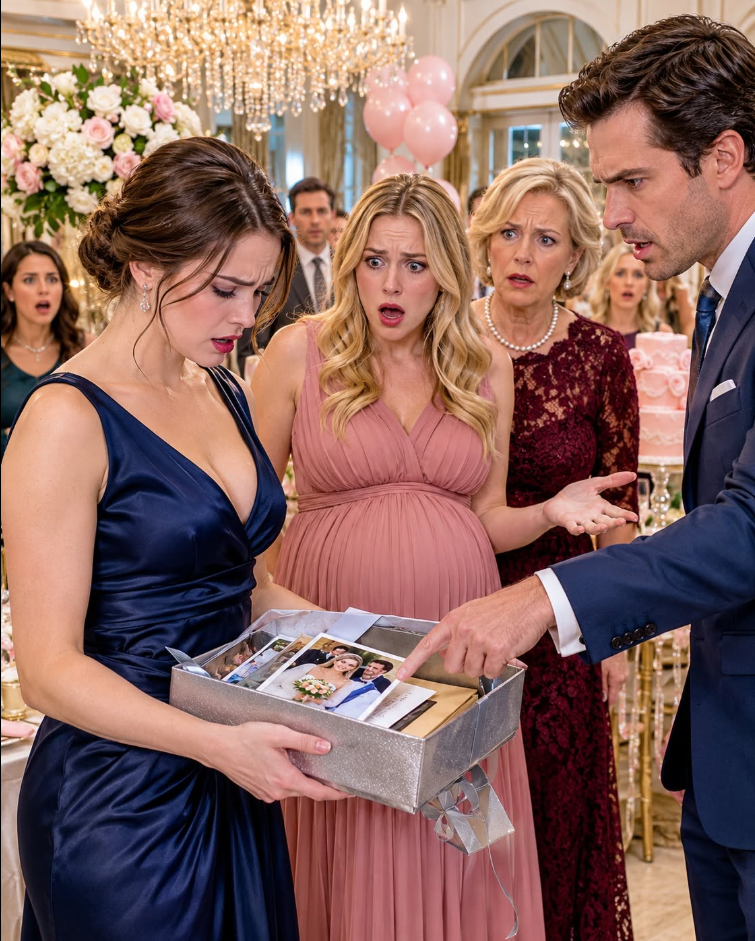
“Don’t turn this into a scene, Nora.” I met his gaze. He wanted me to become unreasonable; that would have spared him the trouble of considering why I had come or what I was carrying. “I wouldn’t dream of it.” I laid the apron over a nearby chair and set the silver box beside the cake. Celeste glanced at it. “You really shouldn’t have.” “I think you’ll want to open this one yourself.” People began drawing closer, attracted by the present and by the change in the room. Celeste looked toward Grant. His small answering nod suggested they still believed the joke belonged to them.
She began untying the silver ribbon while Grant leaned toward the cake. “Maybe she brought diapers,” he said. “It’s not as if she’ll need them.” Marjorie laughed. One of the older guests lowered her eyes, a small movement I noticed even then. I did not reach for the box or offer another explanation. Everything inside it had been verified, and nothing in it required embellishment. Celeste lifted the lid while the people nearest us watched. For the first instant, her attention rested entirely on the photograph lying on top.
The color drained from her face. “Owen?” she whispered. Grant’s expression changed at once. “What did you say?” Celeste spread her hand over the photograph, but he reached past it and took the picture. His eyes moved between the image and me. “Who is this?” “Someone your father knew,” I said. Marjorie’s shoulders became rigid, and her mouth tightened. “This is not the place for whatever game you’re playing.” I looked at her. “I haven’t said his last name.” Beside us, the cake and flowers remained perfectly arranged while the confidence around them began to come apart.
Celeste tried to lower the lid, but Grant had noticed the laboratory paperwork under the picture. He pulled it out and read the first page, then read it again, as though repetition might change the result. The conclusion was visible. Owen Mercer was the biological father of Celeste’s unborn baby. Grant turned toward her. “You told me the baby was mine.” She reached for his arm. “Grant, please. I can explain.” He withdrew without shoving her, but his disbelief was impossible to disguise. “Then explain.” The room became so quiet that I could hear staff moving beyond the ballroom doors.
Celeste looked from me to the guests. I did not want her pregnancy made into entertainment, but a spectacle had already been arranged before I arrived. I had brought information into a room where dishonesty had been allowed to pass as celebration. “The test was voluntary,” I said. “Owen agreed to have it done because Celeste told him there was a chance the baby was his.” Grant looked back at the report. “You knew about this?” “I learned about it weeks ago.” “And you waited until today?” “You invited me here today.” He had no immediate answer to that.
Her hands trembling, Celeste tried to collect the papers. Grant stepped away and left the report open on the table. Marjorie had grown pale, although Owen’s name seemed to trouble her more than the test itself. Grant looked again at the photograph. “Why is his picture with you?” I removed the ivory invitation and unfolded it. Our wedding was scheduled for the following month. He read the date, my name, and then Owen’s. “You’re marrying him?” “Yes.” There was nothing more to qualify. My answer did not depend on whether he understood it.
Marjorie reached for the photograph. Her fingers shook as she studied Owen’s features. “This can’t be right.” “The records have been authenticated,” I said. “Owen is your husband’s older son.” Silence settled over the gathering. Grant watched his mother as though she could still undo the statement by denying it. She lowered the photograph with exaggerated care. For years, this family had controlled difficult information by deciding who deserved to hear it. Now the name they had kept outside their conversations lay beside the cake, printed on an invitation they could not pretend they had never seen.
Then the ballroom doors opened. Owen entered with two attorneys, wearing a charcoal suit and carrying a slim leather folder. He paused inside, taking in the guests, the open gift box, and Grant’s face. He showed no pleasure at the scene, but no hesitation either. His presence changed the room again. Until that moment, they had been looking at a photograph and a collection of papers. Now the person those documents concerned stood in front of them, calm and unmistakably real. Marjorie remained still. Grant’s attention moved from his mother to the man approaching the table.
“Hello, Grant.” Grant stepped toward him. “This is some kind of lie.” Owen placed the folder on a side table. “It isn’t. The birth records, our father’s signed acknowledgment, and the trust documents have all been reviewed and authenticated. You can have your own counsel examine them.” His voice carried neither apology nor triumph. The gift box had exposed the baby’s parentage, but the folder concerned a history much older than Celeste’s pregnancy. Marjorie stared at it, and Grant waited for a denial that had still not come. Owen had entered with two attorneys—and the family had not yet heard why.
PART 3 — What the Truth Could Not Finish
Marjorie lowered herself into the nearest chair without taking her eyes off the folder. Grant turned back to Celeste. “You knew who he was?” Tears began running down her face. “Not at first.” Owen’s expression tightened. “But you knew before you married Grant.” That statement disturbed the room more sharply than the paternity findings had. Grant looked between them. “Married?” I had believed he understood the detail being discussed. It was the first thing I had not expected to disclose, and for a moment I could only look at him.
Grant sat near the window. The polished certainty he usually wore had disappeared, leaving him apparently unable to decide what to say. Then he looked at me, and his anger found somewhere familiar to go. “You planned this. You came here to embarrass us.” I kept my voice level. “You and Celeste invited me into a room full of people, handed me an apron, and joked about my ability to have a family. I brought a gift that contained facts you already had a responsibility to face.” I would not accept responsibility for the choices that had made those facts painful.
He turned toward his mother. “Marjorie, do something.” Her attention, however, had shifted to the second folder Owen had brought. It held the trust documents and the authenticated records establishing him as a beneficiary. The trustees were reviewing distributions that appeared to have occurred without the necessary disclosure. For once, Marjorie did not seem able to restore order by changing her tone. The papers described obligations that could not be dismissed as a misunderstanding or settled by making someone else feel unwelcome. The family’s private arrangements had become matters for independent examination.
“You can’t take everything from this family,” she said. Owen did not speak more loudly in response. “I’m asking for what the documents say I’m entitled to. The court can decide the rest.” He made no claim beyond that. There was no speech about replacing Grant, no demand that anyone welcome him as a brother. He had spent years outside a history that concerned him, and he was asking for the rights the documents established. Marjorie looked down at the folder again. For all her fear, the records themselves remained unchanged.
Watching them, I felt no pleasure in Grant’s confusion or Marjorie’s alarm. There was relief in hearing the truth acknowledged, but relief was not the same as enjoying another person’s suffering. I had already lived too long among people who injured one another and then called the damage a family matter. I did not want that habit to follow me into another life. The afternoon had revealed what had been concealed. It could not give me back the years I had spent accepting blame, and it could not make their choices less consequential for the child still to be born.
Celeste reached for my wrist. “Nora, please. I’m pregnant.” I moved my hand away gently. “Your child deserves honesty and a chance to grow up without being used to settle anyone’s arguments.” She appeared ready to respond, but nothing followed. Her pregnancy had never been the reason I wished her harm, because I had never wished harm on her baby at all. The adults in that room had made their decisions. The child would have to live with what they chose to do next, and that mattered more than any victory someone might imagine had taken place beside the cake.
Guests began drifting toward the exit. Some departed silently; others whispered as they went. The pink frosting remained untouched beneath the ballroom lights, as bright as it had been when I arrived. Owen came to stand beside me without taking control of the exchange. He did not answer for me, pull me away, or decide that my part in the afternoon was over. He simply waited. That restraint mattered. After years of being told how to behave so that everyone else could remain comfortable, I was allowed to choose for myself when I had said enough.
I picked up the empty silver box. The pink apron still lay folded over the chair where I had placed it, and I left it there. Owen stood beside me as I turned toward the doors. Beyond the tall windows, the estate grounds looked as composed as ever, untouched by what had happened inside. I had come carrying three pieces of truth and was leaving with an empty container. Yet the emptiness did not feel like loss. The room behind us held all the consequences that remained to be faced, and no amount of silence would put the contents of that box away again.
The months afterward were much less simple than that departure might have suggested. An afternoon can expose a lie; it cannot resolve every legal, financial, or personal question that follows. The directors completed their investigation and removed Grant from management. A court ordered repayment of a substantial part of the diverted money, while other issues continued through the legal system. Some accounts had paid personal expenses directly. Others involved layers of transfers that required months to untangle. It was slow, costly work, far removed from the dramatic version the shower guests might have repeated afterward.
Grant and Celeste’s marriage ended under the weight of the investigation, the paternity findings, and the half-truths on which their relationship had depended. She moved into a modest apartment and prepared for the baby without the luxurious future she had expected. Owen remained involved, initially through legal arrangements and afterward in whatever ways Celeste permitted. None of that was as tidy as a report placed on a table. Knowing the truth did not make every conversation easy or every decision obvious. It simply made it possible for the next decisions to begin somewhere more honest.
Owen never referred to the child as something he had won from Grant. He did not treat fatherhood as a reward for proving a point. When he discussed the baby, he spoke about showing up, honoring his responsibilities, and offering as much stability as the adults could manage. That was the man I had come to know across conference tables and ordinary conversations. The circumstances were difficult, but his understanding of his responsibility did not change with them. He wanted the child to grow up without carrying the burden of the adults’ arguments.
The court eventually approved a restructuring of the family trust, and Marjorie lost control of it. She sent me a letter on heavy cream stationery describing the past as a succession of misunderstandings. I read it once and put it away. There had been a time when I would have examined every sentence, searching for an acknowledgment clear enough to release me from what had happened. I no longer needed that from her. She did not have to name every wrong before I could stop carrying it. Her account of the past could remain hers without becoming mine again.
Owen and I married at the vineyard on a clear September morning. A few friends attended, with my sister and Rebecca in the front row. No one delivered a sweeping speech about second chances. Owen told me he would continue choosing honesty even when it made life uncomfortable. I told him I wanted a home where speaking plainly was not a privilege anyone had to earn. The ceremony was small, just as we had intended. What mattered was not how different it looked from the Hawthorne estate, but how different the promises felt when no one was being asked to disappear inside them.
The following spring, after months of meetings, home visits, and paperwork, we adopted a little girl named Lily. On the first night she slept in our house, I woke three times to make certain she was warm. Afterward, I stayed awake listening to the quiet. Just before dawn, Owen found me sitting beside her crib. “You know she’s all right,” he murmured. “I know,” I whispered. “I just want to remember this.” He lowered himself onto the floor beside me. We watched her sleep together, her tiny hand curled near her cheek.
A year later, the days shortened and the fireplace once again became the center of our living room. I noticed the silver box on the shelf among our photographs. Its ribbon was folded inside, and otherwise it was empty. Owen had put it there after the wedding, not to preserve the humiliation of the shower, but because, to him, it had carried the beginning of the truth. I had once held that box in a room where everyone seemed certain they understood what my life would never contain. Now it sat quietly among the evidence of a life they had never imagined for me.
Our wedding photograph stood on the mantel, with Lily’s picture beside it. The rooms were warm, evening had darkened the windows, and a small toy waited in the upstairs hallway where it had been left. Owen came behind me and rested his chin lightly on my shoulder. “Any regrets?” he asked. I remembered the years spent wondering whether motherhood was something other people had the power to grant or deny. I remembered feeling that I had failed a test whose rules no one would explain, and fearing that the people who blamed me might be right.
Then I looked at our daughter’s photograph. “Only that I believed them for so long.” The life I had wanted had reached me by a route I had not anticipated, through patience and paperwork, through a man who listened and a little girl who made our home feel more complete with every passing day. Its value had nothing to do with Grant losing his position or Marjorie losing her influence. Their consequences belonged to them. What had changed for me was the understanding that I did not have to keep measuring my future against their opinion of my past.
For years, I had mistaken their judgment for a boundary I could never cross. Now the silver box was empty, the photographs were ours, and the home around me asked no one to earn the right to belong. The future I had been so frightened of losing had never belonged to the Hawthornes in the first place. It was mine to enter without their permission. And for the first time, as I stood beside Owen in the warmth of our own home, I could look toward everything still unwritten without knowing where that freedom would lead.
Disclaimer: This story is a work of fiction inspired by real-life themes. Names, characters, places and events are fictionalized, and any resemblance to real persons is purely coincidental. It does not represent any person or organization and does not encourage inappropriate behavior. Images are for illustration purposes only.