PART 1: The Girl at the Perimeter
There is an essential distinction between someone who is violent and someone who is dangerous. Violence often comes from a failure of restraint: shouting, pounding furniture, allowing an impulse to choose the next move. A dangerous woman does not need to raise her voice. Her breathing, her silence, and every movement she makes pass through the same filter of deliberate calculation. During twelve years in the army and the eight years that followed, I earned my living teaching people how to work through situations that appeared to offer no acceptable way out.
Before anyone in my classes could chamber a live round, they spent two full weeks in a windowless briefing trailer studying human terrain. Identify the leverage. Trace the money. Find the seam holding the structure together. Do not act until one decisive move can bring the whole thing down. At forty-eight, I wore my gray-streaked hair in a tight knot. Old parachute landings and desert patrols had left their persistent aches in my body, but they had never introduced a tremor into my hands.
Dane possessed the polished charm of a man who had never endured genuine physical hardship: soft hands, a ready smile, and an entire family dynasty standing behind him. The Garritys of Cottle County owned Garrity Ridge, a broad hollow in Eastern Kentucky that had belonged to them since before the roads were paved. Their patriarch, Conway Garrity, ruled his relatives, mechanics, and friendly town deputies like a hollow-eyed monarch. At gatherings, he repeated his guiding principle with the solemn rhythm of scripture: Family handles its own.
The truth reached me on a cold Tuesday in late October, at twelve minutes after two in the morning. A buried seismic sensor on the southern approach, three hundred yards beyond the main gate, sounded through the receiver beside my bunk. Before its second alert, I had pulled on my boots. I left the overnight watchman undisturbed and checked the monitors. An unfamiliar gray sedan stood fifty yards from the concertina wire with its lights off. A frightened tourist would have honked, flashed the headlights, or tried to turn around. This car simply waited in the dust.
I approached along the drainage berm, slipping through mesquite while the wind tugged at my canvas coat. Ten paces from the driver’s door, I heard its hinges complain. A narrow figure fell out toward the gravel. “Mom?” The word was weak, blurred, and full of pain. Whatever professional distance I had maintained disappeared instantly. I reached her before her knees struck the stones and gathered her into my arms. Even in the darkness, my hands registered damage that no mother should ever have to recognize on her child.
Her left ribs had caved inward enough to make every breath a shallow, catching struggle. Swelling and dark bruises covered the right side of her face, closing her eye. Distinct finger-shaped marks crossed her right forearm where adult hands had restrained her. A blistered cigarette burn marked the inside of her wrist. She had traveled fourteen hundred miles like this, stopping for fuel along lonely highways while strangers chose not to see. “Hadley,” I whispered, supporting her head against my chest. “Who did this to you?”
Her fingers shook as she reached into the pocket of her oversized jacket. She drew out an unfamiliar prepaid phone and pushed it into my hand. Her lips were split, with dried blood along their edges, and speaking cost her effort. “Dane’s family,” she rasped. “Eleven of them. They put me in the barn… and they recorded it.” I held her there beside the dark sedan, the desert around us silent except for her strained breathing. The phone rested in my palm, carrying whatever she had crossed the country to bring me.
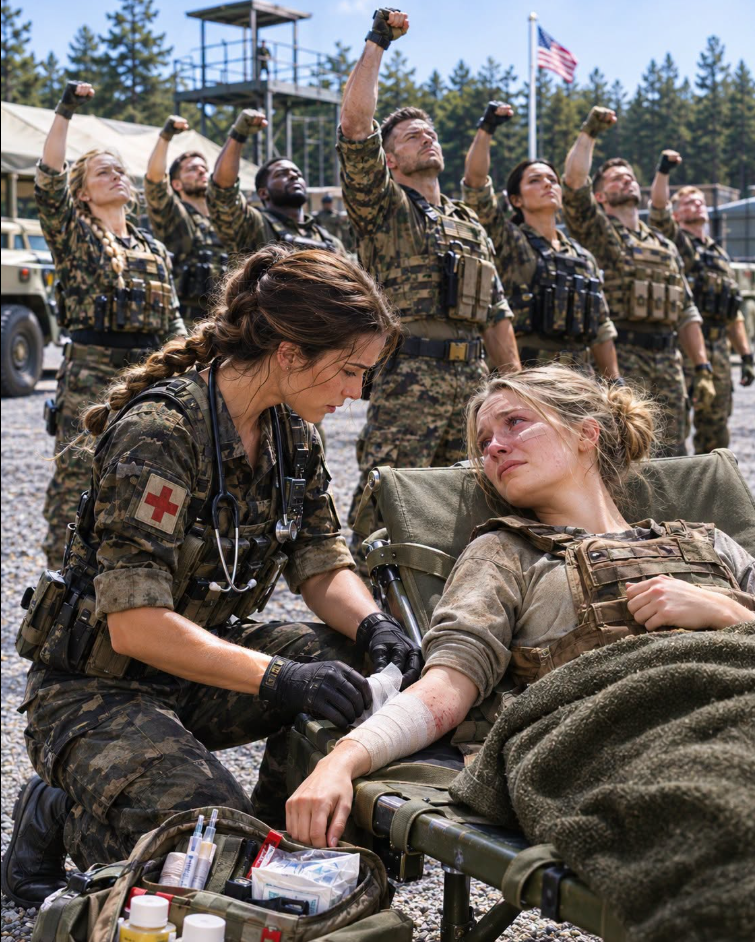
I did not watch the recording that night. Looking at my daughter’s degradation while adrenaline still flooded my bloodstream would have been a novice’s mistake. For twenty years, I had taught soldiers that the instant raw feeling begins directing a response is the instant a team can be led into an ambush. I carried Hadley to the compound’s medical annex. Miller, our resident medic and a retired navy corpsman, began treating her beneath the fluorescent lights. He secured her cracked ribs with medical tape, cleaned the infection at her wrist, and started fluids.
I remained on an aluminum stool beside the gurney, holding her uninjured hand until medication and exhaustion carried her into sleep. Over the next forty-eight hours, the explanation came out slowly, each recollection dragged from her memory like a length of barbed wire. The Garritys’ respectable businesses were scenery concealing something else. Dane’s older brother, Brett, controlled the family’s violence. In a heavily insulated tobacco barn behind the ridge, he staged illegal bare-knuckle bouts involving desperate men who owed money to the Garrity lending operation.
An encrypted pay-per-view service had turned those fights into a profitable attraction for wealthy degenerates across three states. Eventually, ordinary fighting stopped satisfying the subscribers. They began paying substantial fees for what the family called “disciplinary lessons” inflicted on residents who challenged them. Hadley stumbled across the operation on a shared laptop in Dane’s kitchen. Appalled, she told her seventeen-year-old cousin, Cella, and insisted that they bring the files to the state police. She had not understood that, in Cottle County, the Garritys themselves were effectively the law.
Brett learned about the discovery within a day. That Friday, Dane drove Hadley to the barn, telling her they were going to a family dinner. Instead, she was hauled onto its reinforced concrete floor beneath three streaming cameras. Eight spectators—relatives and enforcers—laughed while the family demonstrated what happened to anyone who carried Garrity business beyond Garrity walls. Dane stood against the barn door with his arms folded. Through the entire ordeal, my soft-spoken former husband offered not one word of objection.
“He told me afterward that I brought it on myself,” Hadley whispered, watching dust move through the light at the window. “He said… family handles its own. “ Cella had been sickened by what her relatives had done. Once the men drank themselves senseless, she unlocked the back office, gave Hadley the keys to a pool car, and put the prepaid phone containing the recording into her hands. Then she told her to head west. By the third morning, Hadley was resting in our main residence with armed protection.
I went into my office, turned the deadbolt, and placed the phone’s memory card into an air-gapped terminal. I watched the recording once. There was no shouting, no fist driven into the desk. I sat as motionless as a bomb technician examining a live fuse and forced myself to treat every image as intelligence. Eleven recognizable faces emerged from the footage. I captured each one, along with the barn’s structural details, its commercial lighting supports, exposed coaxial cables, and the streaming interface visible on a monitor.
I also recorded the black partition arranged to conceal the location. And I noted Dane beside the door, holding a coffee cup, overseeing what happened with the detachment of a man watching a production line. When the recording ended, grief hardened into something quiet and lethal. I opened the office and called Roman Stag inside. Six feet three inches of controlled composure, Roman had served through the same desert deployments that had shaped me. Twenty seconds into the video, the muscles along his jaw tightened.
He lifted his pale eyes to mine. “Tell me what you need,” Roman said softly. “And tell me what you need me never to see.” I answered without raising my voice. “For the next fourteen days, you manage the compound,” I instructed him. “The administrative manifests, the digital logbooks, and every perimeter camera must place me right here on the Range every single morning and afternoon. I need you running standard firing evolutions in front of our domestic clients. I am invisible, Roman. I never leave New Mexico.”
“And what happens to the class currently running the advanced curriculum?” Roman asked. “The class is graduating,” I said. “And for their final operational exercise, they are going to solve a real-world problem.” There were sixteen operators in the current Ironwood course: European tactical officers, international private security specialists, and two former intelligence officers whose passports carried diplomatic stamps. They had already spent three weeks learning my doctrine. Nine days remained before they dispersed to their respective continents, far beyond the reach of an American county sheriff.
At thirteen hundred hours, I brought them together in the secure underground briefing room. I made no emotional appeal and showed none of the recording. Instead, the projector displayed a detailed topographical map of Garrity Ridge beside eleven sharp profile photographs. “Operators,” I said, my voice carrying evenly against the cinder block. “Your final practical evaluation is an unconventional network-interdiction exercise. Real terrain, entrenched hostile actors, deeply compromised local institutions, compressed timeline. You will map the adversary’s logistics, isolate their communication nodes, strip their financial shielding, and dismantle their leadership structure.”
After one measured breath, I indicated Brett’s photograph, then Dane’s, then Conway’s. “This is not a theoretical exercise,” I told them plainly. “This syndicate committed a grave atrocity against someone under my personal protection. I cannot order you across that state line. I cannot offer you operational immunity. But if you want to apply the doctrine you paid to learn against a target that deserves every fraction of what is coming… this is your target package.” I stopped and met every pair of eyes in the room.
“Who wants the field problem?” Sixteen hands went up. Not one operator hesitated.
PART 2: The Family Begins to Fracture
Storming Garrity Ridge with armed personnel would have been the decision of a fool. Rifles and plate carriers would have announced an enemy, started a long firefight against a family entrenched on its own ground, and put all of us on the evening news. We would have gone to federal prison while the Garritys were remembered as martyrs. That was not the doctrine I taught. A corrupt empire does not need to be battered from outside. Its roots can be turned against it until the structure falls beneath the weight of its own decay.
Brett imagined himself an apex predator because an isolated Kentucky hollow belonged to him. In the larger criminal world, however, he was only a regional supplier. The profitable streaming platform was not actually Garrity property. Its servers belonged to an Eastern European syndicate operating through Atlanta shell companies. Those men insisted upon one condition above everything else: no outside attention and no federal scrutiny. Brett’s private kingdom depended on people whose loyalty would last only as long as he remained profitable and quiet.
We separated the sixteen operators into four cells and sent them into neighboring counties with rental vehicles, encrypted satellite connections, and high-frequency scanners. There would be no gunfire and no fingerprints left at the scenes. The first opening was Hutch, a cousin who ran the family salvage yard. That business dismantled stolen vehicles and sent the proceeds through Dane’s rental company. Hutch was also the chain’s least reliable link, a bullying loudmouth who liked to spend his evenings drinking bourbon in a local tavern and announcing how untouchable he was.
On a wet Thursday evening, Hutch was entertaining his usual audience at the bar when a member of our French contingent entered the salvage yard’s rear office. Two minutes with a digital imaging device produced four years of fraudulent vehicle identification numbers, falsified titles, and records of payments to the Cottle County Sheriff’s office. We did not hand the material to anyone local. It went straight to Special Agent Devin Pryor in the Kentucky State Police Organized Crime Division, whose Garrity investigations had spent four years collapsing after warrants leaked from the circuit court.
At seven the following morning, Hutch emerged from his double-wide and found four unmarked state police vehicles across his driveway. He had neither the courage nor the endurance for a possible twenty-year prison term. Within half an hour of being seated in an interview room two counties away, he was offering everything he knew. He described the stolen-car business, the lending racket, and the men who provided security for Brett’s weekend events. The first node had fallen through an arrest, evidence, and a suspect’s eagerness to save himself.
The next two were Boone and Gunner, the enforcers who had forced my daughter’s shoulders against the concrete. Our cyber-reconnaissance team examined the streaming service’s encrypted betting records and found a revealing inconsistency. During the previous eight months, about eighteen percent of digital wagers had been diverted into two private offshore cryptocurrency wallets before the Atlanta distributors received their share. Boone and Gunner had been stealing from the people who kept Brett’s operation online. Their apparent strength concealed a vulnerability entirely of their own making.
We neither approached them nor brought the theft to the police. Our specialists assembled the ledger, matched the transactions to the two men’s personal IP addresses, and delivered the unencrypted evidence to the syndicate’s private administrator portal. On Saturday night, Boone and Gunner never arrived for duty at the barn. The next morning, their trucks appeared at an Interstate 75 rest stop. The keys remained in the ignitions and their phones lay on the consoles. Neither man was ever seen in Cottle County again.
The family decided the pair had run after learning that Hutch was cooperating. No one on the ridge understood how much more there was to fear. By Monday, three of the eleven faces had disappeared from the Garrity structure, and Brett had not encountered a single visible attacker. He could not aim a rifle at an enemy he could not identify. He could only look at the people around him and wonder which familiar face might explain why his carefully protected world had begun to come apart.
I stayed at the Range, receiving reports in my office. On the digital tactical board, I marked Hutch, Boone, and Gunner with firm red lines. Roman brought in a fresh cup of black coffee and studied what remained. “Brett is spiraling,” Roman observed, setting it on my desk. “He’s pulled the remaining men up to the ridge. They’ve locked the gates, and Conway is demanding to know why his family is coming apart.” I kept my attention on Dane’s photograph.
“A clan operates on the absolute certainty of mutual protection,” I replied, staring at the face of Dane Garrity. “The moment that certainty fractures, they will begin consuming each other.” That afternoon, the second phase began. Fear could make a foolish man savage, but arrogance made him blind. With Hutch talking and the enforcers missing, Brett settled on the explanation that someone close to him was engineering a takeover. He gathered the survivors at the ridge house, drawing the remaining pieces of the network closer together.
Among those he summoned were Dane, their cousin Merle, a mechanic called Dax, and two more enforcers, Tucker and Shaw. Meanwhile, our second cell had spent forty-eight hours observing cellular traffic around the property from a forestry-service van on a neighboring logging track. A directional IMSI-catcher supplied the traffic they needed to study. Merle had recently borrowed money he could not repay. He also feared Brett’s temper. Those existing circumstances supplied the fracture; the operation needed only to apply pressure at that point.
Our technical personnel created falsified text exchanges and placed them in Brett’s compromised phone history. They appeared to show Merle discussing immunity with Special Agent Pryor’s task force, offering the location of the barn’s primary digital servers in exchange. Brett never sought an explanation from the man he accused. At two on Tuesday morning, he hauled Merle onto the gravel drive and began shouting about betrayal in front of the family. Under the porch lights, accusations turned into a furious, noisy fight.
Conway appeared on the upper veranda in his bathrobe and barked orders. Nobody listened. The authority that had once silenced an entire gathering could no longer interrupt a struggle in his own driveway. Merle escaped Brett’s grasp, scrambled into his truck, and hurtled down the mountain at eighty miles an hour. He kept driving until Tennessee lay around him. Then he disappeared into the hills and never returned to Cottle County. The fourth node was gone, driven out by the very family that promised its members protection.
The fifth began to break almost immediately. Dax had watched Merle’s escape and understood what staying loyal might cost. He had spent years repairing stolen cars, but he was a mechanic, not one of Brett’s enforcers. During Hadley’s ordeal, he had remained at the back of the barn, horrified and silent. That silence did not make him innocent. It did, however, leave him with knowledge that had become useful once he realized the ridge could no longer guarantee his safety.
At eight on Wednesday morning, Dax entered the federal courthouse in Lexington with a lawyer at his side. Nobody had brought him in. In return for protective custody, he described Echo Ridge Youth Academy in full: fraudulent county invoices, forced labor, and physical intimidation. His testimony exposed another part of the family’s respectable façade. Five nodes were now neutralized, and the framework beneath the Garrity businesses was splintering. Each person who chose survival over loyalty left those still on the ridge with fewer places to hide.
Tucker and Shaw required something different. They were not frightened men like Hutch, and they had not secretly stolen from their criminal partners like Boone. Cruelty itself appealed to them. Of all the men in the barn, their hands had caused some of the worst damage to my daughter. I approved direct contact by the international operators, with the requirement that it remain nonlethal. The objective was not a public confrontation. It was to remove two violent men from the family’s protection and place their documented crimes before federal authorities.
On Wednesday night, Tucker was intercepted as he left an isolated package store twelve miles beyond the county boundary. Forty minutes later, Shaw was caught outside an equipment depot. There were no shouted speeches, no shots, and no theatrical warnings. The operators restrained them, covered their heads, and secured their wrists with zip-ties. Their identification, phones, and vehicle keys were removed. They were then left inside the secure compound of an industrial federal holding facility ninety miles away, with an anonymous manifest describing their involvement in aggravated kidnapping and organized racketeering.
When Thursday’s sun reached Cottle County, both men were being processed into federal custody without bail. Seven names could now be crossed out. What remained was the family’s center: Brett, who had organized the brutality; Dane, who had watched from the doorway; Reese Garrity, the cousin who had filmed and laughed; and Conway, whose authority had sheltered the entire operation. Removing the outer layers had not changed what those four had done. It had only stripped away the people and institutions that had allowed them to believe there would never be consequences.
Reese was twenty-three. She had persuaded herself that standing behind a camera placed her outside whatever happened in front of it. Recording cruelty, in her mind, made her a director rather than a participant. She had smiled while moving the lens around the barn, trusting both the equipment and the family name to keep her separate from the suffering she documented. Of all the illusions supporting Garrity Ridge, hers required the least effort to overturn.
For Reese, I chose the camera itself.
PART 3: What Remained on the Ridge
I returned to the recording on the prepaid phone and removed every frame that showed Hadley’s face, captured her voice, or threatened her dignity. Nothing about exposing Reese required exposing my daughter again. The edited piece lasted thirty seconds. It showed the tobacco barn, the expensive streaming equipment, the whiteboard used to track wagers, and, at the lower right of the image, Reese Garrity’s uncovered face. She was smiling and laughing while moving the camera through the room. What she had considered protection had preserved the evidence against her.
We sent the clip simultaneously to the regional FBI office, the Kentucky Attorney General’s public integrity portal, and the senior investigative reporter at the state’s largest newspaper. By Thursday afternoon, news outlets throughout the commonwealth were carrying it. The family had relied on distance, closed doors, and compromised local officials. Now the inside of their barn was visible well beyond the county. The recording no longer belonged only to the people who had created it and the subscribers who had paid to watch.
Reese was not arrested immediately. Instead, the life she had maintained beyond the ridge began disappearing in public. Her name, photograph, and social media accounts appeared on the evening broadcasts. By Friday morning, her university had withdrawn her enrollment. The boutique that employed her dismissed her by text. Within a day, process servers and television crews were waiting below the property. Crying, she loaded two suitcases into her coupe and drove out of the hollow while news helicopters followed overhead. Eight of the eleven were gone.
Dane’s turn came Friday afternoon. Hutch’s admissions, Dax’s account, and the video establishing the illegal operation had given investigators what they needed. Forty state troopers and federal agents formed a joint task force and climbed the road to Garrity Ridge. The same family holdings that had impressed a custody judge now lay within the scope of a coordinated criminal investigation. There was no friendly local proceeding for Dane to charm his way through, and no quiet warning that could make the evidence cease to exist.
They arrested him on his own front porch. The soft-handed man who had promised a wholesome upbringing for my daughter came down from the house in handcuffs, facing felony child endangerment, conspiracy to commit racketeering, and grand fraud connected to Echo Ridge Youth Academy. His practiced smile had no useful place in the scene. Neither the family name nor the businesses behind it could put distance between him and what he had allowed to happen. Dane became the ninth name on the board.
Sheriff Buck Harmon stood beside his patrol car in the yard. For twenty years, he had been the obliging family friend who chose not to notice. Now he watched, powerless and stripped of authority, while state investigators carried away filing cabinets, computers, financial ledgers, and hard drives. The records that local influence had once protected were leaving the ridge in official hands. The old arrangement between the Garritys and the county could not survive agents who answered to someone beyond Conway’s reach.
Brett did not submit as quietly as his brother. When the law-enforcement convoy climbed the ridge, he withdrew into the fortified tobacco barn with an assault rifle and blocked the heavy doors. For six hours, tactical teams, armored vehicles, and negotiators surrounded the hill. The building where he had staged fear for paying spectators became the last place in which he could pretend to exercise control. Outside, people waited who had neither debts to his family nor reasons to obey him.
He had spent his life acting as king of a secluded valley. Now there was no one left to sustain the performance. His enforcers were in custody. His money had been seized. The Atlanta partners had cut off the digital connections that fed the operation. His father could not order the authorities away. Everything that had made Brett feel powerful had depended on a network of other people, and that network no longer stood between him and the consequences of his own conduct.
The standoff continued into the night. The barn’s reinforced walls could delay the end, but they could not recreate the family that had once gathered inside. Brett was left with the weapon he carried, the doors he had barricaded, and the realization that nobody was coming to restore the world beyond them. The man who had directed violence from a position of safety had finally been reduced to a single frightened person inside a surrounded building.
At midnight, overcome by dehydration, rage, and tear gas, Brett threw his rifle through a barn window. Weeping, he crawled out into the dirt on his hands and knees. The man who had arranged my daughter’s suffering could not even remain standing for his own surrender. Ten.
Only Conway Garrity remained. No one dragged the patriarch away in handcuffs. He was left in the vast, empty house at the top of the ridge, an embittered old man whose authority no longer reached beyond the room around him. Investigators had frozen the assets connected to the family name. Search warrants divided the property into places to be examined, and federal forfeiture proceedings took hold of its acreage. The land he had treated as the foundation of permanent power could no longer protect him.
His sons sat in maximum-security cells. Cousins had scattered, fled, or begun cooperating. Neighbors who once attended his barbecues drew their curtains when anyone mentioned him. The gatherings, favors, and obedient faces that had reflected his importance back to him were gone. Conway had preached that family handles its own until the words seemed as fixed as the ridge itself. In the end, that principle had completed its circle. Their determination to keep everything inside the family had helped carry the entire structure into ruin.
On the eleventh morning, pale amber light spread above the Organ Mountains. I sat on the clinic’s wooden steps with a warm ceramic mug of black coffee between my hands. Below me, Hadley threw a battered tennis ball for Buster, our three-legged rescue hound. The purple on her cheek had softened to yellow, and the swelling around her eye had disappeared. When Buster tangled his remaining legs and rolled into the dirt, she tipped her head back and laughed without holding anything back.
I had not heard that laugh in seven years. Then the phone in my coat began vibrating. An unfamiliar Kentucky area code filled the display. I let it ring twice, then a third time, before standing and walking around the armory where Hadley could not hear. When I answered, I offered no greeting. A broken voice entered the silence. Dane was calling through the collect-phone system at the Fayette County Detention Center. Exhaustion had worn away the confident tone I remembered.
“Nell?” he gasped, his voice dry and unsteady. “Nell, please… you have to tell me what you did.” I watched dust stir near the fence and let him hear nothing for a moment. “Dane,” I said, as quietly and evenly as a desert road after dark. He had always relied on other people to become emotional first. Now there was nothing in my voice for him to seize, no argument he could redirect toward the old version of our marriage.
“They took everything, Nell!” he sobbed. “Brett is looking at thirty years in federal prison. Hutch gave them the books. Dax gave them the academy. My father is up on that ridge all by himself… the bank took the properties, the cars, the accounts! Eleven people, Nell! Eleven of us gone in less than two weeks! I don’t know how… the troopers said you were in New Mexico the entire month… but I know it was you. I know it was you!”
“You’re right,” I answered. The acknowledgment settled into the silence between us with the finality of an anchor striking deep water. “Why?” he wept. “We had an agreement, Nell! She was my family too! You destroyed an entire family!” He spoke as though the destruction had begun with an investigation, as though the barn, the cameras, and his coffee cup belonged to an entirely separate story. I kept looking toward the horizon and answered him without increasing my volume.
“You stood in the door of that barn, Dane,” I told him, every word controlled and distinct. “You stood there with a cup of coffee while your brother broke my daughter’s ribs. You let your cousins film her tears. And when she begged you for help, you looked her in the eyes and told her that family handles its own. “ His breath caught in a rough, involuntary gasp. I gave him no reassurance and no opportunity to make his silence in that doorway sound like anything other than a choice.
“You were right about one thing, Dane,” I continued, lowering my voice until his crying stopped. “Family does handle its own. You handled yours by turning them into monsters. I handled mine by taking your empire apart down to the foundations.” There was no need to explain the map, the names, or the sequence of fractures. He already knew what each loss felt like. For the first time, he simply had to hear whose protection had mattered more than the Garrity name.
“Nell, please—” “Do not ever attempt to contact this number again,” I said. “And Dane? When you walk into the yard during recreation hour tomorrow, look at the men surrounding you. That is your family now. Go count them. I’ll wait.” I disconnected before he could answer. Then I took the battery and SIM card from the burner, dropped the pieces onto the hard desert stone, and brought my boot down until plastic and copper had become crushed fragments beneath the sole.
When I came back around the armory, Hadley stood near the clinic steps with the tennis ball in her hand. Morning air had brought healthy color to her face. Her clear green eyes followed me, searching with the quiet understanding of someone who had passed through darkness and found the other side. I went to her, tucked a loose strand of hair behind her uninjured ear, and rested my palm against her temple. For a moment, I simply stood close enough to feel that she was there.
I took the ball and sent it sailing across the open Range. Buster raced beneath it as it climbed into the bright New Mexico sky. “Who was that on the phone, Mom?” she asked gently. I looked back at her and let a small, genuine smile reach my face. “Nobody that matters, sweetheart,” I said. “Just someone checking to see if the work was finished.”
Disclaimer: This story is a work of fiction inspired by real-life themes. Names, characters, places and events are fictionalized, and any resemblance to real persons is purely coincidental. It does not represent any person or organization and does not encourage inappropriate behavior. Images are for illustration purposes only.