PART 1 — The Stranger I Couldn’t Leave Behind
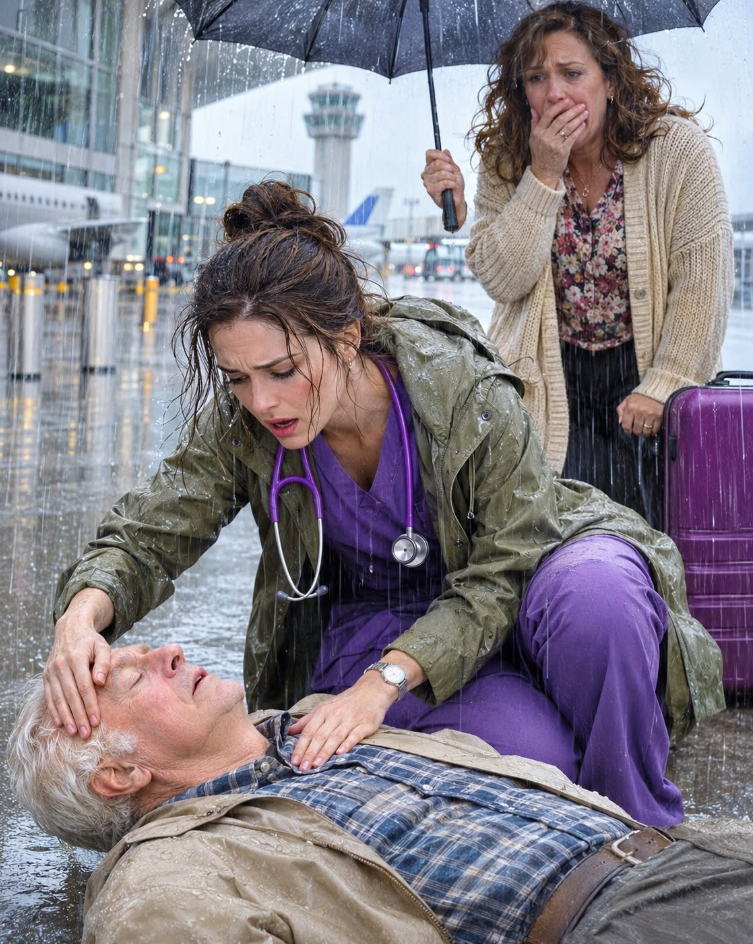
“Don’t lift him! If he has a neck injury, you could paralyze him!” My shout made the driver release the elderly man he had been attempting to pull up from the pavement. I stood there holding a suitcase in one hand and a plane ticket in the other. My name is Camille Hartley. I was thirty-four, and although the hospital where I had spent five years working as a surgeon had just dismissed me, I was still a doctor.
That flight was meant to carry me to Charlotte for an interview with a private clinic. After what had happened at Riverside Regional Hospital, it felt like my final opportunity. The hospital director, Dr. Gordon Pratt, had accused me of falsifying patient records and taking medication. He had offered no evidence whatsoever, but the allegations had circulated through the hospital before my termination letter reached my hands.
My father had died from a heart attack five years earlier. He had worked double shifts to repay a debt his brother had incurred and then walked away from. My mother, Rosemary, earned money doing clothing alterations, while my nineteen-year-old brother, Theo, was preparing for college. For years, I had assured them that eventually we would stop scraping from one paycheck to the next. Once I was fired, that promise began to sound painfully hollow.
I took a taxi to the airport and spent almost all the cash I had left. Unexpectedly, a storm had delayed several departures, and the airline allowed me to move my flight without charging a penalty. I called the clinic in Charlotte and postponed the interview by two days. My bank balance afterward was $212. I settled beside a large window, the knees of my clothes still smeared with mud from helping the injured man.
An older couple sat a few seats away. The husband held a dark wooden cane, and his wife carried a blue folder marked with Riverside’s logo. “Gordon Pratt is looking us in the eye and lying,” she said. “We went all the way to his office and he kept repeating that Camille Hartley stole medication.” My breath caught. “Not only that, Helen,” her husband replied. “We gave eighty thousand dollars to the hospital foundation for emergency room equipment, in gratitude for what she did for Felix. And now nobody can show us where that equipment is.”
Felix. Hearing that name took me back two years, to a shift that had seemed endless. An exchange student had arrived with abdominal pain, deep, heavy breathing, and the unmistakable smell of acetone on his breath. Pratt had wanted to rush him into surgery for what he called appendicitis. I argued until we obtained a glucose reading. The boy had severe diabetic ketoacidosis. He needed immediate medical treatment, not an operation. Later, as he shivered in observation, I wrapped him in a gray scarf my mother had knitted. He was transferred elsewhere, and I never learned what happened afterward.
My legs trembled as I approached them. “Excuse me. Is your son’s name Felix Beaumont?” They turned toward me. “Who are you?” the man asked. “I’m Camille Hartley. I was with him that night. And I didn’t steal anything.” Helen stood and clasped my hands, her eyes filling. “We looked for you for months. They told us you’d left the country. Felix still has your scarf.”
Her husband, Walter Beaumont, opened the folder. Inside lay a donation receipt and a letter bearing Gordon Pratt’s signature, confirming that the equipment had arrived. Its date sent a chill through me. During that very week, our department had still been struggling without enough monitors. “There’s something else you should know,” Walter said. “The director told us you authorized the purchase.” I had no chance to respond. Helen suddenly pressed her hand against her chest, staggered, and collapsed against the seats.
I dropped beside her and asked the surrounding travelers to step back. She remained conscious, but her heart was pounding and she was extremely dizzy. Walter reached for pills in his jacket; I asked him to wait for an assessment. An airport paramedic arrived with his medical kit before I had finished explaining what had happened. “Reuben Doyle, airport medical. Are you family?” “I’m a surgeon. She started with dizziness, a racing heart, and shortness of breath. She needs an exam and an EKG.”
Reuben neither challenged me to defend his pride nor left everything in my hands. We worked together until the on-call physician arrived. The initial EKG revealed no acute changes, but the physician advised observation and another evaluation. Helen’s condition settled in the airport clinic. Noticing my shaking hands, Reuben offered me water. “You need to sit down too, Doctor.” “It’s been a while since anyone called me that without sneering.” He asked no further questions. That alone was a relief.
Once she felt stronger, Helen reached into her handbag and withdrew a carefully folded gray scarf. I recognized my mother’s uneven stitches immediately, the ones she had made sitting beside the window in our old house. “Felix insisted we give this back to you,” Helen said. “He says it reminded him he wasn’t alone.” I cried as I held the wool between my fingers.
We called Felix by video. The half-conscious, dehydrated boy I remembered was now a medical student in Geneva, with a glucose sensor on his arm. “You told me diabetes was a part of my life, not all of it,” he recalled. “That’s why I want to be a doctor.” Afterward, Walter placed the blue folder on the table. “I need you to tell me what happened at your hospital. No sugarcoating.”
I began with Junie, an eight-year-old who had arrived in ketoacidosis although her mother, Dana, insisted she had administered her insulin. Dana had saved the pens, and I examined them. Several seals were damaged. Their lot numbers matched supplies recorded as distributed through a vendor connected to Riverside. I requested an investigation and retained a copy of my report. Without official testing, I couldn’t identify what the pens contained, but the warning signs were far too serious to dismiss.
“And what did Pratt do?” Helen asked. “He had my report buried. Then he ordered me to write that Dana had failed to follow the treatment plan.” I refused. Days later, a note I had never written appeared in Junie’s chart, carrying my signature as the responsible physician. I had been off duty that day. Before she began avoiding me, the pharmacy manager had also mentioned that several deliveries from the vendor failed to match the inventory.
Walter examined the company name in the photograph I showed him: Western Medical Distributors. “It’s on the invoice for the equipment bought with our donation too,” he said. At last, there was a documented connection between the two sets of discrepancies. Richard Whitlock had authorized both transactions. I had nearly married the son of the man who might explain them. Walter wanted to contact his lawyer immediately, but I asked him to hold off. My mother and Theo depended on me. Richard had powerful connections, and my ruined reputation showed what a single telephone call could accomplish.
That afternoon, the Charlotte clinic’s HR department emailed to withdraw my interview. When I requested an explanation, the reply was brief: my former employer had provided negative references. I saved the email. Even after dismissing me, they were still pursuing me. The opportunity I had spent almost my last money trying to reach had disappeared before I could even sit down for the interview.
On my way home, I passed through a suburban shopping center. A metallic crash made me turn. A cleaner was on the floor beside her bucket while a manager shouted that the damage would come out of her wages. Before I recognized her face, I recognized the tortoiseshell clip holding back her hair. The woman on the floor was my mother.
PART 2 — The Signature That Couldn’t Be Real
I hurried over and helped her stand. Her knee was grazed, and detergent had left the skin on her hands cracked. “You told me you were answering phones,” I murmured. “I didn’t want you to stop looking for a job because of me.” Back at home, I learned that Theo had quietly abandoned his test-preparation classes to take work unloading trucks. Neither of them had told me. I had imagined that staying silent about my own troubles protected them, while they were exhausting themselves trying to keep us going.
His name was Vince Dalton. According to him, my uncle Carl had disappeared without paying anything, and the interest continued mounting regardless of whether my mother could afford to eat. He had ordered her not to tell me and said he knew Theo’s schedule. At last, her reaction whenever the doorbell rang made sense. I examined the renewal date twice. My father died on May 14, 2021. The signature was dated August 3, 2022.
Theo tapped the tabletop softly. “I don’t like it when people decide things for me to protect me. If we’re in this, I want to know everything.” He was right. That night, I agreed to meet the Beaumonts’ attorney, on the condition that my family would participate in every decision affecting us. I needed assistance, but I didn’t want to exchange one dependence for another.
The next day, I visited Dana. Junie was coloring a green dog at the kitchen table. Her mother had kept the empty pen boxes and pharmacy delivery slips. I explained that I couldn’t guarantee any outcome or say the medication had been altered until official testing established it. “Then why do you want me to testify?” she asked.
“Because if there was a substitution, other families could be using those same lots. And because nobody has the right to blame you without investigating.” Dana agreed to make a complaint. She handed the containers to the state Attorney General’s office and identified where she had stored them. Investigators explained that opened pens could not, by themselves, establish their original contents. Their lot numbers, however, allowed a search for unopened supplies from the same batches.
I also located Colleen Marsh, the pharmacy manager who had noticed the discrepancies. We arranged to meet at a café in broad daylight. Initially, she would not discuss what had happened. I showed her the report I had signed before Riverside fired me. It was the same concern I had raised while I still worked there, not an accusation invented afterward.
“I’m not asking you to make anything up,” I told her. “Only to say what you saw.” Colleen stared down at her coffee. She had already brought the inventory problems to someone’s attention before she began avoiding me. Now I was asking her to place those observations on the record, where investigators could examine them rather than leave them buried inside the hospital.
“The shipping records listed more pens than we’d received. Richard would order the numbers adjusted, and then shrinkage reports would show up. I complained by email twice. Nobody ever answered.” She showed me the messages in her sent folder. Both predated Junie’s hospitalization. Colleen agreed to provide investigators with the originals and testify about entries she had personally made. Her account didn’t establish medication tampering, but it did establish that the discrepancies had been reported.
Naomi Frazier, the Beaumonts’ attorney, examined the documents and explained the limits of what we had. Suspected medication tampering, purchasing discrepancies, and my dismissal would each involve separate legal procedures. “We’re not going to solve this by giving a speech,” she warned. “First we protect the documents, the patients, and the witnesses.” I submitted a formal complaint to the state Attorney General and supplied information so the Board of Pharmacy could be alerted.
Walter requested an independent foundation review to establish where the donation had gone. I asked for transparency, not political favors. While those steps began, I investigated the supposed debt against my father. In a drawer, I found a notebook recording every payment he had made before his death. I also discovered an old telephone number for Carl, the brother for whom he had taken on the obligation. I sent a message without knowing whether my uncle would respond.
Two days later, Carl called from Tucson. He made no attempt to portray himself as blameless. “I was a coward, Camille. I ran when your dad needed me most. But I have records of transfers I kept sending to Vince. I thought that was finishing the job.” I requested the bank statements rather than apologies. My father’s notebook and Carl’s transfers could not establish the final balance on their own, but they documented payments Vince had never acknowledged.
Naomi reviewed the collector’s demand and confirmed the most obvious impossibility: the alleged renewal was dated after my father’s death. We used his death certificate to support a report of possible forgery and answered the collection threats in writing. My mother stopped giving Vince cash. His claims would have to be examined through records, not accepted because he had frightened her into believing that silence was the only way to keep our home.
A week later, Riverside hosted a ceremony honoring its donors. I went with Walter and Helen. The formal complaints had already been submitted, and I knew Gordon Pratt and Spencer would be there. By then I had seen the donation paperwork, the altered clinical note, the inventory discrepancies, and the impossible date on my father’s supposed signature. At the hospital, I would have to face the men connected to the accusations that had cost me my work—and the man I had once intended to marry.
PART 3 — What the Records Finally Revealed
Spencer intercepted me near the auditorium entrance. He wore the same cologne he had worn during our relationship. “They’re reviewing everything,” he whispered. “My dad says you started this. If you withdraw your complaint, maybe we can fix things between us.”
“You put my name on a note I didn’t write.” He said nothing. That silence told me enough to understand the extent of his involvement, although investigators would have to determine his responsibility. I remembered how often he had expected me to trust him without asking questions.
When Pratt finished, Walter lifted his hand. “Before accepting this recognition, I’d like to see the physical inventory and the original invoices for everything purchased with our contribution.”
Pratt answered with a smile directed at the audience. “Everything is in order. Dr. Hartley, unfortunately, has spread inaccurate information.”
I got to my feet. Former colleagues were watching, and I could feel their attention on my back. My report existed. So did its delivery record. Those were the things I could ask them to examine, regardless of what Pratt said about me.
“My report on the insulin pens has a date and a receipt of delivery. If it was wrong, you should have investigated it, not erased it. I’m not asking you to believe me out of pity. I’m asking you to check the lots, the inventory, and who authorized the clinical notes that carry my name.”
There was no applause. Several members of the foundation board asked that the recognition be suspended until the accounts had been reviewed. No courtroom had vindicated me, and no speech could settle the complaints already under investigation.
I left the auditorium without having won anything in court. But I was no longer concealing myself while someone else decided what my silence meant. Behind me, the request to examine the accounts had been made publicly, in front of the people being asked to celebrate the hospital’s generosity.
My mother was still awake when I arrived home. She didn’t ask if I had embarrassed the director or whether the Beaumonts planned to give us money. She asked whether the little girl was safe and whether I had eaten. As she warmed beans in a small pot, I told her everything. For the first time, speaking honestly about my difficulties did not make me feel that I was burdening her.
The months afterward were much less dramatic than that evening. They consisted of interviews, subpoenas, audits, and nights when I woke convinced that everything might collapse. State inspectors found unopened units from the flagged lots. Official laboratory testing established that several pens held saline rather than insulin. Those supplies were quarantined. The concerns that had been dismissed could now be examined alongside findings from unopened stock, rather than relying solely on the pens Dana had kept.
The review traced altered shipping records, diverted lots, and inflated invoices through the distributor Richard had approved. Some of the foundation’s donation had been invoiced for equipment that did not exist, while Pratt had approved administrative renovations. The Attorney General’s office continued investigating who had physically performed the substitutions. Establishing that unsafe pens existed was not the same thing as establishing every person’s role in getting them to patients.
Pratt and Richard were placed on leave as the proceedings moved forward. Prosecutors considered the potential responsibility of vendors and hospital officials; people named in the investigation did not all face identical allegations or charges. Spencer had to explain how he had created a medical note using my credentials. I supplied my work calendar and a copy of my complaint file. There was no miraculous arrest, no verdict delivered the following morning, and no single moment that resolved every part of what had happened.
The Charlotte clinic did not reverse its hiring decision. That hurt. Still, I obtained a written statement from Riverside acknowledging that the theft allegations had no ruling behind them, and the claim was removed from my employment record. Months later, after going through the usual application and hiring process, I accepted a position at another Columbus hospital. I entered an operating room again without needing permission from the Whitlock family.
The collector’s paperwork also came under review, both for the amount demanded and for the renewal’s authenticity. Once Vince learned that we had identified the impossible signature date, he stopped appearing at our house. The case remained open, but my mother no longer paid him secretly. Carl returned with his records in person. She heard him out and told him she would need time before forgiving him. Nobody insisted that the meeting end with an embrace.
Theo resumed preparing for college. When my mother’s hands required medical treatment, she left the cleaning job and went back to alterations, this time naming her prices without apologizing. Dana continued taking Junie to her appointments and participating in the follow-up concerning the affected lots. Junie continued drawing green dogs. Whenever I saw her, I remembered the patient whose treatment had led me to question those pens in the first place.
Felix came to visit that summer and brought me a stethoscope engraved with my name. He told me he hoped to wear one like it himself someday. Reuben remained part of my life as well. At first, he accompanied me to a deposition because I was nervous. Later, we began taking Sunday walks. He never acted as though I needed him to save me. He treated me as a person who could stand on her own.
One afternoon, we returned to the airport to say goodbye to the Beaumonts. Although the weather was warm, the gray scarf was in my bag. Helen asked whether I regretted confronting people with so much influence. I thought of the money I had lost, the months without employment, my mother kneeling on a wet floor, and the families who might have received unsafe medication. “I regret that it took me so long,” I said. “But I also know why I was afraid. If it happened again, I’d first figure out how to protect my own people. And then I’d report it all over again.”
Walter nodded without attempting to correct me. After they headed toward security, Reuben offered to buy me coffee. Rain was beginning outside, just as it had the morning I stopped for an injured stranger and nearly missed my flight. At the time, I had thought saving one person might cost me my future. What I understood now was less comforting and less simple: doing the right thing does not ensure that someone will arrive to rescue you. Sometimes it only makes you decide what you can risk and whom you must protect along the way.
My mother was no longer handing over money in secret, and I was working as a surgeon again. But the collector’s case was still open. And investigators had yet to establish who had physically replaced the insulin with saline.