PART 1 — The Gift She Refused
My mother-in-law’s living room always smelled like sweetness pushed past burning: scorched sugar, overcooked honey-baked ham, and pine aerosol sprayed generously enough to suggest a battle against something underneath. Christmas made the house more oppressive, not less. Oversized ornaments crowded the artificial tree, whose highest branches nearly touched the ceiling. Cinnamon candles flickered across the mahogany mantel, competing with the kitchen smells. Between two substantial silver candlesticks stood a porcelain cherub with chipped gold wings. Its vacant painted eyes faced the Persian rug, as though even that little ornament dreaded another family gathering. Every polished surface announced celebration, but nothing about the room felt welcoming. In Sharon’s house, peace was never kindness. It was the pause before someone discovered where she had hidden the trap.
Mia was six, gentle and observant, with wide slate-grey eyes that seemed to collect everything around her. While Bella received imported dresses and Noah unwrapped sophisticated machinery, Sharon had given Mia a cheap plastic doll. Sparse synthetic hair exposed patches of its scalp beneath a flimsy ribbon, and its hollow limbs barely moved. Mia paid no attention to the difference. Her thoughts were fixed on the envelope between her nervous fingers. She had worked on its contents for nearly a week, folding thick cardstock and drawing marigolds, hydrangeas, and two figures holding hands beneath an indigo sky. One was a little girl with pigtails. The other was a silver-haired woman in a green sweater. Inside, in painstaking kindergarten handwriting, she had written: To Grandma Sharon, I love you more than all the stars in the night. “I made this for you, Grandma,” she whispered, approaching the armchair with both hands extended. Her patent-leather shoes tapped softly against the floor.
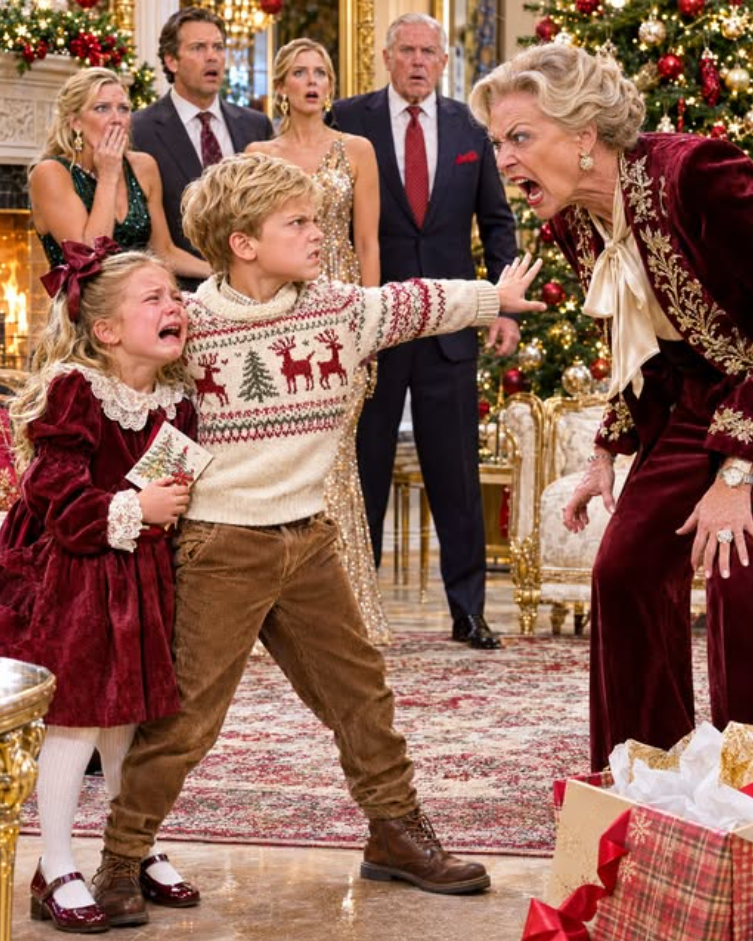
Her face folded inward. Her lower lip shook, and her chest caught twice before the tears began rolling down her cheeks. I seized the carved back of a dining chair until its edges pressed painfully into my palms. I was not holding it because I might fall. I was holding it because I feared what my hands would do if I released it. Lawrence cleared his throat and studied his socks. Melanie covered her mouth, pretending astonishment, though something pleased and ugly shone in her dark eyes. Thomas sat motionless on the sofa, his face drained of color. His mouth opened and closed without producing a word. I recognized the paralysis, the lifelong training that had taught him his mother’s cruelty must never be challenged directly. Then a chair scraped sharply across the hardwood. Noah had stood up. His fists were clenched, his jaw trembling, and his eyes held a fury that looked terrible on such a young face.
He crossed the rug without looking toward either parent. First, he reclaimed his sledding drawing from the table beside Sharon’s wine glass. Then he lifted the expensive remote-control vehicle and dropped its heavy box at her feet. It struck the floor with a solid thud. Melanie gasped. Noah looked directly at his grandmother. “If my sister isn’t good enough to have a grandma,” Noah said, his voice trembling at the edges but holding firm at its core, “then you aren’t mine, either.” Sharon recoiled against the cushions, her mouth hanging open as color flooded her cheeks. Noah turned away before she could recover. He took Mia’s shaking hand and guided her toward me with a tenderness that nearly undid me. “Mom,” he commanded softly. “Get our coats. We’re leaving.” “Yes,” I said, my voice dropping an octave into pure ice. “We are.” Thomas finally rose. He retrieved our coats and opened the front door into the freezing December evening.
We left without another word. Looking back as I reached the brass latch, I saw Sharon staring at the abandoned gift, Melanie already reaching for her phone, and Lawrence withdrawing into the firelight with his drink. The oak door closed behind us with the finality of a vault. Outside, the cold stung the wet tracks on Mia’s face. Thomas drove home in a silence so dense it seemed to press against the windows. Green dashboard light washed over his features, and the tendons in his hands stood sharply against the steering wheel. In the back seat, Noah remained pressed beside his sister, never releasing her hand. He pointed out holiday lights in the passing yards, whispering steadily, trying to give her something ordinary to hold onto. I watched the headlights sweep the road while my rage changed temperature. It stopped burning wildly and hardened into something far less forgiving.
Looking backward, I could trace Sharon’s hostility to the beginning. Thomas and I met during my final undergraduate spring, when an energetic roommate dragged me to a board-game café. I was tired, stressed, and uninterested in romance. He sat beneath a brass lamp in a faded NASA shirt, sorting wooden resource tokens by shade and grain. His wire-rimmed glasses kept slipping down his nose. When I joined him, he looked up and said, “If you’re planning to take the settlement on the eastern tile, I should warn you that the mathematical probability distribution over forty rolls heavily penalizes agricultural expansion.” I laughed. His ears turned pink. Beneath that awkwardness was an earnestness I had rarely encountered. He listened closely, never hurried people, and possessed none of the empty swagger I had come to expect. He was brilliant at computational materials science and remarkably defenseless against dishonesty. His family had taught him that gentleness was an opening other people were entitled to exploit.
At our first dinner in his parents’ house, Sharon assessed me as though I were inexpensive jewelry presented as an heirloom. “Oh,” she had remarked, her eyes lingering briefly on my boots before drifting up to my face. “You’re Emily? You’re significantly shorter than Thomas described. And your shoulders are quite broad, aren’t they?” Over dry pot roast, she questioned my parents’ finances, my mother’s background, my ambitions, and whether I appreciated that Thomas needed a wife prepared to remain quietly behind him. Lawrence contributed obedient nods. “Thomas has always been our delicate genius,” Sharon had purred, refilling her wine glass while ignoring mine. “He carries the entire legacy of this family on his shoulders. He needs someone who understands sacrifice.” At twenty-two, I did not yet understand her definition of sacrifice. Years later, in the glow of the dashboard while our daughter cried behind us, I could translate it without difficulty: Thomas was expected to surrender his money, his peace, and finally his children’s dignity.
The financial arrangement became visible three years into our relationship, shortly after Thomas entered his doctoral program. I brought groceries to his tiny apartment and found his banking page open on the kitchen counter. A recurring nine-hundred-dollar transfer helped cover his parents’ mortgage. Another four hundred dollars went to Melanie. Meanwhile, Thomas worked seventy-hour laboratory weeks, lived on a research stipend, and ate canned soup to afford his textbooks. “Thomas,” I had said, confronting him as gently as I could manage. “Why are you paying your parents’ mortgage? Your father is fully employed at the logistics firm, and your mother runs an interior decorating consultancy.” He flushed and stared at the floor. “They… they hit a rough patch during the housing contraction, Em. It’s just temporary. They gave up everything so I could focus on my early education. I owe them.” “And Melanie?” I asked, pointing at the screen. “Your sister is twenty-six years old. Why are you funding her lifestyle?”
“She’s between contracts,” he murmured defensively, his voice tight. “She’s finding her path. Family doesn’t abandon family when things get complicated.” I should have challenged the arrangement more firmly. Instead, I told myself it was his income and his responsibility to navigate. Surely, I thought, graduation and a professional career would establish a natural boundary. The opposite happened. When Thomas secured a senior computational-modeling position at a private aerospace research firm, Sharon celebrated by ordering imported Italian quartz countertops and forwarding him the invoice. Melanie moved through three unfinished certificate programs, bought a late-model crossover, and sent photographs of overdue bills whenever she wanted additional spending money. What I had mistaken for a temporary connection became a permanent pipeline. Our own household absorbed the pressure, and I swallowed my resentment because Thomas seemed to believe that refusing any request would prove he had failed as a son.
Then Noah arrived, carrying Thomas’s thick dark hair, pale complexion, and unmistakable jawline. Sharon claimed his appearance as a personal achievement. “Our genes are triumphant,” she would announce loudly at family gatherings. “Look at him. He is the living image of my father. True stock.” Two years later came Mia, with her slate-grey eyes, soft chin, and quiet attentiveness. I recognized my grandmother Clara in her immediately. Clara had survived war, widowhood, and poverty while retaining a steady dignity. She had been a seamstress and the strongest presence of my childhood. Her death from cancer during my pregnancy left a grief that Mia’s familiar expressions somehow softened. My daughter’s half-crooked smile brought back the woman who had made me feel understood without explanation. Sharon, however, interpreted a child’s resemblance to her mother’s family as a deliberate insult to her own. She could not bear a lineage in which she was not the central figure.
When Mia was four months old, Sharon leaned over her crib and drew back with a sour expression. “Well,” Sharon had remarked dismissively, stepping back without touching the child. “She certainly doesn’t look like Noah. Or Thomas. In fact, she doesn’t carry a single physical marker of our family tree.” “She looks exactly like my grandmother, Clara,” I had replied evenly, holding my infant closer. Sharon laughed through her nose. “If you say so, dear. Let’s just pray she grows into her features. Otherwise, people on the street might start asking your mail carrier some rather uncomfortable questions.” She called remarks like that jokes. At barbecues and birthday dinners, she found fresh versions. “Look at Noah, working that puzzle like a true academic prodigy! And Mia… well, Mia certainly has an artistic temperament. Who knows where that came from?” Another time: “Are we entirely sure Thomas was in town nine months before Mia arrived? You were traveling quite a bit for that marketing consultancy, weren’t you, Emily? We’re just teasing, darling! Don’t be so terribly sensitive!”
The gifts followed the same pattern. Noah received train sets, museum memberships, and beautifully fitted clothing. Mia received damaged toys, bargain-bin leftovers, and indifference. During one bakery outing, Sharon bought Noah a towering chocolate cake decorated with a sugar racecar, then handed Mia an uniced biscuit from the previous day. Before I could object, six-year-old Noah scraped half his frosting onto his sister’s biscuit and gave her the racecar. “There, Mia,” Noah had whispered solemnly. “Now yours is better.” That night, I confronted Thomas through furious tears. “She is poisoning our children’s minds, Thomas! She is teaching Mia that she is second-class, and she is teaching Noah that cruelty is acceptable as long as it comes with a gift receipt!” He covered his face. “She’s just old-fashioned, Emily. She doesn’t mean it the way it sounds. If I fight her, she’ll make Lawrence’s life hell, she’ll cut Melanie off, she’ll turn the entire extended family against us. Please. Just let it roll off your back.”
I had obeyed that plea for too long. I had protected his fragile balance by absorbing insults that should never have reached our children. Christmas had exposed the cost. When our tires finally crunched into the driveway, Thomas stopped the engine, and the silence inside the car felt almost frightening. We carried the children indoors. I warmed milk with honey and settled them beneath the heavy duvet on our bed, putting on an animated film about woodland animals. I brushed Mia’s hair away from her damp forehead until her breathing steadied. Even asleep, her fingers remained caught in Noah’s sweater sleeve. He stayed awake longer, watching the screen with that solemn vigilance that had become unbearably familiar. When exhaustion finally overtook him, I kissed both foreheads and closed the bedroom door. Down the hall, a narrow bar of blue light shone beneath Thomas’s office door.
I expected to find him collapsed, apologizing, or preparing another defense of his mother. Instead, he sat at his mahogany desk, still wearing his wool overcoat and heavy scarf. His glasses had slid down his nose, unnoticed. Two wide monitors lit the dark room, and his fingers moved rapidly across the keyboard. One screen displayed his banking portal. The other held a spreadsheet stretching back almost nine years: dates, amounts, reference numbers, wire confirmations. I stepped behind his chair as he selected the recurring mortgage payment for Sharon and Lawrence’s house. His cursor moved to TERMINATE RECURRING AUTHORIZATION. A confirmation window appeared. He accepted without hesitation. A quiet electronic chime sounded. Then he opened the next allocation: Melanie’s automobile and insurance, five hundred and fifty dollars each month. He canceled that too. Bella’s performing-arts subsidy followed, then the supplemental household health-and-wellness transfer for his parents.
Payment by payment, Thomas disconnected the arrangements that had bound us to them. He moved with a detached precision I had never seen outside his work. “Thomas?” I whispered, my voice trembling. “What are you doing?” He entered closing notes in the spreadsheet without looking up. “I am performing an overdue mathematical correction,” he said. His familiar hesitation was gone. “Thomas… look at me,” I pleaded quietly, placing a trembling hand on his wool-clad shoulder. He stopped and turned toward me. His eyes were bloodshot and shadowed, full of shame and a cold fury. “Did you see him, Emily?” Thomas whispered, his voice cracking down the middle. “Did you look at our eight-year-old son in that room?” A tear ran down his cheek. “Noah stood between his sister and the wolves,” Thomas said, his chest hitching in a ragged breath. “An eight-year-old boy possessed the spine, the honor, and the moral decency to defend Mia, while her father—the man who is supposed to be the fortress around this family—sat on the sofa like a terrified, obedient child.”
He dragged his hands down his face. “I sat there, Emily. For six years, I convinced myself that if I just kept pouring money into their accounts, if I just kept absorbing their contempt, if I just kept apologizing for existing, they would eventually love us. I told myself that family was supposed to hurt.” He turned back toward the monitors. “They didn’t see me as a son, Em. They didn’t see Noah and Mia as grandchildren. We were never a family to them. We were an endowment fund that they were permitted to insult whenever the mood struck.” His finger shook as he indicated a red-bordered cell at the bottom of the spreadsheet. Every transfer, rescued credit-card balance, renovation invoice, and direct payment had been totaled. TOTAL EXTENDED CONTRIBUTION: $80,940.12. I stared at the figure. It represented years of work, security we might have built, opportunities for our children, all drained into a family that considered our daughter unworthy of affection.
“Thomas…” I breathed, the sheer weight of the number pressing down on my lungs. “It ends tonight,” Thomas said, his voice dropping into a register that sent a shiver straight down my spine. “Every cent. Every privilege. Every pretense.” Before his words had fully settled, the phone beside his mouse began vibrating against the desk. Its insistent buzz filled the office. MOTHER – MOBILE appeared on the screen. Neither of us moved for an instant. I watched his face, searching for the old reflex: the apology already forming, the fear of disappointing her, the impulse to restore whatever she demanded. It never came. Thomas looked at the name, reached forward, and accepted the call. Then he turned on the speaker, and his mother’s voice burst into the room.
PART 2 — The Lies She Made Public
“Thomas?!” she shrieked, the audio clipping against the phone’s tiny microphone. “Thomas, what on earth is happening with your banking application?! Your father just went online to review our property tax allocation, and our primary mortgage system sent an automated security alert stating that the recurring funding account was manually deleted by the account holder! Did your firm suffer a cybersecurity breach?! Rectify it immediately! Your father’s blood pressure is through the roof!” Thomas rested his forearms on the desk. He did not shout. “There was no cybersecurity breach, Mother,” Thomas said. “I logged into the portal fifteen minutes ago and permanently terminated the payment authorization.” The silence that followed was so abrupt that Lawrence’s strained breathing became audible behind her. “You… what?” Sharon stammered. “What do you mean you terminated it? Don’t be absurd, Thomas! That payment is due on the first of the month! We rely on that allocation! You know Lawrence’s consulting retainers have been slow to materialize!”
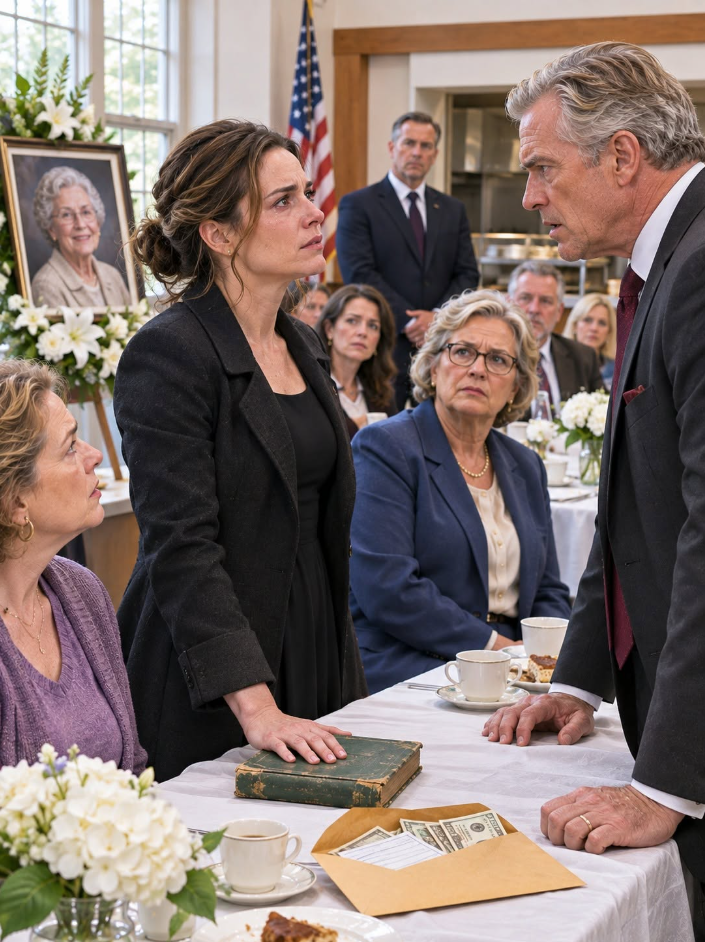
“Then Lawrence will need to secure alternative employment,” Thomas replied smoothly. “Or you will need to sell the vehicle Melanie is driving. Or you will need to sell this house and downsize into an apartment you can actually afford. Because you will never receive another dollar from my accounts for as long as you draw breath.” Sharon’s voice climbed into a howl. “How dare you?!” she cried. “After everything Lawrence and I sacrificed to give you an education?! After we nurtured your intellectual development?! You owe your entire career to this family! You are our son!” He tightened his hands against the desk. “I am the father of two children,” Thomas said. “And tonight, in front of our entire extended family, you looked at my six-year-old daughter—a child who spent a week making you a gift with her own small hands—and told her that she was born of infidelity. You told her she wasn’t worthy of calling you grandmother.”
“Oh, for heaven’s sake!” Sharon barked back. “You are blowing an offhand, humorous observation entirely out of proportion! It was a joke, Thomas! An adult joke! Mia is six years old—she doesn’t have the intellectual capacity to comprehend what was said! She won’t remember a single word of it by New Year’s Day!” “Noah will remember,” Thomas said. “Emily will remember. And I will remember every single syllable until the day they put me in the ground.” Then Sharon abandoned even the pretense of explaining herself. “This is that woman, isn’t it?!” she roared. “This is Emily! She has been poisoning your mind against your own flesh and blood since the day you brought her into our home! She knows that girl looks like a stranger! She knows everyone in this town whispers behind your back! She’s terrified of the truth, so she’s manipulating you into abandoning your own mother! She’s an insecure, manipulative—” “Goodbye, Sharon.” Thomas ended the call. His chest rose heavily beneath his coat, and his shoulders shook.
I reached toward him. “Thomas…” I began. The phone immediately vibrated again: MELANIE – CELL. I closed my eyes. “The auxiliary unit,” I muttered. He answered on speaker. “Thomas, are you out of your psychotic mind?!” Melanie screamed before Thomas could utter a sound. “Mom is hyperventilating in the hallway! Dad is trying to find his nitroglycerin pills! And I just checked my student portal and my registration for spring classes was rejected because the tuition card was cancelled! How the hell am I supposed to pay for Bella’s advanced dance academy?! What is wrong with you?!” “The tuition is cancelled, Melanie,” Thomas said coldly. “The car insurance is cancelled. Your cellular service allocation is cancelled. You are thirty-one years old. If you wish to attend classes, take out a federal loan. If you wish to keep Bella in dance academy, find a full-time job and pay the invoice yourself.” I stood beside him, hardly recognizing the steadiness of his voice.
“You can’t do this to us!” Melanie shrieked. “All of this because Mom made a harmless comment about a drawing?! Everyone knows Mia doesn’t look like our side of the family! Everyone says it! Why are you punishing me and Bella for something Mom said?!” “Because you sat on that carpet and laughed,” Thomas said. “Because for six years, you have whispered, mocked, and enabled our mother’s cruelty while holding your hand out for my paychecks. You insulted my wife’s honor and my daughter’s legitimacy while living on my labor.” “Thomas, listen to yourself!” Melanie yelled. “You don’t even know for a fact that she’s yours! You’re sacrificing your real family for a child who might not even—” “Do not finish that sentence, Melanie,” Thomas warned. “I will finish it!” she spat back. “You’ve always been a blind, spineless coward when it comes to women! You’re throwing away your family for a lie!” He looked up at me. “No,” Thomas said. “I am finally protecting the only family that actually matters.”
He disconnected, opened his settings, and blocked Sharon, Lawrence, and Melanie. Only then did he fold forward with his face in his hands and sob. I wrapped my arms around him and rested my cheek against his hair. I did not promise an easy morning or tell him the worst had passed. We stayed in the dim office until three, holding on while the structure of his old life came apart. Later, beside our sleeping children, I watched passing headlights sweep the bedroom ceiling. Dread settled beneath my ribs. Sharon did not respond to humiliation by examining herself. She gathered supporters. She reshaped events. Losing our money would not make her repentant; it would make her furious. The silence that followed those calls was not peace, and I knew better than to mistake it for surrender. By Tuesday morning, she had found another audience.
At 7:14, while I buttered sourdough toast for Mia and waited for the coffee machine, my phone chimed beside the fruit bowl. Cousin Sarah had written. We had barely spoken since Lawrence’s retirement party two summers earlier. “Emily… oh god. Are you and Thomas okay? Have you seen what Sharon just published on Facebook? The entire extended family group chat is going completely insane. Please tell me this isn’t true.” I wiped my fingers and opened the application. Sharon’s post was already circulating through community groups and the family network. Above twelve paragraphs of carefully staged anguish was an old sepia photograph of her holding Thomas as a newborn. She looked tender and fragile. Scripture references and crying emojis framed her account. “There is no agony on this earth quite like the cross a mother must bear when her firstborn son is stolen away into darkness,” the post began. In her version, she and Lawrence had spent their later years rescuing us from our “countless personal crises.”
She described Thomas as controlled by an “insecure, deeply manipulative woman,” then published the accusation she had spent years disguising as humor. “As parents, we tried to remain silent. We swallowed our pain when our beloved son was coerced into financially abandoning us on Christmas Eve, leaving his aging, ailing father without his necessary medical allocations. But our greatest heartbreak has always been the dark cloud of deceit hanging over our precious grandchildren.
We only ever sought the truth. We only ever asked for honesty regarding little Mia’s true lineage, because any person with eyes can see she carries none of the physical or intellectual heritage of the family. We simply wanted to protect our son from a lifetime of living beneath a lie of another woman’s making. For the crime of desiring honesty, for the crime of loving our son too much, we have been cast out into the cold, cut off from our beloved Noah, and discarded like refuse. May God forgive those who break the sacred bond of family.”
Eight hundred mutual acquaintances could see it: relatives, former classmates, church members, and people from Thomas’s laboratory. Melanie supplied a constant stream of agreement. “Stay strong, Mom! The truth always comes into the light! Thomas is blinded by love, but everyone who attended the baby shower knows what was being whispered! She’s taking him for everything he’s worth!” Others followed. “Oh, Sharon, I am weeping for you! How utterly demonic!” Another wrote, “I always wondered! Noah looks identical to Thomas, but that little girl… well, genetics don’t lie, do they?” Then: “He needs to demand a paternity test immediately! A man shouldn’t be forced to raise another man’s child under emotional blackmail!” And: “Unbelievable. To cut off his own parents’ mortgage at Christmas? That woman has completely destroyed his moral compass.” Thomas entered in his fleece robe, took in my face and the toast burning under the broiler, and immediately lost his sleepy expression. “What did she do?” he demanded.
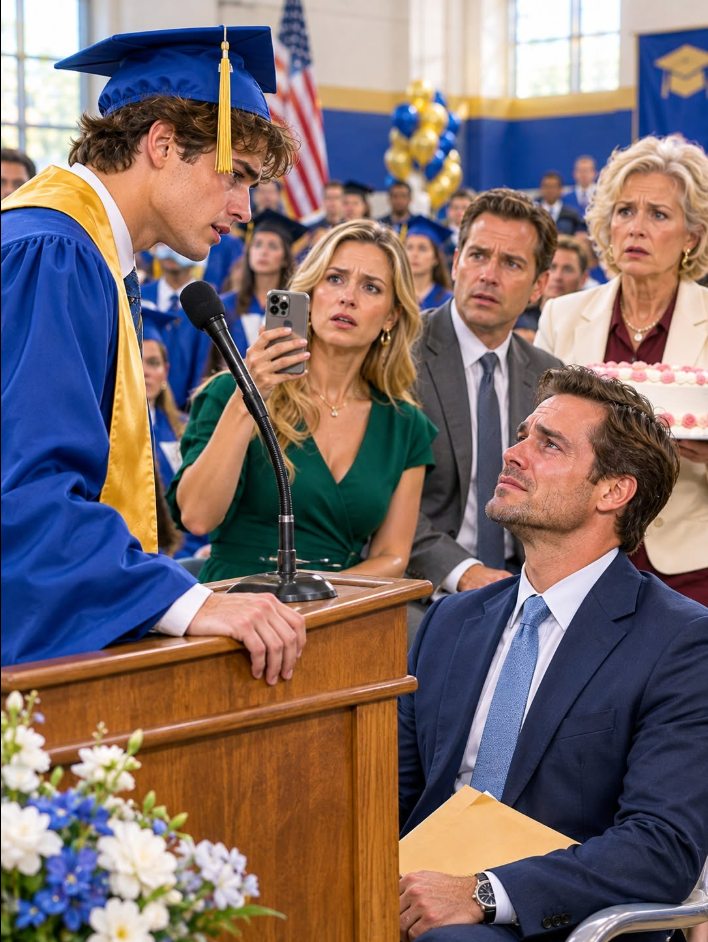
I handed him the phone. As he read, the muscles in his jaw tightened. “They’re putting circles around Mia’s face, Emily,” he whispered. “Melanie posted a split-screen photo of Mia and Noah in the comments. She’s drawing circles around Mia’s eye shape and cheekbones to prove she isn’t mine.” He placed the phone on the counter with unnerving care. “They are destroying our daughter’s name before she is even old enough to read,” I said, tears of pure humiliation finally spilling over my lashes. “If this stays out there… if this becomes the narrative… Noah will hear it on the playground. Mia will be whispered about at school drop-off. Her entire childhood will be tainted by this filth.” Thomas stood with his eyes closed for a full minute. When he opened them, something final had settled behind his glasses. “Get dressed,” Thomas said quietly. I stared at him. “What?” “Get dressed. Call Dr. Henderson’s pediatric office and ask for an immediate clinical referral. We are going to the certified molecular diagnostic center downtown.”
The words hurt before I understood them. “Thomas… you don’t need a test,” I choked out. “You know she’s yours. You were there the night she was conceived. You held her five minutes after she left my body! You know I have never—” He took my face between his warm hands. “Emily, listen to me,” he said. “I do not need a piece of paper to know Mia is my daughter. She is the beat of my heart. I know every freckle on her nose. I know she has my laugh and your grandmother’s soul.” He kissed my forehead. “I am not getting this test for me,” he whispered fiercely. “I am getting this test because Sharon and Melanie have built an altar of lies in the public square, and I am going to burn it to the ground with clinical, empirical, irrefutable science. They want to play with laboratory data? Computational genetics is my field. Let’s show them what real data looks like.”
Two hours later, we sat in the waiting room of a state-certified genetics facility. To Mia, the appointment was a scientific adventure. Thomas showed her a diagram of a cell and explained DNA as a secret code responsible for curling hair and grey eyes. When the technician swabbed her cheek, she giggled. Noah watched with the attention of a junior scientist, then wanted to know whether a cheek swab could reveal superpowers. The technician smiled, sealed the samples in tamper-evident sleeves, and completed the chain-of-custody records. “Standard turnaround for legal-grade chain-of-custody results is five business days,” the technician informed us, handing Thomas the tracking receipt. “Because this is expedited for court admissibility, the digital portal will update the moment the sequencer completes the allele matching.” “Thank you,” Thomas said, taking the receipt and sliding it carefully into his breast pocket. “We’ll be watching the portal.” Our children left with their curiosity intact. I held onto that small mercy.
While the laboratory worked, I went to my mother’s house. Together, we lowered the attic stairs and brought down three dusty cedar chests holding the history of her family. We spent four hours among albums, old paper, and the fading scent of lavender. In a leather-bound album from 1952, I found Clara at six years old. She sat on a low velvet bench in a pleated sailor dress, her hands folded neatly in her lap. The studio portrait was beautifully preserved. I opened a photograph of Mia at her kindergarten graduation and held the two images together. The resemblance stopped me. The same almond-shaped eyes, the same slight indentation beneath the lower lip, the same thoughtful mouth. It was not merely a family similarity. It felt like meeting a beloved face across generations. I scanned Clara’s portrait at the highest resolution available. Sharon’s accusation depended on pretending my family had contributed nothing at all.
For three days, the post continued spreading. Melanie accepted condolences and encouraged speculation. Distant aunts emailed Thomas, urging him to “come to his senses” and “remember the Fifth Commandment.” Lawrence published a vague complaint about “unconditional parental sacrifice being repaid with betrayal.” We answered none of it. Instead, we saved screenshots: every accusation, every tagged name, every false assertion. The silence demanded effort. At times, my hands shook as I stored another image of strangers discussing my child’s face. But answering in fragments would only let Sharon turn the argument into another performance. We waited for something she could not wave aside as sensitivity or disloyalty. On Friday afternoon, at precisely 3:42, Thomas’s computer sounded a notification. GENE-TRACE CLINICAL LABORATORIES: SECURE RESULT READY FOR DOWNLOAD. I stood behind his chair with my fingers pressed into his shoulders as he opened the portal and entered his authentication details.
The certificate appeared, carrying the director’s signature and a digital verification seal. My eyes passed over the technical columns until they found the conclusion. PROBABILITY OF PATERNITY: 99.9999%. Below it: CONCLUSION: ALLELIC MATCH CONCLUSIVELY CONFIRMS THAT THOMAS EDWARD MILLER IS THE BIOLOGICAL FATHER OF MIA CLARA MILLER. THE HYPOTHESIS OF NON-PATERNITY IS STATISTICALLY EXCLUDED. I released a shaking breath. I had never questioned the answer, yet seeing it documented felt like stepping out of poisoned air. “Look at that, Em,” Thomas whispered, his voice dangerously calm as he stared at the six nines of probability. “Empirical perfection.” He looked up. “Are you ready?” he asked. “I’ve been ready since Christmas Eve,” I replied. He opened his editing software and began arranging three pieces of evidence. The first was the certified report, with our home address concealed. The second placed Clara’s childhood portrait beside Mia’s. The third showed the financial ledger and its total: $80,940.12.
Then Thomas wrote the statement that would accompany the images. He stripped away outrage and let the facts stand plainly: For the attention of our extended family, friends, and community members who have spent the past four days reading Sharon Miller’s public statements regarding our household: Here are the objective, empirical facts: 1. Attached is the certified legal DNA paternity report from Gene-Trace Laboratories. It confirms with 99.9999% certainty what my wife and I have always known: Mia is my biological daughter. The rumors, public accusations, and defamatory assertions regarding my wife’s fidelity are malicious falsehoods invented out of whole cloth. 2. For six years, my mother and sister have claimed Mia ‘looks like an outsider.’ Beside the DNA report is a photograph of Emily’s maternal grandmother, Clara, taken at age six, beside our daughter at the exact same age. Mia carries the heritage of a noble, loving woman—a heritage Sharon refused to acknowledge because she could not manipulate it.
The statement continued: 3. On Christmas Eve, in front of our children, Sharon looked at our six-year-old daughter, rejected her handmade gift, and stated: ‘Children from mommy’s cheating don’t get to call me grandma.’ That cruelty was witnessed by our eight-year-old son, Noah, who possessed the moral courage to return his gifts and walk out of that house. 4. For nine years, I have quietly funded my parents’ lifestyle. I paid their mortgage. I funded my sister’s car insurance, tuition, and living stipends. The total sum transferred from my family’s earnings to their accounts is $80,940.12. When I terminated these payments following Sharon’s verbal abuse of my daughter, this public smear campaign was launched as retaliation for losing access to my bank account. We have severed all contact with Sharon, Lawrence, and Melanie Miller permanently. Any further defamatory statements published online or repeated in the community will be met with immediate legal action for defamation of character and intentional infliction of emotional distress against a minor. Do not contact us. We are done.
Thomas reread the screen, then looked at me. “Post it,” I said. He selected SHARE, changed the audience to PUBLIC, and tagged Sharon, Lawrence, and Melanie. There was no speech afterward, no celebration in front of the monitors. We switched them off, collected the children, and went into the backyard to build a snowman in the fading light. Cold air brushed my face as Noah and Mia worked beside us. For the moment, their concerns were snow and shape and the ordinary pleasure of being together. That was what we had been defending from the beginning. Somewhere beyond our yard, the photographs, the laboratory result, and nine years of payments were reaching the same people who had repeated Sharon’s accusations. We kept our phones out of sight. We had finally answered her in public. Now we had to wait to discover what that answer would bring down.
PART 3 — The Inheritance She Counted On
We did not check our phones until nine that evening, after the children were asleep. By then, Thomas’s post had been shared more than four hundred times. The people who had crowded Sharon’s page with sympathy were now confronting her beneath the original photograph. “You told a six-year-old child that to her face?! What kind of monster does that over a handmade drawing?!” one demanded. Another wrote, “Look at the picture of Emily’s grandmother! That little girl is her twin! Sharon, you are a deeply sick, manipulative woman.” The money produced its own wave of disbelief. “Eighty thousand dollars?! Thomas was paying your mortgage while you sat around judging his wife?! Unbelievable. You should be ashamed of yourself.” Then came a message that struck directly at the social standing she guarded so fiercely: “Deleting my RSVP for your birthday gala, Sharon. I cannot associate with someone who abuses a child and lies about paternity to cover up financial parasitism.”
Melanie began deleting her comments and the photographs she had marked with circles, but relatives had already preserved screenshots. By ten, her profile had disappeared entirely. Sharon removed her original post and tried replacing it with a softer account. “Family matters should remain private. Words were misunderstood in the heat of a holiday moment. Lawrence and I are praying for peace.” This time, the audience refused its assigned role. Her injured-mother performance had collapsed under documents she could neither explain away nor accuse of misunderstanding a joke. For months, she had been preparing an extravagant sixtieth-birthday celebration at the country club, scheduled for January’s second week. Fifty engraved invitations had gone to relatives across three states. Now the refusals arrived one after another. Cousin Sarah declined. Uncle Robert declined. The Ohio cousins declined. Lawrence’s own siblings said they were “deeply uncomfortable celebrating someone who weaponizes children.”
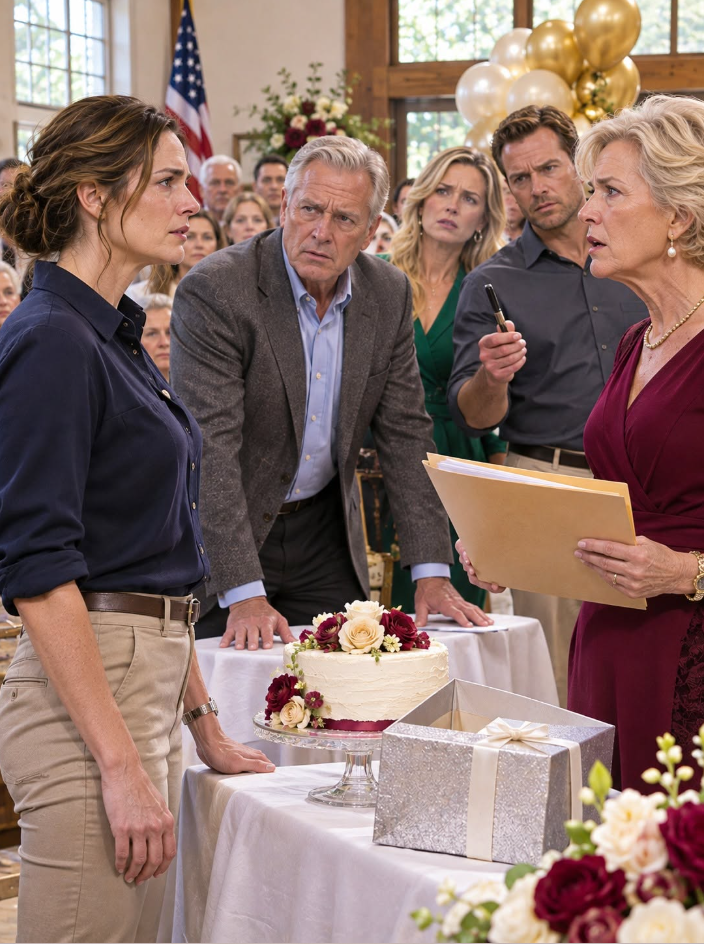
The gala that Sharon had imagined as a tribute to herself became a roomful of empty chairs. She and Lawrence sat beside an expensive three-tiered red velvet cake and four unwanted centerpieces while the staff removed untouched shrimp cocktails. He wore a rented tuxedo. Around them, linen-covered tables waited for guests who did not come. The social collapse was only one consequence. When the first of the month arrived without Thomas’s money, the financial arrangement underneath their apparent comfort failed as well. Lawrence’s supposed consulting retainers were fiction. His logistics employer had let him go on a reduced pension eighteen months earlier, and Sharon had concealed the change. Without the recurring transfers, there was no longer enough money to sustain the picture she had presented to everyone else. The wealth had always depended on Thomas remaining too ashamed, too loyal, or too frightened to stop paying.
Three weeks later, Melanie’s crossover was repossessed when she could not meet its four-hundred-dollar installment. She took night-shift inventory work to cover Bella’s basic needs. By late February, a real-estate sign stood in Sharon and Lawrence’s frozen lawn: FORECLOSURE AUCTION – FORCED DOWNSIZING. The house they had occupied for twenty-five years had to be liquidated. The imported quartz and Persian rugs belonged to the same collection of appearances they could no longer afford to maintain. They moved into a drafty two-bedroom duplex on the industrial side of town. Sharon had treated her son’s earnings as a resource guaranteed by birth. She had mistaken his willingness to endure for an inability to leave. Yet the change that would most profoundly reshape our own future did not come from their lost house or ruined reputation. It came on a Thursday in late March, when my phone rang while I folded laundry in the sunroom.
The number was private, carrying an affluent upstate New York area code. “Hello?” I answered cautiously. “Is this Emily Miller?” a voice inquired. It was an older woman’s voice, elegant, exact, and accustomed to being heard. “Yes, it is,” I said. “May I ask who is calling?” After a measured pause, she answered. “My name is Virginia Caldwell,” the woman said. “I am Thomas’s maternal aunt. Sharon’s elder sister.” I sat on the edge of the laundry basket. In ten years, I had met Virginia only twice. Eight years older than Sharon, she had married a maritime logistics industrialist and lived on a historic stone estate near the Finger Lakes. Her life involved charitable foundations and travel, far from her sister’s domestic court. Sharon described her as “cold, elitist, and detached from family values.” The bitterness beneath those words had always been obvious. Virginia had stopped including Sharon in her immediate social life twenty years earlier.
“Hello, Aunt Virginia,” I said, my voice carefully neutral. “It’s been a very long time.” “It has, my dear,” Virginia replied, her tone softening just a fraction. “I am calling because Cousin Sarah forwarded me the complete digital dossier of what transpired in my sister’s home this past Christmas. I have reviewed Thomas’s public accounting. I have seen the laboratory genetic documents. And I have seen the photograph of your grandmother Clara.” I waited, uncertain what she wanted from me. “Tell me honestly, Emily,” Virginia commanded quietly. “Did Sharon look at that innocent child and speak those exact words to her face?” My throat tightened. “Yes,” I said. “Word for word. Mia handed her a handmade Christmas card, and Sharon shoved it back and said that children from mommy’s illicit affairs don’t get to call her grandma.” Saying it aloud brought back the armchair, Mia’s hands, and the terrible stillness after the words.
Virginia exhaled slowly. “My sister has been a venomous, envious creature since the day she took her first breath,” Virginia said. “She was jealous of our mother. She was jealous of my marriage. And she has spent thirty years being pathologically jealous of the fact that her brilliant, gentle son managed to build a beautiful life with a woman of true substance.” I could hear paper moving at her end of the call. “Sharon has spent the last fifteen years operating under the comfortable, entitled assumption that when my time comes, my late husband’s estate would pass down to her and Melanie,” Virginia continued smoothly. “She has bragged about her expected inheritance to anyone who would listen. She treated it as her personal, guaranteed retirement fund.” My pulse changed. I had understood Sharon’s appetite for Thomas’s income. I had not known that she had already assigned herself ownership of someone else’s future estate.
“Aunt Virginia… you don’t need to involve yourself in—” I began. She stopped me with brisk warmth. “Do not interrupt me, Emily; I am seventy-two years old and I rarely repeat myself,” Virginia stated with brisk affection. “Yesterday morning, my estate attorneys arrived at my residence. I have executed an irrevocable codicil to my last will and testament.” I sat completely still. Laundry lay unfinished around me, but it had become difficult to register anything except her voice. Virginia was not calling to ask us to reconcile, forgive quietly, or consider what the neighbors might think. She had reviewed what happened and made her own decision. The authority in her voice was unlike Sharon’s. It did not demand submission or require an audience. It simply announced a boundary that had already been established. Then she explained exactly what that boundary meant for the inheritance her sister had spent fifteen years counting.
“Sharon has been completely, permanently disinherited,” Virginia declared. “She will receive precisely one dollar and a copy of the certified paternity test, so she may reflect upon the cost of her malice. Melanie has been stripped of every educational trust allocation. Lawrence will receive nothing.” I could not immediately form an answer. The woman who had accused my daughter of having no rightful place in her family had just lost the legacy she considered unquestionably hers. Virginia took a steady breath before continuing. “The entirety of my late husband’s primary family trust—including the commercial real-estate holdings and the liquid investment portfolio—has been restructured into a generation-skipping educational and protective endowment. The sole trustees are Thomas and yourself. The primary beneficiaries are Noah and Mia.” My hand covered my mouth. For a moment, all the weight I had carried since Christmas seemed to gather in one place inside my chest.
Tears blurred the sunroom. “Virginia… no,” I choked out, completely overwhelmed by the magnitude of what she was saying. “That is… that is millions of dollars. We cannot accept that. Thomas never asked for—” “That is precisely why you are receiving it, my dear,” Virginia said. “Because Thomas never asked. Because Thomas sacrificed his youth, his peace, and eighty thousand dollars of his own blood and sweat trying to keep his ungrateful mother afloat, and he never asked for a reward.” Her voice held a warmth so firm that it steadied me even while I cried. “This is not charity, Emily. This is justice. Your children deserve to grow up knowing that the world is not governed by the petty, vindictive cruelty of small-minded narcissists. They deserve to inherit a legacy built on integrity, honor, and truth. Sharon believed she could starve you emotionally. I am ensuring that your family will never have to answer to a single soul for the rest of your lives.”
When the call ended twenty minutes later, I sank onto the sofa and wept until my ribs hurt. The tears were not the furious ones I had swallowed at family dinners, nor the humiliated ones that fell over Sharon’s post. They came from relief so large I could barely contain it. Someone had looked at our family without asking us to excuse the harm done to it. Someone had understood what Thomas had given and what Noah had been forced to become in that room. Virginia’s decision did not change the words Mia had heard. It did not erase the years of unequal gifts or my husband’s silence. But it placed something substantial on the other side of those memories: protection, recognition, and a future no longer dependent on keeping cruel people comfortable. The long winter had finally begun to loosen its grip.
That evening, when Thomas returned from the aerospace laboratory, I seated him at the kitchen table and placed a glass of water in front of him. I held his hands while I explained the call. He listened without moving. For a long time afterward, he said nothing. Then he looked through the window into our backyard, where spring air was wearing away the last patches of snow and green shoots were appearing underneath. He drew me against him and buried his face in my neck. The breath he released was long and quiet. I had heard him sigh with exhaustion, fear, and resignation countless times. This was different. It sounded like a man discovering that the door he had believed locked all his life was standing open. There was nothing triumphant in it, nothing directed at his mother. It was simply the sound of someone finally permitted to stop carrying what had never been his alone to carry.
Six months have passed since Christmas. The absence of calls from the other side of town has become one of the gentlest facts of our days. Sharon and Lawrence remain in the small duplex near the freight tracks. Lawrence spends afternoons smoking in the gravel driveway. Reports reach us that Sharon devotes her time to private online forums, railing against parental alienation and ungrateful children. Melanie works forty-hour weeks at a distribution warehouse, learning the value of earnings she once expected her brother to provide. Bella now follows a standard public-school curriculum after her grandmother’s payments failed. Their lives have narrowed into the consequences of their own arrangements. I no longer spend my evenings planning how to survive the next holiday invitation or measuring how much disrespect I can absorb before speaking. The silence does not feel empty. It feels like space returned to the people who actually live in our home.
Our own lives have changed more quietly and more completely than any public argument could have accomplished. With the financial drain stopped and Virginia’s trust established, Thomas left the commercial contract firm that had nearly exhausted him. He accepted an endowed associate professorship at the university, where he researches advanced quantum lattices without the constant pressure of overtime and urgent requests for money. He smiles freely now. His shoulders no longer appear braced for the next demand. The intelligence I first noticed beneath that brass café lamp has room to exist alongside joy. He is still gentle. He still listens with the same careful attention. What has changed is his belief that gentleness obligates him to submit. The father who sat frozen on Sharon’s sofa is a memory he does not excuse, but neither does he hide behind it. Every ordinary day with the children gives him another chance to be present.
Yesterday was the summer solstice. Late-June light spread across our backyard, warm and golden. The air carried clover, jasmine, and the cedar smoke rising from the barbecue. Near the wooden fence, Noah crouched beside Thomas while they calibrated the suspension of a competition-grade robotic rover assembled from scrap aluminum in the garage. His dark hair lifted in the breeze as he laughed and called out telemetry calculations. Watching him, I thought of the boy who had stood beside the Christmas tree with his fists clenched. I was proud of what he had done, but I was grateful to see him occupied with something that belonged to childhood again. A machine could challenge his patience without injuring anyone he loved. His father was beside him, not waiting for him to stand in the way of danger. Across the lawn, beneath our weeping willow, Mia sat on a low wooden bench.
She wore a yellow sundress, and a thick watercolor pad rested across her knees. Paint pots stood in the grass around her feet. Sunlight filtered through the willow branches and moved over her face, brightening those slate-grey eyes that had caused so much invented suspicion. I crossed the lawn with a pitcher of lemonade. She looked up, thoughtful and absorbed, carrying Clara’s familiar expression without knowing how much history lived inside it. “Look, Mama,” Mia whispered, holding her painting up toward the sunlight. I stopped beside her. The paper was filled with our garden: indigo hydrangeas, golden marigolds, and a radiant sun. She had painted the flowers she once offered Sharon, but this picture did not wait anxiously for a grandmother’s approval. It belonged to the place where she was sitting, to the people whose voices she could hear across the grass, and to the life unfolding around her.
Four figures stood in its center, holding hands. There was a boy with a wrench, a man wearing glasses, a broad-shouldered woman, and a little girl carrying a paintbrush. Above them, in neat, confident handwriting, Mia had written: Our real family, right where we belong. I lowered myself onto the grass beside her and drew her close. The little porcelain angel in Sharon’s parlor could keep its damaged gold wings. We had something stronger than an appearance of holiness on a polished mantel. We had truth, the courage of a child who had refused to bargain away his sister, and the love of a man who had finally learned where his first duty lay. Yet as I looked from Mia’s painting to Thomas and Noah across the lawn, I understood that escaping Sharon’s house was not the whole story. We had taken our family back. What we would build with that freedom was only beginning.