PART 1 — The Call That Changed Everything
By the time the hospital reached me, the life I had known was already gone. The nurse kept her voice gentle. “Your wife is alive, sir. But you need to get here as soon as possible.” Alive. That was the word I carried with me as I hurried toward her. After months overseas, making decisions that could change lives in an instant, I should have understood helplessness. Instead, I discovered how little any of that experience had prepared me for a hospital room where the person I loved lay almost motionless.
“I’m deeply sorry. We couldn’t save your baby.” For several seconds, words deserted me. We had chosen names and spent evenings picturing a child neither of us had met but both of us already loved. We had talked about a future that had felt close enough to touch. Now I stood beside Meredith while those possibilities vanished into a silence I could barely endure. At last, I looked back at the doctor. “What happened to her?”
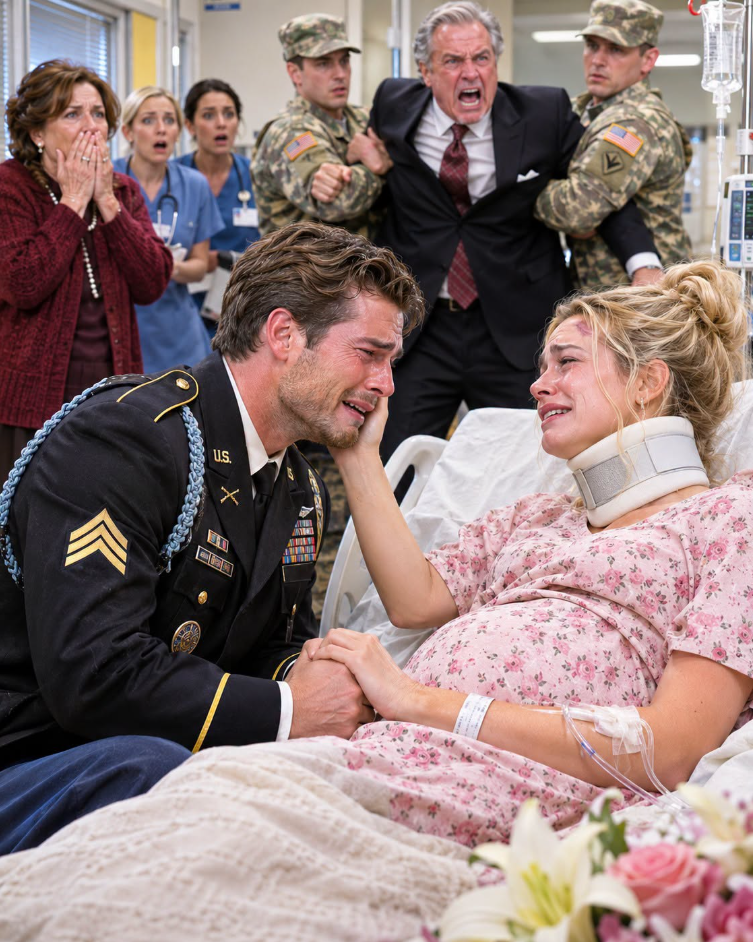
I approached them slowly. “What happened to Meredith?” My father-in-law showed little concern. “She had an accident,” he replied. “An accident?” He answered as though I were the one being unreasonable. “She fell. That’s all you need to know.” One of her brothers gave an uneasy laugh. “Why are you making such a big deal out of this?” I turned toward him. “My wife is in intensive care. We lost our baby.” He shrugged. “Then perhaps you should’ve been home.”
I drew a slow breath. “You’re right about one thing,” I said. My father-in-law’s mouth curved. “And what’s that?” “I’m a soldier.” He crossed his arms. “Exactly.” I met his eyes. “But you’ve made a serious mistake if you think that means I have no one standing beside me.” One of his sons rolled his eyes. “Is that supposed to scare us?” “No,” I replied. “It’s supposed to remind you that actions have consequences.” At that moment, my father-in-law’s phone began to ring.
He looked at the screen and frowned. Another phone sounded, then another. Confidence began draining from the faces around him. “What is going on?” one of the brothers muttered. I offered no answer. Down the corridor, the hospital’s glass entrance doors opened, admitting police officers and investigators. A security supervisor met them and indicated our hallway. My father-in-law straightened as they approached. “What’s all this?” An investigator stopped nearby. “We need to speak with everyone involved in the incident concerning Mrs. Callahan.”
“There’s been a misunderstanding.” My father-in-law’s assurance no longer sounded effortless. The investigator remained composed. “Then you’ll have an opportunity to explain what happened.” One brother glanced toward the exit. Another stared down. No one laughed now. My father-in-law faced me. “You called the police?” I held his gaze. “My wife deserves the truth.” He started to speak but produced nothing. Then Meredith’s door opened behind me, and a nurse stepped into the corridor. “Sir, your wife is awake. She’s asking for you.”
The hallway stopped mattering. I hurried back to Meredith, who looked exhausted but whose eyes filled when she saw me. Taking her hand gently, I said, “I’m here, sweetheart.” Her fingers closed around mine. “I was scared,” she whispered. “I know.” She looked at me through her tears. “Please don’t leave.” I leaned closer. “I’m not going anywhere.” Outside, investigators continued their questions. Inside, I stayed where she needed me, holding the hand I had feared I might never feel tighten around mine again.
The men outside were no longer acting as though they controlled what happened next. They were being required to explain themselves. Whatever the truth proved to be, it would have to emerge through evidence, medical records, and Meredith’s account when she could give it. Revenge was not what I wanted. I wanted her safe. I wanted accountability. More than anything, I wanted her to understand that facing her family would never again mean facing them alone. Her father had mistaken my restraint for isolation, and he was wrong about both.
I had spent years disregarding Dutch Braddock’s contempt. At Thanksgiving, he would lean back at the head of the long farmhouse table in rural Pennsylvania and question what I did all day, “marching around for a government paycheck.” His sons—Cole, Boyd, Wade, Hank, Rusty, Ty, Gus, and Clint—always supplied the laughter. I generally let the insults pass. I had Meredith, and preserving our life together mattered more than winning an argument with a man determined to despise me.
Those familiar humiliations had felt insignificant on the flight home. Thousands of miles from Meredith, with the cargo plane’s engines vibrating through me, I had thought only about reaching her. My encrypted satellite phone had buzzed against my vest, displaying a Massachusetts General Hospital routing code. I answered immediately. “Captain Callahan?” The nurse sounded professional, although worry edged her voice. “I’m listening.” “Your wife is alive, Captain, but she’s in critical condition. There’s been a serious incident, and the doctors need you here as soon as possible.”
My commanding officer had approved emergency leave before that call was over. Colonel Reyes met me at the ramp, took in my expression, and offered no unnecessary questions. “Go. Your unit has your back, Grant. Whatever you need.” At the time, I heard the promise without understanding everything it would come to mean. Twenty hours later, I was standing in the hospital, hearing about injuries, a lost baby, and the possibility that people Meredith knew had deliberately harmed her.
Once investigators separated the Braddocks and took them away to give statements, I remained beside Meredith until the monitors grew indistinct before my eyes. Around midnight, Detective Marian Okafor found me there. She was in her mid-forties, with tired eyes and a notepad she had not opened. She did not approach as though this were routine, and I was grateful for that. There was nothing ordinary about the hours we were living through, even if hospitals and investigations had procedures for all of them.
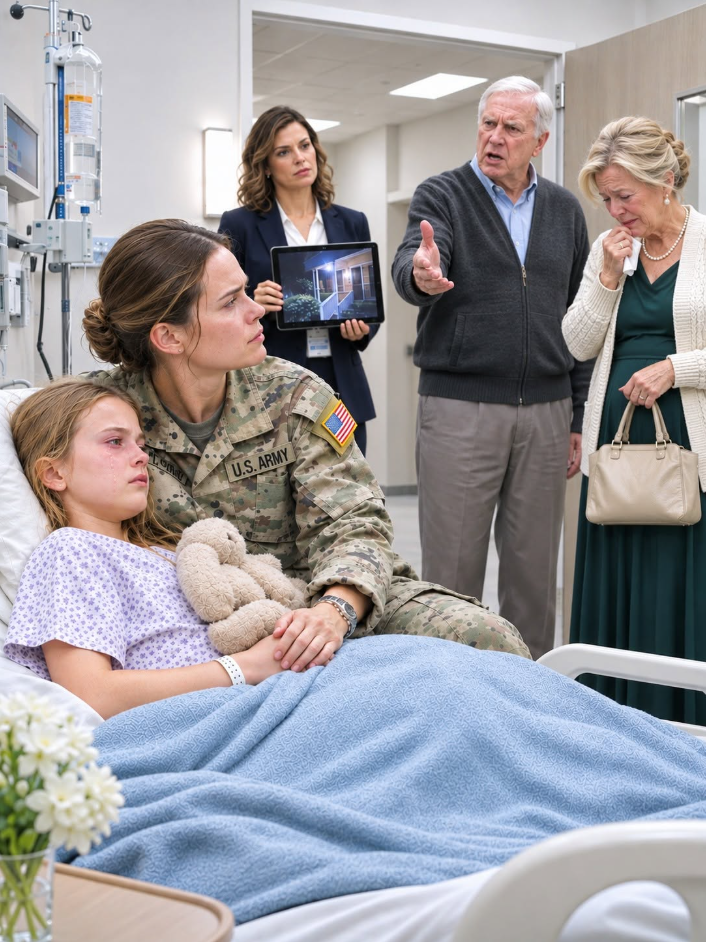
“Captain, I’m sorry to do this tonight. But your wife’s phone gave us something we need you to hear first.” She raised an evidence tablet and started a recording. Meredith’s voice came through first, controlled but thin. “I’m not signing it, Dutch. My mother left that land to me. It isn’t yours to sign away.” Hearing her speak outside the weakness of the hospital bed made me ache. Then I heard her father, and every part of me went still.
Dutch’s voice was low and flat. “That land is family property, girl. Your husband’s off playing soldier, and you’re carrying on like you’ve got a say.” I closed my eyes. For years, I had listened to him belittle me and told myself his words did not matter. Now I was sitting beside my injured wife while those same words emerged from a recording made before her fall. The file was still playing, and I had not yet heard what came next.
PART 2 — The People Who Came
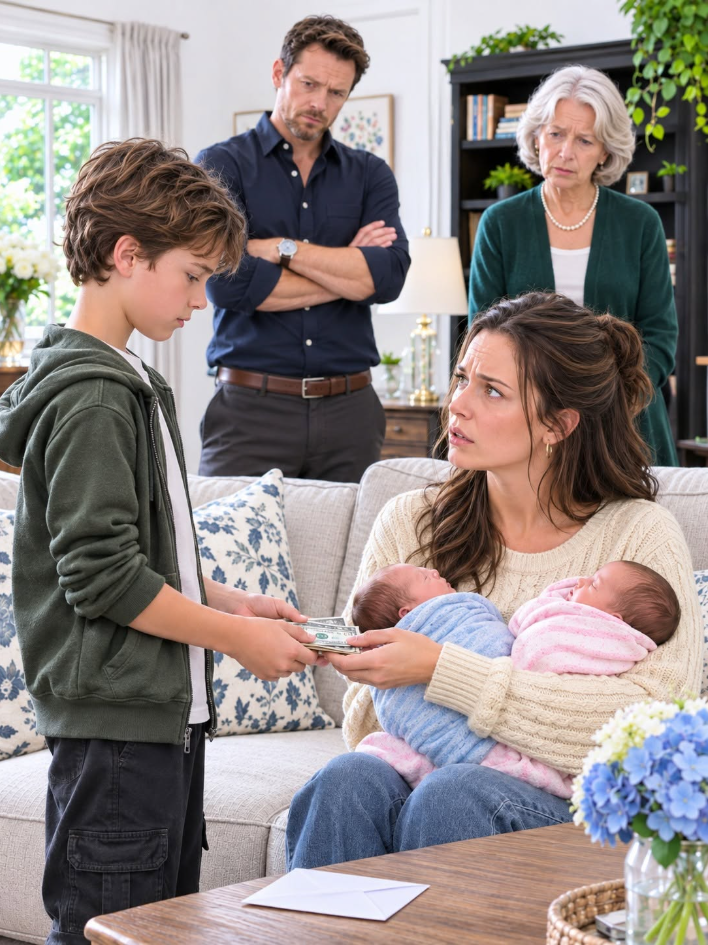
I knew exactly which land they were arguing about. Meredith’s mother had died two years earlier, leaving her sixty acres of lakefront property near the family farm and a modest trust. Dutch had been pursuing it ever since. He had arranged a development deal with a Pittsburgh buyer, but the agreement could not proceed without Meredith’s signature. Again and again, I had urged her not to meet him alone. Her answer had always carried the same certainty. “He’s my father, Grant. He wouldn’t.”
On the recording, the voices began overlapping. Cole mocked her. Boyd told her to stop being dramatic. Then Meredith spoke again, her control slipping. “Let go of my arm. I’m pregnant. Please. Let go.” A struggle followed, then a cry, then the heavy sound of a body striking the cellar stairs. I would hear that sound in my sleep for years. After it came silence. Then Dutch spoke with terrible clarity. “Nobody calls anyone. Let her sit there and think about it.”
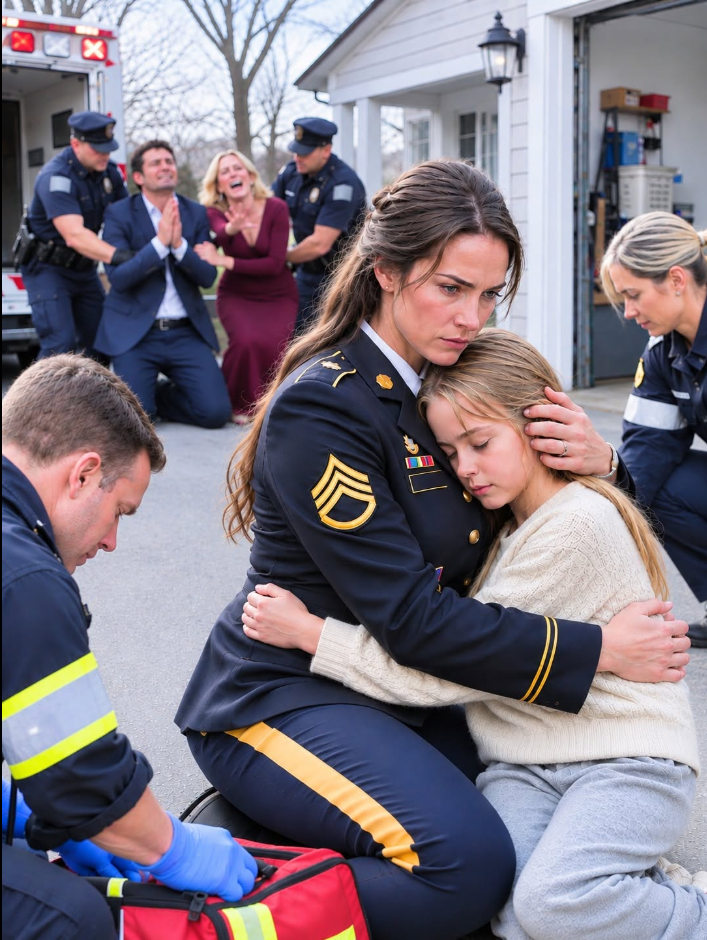
I looked at Detective Okafor. Her jaw had tightened. “We believe she was down there for nearly forty minutes,” she said quietly. “A farmhand named Eli Navarro heard her calling and phoned 911 behind the family’s back. They told him to mind his own business. He called anyway.” I tried to fit those forty minutes into something I could understand and could not. Finally, I asked, “Why was she recording?” The question seemed small beside everything else, but I needed to understand how we had her voice at all.
“She told her sister she’d started doing it two months ago. After the third time her father threatened her.” The detective paused. “Her phone auto-backed up the file to her cloud account. Her sister found it when she couldn’t reach Meredith and called us.” Frances was already traveling from Ohio. She had contacted police before I even entered the hospital. Their arrival during my confrontation with Dutch had not been something I arranged. I had made no call. I had simply told him Meredith deserved the truth.
“Captain,” Okafor said, “I need you to understand that this isn’t an accident case. What’s on this recording is assault on a pregnant woman and a deliberate delay of medical aid. We’re taking it to the district attorney in the morning.” I thanked her, although my voice sounded unfamiliar. Until then, I had been trying to understand how badly Meredith was hurt. Now I also knew that her own family had heard her suffering and chosen not to help.
The following afternoon, Meredith woke fully. Her injuries included a fractured pelvis, two broken ribs, a concussion, and a cracked vertebra protected by the neck brace. The surgeons hoped she would eventually walk without pain. About the rest, they could offer less certainty. The doctor had already told her about the baby, but she needed to hear it from me. Holding her hand, I repeated what neither of us wanted to be true. She turned into the pillow and cried without making a sound.
After a long while, she whispered, “We named her.” “I know.” Her next words nearly undid me. “Hope. I never told you. If she’d been a girl, I wanted Hope.” I had been thinking of the same name, but I did not tell her then. I lowered my forehead to her hand and stayed there. There was no explanation that could soften what had happened. I could only let her feel that she had not been left alone with it.
By Friday, Dutch’s lawyer was speaking to a local newspaper. He described the recording as “edited and taken out of context,” called Meredith “emotionally unstable after a difficult pregnancy,” and portrayed her husband, “an absent military man,” as someone “exploiting a family tragedy.” The comments were much as I expected: sympathy mixed with sneering assumptions about military wives. I read the article once and set the phone aside. Then calls began arriving—first Colonel Reyes, then Sergeant Major Dale Whitaker, who had served beside me on two deployments, and then many more.
By Sunday, forty-one people had gathered in the hospital’s family waiting room. Soldiers I had served with came in uniform, jeans, and veterans’ caps. Spouses from the unit’s family readiness group arrived carrying casseroles and groceries. Priya Venkataraman, a retired Army JAG officer, drove from Connecticut and settled a briefcase on her lap as though preparing for the Supreme Court. There was a Pennsylvania state trooper who had belonged to my platoon, and the chaplain who had stood beside us during the worst night of my first tour.
Dutch had said nobody would come to help. Now Sergeant Major Whitaker rose and clasped my hand between both of his. “We don’t leave our own behind, Captain. And she’s one of ours.” Within an hour, Priya was organizing what needed doing. “Grant, I’m not licensed here, but I’ll find you someone who is. Meanwhile, no more statements to anyone. Everything goes through counsel.” I looked around that crowded room, at people who had made the journey without needing to be persuaded, and finally understood Colonel Reyes’s promise.
Before nightfall, Priya had connected us with Dolores Haynes, a victims’ rights attorney in Philadelphia. Dolores reviewed the recording and did not hide her assessment. “This is the cleanest evidence I’ve ever seen. Their defense is already dead. They just don’t know it.” Her certainty could not restore what we had lost, but it gave us something practical to hold on to. While Meredith concentrated on surviving her injuries, other people could help us navigate what her father’s lawyer was trying to turn into a public argument.
Eventually, I learned what had caused the phones to ring in the hospital hallway. There had been no scheme behind it and no order from me. The county sheriff’s office had called first, instructing the Braddocks to remain at the hospital. The Pittsburgh buyer called after seeing the news and withdrew from the land agreement entirely. Their business partners called, too, demanding to know why the construction company’s name had become connected to a felony investigation. Dutch’s confidence had been collapsing for reasons he could no longer dismiss.
The consequences had not required me to threaten anyone. They required a witness who would act, a recording that survived, and people prepared to follow the evidence. The case progressed faster than I had feared it might, but slower than I wanted. Waiting meant watching Meredith manage pain while other people debated the events that had caused it. Still, there was a difference between waiting without answers and waiting while investigators assembled them. For the first time, her family could not simply decide which version everyone else would hear.
Cole and Boyd, who had held Meredith’s arms, were charged with aggravated assault and causing the loss of a pregnancy. Dutch faced conspiracy, reckless endangerment, obstruction of emergency medical care, and attempted coercion involving the property. Investigators discovered messages in which Rusty and Wade coordinated their account of what happened; both had been in the house and heard everything, and both were charged with obstruction. The younger four brothers had arrived afterward. They cooperated with investigators and avoided charges.
Two of those younger brothers sent Meredith written apologies. I read the letters, then passed them to her without offering an opinion. What she chose to do with them belonged to her. After everything that had been taken from her, I was not going to decide how she should respond to an apology, or whether she should respond at all. Accountability did not mean she owed anyone forgiveness. Supporting her meant remembering that her decisions were still hers to make.
Eli Navarro lost his farm job during the same week he made the emergency call. Once Frances and I learned about it, we helped him find another. By the end of the month, a veteran-owned landscaping company in Harrisburg had hired him. Someone from our unit knew the owner. Eli had heard Meredith and acted when others told him to look away. Doing the right thing should not have meant losing his livelihood, and this was one consequence we could help put right.
The months between the hospital and the courtroom did not pass quickly for Meredith. There were injuries to recover from and grief that no medical plan could resolve. When the time finally came for her testimony, eleven months had passed. I took a seat in the front row. Frances had helped her choose a navy dress. Meredith approached the witness stand with a cane, her shoulders held back. Watching her cross that room, I could see both how much she had endured and how determined she was to speak for herself.
She described the events in direct, even sentences. When the prosecutor asked about the cellar, she did not turn toward Dutch. She looked at the jury. “I called out for forty minutes,” she said. “I heard them upstairs. I heard them laughing. Nobody came.” I sat motionless in the front row. Her father’s lawyer would question her next—the same side that had already called her unstable and dismissed the recording. Now Meredith would have to face those accusations with her father sitting in the room.
PART 3 — What We Kept
Dutch’s attorney tried to unsettle Meredith during cross-examination. He asked whether she had provoked the disagreement and whether she had been emotional. Then he wanted to know if she had ever, in her own words, “exaggerated family conflicts.” I had already heard his version of her in the newspaper: a woman whose pain could be used to question her credibility. Sitting in the front row, I could do nothing except watch her decide how to answer. Meredith paused instead of letting him hurry her.
Then she answered in a calm voice. “I recorded that conversation because I was afraid, and because I knew that if I didn’t, no one would believe me. I was right to be afraid. And I was right about that, too.” For a long time afterward, the courtroom stayed quiet. She had not raised her voice or looked to her father for a reaction. She had simply explained why the recording existed and why she had needed something beyond her own account.
The jury deliberated for less than four hours. Dutch was found guilty on every count and received a nine-year sentence. Cole received seven years and Boyd six. Rusty and Wade were each sentenced to eighteen months. At sentencing, the white-haired judge spoke at length. What happened in that farmhouse, she said, was not a private family matter and never had been. The law could not repair the loss of our child, but the court had a duty to acknowledge that loss plainly rather than allow it to be minimized.
As deputies led him away, Dutch looked directly at me. His mouth moved as though he still had something to say. Even then, he seemed unable to understand what everyone else in the courtroom had learned. I returned his gaze without speaking. There was no argument left that I needed to win, no answer I owed him, and no satisfaction in imagining another exchange. I had nothing more to say to him. Discovering that silence was its own kind of peace.
Recovery remained slow after the verdict, just as it had been before it. During some months of physical therapy, Meredith cried because of the pain. During others, the tears came from somewhere treatment could not reach. My command approved extended leave without questioning the request. I learned to change the dressings beneath her brace, prepare the one meal she could tolerate, and sit beside her on the porch at three in the morning when sleep would not come. None of those things felt small when they were what she needed.
Sometimes she asked questions for which there could never be answers. Would our daughter have had my eyes? Would she have loved music? I did not pretend to know, and I did not try to make uncertainty sound comforting. I told her I wished we had been given the chance to find out. Then I held her until she slept. We had already endured enough words from people who wanted to explain away our grief. Between us, there was room to admit what we could not explain.
Our friends kept coming long after the first crowded hospital weekend. Sergeant Major Whitaker mowed the lawn without waiting for us to ask. The family readiness group delivered meals to the porch in disposable containers labeled with names and dates. Every Sunday, Priya called with the same question: “Has anyone given you trouble?” Every time, the answer was no. The support did not arrive as one dramatic gesture and disappear. It became part of ordinary days, helping us manage what those days required.
By spring, Meredith could finally walk without her cane. We drove to the sixty acres beside the lake, the property Dutch had wanted badly enough to try to force her signature. She had kept it. His conviction had defeated his claims, and the trust belonged to her alone, its ownership clear. At the water’s edge, the air carried the smell of cut grass and cold stone. We stood together on land that was hers, without him there to tell her otherwise.
“I want to plant something here,” she said. I turned toward her. “What do you want to plant?” She stayed quiet for a while before answering. “A garden. For her.” So that summer we brought friends to the shoreline. Half a dozen people from the unit helped, and Frances flew in with her children. Together we planted rows of roses and lavender. The work gave our hands something to do for a child we had never been able to hold.
We placed a small stone bench near the water. One word was carved into it: Hope. Sergeant Major Whitaker stood behind the others, holding his cap in both hands. I had never seen him cry in public, but his eyes were red. “She’d be proud,” he said. I nodded because I could not speak. Around us were Meredith’s flowers, the lake, her sister, and people who had chosen to stand with us. The bench could not replace our daughter. It gave our love for her a place.
A year after the verdict, I returned to base for a ceremony. Colonel Reyes pinned a commendation to my uniform for a deployment I could scarcely remember. My life had become divided by other things since then: the call, Meredith’s hospital room, the recording, the courtroom, the first walk without a cane. Still, I stood through the ceremony with the same people who had made sure my family did not disappear from view once the emergency was no longer new.
Afterward, a young private I did not recognize stopped me in the corridor and saluted. “Sir, my sergeant told me about what your unit did for your wife. I wanted to say thank you. My mom’s alone back home, and… it helps to know someone would come.” I returned his salute. “Somebody always does, Private,” I said. “That’s what we’re here for.” He smiled and continued down the corridor. I remained there a moment, thinking about how far the meaning of those visits had traveled.
That evening, Meredith and I sat on the porch with tea. Her head rested against my shoulder, and the fading light caught in her hair. It was an ordinary enough scene, the kind we might once have passed through without noticing. Now I knew what it meant to be beside her without a monitor sounding nearby, without a courtroom waiting, without wondering whether she would be able to take the next step. None of it erased what had happened. All of it mattered.
“Do you ever think about what he said?” she asked. “That you were just a soldier?” I gave a small laugh. “Sometimes.” She looked toward me. “What do you think?” Before answering, I remembered the waiting room crowded with people who had driven hundreds of miles. I thought of the attorney who would not bill us, and the farmhand who called for help knowing it could cost him his job. I remembered Frances refusing to let her sister’s fear remain hidden.
There were others, too: a jury willing to listen, a judge unwilling to call cruelty a family matter, and a detective whose notepad had stayed closed while she brought me the truth. Dutch had imagined that a person’s strength could be measured by how thoroughly he controlled everyone around him. What I remembered instead was how much had depended on people making their own decisions to help. No one person had done everything. Each had done something that the rest of us needed.
“I think he had it backward,” I said. “A soldier isn’t someone with nobody. A soldier is someone who learned that when it counts, you stand up for people, and they stand up for you.” Meredith smiled and shut her eyes. Beyond the porch, the lake lay dark and still. Somewhere along its shore, roses flowered around the little stone bench. We had lost someone who could never be replaced, but we had not lost each other. And we had not been left alone.
That was my answer to the only question Dutch Braddock had ever really asked me. Yet I kept thinking about the private in the corridor, about his mother alone back home, and about the words I had given him. “Somebody always does, Private,” I said. “That’s what we’re here for.” For Meredith and me, people had come. Somewhere beyond our quiet porch, another family would need the same answer.