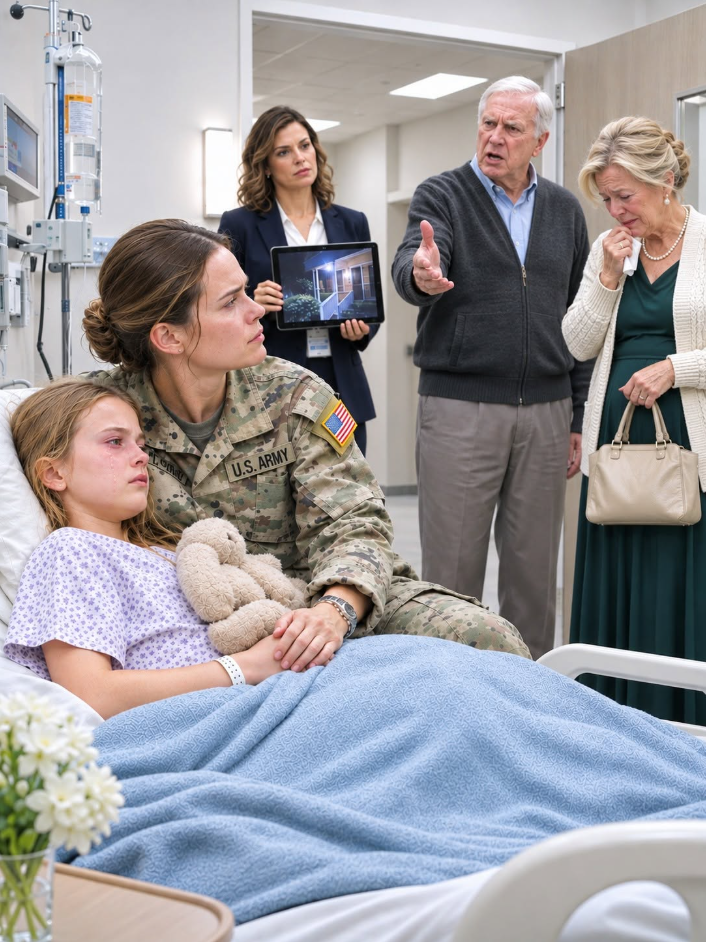
PART 1 — The Homecoming
“Your wife shaved her own head. She’s losing her mind, and we don’t want the girl ending up the same way,” Barbara said, barring her son’s way to the bedroom. Wade had only recently arrived in Phoenix after spending two months overseeing a construction project in Panama. He had changed his flight to come home three days ahead of schedule, imagining the pleasure of surprising his family.
“Where are Carolyn and Willow?” Wade asked. “Your wife is resting,” Barbara answered, a little too fast. “Lately she gets aggressive, makes things up, and wants to leave the house. We’ve done everything we could to look after her.” Wade stared at her. “Why didn’t anyone tell me?” Kendra interrupted before their mother could respond. “Because you were working. We weren’t going to ruin your contract over her tantrums,” Kendra cut in.
Carolyn sat on the floor in the narrow space between the bed and the wall. An oversized sweatshirt covered her body, and she had drawn her knees tightly against her chest. Almost none of the dark hair that once touched her shoulders remained. Little red marks speckled her scalp. “Carolyn… what did they do to you?” She lifted her gaze without moving toward him. “Why did you come back early?” she murmured.
Footsteps interrupted him. Willow appeared behind her grandmother, holding her stuffed rabbit. She did not rush into her father’s arms. First she checked Barbara’s face, then Carolyn’s, before dropping her eyes. “Come here, sweetheart,” Wade said. “I’m home now.” His daughter began crying. “Daddy… Mommy isn’t crazy.” Barbara immediately snapped, “Willow, go to your room!” The child trembled at the command.
Wade placed himself between his mother and his daughter, then crouched until he was level with Willow. “Nobody’s going to scold you for telling the truth.” The little girl crushed the rabbit against herself. “Mommy kept telling them to stop. Grandma held her arms… and Aunt Kendra ran the clippers over her head.” Slowly, Wade faced the women who had spent years telling him that nothing mattered more than family.
Then Willow spoke again, and both women lost their color. “Daddy, they locked Mommy in so she couldn’t tell you what they were doing.” Wade did not raise his voice. Perhaps his restraint frightened Barbara more than shouting would have. This time, the son who usually asked his wife to be patient did not offer his mother an excuse. “Get out of the bedroom,” he said. “Both of you.”
“You’re going to believe a little girl who doesn’t even understand what she saw?” Kendra shot back. “It’s because she’s a little girl that I hate that she had to see it.” After they left, Wade closed the door but left it unlocked. Carolyn asked him to stop questioning Willow. Their daughter was exhausted; she needed safety, not another journey through what had terrified her. He agreed, and Willow settled beside her mother until she fell asleep.
While his daughter slept, Wade inspected the bedroom more carefully. Fresh damage marked the door frame where an outside lock appeared to have been removed in a hurry. In the hallway, their security camera still faced the bedroom entrance. Its memory card, however, was gone. The room’s missing belongings and the marks around the door told a very different story from the one Barbara had tried to give him.
He returned to the living room. “I want Carolyn’s phone, her laptop, her cards, and her passport.” Barbara held to her explanation. “We put them away for her own good,” Barbara said. “Then hand them over.” Kendra let out an uneasy laugh. “You’ve been gone two months. You have no idea what we had to put up with.” Wade did not soften. “That’s what I intend to find out.”
The possessions appeared gradually. Carolyn’s phone had been switched off, and its screen was cracked. Her laptop came back without its charger. Barbara had kept the passport and cards in her closet, along with a folder containing the condo deed. Wade looked at the documents. “Why do you have the deed to our home?” His mother said nothing. From the hallway, Carolyn supplied the answer.
“Because they wanted me to sign a guarantee for Kendra’s business.” Wade knew the renovation company. His sister filled her social media with polished offices, new trucks, and supposedly impressive clients, insisting that business had never been better. “It’s not some dangerous guarantee,” Kendra said quickly. “It’s a bridge loan. I have contracts waiting to be paid. I just need time.”
Carolyn kept her voice level as she looked at Kendra. “Did you also need time when you used my personal information without permission?” The color drained from her sister-in-law’s face. Barbara intervened. “Stop accusing your sister-in-law! This house belongs to my son too.” Carolyn answered without retreating. “It’s in both our names,” Carolyn said. “We bought it with my savings and we’ve paid it off together. I wasn’t going to put Willow’s home at risk.”
Shame swept through Wade. He remembered Carolyn trying to tell him about difficulties with his relatives, and how readily he had dismissed them. That’s just how my mom is. Don’t let it get to you. He had offered those words instead of listening. Now his wife’s missing possessions were being handed back from his mother’s hiding place, and the home they owned together had somehow become part of his sister’s financial trouble.
Carolyn took him into the bedroom again. From a children’s book, she retrieved a small notebook concealed between its pages. It contained dates, accounts of conversations, and the names of financial institutions. On an old tablet, she showed him a photograph of a contract. “Look at the last page.” He saw Carolyn’s name beside a signature resembling hers, followed by a request to secure a business debt against their condo.
“Did you sign this?” he asked. “Never. When I found out about the application, I asked the lender to freeze it. That’s when they started telling people I was unstable.” Wade looked from the photograph to his wife. “Why didn’t you call me?” Carolyn lowered her eyes. “Because they listened to every conversation. And because they threatened to take Willow away if I tried to leave.”
Wade moved toward the living room, but Carolyn closed her hand around his wrist. “Not yet. If you lose your temper, they’ll turn your anger into one more lie.” He stopped. She had already seen how their words could be twisted, how resistance could be presented as proof that she was the problem. Their daughter remained asleep nearby, still holding the toy she had clung to when she finally told him the truth.
Carolyn glanced at Willow before speaking again. “My hair was only what they wanted everyone to see. But there’s something they don’t know about. Something Willow hid inside her rabbit before you got home.”
PART 2 — What the Rabbit Held
Carolyn left Willow asleep rather than waking her to ask for the rabbit. Whatever it contained could wait until they were somewhere safe. Before anyone examined a single piece of evidence, they needed to leave the condo. Wade placed the recovered belongings in a backpack. When he brought his wife and daughter into the living room, Barbara and Kendra had positioned themselves near the entrance.
“Nobody’s leaving until we talk as a family,” Barbara warned. Wade answered her directly. “We already talked,” Wade said. “Now my wife and my daughter need some peace.” Kendra gestured toward Carolyn. “She’s manipulating you. If she leaves and files a report, she’ll destroy us.” He paused at that. “Why are you so sure there’ll be a report?” His sister could not answer.
Barbara attempted to stand in Willow’s path, but Wade opened the door and moved aside for his wife and daughter to pass ahead of him. There was no struggle. Inside the elevator, Willow released a breath that sounded as though she had been keeping it trapped for weeks. They stayed that night at a hotel near Carolyn’s parents, away from the condo and the two women.
The following morning, Paula Reyes arrived carrying a folder. A lawyer who had once worked with Carolyn, she accompanied her to a doctor so her injuries and condition could be documented properly. They then organized somewhere safe for Carolyn and Willow to stay. Once the child was occupied in another room, Carolyn prepared to explain. “I need to tell you everything from the beginning,” Carolyn said.
Barbara’s visits had begun a week after Wade departed for Panama. She brought homemade food, volunteered to collect Willow from school, and said no woman should have to manage so much by herself. Carolyn, whose working background was in financial administration, welcomed the support. She had no reason then to imagine that what appeared to be kindness would become a means of watching everything she did.
The questions came first. Barbara wanted to know the mortgage balance, the money available in their accounts, and the location of the original deed. Eventually, she put a power of attorney in front of Carolyn. “It’s just to help you while Wade’s away,” she said. Carolyn examined the provisions and declined to sign. The authority described in the document extended well beyond paying household expenses.
Several days afterward, Kendra arrived crying. Her company had accumulated heavy debts, contracts had fallen through, and she urgently needed money. She proposed using the condo to secure a loan. Carolyn reviewed the arrangement and understood what it meant: if the business failed to repay, their home could be taken. “I won’t gamble my daughter’s roof,” she said. Her refusal changed the way both women treated her.
The meals stopped. Kendra began accusing Carolyn of selfishness. Around relatives, they suggested she considered herself superior because she understood finances. Carolyn attempted to explain the trouble to Wade, but he answered from the construction site. “My mom wants to help. Please don’t fight over everything. I’m buried in work.” She said nothing more on that occasion. Only afterward would she understand the price of remaining silent.
Then a lender sent notice of a credit inquiry Carolyn had never requested. Her personal information had been used, and the listed contact number belonged to Kendra’s company. She changed passwords, added safeguards to her accounts, and photographed every document she could. She also sought Paula’s advice. The lawyer told her not to sign anything and to store copies where nobody in the condo could take them.
Barbara discovered the messages while searching Carolyn’s phone as she attended to Willow. “You’re going to report your own family?” she demanded that night. When Carolyn reached for the device, Barbara put it in her pocket. Kendra removed the laptop. Before long, the passport and several cards disappeared as well. The women who had offered help were now taking away the very things Carolyn needed to seek it.
Barbara and Kendra told neighbors and relatives that Carolyn was suffering an emotional breakdown. They captured fragments of arguments, apparently waiting for her to lose control. Carolyn began to see the purpose behind it. Getting her signature was only part of their plan. If the deception was exposed, they wanted everyone prepared to doubt the woman describing it.
She then discovered a loan application carrying a forged version of her signature. Using the old tablet, she photographed the paperwork and sent the image to Paula. She contacted the lender, established that a preliminary application had been submitted, and insisted that processing stop while the documents’ origin was investigated. The suspension frightened Kendra. “They’re going to come after me for everything!” she shouted. “All you had to do was sign!”
At dawn one day, Carolyn tried to leave with Willow. Barbara and Kendra intercepted them at the door. Barbara had altered the keypad code and added a deadbolt that she could operate from outside. She confiscated their bag and warned Carolyn that continuing to resist would lead them to tell people she could not safely care for her daughter.
“I don’t intend to take Willow from you,” Barbara said. “But if you keep this up, somebody will have to think about her wellbeing.” Concern was merely the wrapping around the threat. Days later, Carolyn again refused to put her name to the documents. This time, Barbara and Kendra placed hair clippers on the table and said they needed something visible to demonstrate that she was out of control.
Carolyn tried to get away, but they restrained her. While the clippers ran, she pleaded with them to stop, especially because Willow could hear from the bedroom. Kendra left her hair cut almost against her scalp, then presented a mirror. “Now tell me who’s going to believe you’re fine,” she said. Remembering her daughter crying behind the door was the hardest part for Carolyn to recount.
She had struggled for days to protect Willow, never imagining that an eight-year-old would be forced to witness such a thing. Paula heard her out without interrupting. Wade remained still. For years, what he had called loyalty had meant trusting his mother before anyone else and stepping away from disagreements. Listening now, he could no longer mistake that habit for keeping peace.
That afternoon, Willow approached with her rabbit. She opened a little pocket Carolyn had stitched into its back and removed a small recorder she used when practicing presentations for school. “I turned it on when I heard Mommy crying,” she explained. “I didn’t want them to say she was lying again.” Carolyn drew her daughter close. “You didn’t have to prove anything, sweetheart. Taking care of us was the grown-ups’ job.”
Only after Willow was with her grandfather did Carolyn, Wade, and Paula play the file. Footsteps sounded first. Then Barbara’s voice emerged: “Sign and this all ends.” Kendra followed her. “Afterward everyone will think you did this to yourself.” The clippers began buzzing. Through that sound came Carolyn’s pleas for her daughter to stay inside the bedroom.
At the recording’s end, a little sob could be heard. “My mommy didn’t do it. My mommy didn’t do it.” Wade covered his face and cried silently. Carolyn did not try to soothe him. For once, she did not feel required to put another person’s suffering ahead of her own. Paula secured the original, created copies, and explained that investigators would consider it together with the other evidence.
They submitted a police report and sought protective orders. The growing collection included lender records, photographs, messages, medical documentation, and information about the additional deadbolt. Yet the evidence still left one question unanswered: why had Barbara and Kendra been so determined to complete the transaction before Wade returned?
PART 3 — The Signature She Refused
An answer began to emerge when Shelby, a former bookkeeper for Kendra’s company, contacted Paula. She had retained receipts documenting payments to another business connected with one of Kendra’s partners. Several transfers had little paperwork explaining their purpose. The receipts alone did not establish a crime, but they gave investigators another direction to pursue and helped account for some of the money that had disappeared.
Wade requested a meeting with his mother and sister to discuss the documents. Willow would not attend. Barbara took his request as a sign that he was finally returning to her side. She brought two relatives into the discussion, expecting them to help persuade Carolyn to settle. The same family pressure that had once encouraged silence was now being assembled around another set of papers.
“You’ll sign, and then we’ll all forget this embarrassment,” Barbara announced as they sat down. Carolyn read the proposed agreement. It went beyond authorizing a guarantee for Kendra’s business. It also demanded that she give up claims arising from what had happened inside the condo. Even now, what they wanted from her was a signature that would protect them.
Carolyn looked up from the agreement. “First I have a question,” she said. “Are you still saying I cut my own hair?” Kendra answered immediately. “Of course!” Kendra replied. “We tried to stop you.” The claim was unchanged, even with Carolyn sitting across from her, even after Wade had brought his wife and daughter out of the home.
Carolyn placed the medical reports and photographs on the table. Next came the loan application bearing the signature she disputed. Barbara maintained that Wade had approved the paperwork. He refused to let that stand. “I never authorized anyone to use Carolyn’s information,” he said. Kendra parted her lips, but this time no explanation followed.
Then Carolyn brought out Shelby’s receipts. Kendra reached suddenly to grab them, but Wade told her the copies had already been secured. “Was all of this to cover a problem at your company?” he asked. His sister broke into tears. “I was going to pay it back!” Kendra cried. “If Carolyn had cooperated, nobody would’ve gotten hurt!”
Carolyn did not accept responsibility for the debts or for what had followed her refusal. “I didn’t make you take on those debts,” Carolyn said. Barbara began crying too, insisting she had only been trying to rescue her youngest child. Wade asked why helping Kendra had required hiding Carolyn’s phone, changing the locks, and allowing Willow to witness her mother’s humiliation.
“Because your wife was going to ruin us,” Barbara sobbed. At last, the accusation no longer hid behind talk of concern or family duty. “Then you weren’t protecting her,” Wade said. “You were trying to silence her.” Carolyn had already endured their version of events being repeated to other people. Now she let the recording speak in the same room as those who had made it.
She played a short section. Conversation stopped. Barbara’s recorded voice demanded the signature, and one of the relatives turned away from Carolyn to look at her instead. “Barbara, that isn’t taking care of anybody,” she murmured. The effort to portray coercion as protection could not survive hearing the demand in Barbara’s own voice.
Kendra insisted that someone had altered the audio. Paula, present to support her client, explained that the original file had been preserved for examination by the authorities. Carolyn neither asked for an apology nor demanded money or an immediate reconciliation. “I didn’t come to humiliate you,” she said. “I came to make it clear that you will never decide for me or my daughter again.”
She left the agreement unsigned. Barbara’s expectation that family pressure would produce the answer she wanted had failed. Carolyn had brought the documents, the medical record, and the preserved recording into the discussion without surrendering the choice that had always belonged to her. Neither the guarantee nor the attempt to erase what happened in the condo received her consent.
In the months that followed, investigators reviewed the loan applications, the company’s financial activity, and Carolyn’s account of what she had endured. The investigation of the disputed documents proceeded separately from the inquiry into confinement and assault. Kendra lost clients while her company’s books came under scrutiny. Barbara had to face questions about her actions rather than describe them as sacrifices made by a devoted mother.
Carolyn did not return to live in the condo. Instead, she rented a smaller apartment near Willow’s school, a place with more sunlight. On their first night there, her daughter went to inspect the door. Then she asked a question no child should have needed to ask about home. “Mommy, can we go out whenever we want from here?” Carolyn answered, “Always, sweetheart.”
Both mother and daughter began counseling. Wade found somewhere nearby to live, accepting Carolyn’s decision that they would not share a home for the time being. He started learning the work of showing up without expecting that work to erase what had happened. He collected Willow when he said he would and listened before offering an opinion.
He also stopped using “That’s just how my mom is” as a response when someone described an injustice. The familiar sentence had once allowed him to close conversations he did not want to have. Carolyn had already paid for that refusal to listen. Respecting her boundaries now meant leaving her room to make decisions without asking her to hurry toward the arrangement most comfortable for him.
Barbara wrote to ask for forgiveness. Carolyn read the letter, then put it away without sending an answer. She could accept that regret might be sincere without treating forgiveness as an obligation. Someone else’s remorse did not require her to set aside what she and Willow needed. For once, she did not have to offer reassurance simply because a relative wanted relief.
As the months passed, her hair began growing again. One Saturday, she brought Willow with her to a quiet salon to have it shaped evenly. When the stylist approached, Carolyn requested scissors and asked to be told what would happen at each stage. Even a simple haircut was something she wanted to choose for herself, with nothing decided over her objections.
Outside afterward, Willow looked up at her mother and smiled. “Mommy, you look different.” Carolyn asked, “Because of the hair?” Her daughter shook off that explanation with words that reached much deeper. “No. Because now when someone wants to decide something for you, you say what you want.” Carolyn’s eyes filled. She took Willow’s hand, and together they walked beneath the Arizona sun.
The woman who had been confined for weeks no longer needed to establish that she deserved a hearing. Her documents were back in her possession. Her voice belonged to her again. So did the right to draw boundaries, including with relatives. The life she was rebuilding did not depend on persuading Barbara or Kendra to approve of those rights.
She understood what she wanted Willow to remember: family could not be sustained by demanding that one person bear every injury in silence. Belonging should never require anyone to surrender dignity. Ahead of them lay the work of healing, while behind them remained choices Carolyn was no longer willing to let anyone make for her. Barbara’s letter was still unanswered.