Part 1 – The Photograph Nobody Meant to Explain
My 17-year-old daughter was told by her dad that he couldn’t afford a prom dress this year. But that same evening, he proudly shared a picture of his stepdaughter wearing a $600 gown. Instead of confronting him, I called his mother, who personally took our girl shopping in Sioux Falls. Sadie was sitting at the kitchen table when her father called.
It was a Tuesday in March, and her bowl of chili was getting cold.
As usual, she put the call on speakerphone.
“Sweetheart, I can’t afford a prom dress this year. Welding work has been slow since Christmas.”
“It’s okay, Dad,” she answered.
She repeated it.
Afterward, she washed her bowl and went upstairs.
At 9:40 that evening, Rory’s wife, Tasha, uploaded a photograph.
Her daughter Madison, also seventeen, was wearing a $600 dress purchased in Sioux Falls.
Rory had left a comment beneath it.
“Beautiful girl. So proud.”
A moment later, I heard Sadie quietly close her bedroom door.
I didn’t call Rory.
We’d been divorced for eleven years, and I knew exactly how those conversations ended.
He was responsible for being Sadie’s father. I couldn’t force him to do better.
But there was someone else who loved her deeply.
I picked up the phone and called his mother.
Darla Lindstrom was seventy-two.
She’d worked as a hairstylist in Howard for forty-one years.
She’d remembered every one of Sadie’s birthdays, even during the terrible ice storm.
I explained what happened without adding my opinion.
Darla remained silent for several moments.
“Is Sadie crying?”
“Not that I can hear.”
“Saturday,” she finally said. “I’ll be there at eight. You’re coming with us.”
That weekend, Darla drove the forty minutes to Sioux Falls herself.
She refused to accept gas money.
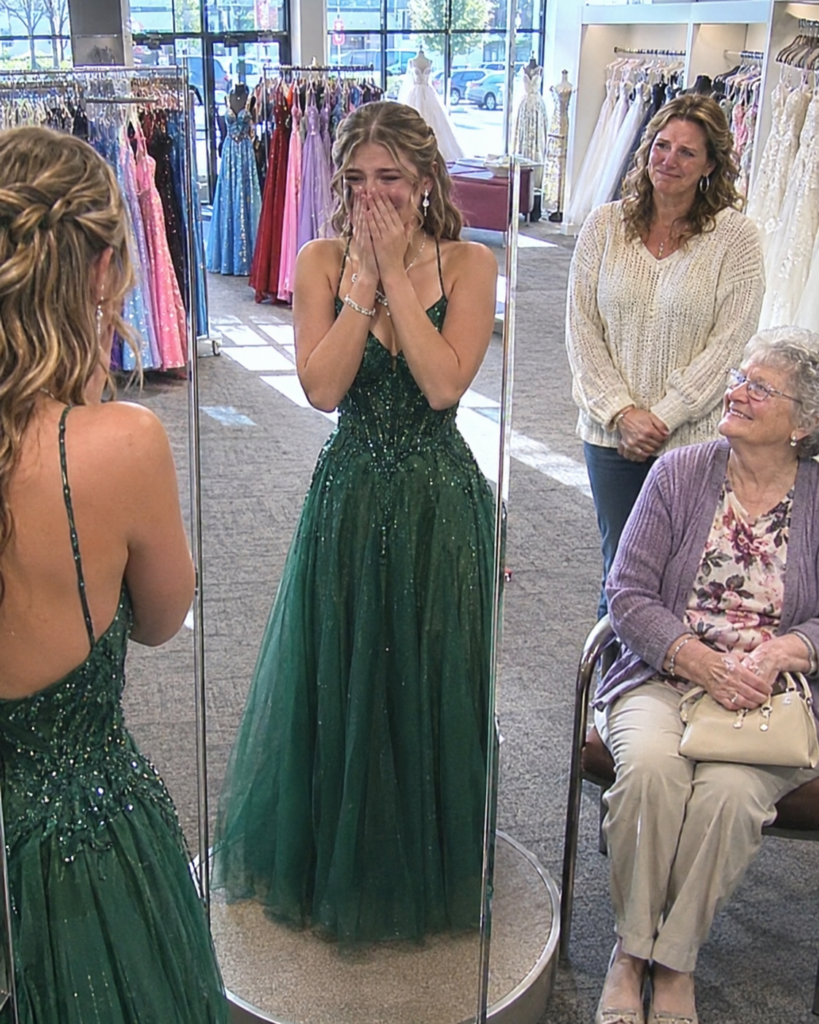
The dress shop was filled with racks of gowns, with sunshine streaming through the front windows.
Sadie tried on six dresses.
Before looking in the mirror, she always checked the price.
Eventually, Darla removed the price tags from the hangers and slipped them into her purse.
“Today, Grandma worries about the cost. Your only job is choosing a dress.”
The seventh gown was emerald green.
Sadie stood on the little circular platform before the three-panel mirror.
She couldn’t find a word to say.
Darla sat nearby, smiling with her purse in her lap.
I stood behind her in my gray cardigan, quietly watching.
This moment belonged to them.
“Oh, sweetheart,” Darla whispered. “That’s the one.”
Sadie turned to examine the back.
Then her gaze dropped.
“Grandma, Dad told me he couldn’t pay for one.”
“I heard what he told you.”
“I don’t want you being angry with him.”
Darla placed her purse beside the chair.
“I’m not upset with anyone. I’m simply buying my granddaughter her prom dress.”
It cost $389.
At the glass register counter, Darla slowly counted out the cash.
Outside, she photographed Sadie holding the dress in its garment bag.
Then she climbed behind the steering wheel and spent several minutes typing something with one finger.
I didn’t question her.
She published the post before we even reached the interstate.
Eleven minutes later, my phone rang.
It was Rory.
He never contacted me unless we needed to discuss a weekend with Sadie.
That had been our arrangement for eleven years.
From the back seat, Sadie noticed her father’s name on my screen.
She immediately went silent and motionless.
I picked up.
Rory skipped the greeting.
“Jodi. Have you seen what my mother just put online?”
I glanced at Darla.
She kept both hands on the steering wheel, looking straight ahead.
“No.”
“You haven’t?”
“No, Rory.”
A pause followed.
Then he gave the short exhale I’d heard a thousand times during our marriage—the one that meant he was trying to organize his frustration before giving it to somebody else.
“She posted the picture from the dress shop.”
“Okay.”
“And she wrote something with it.”
Beside me, Darla’s mouth tightened almost imperceptibly.
I turned around.
Sadie had lowered her eyes to her phone but wasn’t looking at the screen.
“What did she write?” I asked.
Rory hesitated.
That was when I knew the post probably wasn’t the public scolding he’d imagined.
“If people you love are made to feel like an expense,” he read, “remind them that being cherished has never been about a price tag.”
The car seemed to become quieter around us.
That sounded like Darla.
Simple. Direct. No names.
Rory continued.
“Then she wrote, ‘Prom shopping with my granddaughter. Emerald was always her color.’”
I looked at Darla.
She shrugged.
“That’s it?” I asked.
“People know.”
“Know what?”
“What she means.”
“Do they?”
“Come on, Jodi.”
Darla changed lanes smoothly.
A truck passed us going the opposite direction, rocking the car slightly.
I heard Sadie move in the back seat.
“Mom,” she said.
I turned.
“Can I talk to Dad?”
Every instinct in me wanted to say no.
Not because I wanted to keep her from him.
Because I knew her.
Sadie had spent years becoming small whenever adults became uncomfortable.
She apologized when other people bumped into her grocery cart. She said “I’m fine” before anyone asked. When Rory cancelled weekends, she found explanations for him faster than he found excuses for himself.
But she was seventeen.
And the expression on her face was different now.
Not angry.
Ready.
I took Rory off speaker and handed the phone back.
She immediately put it on speaker again.
“Dad?”
His voice changed.
“Hey, sweetheart.”
“You don’t need to be mad at Grandma.”
“I’m not mad.”
Even Darla looked at me.
Sadie apparently noticed too.
“Dad.”
Another silence.
“Okay,” Rory said. “I’m frustrated.”
“Because she bought me a dress?”
“No. Of course not.”
“Because she posted about it?”
“It’s complicated.”
Sadie looked out the window.
The fields along Interstate 90 were still brown from winter, broken by thin patches of old snow beneath the fences.
“I saw Madison’s dress,” she said.
Rory didn’t answer.
“I saw Tasha’s picture Tuesday night.”
Still nothing.
Sadie’s fingers closed around the edge of her phone.
“I don’t care that Madison got a nice dress.”
“Sadie—”
“I mean it. She’s my stepsister. She’s allowed to have things.”
“I know.”
“But you called me and said you couldn’t afford mine.”
Rory finally spoke.
“There’s more to it than that.”
“Then tell me.”
His reply came too quickly.
“Not while you’re in the car with your mom and Grandma.”
That sentence changed something.
I felt it before I understood it.
Darla did too.
Her eyes flicked toward me.
Sadie sat straighter.
“What does that mean?”
“Nothing.”
“Dad.”
“I just don’t want this becoming a courtroom.”
I stared at the windshield.
Eleven years divorced, and somehow Rory could still transport me instantly back to our old kitchen, where every disagreement became a referendum on how unfairly the world treated him.
I didn’t answer.
Neither did Darla.
Sadie did.
“Nobody is saying anything.”
“I know, sweetheart.”
“So explain.”
Rory sighed.
“Madison’s dress wasn’t paid for the way you think.”
Sadie frowned.
“What way do I think?”
“Tasha bought it months ago.”
“The post said you guys got it in Sioux Falls last weekend.”
“She picked it up last weekend.”
“So you didn’t pay for it?”
“No.”
The relief on Sadie’s face appeared before she could stop it.
It hurt to see.
Because that was all she wanted.
An explanation that made her father innocent.
“Okay,” she whispered.
Then Rory added, “I helped.”
Her expression disappeared again.
“How much?”
“Sadie, this isn’t—”
“How much?”
“Two hundred.”
Darla’s grip tightened on the steering wheel.
Sadie stared at her phone.
“You couldn’t help with mine?”
“I told you. Work has been slow.”
“But you had two hundred dollars.”
“That was different.”
“Why?”
There it was.
One word.
No accusation.
No raised voice.
Just a daughter asking her father why another girl’s dress had been different.
Rory didn’t have an answer ready.
When he finally spoke, his voice had lost its irritation.
“Madison’s been having a hard year.”
Sadie’s face changed.
Not dramatically.
If I hadn’t been watching her closely, I might have missed it.
Her shoulders lowered.
“Oh.”
Rory continued.
“There have been some things going on.”
“What things?”
“Things I’m not going to discuss because they’re private.”
Sadie nodded automatically, though he couldn’t see her.
“Okay.”
“And when Tasha asked if I’d help, I did.”
Sadie looked down.
“I understand.”
I wanted to turn around and tell her she didn’t have to understand everything.
That sometimes understanding another person’s reason didn’t erase the wound.
Instead, Darla spoke.
“Rory.”
He went silent.
His mother hadn’t said a word since the call began.
“Dad?” Sadie asked.
“I’m here.”
Darla’s tone remained calm.
“Madison having a difficult year explains why you helped Madison. It doesn’t explain why you told Sadie you couldn’t help her.”
“Mom.”
“You could have said, ‘I only have fifty dollars.’ You could have said, ‘Can we find something secondhand?’ You could have said, ‘Give me until April.’ Instead you told her the matter was closed.”
“We’re not doing this.”
“No,” Darla said. “I’m not doing anything. I’m driving.”
Sadie almost smiled.
Almost.
Rory lowered his voice.
“You know what? Sadie and I can talk when she’s home.”
“That’s fine,” I said.
“I wasn’t talking to you, Jodi.”
“I know.”
Darla’s eyebrows lifted.
Sadie looked between us.
Then she said something I hadn’t expected.
“Dad, did you even know what color I wanted?”
The question landed differently from all the others.
Rory didn’t respond.
Sadie waited.
Outside, a flock of blackbirds lifted from a field all at once.
“Green,” he eventually said.
Sadie’s mouth parted.
For a second, I thought he had saved himself.
Then Rory added, “Right?”
Sadie looked toward the garment bag lying beside her.
“Yeah.”
Her voice softened.
“Emerald green.”
“I remembered.”
Something eased.
Then Darla spoke so quietly that I almost didn’t hear her.
“No, you didn’t.”
Every head in the car turned toward her.
Even though Rory couldn’t see.
Darla’s eyes remained on the road.
“What?” he asked.
“She told you last Thanksgiving.”
“Mom, what are you talking about?”
“You said blue.”
Silence.
Darla continued driving.
“I heard you tell Tasha in January that Sadie wanted a dark blue dress.”
My stomach tightened.
“Maybe he mixed it up,” I said, because suddenly I was the one trying to lower the temperature.
Darla didn’t answer me.
Rory did.
“Exactly.”
But Sadie was no longer listening to him.
She was watching her grandmother.
“Grandma?”
Darla’s expression had changed.
Only slightly.
But enough.
“What?”
“How did you know I wanted emerald?”
Darla smiled.
“You showed me one at Christmas.”
“No.”
The smile faded.
Sadie leaned forward.
“I didn’t.”
Darla glanced into the rearview mirror.
Sadie continued.
“I didn’t decide on green until February.”
The sound of tires against pavement seemed louder.
Darla swallowed.
“Then I must have remembered wrong.”
Sadie stared at her.
I knew that stare.
It was the same look she’d had as a little girl when she realized adults sometimes pretended not to know things.
“Grandma,” she said slowly, “why did you already know what color dress I wanted?”
Darla didn’t answer.
My phone was still connected to Rory.
And his voice suddenly came through the speaker.
“Mom.”
There was something in it I hadn’t heard before.
Alarm.
Darla’s eyes closed for half a second.
“Don’t,” she said.
Sadie looked between the phone and her grandmother.
“Dad?”
Rory said nothing.
“What’s going on?”
Nobody answered.
We passed the exit for Hartford.
Darla drove another mile.
Then another.
Finally, she signaled, pulled onto the shoulder, and stopped.
Cars rushed past us.
She put the vehicle in park.
For the first time all day, Darla looked old.
Not seventy-two.
Older somehow.
Tired in a place that had nothing to do with years.
She turned in her seat until she could see Sadie.
“There is something I need to tell you.”
Rory’s voice exploded through the phone.
“Mom, no.”
Darla flinched.
Sadie did not.
She reached forward and took the phone from between the seats.
“Dad.”
“Sadie, sweetheart, listen to me.”
“No.”
It was the first time I had ever heard my daughter say that word to him without immediately softening it.
“No. Grandma gets to talk.”
Rory went silent.
Darla’s eyes filled.
“Two months ago,” she said, “your father came to my house.”
Sadie waited.
“He asked me for money.”
“For work?”
“No.”
“For what?”
Darla looked briefly at me.
I knew instantly that whatever came next had nothing to do with dresses.
“He asked me for four thousand dollars.”
My breath caught.
Sadie’s forehead creased.
“Why?”
“He said he needed to fix something before you found out.”
The phone went dead.
Rory had ended the call.
Sadie stared at the blank screen.
Then she looked at her grandmother.
“What did Dad not want me to find out?”
Darla’s answer came barely above a whisper.
“I don’t know, sweetheart.”
She reached into her purse.
“But I think this might tell us.”
From an inside pocket, she removed a white envelope.
Sadie’s name was written across the front.
Not in Darla’s handwriting.
In Rory’s.
And beneath it were four words.
For Sadie. When she’s eighteen.
Part 2 – The Envelope in Darla’s Purse
For nearly a minute, nobody touched the envelope.
Cars continued passing on the interstate, each one sending a faint shudder through Darla’s Buick.
Sadie stared at her name.
Then at her grandmother.
“Why do you have that?”
Darla lowered her eyes.
“Your father left it at my house.”
“When?”
“January nineteenth.”
The specificity made the date feel important.
Sadie looked at me.
I had no idea what January nineteenth meant.
“Did he tell you to give it to me?”
“Not yet.”
“Then why do you have it here?”
Darla drew in a slow breath.
“Because after what happened this week, I started thinking perhaps I had misunderstood what he was asking me to do.”
Sadie’s gaze returned to the envelope.
“What did he ask?”
“He said if anything changed before your eighteenth birthday, I was to make sure you got it.”
“What does ‘anything changed’ mean?”
“He wouldn’t say.”
That was Rory.
He could make vagueness sound like a form of responsibility.
I reached back between the seats.
“Sadie, you don’t have to open that right now.”
She looked at me.
“I’m going to.”
I nodded.
Darla offered the envelope.
Sadie took it carefully, as though it were something fragile.
She slid one finger beneath the flap.
Then stopped.
“Grandma, did you read it?”
“No.”
“Do you know what’s in it?”
“No.”
“You swear?”
Darla looked wounded.
“I swear.”
Sadie opened the envelope.
Inside were three sheets of paper.
The first was folded around something smaller.
She unfolded it.
A cashier’s check slipped into her lap.
I heard myself gasp.
Sadie picked it up.
The amount was $3,800.
Payable to Sadie Marie Lindstrom.
Exactly two hundred dollars less than the amount Rory had asked Darla to lend him.
Sadie stared at it.
“Grandma?”
“I didn’t give him the four thousand,” Darla said.
“Then where did this come from?”
“I don’t know.”
Sadie unfolded the first page.
The handwriting was Rory’s.
She read silently at first.
Then her face tightened.
“What?”
I hated asking.
She handed me the page.
There were only a few lines.
*Sadie,*
*This money belongs to you. It always did.*
*I should have fixed this years ago.*
*By the time you read this, I hope I have.*
*Dad.*
That was all.
I read it twice.
Then a third time.
“Money from where?” Sadie asked.
Darla shook her head.
“I truly don’t know.”
The second sheet was not handwritten.
It was a photocopy of an old bank statement.
The account belonged to Rory.
Seven years earlier, there had been a deposit for $4,000.
In the memo line was a phrase that made my stomach drop.
**Sadie Lindstrom – Education Gift.**
I knew what it was.
I had forgotten it existed.
“Oh my God.”
Sadie looked at me.
“You know?”
I closed my eyes.
Years earlier, when Sadie was ten, my uncle Warren had sold a piece of farmland he’d inherited near Mitchell.
He had no children.
At Christmas, he’d given each grandniece and grandnephew four thousand dollars to begin a college account.
My check for Sadie had never come to me.
Uncle Warren had given it directly to Rory during a family gathering because Rory had told him he’d already opened a savings account in Sadie’s name.
At the time, Rory and I had been divorced four years.
I had assumed he’d done exactly what he said.
“That money was for college,” I whispered.
Sadie’s face went blank.
Darla covered her mouth.
“Oh, Rory.”
“What happened to it?” Sadie asked.
The bank statement answered that.
Within five months, the account balance had fallen below three hundred dollars.
There were no college-account transfers.
There were debit-card payments.
A tire shop.
A lumber yard.
Utility bills.
A cash withdrawal.
Sadie studied every line.
Oddly, she didn’t cry.
“Did Dad steal it?”
The word made Darla flinch.
I chose my answer carefully.
“He used money that had been given for you.”
“That’s stealing.”
Nobody corrected her.
Darla looked out the windshield.
“He came to my house in January and said he’d made a mistake years ago. He asked me for four thousand dollars. He said he was trying to put something back where it belonged.”
“And you told him no?”
“I told him I would give *you* four thousand dollars anytime you needed it. I would not hand him four thousand dollars without knowing why.”
Sadie looked down at the cashier’s check.
“So he found the money somewhere else.”
“Apparently.”
A new question entered the car.
Where?
The answer arrived two days later.
Not from Rory.
From Madison.
She texted Sadie on Monday afternoon.
**Can we talk?**
Sadie showed me the message when she got home from school.
“I don’t know what to say.”
“Do you want to talk to her?”
“She’s not the one who did anything.”
“Then maybe tell her that.”
Sadie typed.
Madison responded almost immediately.
They met the following afternoon at a coffee shop near school.
Sadie went alone.
When she returned, she sat in my car for several minutes before coming inside.
I eventually went outside.
She was still behind the steering wheel even though she didn’t have a license yet.
“How’d it go?”
She looked up.
“Madison knew.”
My heart sank.
“About the money?”
“Not all of it.”
I opened the passenger door.
She told me what Madison had told her.
In January, Tasha and Rory had been planning to replace their roof.
They had saved nearly six thousand dollars.
Then Rory withdrew four thousand without telling Tasha.
When she discovered it, they had a fight.
A serious one.
Rory eventually admitted he’d used the money to repay something he had taken from Sadie years ago.
That was the $3,800 check.
The missing two hundred had apparently gone toward Madison’s dress.
“Madison thought the whole reason her mom was upset was because Dad gave me four thousand dollars,” Sadie said. “She didn’t know it was already mine.”
I let that settle.
“How is she?”
“Embarrassed.”
“About the dress?”
“About everything.”
Sadie’s eyes watered.
“She offered to give it back.”
“The dress?”
“The two hundred Dad paid.”
“What did you say?”
“I said no.”
She wiped beneath one eye.
“She didn’t do anything.”
There was something quietly remarkable about that.
At seventeen, with every reason to turn Madison into evidence of her father’s favoritism, Sadie refused.
“I told her I like her dress,” she added.
“I bet she appreciated that.”
“She started crying.”
That evening, Rory called.
Sadie did not put him on speaker.
She went into the backyard.
Twenty minutes later, she came back in.
Her eyes were dry.
“What happened?”
“He apologized.”
I waited.
“It wasn’t a very good apology.”
“What made it bad?”
“He kept explaining.”
I smiled sadly.
Sadie understood.
“He told me he used Uncle Warren’s money because he was behind on everything. His truck needed work. He was scared he’d lose his apartment. He thought he’d replace it in two months.”
“But he didn’t.”
“No.”
She sat at the kitchen table.
“He said every year afterward it got harder to admit.”
That, at least, I believed.
Shame accumulated interest too.
“How do you feel?”
She thought about it.
“Different.”
“Different how?”
“I always thought Dad forgot things because I wasn’t important enough.”
My chest tightened.
“But now?”
“Now I think sometimes he remembers everything.”
She looked toward the dark window over the sink.
“And maybe remembering makes him avoid me.”
A week passed.
Then another.
Rory didn’t call.
Prom approached.
The emerald dress hung on Sadie’s closet door beneath its clear garment cover.
Darla came over to pin the hem.
Madison texted twice about shoes.
Life, stubbornly, kept moving.
Then one Thursday, I found Sadie sitting on the back steps after school.
She was holding a folded piece of notebook paper.
“What’s that?”
“Madison gave it to me.”
I sat beside her.
Sadie handed it over.
It wasn’t from Madison.
It was from Tasha.
*Sadie,*
*There is something you deserve to know before prom.*
*Your father did not tell you the whole truth about the four thousand dollars.*
*Neither did your grandmother.*
*I think you should ask Darla what happened on January nineteenth after Rory left her house.*
Sadie watched me read it.
For the second time in less than a month, the ground beneath our family shifted.
“Mom?”
“Yeah?”
“Why does everybody keep deciding what I’m old enough to know?”
I folded the note.
“I don’t know.”
She looked at the emerald dress through the kitchen window.
Then she stood.
“I’m going to Grandma’s.”
Part 3 – What Darla Had Been Protecting
Darla opened the door before we knocked.
She took one look at Sadie’s face and stepped aside.
“I suppose Tasha talked to you.”
Sadie stopped in the entryway.
“You knew she would?”
“I suspected she might.”
Darla’s house smelled like coffee and the lavender spray she’d used in her salon for as long as I could remember.
On the walls were photographs of children and grandchildren at every age.
Sadie appeared in more than any of them.
First day of kindergarten.
A missing front tooth.
Basketball at twelve.
Her eighth-grade graduation.
A photograph from the county fair where she had blue cotton candy stuck to her cheek.
This house had always felt like proof that somebody had been paying attention.
That made what came next harder.
Sadie sat at the kitchen table.
I remained near the counter.
Darla poured three cups of coffee, although nobody had asked for any.
“Grandma.”
Darla stopped.
“Sit down.”
She obeyed.
Sadie placed Tasha’s note on the table.
“What happened after Dad left here January nineteenth?”
Darla stared at the paper.
“Your father came here asking for four thousand dollars.”
“I know that.”
“I refused.”
“I know.”
“He was upset.”
“How upset?”
“Not angry.”
Darla folded her hands.
“Ashamed.”
That word had become Rory’s shadow.
Darla continued.
“He sat right where you’re sitting. He told me about Warren’s money.”
“Did you know before then?”
“No.”
Sadie watched her carefully.
“What happened next?”
“He left.”
“And?”
“And I called the bank.”
Sadie’s eyebrows drew together.
“What bank?”
“The bank where I keep my savings.”
Darla rose, disappeared into the hallway, and returned with a small accordion folder.
Inside were years of statements arranged by date.
She removed one.
“That afternoon, I withdrew four thousand dollars.”
Sadie’s lips parted.
“You told us you didn’t give Dad the money.”
“I didn’t.”
“Then what did you do with it?”
Darla looked at me.
I understood before Sadie did.
“The cashier’s check,” I said.
Darla nodded.
Sadie stared at her.
“You bought the check?”
“Yes.”
“But Dad wrote the note.”
“Yes.”
Nothing fit.
Sadie leaned back.
“Start over.”
So Darla did.
After Rory confessed what he’d done years earlier, she’d refused to loan him money.
Not because she didn’t want Sadie repaid.
Because she didn’t trust Rory to handle the repayment himself.
“I told him I’d go to the bank,” Darla said. “I’d purchase a cashier’s check payable directly to you. He could repay me over time.”
“Why didn’t you just tell me?”
“Because he begged me not to.”
Sadie’s face hardened.
Darla continued before she could respond.
“He said he wanted a chance to make it right himself.”
“So the money was yours.”
“Yes.”
“Not his.”
“No.”
“And he let me think he’d found a way to repay me.”
Darla looked down.
“Yes.”
Sadie stood.
I thought she might leave.
Instead she walked toward the window.
“Why?”
“He was embarrassed.”
“I’m tired of that word.”
Darla flinched.
Sadie turned.
“Everybody keeps telling me Dad was embarrassed like embarrassment is something that happened to him.”
No one answered.
“He took money that belonged to me. Then he borrowed money from you to replace it. Then when I found out, he let me think he’d fixed it himself.”
Darla’s eyes shone.
“You’re right.”
“And you helped him hide it.”
“Yes.”
The simplicity of Darla’s answer stopped Sadie.
No excuse.
No defense.
Darla rose.
“I thought I was protecting your relationship with your father.”
Sadie swallowed.
“Were you?”
“No.”
Darla’s voice cracked.
“I was protecting my son from the consequences of telling his daughter the truth.”
The kitchen became still.
There was an honesty in admitting that.
Not a comfortable honesty.
But a clean one.
“I was wrong,” Darla said.
Sadie’s anger did not disappear.
But something in her posture changed.
Adults rarely told children they’d been wrong without attaching a reason that diluted the admission.
Darla didn’t.
“Why did Tasha know?” Sadie asked.
“Because Rory told her where the check came from after they fought.”
“So Madison’s dress really wasn’t the reason he couldn’t buy mine.”
“No.”
“What was?”
Darla hesitated.
Sadie’s expression tightened.
“There’s more.”
“Only something I suspect.”
“Tell me.”
Darla sat again.
“The money wasn’t the main reason.”
“Then what was?”
“I think your father was afraid to spend anything on you.”
Sadie gave a disbelieving laugh.
“That makes no sense.”
“It does to someone who carries guilt badly.”
Darla looked toward an old photograph of Rory hanging on the refrigerator.
He was nineteen in it, thin and sunburned, standing beside his first pickup.
“When Rory paid for part of Madison’s dress, that was ordinary. A stepfather helping with prom.”
“And helping me wasn’t?”
“Helping you made him think about what he’d taken.”
Sadie’s eyes filled.
“So avoiding me was easier.”
“I think so.”
“That’s worse.”
Darla nodded.
“Yes.”
Nobody tried to soften it.
That was the moment the story stopped being about money.
Sadie realized it before I did.
Her father hadn’t valued Madison more because he’d spent two hundred dollars on a dress.
He had been able to show up for Madison because she didn’t remind him of his worst mistake.
Sadie did.
It was unfair in an entirely different way.
But at least it was true.
The following week, Sadie asked Rory to meet her.
Not at our house.
Not at his.
At Falls Park in Sioux Falls.
Neutral ground.
I drove her there but remained in the car.
From a distance, I could see them sitting on a bench beside the river.
Rory looked older than I remembered.
He kept his hands clasped between his knees.
Sadie did most of the talking.
Later, she told me what she’d said.
“I told him I wasn’t asking him to be perfect.”
I nodded.
“I told him I wasn’t even asking him to pay for the dress anymore.”
“What did you ask?”
She stared through the windshield.
“I asked him to stop deciding for me what truth I could handle.”
“And?”
“He cried.”
That surprised me.
Rory cried rarely.
Even during our divorce, he had looked angry when he was sad.
“He said Grandma told him about the conversation.”
“Did he apologize?”
“Yes.”
“A real one?”
Sadie considered.
“I think he’s learning.”
That was more generous than I would have been.
But perhaps generosity was different when it had boundaries.
The night before prom, Madison came to our house.
She carried a shoe box.
Sadie opened the door wearing sweatpants, her hair twisted on top of her head.
Madison held up the box.
“My shoes hate me.”
Sadie laughed.
“Mine too.”
Within twenty minutes they were sitting on the living-room floor comparing blister pads, earrings, and makeup.
Watching them, I felt embarrassed by how easily adults could turn children into representatives of conflicts they had never chosen.
Madison wasn’t the girl with the six-hundred-dollar dress.
Sadie wasn’t the neglected daughter.
They were seventeen.
They liked the same terrible sparkling lemonade.
They both hated false eyelashes.
They were worried their dates would forget boutonnieres.
Before Madison left, she stood by the door.
“My mom and Rory are having problems.”
Sadie’s smile faded.
“I know.”
“He might not come tomorrow.”
“To prom pictures?”
Madison nodded.
“Mom told him maybe he shouldn’t.”
Sadie looked surprised.
“Why?”
“Because she thinks you won’t want him there.”
Sadie thought for a long moment.
Then she said, “That’s not her decision.”
Madison blinked.
“Do you want him there?”
Sadie looked toward the stairs where the emerald dress waited.
“I don’t know.”
That night, at 11:13, she texted Rory.
I know because she showed me before sending it.
**Pictures are at 5:00 at Grandma’s. You can come if you want. But if you come, don’t pretend everything is fixed. Just come.**
Rory responded six minutes later.
**Okay.**
Then another message arrived.
**There’s something else I should tell you first.**
Sadie stared at it.
She typed:
**What?**
Three dots appeared.
Disappeared.
Appeared again.
Finally:
**The money from Uncle Warren wasn’t the only thing I kept from you.**
Sadie looked at me.
My stomach tightened.
She typed one word.
**What?**
Rory’s answer arrived.
I have something of yours. I’ve had it for eleven years.