After my husband died, I kept the $28 million inheritance and our New York City penthouse a secret. That same week, my daughter-in-law shouted, “Now that he’s gone, you can cry, pack your bags, and go live on the streets.” I answered with one word. “Okay.” Three months later, an official notice arrived at their house. Five days after my husband’s funeral, the smell of sympathy flowers and reheated casseroles still lingered throughout our home. The March chill in White Plains pressed against the windows, and every room of the house on Maple Avenue felt painfully quiet without the man who had filled it with life.
I’d lived there for forty years.
I’d polished the hardwood floors, stitched the curtains, and stood at that same kitchen counter at 4:30 every morning, waiting for the coffee to finish brewing before leaving for my shift at Saint Vincent’s Hospital.
By the time we came home from the cemetery, my daughter-in-law was already walking through the living room as though she’d been waiting for this opportunity.
She didn’t bother lowering her voice.
She couldn’t even pretend to show me kindness for another day.
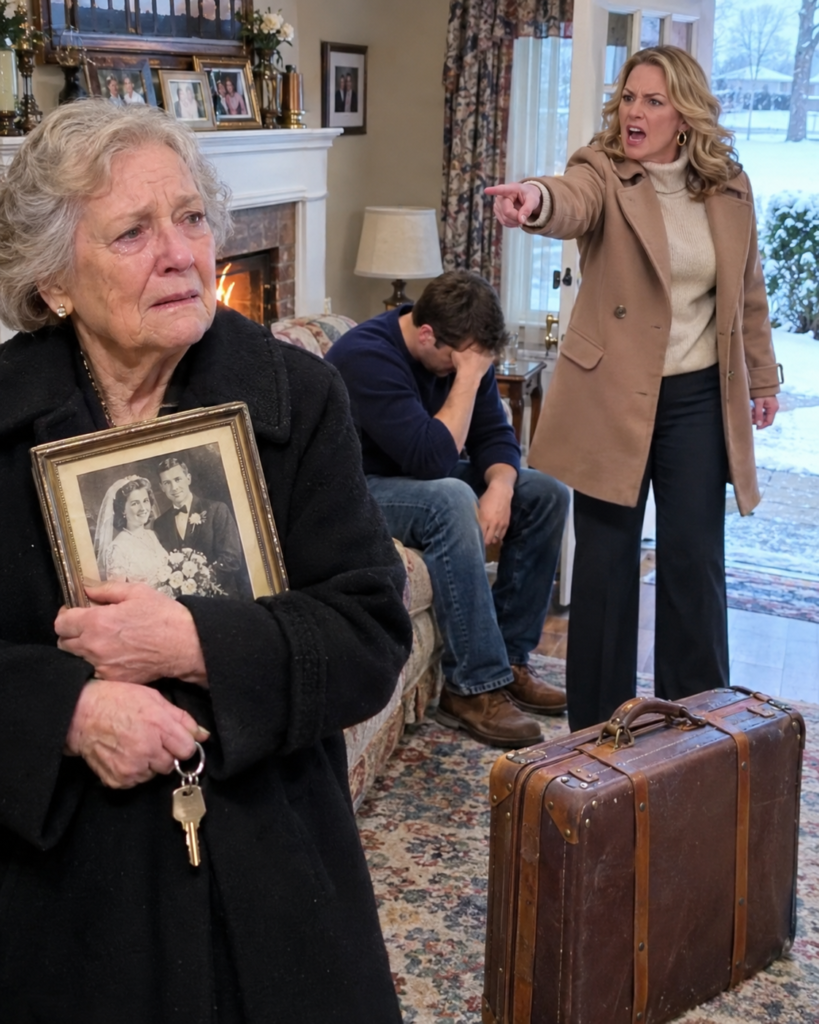
I was still wearing my black funeral dress when she looked straight at me and said, “Now that he’s gone, go ahead and cry. Then pack your things and live on the streets.”
My son stood behind her.
He didn’t say a word.
That was what stayed with me more than anything else.
Not the viciousness of her words.
Not the yellow sticky notes she’d already started attaching to furniture I’d owned for decades.
Not even the sight of our wedding photograph, removed from the mantel and propped against the wall as though it no longer had a place in our home.
What I couldn’t forget was my son’s silence.
I remembered everything that had brought us to that afternoon.
The double shifts I’d worked.
The holidays I’d spent at the hospital instead of home.
The money I’d carefully saved, stretched, and quietly given him whenever he needed help.
I thought about the countless small humiliations I’d excused over the years.
He was my only child.
I’d kept convincing myself that families went through difficult seasons, that grief sometimes made people behave strangely, and that if I remained patient long enough, basic decency would eventually return.
So I gave them the one answer neither expected.
“Okay.”
I didn’t cry.
I didn’t make a scene.
I didn’t plead for permission to remain in the house I’d helped build.
Instead, I reached into my coat pocket and closed my fingers around the little brass key my husband had placed in my hand three weeks before he passed away.
“Keep this somewhere safe,” he’d whispered from his hospital bed. “And don’t tell anyone.”
At the time, I’d assumed his medication was making him confused.
But that afternoon, standing in our bedroom and looking at the stack of legal documents arranged neatly on my bed, I began to understand that he’d been trying to tell me something important.
Something I hadn’t understood before it was too late.
The documents were waiting for my signature.
A voluntary transfer.
The house.
The land.
Everything.
All of it was being directed into my son’s hands while I was still dressed in black, mourning his father.
I packed a single small suitcase.
Two sweaters.
My nursing shoes.
My Bible.
The quilt my mother had made.
And the framed photograph from my wedding.
Before leaving, I placed the signed documents on the kitchen table.
Then I picked up my worn purse and made sure I had three things.
My wallet.
My flip phone.
And the brass key.
That evening, I sat by myself in an inexpensive motel off Route 119.
A lamp with a cracked shade stood beside the bed.
I’d bought dinner from a vending machine, but I couldn’t bring myself to eat it.
Traffic passed outside, and somewhere down the hallway, an ice machine hummed steadily.
As I sat listening, I suddenly remembered the business card my husband had tucked into my purse several months earlier.
It belonged to an estate attorney.
His office was in Manhattan.
On 47th Street.
I made the call.
The man answered as though he’d been expecting to hear from me.
The following morning, before the sun came up, I boarded a bus to Manhattan.
Everything I still possessed fit into one suitcase and one purse.
At exactly 9:07 the next morning, I stood inside a quiet bank on 47th Street.
A woman wearing a gray business suit accepted the brass key from my hand.
She examined the number engraved on its surface.
Then her expression changed.
She stopped addressing me as “ma’am.”
Instead, she reached for the telephone, spoke four words in a hushed voice, and suddenly, the entire atmosphere in that room changed.
“Mrs. Whitmore is here.”
The woman spoke those words into the telephone, then placed the receiver down with extraordinary care.
For a moment, I thought she’d mistaken me for someone else.
I was wearing the same black coat I’d worn to my husband’s funeral. My shoes were scuffed, my suitcase stood beside my feet, and I hadn’t slept more than three hours.
I certainly didn’t look like someone who deserved special attention in a Manhattan bank.
The woman stood.
“Mrs. Whitmore, would you please come with me?”
I hesitated.
“Is something wrong with the key?”
“No, ma’am.”
She glanced at the brass key resting on her desk.
“Quite the opposite.”
She led me through a glass door and down a quiet hallway.
At the end was a private conference room with a long walnut table and windows overlooking the city.
A silver-haired gentleman was waiting inside.
He stood when I entered.
“Mrs. Whitmore. I’m Charles Bennett, senior vice president of private banking.”
I shook his hand.
“Please call me Margaret.”
He smiled gently.
“Of course, Margaret. I’m very sorry about your husband.”
Something about the sincerity in his voice nearly broke me.
I’d heard those words dozens of times over the past week.
But most people had said them while looking over my shoulder, already thinking about what needed to happen next.
Mr. Bennett looked directly at me.
“Your husband was a remarkable man.”
I lowered myself into a chair.
“You knew him?”
“For twenty-three years.”
I stared at him.
“My husband worked in commercial building maintenance.”
“Yes, he did.”
Mr. Bennett smiled faintly.
“But that wasn’t the whole story.”
He placed a thick blue folder on the table.
My husband’s name was printed across the front.
THOMAS WHITMORE — ESTATE AND PRIVATE HOLDINGS.
My hands began trembling.
“I don’t understand.”
Mr. Bennett opened the folder.
“Your husband anticipated that you might come here after his passing. He left detailed instructions regarding your access to certain records and assets.”
He paused.
“Before we go any further, may I ask whether you’ve spoken with the attorney whose card he gave you?”
“Yes. Last night.”
“Good. He’s on his way.”
I looked at the folder.
“Can you please tell me what’s happening?”
Mr. Bennett studied my face.
Then he turned a document toward me.
It was a financial statement.
At the bottom was a figure.
$28,416,730.82.
I stared at it.
Then I looked at him.
“What’s that?”
“The estimated value of the investment portfolio and other financial assets held through your husband’s estate arrangements, based on the most recent valuation.”
I blinked.
“I’m sorry?”
“Approximately twenty-eight million dollars.”
I shook my head.
“No.”
Mr. Bennett remained silent.
“There must be a mistake.”
“I understand why this is surprising.”
“My husband fixed boilers. He repaired elevators. He wore the same winter coat for fifteen years.”
Mr. Bennett nodded.
“And he was an exceptionally disciplined investor.”
I stared at the statement again.
Twenty-eight million dollars.
The numbers didn’t become any more believable the longer I looked.
Then Mr. Bennett turned another page.
“There is also a residential property in Manhattan.”
He placed a photograph in front of me.
It showed a beautiful apartment with floor-to-ceiling windows overlooking the Hudson River.
“A penthouse,” he explained. “Your husband acquired it through a family holding company several years ago.”
I pressed my hand against my chest.
“Thomas owned that?”
“Yes.”
“Why didn’t he tell me?”
Mr. Bennett folded his hands.
“I believe your attorney can answer that better than I can.”
I looked toward the window.
Outside, taxis moved through the streets far below.
People hurried along sidewalks carrying coffee and briefcases.
The world continued exactly as it had yesterday.
But mine had shifted beneath my feet.
My husband had died.
My son had watched his wife throw me out.
And somewhere in the middle of all that grief, I’d discovered that the man I’d shared forty years with had been keeping a fortune hidden.
I didn’t know whether to laugh, cry, or feel betrayed.
So I did none of those things.
I simply whispered, “Thomas, what on earth did you do?”
Twenty minutes later, the attorney arrived.
His name was Robert Ellis.
He was in his early sixties, with silver hair, wire-rimmed glasses, and the quiet manner of someone accustomed to delivering difficult news.
He shook my hand.
“Margaret, I’m sorry we had to meet under these circumstances.”
I looked at him.
“Did my husband really leave all this?”
Robert sat across from me.
“Yes.”
“Why didn’t I know?”
He took a slow breath.
“Because Thomas was afraid of what might happen if certain people discovered it.”
I stared at him.
“What people?”
Robert didn’t answer immediately.
Instead, he opened his briefcase and removed a sealed envelope.
My name was written across the front.
In Thomas’s handwriting.
My throat tightened.
“That’s his writing.”
Robert nodded.
“He asked me to give this to you after his death.”
I carefully opened the envelope.
Inside were three handwritten pages.
The first sentence made my eyes fill.
My darling Margaret,
If you’re reading this, then I wasn’t able to tell you everything myself.
I pressed my lips together.
Robert quietly looked away.
I continued.
I know you’re going to be angry that I kept things from you. You have every right to be.
But before you decide what kind of fool your husband was, please let me explain.
I almost laughed through my tears.
That sounded exactly like Thomas.
Even in a letter written for after his death, he was trying to make me smile.
You remember the little machine shop my father left me?
Of course I remembered.
It had been a miserable old building in Yonkers.
Thomas inherited it when his father died.
For years, he rented the property to a small manufacturing company.
Eventually, the company bought the land.
I remembered Thomas telling me he’d received a decent price.
We’d used some of the money to replace our roof.
At least, that was what I thought.
I didn’t spend most of the money from that sale. I invested it.
Then I kept investing.
I bought shares in companies I understood, reinvested the earnings, and worked with people who knew more about finance than I did.
Over the years, those investments grew far beyond anything I expected.
I looked up.
“Twenty-eight million dollars?”
Robert nodded.
“The original investments were substantial, and Thomas continued building the portfolio for decades. The figures have been verified.”
I looked back at the letter.
I should have told you sooner.
I know that.
But I watched what happened every time our son needed money.
My stomach tightened.
First it was a car.
Then a business idea.
Then a house.
Then another business.
Every time we helped him, the next request became larger.
I closed my eyes.
Thomas had never been cruel to our son.
He’d loved that boy with everything he had.
But he’d also been the one who said no when I couldn’t bring myself to.
I began to understand that if he knew how much we had, he might never learn to stand on his own.
And when his wife began talking about what would belong to them after we were gone, I knew I needed to protect you.
My hands went cold.
Thomas had noticed.
Of course he’d noticed.
The comments at Thanksgiving.
The questions about our savings.
The casual remarks about how difficult it must be for elderly people to maintain large houses.
The way my daughter-in-law had started referring to our home as “the family property.”
I had dismissed it all.
Thomas hadn’t.
I continued reading.
The money is meant to give you freedom, Margaret.
Not obligations.
Not another lifetime of paying for someone else’s mistakes.
You’ve spent forty years taking care of everyone around you.
Now I want you to take care of yourself.
The penthouse is yours to enjoy.
The investments are there to provide for you.
And the house in White Plains is yours, too.
I stopped.
Read that last sentence again.
Then looked at Robert.
“The house?”
He nodded.
“Yes.”
“But I signed papers transferring it to my son.”
Robert’s expression changed.
“What papers?”
I described the documents.
The voluntary transfer.
The signatures.
The pages my daughter-in-law had arranged on my bed.
Robert listened without interrupting.
When I finished, he removed his glasses.
“Margaret, did anyone explain those documents to you?”
“No.”
“Did you have an attorney present?”
“No.”
“Did you receive copies?”
I shook my head.
He was quiet for a moment.
“Did you sign them voluntarily?”
I stared at him.
“I signed because they told me to leave.”
Robert leaned forward.
“Margaret, we need to review exactly what you signed.”
My stomach tightened.
“Have I lost the house?”
“Not necessarily. Signing a document doesn’t automatically establish that ownership has transferred. We need to determine what the documents were, whether they were properly executed, and whether anything has been recorded.”
He paused.
“But there’s something else you should know.”
I waited.
“Your husband placed the White Plains property into a revocable living trust several years ago.”
I blinked.
“A trust?”
“Yes. He was the trustee during his lifetime. Under the trust’s terms, you became the successor trustee and primary beneficiary upon his death.”
I stared at him.
“So the house belongs to the trust?”
“Correct.”
“And my son?”
“Has no present ownership interest under the trust documents.”
I sat very still.
Robert continued.
“Your husband also left explicit instructions that no one was authorized to pressure you into transferring or surrendering the property.”
I looked down at Thomas’s letter.
There was one paragraph remaining.
If our son treats you with kindness, let him be part of your life.
If he doesn’t, don’t confuse being his mother with being his servant.
I love you, Margaret.
And if I could give you one more thing, it would be the courage to believe you deserve better.
Always yours,
Tom.
I folded the letter carefully.
Then I cried.
Not the quiet tears I’d been holding back since the funeral.
I cried so hard that Robert slid a box of tissues toward me and Mr. Bennett quietly left the room.
I cried for the husband I’d lost.
For the forty years we’d shared.
For the secrets he’d kept.
And for the terrible realization that he’d been preparing to protect me from our own child.
When I finally looked up, Robert was still sitting there.
He didn’t rush me.
He didn’t tell me to be strong.
He simply waited.
Then I asked, “What happens now?”
He opened a notebook.
“First, we establish exactly what was signed and whether anyone attempted to record a transfer.”
“And after that?”
“We protect your interests.”
I looked at him.
“Can I ask you something?”
“Of course.”
“Do they know about the money?”
“No.”
“The apartment?”
“No.”
“Does my son know about the trust?”
“Your husband informed him years ago that the house was part of his estate planning. Whether your son understood the implications is another question.”
I sat back.
For the first time since leaving White Plains, I felt something other than grief.
I felt a small measure of control.
“Then I don’t want them told about the money.”
Robert nodded.
“That’s your decision.”
“And I don’t want them told about the penthouse.”
“Understood.”
I looked down at the letter again.
“But I do want to know what they tried to make me sign.”
Robert closed his notebook.
“Then that’s where we’ll begin.”
By noon, I was standing inside the penthouse.
The elevator opened directly into a private foyer.
Beyond it stretched a living room larger than the entire first floor of our house in White Plains.
The windows overlooked the Hudson.
Sunlight reflected off the water.
There were pale hardwood floors, cream-colored furniture, and a kitchen with marble countertops.
Everything looked immaculate.
But the first thing I noticed wasn’t the view.
It was a photograph.
On a small table beside the sofa sat a framed picture of Thomas and me.
We were standing outside Saint Vincent’s Hospital on the day I retired.
I was wearing my nursing uniform.
Thomas had one arm around my shoulders.
Both of us were laughing.
I picked up the photograph.
And suddenly, the apartment didn’t feel like a stranger’s home.
It felt like something Thomas had been preparing for us.
Robert stood near the doorway.
“Your husband furnished the apartment over time. He said he wanted it to feel comfortable rather than extravagant.”
I looked around.
“Did he ever stay here?”
“Occasionally, when he had meetings in Manhattan.”
I nodded.
Then noticed a small wooden rocking chair near the window.
It looked almost identical to the one Thomas had repaired for me thirty years earlier.
I touched the armrest.
Robert smiled.
“He had that brought here last autumn.”
I swallowed.
“Why?”
“He said you liked to read beside a window.”
That was when I started crying again.
Thomas had remembered something so small.
Something I’d never even thought to mention.
I sat in the rocking chair.
Below me, the city moved.
And for the first time in five days, I didn’t feel completely abandoned.
I stayed there until evening.
Then I asked Robert to arrange for my belongings to be collected from the house.
He nodded.
“We can handle that.”
I shook my head.
“Not everything.”
He looked at me.
“Just my clothes, my personal papers, and the things that belonged to my mother.”
“What about the furniture?”
I looked toward the photograph in my hands.
“Leave it for now.”
Robert studied me.
“Margaret, you don’t have to surrender your home.”
“I know.”
I took a breath.
“But I’m not ready to go back there.”
He nodded.
“Then we won’t rush you.”
The next morning, Robert called.
He’d obtained copies of the documents I’d signed.
His voice was unusually serious.
“Margaret, we have a problem.”
I sat upright.
“What kind?”
“The paperwork appears to be a deed transferring the White Plains property from you personally to your son.”
I frowned.
“But you said the house belongs to the trust.”
“It does.”
I waited.
“Which means the deed, as drafted, does not properly convey the trust’s ownership interest.”
I let out a breath.
“Then they can’t take the house?”
“Not through that deed alone. But they’ve attempted to record it, and we need to address the resulting title issue.”
I closed my eyes.
“Did my son know?”
“We don’t know yet.”
Robert paused.
“There’s another concern. The documents were prepared by a company that offers online legal forms. They were not prepared by an attorney representing you.”
I stared at the wall.
My daughter-in-law had arranged everything.
The paperwork.
The sticky notes.
The instructions to leave.
And my son had stood there silently.
I asked, “What do we do?”
“We send formal notice disputing the transfer, preserve the relevant evidence, and seek appropriate relief through the court if necessary.”
“Will they know I’m challenging it?”
“Yes.”
I looked out at the Hudson.
“Good.”
For the next several weeks, I stayed in Manhattan.
I bought groceries.
Learned the neighborhood.
Walked along the river when the weather was warm enough.
And began discovering what it felt like to make decisions without asking whether someone else would approve.
I didn’t buy expensive jewelry.
I didn’t order a new wardrobe.
I didn’t hire a driver.
Instead, I bought a comfortable pair of walking shoes.
A new Bible.
And a little blue ceramic mug from a shop near the apartment.
It cost twelve dollars.
I liked the way it fit in my hands.
That was enough.
Meanwhile, Robert worked.
He reviewed the trust documents.
Obtained the county recording records.
Contacted the company that had prepared the deed.
And arranged for a formal notice to be sent to my son.
The first telephone call came three days later.
I was making tea when my flip phone rang.
My son’s name appeared on the screen.
I stared at it.
Then answered.
“Hello?”
“Mom?”
His voice sounded strained.
“Yes.”
“Where are you?”
“I’m somewhere safe.”
A pause.
“Why did you get a lawyer involved?”
I closed my eyes.
There it was.
Not Are you all right?
Not Do you have somewhere to stay?
Not I’m sorry.
Just the lawyer.
I took a breath.
“Because you and your wife tried to take my house.”
He sighed.
“Mom, that’s not fair.”
“Isn’t it?”
“We were just trying to simplify things.”
I looked down at my tea.
“By telling me to live on the streets?”
He went silent.
Then said, “You know she didn’t mean it like that.”
I felt something inside me settle.
“How else was I supposed to understand it?”
He didn’t answer.
I continued.
“I was still wearing my funeral clothes.”
“Mom—”
“Your father had been buried five days earlier.”
“I know.”
“And you stood there while your wife told me to leave.”
He was quiet.
Then he whispered, “I didn’t know what to say.”
I looked toward the window.
“You could have said no.”
The silence lasted so long that I thought he’d hung up.
Finally, he said, “Can we talk about the house?”
I closed my eyes.
“Robert will handle the house.”
“Mom, please.”
“Goodbye, sweetheart.”
I ended the call.
Then I sat down at the kitchen table.
My hands were trembling.
For forty years, I’d worked in hospital rooms where people said things they regretted.
I’d watched families argue over medical decisions.
I’d seen grief bring out tenderness in some people and cruelty in others.
But nothing had prepared me for the sound of my own son worrying more about property than whether his mother had a bed to sleep in.
I cried for a few minutes.
Then I washed my face.
And made myself lunch.
Two weeks later, my daughter-in-law called.
I almost didn’t answer.
But I wanted to hear what she had to say.
“Margaret.”
Her voice was sharp.
“Hello.”
“Your attorney is making ridiculous accusations.”
I remained quiet.
“He’s claiming we had no right to transfer the house.”
I looked toward the photograph of Thomas.
“Did you have the right?”
She gave a short laugh.
“Your son is Thomas’s only child.”
“Yes.”
“That house should belong to him.”
I took a breath.
“Why?”
She paused.
“What do you mean, why?”
“Why should the house belong to him?”
“Because it’s his inheritance.”
I looked at the framed photograph.
“His father left instructions.”
“Your husband wasn’t thinking clearly near the end.”
I felt my jaw tighten.
“Don’t.”
She paused.
“Excuse me?”
“Don’t speak about Thomas that way.”
She sighed.
“Margaret, you’re being emotional.”
I almost laughed.
“Yes. My husband died.”
“That’s not what I meant.”
“I know exactly what you meant.”
She became impatient.
“Look, we’re trying to do what’s best for the family.”
I looked around the apartment.
The sunlight.
The quiet.
The photograph of my husband.
Then I asked, “Am I part of that family?”
Silence.
I waited.
She didn’t answer.
Finally, I said, “Robert will contact you.”
Then I hung up.
That evening, I took Thomas’s letter from the drawer beside my bed.
I read it again.
And when I reached the sentence about not confusing motherhood with servitude, I finally understood why he’d written it.
He knew me.
He knew I would excuse almost anything if it meant keeping peace with our son.
He knew I would give away money, comfort, and dignity rather than risk being called selfish.
And he’d spent his final months trying to make sure I wouldn’t have to.
The legal matter continued through April.
Robert filed an action seeking to clear the title and confirm that the attempted deed had not transferred the trust’s interest.
The court issued a temporary order preventing further transfers or encumbrances while the dispute was pending.
My son and daughter-in-law retained an attorney.
They argued that I’d intended to give them the property.
They pointed to my signature.
They claimed I’d voluntarily moved out.
But Robert presented the trust documents, the disputed deed, and evidence concerning the circumstances in which I’d signed.
There was another detail my daughter-in-law hadn’t anticipated.
The online document service had retained its order records.
The request had been submitted from an account associated with her email address.
She had selected a form intended for an individual owner.
And she’d entered my name as the grantor without checking the actual title records.
That mistake mattered.
Because the house wasn’t titled in my individual name.
It belonged to the trust.
The transfer she’d arranged was defective.
But I wasn’t satisfied simply knowing that the paperwork was flawed.
I wanted the court to understand how it had happened.
So I gave a sworn statement.
I described the funeral.
The sticky notes.
The wedding photograph.
The documents waiting on my bed.
And the words my daughter-in-law had spoken.
I didn’t exaggerate.
I didn’t call her names.
I simply told the truth.
When Robert finished reviewing my statement, he looked at me.
“Margaret, are you comfortable with this?”
I nodded.
“Yes.”
“You’re aware that it may permanently affect your relationship with your son?”
I looked down at my wedding ring.
“That relationship was already damaged.”
Robert said nothing.
I continued.
“I’m not doing this because I want to hurt him.”
“I know.”
“I’m doing it because I finally understand that loving him doesn’t mean allowing him to hurt me.”
Robert nodded.
“Then we’ll proceed.”
By early May, the case had reached a critical point.
The judge had reviewed the initial filings.
The trust documents were clear.
The deed did not properly transfer ownership.
And my son and daughter-in-law’s attorney advised them that their position was unlikely to succeed.
They agreed to a settlement.
The disputed deed would be formally disclaimed and corrected in the land records.
They would acknowledge that they had no ownership interest in the property.
They would cooperate in surrendering possession.
And they would pay a portion of the legal costs incurred because of the attempted transfer.
I could have demanded more.
Robert explained the options.
But I wasn’t interested in spending years fighting over every dollar.
I wanted my home protected.
I wanted the records corrected.
And I wanted the people who’d thrown me out to understand that their actions had consequences.
The agreement was signed.
But the most difficult part came afterward.
My son asked to meet me.
Alone.
I agreed.
We met at a quiet restaurant near Grand Central Terminal.
He arrived ten minutes early.
When I walked in, he stood.
For a moment, I saw the little boy who used to run toward me after school.
The boy who’d once brought me a crooked paper heart for Mother’s Day.
The boy who’d cried when Thomas taught him to ride a bicycle.
Then I remembered him standing silently behind his wife.
He pulled out a chair.
“Mom.”
I sat down.
“Hello, sweetheart.”
He looked tired.
There were dark circles beneath his eyes.
His hands kept moving around his coffee cup.
For several minutes, we talked about ordinary things.
The weather.
His job.
The train ride into Manhattan.
Then he finally looked at me.
“I’m sorry.”
I remained quiet.
He swallowed.
“I should have stopped her.”
I looked at him.
“Yes.”
His eyes filled.
“I knew she was wrong.”
I felt my chest tighten.
“Then why didn’t you say anything?”
He stared at the table.
“Because I was afraid.”
“Of what?”
“Of the argument afterward.”
I sat back.
He continued.
“Every time I disagreed with her about you, we’d fight for days.”
I looked at him.
“So you decided it was easier to let her hurt me?”
His face crumpled.
“I guess I did.”
I stared at my son.
There was no excuse in his voice.
No attempt to blame his wife entirely.
For the first time, he seemed to understand what he’d done.
He rubbed his eyes.
“Dad would be ashamed of me.”
I looked down.
“Your father loved you.”
He nodded.
“I know.”
“But he expected you to be a decent man.”
My son began crying.
I reached across the table and placed my hand over his.
He gripped it.
“I’m sorry, Mom.”
I let him cry.
Then I said something I’d never said to him before.
“I love you. But I don’t trust you right now.”
He looked up.
I continued.
“Trust isn’t something you can demand because I’m your mother.”
He nodded.
“I understand.”
“It has to be earned.”
He wiped his face.
“How?”
I took a breath.
“Start by telling the truth. To yourself. To your wife. And to me.”
He nodded again.
Then he asked, “Are you ever coming home?”
I looked at him.
“Which home?”
He frowned.
“The house.”
I smiled sadly.
“Sweetheart, I have a place to live.”
He looked relieved.
“Where?”
“Somewhere comfortable.”
“Are you renting?”
I hesitated.
Then answered honestly.
“No.”
He looked confused.
“Did you buy something?”
I studied his face.
He wasn’t demanding anything.
He seemed genuinely concerned.
But I wasn’t ready to tell him about the penthouse.
Not yet.
“I have what I need.”
He nodded slowly.
“Okay.”
Then he said something that surprised me.
“Mom, I don’t want the house.”
I looked at him.
“What?”
“I thought I did. I thought it was what Dad would have wanted.”
He swallowed.
“But after everything that’s happened, I don’t want it.”
I waited.
He continued.
“I just want to know if there’s any chance you’ll forgive me.”
My eyes filled.
“Maybe.”
He nodded.
“I understand.”
“But forgiveness doesn’t mean everything goes back to the way it was.”
“I know.”
I squeezed his hand.
“Then we’ll start there.”
When we left the restaurant, he hugged me.
I held him for a long moment.
Then I stepped back.
He watched me walk toward the subway entrance.
And for the first time in months, he didn’t ask me for anything.
That mattered.
But it wasn’t enough to erase what had happened.
I knew rebuilding our relationship would take time.
And I wasn’t going to rush simply because the apology had made us both cry.
By June, the White Plains house was empty.
My son and daughter-in-law had moved their belongings out.
The locks had been changed.
The disputed deed had been addressed in the land records.
And the trust’s ownership was no longer under challenge.
Robert called me with the final confirmation.
“It’s finished, Margaret.”
I stood beside the penthouse window.
“Everything?”
“The title issue is resolved. The settlement obligations have been completed. The property is secure.”
I closed my eyes.
“Thank you.”
He paused.
“What would you like to do with the house?”
I looked toward the river.
For weeks, I’d been thinking about that question.
The house held forty years of memories.
But it also held the image of my son standing silently while his wife told me to leave.
I wasn’t sure I could ever walk through the living room without remembering that afternoon.
Still, selling it felt wrong.
Not because of its financial value.
But because Thomas had spent years repairing every loose floorboard, painting every window frame, and planting flowers beside the front steps.
I wanted to honor that.
Then I remembered something from my nursing career.
The families who sat in hospital waiting rooms for days.
The spouses who slept in uncomfortable chairs.
The patients whose relatives traveled hundreds of miles and couldn’t afford nearby hotels.
I thought about the young mother I’d once met at Saint Vincent’s.
Her husband had been receiving treatment for a serious illness.
She’d spent three nights sleeping in her car because she couldn’t afford a room.
I’d never forgotten her.
I turned toward the telephone.
“Robert?”
“Yes?”
“I think I know what I want to do with the house.”
Three weeks later, I met with the leadership of a local nonprofit that helped families of hospitalized patients find temporary lodging.
I explained that I owned a house in White Plains.
Four bedrooms.
A large kitchen.
A fenced backyard.
Close enough to several medical facilities to be useful.
I wanted to explore making it available to families who needed a safe place to stay while someone they loved received treatment.
The nonprofit’s director, a woman named Helen, listened carefully.
Then she asked, “Why would you want to do this?”
I smiled.
“Because I spent forty years watching people try to be brave in hospital hallways.”
She nodded.
“And because I know what it feels like to need somewhere safe to sleep.”
We worked through the practical details.
Insurance.
Accessibility.
Maintenance.
Local requirements.
Staffing.
A written operating agreement.
I didn’t simply hand over the keys.
Robert made sure the arrangement protected the property and established clear responsibilities.
I funded the necessary renovations.
The downstairs bathroom was remodeled.
The front entrance was improved.
Two bedrooms received new furniture.
And the kitchen was updated.
By late summer, the house was ready.
We called it Thomas House.
Not because my husband had been wealthy.
Not because he’d owned property in Manhattan.
But because he’d always believed that a home should be a place where people felt safe.
The dedication ceremony was small.
A few volunteers.
Several hospital staff members.
The nonprofit’s board.
Robert.
And me.
I stood on the front porch holding a photograph of Thomas.
For a moment, I couldn’t speak.
Then I looked at the people gathered in the yard.
“My husband and I lived here for forty years.”
My voice trembled.
“We raised our son here. We celebrated birthdays, anniversaries, and Christmas mornings.”
I looked toward the front door.
“After Thomas died, I thought I’d lost everything that made this house a home.”
I paused.
“But I realized something.”
I looked at Helen.
“A home isn’t only the place where your family lives.”
“It’s also the place where someone can come inside, close the door, and know they’re safe.”
I wiped my eyes.
“That’s what I want this house to be.”
The guests applauded softly.
Then Helen handed me a small brass plaque.
It read:
THOMAS HOUSE
In loving memory of Thomas Whitmore.
A place of rest, dignity, and hope.
I held the plaque against my chest.
And for the first time since the funeral, I felt as though Thomas and I had finished something together.
That evening, my son called.
He’d heard about the dedication.
“Mom?”
“Hello, sweetheart.”
“I saw the pictures.”
I smiled.
“Did you?”
“Yeah.”
There was a pause.
“It’s beautiful.”
“Thank you.”
He cleared his throat.
“Dad would have loved that.”
My eyes filled.
“I think so, too.”
Then he said something that made me stop.
“I wish I’d been there.”
I looked toward the window.
“You could have asked.”
He was quiet.
“You’re right.”
I took a breath.
“Maybe next time.”
He swallowed.
“Yeah. Maybe next time.”
Our conversations continued.
Not every day.
Not even every week.
But gradually, they became less strained.
He asked about my health.
He asked whether I was eating properly.
He told me about his work.
Sometimes we talked about Thomas.
Sometimes we didn’t.
I never offered him money.
He never asked.
And slowly, I began to believe that perhaps we could have a relationship that wasn’t built around what I could provide.
My daughter-in-law, however, remained angry.
She sent one letter through her attorney complaining about the legal costs.
Robert handled it.
She sent another message suggesting that I’d embarrassed the family by turning the house into charitable lodging.
I didn’t answer.
There was nothing left to discuss.
She had made her position clear.
So had I.
In September, my son told me they were living separately.
I didn’t celebrate.
I didn’t criticize her.
I simply listened.
He explained that the months following the legal dispute had exposed problems in their marriage they’d been avoiding for years.
Arguments about money.
Expectations.
Control.
And the way they’d treated me.
“I don’t know what’s going to happen,” he admitted.
I looked down at my hands.
“That’s something you’ll have to work out.”
He nodded.
“I know.”
Then he said, “Mom, I’m trying to become someone Dad would be proud of.”
My throat tightened.
“Then start by becoming someone you can respect.”
He was quiet.
Then he said, “I’m working on it.”
I believed him.
Not because he’d said the right words.
But because, for the first time, he seemed willing to do the difficult work without expecting me to fix everything.
Autumn arrived.
The trees along the Hudson turned gold.
I continued living in the penthouse.
I learned to use the building’s little fitness room.
Made friends with a widow who lived two floors below.
Started volunteering twice a week at a community health clinic.
And finally replaced my old flip phone with a smartphone after the receptionist at the clinic patiently showed me how to use one.
I still kept the flip phone in a drawer.
It had carried me through one of the hardest weeks of my life.
Somehow, I couldn’t bring myself to throw it away.
I also kept Thomas’s brass key.
It no longer opened anything I needed to access.
The bank had updated its security procedures, and the documents had been transferred into the appropriate estate files.
But I kept the key on a small chain beside my bed.
Sometimes I held it when I missed him.
It reminded me that even when I thought I’d been abandoned, someone had been trying to protect me.
Three months after the day I’d walked into that bank, an official notice had arrived at my son’s house.
It informed him and his wife that their attempted property transfer was being formally challenged, that the trust asserted ownership, and that they were required to respond through the legal process.
That notice had started the unraveling of everything they’d assumed was theirs.
But by the time autumn came, I understood that the notice itself hadn’t been the most important consequence.
The real consequence was that my son had finally been forced to see me as a person.
Not a source of money.
Not a convenient caregiver.
Not an elderly woman who would surrender whatever he wanted.
A person.
With rights.
With grief.
With memories.
And with a life that still belonged to her.
One evening in November, I was sitting beside the penthouse window when my son called.
“Mom, are you busy?”
“Not particularly.”
“Could I come see you?”
I hesitated.
Then said, “Yes.”
“Where should I meet you?”
I looked around the apartment.
For months, I’d kept its existence private.
I’d needed that time.
I’d needed to know that anyone who came into my life wanted me there, not the things I owned.
But my son had spent the past several months rebuilding trust without knowing about the money.
He’d stopped asking for financial help.
He’d accepted responsibility for what he’d done.
And he’d begun making decisions that suggested he was changing.
I decided it was time.
I gave him the address.
He repeated it.
Then paused.
“Mom, isn’t that a luxury building?”
“Yes.”
“Are you visiting someone?”
“No.”
He was silent.
Then asked, “Do you live there?”
I looked toward Thomas’s photograph.
“Yes, sweetheart.”
Another pause.
“How?”
I smiled faintly.
“Come tomorrow. I’ll explain.”
The following afternoon, my son stepped out of the private elevator and into the foyer.
He stopped immediately.
His eyes moved across the apartment.
The windows.
The furniture.
The view.
Then he looked at me.
“Mom.”
I smiled.
“Hello.”
He stared around the room.
“Is this yours?”
“Yes.”
He swallowed.
“How?”
I led him into the living room.
We sat near the windows.
Then I handed him Thomas’s letter.
He read it slowly.
At first, his expression was confused.
Then astonished.
Then ashamed.
When he reached the paragraph about money and responsibility, his face crumpled.
He covered his mouth.
For several minutes, he couldn’t speak.
Finally, he looked up.
“Dad knew?”
I nodded.
“He knew you were struggling with boundaries.”
My son stared at the letter.
“He thought I’d take advantage of you?”
I took a breath.
“He was afraid you might.”
My son closed his eyes.
Then whispered, “And I did.”
I didn’t answer.
He looked around the apartment again.
“How much did he leave you?”
I hesitated.
Then told him.
“Approximately twenty-eight million dollars in financial assets, along with this apartment.”
He stared at me.
I watched his face carefully.
Shock.
Disbelief.
Then something I hadn’t expected.
He began crying.
Not angry tears.
Not excited tears.
He looked devastated.
“Mom.”
I waited.
“You were sitting in that motel.”
I nodded.
“Yes.”
“With a suitcase.”
“Yes.”
“And you had all this?”
“I didn’t know about it yet.”
He pressed his hands against his face.
“Oh, God.”
I sat quietly.
He looked at me.
“We threw you out.”
I felt tears gather.
“Yes.”
He shook his head.
“We threw you out because we thought you had nothing.”
I stared at him.
Then said the words I’d been carrying for months.
“And that was when I needed you most.”
He began sobbing.
I moved beside him.
He reached for my hand.
“I’m so sorry.”
I held his hand.
But I didn’t tell him everything was forgiven.
Not yet.
After a while, he wiped his face.
“Mom, I don’t want any of this.”
I looked at him.
“What?”
“The money. The apartment. None of it.”
He swallowed.
“I just want another chance to be your son.”
I studied his face.
Then nodded.
“That’s something we can work toward.”
He began crying again.
We sat together until the city lights came on.
Then I made coffee.
He helped me wash the cups.
It was such a small thing.
But after everything that had happened, the sight of my grown son standing at the kitchen sink beside me felt more meaningful than the millions Thomas had left behind.
Before he went home, he stopped near the door.
“Mom?”
“Yes?”
“Can I ask you something?”
“Of course.”
“Why didn’t you tell me about the money sooner?”
I looked at him.
“Because I needed to know whether you could love me without it.”
His eyes filled.
He nodded slowly.
“I understand.”
Then he hugged me.
And for the first time since Thomas died, I hugged him without wondering what he wanted.
Christmas came quietly that year.
I didn’t host a large dinner.
I didn’t decorate every room.
I put a small tree beside the penthouse window and hung the ornaments Thomas and I had collected over forty years.
My son came on Christmas Eve.
He brought a homemade pie.
The crust was uneven.
The filling had bubbled over one side.
I laughed when I saw it.
“Did you make this?”
He smiled sheepishly.
“All by myself.”
I took the pie.
“Your father would be impressed.”
We ate dinner together.
Talked about old Christmas mornings.
And watched snow begin falling over the city.
At one point, my son looked toward Thomas’s photograph.
“I wish he could see us.”
I nodded.
“Me too.”
Then I reached into my pocket and took out the little brass key.
I placed it on the table.
My son looked at it.
“What’s that?”
I smiled sadly.
“The last thing your father gave me.”
He picked it up carefully.
“Does it open something?”
“It did.”
“What?”
I looked around the apartment.
Then toward the photograph of Thomas.
“At first, I thought it opened a bank box.”
My son smiled faintly.
“And now?”
I took the key back.
I turned it over in my palm.
“Now I think it opened a door I was too frightened to walk through.”
He looked at me.
I continued.
“For forty years, I knew how to take care of everyone else.”
I smiled.
“But I didn’t know how to take care of myself.”
My son reached for my hand.
“You do now.”
I nodded.
“Yes.”
Outside, the snow continued falling.
The city lights shimmered through the windows.
And the apartment Thomas had quietly prepared for me felt warmer than any mansion ever could.
A year earlier, I would have believed that losing my husband meant losing the life we’d built together.
Instead, I discovered that he had left me something far greater than financial security.
He’d left me the chance to decide what the rest of my life would look like.
The inheritance remained protected.
Thomas House continued welcoming families who needed temporary lodging.
My son kept rebuilding his life, and our relationship grew stronger through ordinary acts of kindness rather than promises about the future.
I never reconciled with my daughter-in-law.
She never apologized for what she’d said.
And I eventually accepted that I didn’t need her apology to move forward.
I had spent too many years believing that peace meant making everyone else comfortable.
Now I understood that sometimes peace meant closing a door.
And sometimes it meant opening a new one.
That Christmas night, after my son had gone home, I stood beside the window holding Thomas’s wedding photograph.
I looked at his familiar smile.
The crooked tie.
The way he’d leaned toward me as though the rest of the world had disappeared.
“I miss you,” I whispered.
My voice trembled.
“I wish you’d told me everything.”
Then I smiled through my tears.
“But I think I understand.”
I placed the photograph beside the little brass key.
Outside, Manhattan glowed beneath the falling snow.
And for the first time since the day my daughter-in-law told me to pack my bags and live on the streets, I didn’t feel like a woman who had been thrown away.
I felt like a woman who had finally come home.
Not because I owned a penthouse.
Not because I had twenty-eight million dollars.
But because, after forty years of giving everyone else a place in my life, I had finally made room for myself.