PART 2
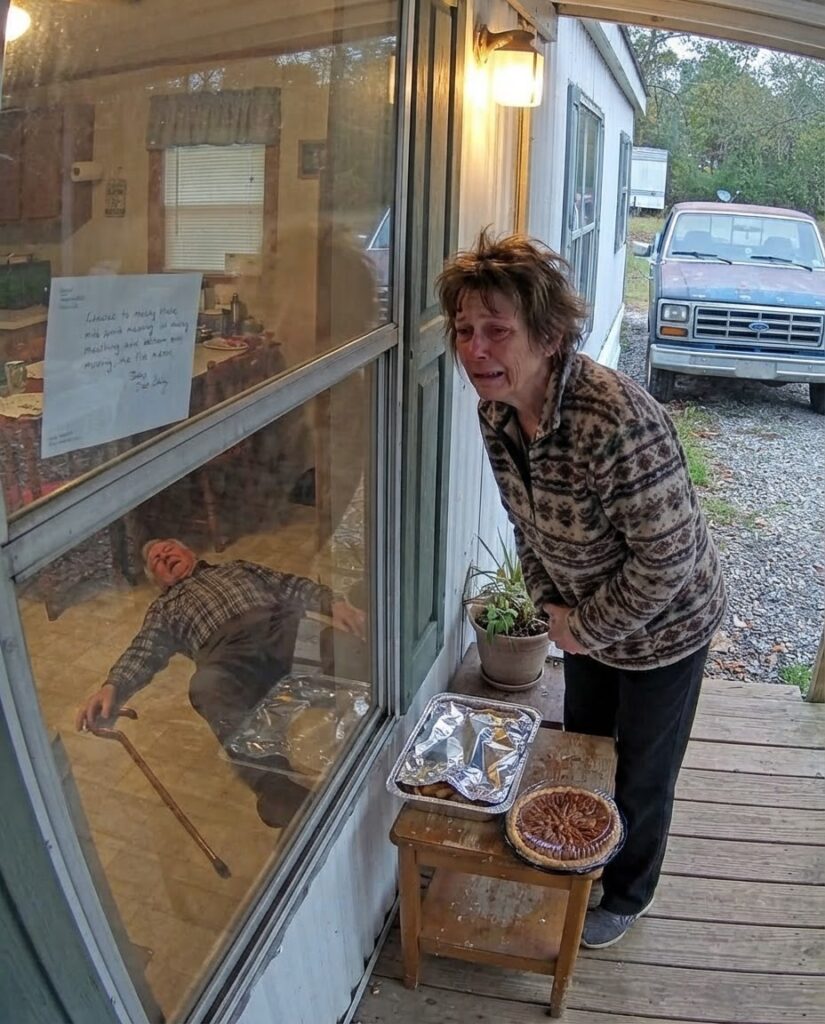
I ran to the front door and tried the handle. It was unlocked.
The trailer was freezing inside. The heater was dead. “Fernley!”
I knelt beside him. His skin was cold. But he was breathing. Slow and shallow.
I called 911 and wrapped him in every blanket I could find.
“Stay with me,” I kept saying. “I brought your pie. You have to eat your pie.”
His eyes opened a little.
“Merrin,” he whispered. “You came.”
“Of course I came.”
The ambulance took him to the hospital. The doctor said his heater had broken two nights before. He’d fallen trying to reach the phone and couldn’t get up. He’d been on that cold floor for almost two days.
“Another few hours,” the doctor told me, “and he wouldn’t have made it.”
I sat in the waiting room with the envelope in my lap. I didn’t open it. It felt wrong.
That evening, a woman in her fifties rushed into the hospital. She’d driven four hours from Pittsburgh.
“I’m Sorrel,” she said. “Fernley’s daughter. Are you Merrin?”
I nodded.
She hugged me so tightly I couldn’t breathe.
“He talks about you every year,” she said. “Every single Thanksgiving. ‘The pie lady came.’ It’s the highlight of his year.”
When Fernley was stable, Sorrel and I went in to see him together. He was warm now. Pink in the face.
He saw the envelope in my hand.
“Open it,” he said.
Inside, there was a letter. And a copy of an old receipt.
The letter said:
Merrin, if you’re reading this, I didn’t make it to Thanksgiving. I want you to know the truth. Nine years ago, after my wife died, I gave the church $30,000 to build a new kitchen, on one condition: that it would be used to feed people who were alone. I asked them to keep my name off it. Thank you for keeping my wife’s wish alive. Keep cooking. — Fernley
The receipt was from the church. Nine years old. For $30,000.
I looked at him.
“You built that kitchen?”
He smiled.
“My wife, June, always said nobody should eat Thanksgiving dinner alone. So I made sure they wouldn’t.”
The next Sunday, I brought the letter and the receipt to the church board meeting.
I didn’t yell. I just put them on the table in front of Bramwell.
“The kitchen you said no plate would leave,” I said, “was built by one of the freeloaders.”
The room was silent.
One of the older board members, a man who had been there nine years ago, picked up the receipt and read it. Then he looked at Bramwell.
“I remember this donation,” he said quietly. “It came with a condition. We agreed to it. In writing.”
By the end of the meeting, the board voted to restore the Thanksgiving program. Permanently. Bramwell was removed as chair a month later.
The church put a small plaque on the kitchen door. With Fernley’s permission this time.
The June Kitchen.
This year, Fernley came to the church on Thanksgiving morning. Sorrel drove him. He sat in a chair by the door and handed out the pecan pies himself.
When everyone was gone, he looked at me and said the same thing he always says.
“Best pecan pie in the county, Merrin.”
Then he winked.
“Don’t tell June.”
THE END.