PART 2
I ran faster than I’ve ever run in my life.
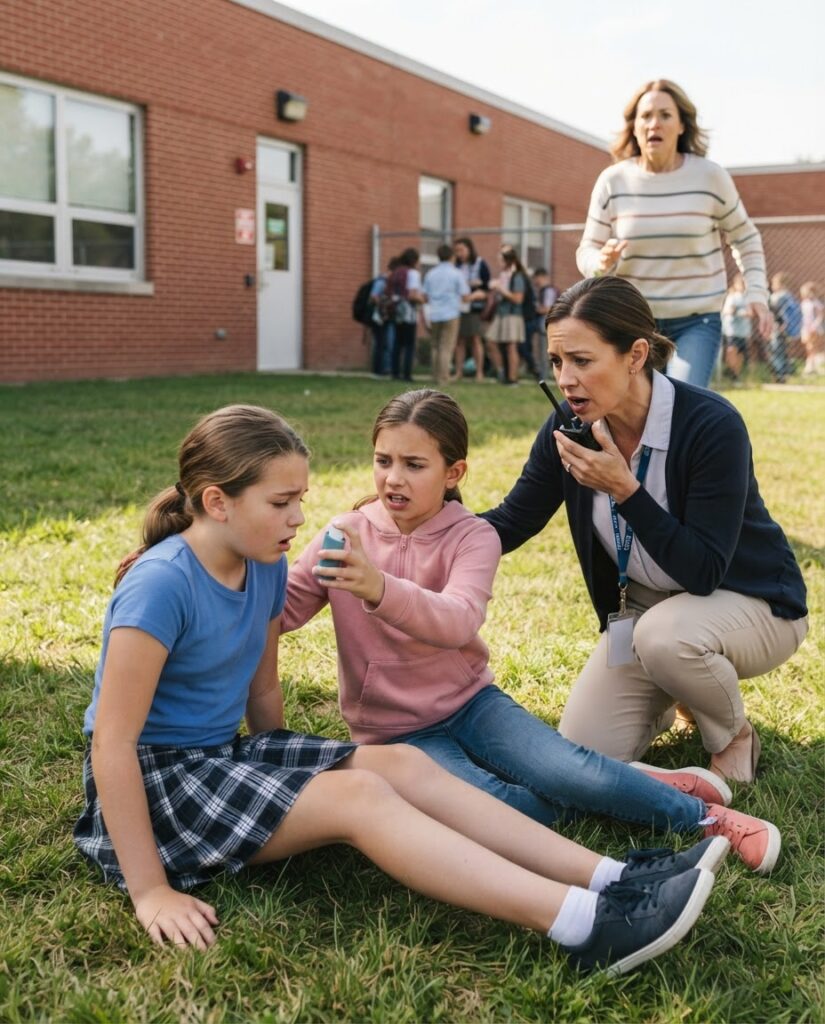
I dropped to my knees on the grass between the two girls. I ripped open the pharmacy bag with my teeth and tore the new inhaler out of its box. I shook it hard.
“Selah! Selah, baby, look at me!”
Her eyes were half closed. Her lips were blue. Her chest was barely moving.
I put the inhaler in her mouth. I pressed it. Once. Twice.
“Breathe, baby. Breathe in.”
Next to me, the teacher grabbed the other inhaler from Anouk’s hand and gave her two puffs too.
The school nurse came running across the field with her emergency bag. Someone was already calling 911.
I pressed the inhaler again. And again.
After the fourth puff, Selah gasped.
A big, rattling, ugly breath.
Then another.
Her eyes opened. Her lips started turning pink.
“Mommy,” she whispered.
I held her and sobbed.
Next to us, Anouk was coughing and crying, breathing too.
The ambulance took both girls to the hospital. They rode in the same ambulance, holding hands.
The doctors gave them breathing treatments. Steroids. Oxygen. They kept them overnight.
The ER doctor told me that Selah’s airways had almost closed completely. If I’d arrived even five minutes later, with that inhaler, she might not have survived.
“And the other girl,” the doctor said, shaking his head. “She has severe, untreated asthma. Her lungs are in bad shape. She’s been suffering for a long time. Has nobody ever treated her?”
“Her father doesn’t believe in it,” I said.
The doctor’s face hardened.
Lazlo showed up at the hospital that night. He stormed into Anouk’s room.
“What is this? Who called an ambulance? We can’t afford this! She’s fine! She just gets winded!”
The doctor stepped in front of him.
“Sir, your daughter nearly died today. She has severe asthma. She needs medication every single day. If she doesn’t get it, the next attack could kill her.”
“She’s faking it,” Lazlo said. “She’s always faking things.”
That’s when Selah, sitting up in the bed next door with an oxygen tube in her nose, said something very loudly.
“She’s NOT faking! She can’t breathe at night! I gave her my inhalers so she wouldn’t die!”
The whole room went silent.
Lazlo looked at my ten-year-old daughter. Then at his own.
Anouk was crying.
“It’s true, Daddy,” she whispered. “Selah saved me. Every night. For six weeks.”
Lazlo sat down in the chair very slowly.
For a long time, he didn’t say anything.
Then he put his face in his hands.
“My father told me asthma was weakness,” he said quietly. “I had it too. When I was a kid. He told me to toughen up. I almost died twice.”
He looked at Anouk.
“I’m sorry, baby. I’m so sorry.”
The hospital social worker helped Lazlo sign Anouk up for free asthma care through the state children’s insurance program. Daily medicine. A rescue inhaler. A specialist.
Lazlo took her to every appointment.
The girls are eleven now. Neither one has had a serious attack since that day.
And every morning, before school, they do the same thing.
They stand at the school gate, unzip their backpacks, and show each other their inhalers.
“Got mine,” Selah says.
“Got mine,” Anouk says.
Then they walk in together.
THE END.