Part 2
“Even if I already had dinner?”
“Even then.”
Maya stared at me for several seconds, as if she were waiting for the hidden condition.
Then her lower lip trembled.
She didn’t reach for the food.
She reached for me.
I held her in the middle of the kitchen while the refrigerator door remained open behind us, spilling cold white light across the floor. She buried her face against my stomach and cried so quietly that I almost didn’t realize what was happening.
Four years later, we adopted Lily.
She was smaller, louder, and furious at the world. She bit Michael during our first meeting, kicked a social worker in the shin, and told me she hated my hair.
I loved her immediately.
Neither of our daughters had come from my body.
But I had sat beside Maya through night terrors. I had carried Lily through three emergency rooms during an asthma attack. I knew which song made Maya stop crying and which stuffed animal Lily pretended she had outgrown but still searched for whenever she was frightened.
I had signed school forms, packed lunches, cleaned vomit from sheets, learned how to braid hair, and spent hundreds of nights listening for footsteps outside their bedrooms.
No one got to tell my daughters that this was not motherhood.
Especially not my own family.
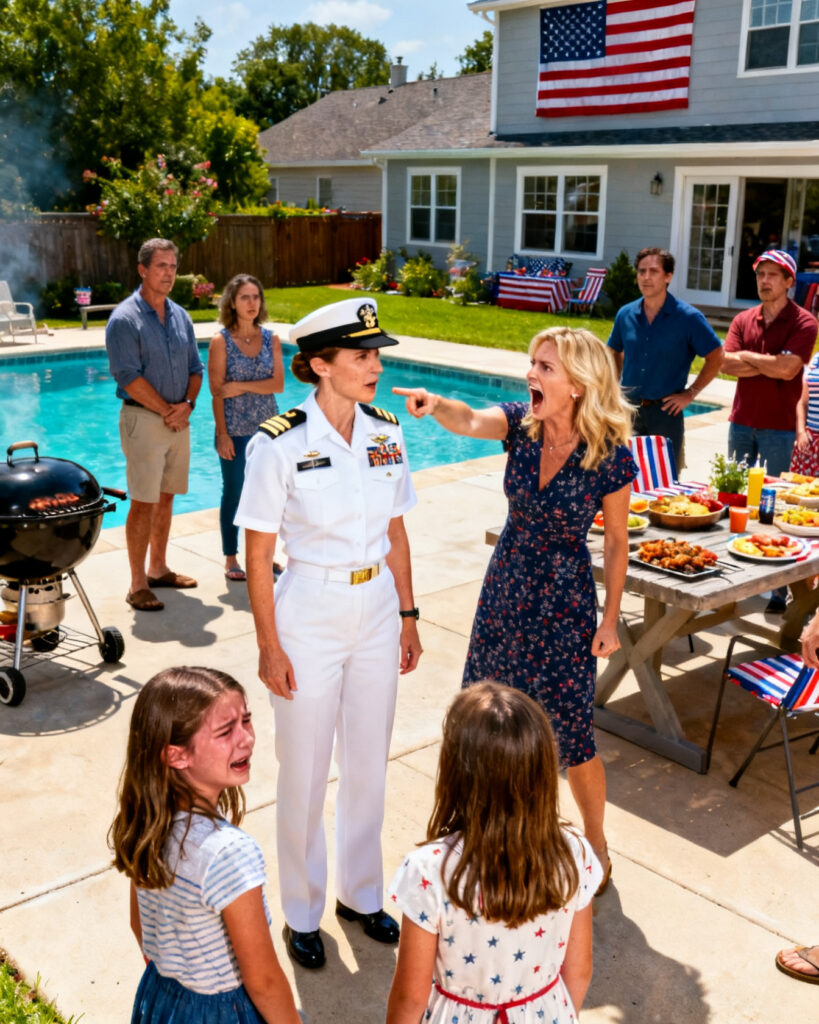
When we arrived home from the barbecue, Maya went straight upstairs.
Lily followed me into the kitchen.
She stood near the table, twisting the hem of her shirt around one finger.
“Mom?”
I turned.
Her face was blotchy from crying.
“Are we really yours?”
The question struck harder than Vanessa’s hand.
I crossed the room and knelt in front of her.
“You are my daughter,” I said.
“But she said—”
“I know what she said.”
“Is it different because you didn’t have me in your stomach?”
“Yes,” I answered.
Lily’s eyes widened.
I took both of her hands.
“It means our story started differently. That’s all. Some mothers meet their children in a hospital. Some meet them in a courtroom. Some meet them when a frightened little girl throws a shoe at them because she doesn’t trust anyone yet.”
Lily’s mouth opened.
“You said you’d never tell anyone about the shoe.”
“I’m making an exception.”
A reluctant smile appeared.
I squeezed her hands.
“You didn’t grow under my heart, Lily. You grew inside it. There is nothing fake about you being my daughter.”
She threw her arms around my neck.
Maya was standing halfway down the stairs.
She had heard everything.
I opened one arm, and she came down slowly before dropping to her knees beside us.
Michael joined us without saying anything.
For several minutes, the four of us sat on the kitchen floor.
Then I stood.
My cheek had started swelling. The cut inside my mouth was still bleeding slightly. My phone showed seventeen missed calls from relatives.
I ignored them.
I asked Michael to photograph my injury from several angles. I wrote down the time of the assault, the names of everyone standing nearby, and the exact words Vanessa had used.
Then I called the police.
Not because I wanted revenge.
Because my daughters had watched a woman strike their mother and then watched an entire family expect her to remain silent.
What I did next would teach them what silence meant.
A patrol officer arrived forty minutes later.
He was younger than I expected, with a tired face and a notebook that had been bent in half too many times. He listened while I described what happened. Michael gave his statement. Maya insisted on giving hers too.
The officer hesitated.
“She doesn’t have to,” he told me.
“I know,” I said.
Maya lifted her chin.
“I want to.”
Her voice shook, but she told him everything.
She told him about Connor’s insults.
She told him Vanessa had grabbed my arm before striking me.
She told him Uncle Grant had asked me not to make a scene.
When she finished, the officer closed his notebook.
“There were a lot of witnesses?”
“At least fifty.”
“And two active-duty Navy personnel standing nearby,” I said. “Lieutenant Commander Harris and Chief Petty Officer Daniels.”
The officer’s expression changed slightly.
“Do you have their contact information?”
I handed it to him.
My phone vibrated again.
This time it was my mother.
I answered.
“Lauren,” she said immediately, “your father and I think everyone needs to calm down.”
I stared at the kitchen wall.
“Vanessa assaulted me.”
“She was upset.”
“She struck me in front of my children.”
“Grant said you threatened Connor.”
“I told Vanessa to step away from me.”
“He says you’re planning to destroy his family.”
That sentence told me Grant had already begun shaping the story.
“Did he tell you why he thinks I can do that?”
Silence.
My mother lowered her voice.
“I don’t know what you’re talking about.”
“Then ask him.”
“Lauren, please. Your brother has worked very hard for everything he has.”
I looked at Michael.
He had heard her.
His expression went still.
“No,” I said. “Grant has worked very hard to make everyone believe that.”
I ended the call.
The officer was watching me.
“Is there something else going on?”
“Yes,” I said.
“But it’s not part of tonight’s assault report. Not yet.”
After he left, Michael locked the front door.
Then he turned toward me.
“What does Grant think you can do to his family?”
I had never lied to my husband.
But there were things I had kept from him because they belonged to a period of my life when Grant’s children were young and our parents were still healthy. I had convinced myself that preserving peace was the same as protecting everyone.
It wasn’t.
“Five years ago,” I said, “my father called me because Bennett Financial’s internal network had been compromised.”
Michael frowned.
“Your family’s company?”
I nodded.
The Bennett family liked to describe the company as Grant’s empire. In reality, my grandfather had built it from a two-room bookkeeping office. My father expanded it into a regional financial-services firm with nearly four hundred employees.
Grant inherited the title of president.
He also inherited the belief that consequences were for other people.
“Dad thought it was ransomware,” I continued. “He asked me to look at the system privately before they contacted outside investigators.”
“You investigated your brother’s company?”
“I inspected one isolated copy of the affected server. What I found wasn’t ransomware.”
Michael waited.
“It was an attempt to erase transaction records.”
“How much?”
“Initially, one point eight million dollars.”
His face hardened.
“Grant stole nearly two million dollars?”
“Not all at once. He created fake consulting vendors and approved payments to them over three years. Some of the money came from operating accounts. Some came from employee benefit funds.”
Michael took a step back.
“Did your parents know?”
“No.”
“Why wasn’t he arrested?”
“Because Grant begged me to give him forty-eight hours before I reported it.”
I remembered him sitting across from me in an empty conference room at two in the morning.
His expensive tie had been pulled loose. His hands shook around a paper cup of water.
He told me Vanessa didn’t know.
He told me they would lose their house.
He told me Connor and his younger sister would be thrown out of school.
Then he said the sentence he had used all his life.
We’re family.
I had not destroyed the evidence.
I had brought in an independent forensic accountant and a corporate attorney. Grant signed a confession, surrendered his voting shares, and agreed to repay every dollar under strict supervision.
The company avoided collapse because an investment group called Northstar Strategic Holdings purchased its debt, stabilized its accounts, and quietly assumed controlling ownership.
Everyone believed Northstar was a private firm based in Virginia.
They were partly right.
“What does that have to do with you?” Michael asked.
“I own Northstar.”
The kitchen became completely silent.
Michael stared at me.
“You own your family’s company?”
“Sixty-two percent of the voting interest.”
“How?”
“I used the money from the cybersecurity software license I sold eight years ago. Then I borrowed against the remaining royalties.”
Michael ran one hand over his face.
All those years, my family had laughed at my plain car and called my Navy career a hobby. They never knew that a threat-detection program I helped design had been licensed by three private contractors.
I never corrected them.
Money had never been the thing I wanted from them.
Respect had been.
And no amount of money could buy respect from people determined not to give it.
“Grant stayed president?” Michael asked.
“Publicly. The board believed removing him immediately would create panic and hurt hundreds of employees. His repayment agreement allowed him to remain as long as he followed financial controls and committed no further fraud.”
“Does Vanessa know?”
“No.”
“Your parents?”
“No.”
“Only Grant?”
“And three attorneys bound by confidentiality.”
Michael looked toward the stairs, where our daughters had gone to bed.
“Why did you protect him?”
“At first, because of his children. Later, I told myself I was protecting my parents.”
“And now?”
I looked down at the fading smear of blood on my thumb.
“Now I think I was protecting the version of my family I wished existed.”
My phone buzzed on the counter.
An email notification appeared.
The sender’s address belonged to the Navy’s security office.
The subject line read:
URGENT CONDUCT ALLEGATION — COMMANDER LAUREN BENNETT-HALE
Michael read it over my shoulder.
I opened the message.
Someone had filed an anonymous complaint claiming I had physically threatened a minor child, assaulted a civilian at a family gathering, and boasted that my government access could be used to “make people disappear financially.”
Attached was a written statement.
Vanessa’s name appeared at the bottom.
She hadn’t waited until morning.
She was trying to destroy my career before the police could establish what had happened.
Michael whispered a curse.
I read the statement twice.
Then I noticed one sentence.
Commander Bennett-Hale has repeatedly threatened to interfere with the upcoming acquisition of Bennett Financial.
I went cold.
The acquisition had not been announced.
Only the board, Grant, the company attorneys, and Northstar knew about it.
Vanessa had just connected the assault to the company.
I forwarded the complaint to my attorney.
Then I called Northstar’s forensic auditor.
She answered on the second ring.
“Lauren?”
“Check every outbound transfer from Bennett Financial in the last seventy-two hours.”
Her tone sharpened.
“Why?”
“Because Grant’s wife just mentioned a confidential acquisition in a false complaint against me.”
Keyboard sounds filled the line.
“Give me a minute.”
Michael stood beside me while I waited.
Forty-three seconds later, the auditor inhaled sharply.
“We have a blocked transfer.”
“How much?”
“Six hundred and fifty thousand dollars.”
“Destination?”
“A consulting company registered three weeks ago.”
“Name?”
“VLR Advisory Group.”
Vanessa Lynn Reynolds.
Her initials before she married Grant.
“What time was the transfer initiated?” I asked.
The auditor answered.
4:17 p.m.
The exact minute Vanessa slapped me.
The barbecue had not simply been a family argument.
It had been a distraction.
And when I refused to lose control, Vanessa created the incident herself.
“Freeze Grant’s access,” I said.
“Lauren—”
“Do it now.”
I ended the call.
Michael stared at me.
“What happens next?”
I looked toward the dark windows.
“Grant finds out that ten seconds was the generous offer.”
Part 3
At 6:12 the next morning, someone began pounding on our front door.
Michael checked the security panel.
“It’s Grant.”
I walked downstairs wearing Navy sweatpants and a plain gray shirt. My cheek was purple along the jawline.
Grant stood on the porch alone.
His hair was uncombed. His shirt had been buttoned incorrectly. He looked less like the polished president of a financial company and more like the frightened man I had confronted five years earlier.
I opened the door but kept the chain secured.
“You froze my accounts,” he said.
“I froze company accounts you were not authorized to access.”
“Vanessa made that transfer.”
“Using your credentials.”
“I didn’t know what she was doing.”
“That excuse didn’t work five years ago.”
His eyes flicked toward the bruise on my face.
“Lauren, she panicked.”
“She filed a false report with my command.”
“I told her not to.”
“She knew about the acquisition.”
Grant looked away.
That was the moment I knew.
“You told her everything,” I said.
“She’s my wife.”
“You showed her confidential board documents?”
“She was trying to help.”
“She created a shell company.”
“I can fix this.”
“No.”
His head snapped toward me.
“You don’t understand,” he said. “The acquisition is worth eighty million dollars. Once the company sells, Northstar gets paid, you get your investment back, and everyone walks away.”
“Everyone?”
His mouth tightened.
“How much were you receiving privately?”
He didn’t answer.
“How much, Grant?”
“Three million.”
Michael appeared behind me.
Grant’s face changed.
“You told him?”
“I should’ve told him years ago.”
“You promised this would stay between us.”
“I promised not to expose what you did if you repaid the money and never stole again.”
“I wasn’t stealing.”
“You arranged a secret payment from a buyer whose offer would eliminate two hundred and thirty jobs.”
“That’s business.”
“No. That’s you selling other people’s lives to preserve your lifestyle.”
He gripped the porch railing.
“Our parents will lose everything.”
“Our parents don’t own the company anymore.”
“They don’t know that.”
“They will today.”
Panic flashed across his face.
“Lauren, wait.”
“You should leave.”
“Vanessa could go to jail.”
“That depends on the prosecutor and what the evidence shows.”
“What about Connor?”
At the mention of his son, my anger shifted.
“Connor is fourteen,” I said. “He repeated things he was taught. I’m not going after him.”
“He could be expelled if this becomes public.”
“Then you should have thought about him before involving him.”
Grant stepped closer to the door.
“Please.”
For once, he wasn’t asking me to protect our parents.
He wasn’t asking me to protect his employees.
He was asking me to protect him.
“I gave you five years,” I said. “You used them to build a nicer cage.”
I closed the door.
At nine that morning, the board of Bennett Financial met in an emergency session.
I attended by secure video from my home office.
Grant appeared from the company’s headquarters. He had managed to fix his shirt and comb his hair, but sweat gleamed along his forehead.
The board chair, Evelyn Shaw, opened the meeting.
“Northstar has requested the immediate suspension of President Grant Bennett pending investigation into an unauthorized transfer, a concealed acquisition payment, and possible violation of his restitution agreement.”
Grant interrupted.
“This is a family dispute being exaggerated by my sister.”
Several board members looked confused.
They knew Northstar’s representative as Lauren Hale.
Most had never realized I had been born Lauren Bennett.
I activated my camera.
Grant saw me on the screen.
His shoulders collapsed.
“My name is Commander Lauren Bennett-Hale,” I said. “I am the managing owner of Northstar Strategic Holdings.”
No one spoke.
The board chair removed her glasses.
“Commander Bennett-Hale?”
“Yes.”
Grant tried to smile.
“This is exactly what I mean. She’s angry because of an argument at a barbecue.”
“Your wife assaulted me at that barbecue while a transfer was being initiated using your credentials.”
“That’s circumstantial.”
I held up a folder.
“This is your signed restitution agreement from five years ago. This is the forensic report documenting one point eight million dollars in fraudulent vendor payments. This is your written confession. And this is the clause requiring your immediate resignation if you conceal another transaction.”
Grant’s polished expression disappeared.
A board member whispered, “There was previous fraud?”
“Yes,” I said. “Northstar chose confidentiality to protect employees, clients, and the Bennett family. That decision was mine.”
Grant leaned toward his camera.
“You can’t disclose that.”
“I just did.”
Evelyn Shaw looked at him.
“Did you divert employee benefit funds?”
Grant said nothing.
“Did you sign this confession?”
Silence.
“Did you negotiate a personal payment connected to the acquisition?”
His face reddened.
“It was a consulting arrangement.”
“Three million dollars?” Evelyn asked.
No one had told her the amount.
Grant looked at me with pure hatred.
The board voted eleven to zero to remove him.
The acquisition was suspended.
The blocked transfer was referred to outside counsel and federal financial investigators because some of the company’s accounts included regulated employee funds.
Grant’s company access was terminated before the meeting ended.
At 10:34, my father called.
“What have you done?” he shouted.
“I stopped Grant from stealing again.”
“You humiliated him in front of his board.”
“He stole from your employees.”
“He’s your brother.”
“So you keep reminding me.”
My mother was crying in the background.
My father lowered his voice.
“Your mother says you secretly took control of the company.”
“I purchased its debt after Grant nearly destroyed it.”
“You had no right.”
“You signed the restructuring documents.”
“We thought Northstar was an investment company.”
“It is.”
“You deceived us.”
“No, Dad. You never asked who saved the company because Grant told you he did it.”
He stopped speaking.
I heard my mother ask what I meant.
I continued.
“The money Grant stole included four hundred thousand dollars from your retirement account.”
My father’s breathing changed.
“That isn’t possible.”
“I’ll send you the forensic report.”
“Grant said the market losses—”
“Grant was the market loss.”
The line went quiet.
For the first time in my life, my father had nothing to say in his son’s defense.
I ended the call.
At noon, a detective contacted me.
Vanessa had claimed I struck her first.
That story lasted less than an hour.
Lieutenant Commander Harris had seen the entire incident.
So had Chief Daniels.
So had the caterer, two neighbors, Michael, Maya, and eleven other guests willing to provide statements.
Even my aunt Rebecca, who had spent most of my childhood praising Grant, admitted Vanessa had walked across the patio specifically to confront me.
Vanessa was charged with assault.
The false complaint she submitted against me was added to the investigation after my command confirmed its contents were unsupported.
My security review remained open for forty-eight hours.
Then it was closed.
I was cleared.
Vanessa was not finished.
That evening, she posted a long message in the family group accusing me of using military power to destroy a mother.
She called me jealous.
She called my daughters damaged.
She wrote that adopted children often brought instability into otherwise normal families.
Before I could respond, a new message appeared.
It was from Connor.
Mom, stop.
The group went silent.
A second message followed.
You told me what to say to Lily.
Then another.
Dad said Aunt Lauren had to get angry in front of witnesses or she would stop the sale.
Vanessa immediately deleted her messages.
But Connor kept writing.
You promised me a car if I made Maya cry.
My stomach turned.
Michael came to stand beside me.
Connor’s final message appeared.
I’m sorry, Aunt Lauren. There’s something in my backpack you need to see.
Three minutes later, the doorbell rang.
Connor stood outside.
He was alone, clutching a black school backpack against his chest.
His face was pale.
“My mom thinks I’m at my friend’s house,” he said.
I let him inside.
He saw Maya standing near the stairs and lowered his eyes.
“I’m sorry,” he told her. “I didn’t mean what I said.”
“You still said it,” Maya answered.
“I know.”
Her voice was steadier than his.
Connor unzipped the backpack.
Inside was a blue folder.
He handed it to me.
The first page contained printed photographs of my daughters taken from school social-media posts. Someone had written notes beside them.
Maya becomes protective when Lily cries.
Mention abandonment.
Use the word defective.
Lauren must react physically.
Behind those pages were copies of my Navy biography, my command’s public contact information, and a draft complaint dated three days before the barbecue.
Vanessa had planned the report before she struck me.
But the final page was worse.
It was a letter signed by Grant promising the buyer of Bennett Financial that I would be “professionally compromised” before the acquisition vote.
In exchange, the buyer would wire Grant’s three-million-dollar fee through VLR Advisory Group.
Connor watched me read it.
“I found the folder in Dad’s office,” he whispered. “Mom told him to burn it after the barbecue.”
“Why did you take it?”
His eyes filled with tears.
“Because Lily was crying.”
No one spoke.
He wiped his face with his sleeve.
“And because I realized they were going to blame everything on me.”
I closed the folder.
Grant and Vanessa had not simply used their son.
They had prepared to sacrifice him.
Part 4
The investigation lasted four months.
Grant’s attorneys tried to describe the hidden payment as a legitimate consulting fee.
The signed letter made that explanation impossible.
Vanessa claimed the blue folder was only a collection of ideas and that she never intended to provoke anyone.
The draft complaint, created three days before the assault, made that explanation impossible too.
The company’s forensic auditors discovered two additional shell corporations. More than nine hundred thousand dollars had been routed through them over eighteen months.
Grant had not stopped stealing after his first confession.
He had simply become more careful.
My parents received the full report in a conference room at Northstar’s attorney’s office.
My father read the first twelve pages without speaking.
My mother cried.
Grant had used their home as collateral without telling them. He had redirected part of their retirement income and convinced them that reduced payments were caused by poor investments.
When my father reached the copy of Grant’s confession from five years earlier, he looked at me.
“You knew.”
“Yes.”
“And you saved the company.”
“Yes.”
“Why didn’t you tell us?”
“Because I knew you would protect him.”
My mother shook her head.
“We would not have protected this.”
“You protected him after Vanessa hit me.”
“That was different.”
“No, Mom. It was smaller. That’s why it was easier to excuse.”
She looked down.
I continued.
“You taught Grant that every consequence could be transferred to someone else. When he failed, you blamed the teacher. When he crashed the car, you blamed the weather. When he stole, he blamed pressure. When his wife assaulted me, you told me to calm down.”
My father closed the folder.
“What do you want from us?”
It was the first time either of my parents had ever asked that question.
“I want you to stop asking me to carry the cost of loving him.”
My mother reached across the table.
I moved my hand away.
Not dramatically.
Just enough.
“I’m not punishing you,” I said. “But access to my daughters is a privilege. Until you understand why defending Vanessa hurt them, you won’t see them.”
My mother began to cry harder.
My father looked angry, then frightened, then old.
For years, I had mistaken their disappointment for authority.
Sitting across from them, I finally saw it for what it was.
A habit.
And habits could be broken.
Connor stayed with my aunt Rebecca during the investigation.
His younger sister went with him.
I arranged for their school tuition to be paid directly through a protected education trust. Grant could not touch it. Neither could Vanessa.
Maya asked why I was helping Connor after what he said.
“Because accountability doesn’t require cruelty,” I told her.
“He hurt Lily.”
“Yes.”
“So shouldn’t he lose something?”
“He lost the version of his parents he thought he had.”
Maya considered that.
“Is that enough?”
“It will have to be his beginning.”
Connor apologized to Lily in person.
He didn’t ask her to forgive him.
That mattered.
Lily listened with her arms crossed.
When he finished, she said, “You don’t get to call us leftovers ever again.”
“I won’t.”
“And I’m not defective.”
“I know.”
She stared at him.
Then she pointed toward the front door.
“You can go now.”
After he left, she climbed into my lap even though she insisted she was too old for it.
“You were scary,” she said.
“Me?”
“When you told him to leave.”
“I thought you told him to leave.”
“I got it from you.”
The criminal cases did not end with dramatic courtroom speeches.
Real consequences rarely arrived with music.
They came in envelopes, suspended licenses, frozen accounts, mandatory appearances, and long meetings in windowless rooms.
Vanessa eventually pleaded to assault and making a false statement. She received probation, community service, mandatory counseling, and a protective order barring her from contacting me or my daughters.
Grant pleaded guilty to financial crimes connected to the concealed transfers. His sentence included prison time, restitution, and a permanent ban from serving as an officer of a regulated financial company.
Bennett Financial survived.
The acquisition was canceled.
Northstar appointed a new president, restored the employee funds, and gave every affected worker a written explanation.
I refused to take Grant’s old office.
I never wanted his chair.
Six months after the barbecue, my father sent me a handwritten letter.
It contained no excuses.
That was new.
He wrote that he had spent his life confusing favoritism with love and loyalty with silence. He admitted he had celebrated Grant’s potential while treating my achievements as inconveniences.
At the bottom, he wrote:
I kept waiting for you to prove you deserved a place in this family. I understand now that you were the person holding it together.
I did not forgive him immediately.
But I kept the letter.
My mother started therapy.
She did not ask to see the girls again until nearly a year had passed. When she finally did, she came to our home alone.
She apologized to Maya and Lily directly.
No explanations.
No request that they understand Vanessa’s stress.
No sentence beginning with “but.”
Lily watched her carefully.
Then she asked, “Do you think she’s our real mom?”
My mother looked at me.
“Yes,” she said. “I should never have allowed anyone to suggest otherwise.”
Lily nodded.
“That’s the right answer.”
The following Fourth of July, we held a barbecue in our own backyard.
There were no crystal glasses.
No speeches about the Bennett legacy.
Michael burned the first tray of hamburgers. Chief Daniels argued with Commander Harris over the correct way to light charcoal. Connor and his sister came with Aunt Rebecca and spent most of the afternoon in the pool.
At one point, I saw Connor hand Lily the last red popsicle.
She accepted it without smiling.
For her, that was progress.
As the sun went down, Maya sat beside me on the porch steps.
She was holding the faded purple backpack she had carried into our lives eight years earlier. We kept it in the back of her closet, though she rarely took it out.
“I used to think this was everything I owned,” she said.
I touched one of the frayed straps.
“You owned more than you knew.”
She leaned her head against my shoulder.
“Is Grandma part of the family again?”
“She’s trying to be.”
“What about Uncle Grant?”
“He’s still related to us.”
“That’s not what I asked.”
I smiled.
“No. It isn’t.”
Across the yard, Lily laughed as Michael sprayed her with the garden hose.
Maya watched them.
“Maybe real family isn’t about where you came from,” she said. “Maybe it’s about who makes sure you’re safe when everything goes bad.”
I put my arm around her.
“That’s a pretty good definition.”
Fireworks began exploding beyond the trees.
A year earlier, the sound of celebration had stopped when Vanessa’s hand struck my face.
For a long time, I believed my greatest strength was how much I could endure without reacting.
The Navy had taught me control.
My daughters taught me something more important.
Control did not mean accepting abuse.
Restraint did not mean surrender.
And love did not require silence.
Vanessa had believed I gave her ten seconds because I was afraid to act.
She was wrong.
Those ten seconds were mercy.
They were also the last ten seconds my family would ever be allowed to mistake my restraint for permission.