PART 2
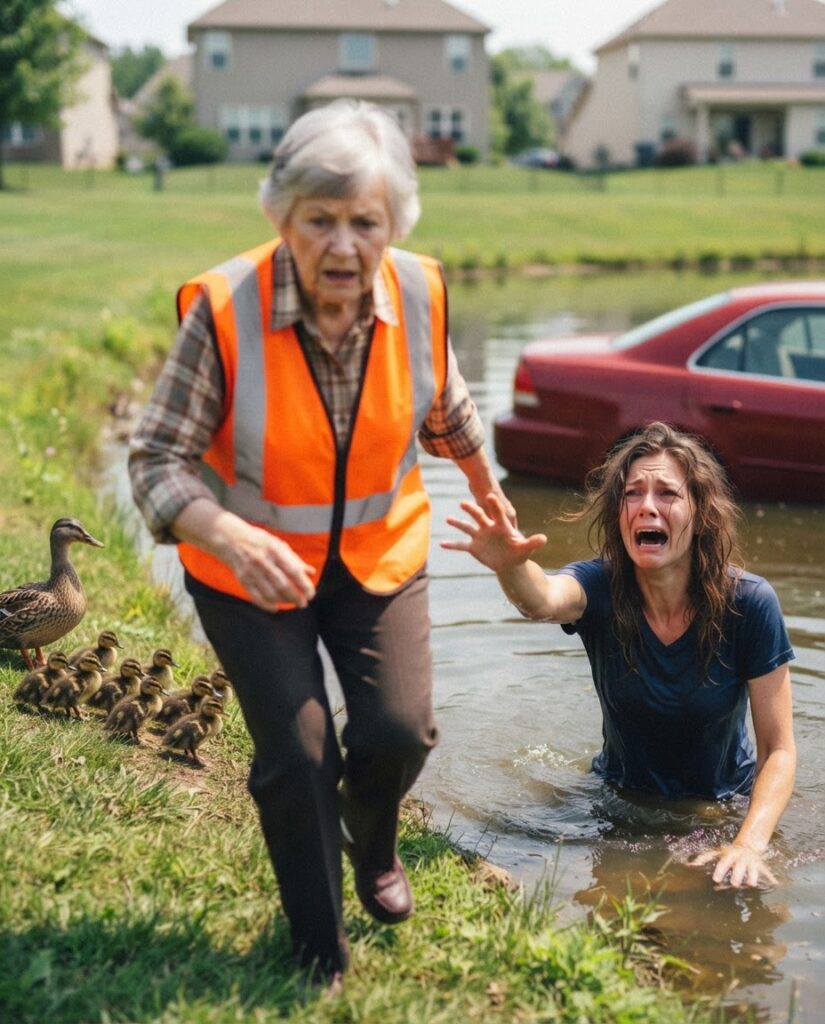
I kicked off my shoes and ran into the pond.
The water was cold and muddy. It came up to my waist. Then my chest. I’m sixty-eight years old. I’m not a strong swimmer. The woman was splashing, choking, trying to dive back down.
“She’s in her car seat!” she screamed. “I can’t open the door! I can’t get her out!”
I tried to dive under. I couldn’t see anything. The water was black. I couldn’t hold my breath long enough. I came up gasping.
“HELP!” I screamed toward the road. “SOMEBODY HELP US!”
A black truck was coming down Mill Pond Road.
It was Mr. Fitz.
He was going fast, like always. Then he saw my orange vest in the middle of the pond. He saw the woman screaming. He saw the tire tracks.
He slammed on his brakes so hard his truck slid sideways.
Then he jumped out, grabbed a tire iron from the back of his truck, and ran straight into the pond in his work clothes.
He didn’t say a word to me. He just took a breath and dove.
I counted. Ten seconds. Twenty. Thirty.
I heard a muffled crack under the water. Glass breaking.
Forty seconds.
Then he came up. Gasping. Holding a little girl in a pink dress.
She was limp. Her lips were blue. Her eyes were closed.
He carried her to the edge of the pond and laid her on the grass.
“I don’t know CPR,” he said, his voice shaking. “I don’t know what to do.”
I did.
I taught kindergarten for thirty-five years. Every single year, we had to take infant and child CPR training.
I knelt down next to her. I tilted her head back. I gave her two small breaths. Then I pressed on her tiny chest with two fingers. Thirty times.
Two more breaths.
Thirty more compressions.
“Come on, sweetheart,” I whispered. “Come on.”
On the third round, she coughed.
Pond water came out of her mouth. Then she gasped. Then she started screaming.
The most beautiful sound in the world.
Her mother collapsed in the grass next to us, sobbing.
Mr. Fitz sat down hard in the mud with his face in his hands.
The ambulance arrived six minutes later. The little girl’s name was Bristol. She was three years old. Her mother, Noemi, had swerved to miss a deer in the fog on her way to daycare. The car had gone off the road and straight into the pond.
“If you’d found them two minutes later,” one of the paramedics said, “that little girl wouldn’t have made it.”
“I didn’t find them,” I said.
I pointed at the edge of the pond.
The mother duck was standing there with her nine babies. Quiet now. Watching us.
“She did.”
Bristol spent two days in the hospital. She made a full recovery.
The next morning, at 7 a.m., I put on my orange vest and went out to the road like always.
Mr. Fitz’s black truck was already parked on the shoulder.
He was standing in the middle of Mill Pond Road with his hand up, stopping traffic.
The ducks waddled across in front of him.
When they reached the pond, he turned and looked at me. His face was red.
“I’m sorry, Ulla,” he said. “For everything I said. You and those ducks saved that baby’s life.”
“You saved her too,” I said. “You went into that water.”
He nodded slowly.
That week, Mr. Fitz built a big wooden sign and put it up on the side of the road himself.
“DUCK CROSSING. SLOW DOWN. THEY SAVE LIVES.”
Bristol and her mother come to visit me every Sunday. She feeds the ducks a handful of the duck pellets I keep by the door.
And she always waves to the mother duck.
“Thank you, Mama Duck,” she says.
THE END.