The name on the evidence bag was Eleanor Whitcomb.
I knew that name.
So did Principal Holloway. And judging by the way his face drained of color in the third row, he knew exactly what that sealed bag contained.
Eleanor Whitcomb was the school’s longtime administrative secretary.
Sixty-two years old, silver-haired, soft-spoken, and the kind of woman who remembered every student’s birthday without needing to check a calendar.
She had worked at Dunmore High for thirty-one years.
She was also the only person who had looked Cameron in the eyes when I brought him to school that morning and quietly asked whether he needed anything.
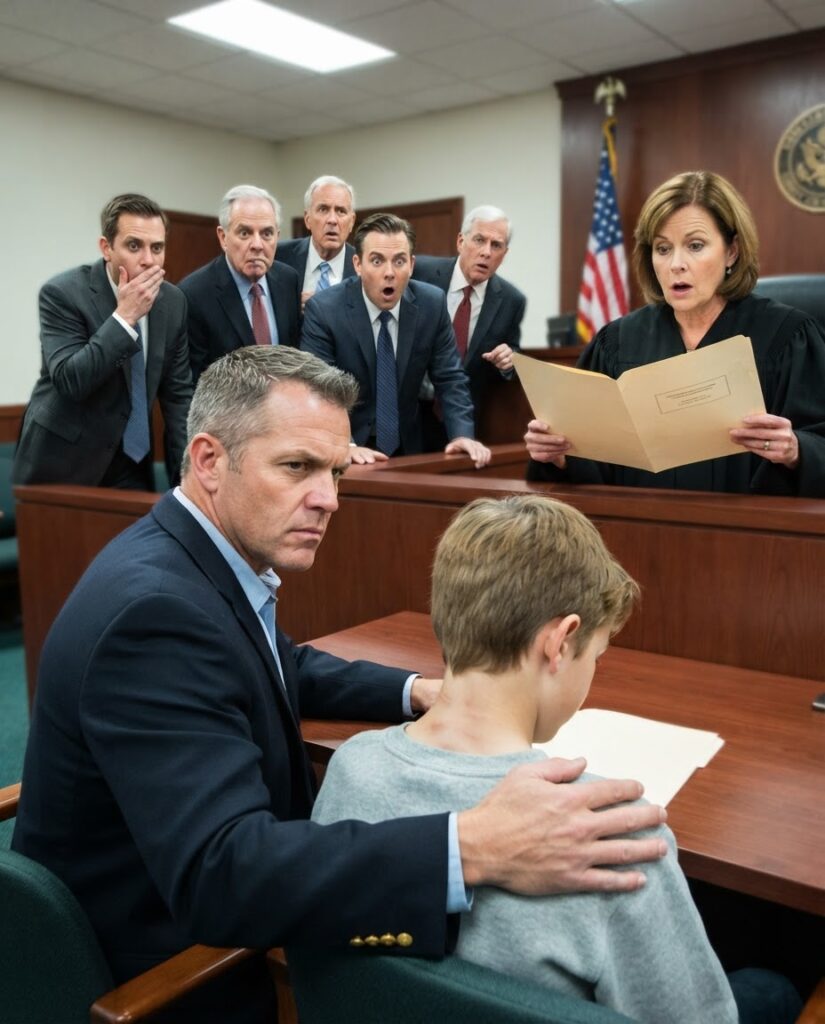
The trooper approached the bench.
“Your Honor, this evidence was delivered to the Pennsylvania State Police at 6:12 this morning.
The source has requested protective measures before her identity becomes public.”
Judge Robert Callahan studied the label.
Then he looked toward the five fathers.
“Counsel, approach.”
The attorneys rose almost simultaneously.
I remained seated.
My hands rested on my knees, palms down, exactly where everyone could see them.
Across the aisle, Richard Voss, the wealthiest man in Dunmore, leaned toward his attorney and whispered something sharp.
His attorney did not answer.
That interested me.
Voss owned three construction companies, two commercial properties, and enough influence over the school board that people routinely referred to him as the man who really ran Dunmore High.
His son, Tyler, was one of the five boys who had held Cameron down.
The others were Bradley Keene, Mason Price, Garrett Sloan, and Dylan Mercer.
Five boys.
Five powerful fathers.
And one fourteen-year-old child they had believed nobody would protect.
The judge examined the paperwork accompanying the evidence.
His expression changed.
Not dramatically.
Just a slight tightening around his mouth.
“Officer,” he said, “has this footage been authenticated?”
“Preliminary authentication, Your Honor. The original recording system and access logs have been preserved.
Investigators are securing the remaining material.”
“Does it contain images of the alleged assault?”
“Yes, sir.”
A low murmur spread through the courtroom.
Voss stood abruptly.
“This is ridiculous!”
“Sit down, Mr. Voss.”
“But Your Honor—”
“Sit. Down.”
The judge’s voice cracked through the room like a rifle shot.
Voss lowered himself into his chair.
For the first time since the hearing began, he looked less like a man who owned the town and more like a man discovering that ownership had limits.
Judge Callahan turned toward the attorneys.
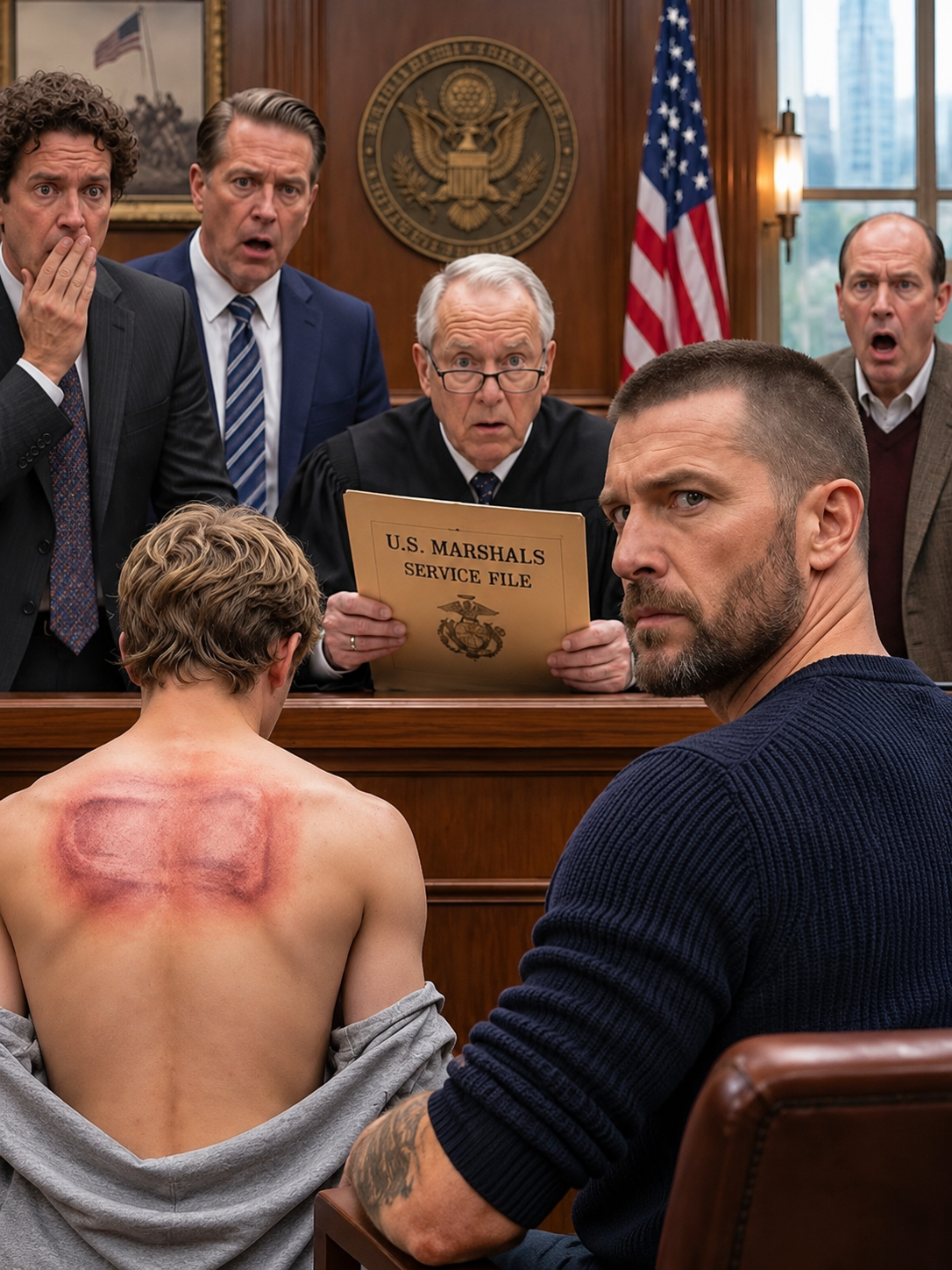
“Given the involvement of a minor and the nature of the injuries, the footage will not be displayed publicly.
I will review the material in chambers with counsel and the appropriate authorities.”
He paused.
“And I am ordering everyone present not to discuss or distribute any images of the child.”
Then his eyes settled on me.
“Captain Rivera, you will remain available.”
“Yes, Your Honor.”
He held my gaze for another second.
Something passed across his face.
Recognition, perhaps.
But not the kind the fathers imagined.
He had read my military record.
He knew I had spent years making decisions under pressure.
What he did not know was that the most difficult decision of my life had happened in a hospital room ten days earlier.
And I had nearly made the wrong one.
The judge recessed the hearing.
Chairs scraped against the floor.
Reporters rushed toward the doors.
The fathers gathered around their lawyers, speaking in urgent whispers.
I stood slowly.
And that was when Richard Voss stepped directly into my path.
“You think you’ve won something?” he hissed.
I looked at him.
He was taller than me by two inches, broad through the shoulders, wearing a watch that probably cost more than my truck.
But his hands were shaking.
“Move aside, Richard.”
His jaw tightened.
“My boy may never play football again.”
For a moment, I said nothing.
Then I answered.
“My son may never feel safe in a locker room again.”
Voss’s face hardened.
“You have no idea what you’ve started.”
I leaned just close enough that he could hear me without anyone else needing to.
“Neither did your son.”
He stepped backward.
I walked past him.
Outside the courtroom, the hallway smelled of floor polish and old paper.
A vending machine hummed against the wall.
At the far end stood Cameron.
He had insisted on coming, despite my objections.
He wore a loose gray sweatshirt, even though the building was warm. The fabric hung carefully away from the dressing beneath his shirt.
Beside him stood Dr. Hannah Brooks, the physician who had treated his burn.
She had offered to accompany him when she learned about the hearing.
Cameron looked up as I approached.
“Dad?”
I stopped.
There were a hundred things I wanted to tell him.
That everything would be all right.
That the boys would never hurt him again.
That the world was fair.
But war had taught me the danger of promising things you could not control.
So I crouched slightly and placed one hand on his shoulder.
“Someone brought evidence, Cam.”
His eyes widened.
“Of what?”
I hesitated.
“The truth.”
His lower lip trembled.
Then he whispered something that made my chest tighten.
“Are they going to believe me now?”
I swallowed.
“Yes, son.”
He looked down at his shoes.
“I told them before.”
“I know.”
“I told Coach Bennett.”
My hand went still.
Cameron had mentioned the coach once, but never explained what had happened.
“What did he say?”
Cameron stared at the floor.
“He said I needed to learn how to be part of a team.”
Dr. Brooks closed her eyes briefly.
Cameron continued.
“He said seniors have traditions. And if I couldn’t handle them, maybe I shouldn’t be around the football program.”
I felt something old and dangerous begin moving inside me.
Not anger.
Something worse.
The knowledge that adults had been given opportunities to stop this and had chosen not to.
“Cam,” I said carefully, “did Coach Bennett know what they were planning?”
He didn’t answer.
Instead, he reached into his sweatshirt pocket.
And pulled out a folded piece of paper.
“I didn’t tell you because I thought you’d get mad.”
I took it.
The paper was creased so many times that the edges had begun to split.
Across the top were five handwritten names.
Tyler Voss.
Bradley Keene.
Mason Price.
Garrett Sloan.
Dylan Mercer.
Below them was a sentence written in blue ink.
*Friday. Equipment room. Make the freshman understand.*
At the bottom were two initials.
D.B.
Daniel Bennett.
The football coach.
I looked at Cameron.
“Where did you get this?”
His voice barely carried.
“Coach dropped it when he was talking to Tyler.”
“When?”
“The day before they hurt me.”
I stared at the paper.
The implications settled slowly.
This was not merely a group of older boys acting without supervision.
Someone had known.
Someone had prepared.
Someone had made cruelty sound like tradition.
And suddenly, Eleanor Whitcomb’s decision to come forward made terrifying sense.
Before I could speak, the courtroom doors opened.
A deputy stepped into the hallway.
“Captain Rivera? Judge Callahan needs you.”
I handed the folded note to Dr. Brooks.
“Please keep this safe until the trooper can collect it properly.”
She nodded.
Cameron caught my sleeve.
“Dad?”
I turned.
“Please don’t do anything.”
Those five words nearly broke me.
Because my son was not asking me to protect him from the boys anymore.
He was asking me to protect him from losing his father.
I knelt in front of him.
“Look at me.”
He did.
“I am coming home with you.”
His eyes searched mine.
“Promise?”
I thought of Lindsay.
Of the last promise I had made in that hospital room.
And of how easily a man could mistake vengeance for protection.
“I promise.”
Then I stood and followed the deputy.
Inside the judge’s chambers, the atmosphere had changed completely.
Two state investigators stood near the window.
The attorneys sat around a polished conference table.
Principal Holloway was there, too.
His face had turned the color of wet newspaper.
On the table sat a laptop.
The screen was paused on a grainy image of a school hallway.
Judge Callahan gestured toward an empty chair.
“Captain, sit.”
I obeyed.
The judge folded his hands.
“I want you to understand that what we are about to discuss may become part of multiple criminal investigations.”
“Understood.”
He glanced toward the investigators.
“Play the relevant segment.”
The video began.
The timestamp showed 3:21 PM.
A hallway outside the boys’ locker room.
Students moved through the frame.
Then five seniors appeared.
Tyler Voss led them.
Cameron followed several feet behind, clutching a notebook against his chest.
One of the boys blocked his path.
Another took the notebook.
Cameron reached for it.
They laughed.
Then Tyler opened the equipment room door.
And Coach Daniel Bennett stepped into view.
My breathing stopped.
He looked directly at the group.
He looked directly at Cameron.
Then he said something.
The footage had no audio.
But the next movement needed no translation.
Bennett held the door open.
The five boys pushed my son inside.
And the coach closed the door behind them.
Nobody spoke.
The video continued.
Seven minutes passed.
Then nine.
Then eleven.
At 3:35, the door opened.
Cameron stumbled into the hallway.
He was bent forward, one arm wrapped around his ribs.
The boys emerged behind him.
Tyler was laughing.
Coach Bennett appeared last.
He looked down the hallway.
Then he reached up and adjusted the security camera mounted above the door.
The image tilted toward the ceiling.
The recording ended.
I stared at the blank screen.
For fifteen years, I had watched men do terrible things.
I had seen cruelty carried out in places where law and mercy seemed impossibly far away.
But nothing had prepared me to watch my child stumble out of a room while an adult calmly adjusted a camera.
Judge Callahan spoke softly.
“Captain Rivera?”
I did not answer immediately.
My fingers had curled against my palms.
I forced them open.
“Yes, Your Honor.”
“Do you recognize the child?”
“That’s my son.”
“Do you recognize the adult?”
“Coach Daniel Bennett.”
The judge nodded.
Then one investigator placed a second document on the table.
“There is more.”
Holloway made a small choking sound.
The investigator continued.
“Mrs. Whitcomb preserved archived administrative messages from the school system. The original records are being obtained directly from the provider.”
He looked toward the principal.
“Mr. Holloway, would you like to explain why a disciplinary incident report concerning Cameron Rivera was created, modified, and then deleted from the school database?”
Holloway stared at the document.
His lips parted.
No words came.
The investigator slid another page forward.
“Or why Coach Bennett sent you a message at 4:02 PM that afternoon saying, ‘The Voss situation got out of hand. We need to contain it before the father hears’?”
The silence became suffocating.
I slowly turned toward Holloway.
He would not look at me.
For ten days, I had replayed our meeting in my head.
His dismissive voice.
His folded hands.
The way he called my son’s injury a ritual.
Now I understood.
He had not been minimizing something he failed to understand.
He had been minimizing something he already knew.
Judge Callahan removed his glasses.
“Mr. Holloway, you should refrain from answering further questions until you have counsel.”
The principal began shaking.
And for the first time, I saw what real fear looked like on a man who had spent years making children afraid.
But the investigators were not finished.
One of them turned toward me.
“Captain Rivera, we also need to discuss the incidents involving the five seniors.”
The room shifted.
Every attorney straightened.
I met the investigator’s eyes.
“Go ahead.”
“We have reviewed the medical reports and initial police statements. The boys’ families allege that you personally retaliated against them.”
“I know.”
“Did you?”
I looked at the laptop.
At the frozen image of the empty hallway.
Then I thought of Cameron standing outside, waiting for me to keep my promise.
“No,” I said.
One attorney scoffed.
The investigator raised a hand.
“Let him finish.”
I looked around the table.
“I wanted to.”
The room went silent.
“I wanted to find every one of those boys. I wanted them to understand what it felt like to be helpless.”
My voice remained steady.
“But wanting something and doing it are different things.”
I turned toward the judge.
“The night Cameron was admitted to the hospital, I sat in my truck for forty-three minutes with my hands on the steering wheel.”
I could still feel the leather beneath my fingers.
“The keys were in the ignition. I knew where Tyler Voss lived. I knew where the others spent their evenings.”
I swallowed.
“And then my son called.”
The memory struck with almost physical force.
“He asked whether I was coming back.”
I lowered my eyes.
“That’s when I realized he had already lost his mother. I wasn’t going to make him lose his father because I couldn’t control myself.”
Nobody moved.
The investigator studied me.
“Then what happened to the five boys?”
“I don’t know everything that happened to them.”
“Everything?”
I looked up.
“I know someone had been watching them. I know someone was collecting evidence. And I know they were frightened long before their families filed these lawsuits.”
The investigator exchanged a glance with his partner.
Then he opened a folder.
“Captain Rivera, did you contact a former Marine named Thomas Reed?”
“Yes.”
“Why?”
“Thomas works in digital forensics. I asked him to help preserve evidence and identify witnesses.”
“Did you ask him to intimidate the boys?”
“No.”
“Did he?”
“Not to my knowledge.”
The investigator nodded.
“Mr. Reed has already provided his communications and work records. They are consistent with your statement.”
One of the attorneys shifted uncomfortably.
I continued.
“I also hired a private investigator, a licensed former state trooper named Rebecca Shaw. I asked her to document what happened to Cameron and find out whether other students had been hurt.”
The judge leaned forward.
“And did she?”
“Yes.”
I reached into my jacket and removed a sealed folder.
“Seven former students. Four families willing to testify. Two others still deciding.”
Holloway made a faint sound.
I placed the folder on the table.
“Some of those children were injured. Others were threatened. One transferred schools after being told his scholarship recommendation would disappear if he complained.”
The investigator took the folder.
“Who told him that?”
I looked directly at Holloway.
“Coach Bennett.”
The principal lowered his head.
For several seconds, the only sound came from the heating vent above us.
Then Judge Callahan spoke.
“Captain, you understand that the military record I reviewed earlier does not place you above the law.”
“Of course, Your Honor.”
“Nor does it make you immune from investigation.”
“I wouldn’t want it to.”
He watched me closely.
“Then why did you allow these allegations to continue without publicly defending yourself?”
I considered the question.
“Because the investigators were working. Because Cameron needed medical care more than I needed a public argument.”
I paused.
“And because I was afraid that if I started talking before I knew the truth, my anger would become the story instead of what happened to my son.”
The judge sat back.
His expression softened.
Not with approval.
With understanding.
“That,” he said quietly, “is an important distinction.”
Then the second investigator cleared his throat.
“Your Honor, we have another development.”
He placed five photographs on the table.
Hospital photographs.
Each showing one of the injured seniors.
The investigator pointed to the first.
“Bradley Keene fractured his wrist during an altercation at a private party. Multiple witnesses identify another student as the person involved.”
The second.
“Garrett Sloan injured his ankle while fleeing a confrontation outside a convenience store.”
The third.
“Mason Price was found unconscious after an assault. Investigators are still identifying the attacker.”
The fourth.
“Dylan Mercer sustained injuries in a vehicle collision. There is no evidence connecting Captain Rivera to that incident.”
Then the fifth.
Tyler Voss.
His face was swollen.
His left arm rested in a sling.
“Tyler Voss initially claimed Captain Rivera threatened him outside his home.”
The investigator paused.
“We obtained footage from the Voss residence.”
One of the attorneys closed his eyes.
The investigator continued.
“Captain Rivera never appeared there.”
I looked toward the judge.
“Then who did?”
The investigator’s face tightened.
“That is what we are still determining. But Tyler’s statement was false.”
A heavy silence followed.
Then the investigator added something that changed the direction of the entire case.
“All five boys received anonymous messages shortly before their respective incidents.”
He placed a printed message on the table.
Three words.
*Tell the truth.*
The room seemed to grow colder.
I stared at the page.
I had never seen that message before.
And suddenly, I understood something deeply unsettling.
Someone else had decided to fight this battle.
Someone who had watched the school protect its athletes.
Someone who had watched families buy silence.
Someone who had become desperate enough to act.
The investigator studied my face.
“Do you recognize that message?”
“No.”
“Any idea who sent it?”
I hesitated.
Then I remembered something Cameron had said during his first night in the hospital.
A sentence I had barely understood at the time.
*Dad, Tyler said this wasn’t the first time.*
I looked up.
“Maybe you should ask the students who came before my son.”
The investigator’s expression changed.
“Why?”
“Because I don’t think Cameron was the first child they hurt.”
He closed the folder.
“We don’t either.”
A knock interrupted us.
The deputy opened the door.
“Your Honor, Mrs. Whitcomb is here.”
Every face turned.
The judge nodded.
“Bring her in.”
Eleanor Whitcomb entered slowly.
She wore a dark blue cardigan and held a worn leather handbag against her chest.
Her silver hair was pinned neatly behind her ears.
She looked smaller than I remembered.
But her eyes were steady.
When she saw me, she stopped.
“Mr. Rivera.”
“Mrs. Whitcomb.”
Her mouth trembled.
“I’m sorry.”
I stood.
“You have nothing to apologize for.”
She shook her head.
“Yes, I do.”
Her fingers tightened around the handbag.
“I knew there were problems. I knew those boys had been frightening younger students.”
She glanced toward Holloway.
“And every time I tried to report something, I was told to stay out of it.”
The principal stared at the floor.
Eleanor continued.
“Three years ago, a boy named Nathan Bell came into my office crying. He had bruises on his arms. He told me the football players had locked him in a storage closet.”
Her voice broke.
“I wrote a report.”
She swallowed.
“The next morning, the report was gone.”
Nobody spoke.
“His mother came to school. Mr. Holloway told her Nathan had misunderstood a harmless prank.”
Eleanor wiped her cheek with the back of her hand.
“Two weeks later, Nathan transferred.”
She looked at me.
“I told myself I couldn’t do anything.”
The room remained still.
“And then I saw Cameron.”
Her shoulders began trembling.
“He looked just like Nathan had looked. Trying so hard not to cry because he thought crying would make everything worse.”
She opened her handbag.
Inside was a small notebook.
“I started keeping copies after Nathan left. Dates. Names. Messages. Every complaint I could document.”
She placed it on the table.
“I should have done it sooner.”
I looked at that notebook.
At the years of quiet courage hidden inside something small enough to fit in a handbag.
“Mrs. Whitcomb,” I said, “you did something when it mattered.”
She shook her head again.
“It mattered before.”
I had no answer.
Because she was right.
The judge spoke gently.
“Mrs. Whitcomb, your decision to preserve these records may help protect other children.”
She nodded.
But she did not smile.
Then she turned toward me.
“There’s something else you need to know about Cameron.”
My heart tightened.
“What?”
She hesitated.
“The day after he was hurt, I found a drawing in the hallway.”
She reached into her handbag again.
This time, she removed a sheet of paper.
It showed a small dog standing in front of a much larger animal.
The dog was trembling.
But it had planted itself between the larger animal and a group of puppies.
Beneath the drawing, in Cameron’s familiar handwriting, were five words.
*Being scared isn’t being weak.*
I stared at the paper.
Eleanor’s voice softened.
“He dropped it outside the nurse’s office. I kept it because I thought he might want it back.”
My throat closed.
Cameron had drawn animals since he was old enough to hold a pencil.
When Lindsay was dying, he had drawn birds on the backs of hospital meal receipts and taped them to her bedside wall.
She had called them her little guardians.
Now he was drawing guardians again.
Only this time, he was trying to become one.
I took the paper carefully.
“Thank you.”
Eleanor nodded.
Then she looked at the investigators.
“I’ll tell you everything.”
That afternoon, the hearing resumed.
The courtroom was no longer filled with confident whispers.
The fathers sat rigidly beside their attorneys.
Principal Holloway had left under the supervision of investigators to arrange legal representation.
Coach Bennett had been contacted for questioning.
And Eleanor Whitcomb had provided the beginning of what would become the most serious investigation Dunmore High had ever faced.
Judge Callahan entered.
Everyone stood.
When he sat, he looked first at the plaintiffs.
Then at their attorneys.
“I have reviewed the newly submitted evidence and heard representations from investigators.”
He paused.
“The allegations before this court cannot be evaluated in isolation from the underlying assault on Cameron Rivera.”
Richard Voss leaned toward his lawyer.
The judge continued.
“The evidence raises grave concerns about institutional misconduct, intimidation of witnesses, and deliberate concealment of serious injuries to a minor.”
He looked directly at the fathers.
“Let me be absolutely clear. Financial influence does not entitle anyone to interfere with an investigation.”
Nobody moved.
“The plaintiffs’ claims against Captain Rivera remain subject to the ordinary rules of evidence. His military service neither proves nor disproves the allegations.”
I lowered my head slightly.
That was exactly how it should be.
“But unsupported accusations will not become facts merely because powerful people repeat them.”
A ripple passed through the courtroom.
The judge turned a page.
“I am preserving the relevant evidence, directing counsel to comply with applicable disclosure obligations, and referring the newly presented material to the appropriate prosecutorial authorities.”
Then he looked at Richard Voss.
“Mr. Voss, do you wish to confer with your attorney before proceeding?”
Voss’s face was rigid.
For several seconds, he said nothing.
Then he whispered something to his lawyer.
His attorney rose.
“Your Honor, my client requests additional time to review the evidence.”
The judge nodded.
“That request will be considered under the applicable procedures.”
Voss looked toward me.
His expression was no longer confident.
It was calculating.
I recognized the look.
He was searching for a way out.
But this time, the door was not his to open.
Outside the courthouse, the afternoon sky had darkened.
Rain gathered against the windows.
Cameron sat on a wooden bench, holding a paper cup of hot chocolate that Dr. Brooks had bought him.
When he saw me, he stood too quickly and winced.
I crossed the hallway immediately.
“Easy, son.”
He ignored the pain.
“What happened?”
I knelt beside him.
“The truth is coming out.”
He looked past me toward the courtroom doors.
“Are they going to jail?”
“I don’t know yet.”
“Are they going to get away with it?”
I looked at him.
“No one can promise what a court will decide. But people are finally listening, and we’re going to make sure the evidence is heard.”
He nodded slowly.
Then he asked the question I had been dreading.
“Dad, did you hurt those boys?”
Everything inside me went quiet.
Dr. Brooks turned away, giving us privacy.
I sat beside Cameron.
“No.”
He studied my face.
“Not even Tyler?”
“Not even Tyler.”
His shoulders dropped.
He stared at his hot chocolate.
“I thought maybe you did.”
I felt the words settle between us.
“Why?”
“Because you were so quiet.”
I looked at my hands.
“I know.”
“And because they were getting hurt.”
“I know.”
He swallowed.
“I was scared you’d go away.”
I turned toward him.
“Cameron.”
He finally looked at me.
“I was angry enough to make a terrible mistake,” I admitted. “But I didn’t make it.”
His eyes filled.
“I don’t want you to be like them.”
The words struck harder than any accusation in that courtroom.
I reached for his hand.
“Neither do I.”
He held on.
For a long moment, we sat together beneath the humming courthouse lights.
Then he leaned against my shoulder.
Carefully, because of the bandage.
And whispered, “I miss Mom.”
My eyes burned.
“Me too.”
“She would know what to say.”
I stared through the window at the rain beginning to fall.
“She probably would.”
Cameron gave a small, broken laugh.
“She’d tell you to stop looking so scary.”
I smiled despite myself.
“She told me that a lot.”
Then his face grew serious again.
“Dad?”
“Yeah?”
“Can we go home?”
I wrapped my arm around his shoulders.
“That’s exactly where we’re going.”
But as we reached the courthouse doors, someone called my name.
“Captain Rivera!”
I turned.
A woman stood near the entrance, rainwater dripping from the shoulders of her coat.
She was in her forties, with tired eyes and a tightly clenched jaw.
Beside her stood a young man, perhaps seventeen or eighteen.
He kept his hands buried in his pockets.
The woman approached slowly.
“My name is Sarah Bell.”
I stopped.
“Nathan’s mother?”
She nodded.
Eleanor Whitcomb stood several feet behind her.
Sarah looked toward Cameron.
Then back at me.
“I heard what happened to your son.”
Her voice shook.
“I came because I couldn’t stay quiet anymore.”
The young man beside her lifted his head.
Nathan Bell.
The boy who had transferred three years earlier.
He looked at Cameron.
For a moment, neither spoke.
Then Nathan said quietly, “They did it to me too.”
Cameron’s fingers tightened around mine.
Nathan stepped closer.
“I thought I was the only one.”
My son stared at him.
Then slowly shook his head.
“No.”
Sarah pressed a hand against her mouth.
Nathan’s eyes filled.
And in that crowded courthouse hallway, two boys who had never met understood each other without another word.
Then Nathan reached into his pocket.
He pulled out his phone.
“I have something,” he said.
His mother turned sharply.
“Nathan?”
He looked at her.
“I’m done being scared.”
He opened a folder on his screen.
There were photographs.
Messages.
Names.
And a video.
Nathan held the phone toward me.
“Three years ago, Coach Bennett told me to delete this.”
I stared at the screen.
“Did you?”
Nathan shook his head.
“No, sir.”
Then he said something that made the entire hallway seem to fall silent.
“Because the boy they hurt before me never came back to school.”
I felt Cameron go still beside me.
Nathan swallowed.
“His name was Jacob Ellis.”
Sarah Bell began crying.
Nathan looked directly into my eyes.
“And his father has been trying to make people listen for five years.”
Outside, thunder rolled over Dunmore.
I looked at my son.
At Nathan.
At Eleanor Whitcomb standing silently behind them.
And suddenly, I understood that what happened to Cameron was not the beginning of this story.
It was the moment the silence finally cracked.
I took out my phone and called Rebecca Shaw.
She answered on the second ring.
“Marshall?”
“Rebecca, I need you to find someone.”
“Who?”
I looked at Nathan.
“Jacob Ellis.”
There was a long silence.
Then Rebecca said, very quietly, “Marshall, I already found him.”
My grip tightened.
“Where is he?”
She exhaled.
“He’s alive. He’s twenty now. And he’s been waiting a very long time for someone to ask him what really happened.”
I closed my eyes.
For the first time in ten days, the cold certainty that had carried me through every meeting, every threat, and every sleepless night began to change into something else.
Not vengeance.
Responsibility.
Because I had promised Lindsay I would keep our son safe.
But standing in that hallway, surrounded by children who had been abandoned by the very adults responsible for protecting them, I realized something I had not understood before.
Keeping Cameron safe could not mean making other children afraid.
It meant helping build a world where they would not have to be.
I opened my eyes.
“Tell Jacob,” I said, “that someone is finally ready to listen.”
Rebecca was silent for a moment.
Then she answered.
“I think he’s been waiting to hear those words for five years.”
I ended the call.
Cameron looked up at me.
“Dad, what’s going to happen now?”
I watched the rain streak down the courthouse windows.
Then I looked at the boys standing beside him.
“We’re going to tell the truth,” I said.
“All of it.”
And behind us, the courtroom doors opened once more.
A state investigator stepped into the hallway, scanning the crowd until his eyes found mine.
“Captain Rivera,” he called.
I turned.
His expression was grave.
“We need to speak with you immediately.”
I felt Cameron’s hand tighten around my fingers.
The investigator approached and lowered his voice.
“We’ve identified the person who sent the anonymous messages to the five seniors.”
I waited.
He glanced toward Nathan Bell.
Then toward Eleanor Whitcomb.
And finally back at me.
“It’s someone your son knows.”
Cameron went pale.
The investigator continued.
“And according to the evidence we’ve recovered, that person wasn’t trying to punish those boys.”
He paused.
“They were trying to stop something much worse from happening.”
For several seconds, nobody breathed.
Then Cameron whispered a name.
A name I had never heard him say before.
And the investigator’s expression told me my son was right.
“Ethan.”
The name barely escaped Cameron’s lips.
But the moment he said it, the investigator stopped moving.
I felt my son’s fingers tighten around mine.
“Ethan who?” I asked.
Cameron stared at the polished courthouse floor.
“Ethan Walker.”
The investigator exchanged a glance with his partner.
“How do you know that name, Cameron?”
My son swallowed.
“Because he told me something bad was going to happen.”
The hallway seemed to grow colder.
Rain hammered against the courthouse windows. Somewhere behind us, a door slammed, and Cameron flinched so violently that I instinctively moved closer.
“Cam,” I said gently, “look at me.”
He raised his eyes.
They were full of something I recognized immediately.
Not fear of punishment.
Fear of what telling the truth might cost someone else.
“Ethan is my friend,” he whispered. “He’s the only one who tried to help me.”
The investigator lowered his notebook.
“Then we need to understand what he told you.”
Cameron looked toward Nathan Bell, then Eleanor Whitcomb.
“He said Tyler and the others were planning something worse. Something they called Founder’s Night.”
Nathan’s face changed.
His mother noticed immediately.
“Nathan?”
The young man took one step backward.
“No,” he whispered.
I turned toward him.
“What is Founder’s Night?”
Nathan’s mouth opened, but no words came.
His mother reached for his arm.
He pulled away.
“That wasn’t supposed to happen again.”
The investigator straightened.
“Nathan, what do you know?”
Nathan stared at Cameron.
Then he said something that made every instinct I had developed during fifteen years in the Marines rise to attention.
“Founder’s Night is when they choose someone they think nobody will defend.”
Silence.
“Five years ago,” Nathan continued, “they chose Jacob Ellis.”
My jaw tightened.
“What happened to him?”
Nathan’s eyes filled.
“They made him disappear from school.”
I watched his hands.
They were trembling.
“Not because he transferred,” Nathan whispered. “Because they destroyed everything that made him want to stay.”
The investigator looked toward the courthouse entrance.
“We need to move this conversation somewhere private.”
I nodded.
But before anyone could move, Cameron spoke again.
“Ethan said they were going to do it to someone else.”
“Who?” I asked.
He hesitated.
Then he looked directly at me.
“A girl.”
My stomach dropped.
“What girl?”
Cameron’s voice broke.
“Her name is Lily.”
The investigator’s radio crackled.
He stepped aside to answer it.
I watched his expression change as he listened.
Then he turned toward us.
“We have a problem.”
The words were quiet.
But I had heard that tone before.
In combat, it usually meant someone had just discovered that the danger was closer than anyone realized.
“What problem?” I asked.
The investigator looked at Cameron.
“Ethan Walker was reported missing this morning.”
My son stopped breathing.
And suddenly, the entire courthouse hallway seemed to tilt beneath my feet.
The conference room they brought us into was small, with beige walls, fluorescent lighting, and a rectangular table covered in old scratches.
Cameron sat beside me.
Nathan and his mother occupied the chairs opposite us.
Eleanor Whitcomb stood near the window, twisting a tissue between her fingers.
Two investigators entered.
The older one introduced himself as Detective Lieutenant Andrew Collins of the Pennsylvania State Police.
He was a broad-shouldered man in his late forties, with tired eyes and the deliberate movements of someone who had spent too many years delivering bad news.
“Captain Rivera,” he said, “I need everyone here to remain calm.”
I looked at him.
“Then tell us what happened.”
Collins placed a photograph on the table.
A teenage boy with dark brown hair, freckles across his nose, and a crooked smile stared up from the paper.
Cameron made a small sound.
“That’s Ethan.”
Collins nodded.
“Fifteen years old. Sophomore at Dunmore High. His mother reported him missing at 7:40 this morning.”
“When was he last seen?” I asked.
“Yesterday afternoon, leaving school.”
“Alone?”
“We’re working on that.”
I studied the photograph.
There was something about the boy’s expression.
The kind of smile children wore when they were trying to convince adults that everything was fine.
I had seen it on Cameron.
Too many times.
Collins opened another folder.
“Ethan’s mother says he had been frightened for several days. He stopped sleeping. He kept checking the street outside their house.”
Cameron lowered his head.
“He told me.”
I turned toward him.
“Told you what?”
My son rubbed his thumb against the edge of his sweatshirt.
“That somebody was watching him.”
“Who?”
“I don’t know.”
His voice grew smaller.
“He said he found something on Coach Bennett’s computer.”
The room went silent.
Collins leaned forward.
“What did he find?”
Cameron looked toward the door.
Then he whispered, “Videos.”
Nathan closed his eyes.
His mother covered her mouth.
I felt the muscles in my shoulders tighten.
“What kind of videos, Cam?”
My son struggled to answer.
“Kids getting hurt. Kids crying. Older boys laughing.”
He swallowed.
“And adults standing there.”
Eleanor Whitcomb sat down abruptly.
Her face had gone white.
Collins wrote something in his notebook.
“Did Ethan tell you where those videos were stored?”
Cameron shook his head.
“He said he copied them.”
“Copied them where?”
“I don’t know.”
I watched my son carefully.
He was telling the truth.
But there was something he was holding back.
I knew that look.
He had worn it the afternoon I found him on Creekwood Lane.
“Cam,” I said softly, “is there something else?”
His eyes filled.
“He gave me something.”
Every person in the room became still.
“What did he give you?”
Cameron reached into his pocket.
Then stopped.
His face crumpled.
“I left it at home.”
Collins straightened.
“What was it?”
“A little silver flash drive.”
I felt a chill move down my spine.
“Where is it?”
“In my drawing box.”
“Are you certain?”
Cameron nodded.
“Ethan said if anything happened to him, I should give it to somebody who wouldn’t be afraid of Coach Bennett.”
He looked at me.
“I was going to give it to you.”
A tear slid down his cheek.
“But then those boys hurt me, and everything got so confusing.”
I placed my hand over his.
“You did nothing wrong.”
He shook his head.
“If I’d told you sooner, maybe Ethan wouldn’t be missing.”
I leaned closer.
“Listen carefully. Whatever happened to Ethan is not your responsibility.”
He stared at me.
“But I could have helped.”
“You are helping.”
His lip trembled.
“Then why does it feel like everybody who helps me gets hurt?”
I had no immediate answer.
Because that was the cruelest part of what those boys and their protectors had done.
They had taught children that doing the right thing carried a price.
And now my son was trying to calculate whether telling the truth was worth someone else’s suffering.
I squeezed his hand.
“Because the people who should have protected you failed. But that doesn’t mean telling the truth was wrong.”
Collins closed his notebook.
“Captain, we need that drive.”
“You’ll have it.”
“We’ll send officers to your house.”
I nodded.
Then I looked at him.
“And Detective?”
“Yes?”
“Find Ethan.”
Collins held my gaze.
“We intend to.”
The drive back to our house felt longer than any journey I had made in years.
Rain swept across the windshield.
Cameron sat silently in the passenger seat, watching the trees bend beneath the wind.
Two unmarked police vehicles followed us.
I kept both hands on the steering wheel.
There had been a time when danger was simple.
You identified the threat.
You protected your people.
You completed the mission.
But this was different.
The enemy was not hiding behind a distant wall.
It was woven into school board meetings, football fundraisers, and smiling photographs in the local newspaper.
And every time I thought I understood the full extent of it, another child appeared.
Another secret.
Another family that had been told to remain quiet.
“Dad?”
I glanced at Cameron.
“Yeah?”
“Do you think Ethan’s alive?”
The question hit me harder than I expected.
I wanted to tell him yes.
I wanted to give him certainty.
Instead, I answered carefully.
“I think we have reasons to hope.”
He nodded.
Then whispered, “He’s really smart.”
I smiled faintly.
“Yeah?”
“He can fix almost anything. Computers. Phones. He even repaired the old projector in our classroom.”
Cameron paused.
“He doesn’t like football.”
“Neither do you.”
That earned the smallest smile.
“He says football players act like they own the school.”
I looked through the rain.
“Some of them seem to believe that.”
Cameron turned toward me.
“Ethan said the school has two sets of rules.”
I waited.
“One for kids whose parents have money.”
“And the other?”
“For everybody else.”
The words hung between us.
I thought of Richard Voss.
Of Principal Holloway.
Of Coach Bennett holding open the equipment room door.
Then I thought of Lindsay.
She had been a public school teacher before Cameron was born.
She believed schools should be the safest places children knew.
She used to say that a child’s trust was something adults borrowed, not something they owned.
I wondered what she would think of Dunmore High.
And I knew.
She would be furious.
Not loud.
Not theatrical.
Just quietly, relentlessly furious.
The kind of anger that made her stay awake until midnight helping a struggling student understand a lesson.
The kind that made her confront administrators who dismissed children as problems.
I had spent years thinking strength meant being able to withstand pain.
Lindsay had taught me that sometimes strength meant refusing to let someone else endure it alone.
We pulled into the driveway.
Two police vehicles stopped behind us.
I turned off the engine.
Cameron looked toward the house.
Then his face changed.
“Dad.”
I followed his gaze.
The front door was open.
Only a few inches.
But I knew I had locked it.
And I knew Cameron had not opened it.
I raised one hand.
“Stay in the truck.”
The officers behind us were already moving.
I stepped out slowly.
Rain struck my face.
One officer approached the porch while the other moved toward the side of the house.
I remained near Cameron’s door, keeping him in sight.
There was no reason to rush inside.
No reason to make a dangerous situation worse.
A minute passed.
Then two.
Finally, an officer emerged.
“Captain Rivera?”
“Yes?”
“Your house has been entered.”
My stomach tightened.
“Is anyone inside?”
“Not now.”
“Was anything taken?”
The officer hesitated.
“You should see this.”
I looked toward Cameron.
He was watching through the windshield, his face pale.
I opened the passenger door.
“Cam, stay here with Officer Daniels.”
He grabbed my wrist.
“Dad, my drawing box.”
I looked at him.
He already knew.
And so did I.
The living room looked almost normal.
That was what disturbed me most.
The couch cushions were still arranged the way Cameron liked them.
Lindsay’s framed photograph stood on the mantel.
The small ceramic lighthouse she had bought during our last family vacation remained beside it.
But the hallway drawer had been pulled open.
The study door stood ajar.
And Cameron’s bedroom had been searched.
Not destroyed.
Searched.
Drawers opened.
Books moved.
Closet shelves disturbed.
Someone had been looking for something specific.
I stood in the doorway while the officers photographed the room.
Cameron’s drawing box sat on the bed.
Its lid was open.
Inside were pencils, erasers, sketchbooks, and a small envelope containing photographs of Lindsay.
The silver flash drive was gone.
I stared at the empty space.
Then I noticed something beneath the box.
A folded sheet of paper.
The officer carefully photographed it before collecting it.
Across the page, written in thick black marker, were six words.
STOP LOOKING OR THE BOY DISAPPEARS.
My vision narrowed.
For several seconds, I heard nothing.
Not the rain.
Not the officers speaking.
Not the distant sound of traffic.
Only Cameron’s voice from earlier.
Do you think Ethan’s alive?
I stepped backward.
My hands were trembling.
I had faced armed men in places where hesitation could kill.
But standing in my son’s bedroom, staring at a threat left beside his drawings, I felt a kind of fear I had never experienced in combat.
Because this time, the people I loved were the battlefield.
An officer touched my shoulder.
“Captain?”
I turned.
“We need to secure the house and document everything. Please don’t touch anything else.”
I nodded.
“Understood.”
He studied me.
“Are you all right?”
I almost laughed.
Instead, I looked at Lindsay’s photograph on the dresser.
“No.”
It was the first honest answer I had given that day.
“No, I’m not.”
By evening, Dunmore was unraveling.
The state police had secured our house.
Ethan Walker’s disappearance was receiving regional attention.
Coach Bennett had been placed on administrative leave while investigators pursued evidence of his involvement.
Principal Holloway had retained an attorney.
And Richard Voss was suddenly refusing to answer reporters’ questions.
But the most important development came at 6:23 PM.
My phone rang.
Unknown number.
I answered.
“Rivera.”
For three seconds, there was silence.
Then a young male voice whispered, “Captain?”
I stood.
“Who is this?”
“Ethan.”
My heart slammed against my ribs.
I signaled to Detective Collins, who was standing across the room.
He approached immediately.
“Ethan,” I said carefully, “where are you?”
The boy’s breathing was ragged.
“I can’t tell you.”
“Are you hurt?”
A pause.
“Not bad.”
I closed my eyes briefly.
“Listen to me. Cameron is safe. The police are here. We can help you.”
“No.”
His voice sharpened.
“You don’t understand.”
“Then help me understand.”
I heard a distant metallic sound.
A door, perhaps.
Then Ethan whispered, “They took the wrong drive.”
I went still.
“What?”
“The one in Cameron’s room. It was a decoy.”
Collins leaned closer.
I put the call on speaker.
Ethan continued.
“I knew they’d search his house if they found out.”
“Where is the real one?” Collins asked.
Ethan fell silent.
“Who is that?”
“Detective Collins. Pennsylvania State Police.”
“No police.”
“Ethan,” I said, “he’s trying to help.”
“You don’t know who you can trust.”
His voice broke.
“They have people everywhere.”
I looked at Collins.
The detective’s expression hardened.
“Ethan, we can arrange a safe meeting. You don’t need to tell us your location over the phone.”
The boy breathed unevenly.
Then he said, “There’s a place.”
I waited.
“Old Saint Andrew’s Church. The building behind it. Midnight.”
Collins shook his head slightly.
I understood.
An unknown location.
A frightened child.
A possible trap.
We needed to handle it carefully.
“Ethan,” I said, “don’t go anywhere dangerous. Tell us whether you’re alone.”
He hesitated.
Then whispered, “Not anymore.”
My stomach dropped.
“Who’s with you?”
A long silence.
Then another voice entered the call.
Older.
Male.
Calm.
“Captain Rivera.”
I froze.
I knew that voice.
I had heard it once before.
At Dunmore High School.
During the meeting when I confronted Principal Holloway.
The man had stood near the office doorway, watching without speaking.
Coach Daniel Bennett.
“Captain,” he said smoothly, “I believe we need to have a conversation.”
Collins immediately signaled to the technical team working nearby.
I kept my voice steady.
“Where’s Ethan?”
“Safe, for now.”
“Let me speak to him.”
A pause.
Then a muffled sound.
Ethan gasped.
“Captain, don’t—”
The line went dead.
I stared at the phone.
For a moment, nobody moved.
Then Collins spoke.
“We have enough to treat this as an immediate threat to a missing minor.”
He turned toward his team.
“Get the local units moving. Secure the church area. Coordinate with the county emergency response team. We do this carefully.”
I stepped toward him.
“I’m coming.”
He shook his head.
“No.”
“Detective—”
“Captain Rivera, you are a witness and the father of another threatened child. You are not part of this operation.”
I looked at him.
“That boy called me.”
“I know.”
“He trusted me.”
“And the best thing you can do for him is let us bring him home.”
I stared at the phone in my hand.
Every instinct I possessed screamed at me to move.
To act.
To do something.
But then I remembered Cameron.
His small hand gripping my sleeve.
Please don’t do anything.
I slowly placed the phone on the table.
“Bring him back,” I said.
Collins nodded once.
“We’re going to do everything we can.”
At 11:41 PM, Cameron was asleep on the couch in the temporary apartment the state police had arranged for us.
He had refused to sleep in the bedroom.
I hadn’t argued.
The television played quietly with the sound muted.
Rain continued tapping against the windows.
I sat beside him, watching his chest rise and fall.
His injured side was supported by a pillow.
His hand rested near the edge of the blanket.
For the first time that day, he looked fourteen.
Not like a witness.
Not like a victim.
Not like a boy carrying secrets too heavy for his age.
Just a child.
My child.
I reached toward the coffee table and picked up Lindsay’s photograph.
It was the one taken during our last summer together.
She stood on a beach in a yellow sundress, laughing because Cameron had splashed water onto her legs.
I could still hear that laugh.
I traced the edge of the frame with my thumb.
“I’m trying, Lin,” I whispered.
My throat tightened.
“I really am.”
For two years, I had believed the hardest part of losing her was learning how to live without her.
But I had been wrong.
The hardest part was making decisions she should have been there to help me make.
I looked toward Cameron.
“I don’t know if I’m doing this right.”
The room remained silent.
Then my phone vibrated.
A message from Detective Collins.
Units are in position. No confirmed sighting yet.
I set the phone down.
And waited.
Midnight passed.
Then 12:17.
Then 12:36.
At 12:48, my phone rang.
I answered immediately.
“Collins?”
His voice was tense.
“We found the building.”
“And Ethan?”
A pause.
“He’s alive.”
I closed my eyes.
Relief hit so suddenly that I had to grip the edge of the table.
“Where is he?”
“With paramedics. He’s frightened and dehydrated, but conscious.”
I looked toward Cameron.
“Thank God.”
Collins continued.
“Coach Bennett fled before officers entered. We’re searching for him now.”
My relief faded.
“Did Ethan say anything?”
“Yes.”
I waited.
Collins lowered his voice.
“He said Bennett wasn’t the person running the operation.”
I went still.
“What operation?”
“The recordings. The intimidation. The cover-ups.”
Rain tapped against the window.
Collins continued.
“According to Ethan, Bennett was following orders.”
I looked at Lindsay’s photograph.
“Whose orders?”
A pause.
Then Collins said a name.
“Richard Voss.”
I felt the room become very quiet.
But Collins wasn’t finished.
“Captain, Ethan also told us something else.”
“What?”
“He said the original recordings weren’t kept at the school.”
I stared at the wall.
“Where were they?”
“At a private property owned by Voss.”
My fingers tightened around the phone.
“And there’s more.”
I waited.
Collins exhaled.
“Ethan says he found records showing that the families of several injured students received money in exchange for signing confidentiality agreements.”
I closed my eyes.
Nathan Bell.
Jacob Ellis.
Seven former students.
Perhaps more.
All those years.
All that silence.
Bought and sold like construction contracts.
“How many families?” I asked.
“We don’t know yet.”
Then Collins said something that made my blood run cold.
“But one of the names on the payment records belongs to someone connected to your family.”
I stopped breathing.
“What name?”
There was a pause.
“Marshall, I think you should sit down.”
“I’m already sitting.”
Collins hesitated.
Then spoke.
“Lindsay Rivera.”
For a moment, I could not understand the words.
I looked at the photograph in my hand.
At my wife’s smile.
At the sunlight in her hair.
At the woman who had died two winters earlier.
“That’s impossible.”
“I understand.”
“No,” I said sharply. “You don’t.”
Cameron stirred on the couch.
I lowered my voice.
“My wife died before we moved to Dunmore.”
“I know.”
“She never worked at that school.”
“I know.”
“Then why would her name be on their records?”
Collins was silent.
Then he answered.
“That’s what we need to find out.”
I stared at Lindsay’s photograph.
My heart began pounding.
For two years, I had carried the memory of her final moments like something sacred.
Her hand in mine.
Her voice barely audible.
Keep him safe.
I had always believed she meant the ordinary dangers of growing up without a mother.
Loneliness.
Grief.
The cruel unpredictability of life.
But suddenly, another possibility opened before me.
A possibility so disturbing that I could barely allow myself to consider it.
What if Lindsay had known something?
What if she had tried to warn someone?
What if the promise she made me give her had meant more than I understood?
I rose slowly.
Across the room, Cameron opened his eyes.
“Dad?”
I turned.
He sat up carefully.
“Did they find Ethan?”
I nodded.
“Yes, son.”
His face brightened.
“He’s okay?”
“He’s alive. He’s getting help.”
Cameron covered his face with both hands.
A quiet sob escaped him.
I crossed the room and knelt beside the couch.
He wrapped his arms around my neck.
I held him gently, careful of his injury.
For a long moment, neither of us spoke.
Then Cameron whispered, “Mom would be proud of Ethan.”
I closed my eyes.
“Yes.”
He leaned back.
“And she’d be proud of you.”
The words nearly undid me.
I looked at my son.
At the exhaustion beneath his eyes.
At the courage he had shown without ever understanding how much courage it took.
Then I placed my hand against his cheek.
“She’d be proud of you most of all.”
He smiled faintly.
And for one brief moment, the world felt almost peaceful.
Then my phone vibrated again.
Another message from Collins.
We need to speak in person. Do not discuss Lindsay’s name with anyone until we verify the records.
I read it twice.
Then turned the phone facedown.
Cameron watched me.
“Something wrong?”
I forced myself to breathe.
“Something we need to understand.”
He studied my face.
“About Ethan?”
“Maybe.”
He nodded slowly.
Then settled back beneath the blanket.
I remained beside him until his breathing became steady again.
Only then did I rise.
I walked to the window.
Outside, the rain had stopped.
The streetlights reflected off the wet pavement.
Somewhere in Dunmore, Coach Bennett was running.
Richard Voss was preparing his next move.
And a fifteen-year-old boy had survived long enough to expose a secret that powerful men had spent years protecting.
But the name on those records haunted me.
Lindsay Rivera.
My wife.
The woman I had buried.
The woman who had never lived in this town.
I looked down at her photograph.
And remembered something.
Three weeks before she died, Lindsay had asked me to bring her a small wooden box from our bedroom closet.
Inside were old letters, photographs, and documents from her teaching years.
She had held the box against her chest for a long time.
Then she asked me to promise that I would never throw it away.
I had agreed without asking why.
After her funeral, I packed the box with the rest of her belongings.
I hadn’t opened it since.
Now, standing in the dim apartment, I remembered exactly where I had stored it.
In the locked compartment beneath the back seat of my truck.
I looked toward the keys on the kitchen counter.
Then toward Cameron.
For several seconds, I did not move.
Finally, I picked up my phone and called Collins.
He answered immediately.
“Marshall?”
“I remembered something.”
“What?”
“My wife left me a box.”
A pause.
“What kind of box?”
“Letters. Documents. Things from before she got sick.”
Collins was silent.
Then he asked, “Where is it?”
“In my truck.”
“Don’t open it yet. I’ll come to you, and we’ll document what you find.”
I looked through the window.
“Detective?”
“Yes?”
“If my wife knew something about these people, I need to know why.”
His answer was quiet.
“So do I.”
I ended the call.
Then returned to the couch.
Cameron was asleep again.
I pulled the blanket over his shoulder and sat beside him.
And while I waited for Collins, I remembered the final night of Lindsay’s life.
The monitors.
The cold hospital light.
The way her fingers tightened around mine when she said those three words.
Keep him safe.
At the time, I thought she was afraid of leaving Cameron without a mother.
Now I wondered whether she had been afraid of something else entirely.
Twenty minutes later, headlights swept across the apartment windows.
Collins had arrived.
I stepped outside with my keys.
The night air smelled of wet asphalt and pine.
Together, we walked toward my truck.
I unlocked the rear compartment.
Inside sat the wooden box.
Dark walnut.
Brass hinges.
A tiny scratch across the lid where Cameron had dropped it years earlier.
I lifted it carefully.
For a moment, I simply held it.
Then Collins asked, “Are you ready?”
I nodded.
We carried it inside, where he photographed the box and its contents as I opened it.
The first thing I saw was a photograph.
Lindsay.
Younger.
Standing beside three other women outside a brick school building.
On the back, in her handwriting, were four words.
Dunmore Education Accountability Project.
I stared.
Collins leaned closer.
“Marshall?”
I didn’t answer.
Beneath the photograph lay a folder.
Inside were letters.
Financial records.
Copies of complaints.
And a handwritten list of names.
Daniel Bennett.
Dennis Holloway.
Richard Voss.
My heart began pounding.
I turned another page.
Then another.
And finally, I found an envelope addressed to me.
The handwriting was unmistakable.
Lindsay’s.
Across the front, she had written:
Marshall — if you ever find yourself in Dunmore, please read this before you trust anyone.
My hands began shaking.
I looked toward the couch.
Cameron was still sleeping.
Then I carefully opened the envelope.
Inside was a letter.
The first sentence made the blood drain from my face.
My love, if you’re reading this, then the people I tried to stop have found their way back into our lives.
I stopped.
Collins watched silently.
I forced myself to continue.
There is something about Dunmore I never told you. Something I was afraid would follow us, even after I was gone.
My vision blurred.
And there is something about Cameron that you deserve to know.
I lowered the letter.
Across the room, my son stirred beneath the blanket.
The little boy Lindsay had asked me to protect.
The child I had raised.
The only family I had left.
I looked back at the page.
And the next sentence changed everything.
Marshall, Cameron was not chosen by those boys at random.
Outside, a car passed slowly along the wet street.
Its headlights swept across the curtains.
I heard Collins say my name.
But I could barely breathe.
Because beneath that sentence, Lindsay had written one final warning in letters pressed so hard into the paper that they had nearly torn through it.
Richard Voss knows exactly who our son is.
And suddenly, I understood that the danger had not begun ten days ago.
It had begun years before Cameron ever walked through the doors of Dunmore High.
The five seniors had not simply found an easy target.
Someone had pointed them toward my son.
Someone had known about Lindsay.
Someone had waited.
And somewhere inside the remaining pages of that letter was the truth my wife had carried to her grave.