For weeks, seven-year-old Oliver Bennett had tried to tell the adults around him that his grandmother was in trouble. Everyone heard a worried child. Nobody heard a warning. This is the story of the afternoon one police officer stopped to listen, what she found behind a weathered yellow door, and the promise a little boy asked a whole room of grown-ups to make.
The Boy Beside the Fence
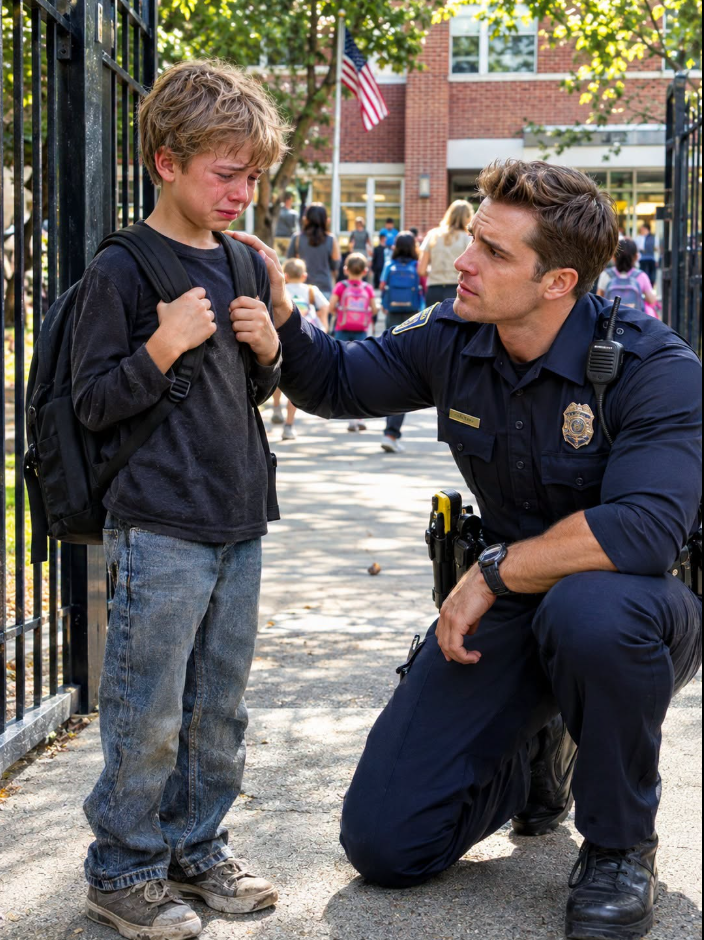
Hundreds of children poured out of Brookfield Elementary that afternoon, a river of shouting and laughing and slamming backpack zippers. One small boy stood still in the middle of it. He wasn’t crying. He wasn’t calling for help. He stood beside the fence clutching a faded blue backpack, and he watched me the way a person watches a door they’re not sure will open.
Then he walked straight up to me.
“Officer, can you come home with me?”
I looked down into a worried little face. I’m Officer Rebecca Hayes, and I’ve served the Cedar Falls, Iowa, community for twelve years. I like to think I know when a child is frightened. But there was something different about this one. He had untidy sandy-blond hair, enormous gray eyes, and sneakers held together by fraying laces.
“Is something wrong, sweetheart?”
He nodded, and what he said next put a knot in my stomach.
“I’ve told everyone. Nobody believes me. And I’m scared Grandma won’t be there much longer.”
“Nobody Believes Me”
His name was Oliver Bennett. I asked what was happening to his grandmother, and his eyes flicked toward the school entrance.
“I can’t explain it here. You have to see.”
“Have you told your parents?”
“Dad says Grandma is getting old. Aunt Patricia says she likes being alone. My teacher says I shouldn’t make up scary stories.” He swallowed hard. “But I’m not making anything up.”
I called the school office, informed my supervisor, and followed procedure before agreeing to go with him. Then we walked together through a quiet neighborhood of maple trees and small white houses. Oliver barely spoke. Every few minutes, he glanced sideways to check I was still there.
“Why did you decide to trust me?” I finally asked.
“Because I saw you helping somebody. Last month, a little girl was crying at the playground. You sat with her until her mom came.” He hesitated. “You didn’t get mad because she was scared.”
I’ve carried that answer with me ever since.
The Yellow House on Willow Street
At the end of Willow Street, Oliver stopped in front of a weathered yellow house. The lawn had gone wild. Newspapers lay untouched on the porch, and a faded flower wreath hung crooked on the door.
He pulled a key from his backpack. Before turning it, he looked up at me.
“Please don’t leave when you see it.”
“I’ll stay,” I told him, “and make sure we get help if someone needs it.”
The door swung open, and the first thing that reached me was the smell of stale food. The second was the silence. The living room was buried in unopened mail, dusty furniture and stacks of old magazines, and a television murmured to an empty corner.
Oliver pointed down the hallway. “Grandma’s in there.”
Margaret
In a small bedroom, beside the window, an elderly woman sat in a worn armchair wrapped in a thin blue blanket. Her silver hair was tangled. A tray of untouched food sat on the table next to her, along with a scatter of medication bottles and an empty water glass.
She turned toward us, confused. “Oliver?” she whispered.
The boy rushed to her side. “Grandma, I brought someone.”
“Oh, honey,” she said, trying to smile. “You shouldn’t have worried.”
But Oliver was already crying. “See?” he said to me. “I told them she wasn’t okay.”
I knelt beside her. “Ma’am, my name is Rebecca. Can you tell me your name?”
“Margaret Bennett.”
“Mrs. Bennett, when was the last time someone helped you get out of this chair?”
She turned her face to the window. “I don’t remember.”
My stomach dropped. Oliver tugged my sleeve and spoke in a rush, like a child unloading a heavy bag.
“Sometimes she forgets to eat. Sometimes she calls me by Grandpa’s name. And yesterday she didn’t remember where the bathroom was. I tried making her sandwiches, but I don’t know how to cook much.”
Then he unzipped his backpack. Inside were two granola bars, a small carton of juice and a carefully folded napkin.
“I saved these from school,” he said. “For Grandma.”
I had to steady my voice before I answered. “Oliver, you’ve done your best. But taking care of Grandma is a grown-up job. You should never have had to do this alone.”
His face crumpled. “Does that mean she’s going to die?”
“I don’t know, sweetheart. But we’re going to get her checked by people who can help.”
The Ambulance and the Hospital
I called for medical assistance at once. While we waited, I spoke gently with Margaret. She was foggy about the day and couldn’t recall her last meal. Oliver never let go of her hand.
When the paramedics arrived, she resisted. “I don’t need a hospital. My family will be home soon.”
Oliver leaned close. “Grandma, please. I don’t want you to be scared anymore.”
Something in his voice got through. She let them help her.
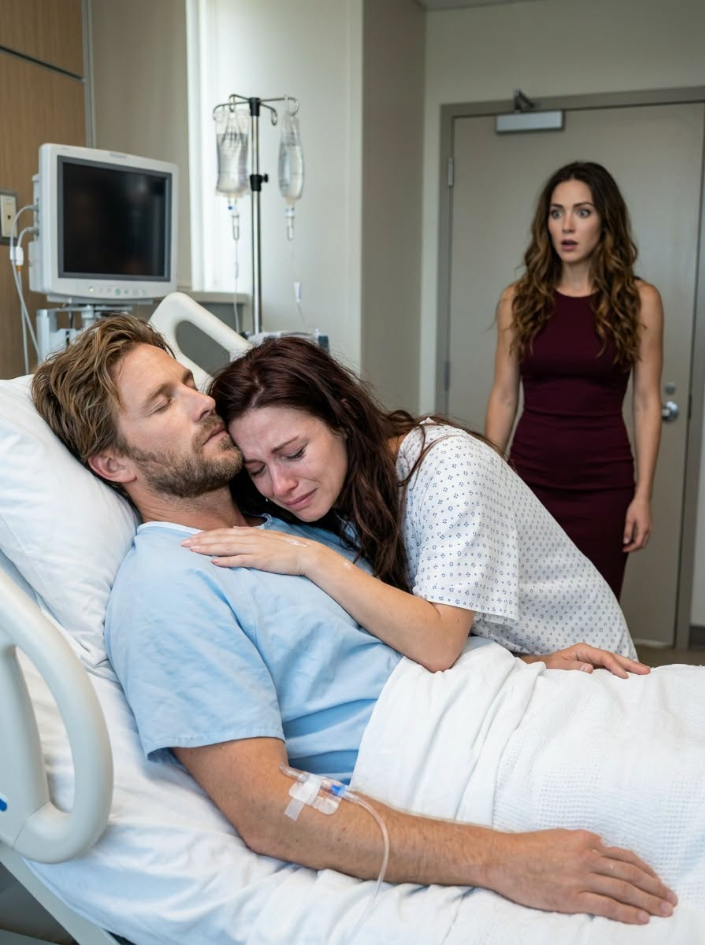
At the hospital, doctors found that Margaret was dehydrated, severely undernourished, and struggling with significant memory problems that needed further evaluation. She would need steady supervision and support.
Afterward, Oliver sat beside me in the waiting room, his feet swinging above the floor.
“Officer Rebecca? Am I in trouble?”
“Why would you be?”
“Because Dad told me not to tell strangers about our house.”
I turned to face him. “Asking for help when someone isn’t safe is never something to be ashamed of.”
“Even if Dad gets mad?”
“Even then.”
Three Words From a Seven-Year-Old
Oliver’s father, Grant Bennett, arrived not long after. He was a forty-year-old warehouse supervisor who worked long shifts and looked worn out before he’d said a word.
“What happened to my mother?” he demanded.
I told him what we’d found. At first, he bristled. “She refuses help. She’s always been stubborn.”
Then I told him about the food Oliver had been saving from school lunches.
Grant went silent.
“Your son has been trying to feed her,” I said. “He was frightened enough to ask several adults for help.”
He lowered himself slowly into a chair. “I thought he was exaggerating.”
A few feet away, Oliver was listening. Grant looked at him. “Why didn’t you tell me it was this bad?”
The boy’s answer was barely a breath.
“I did, Daddy.”
Three words. No anger, no accusation. Just the truth.
Grant covered his face with his hands, and for a long moment nobody spoke. Then he crossed the floor and knelt in front of his son. “You’re right. You told me. And I didn’t listen.”
Oliver’s lip trembled. “I thought Grandma was going to disappear like Grandpa.”
What the Adults Had Missed
That was when Grant began to understand. Margaret’s husband had died the previous winter, and her memory and ability to care for herself had slipped ever since. Grant had mistaken the warning signs for grief and ordinary aging. He visited when he could, dropped off groceries, and assumed his mother was coping. His sister Patricia believed the same.
Neither of them had seen how far Margaret had really fallen. But Oliver, who spent his afternoons at her house while his father worked, had seen all of it. The skipped meals. The confusion. The mail piling up. The days she could barely leave her chair. He had been trying to explain for weeks.
Everyone had heard a child worrying. Nobody had heard a child reporting.
Getting the Help She Needed
Hospital social workers stepped in, and a plan took shape to protect both Margaret and Oliver while the family arranged proper care. Grant and Patricia were asked hard questions about the supervision Margaret had received. They cooperated, and they started making changes.
Margaret stayed in the hospital for several days, then moved into a rehabilitation program. Her doctors were cautious, but she slowly regained her strength. Oliver visited with his father, sometimes with drawings, sometimes with stories from school, and sometimes with nothing at all but his hand to hold.
A Letter on My Desk
Three weeks later, a handwritten letter arrived at the station. The letters were large and uneven.
“Dear Officer Rebecca,
Grandma has people helping her now. She eats breakfast and lunch and dinner. Dad says I don’t have to worry about her all day anymore.
I got to play soccer after school yesterday.
I forgot how much I liked soccer.
Thank you for believing me.
Love, Oliver.”
I kept it in my desk drawer. I hadn’t done anything extraordinary. I kept it because it reminded me how easily a child’s voice can vanish beneath adult assumptions.
“My Dad Listens to Me Now”
A month later, I visited Oliver’s school for a community safety presentation. He was sitting near the back, laughing with another boy. His backpack was covered in bright stickers, and his sneakers looked new. When he saw me, his hand shot up. “Officer Rebecca!”
His teacher invited him to speak. Oliver stood tall. “My grandma is getting better. And my dad listens to me now.”
The whole class burst into applause. In the hallway afterward, he tugged my sleeve. “Can I tell you something?”
“Of course.”
He grinned. “I don’t have to save my lunch anymore.”
Then he sprinted out to join his friends. I watched him vanish into the playground, where kids were chasing each other under the afternoon sun, and for the first time since I’d met him, Oliver looked like exactly what he was. A seven-year-old boy. Not a caretaker. Not a frightened child carrying a load far too heavy for him.
Sometimes children don’t need us to have every answer. They need us to take their questions seriously, and to understand that fear can be a warning rather than an exaggeration. They need to know that when they finally find the courage to say something is wrong, someone will listen.
Six Months Later: A Phone Call
Six months after Oliver stopped me outside Brookfield Elementary, my phone rang. It was Grant, sounding oddly nervous.
“Officer Hayes, Oliver has been asking about you.”
“Is everything okay? How’s Margaret?”
“She’s doing much better. That’s actually why I’m calling. Oliver wants to invite you somewhere.”
“Where?”
He hesitated. “To Grandma’s birthday party. She’s turning seventy-eight. But there’s something else. Oliver has been working on a surprise for weeks. He says you’re the only person outside our family who needs to be there.”
I said yes. I had no idea it would become one of the most unforgettable afternoons of my career.
A Birthday Party at the Community Center
The following Saturday, I drove to a modest community center on the edge of Cedar Falls. Balloons crowded the entrance, and a handmade banner stretched over the door: HAPPY 78TH BIRTHDAY, GRANDMA MARGARET! Inside, about thirty people had gathered around tables covered in flowers, homemade desserts and family photographs.
Grant met me near the refreshments. He looked like a different man from the one in the hospital, with relaxed shoulders and a warmer face.
“Thank you for coming.”
“How’s everything going?”
He glanced across the room. “Better than I ever thought possible.”
Margaret sat in a comfortable chair beside the cake, her silver hair neatly styled, a lavender cardigan over a floral dress. She looked healthier. But what struck me most was that she was laughing, a real and joyful laugh, nothing like the uncertain smile I’d seen in that dim bedroom months before.
Oliver was beside her, showing her a drawing of a bright yellow house ringed with flowers. When he saw me, his whole face lit up.
“OFFICER REBECCA! You came!”
“Of course I did. I wouldn’t miss your grandmother’s birthday.”
He grabbed my hand. “Come see Grandma! She remembers you!”
Margaret looked up, recognition warm in her eyes. “Rebecca. My grandson’s favorite police officer.”
“How are you feeling, Mrs. Bennett?”
“Much better, thank you.” She took my hand. “I don’t remember everything from those difficult weeks. But I remember Oliver telling me he was going to find someone who could help.” She smiled at her grandson. “And he did.”
Oliver leaned in and whispered, “Don’t leave after cake. I have something important.”
The Blue Folder
After everyone had eaten, Grant stood and tapped a spoon against his glass. “Before we open presents, Oliver has something he’d like to share.”
Oliver walked to the front carrying a large blue folder, his cheeks pink under all those eyes. Grant rested a steady hand on his shoulder. “Take your time, son.”
Inside the folder were drawings. The first showed a small yellow house. The second showed an elderly woman sitting by a window. The third showed a little boy holding the hand of a police officer.
He held them up for the room. “This is Grandma’s old house. And this is when she was sick.”
The room went quiet. He lifted the third drawing. “This is Officer Rebecca.” He looked right at me. “She listened when I told her something was wrong.”
My throat tightened.
“When Grandma got sick, I thought I had to fix everything. I tried giving her food and helping her find things.” He paused. “But I couldn’t make her better.”
Grant lowered his eyes.
“Then Officer Rebecca told me something.” Oliver read carefully from a sheet of paper. “She said taking care of Grandma wasn’t supposed to be my job.” He turned to his father. “Daddy says that’s true.”
“It is, son,” Grant said.
The Listening Promise
Oliver drew a breath. “So I made something.”
He pulled out one more page. Across the top, in enormous colorful letters, it read: THE LISTENING PROMISE. Beneath were three sentences.
When a kid says something is wrong, I will listen.
When someone needs help, I will try to find a safe grown-up.
When I make a mistake, I will say sorry and try to do better.
He scanned the room. “I want all the grown-ups to sign it.”
For several seconds, no one moved. Then Grant stepped forward. “I’ll sign first.”
He took the marker, but before writing a word, he knelt beside his son. “Oliver, I’m sorry I didn’t listen when you told me Grandma needed help. You should never have had to carry that worry by yourself.”
“I know, Daddy.”
Grant pulled him into a hug. “And I promise I’ll do better.”
One by one, the adults came up to the table. Patricia signed. Oliver’s teacher signed. The neighbors signed. Even Margaret carefully wrote her name beneath the promise. At last, Oliver brought the paper to me.
“Will you sign too?”
“Absolutely.”
As I wrote my name, he whispered something I will never forget. “I don’t want other kids to feel like nobody believes them.”
From One Boy’s Idea to a School Project
Two weeks later, Grant called again. Oliver’s teacher had been so moved by the party that she wanted to start a classroom activity about asking for help and listening respectfully, and the principal had approved a small community project. They named it The Listening Promise Project.
It wasn’t complicated. Children learned how to notice when someone might need help, how to find trusted adults, and how to explain their worries without shame. Teachers practiced taking children’s concerns seriously. Parents received information on recognizing changes in elderly relatives who might need more care.
Oliver became its unofficial inspiration, but he wasn’t asked to give speeches or retell his painful story. Grant made sure of that. “He’s seven,” he told the principal. “He deserves to enjoy being seven.”
Instead, Oliver helped design a poster of two hands holding a heart, with a line in his own handwriting underneath: SMALL VOICES MATTER TOO. It hung near the school’s main entrance, the same spot where a frightened boy had once stood alone. Within a month, neighboring schools were asking about the project. He had never wanted attention. He had only wanted someone to listen.
A Boy Free to Imagine
By early spring, Margaret had settled into a comfortable assisted-living community fifteen minutes from Grant’s home. Her memory still varied from day to day, and she continued to receive medical care. Some mornings were easier than others. But she was safe, with regular meals, attentive caregivers and a family who understood what she needed. Best of all, Oliver no longer felt responsible for protecting her.
Every Sunday, Grant took him to visit. They brought flowers, played simple card games, and sometimes watched old family videos. One afternoon, Margaret asked, “Sweetheart, what do you want to be when you grow up?”
Oliver thought hard. “A police officer.”
Grant chuckled. “Really?”
“Maybe.” Then he reconsidered. “Or a teacher.”
“Why a teacher?” Margaret asked.
“Because teachers can help kids when they’re worried.”
She squeezed his hand. “That sounds wonderful.”
“Or maybe I’ll be a soccer player,” Oliver added, and everyone laughed. That was the beautiful part. He was finally free to imagine a future that belonged to him.
One More Letter
Nearly a year after we first met, I spotted Oliver at the school’s spring festival, racing across the playground with his hair blowing in the wind. When he saw me, he waved and ran over holding a small gold-colored medal.
“Look! Our soccer team won!”
“Congratulations!”
He pressed the medal to his chest. “Do you still have my letter?”
“The one you wrote after Grandma went to the hospital? It’s in my desk.”
He grinned. “Good. Because I wrote another one.”
He handed me a folded page. Inside, in that familiar uneven handwriting, it said:
“Dear Officer Rebecca,
Grandma is safe.
Daddy is happy again.
I have lots of friends.
I don’t feel scared when I go to school anymore.
Thank you for helping my family.
I hope you help lots of other kids too.
Your friend,
Oliver.”
I read it twice. When I looked up, he was already halfway back to the soccer field. He wasn’t waiting for reassurance. He wasn’t checking whether I’d follow. He was just playing.
The Lesson I Keep in My Desk Drawer
That evening, I placed his second letter beside the first. Two pieces of paper, two reminders of a lesson I hope never to forget. A child should never have to prove that their fear deserves attention. Sometimes the most important thing an adult can do is stop, listen, and take the next responsible step.
Oliver’s story didn’t end when his grandmother reached the hospital. It ended with an elderly woman receiving proper care, a father learning to listen, and a little boy running across a playground without the weight of the world on his shoulders. To me, that was the happiest ending of all.
Oliver didn’t save his grandmother by knowing what to do. He helped save her by refusing to stop asking for help. And every adult who hears a child say, “Nobody believes me,” should remember that sometimes the smallest voice in the room is the one telling us what we most need to hear.