I lifted it, and the call on line three gave me nothing but a faint, uneven sound.
I set my coffee beside the folded dispatch checklist and tried again.
“Silverwood 911. Can you hear me?”
No answer came back. I could hear breathing, though, so I kept the line open.
“My name is Helen. I am here with you. Can you tell me your name?”
A small sound came through, almost too quiet to make out.
“Mia.”
“Hello, Mia. Are you hurt?”
“Yes.”
I moved the coffee farther from the console and opened a fresh entry on the screen. It was 8:07 on a Tuesday morning in late September. My coworker was sorting a stack of overnight reports, and the printer behind her had begun its usual complaint about an empty paper tray.
“Mia, can you tell me where you are?”
“My room.”
“All right. Are you alone in your room?”
“Yes.”
“Can you tell me what hurts?”
There was a pause. I pressed my thumbnail against the seam of my headset, then took my hand away and reached for the keyboard.
“My hip. I can’t move right.”
“Do not try to stand up. Stay where you are, and keep talking to me.”
“I tried already.”
“What happened when you tried?”
“It hurt more.”
I entered her words as she spoke them. I had learned years before that a child’s own words could get lost once adults began explaining what they thought had happened. I did not want to give Mia words she had not used herself.
“Mia, do you know your street address?”
“I don’t know the numbers.”
“That’s all right. We can work it out together.”
She began to cry, but she did not hang up. I asked her to tell me what she could see from where she lay, and she mentioned a white wall with paint peeling near the floor.
“Is there a window in your room?”
“Yes. The curtains have little yellow flowers.”
“Can you see anything outside?”
“The mailbox is broken.”
I stopped typing for a second.
“What do you mean, Mia? Is it lying down?”
“No. The door part hangs open. It does that all the time.”
That was enough to give me a place to start looking, but I still needed to make certain I had the right house.
“Mia, you do not have to explain everything. Just tell me what you can see.”
“The blue flowerpot is outside.”
I asked her to describe the house again, slowly, while I traced the call location and checked the street information on my screen. Silverwood was small enough that a broken mailbox could be useful, but not small enough for me to send help on a guess.
At 8:10, I found the address that matched the call location and her description. The white house stood on a residential road a short distance from the main street, with a damaged mailbox noted in an earlier service entry.
I read the address back to her.
“Is that your house, Mia?”
“Yes.”
“Good. I am sending help there now.”
“Will they come inside?”
“Yes, they will come to help you.”
“What if Derek comes first?”
I kept my fingers over the keys.
“Who is Derek, Mia?”
She did not answer. I heard a faint rustle, then her voice again.
“I don’t want him in my room.”
“Has he come into your room today?”
“No.”
“Is he there now?”
“No.”
I recorded those answers without adding anything to them. I did not know who Derek was, what had happened before the call, or why his name had frightened her. I knew only that Mia was in pain, she could not move comfortably, and she was afraid someone might come to her.
At 8:13, I keyed the radio and called the ambulance crew.
“Erin, I have a six year old child at the confirmed address. She reports hip pain and says she cannot move without increased pain. No cause established. She is awake and talking, and she has asked that a person named Derek not come into her room.”
Erin Clarke answered at once.
“Understood. Is she alone?”
“She says she is alone in the room. I cannot confirm who else is in the house.”
“Any trouble breathing?”
“She is breathing and speaking. I have no other medical observations.”
“All right. We are moving.”
I wrote down the time of Erin’s acknowledgment. My folded checklist had a crease through the corner where I usually noted dispatch changes, so I flattened it against the console and added the call number.
“Keep her on the line if you can,” Erin said.
“I will.”
I returned to Mia.
“Mia, help is on the way. I am going to stay with you until the paramedics reach you.”
“Do I have to get up?”
“No. Please stay where you are.”
“My school shoes are under the chair.”
“That’s fine. You can leave them there.”
“They have mud on them.”
I heard the smallest change in her voice, as if muddy shoes were a problem she could manage when the pain was not. I told her the shoes could wait. She asked whether the paramedics would wear gloves, and I told her they might, depending on what they needed to do.
“Will they tell me first?”
“Yes. You can ask them to explain what they are doing.”
I kept the line open and checked the clock. Each minute was recorded, not because I expected a report to settle every question, but because the order of events mattered. Whatever had happened before 8:07, nobody could later say that an adult had supplied Mia’s first account. Her first words were hers.
At 8:19, I heard another voice in the background at the house, too distant for me to identify. Mia stopped speaking.
“Mia?”
She did not answer.
I waited a few seconds, then asked again.
“Mia, can you hear me?”
“Yes.”
“Is someone there with you?”
“No. It’s outside.”
“What can you hear?”
“Car doors.”
I looked at the dispatch status. The ambulance was close, but I did not tell Mia that until the crew confirmed their arrival. I wanted to give her facts, not promises that depended on a moving vehicle.
At 8:21, Erin came over the radio.
“We are at the address. Front door is locked.”
“Copy. The child is still on the phone. She is in the bedroom and says she cannot move comfortably.”
Erin’s reply was steady. “We’ll make contact at the door.”
Through the open line, I heard a knock, followed by a man’s voice calling into the house. Then another knock, firmer this time.
“Mia,” Erin called, “my name is Erin. I am a paramedic. Can you hear me?”
Mia answered her through the phone, though her voice was so small I could barely hear it.
Erin called again, giving her name and explaining that she and her partner were there to help. Noah Blake was with her. I heard him ask whether they had another way in, then heard Erin tell him to wait a moment.
I stayed connected to Mia while they tried the handle. It did not open.
“Can you tell me where the key is?” Erin asked through the doorway. “We won’t come in until we know how to get inside safely.”
Mia answered after a pause.
“Outside. In the blue flowerpot.”
“Thank you, Mia. Is it the big pot or the little one?”
“The big one. By the door.”
Erin repeated the location to Noah. I heard the scrape of the pot being moved, then a brief clink of metal. A second later, Erin said the key had been found.
The lock turned.
I entered 8:21 as the arrival time and noted that the crew had gained entry using the spare key, with no forced entry reported. The detail seemed ordinary, but I included it anyway. A door opened one way, not another, and the record needed to say which.
“Mia, we’re coming to your room now,” Erin called. “You do not have to move.”
Footsteps crossed the house. Noah asked Erin to bring the medical bag, and she told him she had it. Their voices grew clearer as they reached the bedroom doorway.
“I can see you, Mia,” Erin said. “I’m going to stay right here for a moment. My partner is Noah. We are both here to help you.”
I heard the soft movement of a bag being set down.
“Can I come closer?” Erin asked.
Mia said nothing at first.
“You can tell me no if you need another minute.”
“Okay,” Mia whispered.
Erin moved closer. Noah remained back near the doorway, and I heard him say he would keep the path clear. Erin asked Mia where it hurt, then waited for her answer instead of filling the pause.
“My hip.”
“All right. I won’t try to move you yet.”
The sound of paper rustled as Noah made a note on the back of his folded ambulance checklist. He asked Erin whether she needed anything, and she told him to stay where he was while she spoke to Mia.
I could no longer hear every word clearly, but the radio remained open. Erin told Mia what she was doing before she reached toward her, then stopped when Mia stiffened.
“No moving yet,” Erin said. “We have time to do this carefully.”
Mia’s answer came in a rush.
“Don’t make me get up.”
“We won’t ask you to stand right now.”
A few seconds passed. Then Erin spoke more softly.
“I’m going to sit beside you. You can see both my hands.”
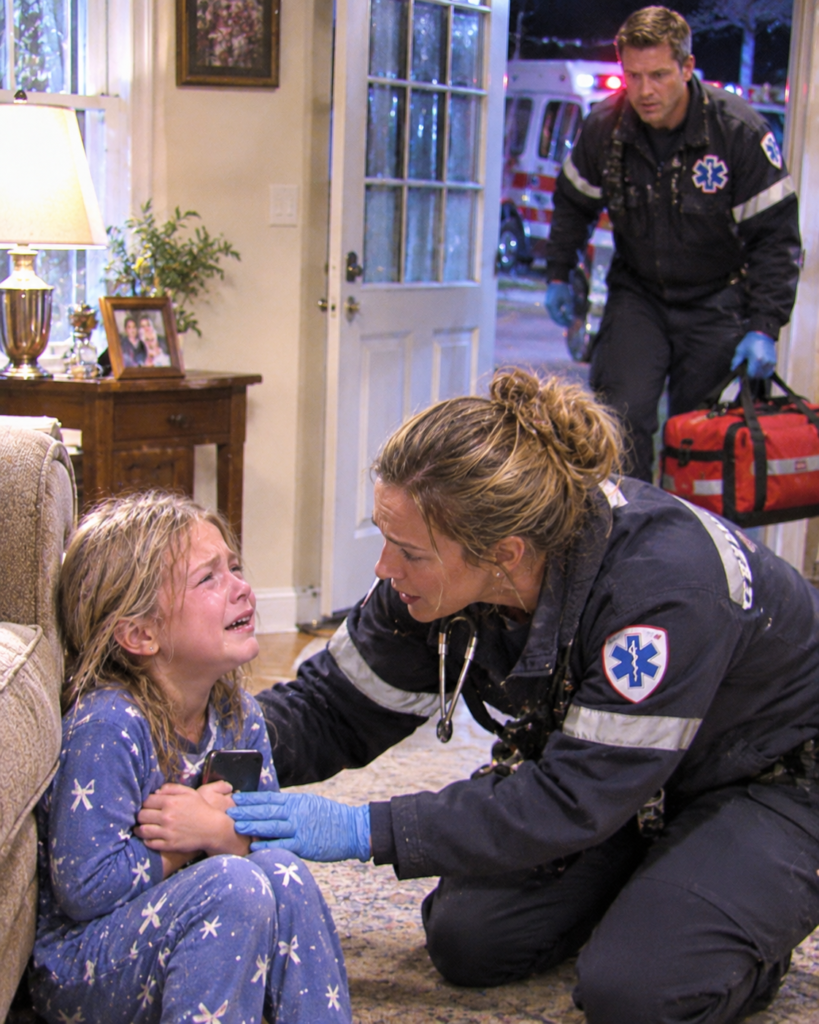
The bed creaked as she lowered herself near the floor. Mia was lying beside the bed with her knees bent, and when Erin settled within reach, the child caught the cuff of her sleeve and twisted it between her fingers.
Erin kept her hands where Mia could see them. “I am going to look at your leg now. I will tell you before I touch you.”
Mia held the cuff tighter. Erin waited until the child looked at her, then moved one hand a few inches.
Noah crouched near the bed with the torn lower corner of his ambulance checklist resting against his knee. He looked from Mia to the floor and then to the doorway.
“I do not see an obvious wound,” he said.
Erin nodded. “That does not tell us why she hurts.”
The smell of cleaner was strong enough to sting my nose when I stepped closer to the bedroom doorway. Noah glanced toward the hall.
“Could be from the floor,” he said. “Could be from the bathroom. I am not calling it a cause.”
That distinction mattered. I had learned long ago that a strong smell could make a simple explanation arrive too early.
Erin adjusted the blanket without lifting Mia. “Can you tell me where it hurts most?”
Mia pointed toward her hip.
“Thank you. We can work with that.”
Noah wrote two short lines on the back of the checklist. He did not write down a diagnosis because he did not have one.
Erin looked at Mia again. “We need to get you onto the stretcher. I will tell you each step.”
Mia looked toward the bedroom door.
“My mom’s at work.”
“We will tell her where you are,” Erin said. “You do not have to decide anything else right now.”
The transfer took longer than it would have with an adult who could simply stand and walk. Erin moved slowly, stopping whenever Mia needed her to stop.
At 8:34, the ambulance doors shut, and Erin secured the blanket around Mia’s shoulders. The blue light outside flashed across the metal cabinet as Erin checked the straps.
“Is there another adult we should call?” Erin asked.
Mia stared at the ceiling.
“Derek?”
Mia’s fingers worked the blanket edge.
“No.”
Erin did not fill the pause. “You do not want us to call Derek?”
Mia shook her head.
“All right. I will pass that along.”
Mia looked at Erin. “He comes in my room.”
Erin’s face stayed calm. “Thank you for telling me.”
Noah had already sent the first report ahead. Erin added the request about Derek without adding an explanation Mia had not given.
At Silverwood Community Hospital, Dr. Victor Hale was waiting in the pediatric examination room at 9:02. He pulled a stool beside the bed instead of standing over Mia.
“I am going to ask a few questions,” he said. “If you do not know an answer, you can say you do not know.”
Mia nodded.
He examined her carefully, stopping to explain each movement before he made it. Erin stayed near the foot of the bed.
“Can you tell me what makes the pain worse?” Dr. Hale asked.
Mia pointed toward the bed rail.
“Moving that way.”
Dr. Hale looked at Erin. “Her pain is more severe than the first examination would suggest.”
Erin folded her hands on her knees. “No obvious external injury.”
“I see that.”
He wrote on the tablet, then looked back at Mia.
“I want pictures of the areas that hurt. That will help us understand what we cannot see from the outside.”
Mia asked, “Will my mom come?”
“Yes,” he said. “We are contacting her.”
Erin touched the blanket near Mia’s shoulder, not the child herself. “You did a good job telling us where it hurts.”
The imaging order went through at 9:08. No one used the cleaner smell as an answer.
By 9:26, Mia’s mother was sitting across from Dr. Hale in the consultation room with her older work bag at her feet. Her phone lay beside the bag, and a small location sharing notification remained open on the screen.
She picked it up. “I do not know why this keeps showing.”
Dr. Hale glanced at it. “We can come back to that. I need to understand last night first.”
“I left for work this morning,” she said. “Mia was asleep.”
“And Derek?”
“He was supposed to be out of town.”
“Supposed to be?”
She looked down at the phone. “That is what he told me.”
Dr. Hale waited.
“He has helped with Mia when I work. I thought he was gone.”
On the table, the first imaging images appeared. Dr. Hale studied them without moving the tablet toward her yet.
“Did Mia have a fall recently?”
“She has fallen before.”
“When?”
The mother opened her mouth and stopped.
“I thought it was the bathtub,” she said.
Dr. Hale made a note. “Was that the only time?”
“No.”
He looked at her. “Then we need the other times too.”
She rubbed her thumb along the edge of her work bag. “I do not know if they are related.”
“We are not going to guess,” Dr. Hale said. “And we are not going to move faster than the evidence allows.”
Her phone lit again with the same location sharing notice. She turned it face down.
“Can I see the images?”
Dr. Hale studied the screen for another few seconds.
“Not yet. I want to review them with the radiologist first.”
He stood and carried the tablet toward the door.
The mother remained at the table, one hand resting on the phone she had just turned over.
“Doctor?”
He stopped.
“Does this mean she cannot go home?”
Dr. Hale looked back at her.
“It means I need more answers before we make that decision.”
He stepped into the corridor, carrying the images with him.
I had spent the morning listening for the smallest useful detail. Now my folded dispatch checklist sat with the hospital liaison, and the exact words Mia had used were no longer only mine.
Inside the examination room, the mother picked up her phone again. The notification was still there, waiting for an explanation she did not yet have.
The hospital liaison slid a manila envelope across the waiting room table, and the loose corner of my folded dispatch checklist caught against it.
I pulled the checklist free and kept one hand on the envelope. Erin stood near the doorway with her arms folded, watching the pediatric hall.
“She still does not want Derek called,” Erin said.
“Did she say why?”
Erin shook her head. “She only said, ‘Please do not call him.’ I did not ask her to explain.”
That was enough for me. I had heard the exact words before they reached the hospital, and I wanted them preserved without adding my own meaning.
I opened the envelope and checked the first page. The call time was there, 8:07 a.m., along with the address I had pieced together from Mia’s answers.
The liaison reached for the page. “Is this your original record?”
“My working copy is here. The original is in dispatch.”
“Then I need this copy marked as a contemporaneous record.”
I wrote my initials in the space she pointed to. The pen left a small dark line across the paper.
Erin came closer. “Her mother told us Mia has had pain before.”
“How many times?”
“She mentioned the bathtub first.”
I looked up. “The bathtub?”
“That was the explanation she heard.”
The liaison turned another page. “Was there another complaint?”
Erin glanced toward the pediatric corridor. “Her mother mentioned one involving the stairs. She did not give me the date.”
I wrote nothing down yet. “Did Mia give either explanation?”
“No. Her mother gave them.”
The distinction stayed with me.
I had learned over the years that the first explanation offered in a frightened household could become the explanation everyone carried forward. The trouble was that the first explanation was not always the first account.
Erin touched the edge of the envelope. “I told her we would let Mia answer what she could, if she wanted to.”
“Good.”
“She keeps asking whether her mother is still here.”
“She is.”
Erin nodded. “Then I will tell Mia that.”
The vending machine at the end of the room gave a heavy click and dropped a cup into its tray. Erin smiled at it.
“That machine charges $2.25 for coffee,” she said. “It should at least apologize.”
I laughed once, quietly. “Does it?”
“No.”
For ten seconds, the hospital was simply a place where a bad cup of coffee cost too much.
Then the liaison lifted the dispatch record again.
“Can you stay with me for the next few minutes?”
I looked at the clock.
“Yes.”
We moved into the consultation room with Mia’s mother, and Dr. Hale was already there. He had a visitor slip on the table and a pen beside it.
Her mother sat with both hands around the edge of her work bag. The faded name patch on her uniform was turned toward me.
Dr. Hale sat across from her.
“I want to ask about earlier complaints,” he said. “You can stop if you need a break.”
She nodded.
“When did Mia first complain about pain like this?”
She looked at the visitor slip. “I thought it was after the bathtub.”
“What date?”
“I do not remember the exact date.”
Dr. Hale waited.
She picked up the pen. “Thursday, I think.”
“Which Thursday?”
She pressed the pen against the paper without writing.
“The Thursday before I changed shifts,” she said. “September fifth.”
She wrote 9/5.
Dr. Hale asked, “Was there another complaint?”
“The stairs.”
“When?”
She looked toward the door.
“September twelfth.”
She wrote it underneath the first date.
“And the third?”
Her hand stopped.
“September twenty third.”
She wrote that too.
The three dates sat on the back of a visitor slip, close enough that I could read them from where I stood.
Dr. Hale pointed to the first one.
“What did you understand had happened that day?”
“I thought she slipped getting out.”
“Who told you that?”
“Derek.”
The pen moved between her fingers.
Dr. Hale did not fill the room with another question.
She looked at the dates again. “He told me before I even got home.”
I looked at the dispatch record in my hand.
The dates were no longer three separate pieces of paper in three separate memories.
The mother rubbed the corner of the visitor slip with her thumb.
“I thought each time was its own little accident, until I put the dates next to one another.”
Dr. Hale kept his voice level.
“Did Mia ever tell you something different before Derek gave you his explanation?”
Her mouth opened, then closed.
“I do not know.”
“That is an answer.”
She looked at him.
“I cannot remember asking her first.”
No one spoke for a few seconds.
The visitor slip shifted under her palm.
I thought of Mia answering me with the names of objects in her room because objects were easier than explanations.
Dr. Hale reached for the imaging summary.
“I am not asking you to decide what happened this minute. I am asking you not to erase what you remember.”
Her eyes stayed on the three dates.
“What happens to my job if I tell you all of it?”
Dr. Hale did not answer for her.
“We will deal with that question too.”
“And my house?”
“We will have to ask what arrangement keeps Mia safe.”
She looked down at the slip again.
“I cannot lose the house.”
“I understand.”
She folded the visitor slip once.
Then she unfolded it and placed it flat.
I stepped forward with the dispatch record.
“The call came at 8:07,” I said. “Mia gave the address before anyone else spoke to me.”
Her mother looked at the paper.
“She did?”
“Yes.”
“And she said not to call Derek.”
“Yes.”
The mother closed her eyes for one second.
“When did you write that down?”
“During the call.”
She reached for the slip.
“Can I see the dates beside your record?”
I placed the dispatch copy next to it.
September fifth.
September twelfth.
September twenty third.
Eight oh seven.
The papers were ordinary. That was what made them hard to look at.
Her mother touched the first date.
“That was the bathtub.”
She touched the second.
“That was the stairs.”
Then the third.
“I do not remember what I called this one.”
“You do not have to decide right now,” I said.
She looked at me.
“I need to tell you what I remember.”
“Yes.”
“Even if it makes me look bad?”
I kept my answer plain.
“Tell us what you remember.”
She picked up the visitor slip and held it between both hands.
“The first time, Derek said she slipped.”
She stopped.
“The second time, he said she was running.”
She stopped again.
“And the third time, he said she had been playing.”
Dr. Hale wrote each phrase beneath the corresponding date.
Her mother watched the pen move.
“I accepted all three.”
Nobody corrected her.
She put the slip beside my record.
“I will tell you the whole account.”
I heard my own chair scrape the floor as I sat down.
At 10:48, the pediatric corridor was quieter, but the questions were no smaller.
Her mother stood beside me while I read the call time from the dispatch record. She held the visitor slip in one hand and the three dates were still visible.
“Eight oh seven,” I said.
She nodded.
“September fifth.”
She nodded again.
“September twelfth.”
Her finger moved to the next line.
“September twenty third.”
She swallowed and looked toward Mia’s room.
“I want to correct something.”
“What?”
“I kept telling people what Derek told me.”
I waited.
“I should have started with what Mia told me.”
The sentence stayed between us.
She folded the slip carefully and put it into the county folder the liaison had given her.
A blank plastic sleeve made a soft crackle as she opened it.
“What happens if I give you the whole account?” she asked.
“We document it.”
“And then?”
“Then the people responsible for safety decide what needs to happen.”
She looked at the folder.
“Will Derek be told?”
“Investigators may need to speak with him.”
Her hand stopped on the plastic sleeve.
“That could mean I lose the house.”
“It could mean the arrangements change.”
“And my shifts?”
“I do not know.”
She nodded once.
“Then write that I do not know either.”
I looked at her.
She pushed the visitor slip farther into the sleeve.
“I do not want anyone filling in the blanks for me anymore.”
I wrote that request in my notes.
A nurse came through the corridor carrying a small stack of clean blankets. She paused when she saw the papers spread across the chair.
“Do you need another folder?”
The mother looked at the one in her hand.
“Not yet.”
The nurse smiled and kept walking.
For a few seconds, the ordinary hospital sounds returned. A cart rolled past. A door clicked shut. Somewhere down the hall, a child laughed at something that had nothing to do with us.
Then the mother picked up the phone from her work bag.
“Derek has called twice.”
She did not answer it.
She placed it face down beside the folder.
At 11:06, Erin and Dr. Hale were in the nurses’ workroom, with the dispatch record, the three dated complaints, and the medical notes spread across the counter.
Erin rested both hands on her knees before speaking.
“Mia asked us not to call Derek.”
Dr. Hale nodded.
“Her mother has now identified three earlier complaints.”
Erin looked at the dates.
“Same person involved each time?”
“The mother says Derek supplied the explanations.”
Erin turned toward me.
“Did Mia say anything about those events?”
“Not during my call.”
I handed Dr. Hale my copy of the dispatch record.
“The exact wording is here.”
He read it without changing his expression.
Noah was not in the room, but his folded ambulance checklist lay beneath the medical notes, its torn lower corner visible.
Dr. Hale picked it up.
“These observations were made before transport?”
“Yes.”
He read the short entries and set the checklist beside the other papers.
“We have a child in pain, injuries requiring imaging, repeated earlier complaints, and a stated fear of one adult.”
Erin asked, “Do we have enough to notify child protection?”
Dr. Hale looked at the phone on the counter.
“Yes.”
Erin picked it up.
“And police?”
“Yes.”
She started dialing.
I watched the three dates disappear under the edge of the medical summary.
The mother’s account was no longer just a family explanation.
It was a record.
Erin spoke quietly into the phone.
“Silverwood Community Hospital. Pediatric unit. We need child protection and police notification.”
Dr. Hale reached for a release form.
“Her mother needs to authorize the records.”
I carried the form down the corridor.
Her mother was still holding the phone.
I set the paper beside her.
“These records can be shared with child protection and police if you authorize it.”
She looked at the signature line.
“Will that include your call?”
“Yes.”
She looked at me.
“Then include it.”
She picked up the pen and signed.
Derek answered before she finished the first question.
“About the bathtub, yes. She slipped getting out. I told you that Tuesday. She was tired, and the bath mat was wet.”
Mia’s mother held the phone against her ear and looked down at the visitor slip. “I was asking what you saw.”
“I saw her sitting on the floor. I helped her up. That’s what happened.”
“You didn’t mention helping her up before.”
“I thought you knew that.”
She rubbed the corner of the paper with her thumb. “Did Mia say she fell?”
“She was crying. She said her hip hurt. What else would she say?”
I wrote that sentence down in my notebook before I could stop myself.
Derek continued, “You need to keep this practical. The doctor is going to ask what happened, and you should give him the simple answer.”
The mother looked toward the closed door. “Why are you telling me what to say?”
“I’m trying to keep this from becoming more complicated than it is.”
He had answered before the question was finished, again. Then he asked whether Mia was being kept overnight, and the mother did not answer.
I watched her lower the phone from her ear.
“I need to go,” she said.
Derek’s voice came through the speaker. “Wait. Did you tell them about the other fall?”
She stopped with her thumb over the screen.
“What other fall?”
He did not answer right away.
“The one by the back steps,” he said. “You know, when she slipped outside.”
The mother looked at me, and the visitor slip bent between her fingers.
At 11:52, I bought two cups of coffee from the vending machine. Each cost $2.25, and mine had the bitter taste of something that had been waiting too long to be chosen.
Her cup sat untouched between us.
I put the visitor slip beside it. “What did Mia say before Derek gave you an explanation?”
She stared at the printed date.
“I don’t remember.”
“You don’t have to remember the whole conversation.”
“I remember him telling me about the bathtub.”
“Before that.”
She pressed both hands around the paper cup.
“I thought she had fallen.”
“Did Mia tell you that?”
The question stayed between us.
She shook her head once.
“I think I asked Derek.”
“Do you remember asking Mia?”
“No.”
She lifted the coffee and put it back down without drinking.
“I always thought I did.”
I waited.
Her eyes moved to the three dates written on the visitor slip.
“I asked him first every time,” she said.
The admission was quiet, but it changed what those three dates meant.
She picked up the cup again.
“He always had an answer ready.”
I said, “What did he say when you asked about the bathtub?”
“He said she slipped.”
“And when you asked what Mia said?”
The mother looked at the hospital door.
“I don’t know if I ever did.”
A cart rolled past us, and she moved her cup out of its path.
Then she asked, “How am I supposed to know which memory is mine?”
Before I could answer, Erin came to the pediatric doorway and lifted one hand.
I followed her to the room, where Mia was sitting with her knees bent. Erin stayed beside the doorway and lowered herself until her eyes were level with the child.
“Your mom can stay,” Erin said. “Or she can wait outside for a minute. You get to choose.”
Mia looked at her mother.
“Stay.”
Her mother pulled a chair closer.
Erin kept both hands on her own knees. “Okay. She stays.”
Mia reached for the sleeve of Erin’s uniform and twisted the cuff around two fingers.
Erin did not pull away.
“Do you want me to check your blanket?”
Mia nodded.
Erin adjusted the corner without touching Mia’s legs.
Then Mia’s mother said, “Derek asked about you.”
Mia’s fingers tightened around the cuff.
Her face turned toward the wall.
Erin looked at the mother, then back at Mia.
“Do you want to talk about something else?”
Mia nodded.
“Blue cup,” she whispered.
Her mother gave a small smile. “The one with the crooked handle?”
Mia nodded again.
For a few seconds, the room was about the blue cup and nothing else.
I stayed outside the doorway. Erin came out after Mia began talking about breakfast.
“She answered without us asking her to explain,” Erin said.
I looked through the glass at Mia, who was still working the sleeve between her fingers.
“What did you notice?”
“She changed when his name came up.”
Erin paused.
“That is enough for me to document. It is not enough for me to put words in her mouth.”
I nodded.
At 12:40, Dr. Hale came into the consultation room carrying the hospital tablet. He placed it on the table and sat across from Mia’s mother.
“The images show injuries from different times,” he said.
She looked at him.
“Different times?”
“Yes. They do not fit one recent fall.”
She folded the visitor slip in half.
“Could she have fallen more than once?”
“That is possible.”
“Then Derek could still be right.”
Dr. Hale waited.
“He could have seen her fall each time.”
“He could have,” he said. “But we have to compare that explanation with the dates you gave us.”
She opened her mouth, then closed it.
“I don’t want to accuse him because I am embarrassed that I believed him.”
“I am not asking you to accuse anyone.”
He turned the tablet toward himself.
“I am asking you to tell me what you remember, including the parts that do not make Derek look good and the parts that do not make you look good.”
Her fingers went to the faded edge of her work uniform.
“The first time was after the bathtub.”
“What happened when you got home?”
She looked at the visitor slip.
“Derek was already talking.”
“What did he say?”
“He said, ‘Don’t worry. I took care of it.’”
Dr. Hale waited.
“He said Mia had slipped. Then he told me she was embarrassed and did not want me making a fuss.”
The mother looked down at her hands.
“Did you ask Mia?”
“I thought I did.”
“Did you?”
She shook her head.
“No.”
The word came out smaller than the others.
I looked at the three dates. One was written darker because the pen had nearly run dry.
The mother touched the first date.
“I remember something else.”
Dr. Hale said, “Take your time.”
“She was holding the bathroom towel. Derek took it from her and put it in the laundry.”
She stopped.
“I remember that because he told me not to leave wet towels on the floor.”
Dr. Hale made a note.
“Did Mia say anything?”
The mother stared at the table.
“She said she wanted me.”
No one spoke for a few seconds.
Then she added, “I thought she meant she wanted me because she was tired.”
Dr. Hale closed the tablet cover.
“Please do not change that memory to make it easier.”
She nodded.
I reached for the visitor slip, but she placed her hand over it.
“I need to keep these dates.”
“You should.”
She picked up the paper.
“Thursday, the twelfth. Then the Monday after that. Then the bathtub.”
“Those are the dates you gave us.”
She looked toward the door.
“I remember another sentence.”
“What sentence?”
“Derek said, ‘You don’t need to ask her. She doesn’t know what happened.’”
The mother stopped there.
Dr. Hale did not fill the silence.
She folded the visitor slip once more, and this time she put it beside his written imaging summary.
“I don’t know what else I got wrong,” she said.
I looked at the two papers lying side by side.
“Then we keep what you remember.”
She nodded, but her hand stayed on the visitor slip.
Outside the room, a staff member called for Erin.
Erin appeared at the doorway, holding a small stack of discharge papers.
“Can I sit with you for a minute?” she asked.
The mother looked at the papers.
“Yes.”
Erin set them down without opening them.
“The county will want the dates kept together,” she said.
The mother glanced at me.
“County?”
Erin nodded.
“They will explain what happens before Mia leaves.”
The mother reached for the papers.
“What happens before she leaves?”
Erin rested her hand on the top page, but did not turn it over.
Erin gathered the visitor slips into one stack and tapped their edges against the table. The third slip had a coffee ring across the corner, and the date underneath it was still readable.
“Keep those three together,” she said. “Do not separate them when you get home.”
The mother looked at the slips, then at the discharge papers. “Home?”
“Not yet,” Erin said. “There has to be a safety plan before Mia leaves.”
The mother rubbed her thumb along the folded edge of the top slip. “So what am I supposed to do?”
“Come to the county meeting. Let them put the rules in writing. You can ask questions before you sign anything.”
The mother glanced toward the hall. “And if I say I cannot do this?”
Erin pulled the discharge instructions closer. “You can say that. You can also say you need help getting through it.”
The mother gave a short laugh that held no humor. “I need help keeping my job.”
Erin nodded. “That belongs in the plan too.”
I watched them from the other side of the waiting area and kept my folded dispatch checklist beside my chair. The ordinary work of my shift had narrowed to dates, names, and what had been said before anyone had a chance to explain it away.
The mother picked up the first visitor slip. “If I go to the county office, does that mean I am accusing him?”
“No,” Erin said. “It means you are agreeing to have the adults who are responsible for safety look at the records.”
The mother held the slip between both hands. “And they will look at me too.”
“Yes.”
That answer stayed on the table between them.
Erin stood and gathered the discharge papers. “I will walk you through the first step.”
The mother followed her toward the elevator, carrying the three slips in her hand, while I folded my checklist back along its old crease.
At 2:05 p.m., the county office gave the mother a clear plastic folder with a flap that would not stay closed unless she pressed it twice. The caseworker slid the three dated complaints across the desk one at a time.
“Put them in date order,” the caseworker said.
The mother placed the oldest one first. “This is the bathtub.”
The next slip followed. “This was the day she would not climb the stairs.”
Then the third. “This one was when she complained again.”
The caseworker looked at the dates. “These are the dates you remembered at the hospital?”
“Yes.”
“Keep them separate from your opinions about what caused them.”
The mother stopped with the last slip halfway into the folder. “What do you mean?”
“Write down what you saw, what Mia said, and what Derek told you. Do not combine them into one account.”
She put the slip down. “I did not think I would have to write all of this.”
“I know.”
The caseworker opened a second sheet. “Until the review is complete, Mia stays where the hospital and county staff can keep her safe. Any contact with Derek has to follow the temporary instructions.”
The mother looked at the paper. “Does he get to decide anything?”
“Not about whether he can collect Mia.”
The mother closed the folder flap and pressed it twice. “All right.”
She wrote the next appointment on the inside cover, then slipped the three complaints behind the safety instructions.
The caseworker pointed to the folder. “That stays with you.”
The mother tucked it under her arm. “I will not lose it.”
At 2:40 p.m., Dr. Hale sat beside Mia’s hospital bed with his hands resting on his knees. He did not touch the tray table until Mia looked at him.
“You are staying here for now,” he said.
Mia looked toward the door. “Until when?”
“Until the adults finish making a safe plan.”
“Does my mom stay?”
“She can visit. The adults will tell you where she can be.”
Mia twisted the cuff of the sleeve Erin had left her holding earlier. “Do I have to see Derek today?”
Dr. Hale waited a second before answering.
“No. Nobody is going to arrange contact with Derek until the safety review is finished.”
Mia looked at him. “You promise?”
“I can tell you what the plan says. The plan says there will be no contact before that review.”
She nodded and picked up the corner of her blanket.
Dr. Hale reached for the small paper cup on the bedside table. “Would you like water?”
“Yes.”
He filled it from the pitcher and set it where she could reach it.
Mia took two small sips. “Can my mom come back?”
“Yes.”
“Can she bring my blue cup?”
Dr. Hale smiled. “If she knows where it is.”
“It is by the sink.”
“Then tell her.”
For the first time that afternoon, Mia had a question that had nothing to do with a form, a date, or an adult explanation.
At 3:20 p.m., I sat beside the mother in the consultation room with my folded checklist open across my lap. I had the call record in front of me, and she had the county folder tucked against her chair.
“The call came in at 8:07,” I said. “I need to confirm the words you want included in the official record.”
She looked at me. “You already wrote them down.”
“I did.”
“Then why ask me?”
“Because this record belongs to the case now. I want the wording right.”
She nodded.
I read the first sentence from my notes. “Mia said she was beside the bed.”
The mother looked down.
I continued. “She told me she was afraid someone would come into the room.”
The mother rubbed the edge of the county folder.
“That is what she said,” I told her.
“I know.”
I turned the page. “She also told me where the spare key was.”
The mother looked up. “The blue flowerpot.”
“Yes.”
She was quiet for several seconds.
“Do you need to change anything in the record?” I asked.
“No.”
“Do you agree that the hospital can share it with the investigators?”
She looked at the county folder, then at the papers on my lap.
“I do.”
I put the checklist back into my bag.
The mother kept her hand on the folder. “I wanted to handle this inside the family.”
“I understand.”
“I thought if I could get her home, talk to Derek, and make him understand, maybe we could fix it.”
I did not answer for her.
She opened the folder and looked at the three dates again.
“I cannot do that now, can I?”
“No,” I said. “Not if the safety plan says otherwise.”
She closed the folder.
Then she opened it again and moved my confirmation sheet behind the three dated complaints.
“Put it there,” she said.
I slid the page into place.
The plastic flap came down, but one corner lifted back up.
The mother pressed it flat.
Outside the room, a county worker called her name.
She stood, gathered the folder, and left the call record on the table for me to sign.
I picked up my pen, but before I could write, the hospital phone on the wall rang.
Derek’s voice came through the hospital family room speaker, warm enough to make the county folder on the table seem almost out of place.
“I can take next week off with you,” he said. “Or cover your shifts. Whatever they need. You have enough on your plate.”
The mother rubbed the corner of the folder with her thumb. “You cannot cover my shifts.”
“I can cover the childcare. That’s what I meant.”
She looked at the closed door. “Mia is staying here.”
“I know. I am talking about after.”
The offer was practical. That was what made it hard to set aside. Her supervisor had already told her that missing work would cost her hours, and the rent did not care why she was absent.
Derek continued before she could answer. “You need groceries too. I can bring them tonight. You do not have to figure out every little thing by yourself.”
The mother glanced at me through the glass beside the door. I kept my face still and let her make the decision.
“I have to talk to the county first,” she said.
“Of course.”
He made that sound easy.
Then he asked, “What time are you leaving the hospital?”
She looked down at the folder.
“I do not know.”
“You usually leave around six.”
Her fingers stopped moving.
“I said I do not know.”
“I was only trying to plan.”
He started talking about bread, milk, and the broken mailbox. I wrote the time on my folded dispatch checklist, not because I needed another record of Derek’s voice, but because his question had landed in the wrong place.
When the call ended, the mother did not put the phone away.
“He is trying to help,” she said.
“He may be,” I said. “But the county restrictions still apply.”
She nodded, and the phone remained in her hand.
At 4:32, Erin found us in the pediatric corridor with the discharge checklist tucked beneath her arm. She stopped beside the mother and pointed to the first line.
“Tell me what this one says.”
“No direct contact with Mia.”
“And this one?”
“No picking her up or taking her anywhere without approval.”
Erin nodded. “Good. What about messages?”
The mother looked at the paper. “He can contact me?”
“Only in the way the county has approved. If you are unsure, you do not answer.”
The mother folded the checklist once, then opened it again.
“I keep thinking he will understand.”
Erin rested both hands on her knees before speaking.
“Maybe he will. The plan cannot depend on that.”
The mother gave a small laugh. “That sounds very simple when you say it.”
“It is simple on paper. The hard part is following it when somebody offers to solve your grocery problem.”
That got another small laugh from the mother, the first one I had heard from her all day.
“I have thirty dollars until Friday,” she said.
Erin looked at the county folder. “Then we write that down too.”
At the hospital entrance, the mother checked her phone again. Rain had darkened the entry mat, and the automatic doors opened for a man carrying a paper bag before sliding shut.
A new message from Derek waited on her screen.
“I can bring groceries at 5:45. I can fix the mailbox while I am there.”
She read it twice.
Then she pointed to the next line.
“He knows when I leave work.”
I looked at the screen.
“You told him?”
“No.”
“Did you tell him you were here?”
She shook her head.
“I called him after you did the first safety review.”
“What did you tell him?”
“That Mia was being kept overnight.”
The mother scrolled upward.
There were no details about the hospital entrance. No name. No room number.
Derek had still chosen 5:45.
She pressed the screen dark.
“I usually leave work at 5:30,” she said.
I did not answer.
She slipped the phone into her purse, then took it back out.
“He could have guessed.”
“Maybe.”
She looked at me. “Could he?”
I heard Erin’s earlier words in my head, but I did not borrow them.
“I would rather have the question answered than guess.”
The mother put the phone away again.
At 5:26, Dr. Hale sat across from her in the consultation room with the imaging summary between them. He did not reach for it right away.
“Can we go back to normal if he apologizes?” she asked.
Dr. Hale looked at her for a moment.
“What would normal mean?”
“Home. Work. Mia with me. Derek helping when I cannot get off work.”
“Would Mia be safe under that arrangement?”
The mother rubbed the faded edge of her work uniform’s name patch.
“I do not know.”
“That is why the review has to happen.”
She looked at the papers.
“He sounded like himself.”
“I am sure he did.”
“He offered to cover my shifts.”
Dr. Hale nodded. “That can be generous.”
The mother looked up.
“And still not be enough.”
“Correct.”
She swallowed and looked toward the door.
“He wants to collect her.”
“Do you want him to?”
“No.”
The answer came quickly.
Then she added, “I keep wanting to believe he will cooperate voluntarily.”
Dr. Hale pushed the written instructions a little closer.
“Do not build Mia’s safety around what you hope he will choose.”
The mother read the line again.
“I will not let him collect her.”
Dr. Hale nodded once.
“That is the decision you need tonight.”
She stood and gathered the papers.
At the doorway, she stopped.
“If I do that, I lose the help.”
Dr. Hale answered carefully.
“You may lose the arrangement you depended on. That is different from losing every way forward.”
She left without answering.
I followed a few minutes later and found Erin near the nurses’ station. She was checking the discharge checklist against the county instructions.
“The mother is going to follow it,” Erin said.
“For tonight?”
“For tonight.”
I looked at the clock.
5:41.
My checklist was still folded in my pocket.
“Did she tell you Derek knows her schedule?”
Erin shook her head.
“She showed me the message.”
“What did you think?”
Erin glanced toward the family room.
“I think we should not ask Mia to explain any of this.”
“I agree.”
Erin closed the checklist.
“Her mother can give us the records.”
That was the first quiet answer I had heard all afternoon.
At 5:45, the mother returned to Mia’s room with the grocery message still in her purse.
Mia was awake, sitting with her blanket pulled over her legs. Erin was beside the chair, and a cup of water stood untouched on the tray.
“Mom?” Mia asked.
“I am here.”
“Are we going home?”
“Not tonight.”
Mia considered that.
“Is Derek coming?”
The mother looked at Erin before answering.
“No.”
Mia nodded and reached for the cuff of Erin’s sleeve, twisting the fabric between her fingers.
The mother sat beside her.
“I am staying too.”
Mia leaned against her.
For a few seconds, nobody spoke.
Then the mother’s phone lit up inside her purse.
She did not reach for it.
I saw the glow through the open zipper.
The screen went dark.
A moment later, the hospital desk phone rang down the corridor.
I walked toward it, and the mother called after me.
“Helen.”
I turned.
She had one hand on the purse and the other on the county folder.
“I want that message kept.”
“I will make sure it is preserved.”
She nodded.
Then she opened the purse, pulled out the phone, and looked at the message again.
Her face changed only when she saw the final sentence.
“I know you will be leaving at 5:30.”
She looked at me.
“I never told him that.”
I took one step closer.
“Do you know who did?”
The detective placed the phone on the table between us and asked Mia’s mother to unlock it. The screen showed a small location symbol beside an account she did not remember setting up.
“Is this yours?” the detective asked.
She leaned over the table. “The phone is mine.”
“I mean this sharing setting.”
She touched the screen, then pulled her hand back. “Derek set most of this up when I got the phone.”
The detective did not touch the screen again. “Did you know he could see where the phone was?”
“No.”
He waited.
She looked at me. “Helen, I called you from the house. Then I came here. I did not tell him.”
“I know what time you called,” I said. “The call record has not changed.”
The detective scrolled to the sharing details and stopped at Derek’s name. “He has access right now.”
She reached for the phone, but he put one finger beside the screen.
“Let me print this first.”
The printer on the counter began its slow clicking.
She watched the paper emerge. “So when he said he was out of town…”
“He could still see the phone,” the detective said.
She rubbed the edge of the case with her thumb. “Then how did he know we were here?”
The printer stopped.
The detective tore off the page and set it beside the phone. “That is what I want to compare.”
At 6:32, I sat with the detective in the family room while rain tapped against the hospital windows. He had the printed location record in one hand and Derek’s message in the other.
I opened my folded dispatch checklist and read the first line aloud.
“Eight oh seven and twelve seconds. Incoming emergency call.”
The detective checked his page. “His message came at eight fourteen.”
I looked at him.
He tapped the paper. “The location record places her phone here before that message.”
“She had not called him.”
“That is what she told me.”
I ran my finger down the dispatch record. Mia had given me the house description before anyone else had offered an explanation.
“The broken mailbox,” I said. “The blue flowerpot.”
The detective nodded. “We need to see the house.”
I closed the checklist. “Then let’s see it.”
At 7:15, Noah met the detective at the white house. The broken metal mailbox leaned toward the porch, and the blue flowerpot sat where Mia had said it was.
Noah pointed without touching it. “That is the pot she described.”
The detective photographed it first.
“Do not move anything yet,” he said.
Noah crouched beside the flowerpot. “Spare key?”
The detective nodded.
Noah lifted the pot carefully and exposed the key underneath. “There it is.”
The detective photographed the key, the pot, the lock, and the path from the walk to the door.
“It matters that the door was locked,” Noah said.
“It matters that someone who knew the routine could get in without forcing it.”
Noah looked toward the windows. “And Derek knew the routine.”
The detective wrote that down.
I was not there, but Noah called me before they left. He described each photograph and read the entry notes back to me, including the location of the spare key.
“Anything else?” I asked.
“One small detail,” Noah said. “There is a hook by the kitchen door with two sets of keys.”
“Whose?”
“The mother’s and Derek’s.”
He paused.
“Do not put an answer in the record that you cannot prove,” I said.
“I won’t.”
At 8:05, Erin sat beside Mia’s bed with both hands resting on her knees. Mia had a blue blanket pulled to her waist and was twisting the cuff of Erin’s sleeve between two fingers.
Erin spoke softly. “The adults are checking the facts.”
Mia looked at her.
“You do not have to decide what happens next,” Erin said. “That is our job.”
“Does Mom have to talk to Derek?”
“Your mother is talking to the adults who are helping her.”
Mia picked at a loose thread.
Erin waited.
“He always had an answer,” Mia said.
“An answer for what?”
Mia looked toward the doorway. “Before Mom asked.”
Erin did not fill the space after that.
Mia twisted the cuff again. “He would tell her what happened first.”
“Did you want your mother to ask you?”
Mia nodded once.
Erin kept her hands where Mia could see them. “You do not have to tell me more tonight.”
Mia looked down at the blanket. “Okay.”
When I saw the detective again, he had the sealed evidence envelope under his arm. He put it on the table and did not open it.
“The location record is clear,” he said.
“The house access?”
“Documented.”
“And Mia?”
“Her words are in the medical record and your call record.”
He looked toward the envelope.
“There is still one question.”
“What question?”
“What Derek does when he finds out she is not going home with him.”
I picked up my folded checklist.
The detective slid the envelope toward the county caseworker’s empty chair.
“We will find out tomorrow.”
I looked at the sealed flap.
“Tomorrow is not very far away.”
“No,” he said. “It isn’t.”
He gathered the house photographs and stood.
Before he left, his phone lit with a new message.
Derek’s name was on it.
PART 2
The detective stared at his phone for several seconds before turning the screen toward me.
The message was short.
“I know you took photographs of my property. You have no right to be there. Tell the mother I am coming to collect Mia tomorrow morning. This has gone far enough.”
I read it twice.
“He knows about the investigation?” I asked.
The detective shook his head.
“Not officially. But somebody has told him we’re at the house.”
“Could it be the location-sharing setting?”
“Possibly. We haven’t established when he received the location information or whether anyone else had access. That’s why we’re preserving everything.”
He slipped his phone into his pocket.
“There’s something else, Helen. I want you to understand this before tomorrow. Derek may try to make himself look like the reasonable parent. He may say the mother is confused, frightened, or incapable of making decisions. We need to be prepared for that.”
I thought about Mia’s tiny voice on the emergency call.
Please don’t let him come into my room.
I had written those words down at 8:07 that morning.
Now it was nearly nine at night.
And that little girl was still in a hospital bed, wondering whether the adults around her would keep their promises.
At 9:18 p.m., the county caseworker called the hospital.
Her name was Patricia Moore. She had reviewed the preliminary medical findings, the three dates written on the visitor slip, the dispatch recording, and the photographs from the white house.
She requested a meeting with Mia’s mother first thing in the morning.
I was standing outside the pediatric unit when Patricia arrived.
She carried a thick folder and wore the exhausted expression of someone who had spent too many years explaining difficult decisions to frightened families.
The mother was sitting beside Mia’s bed.
Patricia introduced herself and pulled a chair closer.
“I want to talk about tomorrow,” she said.
The mother immediately looked at the door.
“Is Derek coming?”
“Not to this meeting. There are temporary safety instructions in place, and those instructions remain in effect.”
The mother nodded.
Patricia opened her folder.
“Have you thought about the three dates we discussed?”
The mother looked down.
“September fifth. September twelfth. September twenty-third.”
“Do you remember what happened on those days?”
“I remember what Derek told me.”
Patricia waited.
The mother swallowed.
“I don’t know what actually happened.”
That was the first time she had said it without defending herself afterward.
Patricia closed the folder.
“Then we will separate what you remember seeing from what somebody told you. Nobody expects you to reconstruct everything tonight.”
The mother looked at Mia.
“She asked me whether I believed her.”
Patricia’s expression softened.
“What did you say?”
“I told her I did.”
Her voice broke.
“But I should have asked her before I believed him.”
Patricia did not offer an easy answer.
Instead, she said, “You can make a different decision now.”
At 10:40 p.m., my shift was supposed to end.
I had already completed the dispatch report and signed the supplemental statement. I should have gone home.
But I stayed until the detective returned.
He had received authorization to examine the phone’s account history and the records connected to the location-sharing feature.
“There are several things worth looking at,” he said.
He placed a printed page on the table.
The first entry showed that Derek had been added to the mother’s location-sharing account months earlier.
The second showed that the sharing feature had remained active.
The third showed that the mother had never received a notification that clearly explained the ongoing access.
“Could he have watched her movements?” I asked.
“The records suggest he had the ability to see the phone’s location. We still need to establish what he actually viewed and when.”
He pointed to another line.
“This is important. The phone recorded a location request shortly after Mia’s emergency call.”
I leaned closer.
“What time?”
“Eight fourteen.”
The same minute Derek had sent the message.
The detective looked at me.
“He knew the phone was no longer at the house.”
“Or at least he knew it had moved.”
“Exactly.”
He turned another page.
“There is a second account connected to the device. We’re checking whether it belongs to Derek or someone else.”
I looked at the printed record.
Three dates.
One location setting.
And a message that had arrived seven minutes after a six-year-old child called for help.
I had spent years listening to people explain emergencies.
But I had never seen an ordinary phone setting become such an important piece of a child’s safety investigation.
At 6:15 the next morning, I returned to Silverwood Community Hospital.
Mia was awake.
She was eating a small bowl of oatmeal while Erin checked her medical chart.
Her mother sat beside her, still wearing the same faded work uniform.
There were dark circles beneath her eyes.
When she saw me, she gave a small nod.
“Did you sleep?” I asked.
“A little.”
“Any news?”
She looked toward Mia.
“Patricia is coming back.”
Mia raised her spoon.
“Helen?”
I turned toward her.
“Yes?”
“Are you the lady who answered the phone?”
“I am.”
She looked down at her oatmeal.
“You stayed.”
I pulled a chair closer.
“I told you I would.”
She considered that for a moment.
Then she pushed a small plastic cup across the tray.
“Do you want my apple juice?”
I smiled.
“That’s very kind. But you should drink it.”
She nodded seriously.
I looked at Erin.
For the first time since the emergency call, Mia seemed less interested in listening for footsteps outside the room.
That mattered more to me than any document in the investigation.
At 7:30 a.m., Patricia arrived with the detective.
They asked the mother to join them in a private consultation room.
I remained outside with Erin.
Through the glass, I could see the mother sitting with her hands folded on the table.
Patricia placed three documents in front of her.
The first was the medical summary.
The second was the location-sharing report.
The third was a preliminary timeline of the three earlier incidents.
“Before we discuss Derek,” Patricia said, “I want to ask you something about your phone.”
The mother nodded.
“Did you know he could see your location?”
“No.”
“Did you ever knowingly agree to share it with him?”
“He said he was setting up the phone so I could find it if I lost it. He also said it would help if Mia and I ever needed him.”
“Did he explain that he could continue seeing your location?”
“No.”
The detective opened his notebook.
“Do you remember when he installed the applications?”
“February. I had broken my old phone, and he helped me transfer everything.”
“Did he have your password?”
The mother hesitated.
“Yes.”
“Do you still use that password?”
She looked down.
“I did.”
The detective made a note.
“We’ll help you secure the device and preserve the account records. Don’t change or delete anything until we’ve completed the evidence collection.”
The mother nodded.
Then Patricia turned to the three dates.
“Let’s go through them one at a time.”
The mother picked up the first sheet.
“September fifth.”
“What did you see?”
“I came home from work. Mia was sitting on the bathroom floor. Derek said she slipped getting out of the bathtub.”
“Did you see her fall?”
“No.”
“Did you hear her fall?”
“No.”
“Did you ask Mia what happened?”
The mother closed her eyes.
“I don’t remember.”
Patricia moved to the second sheet.
“September twelfth.”
“The stairs.”
“What did Derek tell you?”
“He said she slipped on the last step.”
“Did you witness that?”
“No.”
“And September twenty-third?”
The mother began crying.
“He said she had fallen outside near the back steps.”
“Did you see that happen?”
“No.”
Patricia waited until the mother could speak again.
“Did you notice anything different about Mia after those incidents?”
“She stopped running around the house.”
“Anything else?”
“She started asking me to carry her upstairs.”
“Did you ask why?”
The mother nodded.
“She said her legs hurt.”
“What did you do?”
“I asked Derek.”
The detective looked up.
“What did he say?”
“He told me children exaggerate pain when they want attention.”
Nobody spoke for several seconds.
Then the mother whispered:
“I believed him because he always sounded certain.”
Patricia gently closed the folder.
“Being certain doesn’t make somebody truthful.”
At 9:05 a.m., the hospital received a call from the front desk.
A man named Derek was asking to see Mia.
The nurse checked the visitor instructions.
“He isn’t on the approved list,” she said.
The caller became angry.
“He’s my daughter. You can’t keep me from seeing my own child.”
The nurse repeated the instructions.
“Any contact must be arranged through the county.”
There was a pause.
Then Derek said something that made her write down the exact words.
“You people have no idea what you’re dealing with. Her mother has been unstable for months. I’m the one who takes care of that child.”
The nurse ended the call and informed security.
Five minutes later, the detective received the report.
He looked at Patricia.
“That’s interesting.”
“What is?”
“He is already trying to establish a different explanation.”
The detective asked the front desk to preserve the call details.
Then he looked at the mother.
“He may contact you again. You don’t have to answer.”
She nodded.
For the first time, she did not ask whether Derek might be upset.
She asked whether Mia was safe.
At 10:20 a.m., Noah Blake arrived with another envelope.
He had returned to the white house with the detective to complete the authorized inspection.
The envelope contained photographs, a property-access report, and copies of the records obtained from the phone account.
The detective opened it in the consultation room.
“There is something we need to discuss.”
He placed a photograph on the table.
It showed the blue flowerpot beside the porch.
The spare key was underneath it.
Then he placed another photograph beside it.
It showed the interior of the kitchen.
Two sets of keys hung on the hook.
One belonged to the mother.
The other belonged to Derek.
Noah explained that Derek had previously told the mother he was staying out of town.
But the access records and other evidence suggested he had retained the means to enter the property.
“We haven’t established every occasion when that key was used,” the detective said. “But we are investigating whether he entered the home while the mother was working.”
The mother stared at the photograph.
“He told me he was in another state.”
“Do you have messages confirming that?”
“Yes.”
“Please preserve them.”
She took out her phone.
Then she stopped.
“I want to tell you something.”
The detective waited.
“Sometimes, when I came home, Mia would be sitting in the same place. She wouldn’t want to come out of her room.”
“Did you ask her why?”
“I asked Derek.”
“What did he say?”
“He said she was being difficult.”
The mother pressed her fingers against her forehead.
“He always made everything sound like a problem with her.”
I watched her struggle with the realization.
The three dates had once been ordinary moments in a busy household.
A bathtub.
A staircase.
A set of back steps.
Now each one had become a separate question that could no longer be answered by Derek’s explanations alone.
At noon, the detective received a response from the phone service provider.
The location-sharing account had been active since February.
There were records showing repeated access to the mother’s location.
Some occurred while she was at work.
Others occurred when she was away from home.
The detective compared those records with Derek’s messages.
He found several messages that referred to places and times the mother had never told him about.
One message from September read:
“Why did you stop at the pharmacy after work? You said you were coming straight home.”
Another, dated September twenty-third, read:
“I know you aren’t home yet. Don’t forget what we discussed.”
The mother stared at the screen.
“I thought he was guessing.”
The detective shook his head.
“The account records indicate he had access to your location. We’re documenting that separately from the injury investigation.”
She looked at me.
“He knew where I was all the time.”
I did not know what to say.
She had believed Derek was helping her manage a difficult life.
Instead, she was discovering that the phone she carried in her purse had also allowed someone else to follow her movements.
Then another message appeared.
This one was recent.
“Stop talking to those people. You’re making a terrible mistake. Think about what happens when you lose your job and can’t pay rent.”
The mother read it silently.
Then she placed the phone on the table.
“He knows exactly what I’m afraid of.”
Patricia nodded.
“That is why we’re including your employment and housing situation in the safety plan. You should not have to choose between keeping a roof over your head and protecting your daughter.”
The mother wiped her cheeks.
“I thought he was the only person who could help me.”
Patricia answered quietly.
“He was not your only option. You just hadn’t been given the chance to see the others.”
At 2:40 p.m., Derek arrived at the county office.
He was wearing a clean blue shirt and carrying a folder.
He requested an immediate meeting.
Patricia agreed to speak with him under the established procedures, with the detective present.
The mother was not required to attend.
I heard about the meeting afterward because the detective asked me to confirm the exact wording of my original dispatch recording.
According to his account, Derek entered the room confidently.
He placed his folder on the table.
“I understand there has been a misunderstanding.”
Patricia asked him to explain.
“I’m Mia’s father figure. I’ve taken care of her for years. Her mother works long hours. I do the school runs, meals, everything.”
The detective asked about the three incidents.
Derek leaned back.
“Children fall. That’s what children do.”
“Did you witness all three incidents?”
“I was there.”
“Did you report the injuries to a doctor?”
Derek hesitated.
“She seemed fine afterward.”
“Did Mia complain about pain?”
“Sometimes.”
“What did you do when she complained?”
“I told her to rest.”
The detective opened his notebook.
“Why did you tell the mother what to say when she spoke to the hospital?”
Derek frowned.
“I didn’t.”
The detective read the statement from the recorded call.
The doctor is going to ask what happened, and you should give him the simple answer.
Derek shifted in his chair.
“That was taken out of context.”
“What context?”
“I was trying to prevent unnecessary panic.”
Patricia opened the location-sharing report.
“Why did you have continuous access to the mother’s location?”
“She gave me the phone.”
“Did she understand you would be able to track her movements?”
“I’m not sure.”
“Did you tell her?”
Derek stared at the paper.
Then he said something that changed the direction of the meeting.
“I needed to know where they were.”
The detective looked up.
“Why?”
Derek rubbed his jaw.
“Because I was responsible for the household.”
Patricia remained calm.
“Being responsible for a household does not automatically give someone the right to monitor another adult without informed consent.”
Derek pushed the folder away.
“You’re making me sound like some kind of criminal.”
The detective closed his notebook.
“We’re investigating the facts. Your characterization of the investigation doesn’t change the records.”
Derek stood.
“I want to see Mia.”
“That request must go through the appropriate process.”
He looked directly at Patricia.
“Her mother can’t manage without me.”
Patricia answered without raising her voice.
“Then perhaps you should have considered that before making her feel she had no choice.”
At 4:15 p.m., Mia’s mother received a call from her employer.
She had missed several shifts, and her supervisor wanted to know when she would return.
She listened for a moment.
Then she said:
“My daughter is in the hospital. I have a county safety meeting tomorrow. I don’t know exactly when I can return.”
There was a long pause.
Her shoulders dropped.
When she ended the call, she looked exhausted.
“They’re cutting my hours.”
Patricia sat beside her.
“Let’s see what assistance is available.”
“I can’t lose this job.”
“We’ll document the situation and help you contact the appropriate support services.”
The mother looked toward Mia’s room.
“I promised her I would stay.”
Patricia nodded.
“Then we’ll work around that promise.”
A few minutes later, the mother received another message.
This time it came from Derek.
“You have until tomorrow to fix this. If you keep cooperating with them, don’t expect me to pay another dollar toward the house.”
She read it.
Then she did something I had not seen her do before.
She did not explain herself.
She did not apologize.
She did not ask him to reconsider.
She handed the phone to the detective.
“Please add that to the record.”
The following morning, the county held its first formal review.
Mia remained in the hospital while the adults discussed the medical findings, the dispatch record, the phone evidence, and the temporary safety arrangements.
The review was not a criminal trial, and nobody pretended that every question had already been answered.
But the evidence was becoming harder to dismiss.
The medical report documented injuries that appeared to have occurred at different times.
The three dates showed a pattern of earlier complaints.
The mother’s account established that Derek had repeatedly supplied explanations before she had obtained Mia’s own account.
The dispatch recording preserved Mia’s original words.
The phone records established that Derek had access to the mother’s location.
And the house photographs documented the spare key and the circumstances surrounding access to the property.
The county decided that Mia would remain in a protected arrangement while the investigation continued.
Derek would not be allowed to collect her or contact her directly outside the approved process.
The mother would receive assistance with housing, childcare, and employment arrangements.
When Patricia explained the decision, the mother closed her eyes.
“Thank you.”
Patricia shook her head gently.
“You don’t have to thank us for taking your daughter’s safety seriously.”
The mother began crying.
This time, she did not apologize for it.
Three days later, I visited the hospital during my break.
Mia was sitting in a chair near the window.
Her blanket was folded neatly beside her, and a small stuffed rabbit rested in her lap.
Her mother was reading a picture book.
When I entered, Mia looked up.
“Helen!”
I smiled.
“Hello, Mia.”
She held up the rabbit.
“His name is Button.”
“That’s a good name.”
“He doesn’t like loud noises.”
I sat down.
“Neither do I sometimes.”
Mia considered that.
Then she asked the question I had been expecting.
“Am I going back to the white house?”
Her mother stopped reading.
I looked at Patricia, who had accompanied me into the room.
“That is something the adults are still working out,” Patricia explained. “But nobody is going to send you somewhere without making sure it’s safe.”
Mia nodded.
Then she looked at her mother.
“Can we get a blue cup?”
Her mother smiled through tears.
“The one with the crooked handle?”
Mia nodded.
“I want that one.”
Her mother reached across the bed and held her hand.
“We’ll find one.”
It was such a small request.
A blue cup.
A crooked handle.
A normal morning.
But after everything that had happened, normal was exactly what they needed.
Two weeks later, the investigation took another significant step.
The detective contacted the mother with an update.
Records recovered from Derek’s phone and account history provided additional information about his location-sharing activity and communications surrounding the three dates.
The detective also confirmed that Derek had continued attempting to contact the mother despite being told to follow the temporary restrictions.
The evidence was being reviewed by the appropriate authorities.
The mother asked one question.
“Will Mia have to testify?”
The detective explained that any interview would be handled through trained professionals, with procedures designed to protect her from unnecessary repetition and distress.
“She won’t be asked to tell the story over and over just because adults want to hear it,” he said.
The mother thanked him.
Then she looked at the folder on her kitchen table.
It contained the original three dates.
September fifth.
September twelfth.
September twenty-third.
She had written them in black ink on the back of a visitor slip.
For weeks, those dates had represented moments when she had accepted someone else’s explanation.
Now they represented the beginning of the truth being documented.
She put the visitor slip into a clear protective sleeve.
She would not throw it away.
One month after the emergency call, Mia returned to a temporary family residence arranged through the county.
Her mother had secured a new phone with a new account, changed her passwords, and received help reviewing the security settings.
The old phone remained preserved as evidence.
She had also found a new work arrangement that allowed her to spend more time with Mia.
It wasn’t perfect.
Money was still tight.
There were appointments, interviews, paperwork, and difficult conversations ahead.
But Derek no longer controlled the information she received or the decisions she made.
One evening, I received a call from the mother.
“Helen?”
“Hello. How are you both doing?”
She laughed softly.
“Mia made me put her blue cup in the refrigerator.”
“Why?”
“She says cold juice tastes better when it comes from that cup.”
I smiled.
“That sounds reasonable.”
There was a pause.
Then she said:
“I wanted to thank you.”
“You don’t have to.”
“I know. But I want to.”
I listened.
“When I first came to the hospital, I kept trying to explain Derek’s behavior. I kept thinking about how much he helped us, how he paid for groceries, how he knew the house better than I did.”
She stopped.
“I thought losing him meant losing everything.”
“What do you think now?”
She took a breath.
“I think I was so busy trying to keep the household together that I stopped noticing how frightened my daughter had become.”
I didn’t interrupt.
“She called 911 because she didn’t know who else would listen.”
Her voice broke.
“And you listened.”
I looked down at the folded dispatch checklist still tucked inside my work folder.
“I heard her.”
“No,” she said. “You believed that her words mattered before anyone could explain them away.”
I didn’t have an answer.
She continued.
“I used to think the most important thing was having an adult who could take care of everything. Now I know the most important thing is having an adult who makes a child feel safe enough to speak.”
We said goodbye a few minutes later.
I sat quietly for a long time after the call ended.
Six months later, the case remained under the appropriate legal and child-protection review processes.
Derek faced the consequences of the evidence gathered, including the documented allegations concerning Mia’s injuries and his conduct. The final legal determinations would be made through those proceedings.
Mia was receiving support and continuing to recover.
Her mother had rebuilt a routine around her daughter rather than around Derek’s demands.
She had also learned something that would have seemed impossible to her on the morning of the emergency call.
She could say no.
She could ask questions.
She could make decisions without first checking whether Derek approved.
One afternoon, she sent me a photograph.
It showed Mia sitting at a small kitchen table, drawing a picture.
There was a white house with a blue flowerpot.
A broken mailbox.
A yellow sun.
And beside the house was a little girl holding the hand of a woman.
At the bottom, Mia had written three words in uneven handwriting.
“Mom stayed here.”
I stared at the photograph for a long time.
Then another message arrived.
She wanted you to see it. She says the lady on the phone helped her.
I saved the photograph.
Not because I wanted to remember the house.
I wanted to remember the little girl who had been brave enough to ask for help.
On the anniversary of that emergency call, I was back at my dispatch desk.
The morning was quiet.
At 8:07, I glanced at the clock.
I remembered Mia’s voice.
The broken mailbox.
The blue flowerpot.
The pain in her hip.
And the question she had asked me.
What if Derek comes first?
I had not known the answer that morning.
I had only known that I needed to keep her talking until help arrived.
But I understood something now.
The most important evidence had never been the phone, the spare key, or even the three dates.
It had been the six-year-old girl who had tried to tell the truth before anyone had given her a chance to explain it.
For months, adults had spoken for her.
Derek had supplied the explanations.
Her mother had repeated them.
Other people had accepted them.
But at 8:07 that morning, Mia had spoken for herself.
And this time, somebody listened.
I unfolded my dispatch checklist one last time.
The paper had softened along the creases.
At the bottom, beneath the call number, I had written a sentence in my own handwriting.
“Child’s original words preserved. No adult explanation substituted.”
I folded it carefully and returned it to the file.
Then the next emergency call came in.
A frightened voice.
A location.
A request for help.
I reached for my headset.
Because somewhere, another person might be waiting for someone to believe that what they were saying mattered.
And I knew better than ever that the first person who listens can change everything.
THE END.