PART 2
The police arrived eleven minutes later.
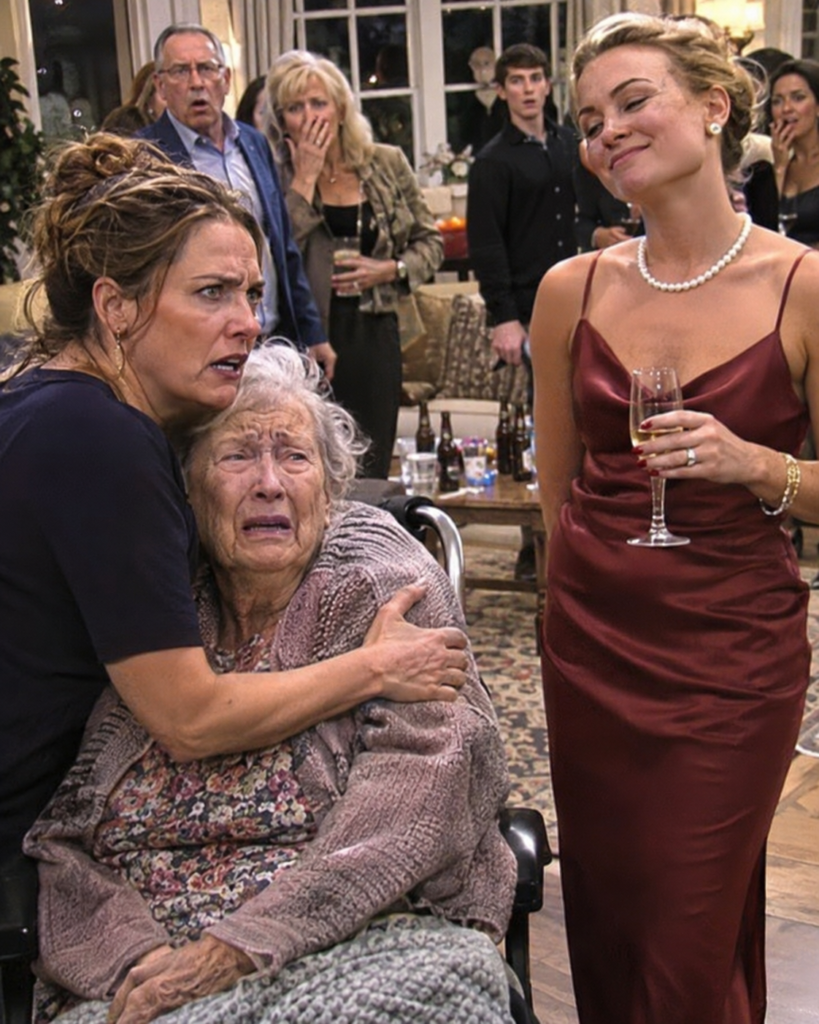
The music stopped. People grabbed their cups and ran out the back door. Within five minutes, the only people left in my house were Belinda, the man in the baseball cap, and two officers. His name was Rollo Gaspard. He was Belinda’s boyfriend. He worked at a local bank branch as a notary.
I handed the officer the envelope.
“My mother has Alzheimer’s,” I said. “She was diagnosed three years ago. I have the medical records. She can’t legally sign a will. And this man notarized it in my house while she was confused, and then threw a party.”
The officer read the will. Then he looked at Rollo.
“Sir, did you notarize this document today?”
Rollo’s face went red. “She signed it herself. She seemed fine to me.”
“Did you ask her what she was signing?”
He didn’t answer.
Belinda started crying. “Miss Edna wanted me to have it! She told me I was like a daughter to her!”
Then my mother spoke up from the hallway. She’d come out of her room in her nightgown, holding on to the wall.
“Who are all these people?” she asked softly. “Cleo, is it Christmas?”
The officer looked at her. Then back at Belinda.
He didn’t say anything. He didn’t need to.
Belinda and Rollo were both arrested that night.
The investigation took two months. Here’s what the detectives found.
Belinda had been doing this before. My mother wasn’t the first. She’d worked for two other elderly clients through the agency. One of them, a ninety-year-old man in Pooler, had changed his will to leave her his car and twenty thousand dollars, three weeks before he died. Rollo had notarized that one too.
The agency never checked.
Belinda was charged with elder abuse, exploitation of a vulnerable adult, and theft. Rollo lost his notary license and his job at the bank, and he was charged as well.
The fake will was thrown out by the court.
My mother’s pearl necklace came back to me in a plastic evidence bag. It had belonged to my grandmother.
I put it back around Mom’s neck the day it came home.
“Oh,” she said, touching it. “I’ve missed this.”
After that night, I made changes.
I cut back my hours at the hospice. I found a licensed adult day program for Mom, with nurses and cameras and a long waiting list. I put a lock on her bedroom that only opens from the inside.
And I report every caregiver agency I come across that doesn’t do proper background checks.
The other families found me, too. The daughter of the ninety-year-old man in Pooler called me in December. We cried on the phone together for an hour.
“Thank you for coming home early,” she said. “Nobody came home early for my dad.”
Mom doesn’t remember the party. Some days, she doesn’t remember me.
But every evening, when I sit beside her bed, she touches her pearls and asks the same question.
“You’ll stay, won’t you?”
And every evening, I give her the same answer.
“I’m not going anywhere, Mama.”
THE END.