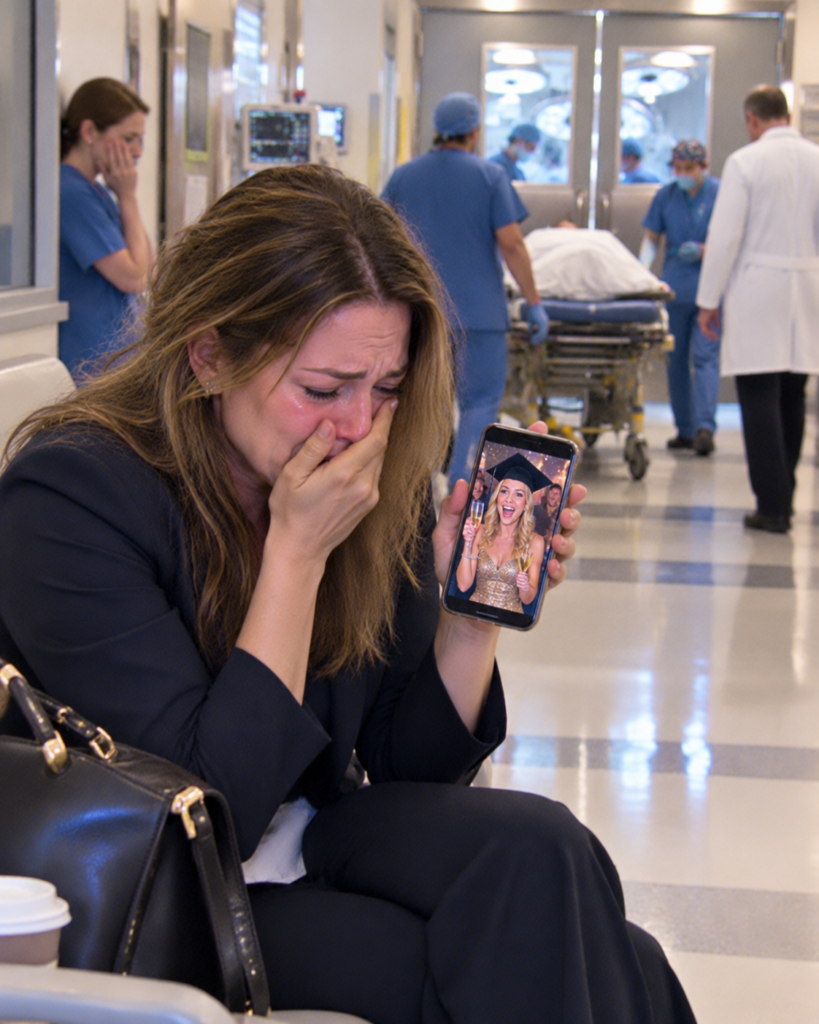
She explained what the team had done and what they would watch for next. Maya had come through the operation. There would be more assessments, uncertainty, and a long recovery.
No one could promise me the future I wanted.
But she was alive.
When I finally stood beside her bed, I could barely see her through my tears.
I tucked her hair away from her forehead.
“I’m here,” I whispered. “Your sneakers are safe.”
Her fingers shifted beneath mine.
I stayed.
By morning, the family group chat had turned into a courtroom in which I had been tried without appearing.
My mother said I had disrupted Chloe’s graduation celebration.
My father said money should never be used to punish people.
Chloe wrote that I had always resented her success.
One aunt asked how I could create financial stress on such an important night.
I read that message twice from a chair beside Maya’s bed.
Then a private message arrived from my cousin Rebecca.
“Did they really know Maya was in emergency surgery?”
“Yes.”
“Your mom told us she was having a scheduled procedure. She said you were upset they couldn’t visit until tomorrow.”
I stared at the screen.
That explained some of the faces behind Chloe—not the three people I had called repeatedly, but the relatives who had been given a convenient version of events.
I sent Rebecca the message I had sent my parents hours before the party.
“Maya was hit by a truck. She has spinal fractures. They’re taking her into emergency surgery. Please come. I don’t want to do this alone.”
The delivery time was visible.
Rebecca called immediately.
“I’m sorry,” she said. “I should have called you myself.”
I had no energy to comfort her.
“Yes,” I said. “You should have.”
She accepted that.
“What can I do now?”
“Bring me a phone charger. And clean clothes.”
She arrived that afternoon with both, along with food I could actually manage to eat.
She didn’t ask about the party.
She sat with me while Maya slept.
My mother came to the hospital the next day.
My father followed her into the waiting area carrying flowers too large for the small vase beside Maya’s bed.
I met them outside her room.
Mom looked exhausted, but the first thing she said was, “You need to explain those accounts.”
“How is Maya?” I asked.
Her mouth tightened.
“Of course we’re worried about her.”
“Then ask.”
My father looked past me toward the room.
“How is she?”
“Recovering from major surgery. Frightened. In pain. We don’t know everything yet.”
He lowered the flowers.
For a moment, I thought we might finally have the conversation we should have had the night before.
Then Mom said, “Your father had to put the additional party charges on his own credit card.”
“The agreed event bill is being settled,” I said. “The extras you added are yours.”
“You embarrassed us in front of people.”
“I was here.”
“You know what I mean.”
I did.
She meant that their expectations had failed in public, and I was supposed to repair that before discussing anything else.
My father spoke quietly.
“We didn’t realize you were paying for so much.”
“You didn’t ask.”
“Where did that kind of money come from?”
“My business.”
“The data work?”
“The company I tried to tell you about.”
My mother folded her arms.
“If you’ve been doing that well, this is an especially cruel time to withdraw support.”
I looked at her for a long moment.
There it was: the discovery of my success had not produced curiosity or pride. It had produced a larger claim.
“I needed you,” I said. “I asked you to sit with me while my child was in surgery. You told me to clear dishes.”
“You’re taking something said under pressure—”
“You gave me twenty minutes.”
My father stared at the carpet.
Mom glanced toward Maya’s door.
“Let us see our granddaughter.”
“Not while this is what you came to discuss.”
Her face changed.
“You can’t keep her from her family because of a disagreement.”
“Maya needs rest. We can discuss visits later. Today, you’re leaving.”
I was shaking when I said it.
My mother noticed. She had always mistaken that for uncertainty.
“Elena.”
“No.”
It was one small word. I had spent most of my life building elaborate sentences to avoid saying it.
They left the flowers at the nurses’ station.
Chloe responded more publicly.
She posted about a jealous sibling who had used money to sabotage a celebration she had worked years to earn.
She left out the hospital.
People congratulated her on the degree and told her to protect her peace.
I wanted to write beneath every comment.
Instead, I saved screenshots and called her.
She answered with, “Are you ready to apologize?”
“Take the post down.”
“Why? Worried people will find out what you’re like?”
“You earned your degree. I never disputed that. But you called me from your party to mock me while Maya was in surgery.”
“I didn’t say it like that.”
“You said nobody wanted another dramatic story from me.”
“You’ve always had a way of making people feel guilty.”
I leaned against the wall outside the rehabilitation consultation room.
“Did you know I paid for the party?”
She didn’t answer.
“Chloe.”
“Mom said you helped.”
“How much did you think I helped?”
Another silence.
Then she said, “If you could afford all this, why did you let us think you were struggling?”
I closed my eyes.
I remembered asking her to watch Maya for two hours during a work deadline years earlier. She had said she couldn’t be expected to rearrange her life because I had chosen to become a mother.
I remembered sending her rent money that same month.
“I wasn’t asking you to admire my income,” I said. “I was asking you to care about my daughter.”
“Those are separate issues.”
“They should have been.”
I ended the call.
The hardest part of cutting off the money was discovering how often I had used giving to manage my own fear.
When the accountant sent the full summary, I couldn’t finish reading it in one sitting.
Each payment carried a memory.
A tense conversation softened by a transfer.
A holiday invitation after I covered an expense.
A rare compliment from Dad after I paid a bill he hadn’t wanted to discuss.
I had built a successful company by noticing patterns.
At home, I had spent years refusing to see one.
My attorney helped put the financial changes in writing. My parents received clear dates, a list of commitments I would finish paying, and notice that I would provide no further discretionary support.
I did not demand repayment of old gifts.
That money was gone, and chasing it would have kept me tied to them.
Instead, I paid what I had promised and closed the arrangement.
My father asked for one last six-month extension.
“We’ve structured our lives around this,” he said.
“So did I.”
“We’re your parents.”
“I know.”
He waited for that fact to change my answer.
It didn’t.
Maya’s recovery refused to follow the neat schedule I wanted.
There were encouraging days, then days when exhaustion swallowed everything she had managed the day before.
I learned how many ordinary things could become frightening after an injury. A transfer from a bed. A doorway. A question about whether something would hurt.
I also learned how to let other people help.
My operations director took meetings I had insisted only I could handle. Rebecca stayed during appointments. A neighbor filled our freezer without asking me to perform gratitude while holding a container.
Their kindness was practical and unannounced.
Nobody attached a family loyalty test to a phone charger.
One afternoon, Maya asked why Grandma hadn’t visited again.
I set down the book I was reading.
“Grandma and I are having a problem,” I said.
“Because I got hurt?”
“No.”
The speed of my answer startled us both.
I moved closer.
“You getting hurt did not cause this. You haven’t done anything wrong.”
She picked at the edge of her blanket.
“I heard you talking in the hall.”
“What did you hear?”
“Something about money.”
I thought carefully before answering.
“I was helping them pay for things. I’ve decided to stop.”
“Are they mad?”
“Yes.”
She considered that.
“Are you still allowed to stop?”
My throat tightened.
“Yes, sweetheart. I am.”
She nodded, accepting a rule I was only beginning to learn.
The financial consequences arrived gradually.
My parents gave up the country club membership at renewal. They changed their vehicle arrangements. Chloe moved to a less expensive apartment.
None of them became homeless. None lost the education, savings, or belongings they already had.
They had to make choices within their own means.
My mother described those choices as humiliation.
My father stopped making that argument after Rebecca showed him the emergency message I had sent before the party.
He called one evening and said, “I read it again.”
I waited.
“Your mother said the doctors had things under control.”
“I told you I needed you.”
“Yes.”
He sounded older than he had at the country club.
“I should have come.”
It was the first apology that contained no request.
I thanked him.
Then I told him I wasn’t ready for a visit.
He said he understood. Whether he fully did or not, he respected the answer.
Chloe removed her post after relatives began asking questions she couldn’t answer without mentioning Maya.
Weeks later, she sent a longer apology. She admitted what she had said on the call. She wrote that she had wanted one night to be about her, and had turned that feeling into cruelty.
I read the message several times.
Then I replied.
“I’m glad you understand what you said. I need distance. Please respect it.”
I didn’t owe her immediate closeness because she had finally named the injury.
My mother never apologized for the kitchen entrance.
She said she had been overwhelmed.
Eventually, I stopped waiting for a better explanation.
Months after the surgery, Maya stood between the parallel bars in the rehabilitation room wearing her purple sneakers.
The therapist stayed close. I sat where Maya could see me.
Her recovery was still unfolding. There were supports, appointments, adaptations, and goals that changed as her team learned what she needed.
That morning, she was focused on moving one foot.
She shifted her weight, concentrated, and took a careful step.
Then another.
I covered my mouth.
“Don’t cry yet,” she told me. “I’m trying to count.”
I laughed through my tears.
“Sorry. Keep going.”
When she finished, she leaned against the support and looked at me with exhausted pride.
“Were you watching?”
“The whole time.”
That evening, after dinner, Maya sat on the couch sorting markers while I reviewed a short work report beside her.
My laptop chimed.
It was a calendar reminder for a payment that no longer existed.
For a moment, I saw myself on the hospital floor again: frightened, shaking, checking how long it would take to obey my mother.
I deleted the reminder.
Then I closed the laptop.
Maya held up two markers.
“Purple sky or orange sky?”
“Your choice.”
She studied them with the seriousness the decision deserved.
“Both.”
I moved closer so she could spread the drawing between us.
I had not gone to the party. I had not cleared the tables. I had paid my final commitments and ended the financial arrangement that had kept me hoping I could purchase a place in my own family.
My parents and sister would decide what to do with the boundaries I had set.
For once, I did not have to decide for them.
“Stay until I finish?” Maya asked.
I picked up a marker.
“Yes.”