PART 1
When I was eight, my mother gave our best food to a homeless teenager while my family struggled to eat, leaving me convinced he had taken something precious from me. After her funeral, I finally went looking for him and found a man I barely recognized waiting outside our old house in Bluebell Valley.
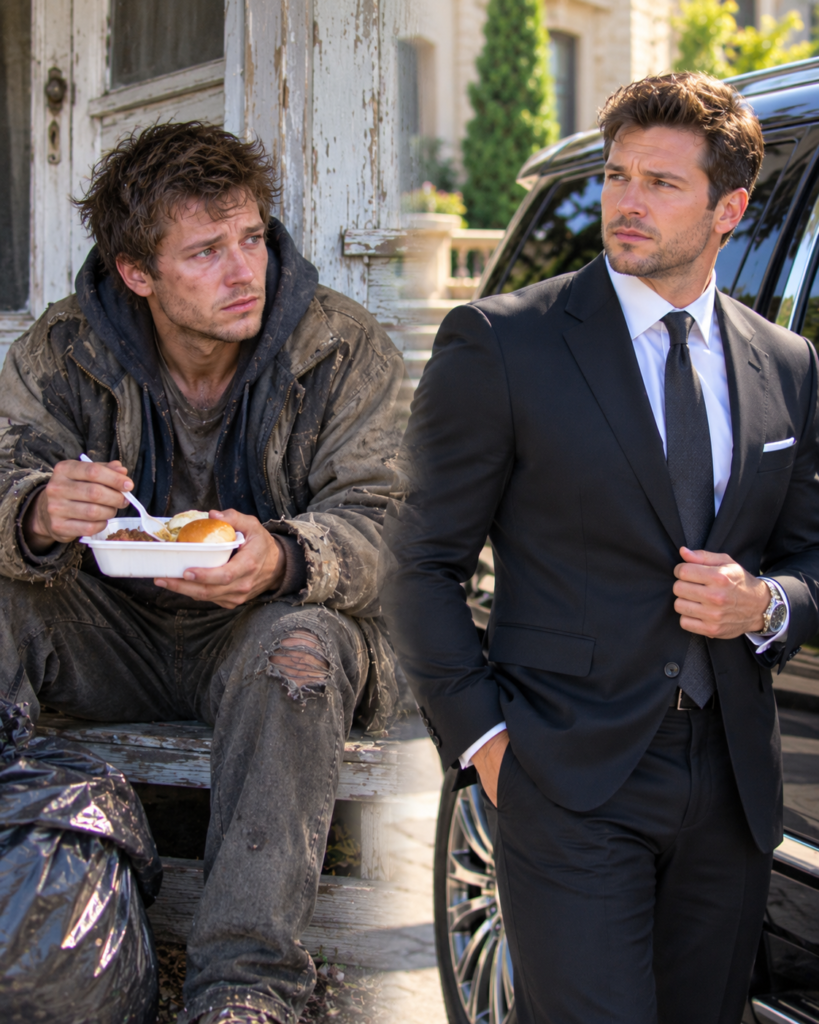
I was eight years old when Gabriel began sleeping beside the municipal dump beyond Oakridge Avenue, huddled under a sheet of rusted roofing tin.
He looked eighteen, maybe younger, with hollow cheeks, dirty sleeves, and the careful eyes of someone who expected trouble from everyone he met.
Dad had died that spring, leaving Mom with unpaid bills, overwhelming grief, and a kitchen where every meal required its own quiet arithmetic.
Still, every afternoon, Mom packed a plate, wrapped it in silver foil, and walked toward the dump without explaining herself to anyone.
Sometimes Gabriel received baked chicken while my little brother and I ate thin broth soup.
Sometimes he got fresh bread while Mom claimed she was not hungry at all.
I watched from the living room window as Gabriel accepted everything with both hands, always thanking her as if she had saved his life.
I felt resentment brewing in my chest every single day because I could not understand why a stranger deserved more than her own children.
Then one Saturday, I found Mom carrying a fresh apple pie toward the back door, warm enough to fog its glass cover.
“Is that for dinner tonight?” I asked, already smiling because apple pie was my favorite dessert that Mom still occasionally baked.
Mom shifted the baking dish against her hip and deliberately avoided my eyes.
“It is for Gabriel, and there is vegetable soup waiting on the stove for us,” Mom said softly.
Something deep inside me cracked at that moment, and tears spilled down my cheeks as my anger flared up.
“Why does he get dessert when we cannot even have decent food?” I screamed.
Mom’s face was engulfed in such a sudden fury that I instantly stopped crying out of pure shock.
“Never say that about Gabriel again, and never make me hear it ever again,” Mom snapped sternly.
She left through the back door with the pie, leaving me alone in our dim kitchen, feeling ashamed, furious, and entirely certain that Gabriel had replaced me in her heart.
After that terrible afternoon, I hated him with the intense focus only a heartbroken child can manage.
Whenever I walked past the dump after school, Gabriel tried waving at me to show friendliness.
Once, he carved me a small wooden songbird and offered it to me with a shy smile.
I deliberately dropped the wooden bird beside his worn shoes and kept my head held high.
“You do not have to like me,” Gabriel said softly as he picked up the carving.
“But your mother worries whenever you walk too close to traffic after school.”
I ignored his words and kept walking briskly, pretending his genuine concern was just another trick designed to steal even more of Mom’s affection.
As far as I knew, Gabriel had no parents, no home, and no job in our small town.
Mom never explained why she seemed to feel so deeply responsible for his survival.
Years passed, and Gabriel vanished from the dump sometime before I finished high school, while Mom stubbornly refused to explain where he had gone.
The moment I graduated, I moved three hours away to a small apartment in Pine Ridge, accepted the cheapest lease available, and rarely called home.
Mom and I spoke only on birthdays, then major holidays, and eventually only when one of us felt guilty enough to try reaching out again.
Eleven years later, a hospital nurse called while I was working at my office desk and asked whether I was Abigail Miller’s daughter.
“Your mother has suffered a severe stroke,” the nurse said over the phone.
“Her condition is critical, so you should come to St.
Jude Regional Hospital as soon as possible.”
By the time I arrived at the hospital room, medical machines surrounded Mom, and she could barely speak.
I took her frail hand in mine and apologized for all the long years of distance between us.
Her fingers tightened weakly around mine, but her clear eyes remained painfully sharp as she looked at me.
“I am here now, Mom,” I said gently.
“You do not have to worry about anything anymore because I will handle the house, the bills, and everything else.”
Her mouth moved several times before any actual sound emerged from her throat.
“Do not abandon Gabriel, so promise me right now,” Mom whispered weakly.
Those were her final words to me before her breathing slowed down.
I felt a sudden wave of sharp anger before sorrow took over, knowing Gabriel had not even come to see her, yet Mom was spending her last strength protecting him again.
“I promise,” I whispered back, though my lingering resentment made the words taste bitter in my mouth.
Mom closed her eyes and died quietly before sunset, leaving me alone with my thoughts.
After the funeral service, I cooked a fresh pot of beef stew, packed some bread, and drove toward our old neighborhood, carrying the heavy weight of an unwanted duty.
I expected to search the dirty dump or ask old neighbors whether Gabriel still wandered nearby so I could leave the food, tell him Mom was gone, and consider my promise fulfilled.
Instead, a sleek black SUV waited on the curb right outside Mom’s house.
Beside the vehicle stood a clean-shaven man in an expensive wool coat, watching my car arrive as tears gathered in his tired eyes.
“I thought you would not come,” he said softly as I stepped onto the curb, still holding the covered pot against my chest.
I studied his refined features until I recognized the younger version of him beneath the polished hair and tired facial lines.
“Gabriel?” I asked in complete disbelief.
His smile looked uncertain as he glanced toward the dark windows of the house.
“You brought dinner,” Gabriel noted quietly.
I nodded slowly, suddenly embarrassed by the cheap plastic container balanced between my hands.
“But what happened to you?” I asked, looking at his car.
“How is any of this possible when Mom spoke as if you were still living nearby and desperately needed help?”
Gabriel looked toward the dark house and let out a long sigh.
“Your mother hid something very important from you,” Gabriel said.
“Before she died, she begged me to keep her secret until the right moment.”
PART 2
The question stayed between Gabriel and me while the last of the evening traffic whispered along Oakridge Avenue.
He looked older than I remembered, of course.
The boy I had once watched from our kitchen window had been all sharp elbows and hunger.
The man in front of me had neat hair, a tailored coat and the tired expression of someone who had traveled a long way without being sure he would be welcomed.
“Your mother wanted me to tell you herself,” he said.
“She tried, several times.
But she never found the courage.”
I tightened my grip on the pot of stew.
“She found the courage to scold an eight-year-old for wanting a piece of pie.”
Gabriel did not defend her.
That almost made me angrier.
“You should come inside,” I said at last.
“If we’re going to talk about my mother, I won’t do it on the sidewalk where the neighbors can watch.”
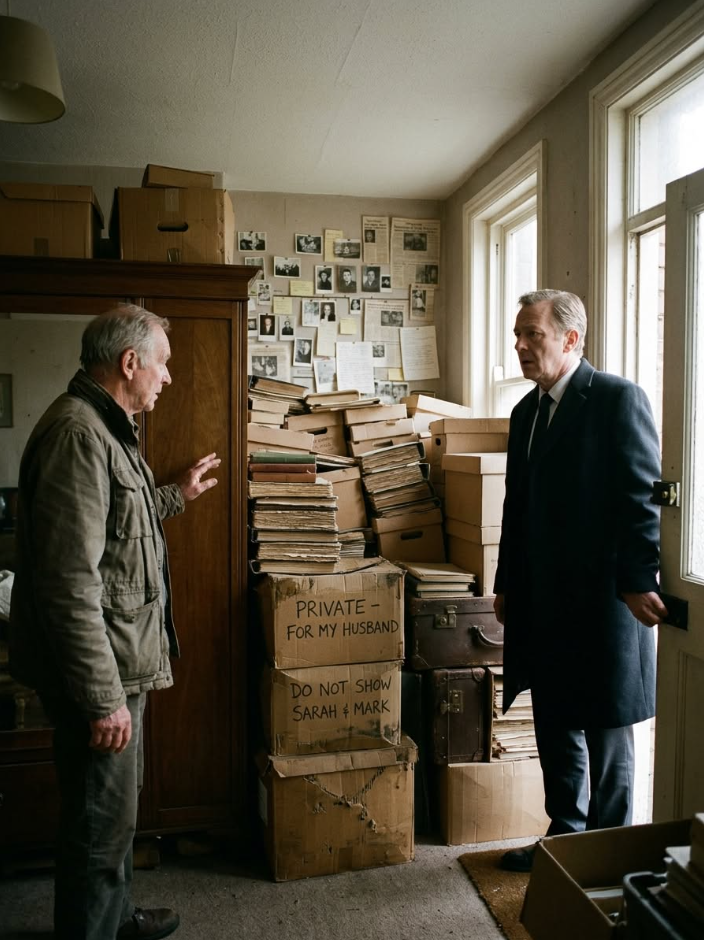
The house smelled of furniture polish and the wilted lilies left after the funeral.
I had not yet moved the shoes from the mat or the blue cardigan from the hook near the back door.
Mom had left those things in their usual places, as though she might be gone for an afternoon and come home before supper.
Gabriel stopped on the threshold.
“May I?”
“It’s not a museum,” I said, too sharply.
“Come in.”
He entered carefully, with the respect of a guest who remembered what it felt like to have nowhere to go.
In the kitchen, he stood beside the same table where Mom had told me the apple pie was for him.
There was a shallow dent in the wood where my brother used to knock his spoon against the edge.
“Where is your brother?” Gabriel asked.
“Daniel lives in Portland.
He flew home for the service and left this morning.” I put down the stew.
“He has two children, a job that barely lets him take a day off, and less interest in family mysteries than I apparently have.”
“Does he know you’re here?”
“He knows I’m clearing the house.”
Gabriel nodded and did not ask further.
Then he reached into his coat pocket and brought out a small brass key on an old red string.
“Your father gave me this when I was seventeen,” he said.
“There is a box I was supposed to put in your hands years ago.”
I laughed without humor.
“My father died when I was eight.
What could he possibly have given a boy who didn’t arrive at the dump until afterward?”
Gabriel met my eyes.
“I knew your father before you knew me.”
I pulled out a chair and sat down.
I suddenly understood that the worst thing about discovering a secret was not necessarily what it contained.
It was realizing how little of your own history you had been allowed to know.
“Start at the beginning,” I said.
He set the key between us and began.
PART 3
My father had worked as a maintenance supervisor at the old Bellweather packaging plant, a brick building at the edge of Bluebell Valley that employed half the town when I was young.
I remembered his work boots by the radiator and the lemon soap he used to scrub grease off his hands.
I did not remember ever hearing the name Clara.
“Clara was my mother,” Gabriel said.
“She cleaned the offices on the evening shift.
Some weeks she worked six nights because the rent was overdue.”
My father had started leaving a thermos of soup in the break room whenever he noticed she skipped dinner.
Then he helped her repair a broken heater in the small apartment where she and Gabriel lived.
He refused payment and would not let her tell the manager he had used his own time.
“Dad did things like that,” I murmured.
“Yes.
But I don’t want you thinking your parents were saints.
Your father could be stubborn.
He argued with my mother when she refused to see a doctor.
She argued back.
They were ordinary people who kept choosing to help.”
Clara’s health had deteriorated that winter.
Missing shifts led to lost wages, and lost wages led to an eviction notice.
My father paid for a room at the Pine Rest Motel while he helped Gabriel enroll in a welding and machinery course at the community college.
He checked on them on Sunday afternoons after taking Daniel and me to the park.
“Were you there when he got sick?” I asked.
Gabriel looked at the brass key.
“I was there the day he admitted he was afraid.”
That was new to me.
In my memory Dad had died suddenly, almost without warning.
Mother had always said the doctors tried everything, but there had been no time.
Now Gabriel told me Dad had been making appointments for months, quietly hoping treatment would work.
“He didn’t want you children carrying that worry before you had to,” Gabriel said.
“He didn’t tell many people.
He trusted me because he knew I understood what an illness could do to a family.”
I was furious at the thought that a stranger had known my father’s fear when I had not.
Then I remembered I had been eight.
He had probably still been helping with my spelling words while privately considering how to say goodbye.
“Why did he give you a key?”
“He needed someone who could keep a promise without making it into a grand event.
He had been recording things for you and Daniel, whenever he felt well enough.
He asked me to keep the tapes dry, keep them safe and deliver them when you were older.”
“For both of us?”
Gabriel nodded.
“Some were for you.
Some for Daniel.
Some were for anyone willing to listen.”
I looked toward the hall where Mom’s photographs still hung.
There was one of Dad holding me on his shoulders, his face half hidden behind my enormous grin.
My throat hurt.
“Mom knew?”
“She learned about them after the funeral.”
“And she kept them from us.”
“Yes,” Gabriel said, quietly enough that I believed he understood the weight of the admission.
PART 4 (THE END)
I stared at Gabriel, struggling to understand how my mother could have hidden such an important part of our lives.
“Why did she keep the tapes from us?”
“Because listening to your father hurt too much,” Gabriel answered. “And because she was afraid you would blame her for not being able to save him.”
He slid the brass key across the table.
I found the old wooden box in the attic, beneath a blanket of dust. Inside were several cassette tapes, a photograph of my father with Gabriel and his mother, and a small envelope with my name written in Dad’s familiar handwriting.
My hands trembled as I pressed play.
“Abigail, sweetheart,” my father’s voice filled the quiet room. “If you’re hearing this, I’m sorry I couldn’t stay longer. Please remember that love isn’t measured by how much we have, but by what we’re willing to share.”
Tears streamed down my face.
Then he said something that broke my heart.
“Gabriel reminds me of myself when I was young. Someone once helped me when I had nothing. I promised I would do the same for someone else. I hope you’ll understand someday.”
I looked at Gabriel through my tears.
For the first time, I saw the boy beside the dump not as someone who had stolen my mother’s love, but as someone my father had trusted with his own.
“I hated you,” I whispered. “I thought you took something from me.”
Gabriel lowered his eyes.
“I know. Your mother told me. She also told me you were a good person who had been hurt and didn’t know how to express it.”
I covered my face, ashamed of the wooden bird I had thrown away and every cruel thought I had carried for years.
“Did you ever hate me?”
“No,” he said. “I only hoped you would understand one day.”
Before leaving, Gabriel placed the old wooden songbird on the table.
“I kept it,” he explained. “I thought your mother might want you to have it someday.”
I held the little carving against my chest and cried like the eight-year-old girl who had never understood why her mother kept giving away what little she had.
That evening, I packed two containers of beef stew.
One was for Gabriel.
The other was for me.
For the first time in years, I understood my mother’s greatest lesson: love does not become smaller when it is shared.
And as Gabriel drove away, I finally felt that my father—and the woman who had loved him—had come home to me.