The waiting area outside the cardiology wing was nearly empty by then. A television in the corner played a cooking show with the sound turned off, and somewhere down the hall a vending machine hummed like it was tired of its own job. Mom sat very straight in her plastic chair, the way she always did in public, her blue cardigan buttoned all the way to the top. She held the folded paper in both hands for a long moment before she gave it to me.
“I wasn’t going to show you this,” she said. “I promised I wouldn’t. But the doctor said I need less stress, and I’ve been carrying this for a long time, sweetheart. I don’t think I can carry it anymore.”
I unfolded the statement. It was from her credit union, the small one on Maple Street she had used since before I was born. I knew she kept her savings there. I knew roughly how much she had, because after Dad passed, she’d asked me to help her understand the paperwork. It wasn’t a fortune, but it was enough. Enough for her to live carefully. Enough for the in-home care she might need someday. Enough to make sure she would never be a burden on anyone, which was the thing she feared most in this world.
The balance at the bottom of the page was less than a third of what I remembered.
I read it twice, thinking I had misunderstood. Then I looked at the transactions.
On the first of every month, like clockwork, there was an outgoing transfer of six hundred dollars. The recipient line was short. Just two words.
V. Carter.
Vanessa Carter. My wife.
I scanned up the page, then flipped to the second sheet stapled behind it. The transfers went back as far as the statement showed. Mom quietly told me the rest.
“Thirty-six months,” she said. “Three years this October.”
I did the math without wanting to. Twenty-one thousand six hundred dollars. On top of the fourteen thousand she had already given us to cover the mortgage when the boutique was failing.
“Mom,” I said, and my voice came out strange, too quiet. “What is this?”
She looked down at her hands. Her wedding ring was loose on her finger now. She’d lost weight this past year, and I had told myself it was just age.
“After I helped with the mortgage,” she said slowly, “Vanessa came to see me. You were at work. She brought flowers. She sat in my kitchen and cried, David. Real tears. She said the boutique was still in trouble, worse than you knew. She said that if it closed, the debt would ruin both of you, and that you were already so stressed you weren’t sleeping. She said you had too much pride to ask me for anything more, and that if you found out she’d come to me, it would humiliate you.”
I closed my eyes.
“She asked if I could help a little each month. Just until things turned around. Six months, she said. Maybe a year.” Mom gave a small, tired laugh. “I’m your mother. What was I going to say? I thought I was protecting you. Both of you.”
“And it never stopped.”
“Every time I mentioned it, she said they were almost there. Almost. Next quarter. After the holidays. After the spring line.” She smoothed the edge of her cardigan with trembling fingers. “Then about a year ago, I saw pictures on that Facebook page of hers. A trip to Napa with her girlfriends. That new purse. I told myself it wasn’t my business how she spent money. I told myself maybe the boutique was finally doing well, and she would stop the transfers on her own.”
“But she didn’t.”
“No.” Mom’s voice dropped. “When I brought it up in June, she told me I’d agreed to help, and that if I stopped now, the boutique would fail and it would be my fault. She said you’d blame me. She said you’d never forgive me for making your marriage fall apart.”
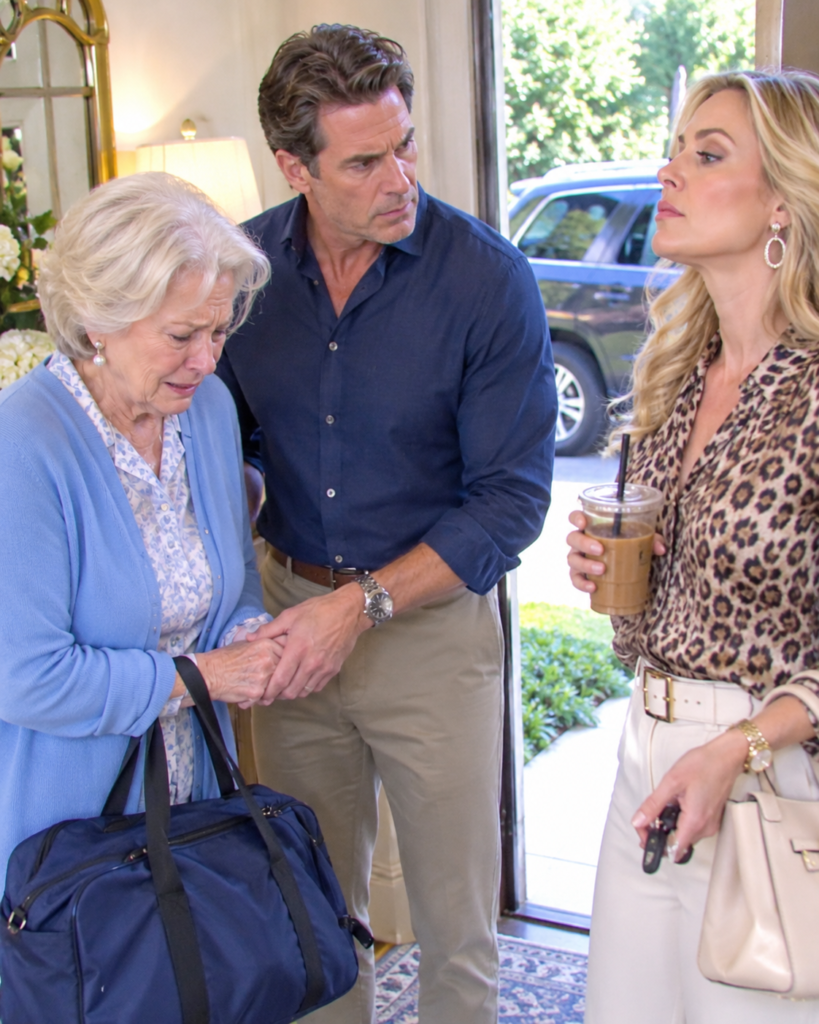
Something cold settled in my chest. I thought of every Sunday dinner when Vanessa had barely spoken to my mother. Every holiday where she checked her phone while Mom told stories about my father. Every time she’d sighed when I said I was going to visit.
Your mother isn’t my responsibility.
She had said that this morning, standing in our hallway with her iced coffee and her designer purse. A purse that, for all I knew, my mother’s savings had helped pay for.
“There’s one more thing,” Mom said.
I didn’t think I could take one more thing. I nodded anyway.
“When Vanessa signed the new lease for the boutique two years ago, the landlord wanted a personal guarantor. Someone with a clean credit history and no business debt. Vanessa asked me.” She swallowed. “I signed it. If she can’t pay the rent, they can come to me.”
I stared at her. “Mom, that lease is for a storefront downtown. The rent is—”
“I know what the rent is.”
“You could lose your house.”
“I know that too,” she said softly. “I knew it when I signed. I thought I was helping my son’s family. I thought that’s what you do.”
I put the statement down on my knee and pressed both hands against my face. For a moment I couldn’t speak. I wasn’t sure if I wanted to scream or cry, and I didn’t want to do either in a hospital waiting room in front of my eighty-two-year-old mother, who had just been told to avoid stress.
When I lowered my hands, she was watching me with an expression I hadn’t seen since I was a boy. Worry. Not for herself. For me.
“I’m sorry,” she whispered. “I should have told you.”
That broke something open in me.
“Don’t you dare apologize,” I said, and I took both her hands. “Do you hear me? You did nothing wrong. Nothing. You trusted someone who told you she loved me. That’s not a mistake, Mom. That’s what good people do.”
Her eyes filled, but she didn’t cry. She was from a generation that didn’t cry in hospitals.
“What are you going to do?” she asked.
I looked out the window at the parking lot, where Mr. Bellamy’s old silver sedan sat near the entrance. He’d insisted on waiting. He was in the cafeteria now, probably on his third cup of terrible coffee, reading a paperback western he kept in his glove box for emergencies.
“First,” I said, “I’m going to take you home. Then I’m going to make some phone calls.”
Mr. Bellamy drove us back to Mom’s house instead of mine. He didn’t ask why. When we pulled into her driveway, he came around to open her door and offered his arm, and she took it with the kind of grace that made you forget she needed it.
“Walter,” she said, once she was on the porch, “you’ll stay for a slice of banana bread. I insist.”
He glanced at me. I nodded.
Inside, Mom’s house smelled like it always did, like cinnamon and old books and the lavender soap she bought from the farmers market. Everything was neat and worn and familiar. The framed photo of my father on the mantel. The quilt on the back of the couch. The kitchen table where I’d done my homework for twelve years.
On the counter sat a loaf of banana bread wrapped in plastic. Next to it, two smaller slices wrapped separately, with a sticky note in Mom’s shaky handwriting.
For Vanessa. Don’t skip breakfast, dear.
I had to walk out onto the back porch for a minute after I saw that.
Mr. Bellamy found me there a little while later. He handed me a cup of coffee and leaned against the railing beside me. He was seventy-one, broad-shouldered, with a gray crew cut and the steady, unhurried manner of a man who had spent thirty years arriving at the worst moments of other people’s lives.
“I’m not going to pry,” he said. “But I spent a long time on an ambulance, David. I know what a man looks like when he’s just found out something he can’t unknow.”
I let out a breath. “How much did you hear in the driveway this morning?”
“Enough.”
“It’s worse than that.”
He waited. That was the thing about Walter Bellamy. He never rushed you.
So I told him. Not every detail, but enough. The transfers. The lease. The tears in Mom’s kitchen and the threats that came later.
When I finished, he was quiet for a long time.
“My wife, God rest her, used to say that you learn who a person is by how they treat someone who can’t do anything for them,” he finally said. “Waiters. Old folks. Kids. Your mother can’t do anything for Vanessa anymore. Not the way she used to.”
“She was still doing something,” I said bitterly. “Six hundred dollars a month.”
“Right.” He sipped his coffee. “And the second your mom needed something back, even something as small as a ride, Vanessa showed you who she was.”
I nodded slowly.
“What do you want to happen?” he asked.
It was such a simple question, and I realized nobody had asked it in years. Not even me.
“I want my mother to be safe,” I said. “I want her money back. I want her name off that lease. And I want…” I stopped.
“Go on.”
“I want my wife to understand what she did. Not just feel bad because she got caught. Actually understand it.” I shook my head. “I don’t even know if that’s possible.”
Walter set his cup down on the railing. “Son, I’ve seen people change. Not often, but I’ve seen it. It almost never happens because someone yells at them. It happens when the consequences finally get big enough that they can’t look away anymore.” He looked at me. “You don’t have to be cruel. You just have to stop standing between her and the truth.”
That evening, I made three phone calls.
The first was to the credit union. Mom sat beside me on the couch and gave her permission, and with her on the line, we canceled the recurring transfer. The young man on the phone was polite and careful, and when Mom explained why, he paused for a moment and then said, “Ma’am, I’m really glad you have your son with you.” I liked him for that.
The second was to a lawyer. Her name was Diane Okafor, and she was the daughter of one of Mom’s old church friends. She was in the middle of dinner with her kids, but she listened to everything, asked sharp questions, and told me to email her copies of the statements and the lease before I went to bed.
“I’ll need to read the guarantee carefully,” she said, “but a lot of these agreements have renewal terms. If the lease is coming up for renewal, your mother may be able to decline to extend her guarantee for the new term. That could protect her going forward. As for the transfers, we’ll talk about options. Your mom gave the money voluntarily, but voluntary consent based on false information is a different conversation.”
“When is the lease up?” I asked Mom after I hung up.
She went to her desk, opened a drawer, and came back with a folder labeled in her neat handwriting. Vanessa—Shop.
She handed me the lease. I flipped to the dates.
The current term ended at the end of this month. A renewal notice was attached, stamped as received three weeks earlier. The landlord required the renewal paperwork, including a signed guarantor agreement, by Friday.
Today was Wednesday.
“She was going to bring the papers over this weekend,” Mom said quietly. “She told me it was just a formality.”
The third call was the hardest one.
I called Vanessa.
She picked up on the second ring, and I could hear music and laughter in the background. Brunch had apparently turned into happy hour.
“So you’re alive,” she said. “Are you coming home, or are you going to sulk at your mother’s all night?”
“I’m staying here tonight.”
She laughed, short and sharp. “Seriously? Over a car?”
“It’s not about the car, Vanessa.”
“Then what is it about?”
I looked at Mom, who sat in her armchair with her hands folded, watching me. I thought about everything I wanted to say. All the anger burning in my throat. But I remembered what Walter had told me.
You don’t have to be cruel. You just have to stop standing between her and the truth.
“We’ll talk tomorrow,” I said. “Goodnight.”
I hung up before she could answer.
My phone buzzed twice more that night. I didn’t pick up. I slept in my old bedroom, under the same faded ceiling where I used to count glow-in-the-dark stars as a kid, and for the first time in years, I slept straight through until morning.
The first call came at 7:12 a.m.
I was in Mom’s kitchen making scrambled eggs when my phone lit up on the counter. Vanessa. I let it ring.
The second came at 7:14. The third at 7:15.
By the time Mom shuffled into the kitchen in her robe, my phone had vibrated eleven times.
“Is that her?” she asked.
I nodded and set a plate in front of her. “Eat first.”
She raised an eyebrow, the same look she used to give me when I tried to skip vegetables. But she picked up her fork.
At 8:03, a text came in.
David answer your phone. This is serious.
At 8:19: The landlord just called me. Why is your mother not answering? I need her signature by Friday.
At 8:40: The credit union payment didn’t go through. Is something wrong with her account??
I read that last one aloud, and Mom set down her fork.
“She noticed fast,” Mom said dryly. “It’s the first. I suppose she’s been watching for it.”
That was the moment I understood the full shape of it. My wife had not forgotten about my mother. She hadn’t been careless or distracted. She knew exactly when the money arrived, down to the morning.
She just didn’t think the woman sending it deserved a ride to the hospital.
By noon, the count was at twenty-six. The texts had shifted from irritated to frantic.
Please call me.
David I’m begging you.
If I don’t get the lease signed I lose the store. Do you understand that? Everything I built.
Did your mother say something to you? Whatever she said, it’s not what it looks like.
That last one made Mom laugh out loud, a real laugh, surprising us both.
“Well,” she said, wiping her eyes, “at least she admits there’s an ‘it.’”
Diane called at one. She’d read the guarantee overnight.
“Good news,” she said. “Your mother’s guarantee is tied to the current term. She has no obligation to sign for the renewal. If she doesn’t, the landlord will need a new guarantor or a larger security deposit, or they won’t renew. Either way, your mother’s exposure ends with this term, as long as the current rent is paid through the end of the month. I checked with the landlord’s office. It is.”
I put the phone on speaker so Mom could hear.
“And the money?” Mom asked.
“That’s going to depend partly on Vanessa,” Diane said carefully. “I’ve drafted a letter documenting the transfers and the circumstances. We can go a lot of different directions, Mrs. Carter. Some people want a formal demand. Some want a repayment agreement. Some just want it on record. What matters is what you want.”
Mom was silent for a long moment.
“I want her to look me in the eye,” she finally said. “That’s what I want first. The money can come after.”
Call thirty-seven came at 5:48 p.m.
Call thirty-eight came at 5:49.
I answered that one.
“David.” Vanessa’s voice cracked on my name. I had been married to her for eleven years, and I had never heard her sound like this. Not even when her father died. “Oh, thank God. Where are you? Why haven’t you picked up?”
“I’ve been with my mother.”
“Is she okay? Is it her heart?” A pause. Then, quickly, too quickly: “Because if she’s in the hospital, I can come help. I can bring her things.”
“She’s fine,” I said. “She’s sitting right here.”
Another pause. I could hear her breathing.
“Then you need to tell her I have to get the renewal signed by Friday,” she said, her voice firming up. “The landlord said if I don’t have a guarantor, I need to put down six months’ rent as a deposit. I don’t have that, David. You know I don’t have that.”
“I know a lot of things now.”
The silence on the other end stretched so long I thought the call had dropped.
“What did she tell you?” Vanessa asked finally. Her voice was very small.
“She showed me the bank statements. Thirty-six months. Six hundred dollars a month. She told me about the flowers and the tears in her kitchen. She told me what you said would happen if she ever stopped.”
“David, I can explain—”
“I’m sure you can. And you’re going to get the chance.” I took a breath. “But the answer to the question you’ve been calling all day to ask is no. My mother isn’t signing. Not Friday. Not ever again.”
“You can’t—” Her voice rose, then broke. “You can’t do this to me. You’ll ruin everything. We’ll lose the business. Do you understand what people will say?”
I looked across the room at my mother. She had her reading glasses on and was pretending to do the crossword in the newspaper, but her pen hadn’t moved in five minutes.
“Vanessa,” I said quietly, “yesterday you told me my mother wasn’t your responsibility. You were right. She isn’t. She’s mine. And I should have taken care of her a long time ago.”
I heard her start to cry.
“Tomorrow at ten,” I said. “Come to Mom’s house. Come alone. Bring whatever explanation you think you have. She wants to hear it from you, face to face.”
“And if I don’t?”
“Then her lawyer will contact you instead.”
I hung up.
My hands were shaking. Mom set down her newspaper, got up slowly from her armchair, crossed the room, and did something she hadn’t done since I was a teenager. She put her arms around me and held my head against her shoulder like I was eight years old and had just fallen off my bike.
“I’m proud of you,” she whispered.
I don’t think I had ever needed to hear anything more.
Vanessa arrived at 9:52 the next morning.
I watched from the front window as the SUV pulled into the driveway. She sat in the car for a full four minutes before she got out. When she finally did, I barely recognized her. No yoga clothes. No iced coffee. She wore jeans and an old gray sweatshirt I hadn’t seen in years, and her hair was pulled back in a messy ponytail. Her eyes were swollen. She held her keys so tightly her knuckles were white.
She stopped on the porch steps and looked at Mom’s flowerbeds for a long moment before she knocked.
Mom answered the door herself. She’d insisted on it.
“Good morning, Vanessa,” she said. “Come in. I’ve made coffee.”
Vanessa stepped inside like someone walking into a courtroom. She looked at me, then away quickly. We sat at the kitchen table, the same table where she’d apparently cried three years ago and asked for help. Mom poured three cups of coffee with steady hands and sat down across from her.
For a while, nobody spoke.
Then Mom slid the bank statement across the table.
Vanessa didn’t pick it up. She just stared at it.
“I’d like to understand,” Mom said. Her voice was gentle, but there was iron in it, the kind of iron I remembered from my childhood whenever I’d lied about my homework. “I’m not here to scream at you, dear. I’m too old and my heart’s too tired. But I would like the truth. I think I’ve paid for it.”
Vanessa’s lip trembled.
“The boutique was failing,” she said. “That part was true. When you helped with the mortgage, it bought us time, but it wasn’t enough. I was behind with suppliers. I had a business credit card I hadn’t told David about. I was so ashamed. Everyone thought I was this successful woman with my own shop, and I was drowning.”
“So you came to me.”
“Yes.” She finally looked up. “And you said yes so easily. You didn’t ask a single question. You just hugged me and said family helps family.”
“I meant it.”
“I know you did.” Tears spilled down Vanessa’s cheeks. “That’s what made it so easy. And so awful.”
“When did the store recover?” I asked.
Vanessa flinched. “About eighteen months ago.”
The kitchen went very quiet.
“Eighteen months,” I repeated.
“I meant to stop,” she said desperately. “I swear I did. But then I had a good quarter and I thought, I’ll pay her back in a lump sum, it’ll be easier. Then I spent it. Then there was the trip with the girls, and everyone was posting pictures, and I didn’t want to be the one who couldn’t afford it. And every month the money just appeared and I stopped thinking about where it came from. It was like it wasn’t real.”
“It was real to me,” Mom said softly. “It was my husband’s pension. It was the money I saved so I could pay for a nurse someday and not have to ask David to take care of me.”
Vanessa covered her face with her hands.
“And when I asked you to stop,” Mom continued, “you told me my son would never forgive me.”
“I know.”
“Why?” Mom asked. It wasn’t an accusation. It was a real question. “I want to understand that part most of all. Why would you say that to me?”
For a long time, Vanessa didn’t answer. When she did, her voice sounded very far away.
“Because when I was fifteen, my grandmother moved in with us,” she said. “My mom worked two jobs, and my dad left the year before. So it was me. I gave Grandma her medicine. I helped her to the bathroom. I missed school. I missed prom. I missed everything. And when she died, my mom told me I should have done more.” She wiped her face with her sleeve. “I swore I would never be responsible for an old person again. Never. And when I married David, I saw how much he loved you, and I was terrified. I thought one day it would be me again. Me giving up my whole life.”
She looked at Mom with red, wet eyes.
“I think I started hating you before you ever did anything to deserve it. And then you were kind to me, and that made it worse, because I couldn’t make you into the villain I needed you to be. So I took your money and told myself you owed it to me somehow. I know how that sounds. I know it’s sick.”
I had been married to this woman for eleven years, and I had never heard that story. Not once. She’d told me her grandmother died when she was a teenager. That was all.
Part of me ached for that fifteen-year-old girl. But another part of me looked at my mother, at her loose wedding ring and her thinning savings and her trembling hands, and that part didn’t move an inch.
Mom was quiet for a long time. Then she reached across the table and put her hand over Vanessa’s.
Vanessa looked like she’d been struck.
“I’m sorry that happened to you,” Mom said. “Truly. No child should carry that alone. And your mother was wrong to blame you.”
Vanessa started sobbing then, deep, ugly sobs that shook her whole body.
Mom let her cry. She didn’t pull her hand away. When the worst of it passed, she spoke again, quietly and clearly.
“But Vanessa, I am not your grandmother. And I am not your mother. I’m Margaret. I’m a person. And what you did to me was wrong, no matter what was done to you.”
Vanessa nodded, unable to speak.
“Here’s what’s going to happen,” Mom continued. “I’m not signing the lease. That’s final. You’ll have to find another way, or you’ll have to let the store go. I’ve spent my whole life cleaning up other people’s messes, and I’m done. My doctor says so, and for once I’m going to listen.”
“I understand,” Vanessa whispered.
“Second. My lawyer has drawn up a repayment agreement. Twenty-one thousand six hundred dollars, plus the fourteen thousand from the mortgage. No interest. I never wanted interest. But I want it paid back, every dollar, on a schedule you can actually keep. Not because I need to punish you. Because I need that money to grow old with dignity.”
“Yes. Of course. Yes.”
“And third.” Mom took off her reading glasses and folded them. “That one isn’t up to me. That’s between you and my son.”
They both turned to look at me.
I had spent the whole night thinking about this moment. I’d imagined saying a hundred different things. I’d imagined throwing her out, packing my bags, filing papers by Monday. And part of me still wanted that. But sitting at that kitchen table, I realized the truth was simpler and harder than any speech.
“I’m not coming home,” I said.
Vanessa’s face crumpled.
“Not right now,” I added. “Maybe not ever. I don’t know yet. For eleven years I made excuses for how you treated my mother. I told myself you were stressed, or private, or just not a family person. I let her eat Christmas dinner while you sat on your phone. I let her bake for you while you rolled your eyes. I’m not going to pretend that’s all on you. I let it happen. That’s mine to own.”
I took a breath.
“But I need to see who you are when nobody is watching and nobody is paying. Not words. Not tears. Time. If you want this marriage, you’re going to have to show me. And if you don’t, I need you to tell me that honestly, so we can both stop pretending.”
Vanessa stared at the table for a long moment.
“Can I ask for one thing?” she said finally.
“You can ask.”
“Will you go to counseling with me? Not to fix it fast. Just…” She swallowed. “Just so I don’t do this alone. I don’t think I know how to change by myself. I’ve never seen anyone do it.”
I looked at Mom. She gave me the smallest nod.
“Yes,” I said. “But you go on your own first. For you. Not for me. For that fifteen-year-old kid.”
Vanessa nodded. She signed the repayment agreement right there at the kitchen table, her hand shaking so badly the signature was barely legible. Then she stood up, and for a second I thought she would just leave.
Instead she walked over to the counter, where the two slices of banana bread still sat in their plastic wrap with Mom’s sticky note on top.
For Vanessa. Don’t skip breakfast, dear.
She read the note. Then she put her hand over her mouth and walked out the door without another word.
She left the banana bread behind. I understood why. Some kindness is too heavy to carry when you know you don’t deserve it.
The weeks that followed were not dramatic. That surprised me. I think I expected some kind of movie version where everything exploded or everything healed. Instead, life just kept going, one small, hard, ordinary day at a time.
I stayed with Mom. I drove her to her follow-up appointments in a rental car until my own came back from the shop. I fixed the leaky faucet in her bathroom that she’d been ignoring for a year. I sorted her medications into a weekly pill organizer. On Tuesday nights, Walter came over for dinner and he and Mom argued cheerfully about baseball. On Thursday nights, we played gin rummy, and she beat me so badly it should have been illegal.
The boutique closed on the last day of the month.
I heard about it from Vanessa’s friend Rachel, who called me out of nowhere. “I just thought you should know,” Rachel said awkwardly. “She sold most of the inventory to a consignment shop. She cried the whole time, but she did it herself. She wouldn’t let any of us help.”
“What about the brunch crowd?” I asked, more bitterly than I intended.
Rachel was quiet. “Honestly? Most of them disappeared once the store closed. Funny how that works.”
I didn’t think it was funny. But I wasn’t surprised.
Vanessa took a job managing the women’s department at a big department store at the mall. It was steady work with regular hours and a fraction of the prestige. I found out later that she’d also sold her designer purse, the Napa photos came down from her social media, and her account went quiet for a long time.
On the first of the following month, a check arrived at Mom’s house.
Five hundred dollars. In the memo line, in Vanessa’s handwriting: 1 of 72.
There was no letter. Just the check.
Mom held it up to the light like it was a rare stamp.
“Well,” she said. “Would you look at that.”
The next month, another came. 2 of 72.
Then 3 of 72.
The fourth one came with a small note.
Started therapy. It’s awful. Going back Thursday. —V.
Mom stuck that note to her refrigerator with a magnet shaped like a strawberry. I asked her why.
“Because she wrote it,” Mom said simply. “And because it’s the first honest thing she’s ever given me.”
Vanessa and I started joint counseling in January. The therapist was a soft-spoken man named Dr. Reyes, with an office that smelled like eucalyptus and a box of tissues on every surface. In our first session, he asked us each to describe the moment we knew the marriage was in trouble.
Vanessa said, “When he walked out the door holding his mother’s hand.”
I said, “Six years ago, at Thanksgiving, when my mother asked you to pass the gravy and you pretended not to hear her.”
Vanessa looked at me like I’d slapped her. “You remember that?”
“I remember all of it,” I said. “I just never said anything.”
Dr. Reyes wrote something down. “That might be the most important thing either of you has said today.”
The sessions were hard. Harder than I expected. I had to admit things about myself I didn’t like. That I had avoided conflict my whole life because my father had a temper and I’d promised myself I’d never be like him. That I had let my wife disrespect my mother because standing up to her felt like becoming the angry man I feared. That my silence had a cost, and my mother had been paying it.
Vanessa had to face harder things. Some weeks she couldn’t talk at all. Some weeks she talked about her grandmother for forty minutes straight. Once, in February, she told Dr. Reyes about the night her grandmother died, and how she’d been in the next room listening to music with her headphones on, and how she’d never forgiven herself for not hearing anything.
“That’s why I couldn’t stand being around your mom,” she said to me afterward, in the parking lot. It was snowing lightly, and her breath fogged in the cold air. “Every time I looked at her, I saw that night. I thought if I let myself care, I’d fail again. It was easier to be cold. Cold felt safe.”
“It wasn’t safe for her,” I said.
“I know.” She looked at her shoes. “I know that now.”
I didn’t hug her. I wasn’t there yet. But I didn’t walk away either. We stood together in the snow for a while, not saying anything, and it was the first time in months that silence between us didn’t feel like a wall.
In March, Mom’s doctor called with news.
The new treatment plan was working. Her heart was stronger than it had been in two years. Her blood pressure was down. Her energy was coming back.
“Whatever you’re doing,” the doctor said, “keep doing it.”
Mom hung up the phone and turned to me with the biggest smile I’d seen on her face in years.
“Less stress,” she said. “Turns out the doctor was right.”
That same afternoon, there was a knock at the door. It was Vanessa, standing on the porch with a bakery box in her hands and an expression I couldn’t quite read.
“I know it’s not the first of the month,” she said nervously. “I’m not here with a check. I just… I wanted to bring something.”
Mom opened the box. Inside was a loaf of banana bread. It was slightly lopsided, a little too dark on one end, and obviously homemade.
“I’ve tried to make it nine times,” Vanessa admitted, her cheeks turning pink. “I found your recipe online, the one you posted on the church website years ago. The first four were inedible. The fifth one set off the smoke alarm. This is the best one so far, and honestly, it’s still not very good.”
Mom broke off a corner and tasted it. She chewed thoughtfully for a long moment.
“It’s dry,” she announced.
Vanessa’s face fell.
“You overbaked it,” Mom continued, “and you used too little banana. You need them almost black, dear. The uglier the better. And you need to stop checking it every five minutes. Every time you open the oven, you lose heat.”
Vanessa blinked. “How do you know I kept opening the oven?”
“Because everyone does the first time,” Mom said. And then she smiled. “Would you like me to show you?”
Vanessa stared at her. Then, slowly, her eyes filled with tears, and she nodded.
I watched from the doorway as my mother and my wife stood side by side in that old kitchen, mashing overripe bananas into a mixing bowl. Mom gave orders like a drill sergeant. Vanessa followed them like a nervous recruit. At one point Mom swatted her hand with a wooden spoon for adding too much sugar, and Vanessa laughed so suddenly that she startled herself.
I hadn’t heard her laugh like that in years. Not the polite brunch laugh. A real one.
When the loaf came out of the oven an hour later, it was perfect. Golden brown and fragrant, filling the whole house with the smell of my childhood.
Mom wrapped two slices separately in plastic and handed them to Vanessa.
“For breakfast,” she said. “Don’t skip it.”
Vanessa looked down at the slices in her hands, and I watched something in her face soften and break open at the same time.
“Margaret,” she said, her voice shaking. “I’m so sorry. Not because I got caught. Not because I lost the store. I’m sorry because you were kind to me every single day, and I treated you like you were nothing. You didn’t deserve that. You never deserved that.”
Mom reached up and gently tucked a loose strand of hair behind Vanessa’s ear, the same way she used to do for me when I was little.
“I know,” she said. “And I forgive you. Not because you’ve finished paying. Because I’m eighty-two, and I don’t have time to carry anything heavy anymore.” She paused. “But forgiving isn’t forgetting, dear. Trust gets built slowly. One slice at a time.”
Vanessa laughed through her tears. “One slice at a time.”
I moved back home in May.
Not all at once. First it was dinner on Fridays. Then Saturday mornings at the farmers market. Then a long, honest conversation one night on the back porch where we both admitted we didn’t know if we could make this work, but we both wanted to try. Not the old marriage. A new one. One where my mother was a person and not an inconvenience. One where silence wasn’t mistaken for peace.
Dr. Reyes said we were doing the work. Some weeks, it felt like we were moving forward. Other weeks, it felt like we were barely holding on. But we kept showing up. That, I learned, is most of what love actually is. Not grand gestures. Showing up.
The checks kept coming on the first of every month. Vanessa never missed one. When she got a raise in the summer, she increased the payments without telling anyone. Mom only noticed because the memo line suddenly jumped from 11 of 72 to 11 of 60.
“She’s going to pay it back early,” Mom told Walter over gin rummy, sounding impressed despite herself.
Walter grinned and laid down his cards. “Told you, Margaret. Sometimes people surprise you.”
“Gin,” Mom said, laying down hers. “And sometimes they don’t. Pay up, Walter.”
In September, almost exactly one year after the morning in our hallway, Mom had her annual checkup with the specialist.
My car was in the shop again. Of course it was. That old sedan seemed to have a personal vendetta against me.
The night before, I mentioned it at dinner, half expecting to call Walter for a ride. Vanessa set down her fork.
“I’ll take her,” she said.
I looked at her. “You have work.”
“I already asked for the morning off.” She shrugged, trying to look casual, but I could see her hands fidgeting with her napkin. “I asked two weeks ago, actually. When I saw the appointment on the calendar.”
I didn’t know what to say. So I just nodded.
The next morning, I watched from the front porch as my wife helped my mother into the passenger seat of the SUV. Vanessa wasn’t wearing designer yoga clothes. She was in sneakers and a plain sweater, holding Mom’s hospital bag in one hand and a thermos of coffee in the other. She had also packed a small cooler with snacks, Mom’s medications, a bottle of water, and her medical records sorted into a folder labeled in neat handwriting.
Margaret—Heart.
“Did you remember the list of her medications?” I called out.
Vanessa rolled her eyes, but she was smiling. “Second pocket of the folder. Alphabetical order. I also called ahead to confirm the appointment and checked which parking garage has the elevator closest to the cardiology wing.”
Mom looked up at me from the passenger seat with an expression of pure, delighted mischief.
“She’s very thorough,” Mom said. “It’s almost annoying.”
“Almost?” Vanessa said.
“Almost,” Mom confirmed.
As they backed out of the driveway, I saw Walter across the street, watering his lawn. He raised his hose in a little salute. I raised my coffee cup back.
Mom’s checkup went perfectly. The doctor said she had the heart of a much younger woman, and Mom made him repeat it twice so she could tell all her friends at church.
On the way home, Vanessa stopped at the farmers market so Mom could buy lavender soap. Then they stopped at the grocery store for overripe bananas. The ugliest ones they could find.
That evening, the three of us sat around Mom’s old kitchen table eating banana bread while the late summer sun slanted through the window. Walter came over halfway through and claimed a slice for himself. Mom told stories about my father that I had heard a hundred times, and Vanessa listened to every single one like it was brand new. She laughed at the right places. She asked questions. Once, when Mom couldn’t remember the name of the lake where Dad had proposed, Vanessa gently said, “Lake Pleasant, wasn’t it? You told me last month.”
Mom looked at her for a long moment.
“You remembered,” she said softly.
“I’m trying to remember everything now,” Vanessa said. “I wasted too many years not listening.”
Later that night, after we’d gotten Mom settled and said goodnight, Vanessa and I sat in the SUV in Mom’s driveway for a while before heading home. The streetlights hummed. Somewhere down the block, a dog barked twice and then went quiet.
“Can I tell you something?” Vanessa said.
“Always.”
“A year ago, when you didn’t answer my calls, I thought it was the worst day of my life. Thirty-eight calls. I counted. I thought I was losing everything. The store. You. My whole life.” She ran her thumb over the steering wheel. “I was so angry. I thought you and your mother had ganged up on me.”
“And now?”
She was quiet for a long time.
“Now I think that day saved my life,” she said. “Not the store. Not my reputation. My actual life. Who I was. I was turning into someone I would have hated if I’d met her. Someone just like my mother. Cold. Bitter. Blaming everyone else.” She turned to look at me, and her eyes were wet. “You could have just screamed at me. You could have divorced me. You had every right. But you didn’t. You just stopped protecting me from the truth. And Margaret…”
Her voice broke.
“Margaret forgave me before I deserved it. Nobody has ever done that for me. Not once in my whole life.”
I reached over and took her hand. It was the first time in a year I’d done that without thinking about it first.
“That’s who she is,” I said. “That’s who she’s always been.”
“I know,” Vanessa whispered. “I just wish I’d seen it sooner.”
We drove home slowly. On the passenger seat between us sat a small bundle wrapped in plastic. Two slices of banana bread, wrapped separately. Mom had pressed them into Vanessa’s hands at the door, with a fresh sticky note in her shaky handwriting.
This time, it didn’t say Don’t skip breakfast.
It said: For my daughter.
Mom is eighty-three now. She still lives in her house with the cinnamon smell and the faded quilt. She still beats me at gin rummy every Thursday. Her savings account is growing again, slowly, five hundred dollars at a time, with a little handwritten memo line on every check counting down to zero.
Last month, the memo said 48 of 60.
Below it, in small letters, Vanessa had added: Almost there, Mom.
I’ve thought a lot about that morning in the hallway. About my mother clutching her hospital bag, lowering her eyes in embarrassment, apologizing for needing a ride. About how close I came to letting that moment pass like all the others. Another excuse. Another silence. Another time I chose peace in my house over justice for the woman who raised me.
Here’s what I learned.
Silence isn’t kindness. It just moves the pain onto whoever is least able to fight back.
Forgiveness isn’t weakness. It’s what strong people do after the truth has been told, not instead of telling it.
And people can change. Not because you shame them, and not because you rescue them. They change when someone loves them enough to stop lying for them, and then loves them enough to leave the door open when they finally find their way back.
My mother taught me that. She taught Vanessa too.
She did it the way she’s always done everything.
Quietly. Patiently. One slice at a time.
THE END