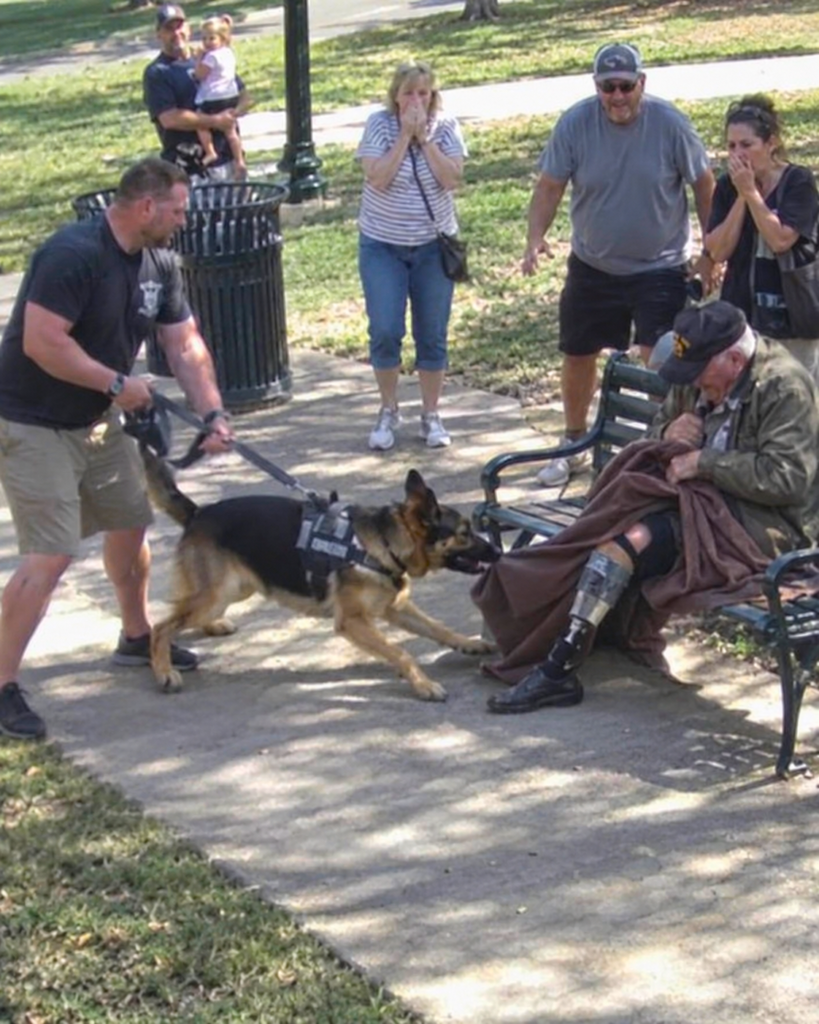
I had worked beside Max for eleven years, and I knew the difference between aggression and urgency. He used that same low growl outside drug houses, locked rooms, and places where something dangerous was hidden on the other side. Now every muscle in his body was focused on whatever that veteran had beneath his blanket. Max wasn’t watching the man’s hands or throat—he was staring at his lap.
“Sir, don’t move,” I told him as I grabbed Max’s harness.
People were gathering behind me, and a man in sunglasses held his phone up with a grin.
“This is going viral,” he muttered, as if a frightened old man had become entertainment.
Then Max shoved his muzzle beneath the blanket, and the crowd erupted.
“He’s going to bite him!” someone yelled.
But I was watching Max’s eyes, and I knew he wasn’t trying to hurt anyone. The old man finally told me his name was Walter Hayes, and when I asked what he was hiding, he answered,
“Nothing.”
Max barked once so sharply that Walter flinched, and that was when I noticed the dark stain spreading along the bottom of the blanket.
Walter moved one hand, and I saw blood on his fingers. I dropped beside him and asked where he was hurt, but he immediately covered his hand and refused to show me. His face had gone pale, yet somehow he seemed more afraid of being exposed than of losing blood.
Then sirens sounded beyond the trees, and panic flashed across his face.
“Don’t let them take me back there,” Walter whispered as he grabbed my forearm.
I asked where he meant, but he only shook his head and tried to stand. His knees buckled almost immediately, and Max moved against his body to keep him from falling. The growling stopped, replaced by the soft whine Max made when somebody was fading.
I ordered everyone to back away, but the man with the phone kept filming. Walter saw the camera and looked more ashamed than angry.
“Please,” he whispered. “I don’t want them looking at me.”
I told him we needed to find the source of the bleeding, but he shook his head again.
Before I could stop him, Max caught the edge of the blanket with his teeth. Walter closed his eyes and covered his face. Then Max pulled.
The blanket slid to the ground, and the entire crowd went silent.
Walter’s right trouser leg ended below the knee. An old prosthetic limb lay crooked across his lap, wrapped in gray duct tape with wire holding one broken strap together. The padding inside was nearly worn through, and a jagged piece of cracked plastic had cut deeply into Walter’s residual limb. Blood had soaked through the liner, but he had hidden it rather than let strangers see the damaged prosthesis.
The mother who had screamed first slowly lowered her hands. Even the man filming stopped smiling. Max pressed his nose against Walter’s good knee, and Walter stared at the broken artificial leg like it had betrayed him in public.
Then he whispered, “They’ll think I’m disgusting.”
That sentence told me this wasn’t only about blood. Something had taught Walter that being seen injured was worse than being injured itself.
When the paramedics arrived, he refused the hospital, refused transport, and became visibly tense the moment anyone mentioned veterans’ medical care. One paramedic examined the layers of tape and asked how long the prosthesis had been broken.
“A while,” Walter answered.
When she asked what “a while” meant, he looked away and said, “Long enough.”
The damage wasn’t new; he had been repairing the prosthesis himself piece by piece, using duct tape, wire, and whatever else he could find. I stared at him and asked the obvious question:
“Why didn’t you get it fixed?”
Walter’s eyes turned cold. “I did ask.”
Those three words changed everything, because this wasn’t a man who had simply been too proud to seek help. He had gone somewhere, trusted someone, and come away so defeated that he would rather walk on a dangerous prosthesis than ask again.
I convinced him to let me drive him to an urgent care clinic instead of the place he feared. The doctor cleaned the wound, closed it with fourteen stitches, and told Walter he could not put pressure on the injured limb until it began healing. Then the doctor asked whether he had another prosthesis.
Walter hesitated before saying yes.
Relief hit me. “Where is it?” I asked.
Walter stared at the floor for several seconds before answering.
“They took it.”
I thought he meant it had been stolen. Walter shook his head and explained that six weeks earlier he had taken his newer, properly fitted prosthesis in for a minor adjustment. They told him it would take forty-eight hours, but days turned into weeks, and no one would return it. Every time he called, he was transferred, placed on hold, or told the repair was still being processed.
“So this broken one is your backup?” I asked.
Walter nodded. He had been using it because the prosthesis he trusted was still somewhere inside the system, and now the backup had finally cut him open. I asked him exactly what happened the last time he went there demanding answers.
Walter looked at the ruined leg leaning against the wall. His voice dropped until I almost couldn’t hear him.
“They took my good leg.”
And when he finally explained what those words meant, I realized the blood in the park was only the beginning.
PART 2
I drove Walter home after the clinic, and that was when I discovered he lived on the second floor of an old building with no elevator. Looking at those stairs, I finally understood what six weeks without his proper prosthesis had really cost him. He had been climbing them on the broken backup, one painful step at a time.
When I offered more support, he snapped, “I can do it,” even while leaning half his weight against me.
Inside his apartment were photographs of a younger Walter in Army fatigues, a woman I later learned was his late wife Ellen, his daughter Rachel, and grandchildren who lived several states away. He told me he had lost his leg in Vietnam at twenty-one. He had lived with a prosthesis for more than fifty years, and the newer one had become part of his independence.
To everyone else it might have been a medical device, but to Walter it meant stairs, groceries, cemetery visits, and the ability to live without asking permission.
Six weeks earlier, he had taken that newer prosthesis in because the socket was rubbing behind his knee. The technician told him the adjustment should take roughly two days, and Walter went home using his old backup. By Friday, nobody had called. Then Monday passed, and every phone call after that led to another transfer, another voicemail, or another promise that someone would contact him.
During the second week, Walter went there personally. He spent hours moving between desks before someone told him the repair authorization had not cleared. Walter asked for the prosthesis back if no work was being done. They told him it had already been entered into the repair process and could not simply be released.
“That doesn’t make sense,” I said.
Walter gave me a tired look and answered, “I know.”
He had raised his voice after hours of waiting, only to be told to calm down while staff continued referring to his prosthesis as “the device.” Walter knew technically that was what it was, but after fifty-four years, he no longer experienced it as just equipment.
By the fourth week, the backup prosthesis began cracking. One strap failed, so Walter fixed it with wire. The socket split, so he wrapped it in duct tape, and when the interior padding wore thin, he stuffed cloth beneath it. He kept calling the medical center and repeatedly told them his backup was failing, but each time he was told a note had been placed in his chart.
Walter’s wife had handled appointments before she died three years earlier. His daughter lived in Arizona, but he refused to tell her because he did not want to become “one more thing she had to manage.” That was when I began seeing the pattern. Walter wasn’t simply independent—he had convinced himself that needing anyone made him a burden.
Then my former police colleague called. Someone had uploaded the park video, but the clip ended immediately after Max pulled the blanket away. It showed me fighting the leash, people screaming, and a huge German Shepherd apparently lunging at a disabled elderly veteran.
The caption read: RETIRED POLICE DOG ATTACKS VIETNAM VETERAN.
Walter watched the video with his face tightening. Thousands of strangers were calling for Max to be seized or put down, and Walter looked sick when he realized the dog that had detected his bleeding might now be punished for saving him.
“Can they take him?” he asked.
I told him honestly that people could cause trouble even though Max had bitten nobody.
Walter sat quietly for several seconds. Then something changed in him. The shame disappeared, replaced by the same stubbornness that had carried him through half a century on one leg.
He pointed toward my phone and said, “Record me.”
I turned on the camera. Walter looked directly into it and said,
“My name is Walter Hayes. The German Shepherd in that video did not attack me. He smelled blood before anybody else knew I was injured.”
His voice shook, but he continued.
“The dog did not humiliate me. What humiliated me was believing I had to bleed quietly so nobody would see that I needed help.”
Then Walter explained that his functioning prosthesis had been sitting somewhere in a repair system for six weeks while he walked on one that was breaking apart.
When I stopped recording, Walter looked at Max.
“Tomorrow, I’m going to do my job.”
“What’s your job?” I asked.
He stared at the broken prosthesis.
“Go get my leg back.”
PART 3
The next morning, Walter stood outside the Veterans Medical Center. He was using a pair of old aluminum crutches I had found in his closet, his left leg bearing all his weight while his right trouser leg was pinned neatly beneath his knee. Max walked calmly by his side, his service vest back on, ignoring the wary looks from people entering the building.
When we reached the main reception desk, the receptionist barely looked up from her screen.
“Name and appointment time?” she asked in a practiced, monotone voice.
“Walter Hayes,” he said, his voice steady. “I don’t have an appointment. I’m here to pick up my leg.”
The receptionist sighed, typed a few keys, and frowned. “Mr. Hayes, your claim is still pending administrative review. We can’t release equipment that is currently logged in the central repair queue.”
“It’s not equipment,” Walter said softly, leaning forward over his crutches. “It is my leg. I lost mine in 1971 in the Mekong Delta. I gave this country my limb, and for fifty-four years, I built a life with what I had left. Six weeks ago, your system took the rest of my dignity. And yesterday, I bled on a park bench because I was too ashamed to admit I was helpless.”
A few people in the waiting area turned to listen. The receptionist blinked, visibly uncomfortable.
“Sir, I understand your frustration, but rules are rules—”
“No,” I stepped forward, taking out my phone. “Rules are for bureaucracy. Humanity is for people. Walter’s video from last night already has over two million views. People aren’t just looking at Max anymore—they’re looking at this building.”
I showed her the screen. Beneath Walter’s video were thousands of comments from veterans, families, and citizens, demanding answers and offering support. The receptionist’s face drained of color. She picked up her desk phone and dialed a three-digit extension.
Ten minutes later, a middle-aged man in a sharp suit walked down the hallway, carrying a dark canvas bag. His eyes darted nervously between the camera in my hand, Max’s watchful gaze, and the old soldier standing tall on crutches.
“Mr. Hayes,” the supervisor said, his voice tense but polite. “There was a… red-tape misunderstanding regarding the authorization codes. We’ve expedited the repair. It was completed this morning.”
He unzipped the bag, revealing Walter’s newer prosthesis—clean, adjusted, and polished.
Walter didn’t yell. He didn’t demand an apology or throw a punch. He simply looked at the man, took a deep, trembling breath, and said,
“A mistake to you was six weeks of agony for me. Don’t ever make another veteran feel invisible again.”
We returned to Walter’s apartment that afternoon. Sitting on the edge of his bed, he fitted the comfortable socket onto his limb. When he stood up without the crutches, he didn’t wobble. He walked toward the window, looking down at the street below, no longer trapped by stairs or fear.
Max padded over and rested his heavy head gently against Walter’s good knee. Walter knelt down—a movement that had been impossible just twenty-four hours ago—and wrapped his arms around the shepherd’s neck, burying his face in Max’s fur.
For the first time since I met him, the old soldier let go. His shoulders shook as silent tears soaked into Max’s fur, releasing fifty years of carrying his burden alone. Max stayed completely still, leaning his weight against Walter, offering the quiet comfort only a loyal partner could give.
“Thank you, boy,” Walter whispered, his voice cracking. “Thank you for making me see.”
Two weeks later, the local park was bright with autumn sunlight. Walter was sitting on the same bench, but there was no brown blanket covering his lap. He wore short sleeves and walked freely, his prosthetic leg clearly visible to anyone passing by.
Children played nearby, and strangers greeted him with warm smiles as they walked past. Next to him, Max lay calmly in the grass, resting his chin on Walter’s shoe.
Walter looked at me, a soft smile finally gracing his face.
“You know,” he said, looking down at his artificial leg, then up at the sky. “I thought if people saw I was broken, they’d think less of me.”
“And what do you think now?” I asked.
Walter reached down, stroking Max behind the ears.
“I think being broken isn’t the end of the story. It’s just the part where you learn who’s willing to help you put the pieces back together.”