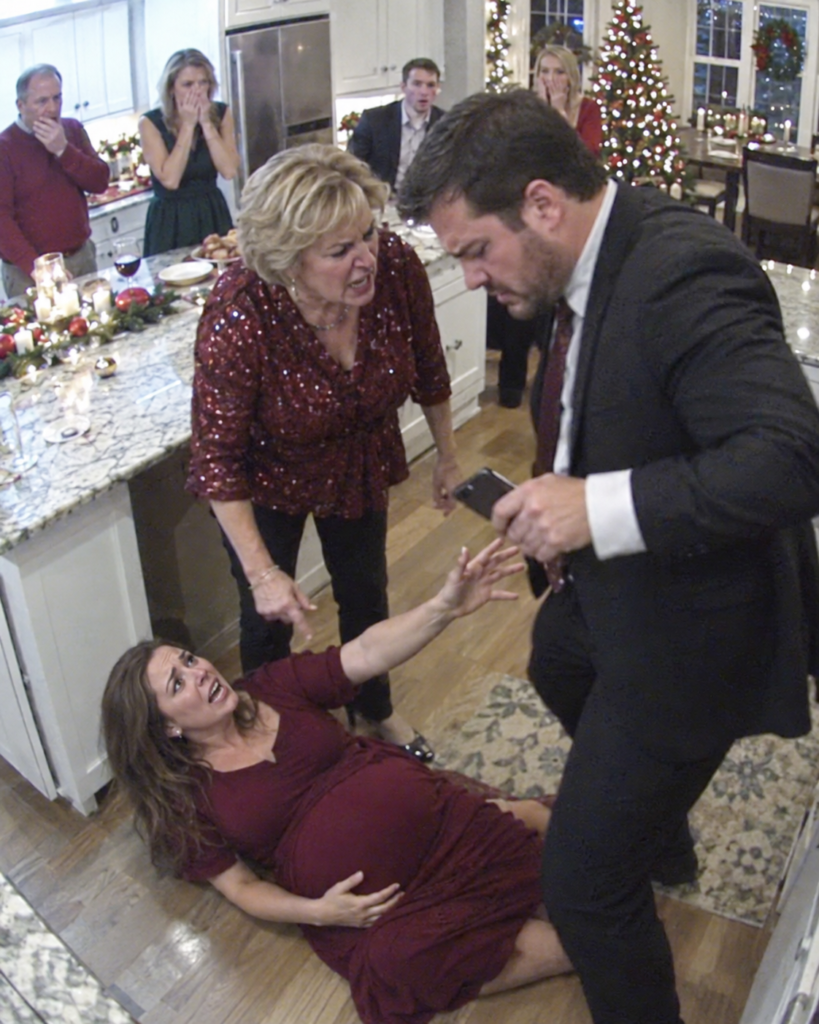
“This is David Miller, Anna’s husband. Your daughter is throwing a tantrum—”
“Where is Anna?”
The voice on the speaker changed everything.
David’s smile faltered.
He had expected an elderly nobody.
A confused father.
Someone he could intimidate with a title and a polished voice.
Instead, the man on the other end sounded calm in a way that made the entire kitchen seem to tighten around him.
David recovered quickly.
“She’s right here. As I said, she’s being hysterical.”
“Put Anna on the phone.”
David looked down at me.
I was still on the floor.
The pain came in waves now, and I had stopped trying to stand.
Sylvia hovered near the island, staring at the blood on the tile.
For the first time all day, she looked frightened.
David rolled his eyes.
“She can hear you.”
There was a pause.
Then my father said:
“Anna?”
“Dad.”
One word.
That was all I managed.
His voice changed instantly.
“Are you injured?”
“Yes.”
“Are you bleeding?”
David’s expression shifted.
I answered.
“Yes.”
“How far along are you?”
“Twenty-nine weeks.”
Another pause.
Short.
Controlled.
Then my father said:
“David, call 911.”
David laughed nervously.
“Sir, with respect, you don’t understand what’s happening.”
“I understand that a woman who is twenty-nine weeks pregnant says she is injured and bleeding.”
“It’s not as dramatic as she’s making it sound.”
My father’s voice remained level.
“Call 911.”
David looked at me.
“No.”
The silence on the line lasted perhaps two seconds.
Then:
“Anna, can you move?”
“A little.”
“Can you get away from David?”
David’s face hardened.
“What the hell kind of question is that?”
My father ignored him.
“Anna?”
I looked toward the doorway.
Beyond it, twenty-three people were sitting around the Christmas table.
Lawyers.
Neighbors.
Two of David’s partners.
Sylvia’s sister.
David’s cousin.
People who had heard at least some of what happened.
Maybe not the shove.
Maybe not everything in the kitchen.
But enough.
“I think so.”
“Go toward other people.”
David grabbed the phone.
“Okay, we’re done.”
“No.”
My father’s voice cracked across the speaker.
Not loud.
Absolute.
“Do not disconnect this call.”
David laughed again.
“You don’t give orders in my house.”
“No.”
My father answered.
“I don’t.”
Then he said something I will remember until I die.
“But Anna does not need your permission to seek emergency medical care.”
David’s jaw tightened.
“I told you, I’m an attorney.”
“Yes.”
“You don’t know who you’re dealing with.”
My father became very quiet.
“David, what is your bar number?”
David froze.
“What?”
“Your bar number.”
“Why?”
“Because you have repeatedly identified yourself as an attorney while attempting to prevent an injured person from obtaining emergency assistance.”
The color left David’s face.
Sylvia whispered:
“Who is he?”
David ignored her.
“Sir, I don’t know what Anna has told you about me—”
“My daughter has told me almost nothing about you.”
That was true.
Painfully true.
I had hidden so much.
The insults.
The financial control.
The way Sylvia treated me.
The way David corrected what I wore before firm dinners.
The way he called me ungrateful whenever I disagreed.
The way he could transform any argument into a lecture about what would happen to me if I ever tried to leave.
I had told myself my father had enough responsibility.
I told myself I was an adult.
I told myself I had chosen David, so fixing the marriage was my responsibility.
Mostly, I was ashamed.
My father continued.
“I am responding only to what I can hear happening right now.”
David swallowed.
“Who are you?”
My father did not answer.
Instead:
“Anna, has anyone called emergency services?”
“No.”
David said:
“She doesn’t need an ambulance.”
I heard movement on my father’s end.
Then another voice.
A woman.
His security aide.
My father said something away from the phone that I couldn’t understand.
David heard it too.
His confidence cracked.
“Where are you?”
My father returned to the call.
“Anna, listen to me. Help is being contacted.”
David stared at the phone.
“You called the police?”
“I arranged for emergency services to be notified.”
“You can’t do that.”
“Anyone can report a medical emergency.”
David looked toward me.
Something ugly moved across his face.
“You did this.”
I almost laughed.
Even then.
Even with me on the floor.
Even with his mother standing beside the place where I had fallen.
Even with my phone broken against the wall.
Somehow I had done this.
Then one of David’s partners appeared in the kitchen doorway.
His name was Michael Grant.
He was in his early sixties and had spent most of dinner telling stories about judges and golf courses.
Now he wasn’t smiling.
“What happened?”
David turned.
“Nothing.”
Michael looked at me.
Then at the floor.
Then at the shattered phone.
His face changed.
“That doesn’t look like nothing.”
Sylvia immediately spoke.
“She slipped.”
I looked at her.
So did David.
That was the first lie.
The first clear, simple lie.
And once she said it, I understood something.
They were already building the story.
I had seen David do it professionally.
Control the first version.
Frame the facts.
Create uncertainty before anyone else had time to speak.
“She didn’t slip.”
The voice came from behind Michael.
Emily.
David’s cousin.
Twenty-six years old.
A pediatric nurse.
She stood in the doorway, pale.
Sylvia stared at her.
“You weren’t here.”
“I saw you follow her into the kitchen.”
“That doesn’t mean anything.”
“No.”
Emily swallowed.
“But I heard Anna tell you not to touch her.”
David snapped:
“Emily, stay out of this.”
Michael turned toward him.
“David.”
“What?”
“Stop talking.”
David stared at his partner.
Michael pointed toward me.
“Your wife needs a hospital.”
David’s entire personality changed.
The arrogance disappeared.
“Mike, this is a family situation.”
“No.”
Michael looked at the broken phone again.
“This is now whatever the facts make it.”
Then we heard sirens.
David went completely still.
My father was still on speaker.
He said:
“Anna?”
“Yes?”
“Stay where other people can see you.”
“I will.”
“I’m coming.”
That frightened me almost as much as everything else.
“Dad, you’re in Austin.”
“I know.”
“You don’t have to—”
“Yes.”
His voice softened.
“I do.”
Then the line disconnected.
David stared at the phone.
“Austin?”
I closed my eyes.
Too late.
He looked at me.
“Your father lives in Austin?”
“Yes.”
“What does he do?”
I said nothing.
Michael Grant did.
He had been staring at the phone number displayed on David’s screen.
Then he looked at me.
Not David.
Me.
“Anna.”
His voice was strange.
“What is your maiden name?”
I met his eyes.
“Whitmore.”
Michael’s face went blank.
David frowned.
“What?”
Michael continued staring at me.
“Whitmore?”
“Yes.”
“Your father is Jonathan Whitmore?”
Sylvia looked confused.
“Who?”
Michael did not answer her.
He looked at David.
And I watched a sixty-two-year-old senior partner realize before my husband did exactly how much trouble was standing in that kitchen.
David laughed.
“Who the hell is Jonathan Whitmore?”
Michael whispered:
“The Chief Justice.”
Silence.
Complete silence.
Even the voices from the dining room seemed to disappear.
David stared at me.
“No.”
I said nothing.
“No.”
He looked at Michael.
“That’s not possible.”
Michael’s expression was almost pitying.
“Jonathan Whitmore has one daughter.”
David turned back toward me.
“You said your father worked for the state.”
“He does.”
“You said he was in public service.”
“He is.”
“You never said—”
“You never asked.”
That was not entirely true.
He had asked what my father did when we first met.
I had said he worked in the legal system.
David had immediately begun talking about himself.
His law school.
His clerkship.
His ambitions.
His firm.
By the end of our first date, he knew I was a teacher.
He knew I had grown up in Austin.
He knew my mother died when I was nineteen.
And he knew almost nothing else.
Years later, I realized that David did not ask questions unless he believed the answer could benefit him.
My father had never benefited the version of me David wanted.
So he had remained unimportant.
Until that moment.
“You lied to me.”
I almost couldn’t believe it.
“I never lied about my father.”
“You deliberately hid who he was.”
“Yes.”
His mouth opened.
That answer surprised him.
“Why?”
I looked at him.
“Because he asked me to.”
That was partly true.
When I left for college, Dad had given me one piece of advice.
“Let people meet Anna before they meet my title.”
He knew what happened around power.
People became warmer.
More interested.
More generous.
Doors opened.
Jokes became funnier.
Mistakes became easier to forgive.
He wanted me to know who liked me before they knew who he was.
So I used my mother’s maiden name professionally.
I built my own career.
I married David without asking my father to make a single phone call for him.
Dad attended the wedding simply as my father.
David had been too busy networking with senior partners to investigate the quiet widower seated at table four.
I used to find that funny.
Now I didn’t.
The paramedics arrived first.
Then police.
What followed was not cinematic.
It was procedural.
And thank God for procedure.
A paramedic knelt beside me.
Questions.
How many weeks pregnant?
Where was the pain?
Had I fallen?
Had someone pushed me?
I looked at Sylvia.
Then David.
Then I answered.
“Yes.”
The room changed.
The officer standing behind the paramedic took out a notebook.
“Who pushed you?”
“My mother-in-law.”
Sylvia made a choking sound.
“She is lying.”
The officer looked at her.
“Ma’am, please don’t interrupt.”
David stepped forward.
“I represent my mother.”
Michael grabbed his arm.
“David.”
“Get off me.”
“Stop.”
“I know my rights.”
Michael looked at him.
“This is not a deposition.”
The paramedics moved me onto a stretcher.
David tried to follow.
I said:
“No.”
He stopped.
It was the first time I had ever seen my husband truly shocked by that word.
“No?”
“I don’t want you coming with me.”
“Anna, I’m your husband.”
“I know.”
“I have the right—”
“No.”
The paramedic looked at him.
“She said no.”
That was all.
No argument about marriage.
No discussion about what looked proper.
No warning about embarrassing his firm.
One word from me.
One sentence from a stranger.
And suddenly my boundary existed.
Emily rode with me.
I asked her to.
At the hospital, doctors moved quickly.
I will not describe those hours in detail.
Some experiences do not become more meaningful because every painful moment is retold.
What matters is that my baby survived.
My daughter.
Grace.
She came far too close to entering the world that Christmas night.
Doctors were able to stabilize us.
I remained in the hospital.
Monitors.
Medication.
Observation.
Fear.
For nearly twenty-four hours, nobody could promise me how the pregnancy would end.
Dad arrived shortly after dawn.
He did not arrive in robes.
He did not bring reporters.
He did not bring state police to arrest my husband.
He came in an ordinary dark suit with the same worn overnight bag he had carried since I was a child.
When he walked into my hospital room, I became eight years old.
“Dad.”
He crossed the room.
I cried before he reached the bed.
He put his arms around me.
And for several minutes, the Chief Justice of the Texas Supreme Court did absolutely nothing important.
He just held his daughter.
Eventually he sat beside me.
“Why didn’t you tell me?”
I knew what he meant.
Not who David was.
What David was doing.
“I thought I could handle it.”
Dad closed his eyes.
“Anna.”
“I was embarrassed.”
“Of what?”
“My marriage.”
He looked at me.
“Sweetheart.”
“I chose him.”
“Yes.”
“I defended him.”
“Yes.”
“I kept telling everyone he was stressed.”
“Yes.”
“I kept thinking if I were easier—”
“No.”
It was not loud.
But it stopped me.
Dad held my hand.
“Whatever happens with your marriage, we will deal with facts. Not shame.”
I cried again.
Then I asked the question I had been afraid to ask.
“Can you make sure he loses his license?”
Dad released my hand.
“No.”
I stared at him.
“What?”
“No.”
“But he—”
“I know what you say happened.”
“You heard him.”
“Yes.”
“He threatened me.”
“Yes.”
“He stopped me calling 911.”
“Yes.”
“He broke my phone.”
“Yes.”
“And you’re telling me you can’t do anything?”
His expression softened.
“I am telling you something more important.”
He leaned closer.
“I will not become the kind of man David accused the system of being.”
I became quiet.
“He threatened you with connections.”
Dad continued.
“He told you his profession made him untouchable.”
“Yes.”
“Then the answer cannot be for your father to use a more powerful title to punish him personally.”
That hurt.
Because part of me wanted exactly that.
I wanted Dad to make one call.
I wanted doors to slam shut.
I wanted David to understand what it felt like to be powerless.
But Dad was right.
“So what happens?”
“The same thing that should happen if your father were a plumber.”
I almost smiled.
“Dad.”
“You give a truthful statement.”
He squeezed my hand.
“Medical professionals document what they observed.”
“Witnesses give their accounts.”
“Police investigate.”
“Prosecutors make independent decisions.”
“And any professional-conduct issue goes through the proper disciplinary process.”
I looked at him.
“You won’t call anyone?”
“I will call your lawyer.”
“My lawyer?”
“You need one.”
“I don’t have one.”
“You do now.”
Despite everything, I laughed.
That hurt my abdomen.
Dad looked alarmed.
“Don’t make me laugh.”
“I’ll add it to the injunction.”
That made it worse.
For the first time in twenty-four hours, I felt like myself.
The investigation did not depend on my father’s title.
That became extremely important.
The kitchen contained evidence.
My shattered phone.
The overturned dishes.
Photographs.
Security footage from the exterior camera showing emergency responders arriving.
Medical documentation.
And witnesses.
More witnesses than David realized.
Emily gave a statement.
Michael Grant gave one.
So did another partner’s wife who had heard David say:
“No ambulances.”
One guest had been recording a Christmas video in the dining room shortly before everything happened.
The recording did not show the shove.
But it captured voices from the kitchen.
Mine:
“Call 911.”
David:
“No.”
Then his voice again:
“I just made partner.”
That recording became important.
So did the phone call to Dad.
His office system retained official call metadata, and Dad’s security aide had been present for part of it.
Nobody needed the Chief Justice to tell them what happened.
The evidence spoke perfectly well without him.
Sylvia’s story changed.
First I slipped.
Then she had touched my shoulder to steady me.
Then I had stepped backward unexpectedly.
Then she admitted pushing me but insisted it was “barely anything.”
That progression mattered.
David’s problem was different.
He had spent years believing words were tools.
That if he chose the right ones quickly enough, reality would follow.
He said he broke my phone accidentally.
Then admitted he threw it.
He denied threatening psychiatric commitment.
Then called it an “emotional exaggeration.”
He claimed preventing the ambulance was an attempt to avoid unnecessary panic.
Then investigators asked why a lawyer believed a pregnant woman with visible bleeding should not receive emergency evaluation.
His answers became longer.
Long answers are not always lies.
But David had spent years teaching me that complicated explanations often appeared when simple truths became inconvenient.
I filed for a protective order.
Then for divorce.
Dad never told me to.
In fact, he refused to.
When I asked:
“What would you do?”
He answered:
“I’m not married to him.”
I became angry.
“You’re my father.”
“Yes.”
“Then help me.”
“I am.”
“How?”
“By refusing to replace David as the person who makes decisions for you.”
That silenced me.
I hated him for approximately three minutes.
Then I understood.
He would help me leave.
Help me stay somewhere safe.
Help me find independent counsel.
Sit beside me.
Hold my hand.
Bring me terrible hospital coffee.
But the decision had to remain mine.
So I made it.
I left.
David’s firm placed him on administrative leave almost immediately.
Not because my father demanded it.
Michael Grant reported what he had personally witnessed to the firm’s managing committee.
The firm had its own obligations.
David called me from an unfamiliar number.
I did not answer.
He emailed.
ANNA, PLEASE. THIS HAS GONE TOO FAR.
I read that sentence several times.
This.
Not what he did.
What happened afterward.
Consequences often feel excessive to people who believed there would be none.
Then came another message.
WE NEED TO THINK ABOUT GRACE.
That one almost worked.
He knew which door to try.
I forwarded it to my attorney.
No response.
Grace was born six weeks later.
Small.
Furious.
Perfect.
Dad stood outside the hospital nursery and cried harder than I did.
“You’re embarrassing the judiciary,” I told him.
He wiped his face.
“Impeach me.”
I laughed.
Grace spent eleven days receiving additional care before I took her home.
Not to David’s house.
To a small furnished rental near my father.
I could have stayed with Dad.
He wanted me to.
I didn’t.
I needed a front door that belonged to me.
A kitchen where nobody told me when I could sit.
A dining table where nobody assigned me a lower place.
For the first few weeks, I ate almost every meal sitting down.
That sounds ridiculous.
It wasn’t.
Sometimes freedom arrives as ordinary furniture.
The criminal and family proceedings moved separately.
I learned to stop treating every court date as the day my life would finally be repaired.
Courts decide legal questions.
They do not return Christmas mornings.
They do not erase fear.
They do not make you trust your own judgment again.
That work happened elsewhere.
Therapy.
Sleep.
Friends.
Fatherhood transformed into grandfatherhood.
Grace gripping my finger.
Learning to answer questions without first calculating which answer would make David least angry.
Sylvia eventually accepted legal responsibility for what she had done under an agreement reached through counsel.
I did not attend every hearing.
I did not need to watch her suffer to know I had stopped protecting her.
David faced consequences connected to his conduct that night, and the professional disciplinary process reviewed his behavior independently.
His law firm did not keep him as partner.
His professional standing changed dramatically.
But not because the Chief Justice destroyed his career.
David had been wrong about the most important thing.
He believed law was power.
My father understood law as restraint.
The rules mattered most when you had enough influence to imagine yourself above them.
Months later, Dad told me something.
“David called my chambers.”
I stared at him.
“When?”
“After your protective order.”
“What did he want?”
“To speak to me privately.”
“Did you?”
“No.”
“Why?”
“I had counsel return the call and direct all communication through appropriate channels.”
I smiled.
“He must have hated that.”
Dad raised an eyebrow.
“I did not ask.”
That was my father.
For years, I had hidden his identity because I wanted to know whether people respected me without borrowing his authority.
David eventually answered that question more clearly than I ever wanted.
He had not respected me.
But something unexpected happened after everything became public within the circles that needed to know.
People began treating me differently because of Dad.
Hospital administrators.
Attorneys.
Even acquaintances.
More careful.
More attentive.
That bothered me.
One afternoon, a lawyer apologized for keeping me waiting six minutes.
I laughed.
“Would you apologize this much if my father sold insurance?”
He turned red.
That was when I understood another part of Dad’s old advice.
Power does not only reveal cruel people.
It can distort good ones.
I wanted neither fear nor favor.
I wanted fairness.
So I became stubborn about it.
My divorce settlement was handled by independent counsel.
Dad had no involvement beyond being my father.
When custody questions arose, he removed himself even further.
No calls.
No suggestions.
No courthouse appearances unless my attorney agreed there was no concern.
At first I felt abandoned.
Then I realized he was protecting me from something I had not considered.
David could never credibly say my father had engineered the outcome.
The record had to stand without Dad’s thumb on the scale.
And it did.
Two years passed.
Grace grew into a fearless toddler who believed every cabinet had been installed specifically for her to empty.
I returned to teaching.
Not because I needed to prove independence.
Because I missed it.
The first morning back, one of my students asked why I had been gone.
“I had a baby.”
“Where is she?”
“At daycare.”
“Why?”
“Because bringing a one-year-old to third-grade math would be chaos.”
He considered this.
“Can she do fractions?”
“Not reliably.”
He nodded as though that settled it.
I laughed more that year than I had during the final three years of my marriage.
My father retired when Grace was four.
At his retirement dinner, hundreds of people attended.
Judges.
Attorneys.
Former clerks.
Public officials.
People whose names appeared in newspapers.
Dad hated almost every minute.
Grace loved the dessert table.
During his speech, he talked about institutions.
Precedent.
Humility.
Public trust.
Then near the end, he looked toward me.
I became nervous.
He had promised not to embarrass me.
“My daughter once accused me of making the law sound boring.”
The room laughed.
I covered my face.
“She was correct.”
More laughter.
“But the older I became, the more I understood that the law’s greatest promise is not that powerful people can use it.”
The room became quiet.
“It is that powerful people are also bound by it.”
My eyes filled.
He did not mention David.
He didn’t need to.
Afterward, I hugged him.
“You stole that from me.”
He smiled.
“You were always my best research assistant.”
“I was eight.”
“You worked cheaply.”
Grace interrupted.
“Grandpa, can I have more cake?”
Dad looked at me.
I shrugged.
“He’s retired. His jurisdiction is limited.”
Grace got the cake.
Years later, when she was old enough, I told her a careful version of what happened before she was born.
Not because I wanted her to hate her father.
I did not.
Children should not be recruited into adult pain.
I told her because secrets can become inheritance too.
She needed to know why our family looked the way it did.
She asked:
“Did Grandma Sylvia know I was in your belly?”
“Yes.”
“Then why did she push you?”
I took a breath.
“She was angry and made a terrible choice.”
“Did Dad help you?”
That was harder.
“No.”
Grace stared at me.
“He should have.”
“Yes.”
She thought about it.
“Did Grandpa save you?”
I smiled.
“No.”
She frowned.
“But you called him.”
“Yes.”
“He got help.”
“Yes.”
“So he saved you.”
I shook my head.
“He helped me.”
“What is the difference?”
I looked at my daughter.
“Saving me would mean I had no power until he arrived.”
She listened.
“I already had power.”
“Even on the floor?”
That question nearly broke me.
“Yes.”
I swallowed.
“Even then.”
She looked doubtful.
“What power?”
“The power to tell the truth.”
She thought.
“And call Grandpa.”
“Yes.”
“And say no.”
“Yes.”
She nodded.
“Okay.”
Children sometimes understand boundaries faster than adults because they have not yet learned to decorate them.
On the tenth anniversary of that Christmas, Dad came to my house for dinner.
My house.
Not a mansion.
Not a judicial residence.
A warm three-bedroom home with a ridiculous yellow kitchen I had chosen because David would have hated it.
Grace was ten.
She helped me cook.
Dad arrived early.
He walked into the kitchen and found me stirring gravy.
“Can I help?”
“Set the table.”
“Yes, ma’am.”
Grace laughed.
“Grandpa has to obey Mom.”
Dad looked solemn.
“In this jurisdiction, absolutely.”
We carried dinner to the table.
Then something happened that stopped me.
Grace pulled out my chair.
“Mom.”
“What?”
“Sit.”
I looked at her.
“You cooked all day.”
I stared at the chair.
For a moment, I was back in David’s kitchen.
Seven months pregnant.
Exhausted.
Asking permission to sit.
Servants don’t sit with family.
The memory still existed.
Healing had not erased it.
It had simply stopped being the only voice in the room.
Dad noticed my face.
He said nothing.
That was another kind of love.
Not every painful memory needs someone rushing in to fix it.
Sometimes you simply need time to stand beside it and realize where you are now.
I sat.
Grace sat beside me.
Dad across from us.
“Grandpa?”
“Yes?”
“Mom says you used to be Chief Justice.”
“I did.”
“Were you important?”
He looked at me.
I smiled.
He answered carefully.
“I had an important job.”
Grace considered that distinction.
“Mom says you couldn’t make Dad lose his job.”
“No.”
“Why not?”
“Because that wasn’t my decision.”
“But you were Chief Justice.”
“Yes.”
“Then what was the point?”
I laughed so hard I nearly spilled my water.
Dad looked offended.
“Excellent question.”
Grace waited.
Finally he said:
“The point of having authority is knowing which decisions are yours and which are not.”
She frowned.
“That sounds boring.”
I pointed at Dad.
“See?”
He sighed.
“Two generations of critics.”
We ate.
Sitting down.
All of us.
Years earlier, David had laughed when I told him to call my father.
For a long time, people who heard pieces of the story thought that was the turning point.
The powerful father.
The terrifying phone call.
The arrogant lawyer discovering his supposedly insignificant wife was connected to someone he could not intimidate.
It makes a satisfying story.
But it is not the part I remember most.
I remember the paramedic saying:
“She said no.”
I remember Michael Grant refusing to let David turn an emergency into a family misunderstanding.
I remember Emily telling the truth even though Sylvia was her aunt.
I remember my father refusing to use power improperly even against a man who had harmed his daughter.
I remember my lawyer asking me what I wanted instead of telling me what I should want.
I remember sitting at my own table.
Those were the moments that rebuilt me.
David had said:
“I’m a lawyer. You won’t win.”
He thought life was a courtroom.
That marriage was an argument.
That whoever had the better connections, stronger voice and more intimidating title controlled the outcome.
He was wrong.
I did not win because my father outranked him.
I did not win because David lost his partnership.
I did not win because Sylvia finally had to answer for what she did.
Those were consequences.
Necessary ones.
But they were not victory.
Victory was much quieter.
It was realizing I no longer needed to ask whether I was allowed to sit down.
Dad is gone now.
Grace is twenty-one.
She is studying engineering, which he considered a personal betrayal because he spent years trying to convince her that law was fascinating.
Before he died, he gave her the old fountain pen he used during his years on the court.
She keeps it in her desk.
Not because she wants to become a judge.
Because Grandpa gave it to her.
Objects are allowed to mean only that.
Last Christmas, Grace came home from college.
We cooked together.
She ruined the rolls.
I overcooked the turkey.
Nobody cared.
When everything was ready, she started carrying dishes into the dining room.
I reached for another platter.
She slapped my hand away.
“Sit.”
“Excuse me?”
“You’ve been cooking since six.”
“Five thirty.”
“Even worse.”
“I can carry a plate.”
“I know.”
She pointed toward my chair.
“Sit.”
I laughed.
Then I did.
Sometimes I wonder what Sylvia would think if she could see me now.
Then I realize I don’t care.
That is another kind of freedom.
My daughter sat beside me.
Friends filled the other chairs.
Dad’s old photograph stood on the sideboard.
Not his official portrait.
I hated that one.
This was a photograph of him in shirtsleeves, holding baby Grace and looking terrified that he might drop her.
Before dinner, Grace raised her glass.
“To Grandpa.”
We repeated it.
Then she added:
“And to Mom.”
I groaned.
“No speeches.”
“Too late.”
Everyone laughed.
Grace looked at me.
“To the woman who taught me that nobody gets to decide your place at the table except you.”
My throat tightened.
I looked down.
There I was.
Sitting.
Not because my father had been Chief Justice.
Not because I had proven anything.
Not because somebody finally granted me permission.
Because it was my chair.
My table.
My life.
David once told me I was a nobody and asked who would believe me.
For years, I thought the answer to that cruelty was my father’s name.
Jonathan Whitmore.
Chief Justice.
A title powerful enough to make an arrogant lawyer afraid.
I was wrong.
The answer was never my father’s name.
The answer was mine.
Anna.
Teacher.
Mother.
Daughter.
Woman.
Witness to my own life.
My father’s title did not make my injuries real.
It did not make my no more valid.
It did not make my testimony worth more than another woman’s.
And it did not make me deserving of protection.
I deserved those things before David knew who my father was.
I deserved them while I was standing in his kitchen cooking for people who treated me like hired help.
I deserved them when Sylvia told me servants didn’t sit with family.
I deserved them on the floor.
I deserved them when my voice shook.
I deserved them before anyone powerful answered the phone.
That is what I eventually taught Grace.
If someone mistreats you, you should not need an important father before the world takes you seriously.
If someone says no, you do not ask who her family knows before deciding whether the no counts.
And if you ever find yourself in a room where somebody’s dignity depends on their status, their money, their profession or the title of the person who might answer their phone—
something in that room is already wrong.
That Christmas, David believed he knew the law.
My father understood something deeper.
The law was not supposed to belong to him.
Or to David.
Or to sheriffs, judges, partners or powerful families.
It was supposed to protect the principle David had forgotten before he ever picked up my phone.
I was a person.
I had the right to seek help.
I had the right to tell the truth.
I had the right to leave.
And I had the right to sit at the table.
No title was ever supposed to be necessary for that.