I drove eighteen hours in my aging semi-truck to watch my daughter be commissioned as an Army officer. But before the ceremony ended, a three-star general noticed the worn leather band around my wrist—and suddenly lost his words. Then, in front of thousands of people, he saluted me.
And in that single moment, everyone who had dismissed the tired truck driver in the crowd looked at me as if they had failed to recognize something that mattered.
My old Freightliner pulled into the stadium parking lot just after sunrise, rumbling hard enough to shake the coffee in the cup holder. When I cut the engine, it gave one final rough cough before falling silent.
I sat there for a few seconds, both hands still gripping the wheel.
The cab smelled like diesel, worn vinyl, and the cheap soap I had used at a truck stop that morning. Families were already walking toward the stadium in clean suits, polished shoes, and careful smiles. Some carried flowers. Some carried flags. Most carried phones, ready to record every moment.
I checked the time.
9:18 a.m.
The ceremony started at ten.
My right knee throbbed when I climbed down from the cab. It always acted up after long hauls, and eighteen hours on the road had made it worse. But I pushed the pain aside.
Today was not about my knee. Today, my daughter was becoming a United States Army officer.
I looked down at the old leather band on my wrist. The edges were cracked. The leather was dark from years of sweat, weather, and work. The black stitching had faded almost gray. To anyone else, it probably looked like a useless piece of junk—something an old trucker kept because he was too sentimental to throw away.
But they would have been wrong.
That band was a promise.
I brushed my thumb over the small metal mark pressed into the leather, then straightened my clean blue flannel shirt. I had ironed it in the sleeper cab with a weak little travel iron. I had shaved at a truck stop outside Nashville and cut my jaw twice.
It didn’t matter.
Emma would be looking for me.
Before I reached the entrance, I heard her voice.
“Dad!”
One word. That was all it took to make eighteen hours of highway disappear.
I turned and saw her running toward me in full dress uniform, sunlight catching the gold on her shoulders.
Cadet First Class Emma Carter. Soon to be Second Lieutenant Emma Carter.
She looked strong. Serious. Grown in a way that made my chest hurt. But when she smiled, she was still the little girl who used to sit in my passenger seat, coloring maps while I hauled freight across state lines.
“You made it,” she said, throwing her arms around me.
“Wouldn’t miss it.”
She pulled back and looked at my face.
“You drove all night again, didn’t you?”
“Maybe.”
“Dad.”
I smiled. “Truck’s still running, isn’t it?”
She rolled her eyes, hooked her arm through mine, and led me toward the seating area.
I felt the stares.
They weren’t exactly cruel. Just quick. Judging.
The kind of glances people give when they are silently deciding whether someone belongs. Around us were families who looked made for a ceremony like this—sharp suits, expensive watches, perfect hair, shoes that had never stood in oil beside a diesel pump at three in the morning.
And then there was me.
Work boots. Rough hands. Tired eyes.
A truck driver surrounded by people who seemed polished enough to be part of the program.
Being dismissed has its own sound. It isn’t laughter. It is the brief pause before people decide you aren’t important enough to notice.
I knew that sound well.
But I hadn’t come there to be seen. I had come there for my daughter.
The ceremony began beneath a bright Tennessee sky. The brass band played. The speakers crackled. Rows of cadets stood across the field, straight-backed and still. Behind me, a mother wiped her eyes. Nearby, a father held up his phone with shaking hands.
Emma stood with her class, chin high, shoulders firm.
I remembered when she was eight years old and used to salute me as a joke beside my truck, her backpack slipping off one shoulder. I remembered late pickups because freight ran behind schedule. Birthday calls made from rest stops. Homework finished in diner booths. Promises I had broken because the road had owned too much of my life.
But there was one promise I had never broken.
When this day came, I would be there.
At 10:07, the guest speaker stepped onto the platform.
Lieutenant General Daniel Mercer. Three stars on his uniform. Decorated commander. Combat veteran.
The kind of man who didn’t need to raise his voice because the room, or in this case the entire stadium, already belonged to him.
He spoke about leadership, sacrifice, service, and the quiet price paid by the people who choose duty. His voice carried across the field while parents recorded and cadets stood motionless in the sun.
I listened from the family section, one hand resting on my aching knee, the other close to the old leather band on my wrist.
Then something shifted.
The general’s eyes moved over the audience like any speaker’s eyes would.
Then they stopped.
On me.
At first, I thought I was wrong. Maybe he was looking at someone behind me. But then his face changed in a way no practiced officer could hide.
Confusion. Recognition. Shock.
He stopped speaking in the middle of a sentence.
The band went quiet. A strange silence spread across the stadium. Phones lowered. Programs rustled. Somewhere in the distance, a baby started fussing.
Emma turned slightly, following his gaze.
The general didn’t continue his speech.
Instead, he stepped down from the platform.
Thousands of people watched as Lieutenant General Mercer walked across the field—not toward the officers, not toward the cadets, not toward the honored guests.
Toward me.
My first instinct was to step back. My second was to remain exactly where I was, because every officer in the stadium was watching, and my daughter’s face had gone pale with confusion.
The closer Mercer came, the less he looked like a man in command of a ceremony. He looked like a man walking toward a memory he had tried to outrun for years.
No one moved.
Programs stayed open in people’s hands. A woman in a cream-colored dress lowered her phone, not realizing it was still recording. Even the officers near the stage looked unsure whether they should follow him.
Mercer stopped directly in front of me.
His eyes dropped to my wrist.
To the leather band. The cracked, battered thing I had worn through truck stops, storms, cheap motel rooms, hospital hallways, and eighteen hours of highway just to stand there for Emma.
His face went pale.
For one long second, a three-star general stared at a truck driver as if he had just seen a ghost.
Then he whispered—
PART 2: THE UNBROKEN PROMISE
Then he whispered—
“Sergeant Carter?”
The word was faint, almost swallowed by the dry autumn wind blowing across the field, but it struck me like a physical blow. It was a name I hadn’t heard spoken aloud in twenty-two years. A title I had buried beneath millions of miles of asphalt, diesel fuel, and endless lonely nights on the interstate.
Lieutenant General Mercer’s hands, covered in age spots and scar tissue, were trembling. The commander who had held thousands of lives in his hands suddenly looked like a young, terrified lieutenant standing in the mud.
“Sir,” I said softly, keeping my voice low so only he could hear. “It’s just Dad today.”
Mercer’s eyes brimmed with unshed tears. He stared at the battered leather band on my wrist. He knew what was stitched underneath the faded leather—the faded bloodstains, the brass serial tag, and the names of four men who didn’t make it out of the Kunar Province in the winter of 2004.
Behind us, the stadium had fallen into a heavy, suffocating silence. Thousands of eyes were locked on the three-star general and the truck driver in a faded flannel shirt.
Emma stood frozen in formation, her bottom lip trembling, her hands locked at her sides. She was looking at me, then at the general, her mind frantically trying to piece together a puzzle she didn’t know existed.
Mercer took a deep breath, expanded his chest, and took two deliberate steps back.
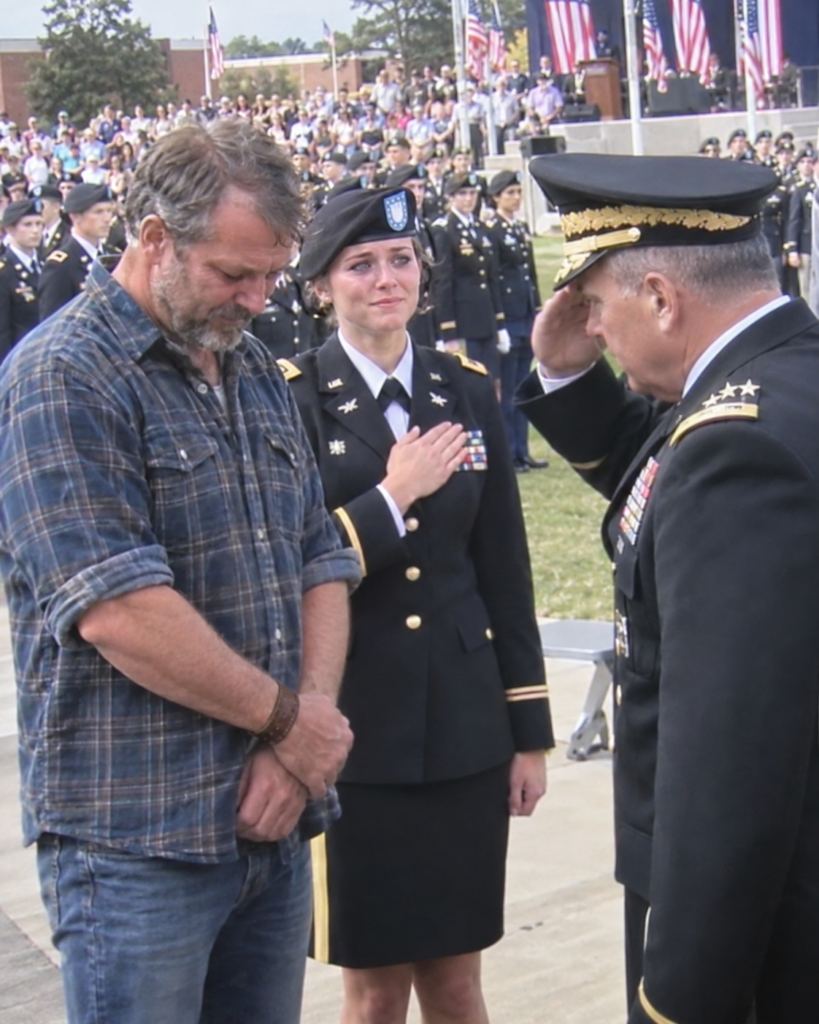
Then, right there in the grass in front of the civilian bleachers, Lieutenant General Daniel Mercer snapped his hand up into a sharp, flawless, and trembling salute.
He held it.
Not for a second. Not as a polite gesture. He held it with his head high, eyes locked onto mine, tears finally slipping down his weathered cheeks.
Gasps rippled through the stands. Officers in the front row stood up straight, their mouths slightly open. The woman in the cream-colored dress who had looked down on me earlier dropped her program onto the concrete.
“You came back,” Mercer choked out, his voice finally cutting through the quiet field. “You promised you’d stay alive… and you came back.”
I felt a lump form in my throat, thick and painful. Slowly, painfully, my right shoulder—the one full of shrapnel and old surgical steel—raised up. My calloused, greasy hand came to rest beside my eyebrow.
I returned the salute.
“I had a daughter to raise, General,” I replied. “I couldn’t stay in the dirt.”
Mercer lowered his hand, swallowed hard, and looked toward the rows of young officers. His eyes found Emma.
“Cadet Carter,” Mercer’s voice boomed across the public address system as he reached for the clip-on microphone on his collar, his tone transforming back into that of a commanding officer, though rich with raw emotion. “Front and center.”
Emma broke formation. Her polished boots hit the grass in crisp, measured steps, though her eyes were wide with shock. She stopped two paces from the general and rendered a crisp salute.
“Sir!”
Mercer didn’t salute her back immediately. Instead, he turned to face the entire stadium, pointing a steady hand toward me.
“Ladies and gentlemen,” Mercer announced, his voice echoing from every speaker. “Twenty-two years ago, in a cold, unforgiving valley in Afghanistan, a second lieutenant made a terrible tactical error. He led his platoon into an ambush. They were pinned down, out of ammunition, and taking heavy mortar fire.”
The stadium went deathly quiet. Even the breeze seemed to stop.
“That foolish young lieutenant was me,” Mercer continued, his voice cracking slightly before settling into absolute gravity. “And the sergeant who dragged three wounded men through two miles of burning wreckage and small-arms fire—the man who took a bullet in the leg and shrapnel in the shoulder to ensure I made it home to my family—is sitting right there in work boots and a blue shirt.”
A collective gasp echoed across the crowd.
Emma turned her head slowly to look at me. Her eyes were wide, brimming with tears, her jaw trembling.
“For twenty-two years, Sergeant Thomas Carter refused the Distinguished Service Cross because he said he was just doing his job,” Mercer’s voice resonated over the quiet crowd. “He took his discharge, bought an old truck, and vanished into the quiet roads of America to raise his daughter alone. He never spoke of his service. He never asked for recognition. He just drove.”
Mercer turned back to Emma, his eyes gleaming with pride and deep respect.
“Lieutenant Carter,” Mercer said softly. “You come from the finest bloodline of courage this nation has to offer. Your father didn’t just haul freight to put you through school. He carried the weight of a unit on his back so we could all stand here today.”
PART 3: THE FINAL HAUL
The applause didn’t start as a thunderous roar. It began with one pair of hands in the back—a grey-haired veteran wearing a Nam cap—clapping slowly, loudly. Then another father stood up. Then an entire row of mothers.
Within five seconds, six thousand people were on their feet.
The polished men in tailored suits, the women with expensive jewelry, the grandfathers, the young siblings—everyone was clapping, cheering, and looking at me with eyes wiped clean of judgment.
The couple seated in front of me turned around, tears in their eyes, reaching out to pat my shoulder.
I stood there, my hands shaking in my pockets, feeling smaller than ever under the weight of so much noise. I had spent two decades hiding in the quiet, dark cabs of big rigs, running away from the noise of war, preferring the rhythmic hum of asphalt to the praise of men.
Mercer stepped aside and motioned for Emma.
Emma didn’t wait for permission. She broke protocol entirely, running those few feet and throwing her arms around my neck with such force that my aching knee nearly gave out.
I caught her, burying my face in the crisp shoulder of her uniform, smelling the starch and the faint scent of rain.
“Dad…” she sobbed against my shoulder, her tears soaking into my ironed blue shirt. “You never told me. Why didn’t you ever tell me?”
I held her tight, feeling the small metal mark on my wrist pressing between us—the leather band made from the boot strap of my old combat boots, held together by the dog tags of the brothers I lost.
“Because I didn’t want you growing up under the shadow of war, baby,” I whispered into her hair. “I wanted you to look at me and just see your dad. Not a soldier. Not a survivor. Just the guy who drove eighteen hours to make sure you were never alone.”
She pulled back, her hands gripping my arms tightly, her face stained with tears and absolute adoration.
“You’re my hero, Dad. You always were.”
“No,” I smiled, wiping a tear from her cheek with a thumb stained with grease that twenty washes couldn’t remove. “Today, you’re the officer. I’m just your escort.”
When the ceremony concluded, the atmosphere in the stadium had completely changed. People lined up not just to congratulate the new officers, but to shake my hand. Men in fine suits waited patiently in line just to thank me for my service.
The woman who had looked at my boots earlier walked up, her eyes red, and handed me a warm cup of coffee from the VIP tent.
“Thank you, Sergeant,” she said softly, her head bowed in genuine humility.
I took the cup, nodding politely. “Thank you, ma’am.”
Later that afternoon, as the sun began to dip behind the stadium walls, casting long golden shadows across the parking lot, Emma walked with me back to my old Freightliner.
The big rig stood tall among the slick sports cars and luxury SUVs, its polished chrome catching the orange light of dusk. It didn’t look like a piece of junk anymore. It looked like a battle-tested warhorse that had carried a hero across the continent.
Emma stopped beside the driver’s door, her brand-new Second Lieutenant gold bars glinting on her shoulders.
“So,” she said, resting her hand against the warm metal of the hood. “Where are you headed next, Dad?”
“Got a load of produce heading up to Ohio,” I said, checking my logbook on the seat. “Need to hit the road before nightfall.”
Emma looked at the cab, then down at my old leather band, and finally into my tired eyes.
“Take care of that knee,” she commanded softly, her voice carrying a sweet mixture of military authority and a daughter’s love. “That’s an order, Sergeant.”
I smiled, standing straight, and brought two fingers to the brim of my cap. “Yes, Lieutenant.”
I climbed up into the high cab, my knee groaning in protest, but the pain felt lighter now—as if twenty-two years of secret burdens had finally been unloaded at the destination.
I turned the key. The massive diesel engine coughed once, roared to life, and settled into a steady, powerful thrum that shook the cab.
Looking in the side mirror as I pulled out of the lot, I saw Emma standing under the golden sky, her arm raised in a crisp, sharp salute that remained held high until my truck rounded the bend and merged onto the open highway, heading home under the quiet stars.