My sister came home without my five-year-old daughter and laughed when she told me she had forgotten her at the store.
My mother told me not to overreact.
I did not scream.
I grabbed my keys.
At 6:18 that evening, Megan dropped my keys into the ceramic bowl beside Mom’s front door as casually as if she had just come back from picking up milk.
She was still looking at her phone, smiling at something on the screen.
Mom was in the living room adjusting the throw pillows before her birthday dinner, and I was carrying plates toward the dining room when I noticed something that should have been obvious the second Megan walked in.
Lily was not with her.
I looked past Megan toward the driveway.
No pink sweater.
No small backpack.
No five-year-old voice asking whether she could have dessert before dinner.
I asked, “Where’s Lily?”
Megan finally looked up from her phone.
For a second, she stared toward the driveway too, almost like she expected Lily to appear there on her own.
Then she gave a little laugh.
“Oh,” she said. “I forgot your little girl at the store.”
I remember the exact way she said it because my mind refused to accept the words at first.
Forgot.
Your little girl.
At the store.
Mom straightened another pillow and sighed before I could even answer.
“Don’t overreact,” she said.
I turned toward her.
Mom told me children wandered away all the time and that Megan had probably assumed Lily was with someone else.
Megan was already looking back at her phone.
I asked which store.
“Oakridge Market,” she said.
Then I asked when she had last seen Lily.
Megan shrugged and said she did not know exactly.
That was enough.
I picked up my purse, grabbed the keys from the bowl, and ran outside.
My hands were shaking so badly that I missed the ignition the first time.
The inside of the car was hot from sitting in the driveway, and dusty air blasted through the vents when I started the engine.
I called Oakridge Market before I reached the end of Mom’s street.
No answer.
I called again before the first traffic light.
Still nothing.
Megan had left for the store with Lily sometime around four twenty that afternoon because Mom needed a few more groceries for her birthday dinner.
I had expected them back well before six.
By the time Megan walked through the door alone, nearly two hours had passed.
I kept doing the math even though I did not want to.
Two hours was enough time for a five-year-old to get scared.
Enough time for her to walk outside looking for us.
Enough time for a stranger to notice she was alone.
I pressed harder on the gas without realizing it until I saw the speedometer and forced myself to slow down.
I needed to reach Lily.
Getting into an accident would not help her.
When Oakridge Market finally came into view, I turned into the parking lot too fast, pulled across two spaces, and left the car crooked with the driver’s door hanging open.
I ran inside.
A cashier near the entrance was folding a receipt into a tiny square while another employee pushed carts near the doors.
Somewhere near the bakery, a floor-cleaning machine backed up with a steady electronic beep.
The ordinary sounds made everything feel worse.
People were choosing cereal and comparing prices while I had no idea where my child was.
“Lily!”
I called her name near the registers.
Then again near customer service.
I checked the toy aisle first because she always slowed down there.
Nothing.
I ran to the restrooms and called through the doorway.
Nothing.
I checked every bench along the front windows.
Empty.
I was heading toward the seasonal section when I heard a sound beneath the store music.
Crying.
Not loud crying.
The exhausted kind a child makes after she has already been scared for too long.
I followed it toward a display of patio cushions near the seasonal doors.
Then I saw a pink sleeve behind the stack.
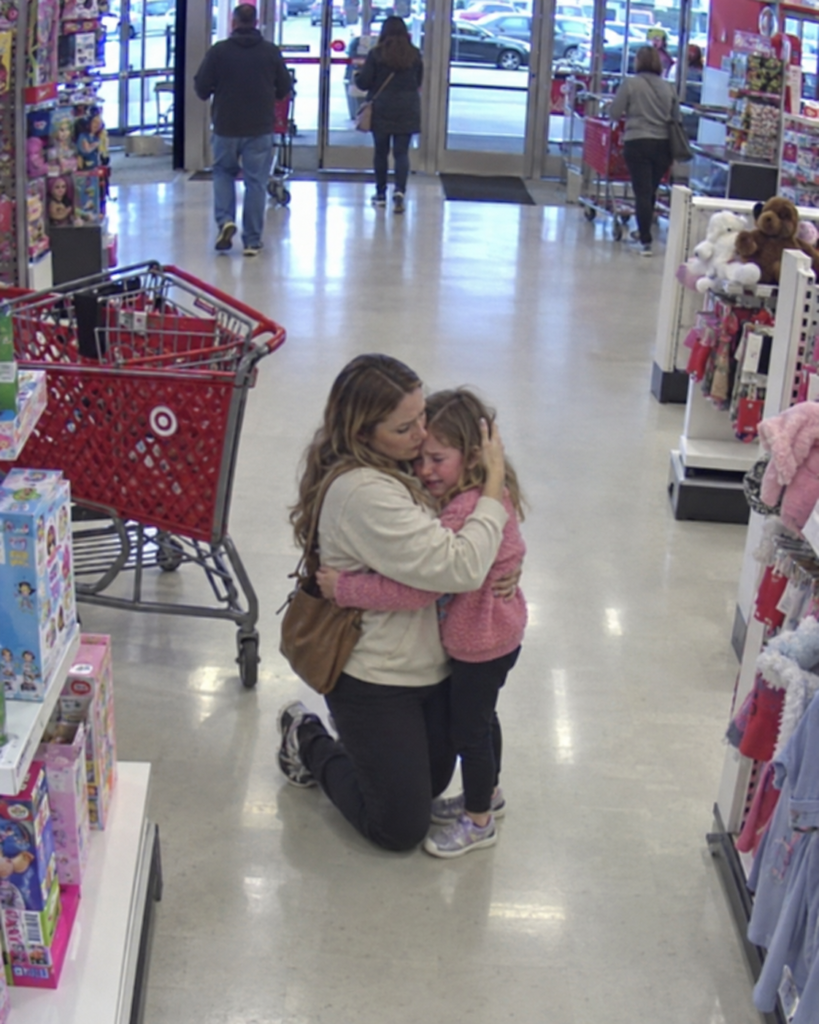
Lily was crouched on the floor with her knees pulled against her chest.
Her shoulders were jerking beneath her sweater.
One shoe was gone.
Her lips looked dry.
In one fist she was gripping a yellow price tag so tightly that the thin string had pressed a red line into her palm.
I dropped to the floor beside her.
She looked up, and the moment she recognized me, she threw both arms around my neck.
I held her so hard I had to remind myself to loosen my grip.
“I’m here,” I told her.
She buried her face against me.
Then she asked the question that changed everything.
“Why didn’t Aunt Megan come back?”
I pulled back enough to see her face.
“What do you mean?”
Lily wiped her cheek with the back of her hand.
She said Megan had told her to wait by the blue bench.
I wanted to ask twenty questions at once, but I knew Lily was frightened, thirsty, and exhausted.
I gave her water from the bottle in my purse.
I wrapped my cardigan around her shoulders.
Then I asked her to tell me only what she remembered.
She said she and Megan had argued near the frozen-food aisle.
Lily had wanted to call me.
Megan had become angry.
According to Lily, Megan pointed toward the bench and told her, “Stay there until you learn to listen.”
Then Megan pushed the grocery cart toward the checkout lanes.
Lily stayed.
Of course she stayed.
She was five years old, and an adult had told her not to move.
She said she waited and waited.
Eventually she became scared and tried to find Megan, but she could not see her anywhere.
So Lily returned to the bench because those had been Megan’s instructions.
She believed Megan was coming back.
I sat there holding my daughter while people walked past us carrying shopping bags.
Outside the glass doors, a pigeon pecked at a silver wrapper near the curb.
I looked at Lily’s missing shoe, the red line in her palm, and the yellow price tag she still would not release.
Then I took out my phone.
My first call was to 911.
I gave the dispatcher Lily’s age, our location, and the basic facts as calmly as I could.
My second call was to Oakridge Market’s closing manager.
His name was Mr. Hall.
I told him my five-year-old daughter had apparently been left alone in the store for nearly two hours, and I asked him to preserve every available security-camera recording from four o’clock onward.
I did not want anything automatically overwritten or replaced overnight.
Mr. Hall hesitated.
He said that sounded excessive.
He suggested Megan might simply have made an innocent mistake during a hectic shopping trip.
I repeated one fact.
“Lily is five.”
There was a pause.
Then Mr. Hall told me he would look into the recordings.
Officer Ruiz arrived while Lily was sitting in my lap near the front of the store eating crackers from a vending-machine packet I had torn open for her.
I gave him the timeline as precisely as I could.
Megan and Lily had left Mom’s house sometime around four twenty.
Megan had returned at 6:18 without Lily.
She had laughed and said she forgot her.
Lily said Megan ordered her to wait near the bench after an argument.
I gave him Megan’s phone number.
Then Lily quietly handed him the yellow price tag.
She had finally loosened her grip on it, but the line across her palm was still visible.
Officer Ruiz asked Lily a few simple questions without crowding her.
He did not put words in her mouth.
He mostly listened.
When we eventually left the store, Lily refused to let go of my hand.
Her missing shoe had not been found.
I carried her to the car anyway.
By the time we returned to Mom’s house, dinner should have been underway.
Instead, the patrol car pulled into the driveway behind us.
Megan was in the kitchen pouring iced tea.
That image stayed with me almost as clearly as Lily behind the patio cushions.
Megan stood there twisting the cap from the bottle while plates of food waited on the counter as though the evening had merely been delayed by traffic.
Mom’s first concern was the patrol car.
She lowered her voice and said everyone needed to calm down before the neighbors noticed.
Officer Ruiz asked Megan to explain what happened at the store.
Her version was completely different from Lily’s.
Megan said Lily had run away from her inside Oakridge Market.
She claimed she had searched for almost an hour.
Then, according to Megan, she had returned to Mom’s house because she needed help finding Lily.
Mom immediately nodded.
She said Megan had been terrified.
Too terrified, apparently, to mention any of that when she came through the door laughing.
I watched Megan screw the cap back onto the iced-tea bottle.
Then loosen it.
Then tighten it again.
Three times.
She never took a drink.
I asked one question.
“If you were terrified, why were you laughing when you walked in?”
Megan’s face hardened.
She called me unstable.
Mom stepped between us emotionally even if she did not physically move.
She put a hand on my arm and murmured that families sometimes said careless things under stress.
That was when I moved Lily behind me.
Not because I expected anyone to touch her.
Because for the first time that night, I understood that my mother was already trying to reduce what happened into a misunderstanding everyone could smooth over before dessert.
I looked at Officer Ruiz.
“Please record every word,” I said.
His pen stopped for a moment.
Then he continued writing.
Megan demanded to know whether I was seriously trying to turn a family mistake into a police matter.
I reminded her that Lily had been alone for nearly two hours.
Megan said I was making the situation sound worse than it had been.
I asked where, exactly, she had searched for Lily during that supposed hour.
She said everywhere.
I asked whether she had spoken with customer service.
She hesitated.
Then she said she could not remember.
I asked whether she had called me.
No answer.
I asked whether she had called Mom.
Nothing.
I asked why she had left the store at all if she believed a missing five-year-old was still somewhere inside.
Mom interrupted and said I was interrogating my sister.
Officer Ruiz told everyone to speak one at a time.
Lily stayed close enough that her fingers were twisted into the back of my shirt.
I could feel every small movement.
At 7:46, my phone rang.
Mr. Hall’s name was on the screen.
I answered immediately.
His voice no longer sounded dismissive.
He told me the security system had captured more than he expected.
I looked at Officer Ruiz.
Megan stopped twisting the tea bottle.
Mr. Hall asked whether I could come back to the store.
I said yes.
Officer Ruiz came with us.
Lily was exhausted, but she refused to stay at Mom’s house without me.
Megan suddenly insisted there was no reason for all of us to return to Oakridge.
She said Lily needed rest.
She said we could deal with the recordings another day.
That was the first thing Megan said all evening that sounded genuinely urgent.
I buckled Lily into the car.
Mom stood in the doorway with her arms folded tightly across her chest.
She did not tell Megan to stop me.
She did not tell me she believed Lily either.
She just said we were turning her birthday into a disaster.
I looked at my daughter in the back seat.
Her eyes were swollen from crying, and she was wearing only one shoe.
I did not answer Mom.
At Oakridge Market, Mr. Hall led us through a narrow employee hallway into the security office.
The room was colder than the rest of the store.
Lily pressed her face into my sleeve while I sat with her beside the desk.
A paper cup rolled gently beneath Mr. Hall’s chair whenever he moved his foot.
There were several screens in front of him.
Officer Ruiz stood behind us with his notebook open.
Megan had followed in a separate car after arguing that she should be allowed to explain whatever we were about to see.
Mr. Hall said very little.
He clicked through the recordings.
The first camera showed Megan and Lily walking into the store together.
The timestamp matched the general time Megan had left Mom’s house.
Lily was beside the cart.
Megan was pushing it.
Nothing about that part looked unusual.
Then Mr. Hall opened footage from another section of the store.
Megan and Lily appeared near the frozen-food aisle.
There was no audio, but their body language was clear enough to show an argument.
Lily stood near the cart while Megan leaned toward her and gestured sharply.
A moment later Lily pointed in the direction of the front of the store.
I remembered what Lily had told me.
She wanted to call me.
Mr. Hall advanced the footage.
The camera angle changed.
We saw Lily moving toward the front area.
The blue bench came into view.
She stopped there.
Megan continued with the shopping cart.
Lily had told the truth about that part.
Officer Ruiz asked Mr. Hall to pause the recording.
He noted the timestamp.
Megan immediately said the video did not prove anything.
She insisted Lily had been misbehaving all afternoon and that she had only told her to sit down for a minute.
That was already different from the story she had told at Mom’s house.
There, Lily had supposedly run away.
Now Megan admitted she had instructed Lily to sit by the bench.
Officer Ruiz asked Megan which version was accurate.
Megan said both could be true.
She claimed Lily had left the bench later and that was when she began searching.
Mr. Hall did not argue.
He simply returned to the computer.
I kept one arm around Lily.
She was staring at the screen now.
I wished she did not have to watch any of it, but she had spent almost two hours wondering whether she had done something wrong.
I wanted the truth established without another adult rewriting it in front of her.
Mr. Hall selected another camera.
This one faced the automatic doors.
Megan stopped talking.
The footage began several minutes before the argument.
Customers came in carrying reusable grocery bags.
A man pushed a cart outside.
Two employees moved near the entrance.
Then Mr. Hall dragged the cursor forward.
The timestamp changed.
Megan appeared near the front of the store.
Officer Ruiz leaned closer.
Mr. Hall slowed the playback.
I could hear the small whir of the computer fan and Lily’s breathing against my shoulder.
No one needed to tell me this camera mattered.
It faced the one place every version of Megan’s story eventually had to pass through.
The doors.
If Megan had searched for Lily for almost an hour before leaving to get help, the footage could show when she actually walked out.
If Lily had run away first, the timing could support that too.
If Megan had done exactly what Lily described, the same camera might answer a question I had been trying not to ask since I found my daughter crouched behind those patio cushions.
Had Megan forgotten Lily?
Or had she known exactly where Lily was when she left?
Mr. Hall moved the cursor back several seconds.
Then forward again.
Megan said something about the angle being misleading.
Officer Ruiz asked her to let Mr. Hall work.
The manager slowed the footage even more.
A figure came into clearer view beside the automatic doors.
Mr. Hall stopped the video.
He stared at the monitor for a second without speaking.
Then he moved the cursor back once more, replayed the same few seconds, and paused at a single frame.
Megan stepped toward the desk.
Officer Ruiz lifted one hand, signaling her to stay where she was.
Mr. Hall enlarged the image.
And every person in that freezing little security office looked at the screen.