PART 1: THE HOUSE HE THOUGHT WAS HIS
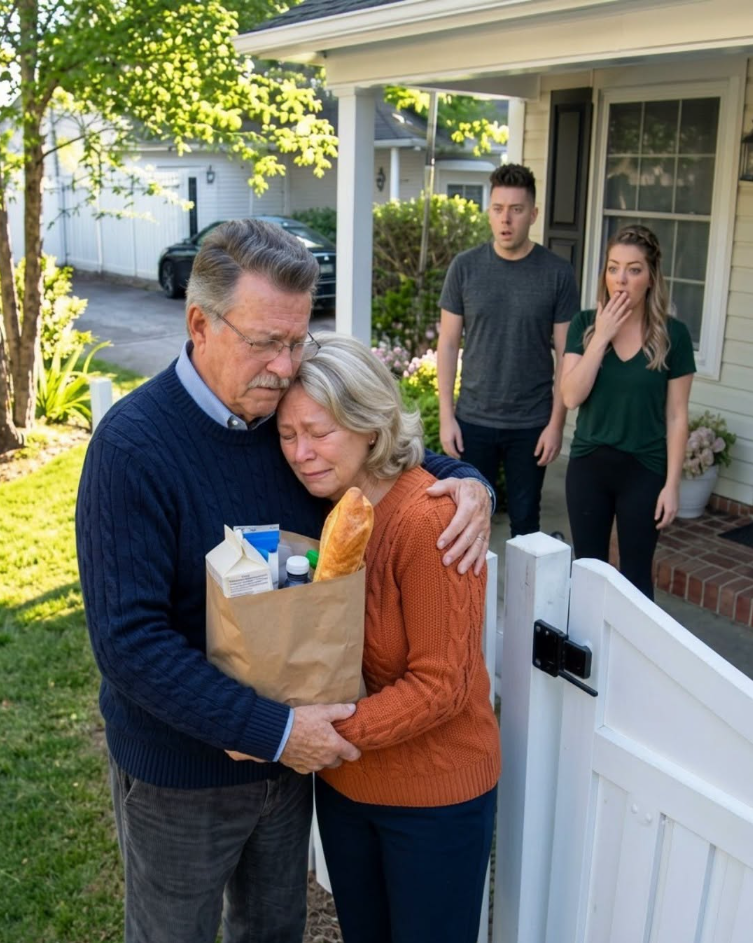
After a long day at work, I returned home and found my wife standing outside the gate of the house we’d shared for decades.
She held a small bag of groceries in one hand, while her other hand clutched her keys.
“Tom,” she whispered, her eyes filling with tears. “Ethan says this is his house now. He changed the gate code and told me I had to leave.”
I took the grocery bag from her trembling hand and looked toward our home.
I couldn’t have imagined that evening would change our family so completely.
When I first pulled into the driveway, I thought Linda was spending time in the garden.
My wife had always loved being outside in the late afternoon, particularly when her roses were in bloom.
But she wasn’t anywhere near the flowers.
Instead, she stood motionless beside the locked gate, staring at the security keypad.
Something about her posture immediately worried me.
I parked my truck and got out.
“Linda? Honey, why are you standing out here?”
She turned slowly.
After thirty-eight years together, I knew my wife’s expressions better than anyone else’s.
I knew when she was worried, when she was hiding a surprise, and when she was trying not to laugh.
But I’d never seen her look the way she did that evening.
She seemed humiliated.
As though someone had convinced her she no longer belonged in the place she’d called home for most of her adult life.
The paper bag she carried contained a loaf of bread, a carton of milk, and a bottle of heart medication.
Her handbag hung from her shoulder.
She gripped her house keys so tightly that her knuckles had turned pale.
“Tom,” she said shakily, “Ethan changed the security code.”
I frowned.
“What do you mean?”
She looked down.
“He told me the house belongs to him now. He said I should get out before you came back because I’ve already spent too many years living off what he considers his inheritance.”
For several seconds, I couldn’t speak.
Our son had said that to his mother.
Ethan was thirty-two years old.
He was our only son, and Linda and I had spent much of our lives trying to provide him with opportunities we’d never enjoyed.
We had supported his education, encouraged his ambitions, and helped him whenever he needed us.
He was now married to Ashley.
Ashley rarely offered to help with anything when she visited.
Yet she always seemed eager to discuss the renovations she wanted to make after the house eventually became theirs.
I’d heard those conversations before.
I hadn’t liked them.
But I’d never imagined Ethan would actually behave as though his inheritance had already been handed over.
I approached the keypad and entered our usual code.
Access denied.
I entered it again.
Access denied.
Behind me, Linda wiped her cheeks.
“He said I shouldn’t cause a scene.”
I turned toward her and carefully took the groceries.
“Come on, sweetheart.”
She hesitated.
“Tom, please don’t start an argument.”
I shook my head.
“I’m not interested in fighting with him.”
Then I looked toward the house.
“But he needs to remember something.”
I led Linda around the side of the property toward the garage.
Ethan had forgotten an important detail.
I’d built this house long before electronic security gates and smart locks became common.
I knew its original entrances.
And I knew exactly where I’d hidden a spare key years earlier.
Inside the shed was an old work boot.
I reached into it, retrieved the key, and unlocked the mechanical lock on the side entrance.
Within moments, Linda and I were inside.
What I found in the kitchen made my anger rise.
Ethan stood beside the counter with Ashley.
She held a measuring tape.
He was examining the wall between the kitchen and dining room.
They were discussing how to renovate the property.
Our property.
While Linda had been left outside with her groceries and medication.
Ethan noticed us first.
His expression changed immediately.
“Dad?”
Ashley lowered the measuring tape.
Ethan looked from me to his mother.
“Listen, we need to have a conversation.”
I set Linda’s grocery bag on the counter.
Then I faced him.
“No, Ethan,” I said. “You’ve done enough talking for one evening.”
I pulled out a chair for Linda.
“Now you’re going to listen.”
Ashley crossed her arms.
“Tom, there’s no reason to make this situation unpleasant. We were only discussing sensible arrangements for the future.”
I looked directly at her.
“You consider locking my wife outside her own home a sensible arrangement?”
Ethan moved forward.
“Dad, Mom was overreacting. We tried explaining things, but she refused to listen.”
I glanced at Linda.
She stood beside the kitchen table, looking uncomfortable.
It was the same table where she’d served countless meals.
The same kitchen she’d helped plan and furnish.
For decades, she’d cared for every corner of this house.
Yet now she looked almost afraid to move around in it.
I turned back to Ethan.
“What exactly was your mother refusing to understand?”
He let out an exaggerated sigh.
He spoke as though he were the sensible adult and Linda and I were confused children.
“Dad, look at the situation realistically. You and Mom aren’t getting younger. Maintaining a house this size is becoming unnecessary.”
I remained silent.
He continued.
“Ashley and I have discussed it. The smartest solution is for us to move in and start managing the property.”
My jaw tightened.
“And what happens to us?”
“Well, you can use the guest bedroom for now. Then, once we figure out a suitable retirement community or senior living arrangement, we can make the transition.”
Linda drew a sharp, distressed breath behind me.
I kept my eyes on our son.
“So let me understand. You and Ashley decided to take control of our home and relocate us.”
He nodded.
“As a practical matter, yes.”
“Without discussing it with either of us?”
Ashley lifted her chin.
“Someone has to plan for what’s coming.”
I looked toward her.
“And apparently, that someone is you?”
She offered no answer.
I faced Ethan.
“Did you really tell your mother she had to leave?”
His confidence weakened.
“I told her to step outside and calm down.”
I held his gaze.
“Ethan, she was standing beyond the locked gate with her medication and groceries. You had changed the code so she couldn’t enter.”
He looked away.
He didn’t apologize.
He didn’t even attempt a convincing explanation.
His silence was enough.
I walked toward my study.
Ethan hurried after me.
“Dad, don’t do anything extreme.”
I didn’t respond.
He knew what I kept in that room.
For decades, I’d carefully organized the documents relating to our home, our savings, our estate, and the hardware company I’d spent most of my adult life building.
I’d always imagined Ethan might eventually take over the business.
I wanted to step aside when the time was right and know that something I’d built would continue within the family.
But imagining a future for my son was not the same as giving him ownership.
And it certainly wasn’t permission to humiliate his mother.
I opened the safe and removed a thick folder.
Inside were the property deed, trust papers, wills, insurance records, and company documents.
I placed everything on my desk.
“Look at me, Ethan.”
He reluctantly met my eyes.
“This home belongs to Linda and me.”
I tapped the documents.
“Not to you.”
His jaw tightened.
“The business is also still mine. And our retirement accounts, savings, and estate are ours to manage.”
Ashley appeared in the doorway.
She no longer looked nearly as confident.
I continued speaking.
“You and your wife seem to have made plans around property and money that neither of you owns.”
Ethan swallowed.
“Dad, I thought—”
I interrupted.
“That’s the problem. You thought your inheritance mattered more than the people who worked their entire lives to create it.”
Then I picked up my phone.
I called Mark Ellison, our longtime attorney.
When he answered, I switched to speakerphone.
“Mark, I need to make some changes to our estate and business arrangements.”
“Of course, Tom. What’s happened?”
I looked at Ethan.
Then at Ashley.
And I made a decision that neither of them had expected.
“I want to review our trust and remove Ethan as the designated successor trustee. I also want him taken out of the company’s future ownership transition plan.”
Ethan stared at me.
“Dad, wait.”
But I wasn’t finished.
PART 2: THE INHERITANCE HE LOST
I kept the phone on speaker and continued giving Mark my instructions.
“And I’d like you to prepare whatever legal notice is appropriate to prevent Ethan and Ashley from entering our property without our permission.”
Her expression shifted from surprise to outrage.
I glanced toward Linda.
“Yes,” I replied. “I mean every word.”
Ethan’s disbelief quickly turned into anger.
“So you’re really doing this?” he demanded. “You’re throwing away your own son’s future because Mom got emotional?”
Linda flinched at his words.
I saw it.
And suddenly, I understood something that made the situation even more painful.
This might have been the first time I’d personally heard Ethan speak to his mother with such disrespect.
But her reaction suggested she’d heard that tone before.
I stepped between them.
“Watch your tone when you speak about your mother.”
Ashley grabbed Ethan’s arm.
“This is completely unreasonable. We were trying to help the family.”
I shook my head.
“No. You were trying to claim an inheritance while the people who own it are still living.”
She pressed her lips together.
For once, she had no convincing response.
Mark’s voice came through the phone.
“Tom, I’ll begin preparing the documents tomorrow morning. For tonight, if anyone refuses to leave your property, you can contact local authorities for assistance.”
Ethan stared at the phone.
“You’d really involve the police against your own son?”
I looked at him for a long moment.
And I remembered the little boy he’d once been.
I remembered Ethan racing toward me after baseball practice.
I remembered helping him build school projects at the kitchen table.
I remembered the nights Linda stayed awake beside his bed whenever he was sick.
I remembered the young man whose future we had worked so hard to secure.
We had given him love.
We had given him stability.
And whenever we could, we’d given him opportunities that had never been available to us.
But somewhere along the way, Ethan had begun treating those gifts as proof that everything we owned already belonged to him.
I spoke carefully.
“You’re my son, Ethan. That will never change. But being my son doesn’t give you permission to mistreat your mother or take control of our home.”
He turned his face away.
I continued.
“I’m asking you to leave tonight. And until we’re ready to discuss what happened respectfully, you and Ashley are not welcome to come back.”
He stood motionless.
For several seconds, I thought he might finally apologize.
But Ashley snatched up her handbag.
“Come on, Ethan.”
They left approximately twenty minutes later.
Ethan slammed the front door hard enough to make several picture frames shake against the wall.
Then the house became quiet.
Linda sat down at the kitchen table.
And she began crying.
There was no dramatic outburst.
No shouting.
Just the exhausted tears of a woman who had been holding herself together for too long.
I made her a cup of tea.
I set her heart medication beside it.
Then I sat down next to her.
“I’m sorry, Linda.”
She shook her head.
“You didn’t do this.”
“I know,” I said. “But I wish I’d recognized what was happening sooner.”
She reached for my hand.
We sat together without speaking.
After thirty-eight years of marriage, we didn’t always need words.
But that evening, the silence carried more pain than I could remember feeling in a long time.
I kept thinking about Linda standing outside the gate.
About the small grocery bag in her hand.
About the shame on her face when she told me what our son had done.
She had spent decades helping make this house a home.
She had raised our children here.
She had cared for our family through illness, disappointment, financial pressure, and countless ordinary challenges.
Yet Ethan had looked at that same house and seen only the inheritance he expected to receive.
I couldn’t change what had happened.
But I could make sure Linda never had to experience it again.
The following weeks were difficult.
Ethan called repeatedly.
He sent lengthy messages accusing us of ruining his future.
He insisted we were selfish.
He claimed we were overreacting.
He argued that we should have appreciated his willingness to manage the property.
But in all those conversations, one thing was missing.
He never acknowledged the pain he’d caused his mother.
Ashley began posting vague complaints online about older generations refusing to share their wealth.
She seemed determined to present herself and Ethan as victims of an unreasonable decision.
I didn’t respond publicly.
There was no point arguing with strangers about a home they didn’t own or a situation they hadn’t witnessed.
Instead, Linda and I focused on protecting ourselves.
Mark began preparing the legal paperwork.
We reviewed our trust and updated the successor trustee arrangements.
We changed the company’s succession documents and informed the appropriate business representatives.
We also replaced the electronic locks and secured access to the property.
Linda and I met with Mark in person to make certain that every change reflected our wishes.
For years, we’d considered Ethan’s future whenever we made a major financial decision.
Now we were finally asking a different question.
What did Linda and I want for the years we had left together?
We had worked hard.
We had raised our children.
We had built a business and a home.
And we were entitled to enjoy the life we’d created.
When our daughter Megan learned what had happened, she immediately booked a flight from Denver.
She arrived two days later.
The moment she saw Linda, she hurried across the living room and wrapped her arms around her.
They held each other for a long time.
Then Megan looked at me.
“Both of you are coming to Denver with me.”
Linda blinked in surprise.
“What?”
“For a week,” Megan said. “No discussions about the house. No paperwork. No arguing. You’re going to rest.”
I opened my mouth to object.
Megan pointed directly at me.
“And Dad, that includes you.”
For the first time in several days, Linda laughed.
It was a small sound.
But hearing it lifted something heavy from my chest.
So we went to Denver.
And that week turned out to be one of the most peaceful vacations we’d enjoyed in years.
We took slow walks in the mornings.
We ate meals without worrying about arguments.
We visited places we’d always wanted to see.
And in the evenings, we talked about ordinary things.
Not inheritance.
Not property.
Not business succession.
Not the obligations other people believed we owed them.
We simply enjoyed being together.
Gradually, Linda began smiling again.
I hadn’t realized how much I’d missed seeing her relaxed and happy.
Watching her enjoy those quiet days reminded me why we’d worked so hard in the first place.
It wasn’t so that someone else could decide when we should leave our home.
It was so we could have security, independence, and time together.
When we returned, the house felt different.
Nothing about its walls had changed.
The same furniture stood in the same rooms.
Linda’s roses still grew in the garden.
But we were no longer waiting for Ethan and Ashley to approve of how we lived.
We had taken responsibility for our own future.
Three months passed.
Then one afternoon, Ethan returned.
This time, he came alone.
There was no Ashley beside him.
No discussion about the property.
No demands about his inheritance.
When I opened the front door, he was standing on the porch with a small grocery bag.
His eyes were red.
I glanced inside the bag.
Bread.
Milk.
And a box of Linda’s favorite tea.
The sight immediately reminded me of the groceries she’d been carrying on the evening he locked her outside.
Ethan looked at me.
“Dad,” he said quietly, “could I speak to Mom?”
I studied his face.
Then I stepped aside just enough to call Linda.
She approached the doorway.
And when Ethan saw her, his expression changed.
“Mom, I’m sorry.”
Linda didn’t answer immediately.
Ethan looked down at the grocery bag.
“I kept thinking about the house. About what I’d eventually receive. About all the plans Ashley and I had made.”
His voice shook.
“I convinced myself I was protecting my future.”
He lifted his eyes toward his mother.
“But I forgot that this isn’t just some property waiting to become mine.”
He paused.
“It’s your home. It’s where you’ve lived your life. And I treated you like you didn’t belong here.”
Linda’s eyes filled with tears.
But this time, she didn’t lower her gaze.
She didn’t apologize for being hurt.
And she didn’t immediately rush to reassure him.
She stood in the doorway, looking directly at our son.
“I love you, Ethan,” she said. “But what you did hurt me more than I can explain.”
He nodded.
“I know.”
“And one apology isn’t going to make everything normal again.”
“I understand.”
Linda opened the door a little wider.
Not all the way.
Just enough to show that she was willing to begin a conversation.
And for the first time in months, our son entered the house without acting as though it already belonged to him.
PART 3: WHAT OUR SON FINALLY UNDERSTOOD
That afternoon, Linda and Ethan spoke for nearly an hour.
I stayed nearby but allowed them the space they needed.
No attempt to shift blame.
For once, Ethan listened to his mother.
She explained what it had felt like to stand outside the gate with her groceries and medication, unable to enter the home she’d cared for over so many years.
She told him that being treated like a burden by her own son had hurt more than the inconvenience of being locked outside.
The security code could be changed.
The locks could be replaced.
But the feeling that her child no longer respected her wasn’t something she could simply forget.
Ethan listened.
It was the kind of conversation our family should have had long before that terrible evening.
Eventually, we agreed to begin family counseling.
We weren’t pretending everything was fixed.
And we weren’t willing to return to the same arrangement that had allowed Ethan to believe he could make decisions about our lives without consulting us.
If he wanted to rebuild our relationship, it would take time.
Trust would have to be earned through consistent behavior.
He would need to call before visiting.
He couldn’t simply arrive at the house whenever he pleased.
And he would have to respect our decisions, even when he disagreed with them.
His apology was a beginning.
It wasn’t a guarantee that everything would immediately return to normal.
We also made another matter perfectly clear.
The estate documents would remain exactly as we’d revised them.
Ethan would not be restored as the designated successor trustee simply because he’d apologized.
He would not automatically regain his place in the company’s ownership transition plans.
Our willingness to consider reconciliation didn’t mean we were prepared to surrender the boundaries we’d established.
Forgiveness and inheritance were separate matters.
And our home wasn’t a reward to be offered in exchange for good behavior.
It belonged to Linda and me.
Over the following months, Ethan began making an effort.
He called to ask how his mother was feeling.
He visited when we invited him.
Sometimes he helped with small tasks around the house.
But unlike before, he no longer behaved as though those favors entitled him to something in return.
He wasn’t earning points toward ownership.
He was simply helping his parents.
The process wasn’t perfect.
There were awkward conversations.
There were moments when old habits resurfaced.
And there were times when Linda and I had to remind him of the boundaries we’d agreed upon.
But gradually, he seemed to understand something that should have been obvious from the beginning.
Being part of a family wasn’t about calculating what you might eventually receive.
It was about how you treated the people who loved you while they were still there.
One quiet evening, Linda and I sat together on our front porch.
The sun was beginning to set behind the garden.
A gentle breeze moved through the roses she’d planted years earlier.
The same roses she’d always loved tending in the late afternoon.
She rested her head against my shoulder.
For a while, we simply watched the fading light.
Then she spoke.
“Tom?”
“Yes, sweetheart?”
“Thank you for bringing me back into our house that day.”
I turned toward her.
Here was the woman who had stood beside me for thirty-eight years.
The woman who had worked and sacrificed alongside me.
Who had helped raise our children.
Who had turned an ordinary building into a place filled with memories.
I took her hand and gently squeezed it.
“Linda, you never stopped belonging here.”
She smiled.
And sitting beside her, I finally understood just how important that truth was.
A house may someday become an inheritance.
It may be passed down through generations.
It may eventually belong to children or grandchildren.
But until that day comes, it remains the home of the people who own it.
It holds their memories.
Their history.
Their security.
And their right to decide how they wish to spend the rest of their lives.
No adult child, regardless of how deeply loved, has the right to take those things away.
Ethan would always be our son.
That bond hadn’t disappeared.
But loving him didn’t require us to accept disrespect.
It didn’t mean allowing him to frighten his mother or decide where we should live.
And it certainly didn’t mean handing over the property we’d spent our lives working to build.
That evening taught me something I wish I’d understood sooner.
Protecting your family doesn’t always mean giving people what they want.
Sometimes it means drawing a boundary they never expected you to draw.
Sometimes it means saying no to someone you’ve spent your entire life trying to help.
And sometimes the most loving thing you can do is refuse to let another person continue behaving in a way that harms everyone around them.
Linda and I hadn’t worked for decades just to become unwanted guests in our own home.
We had built a life together.
And we still had every right to enjoy it.
As the evening grew darker, Linda leaned against me again.
The porch was peaceful.
The garden was quiet.
And for the first time in a long while, neither of us felt the need to worry about who might be making plans for our future.
We were home.
Exactly where we belonged.
So tell me, America: If your adult son locked his own mother out of her home because he believed the property should already belong to him, would you eventually give him another chance—or would that betrayal permanently change your relationship?
THE END.