PART 1
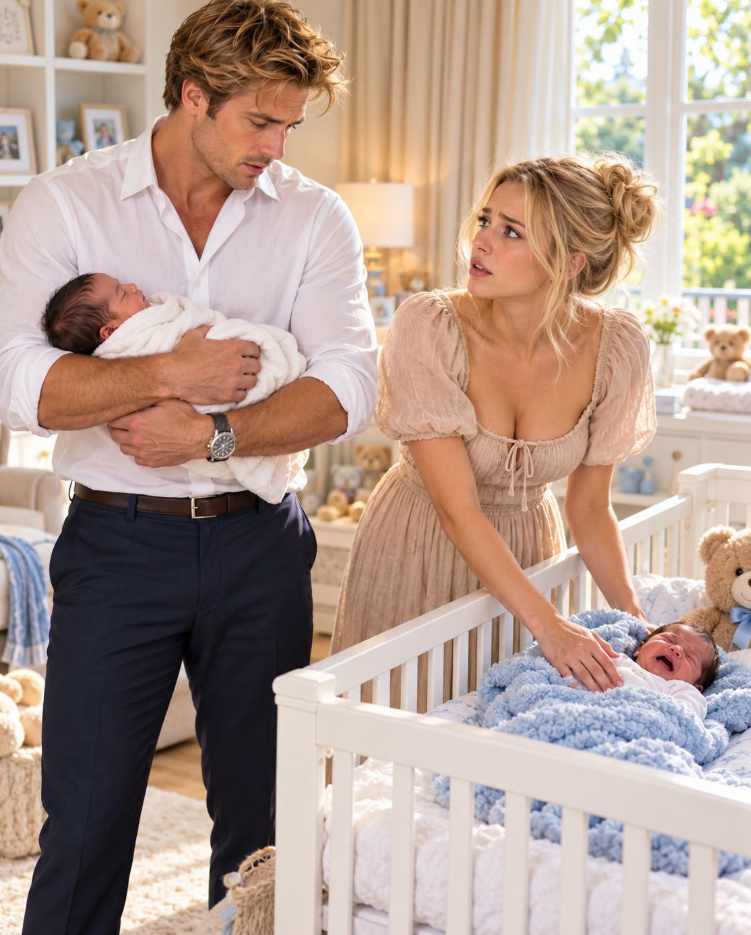
My younger twin had been fussing for nearly ten minutes when my husband walked past the nursery without even looking inside. He picked up Noah, our older son, kissed his forehead, and carried him downstairs.
I stood beside Caleb’s crib, stunned.
He didn’t even turn around.
Our twins were only six weeks old. Ever since we brought them home, Ethan had constantly held Noah. Caleb could cry until his little cheeks turned red, yet Ethan acted as though he couldn’t hear a thing.
I had asked him about it twice.
But something felt different that evening.
I quietly switched on the old baby monitor in the kitchen and set my phone beside it.
Then I heard Ethan come upstairs again.
He thought I was asleep.
His mother, Linda, was on speakerphone.
“Did you tell her yet?” Linda asked.
“No,” Ethan whispered. “She’ll never understand.”
“Then keep doing what I told you.”
I froze.
“What am I supposed to do about Caleb?” Ethan asked.
A long silence followed.
“Love the child you know is yours,” Linda said.
My hands went cold.
Ethan whispered, “I know which one isn’t.”
I nearly dropped my phone.
Caleb was fussing in the nursery.
Ethan didn’t move.
Then Linda said something even more disturbing.
“The DNA report is enough. Once the paperwork is finished, you’ll have no responsibility for that baby.”
I covered my mouth to stop myself from reacting.
A DNA report?
For my six-week-old son?
I had never authorized any test.
That night, while Ethan remained downstairs with Noah, I quietly arranged independent paternity tests for both twins.
Three days later, the first result arrived.
I opened it alone.
Then I saw the words: PATERNITY EXCLUDED.
I stared at the result until the letters blurred before my eyes.
PATERNITY EXCLUDED.
The report claimed Ethan was not Caleb’s biological father.
I felt sick.
Then I remembered his words: “I know which one isn’t.”
He already knew.
I called the laboratory listed on the report.
The receptionist checked the case number and paused.
“Ma’am, this is not one of our authorized reports.”
“What?”
“The formatting is ours, but that file number belongs to another patient.”
My heart sank.
Someone had fabricated a false DNA report.
I saved a screenshot and contacted my attorney friend, Melissa, before speaking to anyone else in my family.
She advised me not to confront Ethan just yet.
“If someone fabricated a medical report involving your child,” she said, “you need the original records first.”
That afternoon, I took both babies to their pediatrician and requested official testing through an accredited laboratory.
Then I waited.
Three days felt endless.
Ethan continued acting as though nothing had happened.
He carried Noah everywhere.
Caleb fussed in his bassinet while Ethan watched television downstairs.
I began recording every incident in a notebook: dates, times, what he said, and what happened.
Then the official results arrived.
I opened them with trembling hands.
PATERNITY CONFIRMED.
Ethan was Caleb’s biological father.
Both babies were his.
I started crying, not just from relief, but from anger.
Why had he been treating his own infant like a stranger?
That evening, I checked the baby monitor again.
Ethan was in the kitchen with Linda.
“You said the false report would be enough,” he whispered.
“It is,” Linda replied. “Once Sarah signs the custody agreement, Caleb won’t be your legal responsibility.”
My stomach dropped.
“You promised he’d stay with her.”
“Of course,” Linda said. “But Noah stays with you. The family trust passes through him.”
I could barely breathe.
They weren’t distancing themselves from Caleb because they genuinely believed he wasn’t Ethan’s son.
They were separating the twins because Linda wanted Noah to become the sole heir to the family business.
Then she uttered the words that erased every remaining doubt.
“Your father changed the trust years ago. Two sons means two heirs. One son means everything goes to Noah.”
Ethan whispered, “And Sarah?”
Linda answered, “She’ll agree once you make her believe Caleb isn’t yours.”
I stared at the monitor.
Suddenly, the favoritism made horrifying sense.
It wasn’t instinct.
It was deliberate.
I quietly photographed the screen, saved the audio file, and called Melissa.
Then Ethan walked into the room.
He saw my expression.
He noticed the phone in my hand.
And for the first time, he realized I knew everything.
“What are you doing?” he asked.
I stood between my twins.
“Tell me why you were prepared to walk away from your own son.”
His expression crumbled.
Then his mother called from the hallway.
“Ethan, don’t tell her anything!”
That was when I understood that the real conflict had only just begun.
Ethan looked from me toward the twins.
“I can explain.”
“No,” I said. “Tell me the truth.”
Linda appeared in the doorway.
“Sarah, you’re misunderstanding.”
“You fabricated a DNA report.”
Her face went completely still.
“You paid someone to make me believe Caleb wasn’t Ethan’s son.”
Ethan lowered his eyes.
“It wasn’t supposed to go this far.”
I felt sick.
“You heard Caleb needing comfort and kept walking away.”
His eyes filled with tears.
“I know.”
“And you still picked up Noah.”
“I thought I was protecting him.”
“From what?”
He said nothing.
“From sharing an inheritance with his own brother?”
Linda began crying.
Our family had already endured a difficult pregnancy and delivery, but the real crisis began after the twins were born.
Ethan’s father owned a regional construction company and had established a family trust years earlier.
Ethan’s mother had become obsessed with the possibility that the business would eventually be divided between both children.
She wanted Noah to become the sole heir.
She convinced Ethan that Caleb might not be his.
Then she found a private testing service and arranged for a sample to be submitted using false information. A fabricated report claimed Caleb was not Ethan’s biological child.
Ethan believed it.
Or perhaps he had simply convinced himself that he did. “If you believed that report,” I asked, “why didn’t you ask me?”
“I was afraid.”
“Of losing what?”
“Everything.”
There it was.
He wasn’t trying to protect Caleb.
He was trying to protect money.
PART 2
Linda stepped forward. “You don’t understand what was at stake.”
I looked directly at her.
She broke down.
“Then you should have protected him.”
We preserved the audio recording, screenshots, fabricated report, and official DNA results.
The lawyers explained that falsifying a report and attempting to manipulate custody documents could carry serious legal consequences.
More importantly, they tracked down the actual family trust.
Linda had been wrong.
The trust did not favor the firstborn.
The inheritance was divided equally between Ethan’s biological children.
Noah and Caleb were both protected.
Linda had nearly destroyed the family trying to resolve a problem that had never existed.
I filed for divorce.
Not because Ethan had made one terrible mistake, but because he had repeatedly denied his newborn son comfort and deliberately treated him as less important to protect an inheritance.
There was a difference between being afraid and choosing to cause harm.
The divorce process was difficult, but it also gave me the distance I needed.
For the first time, my babies and I had a peaceful home.
No arguments. No secret phone calls. No one deciding which child deserved more attention.
Just two boys who needed the same thing: love.
A month later, Ethan asked to see them.
I agreed to supervised visits.
When he entered the room, he stopped beside Caleb’s crib.
He started crying.
“I’m sorry,” he whispered.
He picked Caleb up.
Then Noah.
For the first time, both boys rested in his arms together.
I watched in silence.
That was what he should have done from the beginning.
The legal proceedings continued for months.
The court approved a parenting plan that kept the twins together. Ethan initially received supervised visitation, with additional time granted as he attended counseling and demonstrated consistent behavior.
Linda’s access was restricted as well.
The investigation into the fabricated report continued separately.
The trust remained intact.
Both children would receive equal inheritance under its original terms.
The lie had changed nothing financially.
It had only destroyed trust.
Eventually, Ethan admitted that he had suspected the original report might be questionable even before I uncovered the truth.
That hurt.
“You wondered whether it was fake,” I said, “and still ignored Caleb?”
He cried.
“I didn’t know what to do.”
“You could have picked him up.”
He nodded.
“I know.”
Those words couldn’t undo what had happened.
I still went through with the divorce.
People asked why I couldn’t forgive him.
Perhaps someday I could.
But forgiveness didn’t mean I had to remain married to him.
I could hope he would become a better father while refusing to build my future around his fear.
Our divorce became final eleven months after the twins were born.
That evening, I brought Noah and Caleb home.
I carried them inside and settled them into their cribs.
As they slept, they looked almost identical.
The same tiny hands. The same soft cheeks. The same peaceful little faces.
I stood between their cribs and cried.
Not because my marriage had ended.
But because I finally understood how close we had come to letting greed determine the worth of two innocent children.
Three days had changed everything.
At first, I was simply a mother wondering why her husband favored one twin.
Then I uncovered the secret.
Finally, I discovered that both boys were his—and that the entire disturbing scheme had been built around money.
The official DNA test remained in my files.
So did the false one.
One established the truth.
The other revealed how far someone was willing to go to hide it.
I also learned to stop mistaking silence for peace.
For years, Ethan’s family had dismissed their secrets as “private family matters,” as though keeping quiet could make harmful decisions disappear. It couldn’t. It only allowed those decisions to continue unchecked.
I wanted my boys to grow up in a home where difficult truths could be discussed without anyone being punished for asking questions.
That became the boundary I refused to compromise on.
Today, Ethan still sees both boys.
Little by little, he is becoming the father he should have been from the very beginning.
I don’t know whether we’ll ever have a normal relationship again.
Maybe we won’t.
But the twins are growing up together.
They know nothing about DNA reports or family trusts.
They only know that when one fusses, the other reaches closer.
Every night, as I tuck them into bed, I remember the lesson I learned the hard way:
Children should never have to earn a parent’s love.
Not through blood. Not through inheritance. Not through being born first.
And never through money.
The day I filed for divorce wasn’t the day my family ended.
It was the day I decided my children would never be taught that love should be divided according to who was considered more valuable.