“If they walk into my house again like it’s a free hotel, I’m not opening the door this Christmas—not even if they stand outside crying.”
I said it in my kitchen, with the dishwasher groaning behind me and the smell of cinnamon coffee turning bitter on the counter.
Outside, December pressed cold against the windows, and the porch light flickered over the empty driveway like it remembered every SUV, every suitcase, every person who had ever pulled in assuming I would smile and make room.
Michael didn’t laugh.
He looked at my phone, then at me, and said quietly, “Emily… they’ve already started.”
For years, our three-bedroom house had been treated like Christmas headquarters.
Nobody asked. Nobody confirmed.
They just kept calling it tradition because tradition sounded nicer than unpaid labor.
Every December, the family group chat said the same thing.
“Emily’s house is easiest.”
At first, I was proud of it.
I cooked the turkey, the ham, the sides, the pies, the breakfast casseroles, and the midnight snacks nobody admitted they wanted until they were barefoot in my kitchen at 12:17 a.m.
I set out towels, made beds, stocked coffee, bought extra paper plates, labeled leftovers, and cleaned bathrooms while everyone else watched Christmas movies in my living room.
Then gratitude got thinner.
Expectation moved in.
My brother Chris came days early with his wife, his kids, and enough luggage to make my front hallway look like a motel lobby.
His kids opened cabinets, left sticky fingerprints on the fridge, and once spilled soda across my couch while the adults kept talking like the stain was my problem because the couch belonged to me.
My sister Ashley arrived with oversized suitcases and that tired little smile she used like a permission slip.
She borrowed my shampoo, my charger, my favorite mug, and when I asked her not to treat my dresser like a public shelf, she laughed and said, “Relax, Em. I’m tired too.”
And my mother never helped.
She supervised.
She stood in my kitchen tasting gravy off a spoon and saying, “It needs more care. Women used to take pride in hosting.”
That was her thank-you.
I stayed quiet because Christmas has a way of making the tired woman look cruel the second she stops serving.
You can wash dishes with cracked hands, sleep four hours, pay for groceries you can barely justify, and still become selfish the moment you say you need rest.
Last Christmas finally broke something in me.
Seventeen people came through my front door.
No one brought food.
No one handed me cash.
No one stripped a bed or wiped a counter without being asked twice.
When I asked Chris to take out the trash, he chuckled like I had asked him to perform onstage.
“You’re the organized one,” he said.
The next morning, I opened the fridge and found the cake I had saved for Michael’s parents gone.
The plate sat there smeared with frosting and crumbs, a little white flag of disrespect.
“The kids ate it,” my sister-in-law said casually. “What did you expect?”
That was when I understood.
I wasn’t family in that house.
I was the service.
Kitchen, hotel, maid, and villain if I asked for basic respect.
So this year, on Friday night at 7:38, when the group chat started filling with Christmas plans again, I typed one message and stared at it until my hands stopped shaking.
“This year I’m not hosting. I need rest. We can meet somewhere else.”
I read it three times.
Then I sent it.
The silence lasted less than a minute.
“Don’t be selfish,” my mother replied.
“We already planned to come,” Chris added.
Ashley wrote, “Breaking tradition because you’re too lazy? That’s not a good look.”
I set the phone facedown on the counter.
My palms were damp, and the dishwasher kept rumbling like it was trying to cover the sound of my breathing.
Some people don’t want boundaries explained.
They want them softened until they disappear.
At 8:11, Ashley posted on Facebook:
“Sad when someone values comfort over family.”
My mother liked it.
By 8:26, relatives who had never scrubbed one pan in my house were commenting like judges.
“Family comes first.”
“Some people forget where they came from.”
“Christmas isn’t about convenience.”
The screen glowed in my hand while the kitchen stayed still around me.
The coffee had gone cold.
The sink smelled faintly of dish soap and cinnamon.
Michael reached across the counter and covered my fingers with his.
“Don’t respond,” he said.
I wanted to.
I imagined posting pictures from last Christmas—the trash bags stacked by the garage door, the soda stain on the couch, the guest room floor hidden under wet towels and candy wrappers.
For one ugly second, I picked up my phone.
Then I put it down.
Anger costs more when everyone has trained you to be the calm one.
So I did something better.
I documented everything.
Screenshots.
Times.
Messages.
Names.
7:38 — I said no.
8:11 — Ashley’s public post.
8:26 — first family comment.
I saved the group chat, the Facebook thread, and every text that followed.
Then I listed the house.
Monday morning, I called a local realtor and asked what it would take to close fast.
By Wednesday, we had three offers.
I accepted the one with a thirty-day escrow and no drama over the inspection report.
I signed every page, initialed every disclosure, and packed our personal things quietly while my family kept posting about “togetherness.”
I sold the dining room table first—the one they had scratched, stained, leaned on, prayed over, and never helped clear.
Then the guest bed.
Then the extra dinnerware they loved using like my cabinets were hotel storage.
By December 20th, the living room echoed.
At 10:00 a.m., my mother called with sugar in her voice.
“Emily, honey, we’re two hours away. Make sure the guest room is ready for the kids. Chris is driving, and we’re all so hungry.”
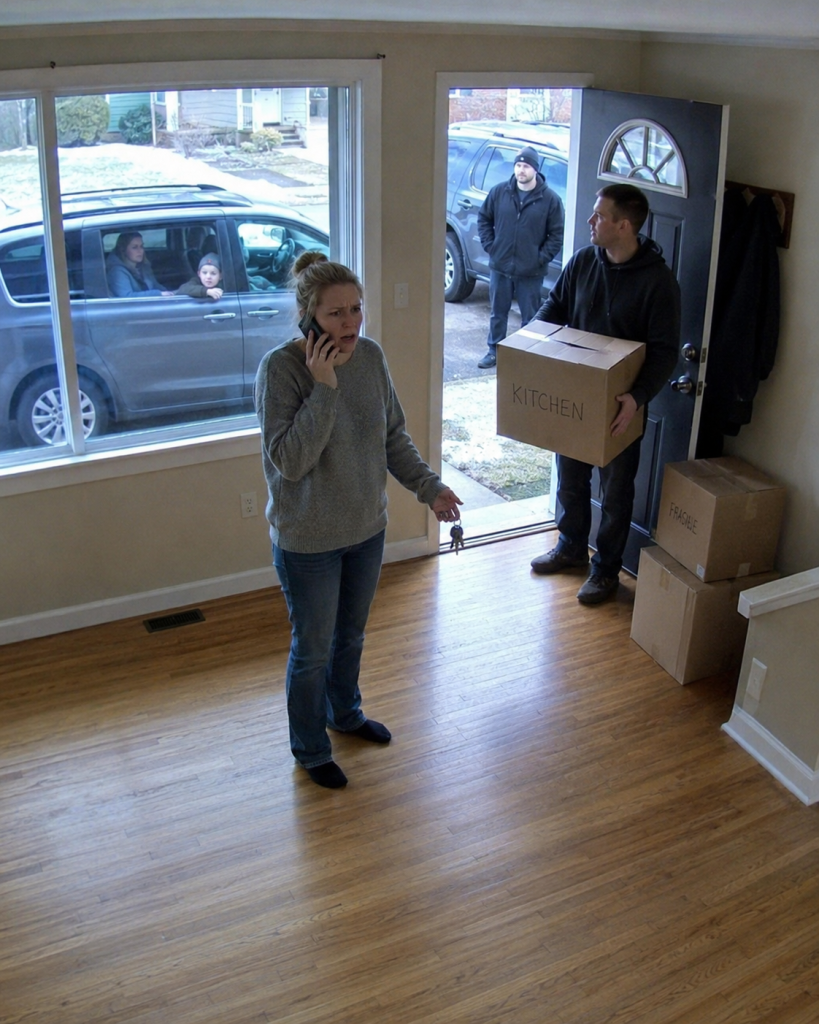
I stood in the center of the empty house, my keys in one hand, my phone in the other, and looked through the front window at my car idling in the driveway.
Then the new owner’s SUV turned onto the street.
And for the first time all December, my hand did not shake.
“Mom,” I said, watching the headlights slow in front of the mailbox, “you’re going to have to—”
“—turn around.”
The words came out so calm that for a second I almost didn’t recognize my own voice.
On the other end, my mother made a small confused sound, the kind she always used when she wanted me to rush in and fix whatever discomfort she had decided was mine to handle.
Behind her, I could hear kids talking, a fast-food bag crinkling, and Chris saying something about being hungry.
“What do you mean, turn around?” she snapped.
“Emily, don’t start this. We are almost there.”
I looked around the empty living room.
No tree.
No couch.
No guest blankets folded at the end of the hall.
Just clean baseboards, bare walls, and the echo of a house that had finally stopped asking me to apologize for owning it.
Then the new dramatic part happened.
A second call started flashing across my screen.
It was Ashley.
And underneath her name was a text she had sent to the family group chat at 10:04 a.m., only four minutes after my mother called:
“We’re pulling in soon. Everybody get ready to take pictures if Emily tries to embarrass Mom.”
Michael saw it over my shoulder and went still.
My mother must have heard my silence because her voice changed.
“Emily,” she said slowly. “What did you do?”
Outside, the new owner stepped out of the SUV holding a folder from the closing office and looked toward the porch like she was waiting for me to hand over the final key.
That was when Chris finally came on the line, loud and breathless.
“Em? Why is there another car in your driveway?”
I looked at the key in my palm, looked at the empty hallway where seventeen people had once dumped their bags, and said—