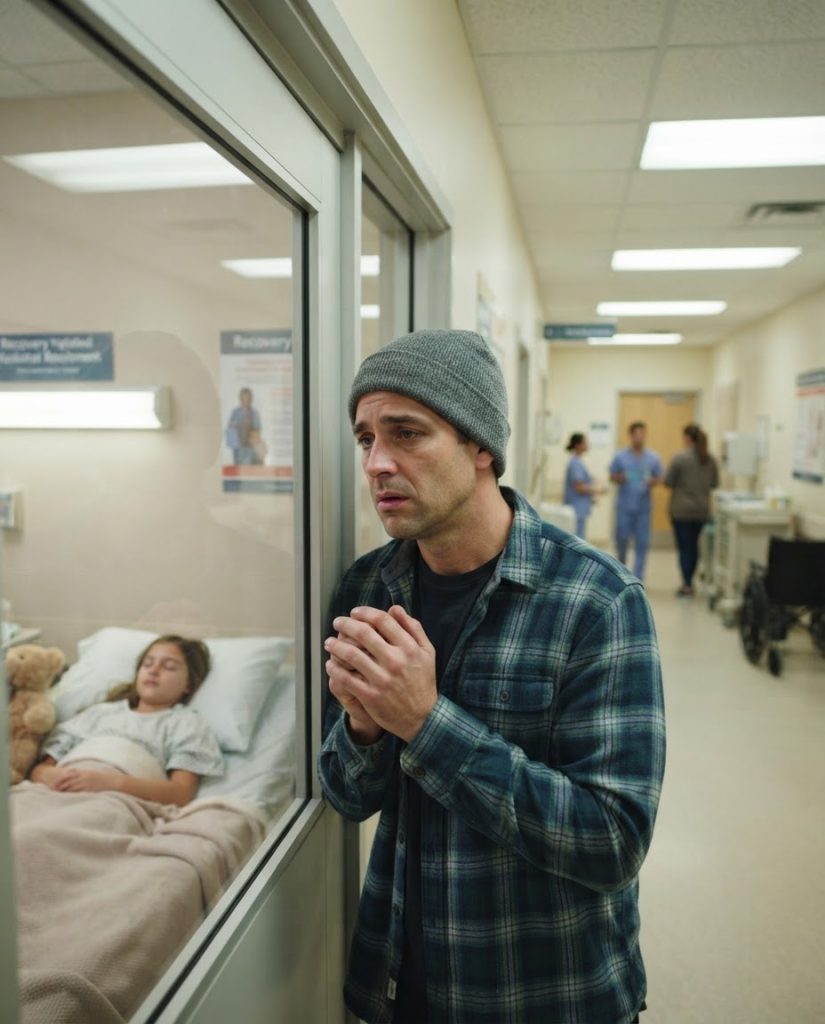
You know those moments that permanently rewire something inside you? The kind you don’t see coming until they’re already halfway through breaking you open. For me, it was a cold Tuesday morning sometime around hour 11 of my daughter’s surgery. I remember staring at the same stale vending machine sandwich. I hadn’t had the stomach to touch. Checking my phone again like it hadn’t been silent for the past 11 hours.
Not a single call, not a single message, not even one of those dry, vague thinking of you texts. I kept refreshing like maybe the apps were broken, maybe there was a tower down, maybe something, anything was delaying the flood of messages I expected, but no, just a blank screen. The kind of silence that doesn’t just echo, but screams.
My name’s Jordan. I’m 38. I work full-time as a project manager for a commercial renovation firm, which basically means I babysit million-dollar construction sites and try not to lose my mind juggling grown adults who act like middle schoolers.
I’m also a single dad. My daughter Lily is 14 and the absolute center of my world. She’s the kind of kid who still says, “Thanks, Dad,” every time I make her lunch, even if it’s just reheated leftovers.
The kind of kid who reads old classics without being told and quietly tucks in a blanket around the dog when she thinks no one’s watching. Smart, kind, a little shy, and way too good for the broken family tree she inherited from me.
Now, when I say family, I mean my parents and younger brother, Austin. We used to be close. Not sitcom clothes, but birthday dinner clothes, group text clothes, the kind of close that always included those subtle jabs that only families can get away with.
But it all started to rot when Lily was born. I was 24, fresh off a nasty breakup with her mother, and barely holding it together. Instead of rallying behind me, my family acted like I’d committed some moral crime by choosing to raise Lily alone.
My mom said things like, “You’re throwing away your future.” My dad offered me a spare room in the basement. Not for me, just for Lily, because kids need a stable home. And Austin? Well, Austin just went radio silent for almost a year. No congratulations, no visit, nothing.
They eventually came around, or at least pretended to. My mom started posting pictures of Lily on Facebook like she was some kind of proud grandma, even though she barely saw her. My dad would toss her a $20 at Christmas and call it spoiling her.
Austin started showing up again once he got engaged to a woman whose parents had money, suddenly needing help with deposits and a little support to get things started. And somehow I was always the one expected to show up, the one to fix things, to lend money, to organize birthdays, to host, to forgive, always forgive.
I told myself it was just the way families worked. That I couldn’t expect them to love Lily the way I did. That maybe being the responsible one meant carrying more weight.
But that Tuesday morning in the hospital, that was the day something inside me cracked.
Lily had been diagnosed with a rare spinal condition about 4 months earlier. I won’t pretend I understood the medical jargon, but the gist of it was this. It was serious. It would get worse, and if we didn’t operate, she could lose the ability to walk.
The surgery was complex, risky, and brutal. 13 hours under the knife, followed by weeks of painful recovery. I kept my family in the loop from the start. Sent updates, shared the surgeon’s notes, even sat down with my parents to explain the timeline.
I didn’t ask for help. Not really. Just maybe some emotional support, a little backup. I thought at the very least they’d show up on the day of the surgery.
Instead, nothing.
I sat in the waiting room with a charged phone and no one to talk to. No one to reassure me, no one to ask how Lily was doing.
The hours crawled. I got updates from nurses every few hours. Each one a little more optimistic than the last, but the silence from my own blood was louder than any monitor beeping in the background.
Around hour 7, I convinced myself they must be on their way. That maybe they were stuck in traffic or running late or just forgot to text.
By hour 10, I gave up on excuses.
I knew the truth.
They didn’t come because they didn’t care enough to come.
It wasn’t like they were out of town. My parents lived 20 minutes from the hospital. Austin works remotely and literally brags about his flexibility every time we meet. No one had a good excuse.
They just didn’t show.
And here’s the part that still makes my jaw tighten.
3 days later, 3 days after the longest, scariest, most emotionally raw moment of my life, I finally get a text from my dad.
Not how’s Lily or we’ve been thinking about you.
No, he wanted to know if I could contribute $3,500 toward Austin’s engagement party.
A destination engagement party in the Bahamas.
He even included a little smiley face like this was normal.
I stared at that message for a long time.
My first instinct was disbelief.
Then came the slow simmering heat of pure electric rage. Not just because of the money, not just because of the timing, but because it confirmed everything I didn’t want to believe about them.
They had completely removed themselves from my life unless they needed something.
I had poured years into keeping those connections alive, showing up when they didn’t, bending when they pushed.
And this, this was what I got in return.
I didn’t respond right away.
I waited until the next morning after another long night sleeping in the hospital chair beside Lily’s bed. She was groggy, in pain, and scared, but still smiled when I brought her ice chips.
I held her hand and told her she was the bravest kid I’d ever known, and I meant it.
Later, once she was asleep again, I opened the banking app on my phone, transferred 1 cent to my dad’s account, added a note, “Put it toward his future.”
Then, I got to work.
Every shared streaming account I’d let them use, gone. Every card they had access to, every emergency fund they’d guilt me into helping with. Every login they still used, cancelled, revoked, or reset.
I wasn’t subtle about it.
I didn’t warn them.
I just cut it all off.
Not out of pettiness, out of clarity.
Something I should have done years ago.
At 6:03 a.m. the next day, my phone started buzzing.
17 missed calls, all from my mother.
And that was just the beginning.
I didn’t answer the first call or the second or the third. But by number five, I was starting to feel that familiar weight pressing against my chest. The same pressure I’d felt a 100 times growing up.
The unspoken obligation, the guilt, the twisted sense that if I didn’t pick up, something worse would happen, that it would somehow be my fault.
So I caved.
Call number six connected.
I stood in the hallway outside Lily’s recovery room, the overhead lights buzzing quietly above me.
My voice came out flat.
“Hello.”
My mom didn’t even say good morning.
No, her voice came sharp and clipped like I was the one who had crossed some line.
“What the heck is wrong with you, Jordan?” she hissed. “Why did I wake up to a bunch of locked accounts? Your dad can’t access the Hulu. Your brother says the gym membership stopped working. Did you seriously send your father a penny?”
I stared out the window and let the silence hang for a beat longer than necessary.
“Did you forget Lily had surgery this week?”
“Oh, don’t start with that. Of course, I didn’t forget.”
“You didn’t call. You didn’t text. You didn’t even ask if she was okay.”
“Well, we figured you had it handled. And you know how your father gets. He’s not comfortable in hospitals. And Austin had his party to plan. It’s not that we didn’t care. We just didn’t want to overwhelm you.”
That word, overwhelm, it hit me like a slap.
“I sat in a waiting room for 13 hours, Mom,” I said, my voice suddenly thick. “13 hours alone while my kid was under for the most invasive surgery of her life. You weren’t worried about overwhelming me. You just didn’t want to be bothered.”
“Jordan, don’t be dramatic. You’re always doing this, making yourself the victim. It’s exhausting.”
There it was.
That familiar tone.
The same one I’d heard when I was 16 and got passed over for Austin’s private school tuition because he had more potential. The same one from college when I had to work two jobs while Austin got a fully paid apartment downtown.
The same tone I heard when I became a father and was told, “You’ll see. Kids ruin your life.”
I hung up without another word.
For a while, she didn’t call back.
But it didn’t end there.
Over the next few days, the messages started trickling in. First from my dad. Short, cold text like, “We need to talk.”
Then Austin playing dumb.
“Dude, what happened? Mom’s freaking out. Can you fix the Netflix thing? It’s my fiance’s account, too.”
Then, when I didn’t respond, the tone shifted.
Mom sent a long message, guilt-laced, and passive aggressive.
“I just don’t understand how you can be so heartless. We’ve always supported you, and this is how you repay us. Cutting off your family over a simple oversight.”
Oversight.
That word made me laugh out loud in the hospital hallway.
By then, Lily was beginning to walk again, her movements slow but determined. She clutched the walker with trembling fingers and beamed with pride every time she took a few steps.
She never once asked where my parents were, never once brought up Austin or anyone else.
She had already learned not to expect much from them.
The week she was discharged, I took her home and set up her room with fresh sheets, new pillows, and a stack of her favorite books.
I cooked her soup, helped her into bed, and made a promise.
One I didn’t say out loud, but one I felt down to my bones.
She will never feel alone again.
Not while I’m breathing.
But the silence from my family didn’t last long.
A week later, I got an invitation in the mail.
White envelope, gold trim, embossed lettering.
It was Austin’s engagement party.
The same one I was asked to help fund.
The same one that would cost nearly 5 grand per guest.
All expenses paid on some beach resort in Nassau.
The note inside wasn’t addressed to me.
It was addressed to Uncle Jordan and Lily.
Like nothing had happened, like we were still part of their world, like they hadn’t abandoned us at our most vulnerable moment.
I almost tossed it in the trash.
But Lily saw it first.
“Are we going?” she asked quietly, her eyes flicking to mine.
I forced a smile.
“No, baby. We’ve got better plans.”
She didn’t ask again.
The next time I saw Austin was a week before the trip.
He showed up unannounced, knocking on my door like we hadn’t been ignoring each other for a month.
I opened it to find him standing there in designer sunglasses, polo shirt too tight around his biceps, and a smug smile plastered across his face.
“Hey, man,” he said, stepping inside without waiting for an invite. “We need to talk.”
I didn’t move.
“About what?”
He walked past me like he owned the place.
“Look, I get it. You’re still mad about the surgery thing. But come on, man. You’ve always been the strong one. We knew you had it under control. It’s not like you needed us there.”
I stared at him.
“That’s the problem, Austin. You’ve never thought I needed anything. You think showing up only matters when it’s convenient.”
He raised his hands defensively.
“Okay, okay, maybe we dropped the ball, but now you’re acting like a child. Cutting off the gym membership. That was low. You know, Jyn’s been using that for her bridal workouts.”
I almost laughed.
“That’s what you’re here for.”
“A gym membership and the credit card,” he added, scratching the back of his neck. “You know, the one Mom said you kept open in case we needed emergency help. That was for family, man.”
“Funny,” I said. “I thought family showed up for each other. Turns out I was wrong.”
He tried to pivot.
“Look, we really want you there. Jen’s parents are asking about you. They think it’s weird you’re not on the RSVP list. I told them you’re just dramatic sometimes.”
My jaw tightened.
Then he added the final twist.
“Also, Dad said if you’re not coming, maybe you could still help cover part of the open bar tab. We’re a little over budget.”
There was a silence between us then, long, stretched thin with tension.
I stepped forward slowly and said in the calmst voice I could manage, “Get out of my house.”
He blinked.
“What?”
“You heard me. Get out and don’t come back here unless it’s to apologize. Not just to me, but to Lily.”
He scoffed.
“Wow. You really think you’re some hero, huh? Playing the martyr again. Always so righteous. You’re not better than us, Jordan. You’re just bitter.”
I didn’t answer.
I just opened the door.
He stood there for a second like he expected me to change my mind, like I’d fold the way I always had, but I didn’t.
I stared straight ahead, jaw clenched, heart pounding like a war drum.
He finally stepped out, muttering under his breath.
I closed the door behind him, but that wasn’t the end.
2 days before the engagement trip, I got another message from my mom.
This time, it was a voicemail.
I must have listened to it five times.
Each time feeling the pressure build in my chest like a rising tide.
Her voice was dripping with guilt trips and indignation.
“Jordan, I don’t know what’s gotten into you. You’re making a scene. You’re embarrassing the family. Austin says you kicked him out. What happened to being a team? We’ve always supported each other, haven’t we? And now you’re punishing everyone because we missed one little event.”
Little event.
Little event.
My daughter nearly lost her ability to walk.
And to them, it was a scheduling inconvenience.
That night, Lily caught me pacing in the kitchen, phone clenched in my hand, face flushed with frustration.
She was using one crutch now, slowly regaining her strength, her gates still wobbly, but determined.
“Dad,” she said gently. “Are you okay?”
I looked at her and felt the tears sting behind my eyes.
She didn’t need to hear the voicemail.
She didn’t need to know the details.
She just needed to know the truth.
“I’m done, sweetheart,” I said, voice cracking.
“I’m done trying to make people care who clearly don’t.”
She stepped forward and hugged me tight, fierce, the kind of hug that says more than any apology could.
In that moment, I realized this wasn’t just about cutting ties.
It was about choosing peace, protecting what matters, and burning the bridge with every last match I had left.
But even then, I didn’t expect what happened next.
Because the morning after their plane touched down in Nassau, I woke up to a new kind of message.
A screenshot from a mutual family friend.
It was a post from Austin’s fiance.
A group photo on the beach, everyone smiling. My parents standing in the middle, drinks in hand, captioned, “Surrounded by all the people who matter most.”
And just like that, the final thread snapped.
I stared at that image for a long time.
Then I opened my laptop, logged into every shared account I hadn’t yet touched.
Banking, streaming, phone plans, every digital cord still connecting us.
One by one, I started cutting.
And as I reached the final account, the one they’d forgotten I still controlled, I hesitated, not out of doubt, out of something else, something colder, sharper, because this time I wasn’t just cutting ties.
I was setting the stage.
And they had no idea what was coming next.
It’s funny how the worst moments don’t always feel dramatic when they happen.
Sometimes they sneak in quiet.
No fireworks, no big arguments, just a quiet, heavy stillness.
That’s how rock bottom felt for me.
It wasn’t the missed calls or the snide messages or even the picture on the beach.
It was the slow realization that I had no family left, at least not in the traditional sense.
The day after the engagement post went up, Lily asked me if we could stop by a bookstore.
Her walking had improved. She was still on a crutch, but she was moving more confidently, and the doctor had given us permission for short outings.
She wanted a new journal, said she wanted to write more.
I was proud of her, obviously, but when we got to the checkout counter and the cashier casually said, “Are you getting ready for spring break too?” something in me cracked.
I didn’t answer, just smiled and nodded.
But later, when I got home and sat alone on the couch after Lily went to bed, I let everything catch up to me.
The years of being the fallback guy, the fixer, the helper, the responsible one, the invisible one, the silence during Lily’s surgery, the fake invitations, the guilt tripping, the way my parents stood on that beach like they didn’t leave me for dead in a waiting room.
I couldn’t stop thinking about it.
I barely slept.
For the first time in years, I felt that dangerous pull again.
The one that whispered things like, “You’re not enough. You’re not doing enough. You’re not worth staying for.”
I wish I could say I brushed it off easily, but I didn’t.
I stopped checking my email, let a few deadlines at work slip, ignored texts from co-workers.
I kept things functioning at home, made dinner, helped Lily with her schoolwork, drove her to follow-up appointments.
But behind my smile, I was unraveling.
And then the medical bills started rolling in.
Even though we had decent insurance, the coverage didn’t come close to touching the cost of a 13-our surgery, multiple specialists, a week-long hospital stay, and posttop physical therapy.
The stack of envelopes on the kitchen counter grew taller by the day.
Every new total felt like another brick on my chest.
I didn’t ask for help.
I already knew what the answer would be.
But here’s where things started to change slowly, quietly.
It started with a client.
I’d been managing this renovation project for a local arts center, nonprofit, tight budget, but good people.
The director, a woman named Diane, noticed something was off with me.
I guess I wasn’t hiding it as well as I thought.
One afternoon, she pulled me aside and asked, “Are you okay?”
It was such a simple question, and it nearly knocked me over.
I didn’t tell her everything, just enough.
That Lily had been sick, that I was behind on a few things, that life had been heavy.
She nodded.
Didn’t press, just said, “If you ever need a reference, a side job, anything, you’ve been incredible to work with. Don’t forget that.”
It didn’t seem like much at the time, but that sentence stayed with me.
The next week, one of the subcontractors I’d worked with on a few projects, Miguel, called and asked if I could consult on a private home job.
“Just a quick review of blueprints,” he said. “Pays well, flexible hours.”
It was the first time in years someone had approached me like I was valuable, like I brought something to the table beyond just keeping everything from falling apart.
I said yes, and that was the start.
Over the next month, I took on two more side jobs.
Nothing crazy, just project consulting, schedule management, a couple of cost estimates.
It wasn’t glamorous, but it paid.
And more importantly, it reminded me of something I’d forgotten.
I was good at what I did.
I started sleeping a little better.
I drank coffee in the morning without that anxious pit forming in my gut.
I still had bad days, lots of them, but they didn’t sink me the way they used to.
I could feel the tide shifting, even if it was slow.
Lily noticed, too.
“You’re laughing more,” she said one evening while we were playing a card game. “It’s nice.”
I smiled.
“That’s cuz you’re finally letting me win.”
She rolled her eyes.
“I’m literally beating you right now.”
We laughed until we cried.
And then one day while clearing out an old storage bin in the garage, I found something I hadn’t seen in years.
It was a notebook, leather bound, scuffed along the edges.
My handwriting, messy and half-finished, covered the first few pages.
Notes from a business idea I had back in my 20s.
A renovation startup, one that catered to small businesses and nonprofits.
Budget-friendly design, accessible project management.
I had called it Truner of Projects.
I’d forgotten all about it.
But as I flipped through the pages, something stirred in me.
Not a pipe dream, not nostalgia, something closer to purpose.
That night, I stayed up until 200 a.m. researching local LLC requirements, business loan options, and website templates.
The next week, I filed the paperwork.
True North Projects was back on the table.
This time, for real.
I didn’t tell anyone right away.
Not even Lily.
I just kept building quietly, one project at a time, one spreadsheet, one quote, one website section.
I reached out to Diane at the arts center and told her about the idea.
She was immediately on board and referred me to two other nonprofits.
Miguel offered to help with logo design, said his cousin did graphics.
I set up a separate business account, started tracking invoices, got a PO box.
Each little task made it feel more real.
By month three, I had four paying clients and two more lined up.
One of them asked if I could manage their annual budget and recommend where to trim costs without cutting impact.
I spent two days buried in receipts and invoices.
Delivered a 30page report that saved them over $8,000 a year.
They paid me double my quoted fee.
I wasn’t rich.
I wasn’t even fully afloat yet.
But I wasn’t drowning anymore.
And most importantly, I didn’t owe any of it to the people who had abandoned me.
I didn’t owe it to my parents or Austin or anyone who only saw me as a backup plan.
I built it myself with Lily watching the whole time.
Around this time, I started therapy again, something I hadn’t done since my early 20s.
I found someone local, someone with experience dealing with complex family trauma.
We talked about boundaries, about guilt, about the psychological warfare that families like mine wage without ever raising their voices.
One session, I told her about the medical silence, the beach photo, the voicemail from my mom.
She didn’t say much at first, just let me speak.
Then she looked at me and said, “You’ve been grieving a relationship that never existed.”
That line gutted me, but it also set me free.
I wasn’t crazy for feeling abandoned.
I wasn’t overreacting.
I wasn’t selfish.
I was just finally seeing the truth.
I had been holding on to the idea of a family.
One that never showed up.
One that existed only in holiday photos and fake smiles.
One that only reached out when they wanted something.
Letting go of that fantasy hurt more than I expected.
But once it was gone, I could finally breathe.
I told Lily bits and pieces of what I was working on.
She asked smart questions, wanted to see the logo, drew a little design of her own on a sticky note, and stuck it to my laptop.
“You got this, Dad.”
And then something happened.
I didn’t expect.
I got a call from a number I didn’t recognize.
It was a woman named Emma, one of Jen’s Austin’s fiance’s bridesmaids.
She sounded hesitant.
Awkward.
“I hope this isn’t weird,” she said. “But I didn’t know who else to talk to. I’ve been following your business stuff online. It’s really cool. And uh, there’s something you should probably know.”
I sat up straight.
“What kind of something?”
She hesitated.
“Just something about your brother and your parents. I shouldn’t even be telling you this, but after the way they talk about you behind your back, I couldn’t stay quiet anymore.”
There was a long pause.
Then she added, “You’re going to want to see the group chat.”
I blinked.
“What group chat?”
Another pause.
“The one they didn’t mean to add me to.”
And right there, right in that moment, I felt the shift, the rise, because whatever I was about to find out, it was going to change everything.
And this time, I was ready for it.
I didn’t say much to Emma on that first call.
After she told me about the group chat, I just asked one question.
“Can you send screenshots?”
She hesitated.
Said she felt bad, like she was betraying people, but I could hear the crack in her voice.
The same kind of crack I’d had not long ago.
The sound of someone realizing they’ve been backing the wrong people for far too long.
An hour later, my phone lit up.
There were over 70 screenshots.
She labeled the email, “For your eyes only.”
Inside were months worth of texts between my mother, father Austin, Jyn, and two of Jyn’s bridesmaids.
The thread was labeled Wedding Squad.
But Wedding Squad was a generous name.
Half of it wasn’t even about wedding planning.
Most of it was gossip.
Not just the petty kind, the surgical, venomous kind.
The kind where your own mother says she’s glad her granddaughter didn’t inherit your emotional instability.
Where your father jokes that Lily would be a decent kid if she weren’t raised by a martyr.
Where Austin says he’s done feeling guilty for letting Jordan drown in his own life choices.
Where Jyn calls me the family’s cautionary tale.
There were entire strings where they talked about how I exaggerated Lily’s condition for sympathy.
My mom said, “Jordan always needed a crisis to feel important. He thrives on it.”
They debated how to word things so I wouldn’t show up to the destination wedding.
Jyn said she’d die of embarrassment if her in-laws had to meet the baggage brother.
Austin wrote, “Just act like we assumed he couldn’t afford it. He’ll get the hint.”
That one hurt more than it should have, but none of it compared to the last batch of messages dated a week before the engagement trip.
Jen had suggested asking me for another small contribution, specifically for the honeymoon fund.
Said it was the least I could do since I wasn’t attending.
My dad agreed.
“He still got that emergency savings account, right? He owes it to the family to make this a memorable trip for his brother. We’ve given him so many breaks.”
Then Austin wrote something I’ll never forget.
“He’s not going to do it. But if he says no, I say we cut him off. No more family favors. No more pretending. He made his choice.”
Pretending.
That’s what it was to them.
All of it.
The birthdays, the holidays, the group texts, the invitations, the phone calls that came only when they needed something.
All of it had been performance art choreographed around guilt and image.
And I had bought every second of it.
I stared at those screenshots for over an hour.
The slow burn in my chest turning into a controlled, deliberate fire, not panic, not sadness, strategy.
Because for the first time in my life, I had everything I needed.
Proof, leverage, and nothing left to lose.
I didn’t want revenge for the sake of pettiness.
I wasn’t interested in chaos.
What I wanted was clarity, a reckoning, something permanent and undeniable.
So, I started planning.
First, I talked to Emma again.
I thanked her, really thanked her, and asked if she was okay with me using what she’d sent.
She agreed, but warned me to be careful.
“They’re good at twisting things,” she said. “They’ll make you look like the unstable one.”
I already knew.
So I decided to fight fire with professionalism.
I printed every screenshot and organized them into a binder.
I highlighted dates, grouped them by topic.
Gaslighting, financial manipulation, public image.
I even made a digital backup just in case.
Then I did something that felt surprisingly cathartic.
I wrote a letter.
It was a long one.
Six full pages.
Typed, calm, precise.
No accusations, just facts, observations, screenshots referenced like citations.
I walked through a decade of subtle betrayals, financial manipulation, and emotional neglect.
I ended it with a simple paragraph.
“As of this moment, I am stepping away from this family. This is not a reaction to one event. It is a response to a consistent pattern of mistreatment. I am reclaiming my peace. I do not require apologies. I do not accept guilt. And I will no longer fund or support those who knowingly devalue my daughter and me. Please consider this my final communication.”
Then I sent individual copies to my parents Austin and Jen.
But that wasn’t the main play because I knew something they didn’t.
They had always used the idea of image as currency.
Facebook posts, engagement announcements, those polished family group pictures at holidays.
They needed that illusion.
It kept their network intact.
It preserved their standing in their social circles.
So, I made a plan to quietly rearrange their public image.
I started with True North.
I redesigned our website’s about us page.
Added a personal statement founded by a single father who rebuilt from the ground up after enduring silence and betrayal from those who should have stood by him.
True North exists for people who know what it means to stand alone and still rise.
I didn’t name names.
I didn’t need to, but people felt it.
Then I scheduled a newsletter blast to my small but growing client base.
Not a pity party, just an honest reflection on resilience.
With Lily’s permission to include her journey, I titled it Walking Again, what my daughter taught me about standing tall.
That newsletter ended up getting shared a lot.
People forwarded it, tweeted it, even posted snippets on LinkedIn.
It brought in three new clients in a week.
One of them, a local magazine editor, emailed me asking if I’d be willing to do a profile on single parent entrepreneurs.
I said yes.
The story ran two weeks later.
Front page of their business section.
They came by to take a picture of me and Lily at a local park.
She wore her favorite hoodie.
I wore the same jacket I’d worn to every one of her follow-up appointments.
The caption read, “Father, builder, survivor.”
It didn’t take long for the fallout to begin.
Three days after the article published, my mother texted me.
Just a single sentence.
“Why are you doing this to us?”
I didn’t respond.
Then Austin sent a voice message I didn’t listen to.
Then another.
Then a paragraph long text claiming I was destroying the family reputation.
Said I was publicly humiliating them.
All I’d done was tell the truth.
But I wasn’t finished because there was one more thing they didn’t know.
That emergency savings account they’d mentioned, it was real.
But it wasn’t for them.
Not anymore.
I’d started moving funds into a trust.
Lily’s name on it.
Untouchable by anyone but her once she turns 21.
And then with the help of a friend in finance, I tracked down every shared asset I’d ever signed on with my parents.
Old co-signed insurance policies, joint credit lines I’d opened in my early 20s when my dad needed a temporary boost.
One by one, I cut ties.
I withdrew, closed, reassigned, legally separated.
It took three weeks, a dozen notorized forms, but when it was done, I wasn’t connected to them in any measurable way, except one.
My last move wasn’t financial.
It was personal.
The magazine piece had caught the attention of a local community organizer who ran an annual fundraiser gala for pediatric spinal research.
When she reached out, she asked if I wanted to be a featured guest.
“You and your daughter are the kind of story we want to celebrate,” she said.
It was the same weekend as Austin’s wedding, so I said yes.
We bought Lily a simple navy blue dress.
I wore a suit I hadn’t touched in 5 years.
The event was beautiful, thoughtful, hopeful.
We sat with doctors, parents, survivors.
We talked, we shared, we raised over $200,000 that night.
I gave a short speech.
Lily helped me write it.
And just before I stepped off the stage, I said, “Some of us build alone. Some of us walk again when no one believed we would. But we never forget. We never stop building. And we never settle for love that has to be earned.”
That quote ended up going semiviral.
Someone posted it to Instagram.
Jyn’s cousin saw it.
And guess what?
She was at the wedding.
I found out what happened next through the grapevine.
Apparently, someone showed the quote to Jyn during the reception.
She froze.
Austin read it, slammed his drink down.
My mother tried to pretend she hadn’t seen it.
But by then it was too late.
The guests started whispering.
Not loudly, just enough to ripple.
And while they danced under string lights, smiling for photos, playing the role of the perfect family, I was nowhere near them.
I was across town, surrounded by real people, with my daughter by my side.
And the final move, still waiting, still loading, still aimed exactly where it would hurt most.
But I wasn’t rushing it.
Revenge was coming.
I just wanted it to arrive when they least expected it.
You’d think a clean break would be enough.
Cut the ties, burn the bridge, step into the sunlight with your kid, and never look back.
And for a while, that’s exactly what I did.
I focused on Lily, on the business, on breathing without that everpresent weight of what will they want next.
But then the wedding video dropped.
It showed up in my inbox 2 weeks after the ceremony.
Not from anyone in the family, of course, but from the same bridesmaid who’d leaked the group chat, Emma.
The subject line just said, “You’ll want to see this.”
The video wasn’t public.
It was hosted on a private site for guests to download their copies.
Emma had logged in with a bridesmaid password.
I hesitated before clicking play, half hoping it was just more of their carefully polished smiles and cocktail clinks.
But right around my nude 18, during the father of the groom speech, everything shifted.
My dad, dressed in an expensive suit I hadn’t seen before, tie a little crooked, raised a glass in front of a reception hall filled with white tablecloths and tiny glowing candles.
Behind him, Jyn beamed and Austin looked smug as ever.
Then my father said this.
“We’re so proud of Austin. He’s always been the reliable one, the golden boy. The one who never caused drama, who made the smart choices. We’ve had our share of trials as a family, but some branches grow strong while others, well, they snap.”
There was a pause.
A few guests laughed.
He continued, “But that’s okay because at the end of the day, we choose who belongs at the table. And tonight, I can say we’ve got the right people sitting here.”
I felt it like a punch to the chest.
Not because it surprised me, but because it confirmed everything.
They weren’t just pretending I didn’t exist anymore.
They were rewriting the story, painting me as the black sheep, the embarrassment, the bitter shadow who didn’t grow strong.
That speech made one thing clear.
They weren’t ashamed of what they’d done.
They were proud of it.
That’s when I decided it was time.
Not for pettiness, not for attention, but for truth.
Because if they were going to keep telling their version of the story, I was going to make sure the real one left no room for lies.
And I already had the perfect stage.
Remember that fundraiser Galile and I attended, the one where I gave a speech that ended up making its way online?
Well, that same organizer reached out again asking if I’d be willing to participate in a summer series, a spotlight on local small business owners who’d overcome personal adversity.
Each speaker would give a TED style talk open to the public with full press coverage and video uploads across the city’s official business development channels.
It was free, voluntary, no payment, just a platform.
I said yes, but I didn’t tell anyone I was doing it.
For weeks, I prepared the talk not just about true north or being a single dad or starting over, but about narrative control.
About how people try to define you when they lose their grip on you, about image versus truth, about the difference between family and blood.
I kept it tight, clean, honest.
No names, no dragging, but no masks either.
When the event arrived, Lily sat in the front row in a blue sundress, swinging her feet nervously under the chair.
She squeezed my hand before I went on stage.
“You’re going to crush it,” she whispered.
The lights were warm.
The room was full, and I told our story.
I walked them through the hospital waiting room.
The silence, the mist calls, the penny transfer, the screenshots, the rise of true north, the night at the gala.
I framed it all through the lens of resilience and boundary setting.
Then I said this.
“Sometimes the people who raised you will resent your healing because it makes them confront the ways they hurt you. And when you stop playing the role they wrote for you, they’ll try to rewrite the whole script. But that’s the thing about truth. It doesn’t need their permission.”
That line landed hard.
By the time I stepped off stage, I had a line of people waiting to talk to me.
Small business owners, parents, grown children of toxic families, even a local council member who asked if I’d consider joining a mentorship panel for young entrepreneurs next fall.
The video went up the next day.
Within 48 hours, it passed 100,000 views.
Within a week, someone uploaded it to Facebook with a title that said, “He was erased by his own family, then built something they couldn’t ignore.”
The clip made its way to people I hadn’t heard from in years.
Old classmates, past co-workers, and of course, my family.
Austin was the first to respond.
He left a vague, passive aggressive comment on a reposted video.
“Funny how people rewrite history to play the victim, but hey, anything for clout, right?”
It got ratioed so fast, he deleted it within an hour.
But that was just the start of the fallout.
A week later, I got a message from one of Austin’s groomsmen, a guy I barely knew.
He asked, “Is it true your parents pressured you to co-sign their second mortgage back in 2014?”
I said, “Yes.”
He replied, “Wow, they said you were ungrateful and tried to ruin their credit on purpose.”
That same week, Jyn’s cousin, the one who had shared the quote from my gala speech during the wedding, reached out privately.
She apologized, said she had no idea what had been going on.
She also mentioned something else.
“My mom says your story is making the rounds at her office. She works with donors who funded your dad’s last community project. They are re-evaluating.”
Turns out my father had been sitting on a grant committee position for a local civic council.
One that valued transparency, ethics, and community standing.
Within 2 weeks, he was quietly removed.
No press release, just gone.
And Austin.
He’d been trying to launch a joint business with a friend of a friend, some cryptobacked real estate thing I barely understood.
But when his wouldbe partner caught wind of the video, he backed out, politely cited a need for alignment and values.
The irony.
They’d spent years feeding off my name and reputation, holding me up as the one who always helped, the reliable older brother.
But now my name had power, not theirs.
And with that power came something else.
Silence.
They stopped messaging, stopped posting for a while.
It was like they had vanished and I could finally breathe.
Lily flourished.
She started journaling everyday, got back into dance class, asked if she could take a beginner’s coding course online.
She smiled more, walked without help, dreamed out loud about college.
I told her I’d help her build anything she wanted.
Because we didn’t just survive.
We won.
Not by tearing anyone down, but by standing up, by choosing ourselves, by refusing to shrink just to keep someone else comfortable.
One afternoon, months after everything had settled, Lily asked me, “Do you think they’ll ever say sorry?”
I thought about it, about the odds of a real apology, a real reckoning.
Then I shook my head.
“Probably not.”
She nodded like she already knew.
“I’m okay with that.”
And I realized so was I.
We didn’t need their closure.
We had our own.
And as we sat in our little living room surrounded by books and business binders and a rescued dog who refused to stay off the couch, I looked at the life we built.
No smoke, no mirrors, just us.