“I want you to bathe her in our tub. And please, don’t call the staff. Do it yourself.”
I stood frozen in the center of our grand foyer, staring at my husband as though he had suddenly lost every remaining trace of his sanity. The words hung heavily in the air, echoing against the soaring ceilings and polished marble floors of our Chicago mansion.
My name is Mariana. I am thirty-six years old. Until that fateful afternoon, I lived in the comforting illusion that I knew every single hidden facet, every predictable rhythm, and every nuanced detail of the man I had shared my life with for fifteen years.
My husband, Alejandro, was a titan in the commercial construction industry. He owned and operated a massive empire of major commercial construction firms spanning across the entire expanse of Chicago. Our wealth was vast, secure, and entirely self-made through his relentless corporate ambition. We possessed a bank account far larger than we could ever possibly deplete, living a lifestyle of unbridled privilege that included a personal estate, private drivers, and household staff dedicated to our every whim.
Yet, Alejandro possessed one particular habit that occasionally drove me straight to my wit’s end: whenever he set his stubborn, unyielding mind on a charitable crusade, nothing on earth—not logic, not business schedules, not my protests—could stop him.
That particular week, his conscience had struck him in a new direction. He had decided to personally volunteer at a soup kitchen located near the chaotic, bustling bus terminal downtown. He had dismissed my gentle reminders of his corporate standing with a wave of his hand, claiming he was utterly exhausted of merely writing massive corporate checks from behind a mahogany desk just to secure superficial photo opportunities. He insisted he needed a real connection, a raw and unfiltered look at the harsh realities of the world, and a chance to meet the people receiving aid face-to-face.
I hadn’t shared his sudden, dramatic enthusiasm. In fact, I had openly scoffed at it during breakfast that very morning.
“Some people genuinely need a hand up,” I had remarked coldly over my morning coffee, swirling the delicate porcelain cup as our private cook cleared away the silver cutlery. “But let’s be entirely honest, Alejandro—plenty of others just prefer living that way. They choose that life.”
How sickeningly easy those arrogant words had rolled off my tongue. They were spoken from the supreme comfort of my climate-controlled, secure home, protected by walls of wealth and shielded from the brutal realities of the outside world. I understood nothing back then. I was blind, sheltered, and utterly devoid of true empathy.
Late that afternoon, I returned home from a leisurely lunch date with my high-society friends, expecting a quiet evening. Instead, I stepped through our towering double front doors to find Alejandro standing in the grand foyer alongside a living nightmare.
Beside him stood a woman who looked as though she had lived on the unforgiving streets for decades.
Her hair was a catastrophic, tangled, matted mess of gray and dust, stiffened by years of neglect and weather. Her skin was completely caked in thick, dark layers of urban grime, soot, and street filth that obscured her true features. She wore a heavy, threadbare, moth-eaten coat that emitted an odor so overwhelmingly foul, sour, and suffocatingly putrid that I instinctively covered my nose with my manicured hand and stepped backward in sheer revulsion.
“What on earth is she doing in our house?” I demanded, my voice instantly sharpening with defensive hostility.
The unfortunate woman instantly flinched. She quickly lowered her eyes, shrinking into herself as if trying to physically vanish into the polished hardwood floor.
Alejandro answered me with an irritating, completely unbothered calm that only served to fuel my rising fury. “Her name is Lucy.”
“Is that her actual name, or did you just decide to christen her right on the spot?” I snapped, crossing my arms defensively over my designer blouse.
“She doesn’t remember her real name, Mariana,” Alejandro replied evenly, his gaze steady.
For a fleeting second, I genuinely thought he was playing a cruel, sick joke on me. But the profound exhaustion and raw terror in the woman’s posture told a different story.
In a quiet, remarkably raspy, yet strangely cultured voice, the woman began to speak. She explained that she had spent twenty grueling years constantly moving between transit stations, damp public parks, and abandoned industrial buildings across the city. She remembered waking up two decades ago amidst the chaotic debris of an active construction site, but her mind held an absolute void regarding everything before that exact moment. No family, no maiden name, no childhood memories, no home address, and no past.
Nothing at all. A total erasure of a human life.
Alejandro had encountered her while serving bowls of hot soup at the downtown shelter earlier that afternoon. Struck by her quiet dignity despite her horrific circumstances, he had made an impulsive, life-altering decision.
“I’m going to help her track down her identity papers and find a decent, safe place to live,” Alejandro announced firmly, leaving zero room for argument. “Until then, she’s staying in our guest suite.”
I felt my blood boil, hot and fast, rushing to my ears. “In our home?! Are you completely out of your mind, Alejandro?!”
“Yes.”
“What comes next? Are you planning to convert our entire wing into a municipal homeless shelter? This is completely unacceptable!”
The homeless woman took a timid, trembling step backward toward the heavy front door, her eyes glistening with humiliated tears. “I don’t want to cause trouble… Please, I can leave right now. I’ll go back outside.”
Alejandro instantly moved forward, catching her arm with profound gentleness. “You aren’t going anywhere, Lucy.” He then turned his dark, piercing gaze directly toward me, his eyes sharpening into an unreadable expression. “Mariana, I was just filling the large garden tub upstairs in the master bathroom. Go help her wash up.”
I went completely, horrifyingly rigid. My jaw slackened. “Me?”
“Yes.”
“We have a full house staff on payroll, Alejandro! Hire someone! Pay someone!”
“Exactly,” he answered, his voice dropping to a low, authoritative register that cut straight through my protests. “If you truly believe helping people is important, start by treating her like a human being instead of a disgusting mess that someone else simply has to clean up out of sight.”
His words stung like a physical lash across my face because I knew, deep down in the darkest corners of my conscience, that they were aimed straight at my bloated arrogance and profound hypocrisy.
Muttering furious, venomous insults under my breath, my chest heaving with indignation, I turned on my heel and marched toward the grand staircase. I gestured stiffly for the bewildered woman to follow me up the sweeping steps, leading her away from the pristine white walls and opulent chandeliers toward our private master suite.
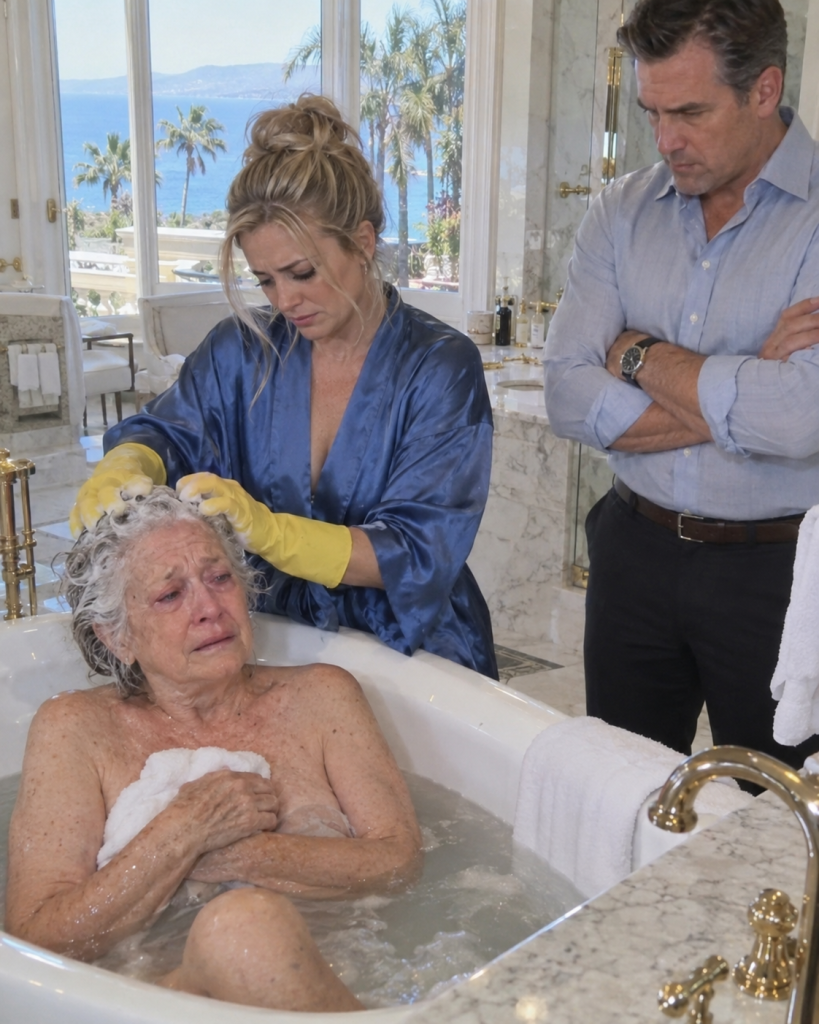
Before entering the pristine marble bathroom, I pulled open a utility drawer and dragged heavy, thick rubber cleaning gloves over my hands, refusing to let her skin make direct contact with mine. I turned to face her with a look of undisguised disdain.
“Take those filthy rags off right now and put them directly into that large trash bag,” I instructed coldly, pointing a gloved finger at the bin. “We are throwing everything you are wearing straight into the incinerator.”
“I can wash myself, ma’am,” she offered softly in that surprisingly polite, articulate tone that felt entirely mismatched with her exterior. “I don’t need assistance.”
“I’d prefer to make certain you don’t ruin the imported Italian marble or clog the plumbing,” I retorted sharply, lacking an ounce of grace.
Even now, sitting here writing these words or speaking of that day, my heart aches with a burning, suffocating wave of profound shame whenever I recall how cruelly and callously I spoke to her.
The woman slowly stepped into the steaming, fragrant water of the expansive garden tub. Almost instantly, the crystal-clear water transformed into a dark, murky, swirling soup of thick brown filth. I grabbed a soft, imported sea-sponge, and forcing myself to swallow the bile rising in my throat from sheer disgust, I began scrubbing her right shoulder.
As layers of decades-old dirt, soot, and neglect finally began to lift away under the warm water and soap, something strange caught my eye beneath the fading grime.
It was a tiny, distinct, crescent-shaped birthmark.
The sponge instantly slipped from my gloved fingers, splashing heavily into the water and sending droplets flying against the marble tiles.
The air completely evaporated from my lungs. My chest locked tight.
“Turn around,” I whispered, my voice trembling so violently it barely sounded like my own.
The woman blinked, looking up through wet, tangled strands of gray hair. “Is something wrong, ma’am?”
Without answering, I ripped off my rubber gloves and threw them to the floor. I grabbed a clean, wet washcloth and began wiping the remaining grime from her face with desperate, frantic, shaking strokes. Beneath twenty years of street neglect, weathering, and hardship emerged a worn, aged, and deeply exhausted face—a face that was completely unrecognizable to the rest of the world.
A face the world saw as nothing more than trash.
But not to me. Not to my soul.
I began to shake so violently my knees nearly gave out beneath me. I backed away from the tub, stumbling backward until my hips hit my vanity table.
With trembling, clawing fingers, I yanked open the top drawer of my vanity, pulled out a heavy, tarnished gold locket that I had kept securely locked away in a velvet box for two agonizing decades, and snapped it open with a sharp click, thrusting it right in front of her face.
Inside the tiny glass frame sat a faded, sun-bleached photograph. A young, vibrant, beautiful woman was smiling brightly, her arms wrapped tightly around a laughing ten-year-old girl.
“This woman was my mother,” I sobbed, the tears instantly blinding my vision, hot and uncontrollable. “She had that exact same crescent birthmark on her right shoulder…”
The woman stared down at the photograph in my trembling hand. Then, with agonizing slowness, she lifted her eyes and stared up into the illuminated bathroom mirror, looking at the clean, washed face reflected back at her.
And right there, in the echoing silence of our luxurious master bathroom, I uttered a name that I hadn’t dared to speak aloud, even in my darkest prayers, in twenty long years:
“Mom… your name is Lucile.”
PART 2
Lucile didn’t throw her arms around my neck. She didn’t weep with sudden, cinematic joy or collapse into a miraculous emotional release.
Instead, she simply held the small, tarnished gold locket in her trembling, water-pruned hands, staring down at the faded image as if trying to decode a language written in a foreign tongue.
“I’m so sorry,” she whispered softly, her voice cracking with profound sorrow and helpless confusion. “I… I don’t remember this little girl.”
I felt as though an invisible hand had reached straight into my chest, grasped my heart, and ripped it violently out of my body.
For twenty agonizing years, my entire family—my aunt, my distant relatives, the adults who raised me—had told me the same tragic story: that my beloved mother had perished in a catastrophic, all-consuming house fire in our old neighborhood. The local firefighters had searched the smoldering ruins but never recovered a body, yet the wooden structure had been reduced entirely to gray ash and rubble, leading everyone to assume the grim reality that no human being could possibly have survived such an inferno.
I had been only ten years old when my world ended.
In the immediate aftermath of the tragedy, I was taken in and raised by an austere, distant aunt who provided for my physical needs but offered very little emotional warmth. At twenty-one, I met Alejandro, a rising force in Chicago construction, and our whirlwind romance led quickly to marriage. Yet, beneath the glittering surface of high society, I had never truly healed. Every single day of my life, a quiet, nagging ghost whispered in the back of my mind, wondering what had truly happened on that awful night.
And now, after two decades of mourning a ghost, my mother was sitting right here in my modern garden bathtub.
Alive. Breathing. Flesh and bone.
Yet, to her, I was an absolute, complete stranger.
When we finally walked downstairs, hand in hand, stepping out of the elevator into the expansive living room, Alejandro was waiting patiently by the fireplace.
I marched straight up to him, my face streaked with tears, my chest heaving. “You knew, didn’t you? You brought her here completely on purpose!”
Alejandro shook his head gently, holding up his hands in a placating gesture. “I wasn’t completely sure, Mariana. I swear to you, I didn’t know for certain.”
He confessed the truth of how the puzzle pieces had come together. While volunteering at the downtown shelter, his sharp eyes had noticed two distinct, unusual details that refused to leave his mind: Lucile’s approximate age and a long, jagged, permanent burn scar running across her left wrist. Years earlier, during one of our late-night conversations, I had mentioned in passing that my mother had severely burned that exact wrist while cooking a holiday meal when I was a little girl.
“I thought it might just be a bizarre, heartbreaking coincidence,” Alejandro explained softly, stepping closer and resting a comforting hand on my trembling shoulder. “That’s precisely why I brought her home. I needed you to see her face before I said a word, because I couldn’t bear to give you false hope if it turned out to be nothing.”
I collapsed against his chest, burying my face in the fabric of his shirt, sobbing uncontrollably as all the shock, relief, and accumulated grief of twenty years finally broke over me like a tidal wave.
The very next morning, we bypassed standard medical channels and brought Lucile directly to a top-tier private neurologist located in downtown Chicago. After a comprehensive, exhausting series of advanced brain scans, neurological tests, and cognitive evaluations, the specialist sat us down in his sunlit office to explain the diagnosis.
The severe physical trauma, smoke inhalation, and overwhelming psychological shock she had suffered twenty years prior had triggered a profound, protective state known as psychogenic amnesia—a rare defense mechanism where the human brain literally locks away memories to shield itself from unbearable pain.
“Do not force her memories,” the neurologist warned us gravely, leaning forward over his desk. “Do not bombard her with demands to remember. Old photographs, familiar places, specific smells, childhood songs… any sensory stimulus deeply tied to her past life might eventually unlock the mental door. But you must be patient. Let it happen naturally, or her mind may retreat even further.”
Over the next several weeks, I transformed our sprawling suburban home into a living museum dedicated entirely to resurrecting my long-lost childhood.
I dragged out heavy boxes of old photo albums from the attic, flipping through pictures of birthdays, holidays, and sunlit afternoons. I woke up at dawn to bake hot cinnamon rolls from scratch—using the exact recipe with the heavy pinch of nutmeg that she used to bake for me every single Sunday morning. I spent hours hunting down rare vintage jazz vinyl records that she used to listen to while cleaning our old living room. I drove her to the quiet neighborhood parks where she used to push me on the swings and buy me vanilla ice cream after school.
Nothing.
Day after day, Lucile offered gentle, polite, appreciative smiles, but the bright, warm light of true recognition never once entered her eyes. To her, these were merely pleasant activities hosted by a kind, wealthy stranger.
One afternoon, while sitting in the study, she pointed a slender, calloused finger toward a framed black-and-white photograph resting prominently on the marble fireplace mantle. It captured a handsome, smiling man standing beside a much younger, radiant Lucile.
“Who is he?” she asked quietly, tilting her head.
A heavy, suffocating lump formed instantly in my throat, choking off my voice. “That’s… that’s my father. Robert.”
“Where is he?” she pressed gently.
I couldn’t answer. The words caught in my windpipe like jagged glass.
“Mariana,” she insisted, turning her head and looking deeply, piercingly into my eyes with a sudden intensity. “What happened to him?”
Unable to bear the weight of her gaze, I stood up abruptly, knocking my chair backward, and quickly rushed over to turn the photograph face-down against the wooden mantle so she couldn’t see his face.
“That can wait, Mom,” I choked out, blinking back fresh tears. “Let’s… let’s not talk about that right now.”
The truth was, I couldn’t bear to tell her. Because for twenty long years, beneath the grief of losing both parents, I had secretly carried a darker, more poisonous conviction: I believed my father had died because of me.
A week later, feeling desperate for a breakthrough, I decided to drive Lucile back to the exact street where our old family home used to stand. The quiet residential lot where my childhood home had once existed in all its warm, imperfect glory was now entirely gone, paved over and replaced by a sterile corporate pharmacy and a sprawling concrete strip mall.
Lucile stared out the passenger window of the luxury sedan, her eyes completely blank, scanning the modern asphalt cityscape with utter detachment.
“I’m sorry, sweetheart,” she whispered, reaching out to pat my hand hesitantly. “I don’t recognize any of this. It’s just… completely foreign to me.”
“It’s okay, Mom,” I murmured, trying desperately to swallow my heartbreaking disappointment and keep my voice steady. “It’s really okay.”
We stepped out of the car, deciding to walk down the modern concrete sidewalk toward a nearby public park that had somehow survived the urban development. The autumn air was crisp, carrying the scent of fallen leaves and exhaust fumes.
Suddenly, the deafening, horrific blare of a massive semi-truck horn pierced the afternoon air, instantly followed by the violent, ear-splitting screech of burning rubber against pavement.
I whipped my head around. A deeply distracted driver of a heavy, overloaded commercial pickup truck had lost control, mounting the high concrete curb and barreling straight toward the pedestrian crosswalk at forty miles an hour.
My nervous system completely short-circuited. I froze in absolute, primordial panic, utterly paralyzed by fear as the massive metal grille of the truck rushed toward my face.
Lucile didn’t hesitate for a single microsecond.
With a burst of sudden, primal energy that defied her frail appearance, she lunged forward, throwing her entire body against mine and shoving me hard out of the vehicle’s deadly trajectory.
I slammed violently onto the rough concrete pavement, scraping my palms and tearing my knees through my designer trousers. The massive truck roared past me with a sickening gust of wind, missing my body by mere inches before smashing head-on into a thick steel utility pole down the block with a deafening crash of buckling metal.
Silence descended upon the street, save for the hiss of a punctured radiator.
When I frantically pushed myself up onto my elbows, my heart hammering like a trapped bird, my mother was already kneeling on the concrete a few feet away. She was gasping heavily for air, her entire body shaking uncontrollably from the sheer adrenaline and shock of the near-death collision.
And then, she began to sob.
But it wasn’t from the shock of the accident. It wasn’t fear.
She slowly turned her head, fixing her eyes upon me with an absolute, searing intensity—an intensity I hadn’t witnessed since I was a terrified ten-year-old child hiding behind her skirt.
“Marianita…”
My heart completely stopped beating. The air froze in my lungs. No one on this earth—not my aunt, not my husband, not my friends—had ever called me by that cherished, intimate childhood diminutive since the day my family was destroyed.
Lucile clutched both trembling hands to her temples, her fingers tangling in her hair, as tears streamed in thick, unchecked rivers down her weathered face.
“I remember…” she gasped, her voice breaking into a ragged, beautiful roar of reclaimed reality. “Oh God… I remember what happened to your father.”
PART 3
“Your father didn’t die because of you, Marianita.”
Those were the very first words my mother spoke as the heavy, suffocating fog of twenty years finally shattered, burned away by a sudden, violent flash of maternal instinct and memory.
I was still sitting directly on the cold concrete sidewalk, my knees bleeding through torn fabric, my heart hammering like a pneumatic drill against my ribs from the near-miss with the out-of-control truck.
“Mom…” I choked out, a sound half-laugh and half-cry tearing itself from my throat.
Lucile scrambled across the pavement on her hands and knees, reaching out to cup my face in her worn, calloused palms. Her eyes were no longer clouded with the distant, vacant haze of the homeless wanderer. They were clear, bright, piercing, and overflowing with a fierce, unending love.
My mother had finally come back to me. All of her. Every fractured piece of her soul was home.
“You were only ten years old,” she wept, pulling me forward and holding me so tightly against her chest I could hear the racing rhythm of her heart. “You were just a little girl. You were never to blame.”
Sitting right there on the urban curb, ignoring the distant sirens wailing toward the crash site down the block, she recounted the horrifying, unvarnished truth of the day our lives were torn apart.
Twenty years ago, my father, Robert, had picked me up early from elementary school because I had a dentist appointment. On our walk home, I had been desperate and impatient to cross the wide, busy commercial avenue because I spotted my mother standing across the street, waiting for us outside the neighborhood grocery store with a bag of fresh fruit.
The pedestrian light changed, and without looking, I had excitedly darted forward into the active crosswalk. But out of nowhere, a reckless driver blew straight through a solid red light at breakneck speed.
My father saw the speeding, lethal machine hurtling toward me a fraction of a second before I did. Without a single thought for his own survival, he sprinted forward, throwing his entire body into the path of the car and violently shoving me out of the trajectory.
I hit my head hard against the concrete curb and instantly blacked out, spared from the worst of the physical impact.
But my father took the full, catastrophic brunt of the vehicle. He died on the asphalt before the ambulance even managed to navigate the afternoon traffic.
My mother had witnessed the entire, blood-chilling horror unfold right before her eyes from across the street. She had watched her husband die to save her daughter.
And for twenty agonizing years, in the quiet, dark recesses of my guilt-ridden mind, I had carried the crushing, toxic belief that my childhood impatience and reckless darting into the street had murdered my father. Hearing the absolute, undeniable truth spoken aloud by my mother lifted a crushing mountain of lead off my soul—a weight I hadn’t even fully realized was suffocating every breath I took.
“Your father chose to save you because you were his absolute whole world,” Lucile whispered, pressing her forehead against mine, her tears mingling with my own. “He loved you beyond measure. He would have walked into a thousand fires for you, and he never, ever would have wanted you to use his eternal love to punish yourself for twenty years.”
I sobbed like a broken child, burying my face deep in her shoulder, letting out two decades of pent-up grief, self-hatred, and sorrow until my throat was raw.
“But what about the fire, Mom?” I asked softly between jagged breaths, pulling back slightly to look into her eyes. “If you survived the accident, how on earth did you end up living on the streets?”
Lucile closed her eyes tightly for a long moment, allowing the newly unspooled memories to settle into place.
After my father’s tragic death, she had plunged headfirst into a deep, paralyzing, clinical depression. Yet, fueled by her fierce love for me, she had forced herself to keep working grueling hours at a local bakery to pay our mounting bills. On the fateful night of the house fire, I wasn’t even home—I had been staying overnight at my aunt’s house so my mother could work a mandatory double shift through the night.
She had returned home in the pitch black of early morning and discovered thick, black smoke billowing aggressively from the kitchen. Panic-stricken, she ran inside, desperate to retrieve a heavy metal lockbox that contained our crucial family identification papers, irreplaceable photographs, and the very few precious mementos we had left of my late husband.
Just as she reached the kitchen counter, a sudden, violent gas explosion ripped through the house, shattering the windows and throwing her violently across the room against the brick wall. Badly burned, bleeding, and half-suffocated by thick toxic smoke, she managed to crawl out through a shattered rear window into the backyard.
She wandered away from the burning wreckage into the night, suffering from severe smoke inhalation, physical shock, and acute trauma-induced delirium. A long-haul truck driver found her collapsed and unconscious near an interstate rest stop miles away from the city, took pity on her, and dropped her off at a rural county medical clinic.
She had no identification on her person. When she finally woke up days later in a sterile hospital bed, her mind had completely wiped her personal history clean. She didn’t even know her own name.
What followed was a harrowing, heartbreaking twenty-year chain of bad luck, systemic failure, cold nights, and predatory individuals who routinely took advantage of a vulnerable woman wandering the fringes of society without an identity. She spent two decades drifting invisibly from state to state, sleeping in rough shelters, working under-the-table day labor, and battling the elements, until an inexplicable, subconscious psychological pull drew her back to the sprawling streets of Chicago.
“Something deep inside my heart, something I couldn’t explain, whispered that you were here,” she told me, her voice filled with quiet wonder and awe. “I didn’t know what I was looking for, but my soul knew it was close to home.”
Twenty years. We had lived less than an hour apart from each other across the same sprawling metropolis for years, completely unaware that our souls were still relentlessly searching for one another through the concrete maze.
When we finally returned to our mansion that evening, Alejandro rushed out to the circular driveway, concern etched across his features. Seeing us stepping out of the car, holding hands tightly with radiant smiles, he slammed on the brakes of his expression and stopped dead in his tracks.
“What happened?” he asked, glancing between us.
I looked at my husband, tears of pure, unadulterated joy streaming down my face for the first time in my life. “She came back, Alejandro. She really came back.”
“Who came back?” he blinked, momentarily confused.
I turned to look at my mother, who stepped forward and offered him a warm, radiant, deeply genuine smile.
“Lucile came back,” she said clearly.
Over the course of the next few months, our entire domestic world underwent a profound, beautiful transformation.
My mother gradually recalled tiny, precious domestic details of our past that meant the absolute world to me. She remembered with uncanny precision that I passionately hated cilantro as a child. She remembered the exact, soothing cadence of the lullaby she used to hum when I spiked a high fever. She remembered sneaking spare change into an old tin coffee can hidden in the pantry every single autumn just to buy me a brand-new pair of shiny school shoes before the semester started.
And in the quiet moments between domestic warmth, I was forced to confront a deeply painful, humbling truth hiding within myself.
The arrogant, haughty woman who, just a few short weeks prior, had turned up her nose in absolute disgust and wrinkled her face at a ragged homeless woman standing in her pristine foyer was the direct flesh-and-blood daughter of a woman who had survived those exact same brutal, unforgiving streets.
I felt a profound, ego-shattering wave of shame for the sheltered, pampered life I had taken so completely for granted, looking down upon humanity from my ivory tower.
One crisp morning, without a word of warning, I asked Alejandro to drive me back down to the downtown soup kitchen where this miraculous journey had begun. I dressed intentionally in plain, unassuming clothes, wore no jewelry, brought no media cameras, and posted nothing on social media. I simply walked into the industrial kitchen, tied a heavy canvas apron around my waist, and began rolling up my sleeves to serve hot, steaming meals to the long, weary line of people waiting out in the cold.
A woman stepped up to the metal serving counter, her hands shaking slightly as she held out a plastic tray. Her coat was visibly frayed at the cuffs, and her hair was matted with the dust of the city.
Instinctively, a sudden flash of memory brought back the sharp, visceral disgust I had felt when I first looked at my mother in our foyer. A sharp, guilt-ridden pain pierced the center of my chest.
I took a deep, steadying breath, pushed the ugly memory down, and looked the stranger dead in the eyes.
“Would you like extra stew today?” I asked softly, offering a warm, completely genuine, unfiltered smile.
The woman looked up, her tired, hollow eyes suddenly lighting up with surprise. “Yes, ma’am… if it isn’t too much trouble for you.”
I reached down with the ladle and gave her a generous, double portion.
Across the stainless-steel serving line, Alejandro caught my eye. He didn’t say a single word out loud. He didn’t need to. His quiet, approving nod communicated everything our hearts already knew.
Yet, my mother still had one final, unresolved debt to settle with her past before her heart could find complete peace.
During dinner one evening around our formal dining table, she set her silver spoon down quietly against her porcelain bowl and looked up at us.
“I need to find someone,” she announced.
“Who is it, Mom?” I asked, leaning forward. “Tell me, and we’ll track them down tomorrow.”
“Theresa.”
My mother proceeded to explain that for the past three grueling years of her life on the streets, a remarkable woman named Theresa had worked exhausting overnight shifts cleaning the filthy, neglected restrooms at the central bus terminal. Theresa earned pennies above minimum wage and lived in a damp, dilapidated, subterranean basement apartment that smelled permanently of mildew. Yet, despite her own grinding poverty, Theresa had consistently, fiercely protected my mother from the dangers of the nocturnal transit hubs.
Theresa had secretly saved leftover bakery bread for her. She had regularly allowed my mother to slip past her cleaning cart and hide safely in a warm, locked supply closet during the bitterest winter nights when the temperature dropped below freezing. She brought her hot, black coffee in paper cups.
And, as it turned out, it was Theresa who had actively pushed, nudged, and encouraged my mother to walk down the block to Alejandro’s soup kitchen on that fateful afternoon.
“If Theresa hadn’t practically forced me to go get a warm meal that day, I never would have crossed paths with your husband,” my mother said softly, her eyes shining with unshed tears. “I’d probably still be sleeping on a concrete park bench tonight, or worse.”
Alejandro instantly set his fork down, wiping his mouth with his cloth napkin. “Then let’s go find her.”
The very next day, our luxury sedan pulled up to the bustling, chaotic central bus terminal. My mother walked purposefully down the wide, tiled, echoey corridors with the sure-footed stride of someone who knew every corner of the labyrinth, until she spotted an elderly woman with thinning gray hair pushing a heavy, squeaking industrial mop bucket across the floor.
“Theresa!” my mother called out, her voice ringing clear across the terminal.
The elderly cleaner stopped mid-motion, turning around slowly and squinting through tired eyes in absolute confusion. It took her several long, agonizing seconds to reconcile the image of the clean, elegantly dressed, dignified woman standing before her with the ragged vagrant she had sheltered for years.
Then, recognition struck.
Lucile burst into warm, silvery laughter. “What’s the matter, Theresa? You don’t recognize the old rag-lady who used to beg you for hot coffee in the dead of winter?”
Theresa dropped her heavy wooden mop handle with a loud, echoing clatter against the tile floor. “Lucy?!”
They collided in the middle of the crowded terminal concourse, throwing their arms around each other in a fierce, desperate embrace as thick tears streamed unheeded down Theresa’s weathered, lined cheeks.
“I thought something terrible happened to you! I looked everywhere for you in the alleys!” Theresa sobbed into my mother’s shoulder.
“Something miraculous happened,” my mother wept, pulling back to beam proudly. “I found my daughter.”
Theresa lifted her head, her gaze shifting to look at me, and then slowly over to Alejandro standing beside us. When she finally realized that the wealthy, sharp-suited man who ran the charitable foundation was married to my mother’s daughter, she nearly fainted from shock, stepping backward and grabbing the edge of a nearby ticket kiosk for support.
Alejandro stepped forward smoothly, closing the distance and taking Theresa’s rough, chemical-burned hands in his own. “Theresa, we want to thank you from the bottom of our hearts for taking care of my mother-in-law when she had no one else in the world.”
Theresa shook her head vigorously, waving a hand dismissively in the air. “Oh, no, sir, please. I didn’t do anything special at all. Just… just what any decent human being ought to do for another person in the dark.”
Unknown to Theresa, Alejandro had already quietly spent the past week researching her background. He had uncovered the poignant fact that Theresa had been a remarkably skilled seamstress in her youth back in her home country, altering exquisite garments for her neighbors, but she had never possessed the financial capital to buy professional equipment or lease a storefront of her own.
Alejandro didn’t just hand her a lazy charity check that would vanish in months. He offered her a life-changing, permanent foundation.
Within a fortnight, he had leased a charming, highly visible storefront in a bustling neighborhood commercial plaza. He furnished it completely with top-of-the-line industrial sewing machines, heavy-duty cutting tables, and secured a lucrative commercial contract for her to handle alterations for several local school uniform districts. Furthermore, he quietly paid the first two years of rent on a bright, clean, sunlit one-bedroom apartment located just a five-minute walk from her new shop.
When Theresa was brought to the storefront and handed the brass keys to her new life, she completely broke down. She covered her weathered face with her trembling hands, sinking onto a stool and weeping until her shoulders shook.
“I can’t accept this… I don’t deserve this,” she choked out through her fingers. “I didn’t do anything extraordinary…”
My mother stepped forward, wrapping her arms securely around her old friend’s neck. “You shared your only crust of bread with me when you barely had enough to survive yourself, Theresa. Now, let us share our blessings with you. It is our turn.”
That entire chapter of our lives fundamentally altered my core philosophy on human existence.
I had grown up in a bubble of privilege, unconsciously believing that homelessness, poverty, and misery were simply the direct, predictable results of poor personal choices and laziness. My own mother—the woman who birthed me—had completely shattered that arrogant illusion, proving beyond a shadow of a doubt that a human life can be utterly dismantled, dismantled down to the bone in a single, catastrophic night by an unexpected accident, a sudden neurological trauma, or a cascading tragedy. And more importantly, she proved that it can take twenty long, brutal years for the universe to align and allow someone to extend a loving, capable hand to help rebuild it.
Together with Alejandro, we formally launched a specialized, heavily funded non-profit foundation dedicated entirely to helping unhoused individuals across Illinois recover their lost legal identities, track down estranged family registries, and access comprehensive psychiatric and medical care without judgment.
Yet, despite our immense wealth, my mother steadfastly refused to let her past be erased by luxury.
Whenever I attempted to shower her with high-end designer clothes, rare jewels, and extravagant luxury goods, she would gently reach out, place her hand over mine, and ask me to stop.
“I don’t need twenty years of glittering luxury to make up for twenty years on the street, Mariana,” she told me one quiet morning as we sat together on the back veranda sipping tea.
“I just want to spoil you, Mom,” I protested affectionately. “You deserve the world.”
“Then don’t buy me things,” she smiled softly, her eyes twinkling with deep wisdom. “Just sit here and have breakfast with me every morning. That is all I ever wanted.”
Her simple, grounded request humbled me straight down to my core. She didn’t care about shopping sprees, high-society galas, or diamond necklaces; she wanted quiet conversations. She wanted long Sunday family dinners. She wanted to hear every single detail of the years she had missed—how I grew up, how I fell in love with Alejandro, and what my deepest dreams were for the future.
One year to the day after our miraculous reunion, my mother and I walked back hand-in-hand to the exact urban street corner where she had shoved me out of the path of the out-of-control truck and unlocked her memories.
We stood together on the concrete sidewalk, watching the light traffic flow past.
“This is where I finally woke up from the long nightmare,” she said softly, tilting her face up to catch the warm autumn sun.
“And this is where I almost lost you forever,” I replied, tightening my grip on her fingers.
“No, Marianita,” she smiled, turning her head to look directly into my eyes with infinite tenderness. “This is where we both finally came home.”
My biological father had died an unsung hero, sacrificing his breath to save my life. My mother had lost her mind and her identity to the abyss while desperately trying to survive a world that had forgotten her. Alejandro had stepped into a gritty soup kitchen searching for a deeper corporate purpose. Theresa had shared her meager meal expecting nothing in return. And I—spoiled, arrogant, and blind—had received the greatest gift of the universe while holding my nose in disgust in a marble bathroom.
We had all made mistakes along the way. We had all carried invisible, crushing burdens. The only thing that truly mattered in the ledger of existence was what each of us chose to do after discovering the raw, unvarnished truth.
Before we turned back toward the idling car, my mother looked at me with a sudden, playful, mischievous glint in her eyes.
“Marianita?”
“Yes, Mom?”
“Do you happen to remember the very first time you ever bathed me in your grand garden tub?”
My face instantly flushed a brilliant, burning shade of crimson, heating up all the way to my ears. “Oh, please, Mom, I am begging you, do not ever remind me of that!”
She threw her head back and burst into a warm, rich, melodic laughter that echoed down the quiet street. “You wore heavy rubber cleaning gloves!”
“Mom… I was an absolute idiot! I have apologized to you a hundred times!”
“A hundred and one never hurts,” she winked teasingly.
We ended up standing right there on the public sidewalk, laughing together until our sides ached, wiping tears of mirth from our eyes. Alejandro, leaning casually against the driver’s side door of the sedan down the block, shook his head with a wide, affectionate, knowing smile.
“What on earth are you two laughing about over there?” he called out across the pavement.
“About your remarkable wife,” my mother called back, her voice ringing with triumphant joy, “who originally discovered that the filthy homeless stranger she didn’t even want to touch with a ten-foot pole was the exact same woman who carried her in her womb for nine months!”
I felt a final, warm flush of embarrassment wash over me, but this time, there was no shame in it—only a profound, swelling gratitude as I smiled straight through my happy tears.
Some harsh truths in life hurt us to our core. Others thoroughly embarrass us and humble our fragile egos. But a precious, rare few arrive like a lightning strike just to wake us up to what truly matters before it’s too late.
The dirty, exhausted, broken woman who stepped timidly into my foyer that afternoon didn’t need my pity, nor did she need my charity. She simply needed someone to look at her long enough, deeply enough, to recognize who she really was beneath the dust.
And ever since that unforgettable day, whenever I happen to see a lonely stranger sitting quietly on a cold park bench or walking slowly down the avenue with worn-out shoes, I never look away. I remember the unforgettable lesson my mother gave me with her entire existence:
You never truly know what incredible, heartbreaking story is hidden beneath the grime. You never know what family is desperately, unknowingly searching for them in the dark, or what unimaginable tragedy led them to that exact bench.
Sometimes, all it takes in this broken world is a warm meal, an open door, an unselfish heart, or a tub full of warm water for a life that everyone else gave up on to finally, miraculously, find its way back home.