At the doorway, my husband lifted the extra key from the wall hook and set it in his father’s open hand.
His father stared down at it.
Then he looked up. “What’s this supposed to be?”
My husband glanced toward the entryway, where our son was standing beside me with one hand wrapped around mine.
“We’re not staying here tonight.”
His father laughed once, but there was nothing amused about it.
“Over cereal?”
My husband didn’t answer immediately.
Not this time.
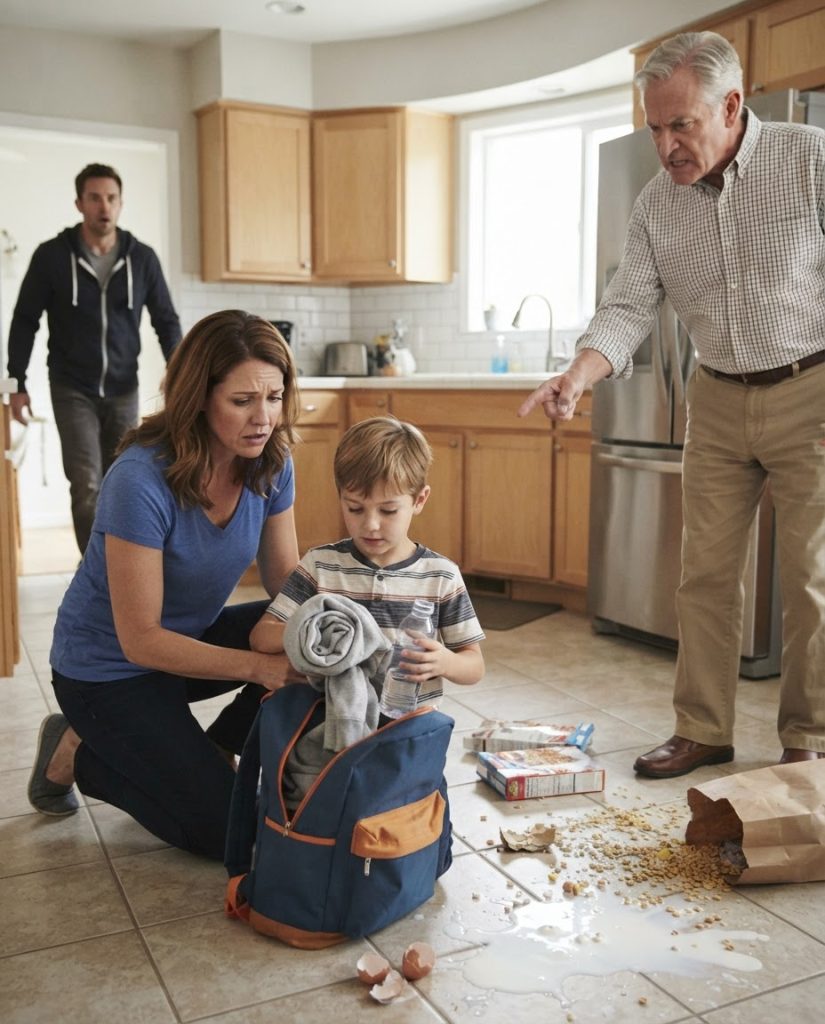
He looked back at the kitchen instead: the split milk carton near the cabinet, the broken eggshells stuck to the floor, the cereal box lying sideways where one of the bags had landed.
Then his eyes dropped to our son’s backpack.
“This isn’t about cereal.”
His father closed his fist around the key.
“So she finally got what she wanted.”
My husband shook his head.
“He packed before she told him anything.”
His father started to respond, but my husband kept going.
“He knew what to do when you got angry. That’s the problem.”
Our son pressed closer to my side.
I felt it immediately.
So did my husband.
He stopped talking about his father and turned toward us.
“Come on.”
That was all.
No speech.
No dramatic announcement.
No demand that his father apologize before we walked out.
My husband took our son’s backpack in one hand and opened the front door with the other.
I carried my purse and the keys I had already been checking for without realizing it.
That detail stayed with me.
The keys were already in my hand.
I had gotten so used to preparing for the possibility of an explosion that my body had started making decisions before my mind admitted what was happening.
My father-in-law followed us as far as the entryway.
“You’re seriously walking out because I lost my temper?”
My husband turned around.
“We’re walking out because my son thinks your temper means he needs an escape plan.”
His father pointed at me.
“And where do you think he learned that?”
My husband looked at my hand.
At the keys.
Then he looked at his father again.
“From watching both of us manage you.”
That landed differently.
His father had been ready to blame me.
He had not been ready to hear his own son include himself.
For years, my husband had defended him in small ways that almost sounded reasonable.
Dad gets loud.
Dad doesn’t mean half of what he says when he’s angry.
Dad grew up differently.
Dad cools off fast.
Dad isn’t going to hurt anybody.
Each explanation had been just believable enough for the next incident to become something we were supposed to absorb.
He had explained the shouting.
He had explained the criticism.
He had explained why his father could turn a forgotten chore, a dinner he didn’t like, or an ordinary disagreement into an hour-long lecture about respect.
He had explained so much that none of us had noticed the explanations becoming part of the household routine.
Our son had noticed something else.
Shoes.
Keys.
Backpack.
Exit.
Children don’t need the vocabulary for fear to build a routine around it.
My father-in-law’s face tightened.
“Fine. Go. You’ll be back when everybody calms down.”
My husband opened the door wider.
“Maybe. But not because we pretend this didn’t happen.”
We walked to the car.
Our son climbed into the back seat with his backpack still in his lap.
He didn’t ask where we were going.
That hurt more than if he had cried.
I buckled him in, and he immediately checked the door beside him.
Then the other door.
Then he looked toward the house.
My husband saw it through the open rear door.
He crouched beside him.
“Hey.”
Our son looked at him.
“You don’t have to keep watch.”
The boy’s fingers tightened around one backpack strap.
“Is Grandpa coming?”
“No.”
“Is he still mad?”
My husband paused.
“Probably.”
Our son glanced toward the front door again.
My husband rested his forearm on the edge of the seat but didn’t reach for him until our son leaned closer first.
“His being mad doesn’t decide what we do now,” he said.
Our son studied his face.
“Are we in trouble?”
“No.”
“Mom too?”
“Mom too.”
That was when his shoulders dropped a little.
Not all the way.
Just enough for me to see how high they had been.
My husband closed the rear door gently.
He stood beside the car for several seconds with one hand on the roof.
I didn’t say anything.
He looked like a man replaying months of moments in the wrong order and suddenly realizing they all belonged to the same story.
When he got into the driver’s seat, he didn’t start the car immediately.
He gripped the steering wheel.
Released it.
Then gripped it again.
“I knew he was hard to live with,” he said.
I waited.
“I didn’t know our kid was planning around him.”
“Neither did I.”
He looked at me.
“You were planning around him too.”
I looked at the keys in my lap.
There wasn’t much point denying it.
“Yeah.”
He nodded once.
“And I kept calling it keeping the peace.”
From the back seat, our son asked if he could take his shoes out of the backpack.
The question was so ordinary that I nearly cried.
“Of course,” I said.
He unzipped the bag and pulled them out one at a time.
One sneaker dropped onto the floor mat.
The second landed beside it.
Then he took out his sweatshirt and folded it across his knees.
My husband watched him in the rearview mirror.
He had seen our son pack those things as emergency supplies.
Now he watched him unpack them because an adult had finally made a decision for him.
We left.
For the first several minutes, nobody talked.
The silence wasn’t peaceful exactly.
It was the silence after doing something you have considered a hundred times without admitting you were considering it.
I kept expecting my husband to defend his father again.
He didn’t.
I kept expecting him to say we should give it a few hours.
He didn’t.
I kept expecting my own guilt to turn the car around for us.
It didn’t.
Instead, my husband said, “I need to tell you something.”
I looked over.
His eyes stayed on the road.
“When I was a kid, I used to know what kind of night we were going to have by how he shut a cabinet.”
I didn’t move.
He swallowed.
“Not slammed it. Shut it. There was a certain way he’d do it when he was already angry.”
His hands settled more firmly on the wheel.
“If I heard that sound, I cleaned things that weren’t dirty. I checked my homework twice. I stayed out of whichever room he was in.”
I had known pieces of my husband’s childhood.
I had never heard that.
“Why didn’t you tell me?”
He gave a small, embarrassed shake of his head.
“Because I didn’t think it counted.”
There it was again.
The same math I had been doing.
Nothing broken badly enough.
Nobody struck.
Nothing dramatic enough to justify calling the atmosphere what it was.
His father had trained him to measure harm by the worst thing that hadn’t happened.
I had eventually learned the same measurement.
Our son hadn’t.
He was measuring what his body told him to do.
My husband went quiet again.
Then he said, “When Dad walked into that kitchen, I did it too.”
“Did what?”
“I started trying to figure out how to make him less mad before I figured out whether you two were okay.”
I thought about the moment he came in from the garage.
He had looked at the floor.
At his father.
At me.
At the backpack.
And then something in his face had changed.
“You stopped,” I said.
“Too late.”
“You stopped.”
He glanced at me.
I wasn’t giving him an easy absolution.
I meant something more practical.
Stopping late still mattered if it meant you actually stopped.
Our son leaned forward as far as his seat belt allowed.
“Dad?”
“Yeah, buddy?”
“Can Grandpa be mad at our house if we’re not there?”
My husband closed his eyes for the briefest second before answering.
“He can feel however he feels. We don’t have to stand next to him while he does it.”
Our son considered that.
Then he sat back.
A few minutes later, he asked for his water bottle.
I passed it to him.
That was the first normal request any of us had made since the cereal box hit the floor.
By the time we stopped for the night, my husband’s phone had started buzzing.
He looked at the screen once and turned it facedown.
I didn’t ask what the messages said.
I could guess the shape of them.
First anger.
Then accusation.
Then an explanation designed to make the explosion sound smaller than everybody’s reaction to it.
My husband left the phone alone until our son was settled.
Only then did he read the messages.
His face tightened, but he didn’t answer right away.
“What is he saying?”
“That I embarrassed him. That you’re using our son against him. That he kicked groceries, not a person.”
I looked away.
There was that measurement again.
Not a person.
As if the absence of a direct hit erased the sound of bags slamming into cabinets.
As if milk running under a table couldn’t tell a child that the room had become unsafe.
As if a six-word distinction could undo a packed backpack.
My husband typed something.
Deleted it.
Typed again.
Deleted that too.
Finally he put the phone down.
“I’m not going to argue facts he already knows.”
That was new too.
His father loved arguments because arguments created openings.
If you debated whether he had shouted for three minutes or ten, suddenly the discussion wasn’t about the shouting anymore.
If you debated whether kicking groceries counted as frightening, the frightened child disappeared from the conversation.
If you defended your tone, your timing, your wording, your face, your memory, eventually you were so busy proving that you deserved to be upset that nobody had to discuss what caused it.
My husband didn’t enter that maze.
He sent one message.
He told his father we were safe, that we would not continue the conversation while he was blaming me or our son, and that living together could not continue under the same pattern.
Then he muted the phone.
No threat.
No insult.
No final jab.
Just a boundary his father couldn’t negotiate by getting louder.
I watched my husband place the phone on the table.
“Are you okay?”
He rubbed both hands over his face.
“No.”
Then he looked at me.
“But I think I’ve been confusing okay with familiar for a long time.”
Our son slept badly that night.
Twice, he woke up and asked whether we were going home.
The first time, I told him we weren’t going back that night.
The second time, my husband answered.
“You don’t need to listen for Grandpa. Go back to sleep.”
Our son did.
The next morning, the backpack was beside his shoes.
For a second, my chest tightened when I saw it.
Then I noticed it was open.
His sweatshirt was half hanging out.
A crumpled piece of paper was tucked in the front pocket.
His water bottle stood on the floor beside it.
It looked like a child’s backpack again.
Messy.
Unplanned.
Ordinary.
My husband noticed me staring.
“I keep thinking about what he said in the kitchen.”
I knew exactly which words he meant.
Our son had wanted to be ready before the adults decided they had waited too long.
We hadn’t taught him that sentence directly.
But we had taught him the logic behind it.
Every time I located my keys during an argument, I taught him that exits mattered.
Every time my husband calmed his father instead of challenging the behavior, he taught him that Grandpa’s mood controlled the room.
Every time we resumed dinner afterward and acted normal, we taught him that normal meant cleaning up and moving on.
My husband sat beside me.
“I don’t want him learning that love means staying until something gets worse enough.”
Neither did I.
So we stopped discussing whether the grocery incident was severe enough to justify leaving.
That was the trap.
The real question was why a child had already developed a response to an adult’s anger.
The real question was why I automatically found my keys.
The real question was why my husband became quieter around his father than he was around anybody else in his life.
Those answers had existed before the cereal box ever came into the house.
Over the next several days, my father-in-law tried more than one version of the same argument.
He said we were exaggerating.
He said families fight.
He said children needed to learn that adults sometimes got angry.
He said my husband had become soft.
He said I had been looking for a reason to leave.
My husband didn’t try to prove him wrong point by point.
He kept returning to one thing.
Our son had packed to escape before either parent told him to.
There wasn’t much his father could do with that fact except explain why it shouldn’t matter.
And that, more than anything, showed us why it mattered.
At one point, my father-in-law insisted that he would apologize to our son and put the whole thing behind us.
My husband refused to turn our child into the person responsible for restoring peace between adults.
“He doesn’t need to make you feel forgiven,” he told his father.
That sentence mattered to me.
My husband had spent years doing exactly that job himself.
His father’s anger happened.
Then his father’s regret happened.
Then everybody else was expected to make the regret comfortable as quickly as possible.
My husband had apologized for being upset by things done to him because his father’s remorse was treated as an emergency.
He wasn’t passing that job to our son.
For the first time, the family’s attention stayed on the behavior instead of rushing toward reconciliation.
My father-in-law didn’t like that.
He wanted an argument he could win or an apology he could receive.
A boundary offered neither.
There was no dramatic final showdown.
No perfect sentence fixed decades of habit.
My husband still loved his father.
That didn’t disappear when the key changed hands.
If anything, that made the choice harder.
He wasn’t rejecting a stranger who had been awful once.
He was changing the rules of a relationship that had shaped him since childhood.
Some days he was angry.
Some days he was sad.
Some days he worried he had overreacted.
On those days, I didn’t remind him about the milk or the eggs.
I reminded him about the backpack.
He never argued with that.
Neither did I.
Because the backpack was the part we couldn’t explain away.
It wasn’t broken furniture.
It wasn’t a bruise.
It wasn’t the kind of evidence adults sometimes wait for because it makes a decision easier to defend.
It was a child’s quiet preparation.
That was enough.
In the weeks that followed, we paid attention to smaller things.
Our son stopped asking whether Grandpa was coming whenever a car door shut outside.
He stopped checking my face when my husband and I disagreed about something ordinary.
The first time my husband dropped a spoon in the kitchen and muttered in frustration, our son looked up sharply.
My husband noticed.
He immediately softened his voice.
“I’m annoyed at the spoon, buddy. Nobody’s in trouble.”
Our son stared at him for a second.
Then he laughed.
It was such a tiny moment.
But tiny moments were how the problem had been built in the first place.
It made sense that tiny moments would be part of changing it.
I changed too.
I stopped keeping my car keys in my hand when voices got tense.
Not because I promised myself I would never leave.
The opposite.
I knew I could leave if I needed to.
I no longer had to rehearse it secretly.
My husband stopped trying to manage every adult emotion in the room.
When he was uncomfortable, he said so.
When something crossed a line, he named it earlier.
When his father tried to make me the explanation for the boundary, my husband refused to let the conversation move there.
“This is my decision too,” he said every time.
He had spent years becoming smaller around his father.
Now he practiced staying the same size.
Our son never heard most of those conversations.
That was deliberate.
He had already carried enough information that didn’t belong in a child’s backpack.
What he needed from us wasn’t the entire family history.
He needed boring mornings.
He needed breakfast without anyone inspecting everyone’s mood.
He needed to forget where my keys were.
He needed to believe that an adult could be irritated without the whole house reorganizing itself around that irritation.
And slowly, those things became ordinary.
One morning, I found him sitting on the floor with his backpack open again.
For half a second, every muscle in my body tightened.
Then I saw what he was putting inside.
A notebook.
His water bottle.
His sweatshirt.
Nothing else.
His sneakers were already on his feet.
“What are you doing, buddy?” I asked.
He looked up at me like the answer was obvious.
“Getting ready.”
The same words as before.
But this time, he wasn’t listening for an angry voice in the kitchen.
He wasn’t watching the driveway.
He wasn’t waiting for me to find my keys.
My husband walked past, handed him the lunch he had almost forgotten, and reminded him to zip the front pocket.
Our son shoved the lunch inside.
He pulled the zipper closed.
That sound had once felt like a warning.
Now it was just a zipper.
He swung the backpack over one shoulder, grabbed the other strap, and headed for the car because it was time for school.


