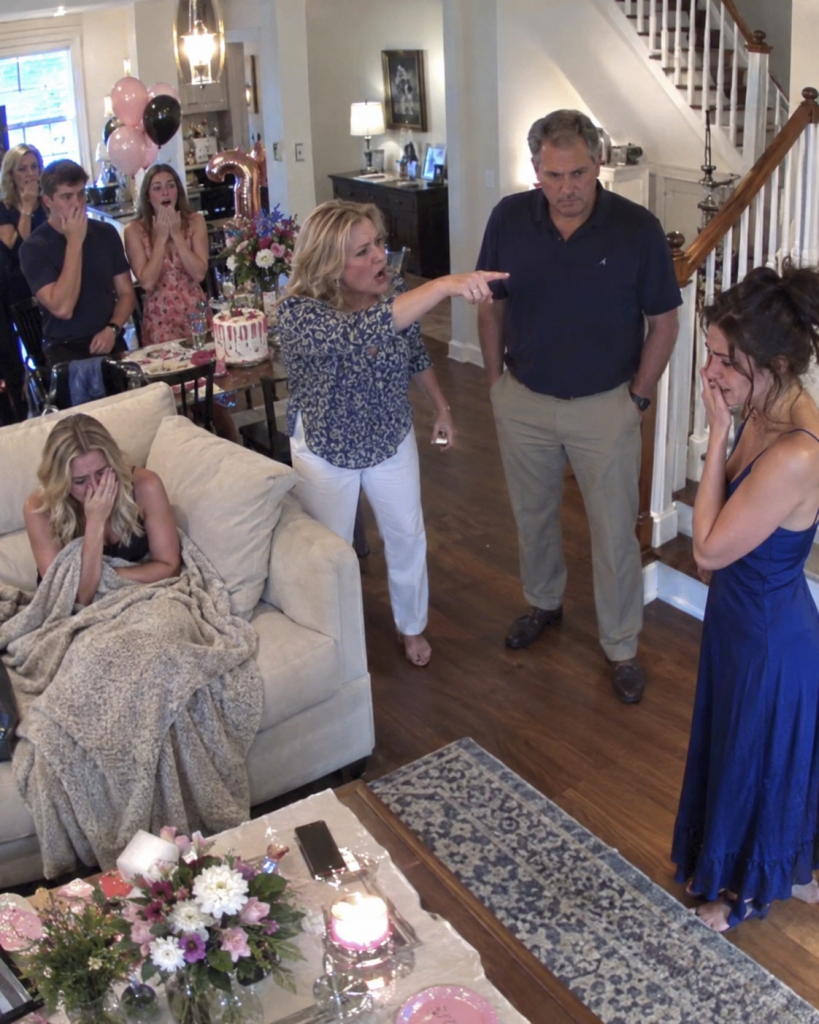
She was not injured. Nothing tragic had happened. She had discovered that the restaurant wrote my name on the birthday cake instead of hers. I stood in the upstairs hallway wearing the deep blue dress I had spent four agonizing months saving for, watching my reflection in the full-length mirror as Mom whispered up the stairs,
“Maybe we should just do it another night, Claire. Madison is overwhelmed right now.”
Dad sighed heavily from the foyer, his footsteps heavy against the hardwood.
“Your sister is fragile right now. Let’s not make this difficult.”
Madison was twenty-two years old, voluntarily unemployed, and perpetually fragile whenever attention shifted more than a few inches away from her orbit.
I walked down the stairs, each step heavy, and entered the living room to watch my birthday disappear in real time.
The custom flower arrangement I had carefully selected and paid for with my own freelance savings was being carried upstairs by Mom and placed on Madison’s vanity.
The restaurant confirmation tab remained open on Dad’s phone, glowing mockingly against the dark screen before he hit the cancel button.
Mom was already on the phone with the local bakery, canceling the order for the vanilla bean cake I had dreamed of tasting.
Madison sat beneath a fleece blanket on the sofa, aggressively wiping completely dry cheeks with both hands, staging a performance of deep emotional distress.
“She feels excluded,” Mom explained, as if that sentence carried the weight of divine law.
“From my birthday?” I asked, my voice dangerously quiet.
Dad gave me the familiar, heavy-lidded look—the exact look that meant I was expected to fold, to swallow my disappointment, to become reasonable and accommodating before anyone required Madison to behave with a shred of basic human decency.
“It’s just one dinner, Claire,” Dad said dismissively.
But it was never only one dinner.
My high school graduation celebration had been abruptly transformed into an impromptu party for Madison’s dance recital because she threw a fit about not being the center of attention.
My first major promotion dinner at my architectural firm was canceled because she broke up with a man she had dated for three chaotic weeks and needed a round-the-clock comforting committee.
My apartment-warming party for my tiny studio flat turned into a four-hour family intervention about how I needed to sacrifice my savings to help Madison “find herself.”
For years, I had quietly paid half the household rent while living in the smallest, dampest bedroom under the eaves.
I covered the utility bills whenever Dad’s hours at the hardware store were reduced.
I bought groceries with my own grocery budget when Mom claimed money was too tight, only to watch luxury packages arrive for Madison a few days later.
And through it all, I still apologized whenever Madison demanded more emotional space, feeling guilty simply for existing in the same room.
I looked at the canceled reservation on the table, the cake being hidden away in the fridge, and the satisfied smirk that was briefly, wickedly visible above the edge of my sister’s blanket.
Something inside me did not shatter.
It did not break or fracture.
Instead, it locked firmly into place, cold, heavy, and absolute.
“Okay,” I said.
Mom blinked, caught off guard by the absence of an argument.
“Okay?”
“Cancel it,” I repeated, my voice entirely steady.
Dad relaxed instantly, his shoulders dropping with unearned relief.
“See? That’s mature. I knew you’d understand.”
I smiled—a thin, hollow curve of the lips.
“I’m glad you think so, Dad.”
I turned away, walked up the stairs for the last time, and removed the blue dress.
I folded it neatly and placed it at the bottom of a suitcase.
Then I packed two large suitcases with my essentials.
I did not slam doors.
I did not raise my voice, and I made no dramatic announcements.
I folded every piece of clothing with mechanical precision.
I collected my birth certificate, social security card, and banking documents from the bottom drawer.
I took the emergency savings envelope hidden beneath my mattress—every hard-earned dollar I had managed to squirrel away despite their constant financial demands.
Then, I placed my heavy metal spare house key directly in the center of my meticulously made pillow.
At 11:43 that night, while my parents sat downstairs eating lukewarm takeout pizza with Madison in the living room, I slipped out through the back door into the cool autumn air.
No farewell.
No argument.
No forwarding address left behind.
The next morning at 8:00 AM, my phone buzzed with a text message from Mom:
Stop sulking in your room. We need you to go down to the market and pick up groceries before noon.
By the time she sent that message, I was already six hours away, sitting in a quiet, sunlit diner across state lines, drinking black coffee and watching the highway stretch out behind me.
For the first time in my life, their perfect little family had to survive without the daughter they had completely forgotten was keeping everything running behind the scenes.
PART 2
For the first time in my life, their perfect little family had to survive without the daughter they had completely forgotten was keeping everything running behind the scenes.
I expected panic.
Instead, I got silence.
For almost two days, nobody called.
Not once.
There were only three messages from Mom.
The first said:
Where are you?
The second came six hours later.
This isn’t funny, Claire.
The third arrived the following afternoon.
Your father is angry. Call us immediately.
I stared at the screen from the small apartment I had rented using the emergency savings I had spent years protecting.
Then I turned my phone facedown.
For the first time, I wasn’t waiting for permission to have a life.
I had found a temporary place in a town three states away. It wasn’t beautiful. The kitchen was barely large enough for one person, and the bedroom had a window overlooking a laundromat.
But the lease was mine.
The bills were mine.
The silence was mine.
And nobody could walk into my room and tell me that Madison needed it more.
On the third morning, my phone started ringing repeatedly.
Dad.
Mom.
Dad again.
Then Madison.
I ignored all of them.
Finally, a voicemail appeared.
I pressed play.
Dad’s voice filled the quiet room.
“Claire, this has gone far enough. Your mother says you took important documents from the house. We need you to come home and explain yourself.”
I almost laughed.
Important documents.
They weren’t his.
They weren’t Mom’s.
They were mine.
My birth certificate.
My Social Security card.
My bank information.
The documents I had been keeping in a drawer because I had never imagined I’d need to protect them from my own family.
Then another voicemail arrived.
This one was from Mom.
“Your father is furious. Madison hasn’t eaten properly since you left. She’s blaming herself, and frankly, Claire, you’re making this much worse than it needs to be.”
I deleted it.
Then I opened my banking app.
For years, every paycheck had been divided into three parts.
Household expenses.
Madison’s emergencies.
And whatever tiny amount remained for me.
But this time, my balance was finally mine.
I transferred the money into a new account at a different bank.
Then I changed every password.
Two-factor authentication.
New security questions.
New mailing address.
New everything.
That afternoon, I called my freelance clients and told them I had relocated.
One of them offered me a larger contract.
Another asked if I could start immediately.
For the first time, nobody was interrupting me with a family crisis.
Nobody needed me to drive Madison somewhere.
Nobody needed money.
Nobody needed me to apologize.
And that was when I realized something terrifying.
I had been calling it sacrifice.
But perhaps it had always been exploitation.
A week passed.
Then Mom called from an unknown number.
I answered.
“Claire?”
I said nothing.
She immediately started crying.
“Please come home.”
I closed my eyes.
“What happened?”
There was a long pause.
“Your father tried to pay the electricity bill.”
“And?”
“He couldn’t.”
I almost smiled.
“Why not?”
“Because the account was empty.”
I looked out the window.
“Dad’s paycheck isn’t enough?”
“It hasn’t been enough for months,” she whispered.
There it was.
The truth.
The thing I had always suspected but never been allowed to say aloud.
My money hadn’t been helping the family.
It had been holding the entire family together.
“What about Madison?” I asked.
Mom hesitated.
“She needs money for her car.”
“She has a car?”
“She says she can’t work without it.”
“She doesn’t work.”
Silence.
Then Mom whispered, “She’s trying.”
“No,” I said quietly. “She’s waiting.”
Mom started crying harder.
“Claire, we’re your parents.”
“And I was your daughter.”
“You still are.”
“No, Mom.”
My voice shook, but I didn’t back down.
“I was your daughter when you took half my paycheck. I was your daughter when you canceled my graduation celebration. I was your daughter when you turned my promotion dinner into Madison’s emotional emergency. I was your daughter when you canceled my twenty-fifth birthday because she cried over a cake.”
Mom said nothing.
I continued.
“And somehow, I was always expected to understand.”
“She was struggling.”
“So was I.”
That sentence finally silenced her.
After a moment, she whispered, “We didn’t know.”
“You didn’t ask.”
The call ended shortly afterward.
I thought that would be the end.
It wasn’t.
Three weeks later, I received a letter from a lawyer.
My parents were claiming that I owed them money for household expenses.
They had calculated everything.
Rent.
Utilities.
Groceries.
Repairs.
Even the money they had supposedly spent raising me as a child.
At the bottom of the letter was a demand that I return to the house and negotiate repayment.
I read it twice.
Then I called my own attorney.
She reviewed the documents and smiled.
“Do you have records of your payments?”
“Yes.”
“Bank statements?”
“Yes.”
“Text messages showing what they asked you to pay?”
“I have hundreds.”
She leaned back.
“Then don’t panic.”
The next morning, I sent her everything.
Bank transfers.
Receipts.
Screenshots.
Messages.
Every payment I’d made.
Every request for money.
Every time Mom had told me that Madison needed help.
Every time Dad had promised it was temporary.
Three days later, my attorney sent one letter.
It was only two pages.
My parents never contacted me about the money again.
But Madison did.
She called at 2:17 a.m.
I almost didn’t answer.
When I did, I heard her crying.
“Claire?”
“What?”
“I need you.”
The old version of me would have sat upright immediately.
The old version of me would have asked what happened.
The old version of me would have offered money before she even finished explaining.
But I wasn’t that woman anymore.
“What do you need?”
“I need you to come home.”
“Why?”
“Mom and Dad are fighting all the time. Dad says it’s because of you. Mom says I ruined everything.”
I was silent.
Then Madison whispered something I never expected to hear.
“I didn’t think you’d actually leave.”
Neither did I.
“I thought you’d come back,” she continued. “You always came back.”
I stared at the dark ceiling.
“That’s the problem, Madison.”
“What?”
“You never thought I would choose myself.”
She started crying.
“I didn’t mean for them to cancel your birthday.”
“You didn’t stop them.”
“I was upset.”
“You were always upset.”
Silence.
Then she said, “Are you coming home?”
“No.”
Her voice cracked.
“Why?”
“Because home was never really home for me.”
She didn’t answer.
I waited.
Finally, she whispered, “I’m sorry.”
It wasn’t enough to erase twenty-five years.
But for the first time, I believed she might actually understand.
I didn’t go back.
Months passed.
I found a better apartment.
My freelance work grew.
I bought a small dining table and placed a vase of flowers on it—not because anyone was visiting, but because I liked looking at them.
Then, one afternoon, a package arrived.
Inside was a vanilla bean cake.
The exact kind I had ordered for my twenty-fifth birthday.
There was a handwritten note.
I recognized Mom’s handwriting immediately.
We should have celebrated you.
I stared at those five words for a long time.
Then I cut myself a slice.
I ate it alone at my little kitchen table.
And somehow, it tasted better than I had imagined.
Not because the cake was perfect.
Because nobody was taking it away from me.
A year later, I celebrated my twenty-sixth birthday.
I didn’t invite my parents.
I didn’t invite Madison.
I invited the people who had shown up for me when there was nothing to gain.
We ate dinner at a little restaurant downtown.
There were flowers.
There was cake.
There were candles.
And when the waiter asked whose name should be written across the top, I smiled.
“Claire.”
Just Claire.
No comparison.
No second choice.
No Madison.
That night, I walked home beneath the streetlights with the cake box in my hands.
My phone buzzed.
A message from Mom.
Happy birthday, Claire. We miss you.
I looked at it for several seconds.
Then I typed one sentence.
I miss the daughter I thought I was supposed to be.
Then I deleted it.
Instead, I turned off my phone and kept walking.
Because I finally understood something my family had spent twenty-five years teaching me the wrong way.
Being loved should never require you to disappear.
And leaving wasn’t the cruelest thing I had ever done to my family.
It was the first kind thing I had ever done for myself.


