On Christmas Day, I left my eight-year-old daughter at my parents’ front door holding her three-year-old sister’s hand so I could rush back to the hospital after my husband’s emergency surgery, and hours later another hospital called to say both girls had been found out in the freezing dark. That sentence still doesn’t sound real when I say it out loud.
What replays in my head isn’t a scream or the ambulance lights or even my father’s lie.
It’s my own voice through the cracked car window, calm and automatic, saying, “Go on inside.
Grandma and Grandpa are waiting.”
I said it the way mothers say ordinary things every day.
I said it like the world was still operating by its usual rules.
I said it because my husband was bleeding internally, my phone wouldn’t stop vibrating, and my mother had just told me, with the same brisk confidence she used for recipes and church committees and funerals, “Don’t drag those babies back to the hospital.
Leave them here.
We’ve got them.”
That morning had started like any Christmas morning with young kids.
Paper everywhere.
A half-built toy kitchen in the living room.
Ruby in red tights with one sock already gone.
Maisie pretending she was too old to be excited while hovering over every present like a small, serious supervisor.
My husband, Nate, was on the floor helping Ruby pry tape off a box when he stood up too fast, winced, and put a hand to his side.
He’d taken a bad fall in the garage about an hour earlier while dragging down storage bins.
He’d slipped off the short ladder and hit the edge of the workbench hard.
At the time he insisted he was fine.
He even laughed when I told him to let me drive him to urgent care.
Then his face went gray.
By the time we got to the emergency room, he was bent over and sweating through his shirt.
A scan, a rush of voices, two forms shoved into my hand, and suddenly a surgeon in blue scrubs was speaking to me in a flat, careful tone about internal bleeding, a damaged spleen, and good timing.
Good timing.
I remember staring at the poinsettia on the desk behind him because it was easier than staring at his mouth.
I had both girls with me in the hospital hallway then, still wearing their Christmas dresses under puffy little winter coats.
Ruby was sticky with candy cane sugar and half asleep on my shoulder.
Maisie was holding my handbag because she’d decided that was one useful thing she could do.
I called my mother because I didn’t know who else to call.
My parents lived fifteen minutes away in the same house I grew up in.
Trimmed hedges.
Porch light always on.
Same chipped flowerpot near the steps.
The kind of house people describe as solid.
Reliable.
Respectable.
They had never been warm people, but they were organized people, polished people.
My mother could chair a fundraiser, arrange flowers for church, and host twenty people for dinner without raising her voice.
My father liked order, quiet, and being obeyed.
They were the kind of parents who treated kindness like a favor and silence like a weapon.
But they were still my parents.
They were still my daughters’ grandparents.
And my mother said, without hesitation, “Bring them here.
We’ve got them.”
So I drove.
I remember every second of that driveway.
The sky had already started going that dim winter gray.
The front door had been freshly painted a bright, glossy white.
The smell was faint even from the porch.
I parked, unbuckled Ruby, fixed Maisie’s scarf, and kissed both girls too quickly because my mind was back in pre-op with Nate.
“Go on inside,” I told them.
“Grandma and Grandpa are waiting.”
Maisie took Ruby’s hand.
She always did that automatically, like she had been born with some extra thread in her that tied her to her sister.
I watched them climb the steps.
I saw the curtain move.
That is the part that matters most to me now.
I did not imagine that.
I saw it.
Someone inside that house was watching them reach the door.
Then I drove away.
The waiting room at the hospital had that overlit, stale look hospitals get in the late afternoon.
A half-dead poinsettia near reception.
Burnt coffee from the machine by the elevators.
A church service playing silently on the television with captions sliding along the bottom.
I sat in a molded plastic chair with my coat still on and texted my mother.
Did the girls get in okay?
No answer.
Ten minutes later I texted again.
Everything alright?
Still nothing.
I told myself she was busy.
Getting them changed.
Heating something up.
Taking boots off.
My mother had always acted as though answering people was optional when she believed she was the most competent person in the room.
Then my phone rang from a number I didn’t know.
A woman said, “Ma’am, we have your daughters here.”
For one stupid second I thought she had the wrong person.
Then she said pediatric intake, exposure to cold, and I was already standing.
I don’t remember the walk to the parking garage.
I remember fumbling my keys.
I remember praying without forming words.
I remember red lights and not caring.
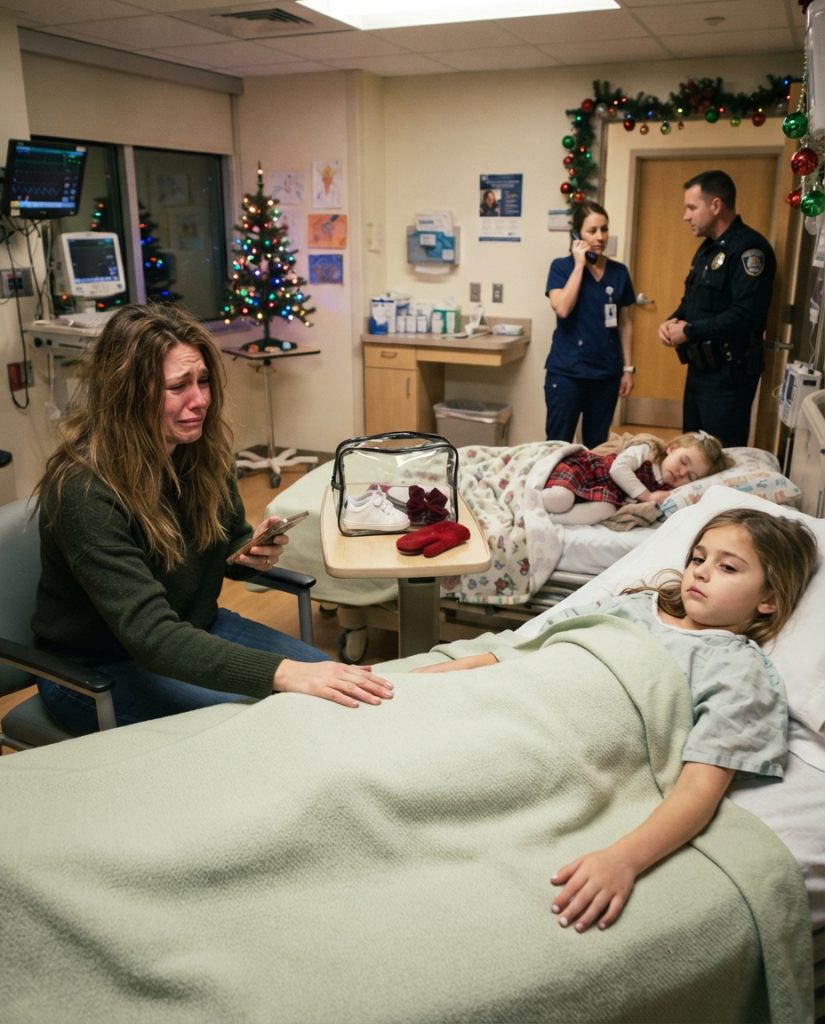
By the time I reached the children’s hospital, both girls were under warming blankets.
Ruby’s lips had lost their color.
Her cheeks were blotchy and pale.
Maisie looked exhausted in a way no eight-year-old ever should.
There was dried salt along the hem of her tights.
Her hair was damp from melted snow.
One of the nurses told me Maisie had kept herself wrapped around Ruby the entire time, even after the paramedics arrived, like letting go wasn’t an option she trusted.
I kissed both of them and kept apologizing, though neither of them was awake enough to hear me.
A nurse came in with a clear plastic bag holding the girls’ things.
Ruby’s mitten.
A velvet bow.
One of Maisie’s shoes with road grit stuck to the bottom.
When she handed me the bag, I looked down and saw Maisie’s hand lying outside the blanket.
Small, red, trembling in her sleep.
That was when I noticed what was caught under her thumbnail.
A thin curl of glossy white paint.
The exact shade of my parents’ front door.
I called my father right there.
He answered on the third ring, irritated, as though I had interrupted dinner.
I said, “Where are you?”
He said, “At home.
Why?”
My voice came out so flat it didn’t sound like mine.
“Now it doesn’t look like theirs.”
Last Christmas Eve, after the girls were asleep, I checked the locks, turned out the downstairs lights, and stood for a moment in the hallway looking at that red door.
It is just a door.
Wood.
Hinges.
Paint.
But it opens the first time.
And every time one of my daughters comes home cold, scared, loud, muddy, crying, sticky, tired, or just wanting in, it opens before she even has to knock.