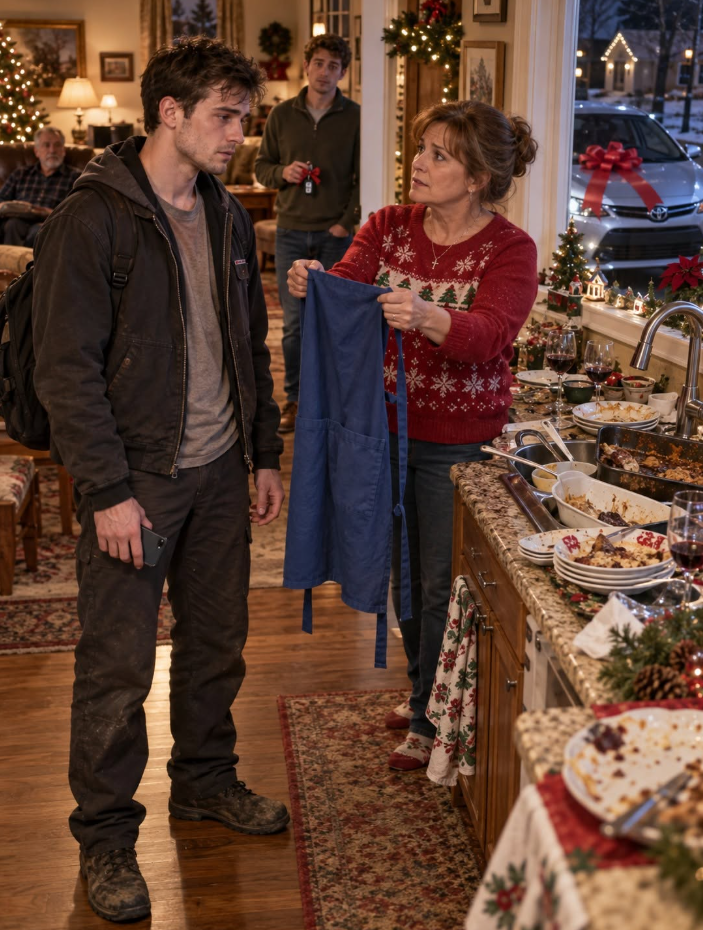
Mom kept holding the apron.
“Ryan?”
“I’m going to shower.”
Her eyebrows lifted.
“What about the kitchen?”
“It’ll still be there tomorrow.”
“People are coming back for breakfast.”
“Then we should probably leave the dishes out so they know where to start.”
Dad said my name from the living room.
Not loudly.
The warning version.
“Ryan.”
I looked at him.
He was sitting in his recliner with Tyler beside him.
The giant red bow was on the floor near their feet.
Dad had worked thirty-one years for the city water department before retiring.
He was not a cruel man.
That complicated things.
Cruel people are easy to understand.
Dad coached my Little League team.
Taught me how to change brake pads.
Drove three hours when my first car broke down outside Cincinnati.
He loved me.
I had never doubted that.
But love, I was starting to understand, could develop habits.
“Don’t disrespect your mother,” he said.
“I’m not.”
“She asked you for some help.”
“I worked ten hours.”
“So did people in this house getting ready for dinner.”
“I wasn’t here for dinner.”
Mom looked hurt.
“We saved you a plate.”
That almost made me lose my temper.
Instead, I laughed.
Quietly.
“I don’t want a plate badly enough to clean up after fourteen people.”
Tyler sat forward.
“Dude, I’ll help.”
Mom immediately turned.
“No. You’ve been running around all day.”
I looked at her.
She heard it.
For the first time, she actually seemed to hear herself.
Tyler stood anyway.
“I can wash dishes.”
“You don’t have to.”
“I know.”
He looked at me.
“Apparently that’s an important distinction tonight.”
I almost smiled.
Dad did not.
“Everybody is tired.”
“Exactly,” I said.
I picked up my backpack.
“I’m going upstairs.”
Mom dropped the apron onto the counter.
“Fine.”
That word followed me all the way to my old bedroom.
I closed the door.
My room had not changed much since high school because my parents used it as a combination guest room and storage closet when I was away at school.
My old baseball trophies still sat on one shelf.
Three plastic bins of Christmas decorations were stacked beside the desk.
I sat on the bed and opened the bursar email again.
$4,684.
I had $3,120 in the savings account I kept specifically for school.
My Christmas Eve shift would add roughly $280 after taxes.
I had another paycheck before the deadline.
I could put the remaining amount on a payment plan.
It would work.
Barely.
That was what I always said.
It’ll work.
I’ll figure it out.
I can cover it.
Somewhere downstairs, dishes began clattering.
Then I heard Tyler laugh.
Not the smug laugh I had imagined fifteen minutes earlier.
An irritated one.
Mom said something I couldn’t make out.
Tyler answered louder.
“He just got home.”
Silence.
Then Dad.
“This isn’t about Ryan.”
I almost laughed again.
Everything in the house suddenly seemed to be about me now that I had declined one apron.
My phone buzzed.
Tyler.
You okay?
I typed:
Fine.
Deleted it.
Then wrote:
Not really.
Three dots appeared.
Yeah. Figured.
I put the phone down.
Ten minutes later, someone knocked.
Tyler came in without waiting.
He was still holding a dish towel.
“Mom is mad.”
“Historic.”
“She’s mostly mad because she knows you’re right.”
“I didn’t say I was right.”
“You didn’t have to.”
He sat at the desk chair.
For a second, neither of us spoke.
Then I said, “The car is nice.”
He looked embarrassed.
“Don’t do that.”
“Do what?”
“Act like this isn’t weird.”
“It’s not your fault they bought it.”
“No.”
He picked at a loose thread on the dish towel.
“But I didn’t exactly refuse.”
“You needed a car.”
“I needed a car.”
He nodded.
“I didn’t need that car.”
That surprised me.
“What did you think they were getting?”
“Dad said maybe something used.”
“The Corolla is used.”
“Eighteen thousand miles isn’t what I pictured.”
I leaned back against the wall.
“Mom said twenty-six.”
“Twenty-six four.”
“You know the exact number.”
“They made me sign financing paperwork this afternoon.”
I looked at him.
“You’re on the loan?”
“With Dad.”
That changed things slightly.
Not enough.
“What are the payments?”
“Four hundred thirty-eight.”
“Who’s paying?”
Tyler hesitated.
“Dad said they’d handle the first year.”
I looked away.
“Okay.”
“Ryan.”
“I said okay.”
“You say okay like a serial killer.”
“I’m tired.”
He rubbed both hands over his face.
Then he said, “They should help with your tuition.”
I looked back.
“Did you say that before the car?”
His silence lasted too long.
There it was.
Not guilt enough to blame him.
Enough to hurt.
“You knew?”
“I knew Dad asked what you still owed.”
“When?”
“Last week.”
“And?”
“And Mom said you had it handled.”
I laughed.
Tyler winced.
“I told them you work too much.”
“Strong advocacy.”
“Ryan.”
“What?”
“I didn’t know what you wanted me to do.”
“Neither did I.”
That was the truth.
I had never asked my parents for the tuition money.
Not directly.
I had mentioned the balance.
Dad asked.
I answered.
Part of me wanted them to offer without making me ask.
That was not exactly fair either.
“You asked for help with a car,” I said.
“Yeah.”
“And they helped.”
“Yeah.”
“I didn’t ask.”
“No.”
“So maybe this is partly me.”
Tyler stared.
“Don’t do that either.”
“What?”
“Turn being ignored into a character flaw.”
I looked at him.
He stood.
“I’ve spent my whole life asking Mom and Dad for things.”
He counted on his fingers.
“Rent. Car repairs. That dumb certification class. Moving money. Security deposit.”
“I remember.”
“You’ve spent your whole life trying to make sure nobody can say you needed anything.”
“That’s dramatic.”
“It’s Christmas Eve. Everything is dramatic.”
I smiled despite myself.
He continued.
“Mom and Dad absolutely treat us differently.”
I said nothing.
“I’m the emergency.”
He pointed at me.
“You’re the plan.”
That sentence stayed with me.
“Which sounds better?” I asked.
“The plan.”
“Usually.”
“Yeah.”
He looked toward the door.
“But emergencies get rescued.”
And plans get expected to work.
Neither of us needed to say it.
Tyler left.
I stayed awake until almost two.
The house went quiet around midnight.
At 1:08, Mom texted from downstairs even though we were separated by one flight of stairs.
I’m sorry tonight ended badly. Merry Christmas. Love you.
I stared at it.
Then answered:
Love you too. We need to talk tomorrow.
Christmas morning was uncomfortable.
Dad made coffee.
Mom cooked eggs.
Tyler kept trying to introduce neutral subjects.
Weather.
Football.
A movie nobody had seen.
Eventually Mom put her fork down.
“Fine.”
She looked at me.
“Let’s talk.”
Dad sighed.
“Mary.”
“No. He wants to talk.”
That framing annoyed me immediately.
As though I had scheduled conflict as a holiday activity.
I put down my coffee.
“I don’t care that Tyler got a car.”
Dad gave me a look that said he did not believe me.
I continued.
“I care that every time Tyler needs help, you decide his need is real. Every time I need something, you point out that I can handle it.”
Mom frowned.
“You never told us you needed tuition help.”
“I told Dad the balance.”
Dad answered.
“And you said you’d make it work.”
“I say that about everything.”
“Then what were we supposed to think?”
That was fair.
I hated that it was fair.
“You could have asked.”
Dad looked irritated.
“We’re not mind readers, Ryan.”
“No.”
I nodded.
“You’re not.”
Mom relaxed slightly.
Then I said, “But you are very good at anticipating Tyler.”
Her expression tightened again.
“That’s not fair.”
“Why?”
“Because Tyler has had a rough few years.”
I looked at my brother.
He stared into his coffee.
“His engagement ended.”
“I know.”
“He moved home.”
“I know.”
“He needs a reliable car to keep his job.”
“I know.”
Mom leaned forward.
“You’re doing well.”
“There it is.”
“What?”
“The reason.”
She stared.
“Because I’m doing well, I get less.”
“That is not what I said.”
“It’s what keeps happening.”
Dad pushed his chair back slightly.
“You’re comparing completely different situations.”
“Yes.”
“I hate scorekeeping.”
“So do I.”
“Then stop.”
“I tried.”
I looked at him.
“For years.”
The kitchen went quiet.
I didn’t list every example.
I didn’t need to.
Instead I said, “Do you remember sophomore year when my laptop died?”
Dad nodded slowly.
“I told you to buy one with your summer money.”
“Yes.”
“You had money.”
“I did.”
“Okay.”
“Two months later, Tyler needed tires.”
Tyler closed his eyes.
Dad frowned.
“What does that have to do with anything?”
“You paid for all four.”
“He was commuting.”
“So was I.”
“You were living on campus.”
“Forty miles from home.”
Mom said, “Ryan, that was years ago.”
“Yes.”
I nodded.
“It was.”
I looked at her.
“Which is why I kept telling myself every situation had a reason.”
Nobody spoke.
“Tonight wasn’t about one car.”
My voice came out quieter than I expected.
“It was the first time I looked at the whole pattern without explaining it for you.”
Mom looked hurt.
That hurt me too.
I loved her.
This would have been easier if I didn’t.
Dad folded his arms.
“What do you want?”
That question landed badly.
Not What do you need?
What do you want?
As if I had arrived at a negotiation with a demand.
“I don’t want you to pay my tuition.”
Mom blinked.
Dad looked confused.
“Then what is this?”
“I want you to stop using my competence as an excuse to treat me like I don’t need care.”
The room changed.
Tyler looked at me.
Mom’s face softened despite herself.
I continued.
“You call me responsible when you mean low-maintenance.”
“That’s not true.”
“Sometimes it is.”
I looked at Dad.
“When I tell you I’m working Christmas Eve because tuition is due, I don’t need you to solve it. But I would like the same concern Tyler gets when his car breaks.”
Dad looked down.
Mom said, “I was concerned.”
“Then I came home and you handed me an apron.”
She flinched.
Good.
Not because I wanted to hurt her.
Because finally the detail sounded to her the way it had felt to me.
“I shouldn’t have done that,” she said.
“No.”
“I thought because you missed dinner—”
“I know what you thought.”
“I wasn’t punishing you.”
“I know.”
That mattered.
Intent again.
Always intention.
“I’m not saying you were trying to humiliate me.”
She looked relieved.
“I’m saying you didn’t even notice how it looked because everyone in this family assumes I’ll handle the thing nobody else wants.”
Tyler raised one hand.
“I support this message.”
Dad gave him a look.
Tyler lowered the hand.
Mom almost smiled.
Then she began crying.
Not dramatically.
That made it harder.
“I really thought we were proud of you.”
“I know you are.”
“We tell everybody.”
“I know.”
“You’ve done everything right.”
There it was.
Everything right.
I leaned back.
“Maybe that’s part of the problem.”
She wiped her face.
“What does that mean?”
“You reward Tyler when he gets back on track.”
Tyler looked down.
“And you reward me by needing less from you.”
Nobody had an answer.
Dad stood and walked to the kitchen counter.
For a while, he stared through the window at Tyler’s Corolla.
Then he said, “I had a brother like you.”
I looked at him.
That was new.
“Uncle Rob?”
Dad nodded.
“My parents worried about me.”
I knew that.
Dad had struggled in school.
Worked construction.
Got into debt at twenty-three.
Grandpa helped him more than once.
“Rob was the one who never asked for anything.”
Dad rubbed one hand over his jaw.
“When Mom died, he told me something similar.”
“What?”
“That everybody loved him for being easy.”
I waited.
“He said nobody ever asked whether easy cost him anything.”
Mom looked at Dad.
“You’ve never told me that.”
“I haven’t thought about it in years.”
He looked at me.
“I didn’t realize I was doing the same thing.”
I felt something loosen.
Not disappear.
Loosen.
Dad sat again.
“What do you need for spring?”
I almost laughed.
“No.”
“What?”
“I just told you I don’t want a check because we had this conversation.”
“Why not?”
“Because then we’ll turn the whole problem into $4,684.”
Mom frowned.
“Wouldn’t paying tuition help?”
“Financially? Absolutely.”
Tyler snorted.
I ignored him.
“But I don’t want the next version of this story to be that I complained until you bought fairness.”
Dad did not like that phrase.
I could tell.
“Then what do we do?”
“I don’t know.”
That was honest.
“I think you notice.”
Mom looked at me.
“Notice what?”
“Before assuming Tyler needs help and I don’t.”
Dad nodded slowly.
I added, “And maybe stop making me clean up everybody’s Christmas because I arrived after the party.”
Mom covered her face briefly.
“I deserved that.”
Tyler said, “For the record, I did most of the dishes.”
I looked at him.
“You want a medal?”
“The car is enough.”
Mom laughed through tears.
Even Dad smiled.
The conversation did not fix our family.
It did change one decision immediately.
Dad did not offer to pay my tuition again that morning.
Instead, after breakfast, he asked:
“Can we look at the payment plan with you?”
Different question.
I almost said no automatically.
That was my reflex.
Handle it.
Protect it.
Don’t owe anyone.
Then I heard Tyler’s sentence again.
You’re the plan.
Plans can accept help too.
“Okay.”
We sat at Dad’s laptop.
The university offered a three-payment plan.
The fee was small.
I had enough saved for the first installment and most of the second.
With my next two paychecks, I could cover all of it without adding credit card debt.
Dad asked if I wanted him to cover the plan fee.
It was thirty dollars.
I laughed.
“You can handle thirty.”
He smiled.
“Big spender.”
I let him pay it.
It sounds ridiculous.
Thirty dollars after they had just put thousands toward Tyler’s car.
But accepting that thirty dollars mattered because it wasn’t a rescue and it wasn’t a consolation prize.
It was Dad participating after asking.
That afternoon, Tyler took me for a drive in the Corolla.
It smelled aggressively new.
He had already put a phone mount on the dashboard.
“Nice car,” I said.
“You can say you hate it.”
“I don’t hate the car.”
“You hate what it represents.”
“Very therapy of you.”
“I dated a therapist for four years.”
“Marketing degree by association.”
He laughed.
At a red light, he became serious.
“I’m going to pay them back.”
“You don’t have to do that because of me.”
“Not because of you.”
He looked at the steering wheel.
“I think I’ve been letting Mom and Dad keep me dependent because it’s comfortable.”
That was not something I expected Tyler to say.
“I had a bad breakup.”
“I know.”
“I didn’t have a bad life.”
I looked at him.
He continued.
“I’m twenty-six. I have a job. I can make the payment after the first year.”
“Okay.”
“I told Dad this morning.”
“How’d that go?”
“He said we’ll talk about it.”
I laughed.
“Classic Dad.”
Tyler smiled.
Then he said, “I’m sorry.”
“For what?”
“For enjoying being the emergency.”
That was more honest than I expected.
“I don’t blame you.”
“I do a little.”
We drove home.
The big red bow was still in the garage.
Tyler threw it into the recycling bin.
January came.
I paid tuition.
Worked fewer overtime shifts once classes started because the payment plan gave me room.
For the first time, when Mom called on a Thursday and asked if I could come over Saturday to help move furniture, I said:
“I have a study group.”
There was a pause.
The old me would have filled it.
But I waited.
Mom said, “Okay. I’ll ask Tyler.”
That was it.
No guilt.
No “you’re always busy.”
No reminder that they had done something for me.
A tiny thing.
It mattered.
In February, Dad called because his truck needed to go to the dealer and he needed a ride home.
“Are you free?”
I checked my schedule.
“No.”
“All right.”
Then he asked Tyler.
Another tiny thing.
Nobody assumed my calendar was the flexible one because I had always made it flexible.
Our family slowly stopped using my reliability as a public utility.
Not perfectly.
Habits don’t disappear after one Christmas argument.
Mom still occasionally said, “Ryan won’t mind,” before catching herself.
Dad still praised me in ways that sometimes sounded like permission not to worry.
Tyler still called when he was short on rent one month.
But that time, he called me for advice.
Not money.
By spring, something else had changed.
I started asking.
That may have been the harder part.
I asked Dad to help me move a used desk into my apartment.
I asked Mom if she could pick up a prescription when I was sick during finals.
I asked Tyler to drive me to the airport for a student conference.
Every request felt slightly embarrassing at first.
Like I was failing at a skill I had built my identity around.
Nobody seemed to think less of me.
That annoyed me.
I had spent years defending a fortress no one had actually ordered me to build.
Some of it came from my parents.
Some of it came from me.
Both could be true.
The following December, I did not volunteer for Christmas Eve.
Not because of the previous year.
Mostly.
I had enough money saved.
I came home at five.
Mom was already cooking.
Tyler was chopping onions badly.
Dad was pretending to understand a football game while falling asleep in his chair.
I walked into the kitchen.
Mom handed me something.
For half a second, my body remembered the apron.
I looked down.
A beer.
I laughed.
“What?”
“Nothing.”
She frowned.
Then understood.
“Oh my God.”
Tyler nearly dropped the knife laughing.
Mom covered her face.
“I will never live that down.”
“No.”
“I have apologized.”
“Multiple times.”
“You told Aunt Susan.”
“She asked why Tyler calls it Aprongate.”
Tyler said, “Because history matters.”
Mom threw a dish towel at him.
Not an apron.
A towel.
Important distinction.
Later, while we were setting the table, Dad handed me an envelope.
My stomach tightened.
“Please don’t tell me you bought me a car.”
“Absolutely not.”
Inside was a receipt.
Thirty dollars.
At first, I didn’t understand.
Then I saw the university logo.
Payment plan fee.
The one he had paid the year before.
He had printed the receipt and written underneath:
For the record, I helped.
I laughed so hard I had to sit down.
Dad smiled.
Then he said, “I should’ve helped more before you had to ask.”
I looked at him.
“We’re okay.”
“I know.”
That was not a dismissal.
It was true.
Across the room, Tyler was telling Mom he had made his first Corolla payment himself that month.
She looked horrified.
“You could have told us.”
“I’m twenty-seven, Mom.”
“You’re still my child.”
He looked at me.
We both started laughing.
Mom pointed at us.
“What?”
“Nothing.”
“Why do both of you say nothing when it’s obviously something?”
Dad said, “Maybe that’s hereditary.”
The house smelled like roast beef and cinnamon.
No giant surprise.
No bow in the driveway.
No one keeping score.
At dinner, Tyler raised his glass.
“To Ryan.”
I groaned.
“No.”
He ignored me.
“To the only man I know who can turn refusing to wash dishes into a yearlong family reform program.”
Everybody laughed.
I did too.
Because this time the joke was not built on making me smaller.
There is a difference.
Last Christmas, I thought what hurt was the Corolla.
It wasn’t.
I didn’t need my parents to spend the same number of dollars on both sons.
Families are not accounting ledgers.
What hurt was learning that my competence had become invisible labor.
Tyler struggled, so people leaned toward him.
I succeeded, so people leaned on me.
The car simply made the difference impossible to explain away.
That Christmas taught my parents to ask before assuming I was fine.
It taught Tyler that being helped and being helpless were not the same thing.
And it taught me something I should have learned years earlier.
Being the reliable son did not require becoming the son who never needed anything.
Sometimes the strongest thing I could say was not, “I’ll make it work.”