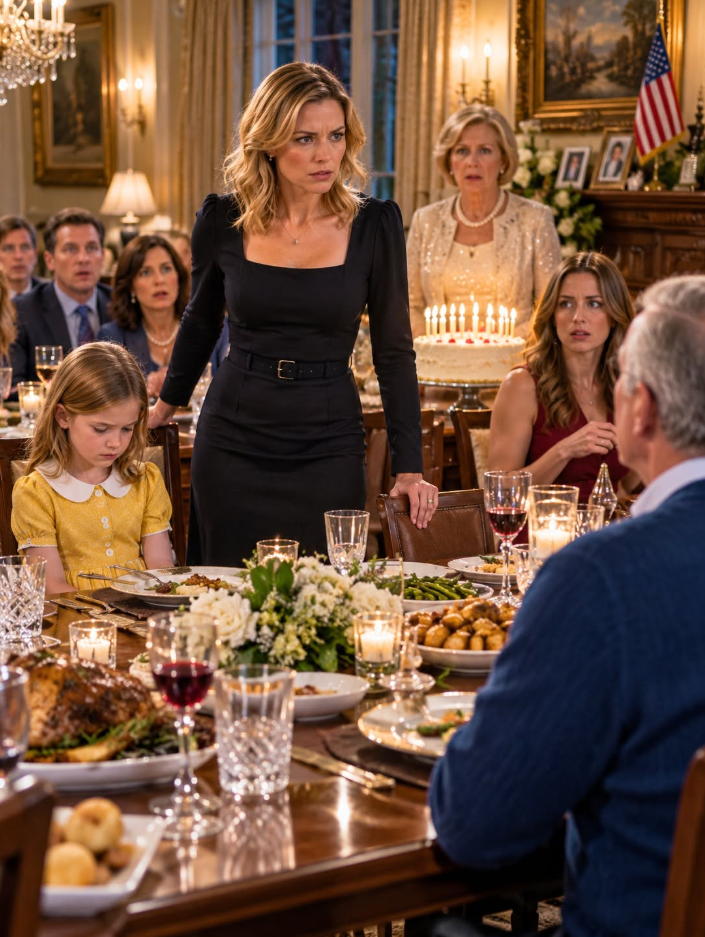
The cake had 37 candles. I counted them while my mother lit each one. Her fingers steady, her smile practiced, the kind of smile she’d been performing for 60 years of family gatherings, where everything looked right and nothing was right.
My father sat at the head of the table in his usual throne, the armchair nobody else was allowed to use, wearing the blue sweater that cost more than my first month’s rent. The dining room smelled like roasted lamb and old money, and the particular silence that settles over a family when everyone is pretending.
I had almost not come.
3 weeks before the party, I’d stood in my kitchen holding the invitation. Cream card stock, gold lettering. Robert and Elaine Callaway request the pleasure of your company.
And I’d felt that familiar weight pressed down on my chest, the weight I’d been carrying since I was 9 years old, and figured out that in this family, love was a currency distributed unequally, and I had always been the poorest one at the table.
But Alice had asked to go.
That’s the thing about having a child who is still luminous enough to believe that grandparents are magical.
She’d put on her yellow dress with the white buttons, the one she’d picked herself at the store, spinning in front of the mirror with that laugh that sounds like someone dropped a jar of bells, and she’d held my hand in the car and said, “Do you think grandma made the chocolate cake this year?”
I’d said yes, even though I knew my mother hadn’t touched a mixing bowl in 15 years.
The party was crowded.
My aunt Patricia and her husband who never learned my name in 34 years. My cousin Derek who works in finance and announces it every 6 minutes. My sister Donna, two years younger than me, two decades more beloved, stationed near my mother like a satellite that had found its perfect orbit.
They laughed at the same moments. They finished each other’s sentences.
[clears throat]
They turned their shoulders, sometimes without even knowing it, to form a wall.
Alice moved through it all like light through water, unbothered, curious, collecting small moments.
She organized the cocktail napkins into a pattern. She asked my uncle about his dog with genuine interest. She sat beside me at dinner and ate her lamb without complaint, even though I knew she didn’t love lamb.
It happened during the toast.
My father stood, glass raised, and he made the rounds, thanking Patricia for coming from Cleveland, praising Donna for always showing up, acknowledging Dererick’s recent promotion.
He was three sentences into something about legacy and family values when Alice, who had been sitting so quietly and so perfectly, looked up at him with those wide, serious eyes of hers, and said, “Grandpa, you didn’t say my name.”
A beat.
The kind that lasts longer than it should.
My father looked at her. Really looked at her. The way you look at something that has interrupted you, not someone.
Then he set his glass down and said, in the same voice he used to discuss quarterly returns, “That’s because this toast is for family.”
The air in the room changed.
I felt it change in my body first. A cold drop like a stone through still water from my throat to my stomach.
Alice blinked.
Her small brain was doing the math, the terrible math, and I watched her face move through the calculation.
“But I’m—”
“You’re not really part of this,” my father said. “Your mother knows what I mean. You’re—you’re on the outside of this, sweetheart. You always have been. It’s just how it is.”
He said “sweetheart” like a period at the end of a sentence, like it made it gentler, like the word was a napkin you could press over a wound.
My mother didn’t move.
And then my sister Donna, my sister who I had defended in seven different arguments, who I had lied for twice, who I had driven to the hospital at 2:00 a.m. in 2019 and held her hand through 6 hours of waiting.
My sister Donna laughed.
Not a nervous laugh. Not an uncomfortable laugh.
A genuine, easy, finally someone said it laugh.
Alice didn’t cry.
That was the worst part.
She just got very still, the way children do when they’re trying to figure out if what happened was real, and she looked down at her plate and she moved her fork one inch to the left and she didn’t say anything else.
I had spent 34 years being quiet at this table.
I had spent 34 years choosing peace over truth because I told myself it wasn’t worth it. Because I told myself they’d never hear me anyway. Because I told myself that protecting Alice meant keeping the door open to these people, giving her grandparents, even if those grandparents were made of stone.
I looked at my daughter’s face.
I looked at the fork she had moved one inch to the left.
And I stood up.
“I’m going to need everyone’s attention,” I said, “because I’m only going to say this once.”
The room went absolutely silent.
My father looked at me like I was a piece of furniture that had begun to speak.
Good.
34 years of silence have a sound when they break.
It’s not loud. It’s not dramatic.
It’s the sound of a chair scraping back on hardwood. The sound of a woman setting down her wine glass with the kind of deliberate slowness that tells everyone in the room that what comes next is not an accident.
I stood at my full height, which had never felt like enough in this house, in this room under these lights, and I looked at my father first, then my mother, then my sister, and I felt something I had not felt in a very long time.
Clarity.
Not anger.
Anger I’d felt for years. In the car rides home, in the 1:00 a.m. conversations with myself, in the careful way I’d always worded things to protect people who had never once considered protecting me.
This was different.
This was the feeling of a woman who has finally completely run out of reasons to protect the wrong people.
“Alice,” I said without taking my eyes off my father. “Will you go to the living room and pick a show? My phone is in my purse, the blue one on the chair.”
She looked at me.
8 years old and already she could read a room better than half the adults in it.
She slid off her chair quietly, took my purse from the hook, and walked out without a word. She didn’t rush. She held her shoulder straight.
I had never loved her more than in that moment.
And I had loved her every moment of every day since the first second she existed.
The door to the living room clicked shut.
I turned back to the table.
“Dad,” I said, “you just told my daughter she doesn’t belong in this family in front of 12 people on your birthday. While she was sitting 3 ft away from you eating lamb she doesn’t even like because she wanted to be here.”
My father opened his mouth.
“I’m not finished,” I said.
He closed it.
Something shifted in the room.
I saw Derek look at his plate. I saw Patricia’s hand move to her husband’s arm. I saw my mother’s jaw tighten in that way it always did when the performance was in danger of falling apart.
“I have been coming to this table my entire life,” I continued. “And I have watched this family decide over and over again who matters and who doesn’t. I watched you forget my college graduation because Donna had a recital. I watched you introduce her as your daughter at my own wedding rehearsal dinner and correct yourself like my name was a minor inconvenience. I watched you send birthday cards to every cousin in this room and send me nothing for 11 consecutive years. And I told myself it was fine. It was old patterns. It wasn’t worth the fight.”
My mother said, “Jennifer, you’re being dramatic.”
“Elaine.”
She stopped.
I had never called her by her name before.
Not once.
Not in 34 years.
I watched it land on her like something physical.
“I spent 34 years being small in this room so you could be comfortable. I am done with that. And [clears throat] I need you to understand, all of you, that what happened tonight is not something I’m going to let pass. Not with a phone call next week. Not with an apology card. Not with Donna saying she was just laughing because she was nervous.”
I looked directly at my sister.
Donna had stopped smiling.
Good.
“You laughed,” I said to her. “You heard a child. My child, your niece, a little girl in a yellow dress who spent the car ride here hoping grandma made chocolate cake. You heard her told she means nothing to this family. And you laughed. And I need you to sit with that. I need you to really sit with what that means about who you are.”
Donna’s face did something complicated.
Her mouth opened and I saw the defense forming, that you’re twisting it, and that you always make everything about you.
And I shook my head once.
“Don’t,” I said. “Not tonight.”
My father found his voice somewhere under his pride.
“I simply meant,” he said slowly, “that the toast was for the direct family, for blood. I wasn’t trying to—”
“She is my blood,” I said. “She is half of my blood and the other half of her blood comes from a man who was in this house for six Christmases and four eers and who you called son. So that argument doesn’t work and you know it doesn’t work and you’re saying it anyway because you’ve never once in your life admitted that you were wrong about anything.”
The candles on the cake had burned down to stubs.
37 little threads of smoke rising in the silence.
“Here is what’s going to happen,” I said.
And my voice was very calm now, the calmst it had been all night, because I had arrived at the part where the decision was already made.
And decisions once made don’t require volume.
“I’m going to go get my daughter. We are going to leave. And from this point forward, the terms of our relationship are mine to set, not yours. You don’t get to decide anymore what role you play in Alice’s life. That is my decision. And tonight, you gave me all the information I needed to make it.”
I picked up my purse from the back of my chair.
“Happy birthday, Dad,” I said. “I hope the lamb was good.”
I walked to the living room.
Alice was curled on the sofa with my phone, watching something with headphones in.
And when she saw me, she pulled one side out and said, “Are we leaving?”
“Yeah, baby,” I said. “We’re leaving.”
She put on her shoes without asking why.
We walked out through the front door, past the coat rack with my father’s blue sweater hanging on the hook, past the framed family portraits in the hallway where I had always noticed without ever saying it out loud.
That the largest one was Donna’s.
The night air was cold and clean.
Alice reached up and took my hand.
“Mom, yeah. You said something, didn’t you?” she said, not a question.
“Yeah,” I said. “I did.”
She nodded like this confirmed something she’d already calculated.
“Good,” she said.
We drove home in the kind of silence that doesn’t need to be filled.
I kept both hands on the wheel and I did not cry until we pulled into our driveway.
And even then, I kept it small, kept it quiet, kept it in the space between one breath and the next because Alice was already unbuckling her seat belt and reaching for the door and some things you carry alone.
But I had said it after 34 years.
I had finally said it.
And now came the part nobody in that dining room had seen coming.
The call came 4 days later.
Not from my father. Not from my mother.
It came from Patricia, my aunt, the one who’d driven from Cleveland, the one whose husband still didn’t know my name.
And she spoke carefully, the way people do when they’ve been asked to make a call they didn’t volunteer for.
“Jennifer, your parents are very hurt. They feel you embarrassed them in front of the whole family. And they think—they think an apology would go a long way toward—”
I let her finish.
I had learned in 34 years that people need to finish.
“Patricia,” I said, “I appreciate you calling. I genuinely do, but I need you to understand something. I didn’t call you 4 days after my daughter was told she means nothing to this family. Nobody did. Your call is about your brother’s feelings. I have no interest in your brother’s feelings right now.”
A pause.
“I—I understand, but family is—”
“I’ll stop you there,” I said. “Have a good evening.”
I hung up.
Then I opened my laptop.
Here’s the thing nobody in that dining room knew about me.
The thing I had never advertised, never brought to a holiday dinner, never made part of the family conversation because in this family, my achievements were background noise.
I am a family and estate attorney.
I have been for 9 years.
I specialize in inheritance disputes, estate restructuring, and most relevantly, the documentation of financial arrangements made between family members that were never properly formalized.
My father had always been generous with money.
Selectively, strategically generous.
Donna’s down payment. Dererick’s business loan in 2018. The renovation of Patricia’s kitchen two summers ago.
Cash, transfers, gifts, all of it running through my father’s accounts like a quiet river that somehow never reached my shore.
None of it documented. None of it declared. None of it run through a lawyer.
My father had always assumed that family meant no paperwork.
He had always assumed that I would keep being quiet.
Both of those assumptions were about to cost him.
I didn’t act from rage.
That’s important.
Rage makes mistakes.
Rage sends emails at midnight and says things that can be used against you.
What I felt sitting at my desk that first week was something colder and more precise.
It was the feeling of a woman who has absorbed 34 years of information about a family’s financial habits, who has been a professional in this exact field for 9 years, and who has just been handed the moral clarity to finally use what she knows.
I started with Derek’s loan.
$240,000, transferred in three installments in 2018.
I knew because Derek, in one of his many Finance World announcement moments, had mentioned it at Easter that same year.
Not the amount, but the fact of it.
I knew the amount because my mother had complained about it once, quietly, in a phone call she forgot I was still on.
I cross referenced the dates with public records.
I found the business registration.
I traced the paper trail the way I trace paper trails for clients every week.
Undeclared gift, taxable, never reported.
Then Donna’s down payment.
115,000.
I knew the year because I’d helped her move into that apartment.
Carrying boxes up three flights of stairs while she directed traffic.
She’d mentioned my parents helped.
She had not mentioned the amount.
I found it the way you find things when you know where to look.
Then Patricia’s Kitchen.
42,000, paid directly to the contractor.
I had the contractor’s name from a Christmas card my mother had sent with a photograph of the renovation.
A business search.
A payment record request.
3 days of careful, methodical work.
I was not going to send this to the IRS.
I want to be clear about that.
That was never the plan.
I’m not interested in destroying my father financially.
I’m not interested in prison sentences or audits or watching my mother lose the house she’s lived in for 40 years.
My revenge was never going to be about money.
It was going to be about power.
I sent one email.
No CC.
No BCC.
Directly to my father’s personal address, which I knew because I was the one who’d set it up for him in 2014 when he couldn’t figure out how to stop using AOL.
The subject line was “For your review.”
The body of the email was three sentences.
“Dad, I’ve attached a summary of undeclared family financial transfers dating from 2018 to present. I have no intention of filing anything or sharing this with anyone. I’m sharing it with you so that you understand clearly that I am not the person you have always assumed me to be and that the quiet I maintained for 34 years was a choice, not a limitation.”
The attachment was a single PDF.
Eight pages.
Clean, precise, professionally formatted.
The kind of document that takes 9 years of expertise to produce and 30 minutes to read and a lifetime to stop thinking about.
I pressed send.
Then I closed my laptop and went to help Alice with her homework.
He called 40 minutes later.
I didn’t answer.
He called again.
I didn’t answer.
I watched my phone light up on the kitchen counter while Alice explained to me very seriously that her teacher was wrong about the water cycle.
And I listened to every word of it.
And when she was done, I told her that she might actually be right and that she should bring it up in class tomorrow.
“What if she gets annoyed?” Alice said.
“Then she gets annoyed,” I said. “You still say the true thing.”
She considered this with the gravity she brings to all things.
Then she wrote something in her notebook.
My father left a voicemail.
I listened to it once, standing in the hallway after Alice was asleep.
His voice was different.
The throne had come out from under him somewhere between the dining room and that phone call.
And what was left was just a man, older than I’d let myself notice, more frightened than I’d ever been allowed to see, saying my name in a way he hadn’t said it since I was small.
“Jennifer, I—I need you to call me back. I need to—I want to talk about the other night, about what I said to Alice. I need to—”
A long pause.
“I need you to know I didn’t mean it the way it came out.”
Another pause.
“I think I’ve made some mistakes.”
I saved the voicemail.
I didn’t call back that night.
What happened in the weeks that followed was not a dramatic reconciliation.
I want to be honest about that because I think stories lie about this part.
They make the confrontation into the ending.
They let the villain collapse and the family heal in a montage, and real life is slower and stranger and less satisfying and somehow more.
My father called three more times before I answered.
When I did, I gave him 20 minutes.
I told him what I needed.
Not what I wanted. Not what would make me feel better, but what I needed.
An apology to Alice delivered directly in person without my mother in the room.
No hedging.
No, “I’m sorry if you felt.”
An actual complete adult apology to a child he had wounded.
He was quiet for a long time.
“Okay,” he said.
“And Donna,” I said.
Another silence.
“I’ll talk to her,” he said.
“That’s not what I said,” I said. “Donna apologizes to Alice separately. Same conditions.”
He exhaled.
I heard 60 years of never being asked to do this kind of thing in that exhale.
I didn’t move to fill the silence.
“Okay,” he said again, smaller this time, more real.
Donna called me on a Tuesday.
She didn’t apologize immediately.
She talked around it for a few minutes, explained her nervousness, explained the tension in the room, explained that she’d always felt caught between me and our parents, like it was a war she’d been drafted into.
I let her say all of it.
Then she said, “I laughed at a child. I laughed at your kid, and I’ve been sick about it since that night.”
That was enough.
Not for everything. Not for the years.
But for this specific wound.
On this specific night, it was enough to work with.
We are not close.
We may never be close.
But she came to our house on a Saturday afternoon and she sat across from Alice at the kitchen table and she said, “I owe you an apology. What happened at grandpa’s party was wrong and I’m sorry.”
Alice listened.
Then she said, “Okay.”
Just that.
Just okay.
The most complete word in the language when a child says it and means it.
My father’s apology happened 3 weeks later in his living room without my mother present.
He sat in the armchair he always sat in and he looked at Alice for a long moment and then he leaned forward with his elbows on his knees, which made him smaller, which I don’t think was accidental.
And he said, “I said something very unkind to you at my party. It wasn’t true and it wasn’t right and I’m sorry I said it.”
Alice looked at him steadily.
“Why did you say it?” she asked.
My father opened his mouth and closed it.
“I don’t have a good answer for that,” he said finally.
Alice nodded slowly.
“That’s okay,” she said. “You can think about it more.”
He laughed, surprised and small and a little broken.
The best kind of laugh, the kind that doesn’t have performance in it.
I didn’t forgive my father that afternoon.
I didn’t forgive my mother, who sent a card with a dove on it and the words hoping to move forward and no actual acknowledgement of anything specific, which told me everything I needed to know about how far she was willing to go and exactly how much space I would keep between us going forward.
Forgiveness, I have learned, is not a door you open once.
It’s a thing you build slowly with correct materials, and only if the other person is willing to pick up tools.
But I chose something that day, standing in my father’s living room, watching Alice explain to him with complete authority that he needed more time to think about his answer.
I chose the version of this story where Alice grows up knowing that when someone hurts her, her mother does not sit down.
She grows up knowing that the quiet was always a choice and she grows up knowing how to stand.
That night I tucked her in and she looked up at me from her pillow and said with the terrifying precision children sometimes land on when they’re almost asleep and their filters are down.
“Mom, I think you were always the strongest one. They just didn’t want you to know.”
I turned off her light.
I stood in the hallway for a long time.
Yeah, baby.