“At the age of 77, I dressed for my son’s 7 p.m. townhouse dinner after covering $93,600 of his expenses that year alone, only to receive a second text from him: “You weren’t invited. My wife doesn’t want you there.” By sunrise, 174 payments had vanished.
“Mom, the plans have changed,” Benjamin texted at 6:18 p.m.
Before I could even lift myself from the kitchen chair, another message appeared.
“You weren’t invited. My wife doesn’t want you there.”
The navy dress I had carefully chosen still carried the creases from where I had smoothed the fabric with my hands. Rain tapped gently against the kitchen window. The kettle on the stove made one soft click as it cooled, completely empty. The room smelled of lemon polish, old wood, and tea that had gone cold and bitter.
Thomas’s photograph sat on the mantel.
I picked up the silver frame. It felt cold against my fingertips.
Beside it were the pearl earrings he had given me for our fiftieth wedding anniversary. Next to them was the townhouse brochure Benjamin had mailed me in March, filled with white trim, perfectly arranged furniture, smiling couples, and promises printed on thick, glossy paper.
“For you too, Mom,” Benjamin had told me.
I believed him.
Because mothers are taught to recognize love, even when what they’re hearing is only convenience disguised as their son’s voice.
A metallic taste filled my mouth.
The clock showed 6:20.
I read the message again and again until there was no way to convince myself it had been a mistake.
*You weren’t invited.*
Genevieve had never been the kind of woman who needed to raise her voice.
She never had to.
Her cruelty always came wrapped in polished manners, perfectly folded napkins, and soft words she could later deny ever saying.
“Your mother makes people uncomfortable,” she had once said with a pleasant smile while drinking a fourteen-dollar coffee I had paid for. “She means well, but still.”
I had laughed back then.
A quiet, practiced laugh.
The kind of laugh women give when they have spent years trying their hardest not to become a burden.
My hand rested on the back of the chair. The familiar wood felt firm beneath my palm. I pulled the chair out, sat down, and opened the old desk drawer that had once belonged to my mother.
Inside was a folder marked **BENJAMIN**.
It contained years of silent rescues.
College tuition.
Insurance payments.
Mortgage assistance.
Country club dues.
Emergency transfers that had somehow turned into monthly expenses.
A $2,800 preschool tuition payment for my granddaughter.
A $6,400 home repair Genevieve had promised would be “just temporary.”
Old paper has a particular smell.
Dust.
Ink.
And grief that has been tucked away for far too long.
At 6:47 p.m., my granddaughter sent me a message.
“Grandma, are you coming?”
I stared at those four words until my eyes started to sting.
Children rarely understand which adults are quietly putting walls between them and the people they love.
I replied.
“Not tonight, sweetheart. I love you.”
Then I reached for the landline.
I didn’t call Wesley.
I didn’t call Serena.
And I certainly wasn’t going to beg for a seat at a dinner table I had spent years helping to finance.
When I called the bank, my voice remained completely steady.
The representative on the emergency line asked me to verify my identity.
I gave her my birthdate.
Thomas’s middle name.
The last four digits.
My security phrase.
Then she asked, “Which authorizations would you like us to cancel?”
“All of them connected to Benjamin Kelley.”
There was a short silence.
Then I heard her fingers moving across the keyboard.
It sounded like a mother remembering that she was still allowed to be a person.
At 7:03 p.m., I sent my son one final message.
“Then you and your wife can start paying your own way.”
I pressed send.
Turned off my phone.
And took off the pearl earrings.
By 8:11 the following morning, I was sitting across from Clara at First National Bank with the folder opened between us.
She had known our family for twenty-two years.
She had approved Thomas’s first retirement account.
She had sent flowers after he d:ie:d.
She didn’t look at me with pity.
I appreciated that.
“Are you certain, Mrs. Kelley?” she asked gently.
I placed both hands on the desk. Blue veins showed beneath my skin. My wedding ring sat loosely around my finger.
“Yes,” I answered.
Eight pages slowly came out of the printer.
Mortgage payments.
Insurance.
Utility bills.
Country club dues.
Tuition.
Subscriptions.
Even a business account Benjamin had never mentioned to me.
One hundred seventy-four recurring payments.
Clara turned the monitor toward me, rows of numbers glowing neatly across the screen.
I felt warmth spread across my face.
Not embarrassment.
Understanding.
“It rarely happens overnight,” Clara said quietly.
“No,” I replied.
“It never does.”
People love repeating little sayings.
They don’t mean much…
Until they cost you something.
Then they become receipts.
My pen moved across the final authorization form.
That tiny sound closed a door that had been left open for fifteen years.
When I returned home, I made tea in my finest cup.
Not the chipped one.
Not the one I always used because I believed the nice things should be saved for company.
At exactly 11:26 a.m., the first payment was declined.
Then another.
And another.
A few moments later, I heard tires crunching over the wet gravel outside.
I pulled the curtain back.
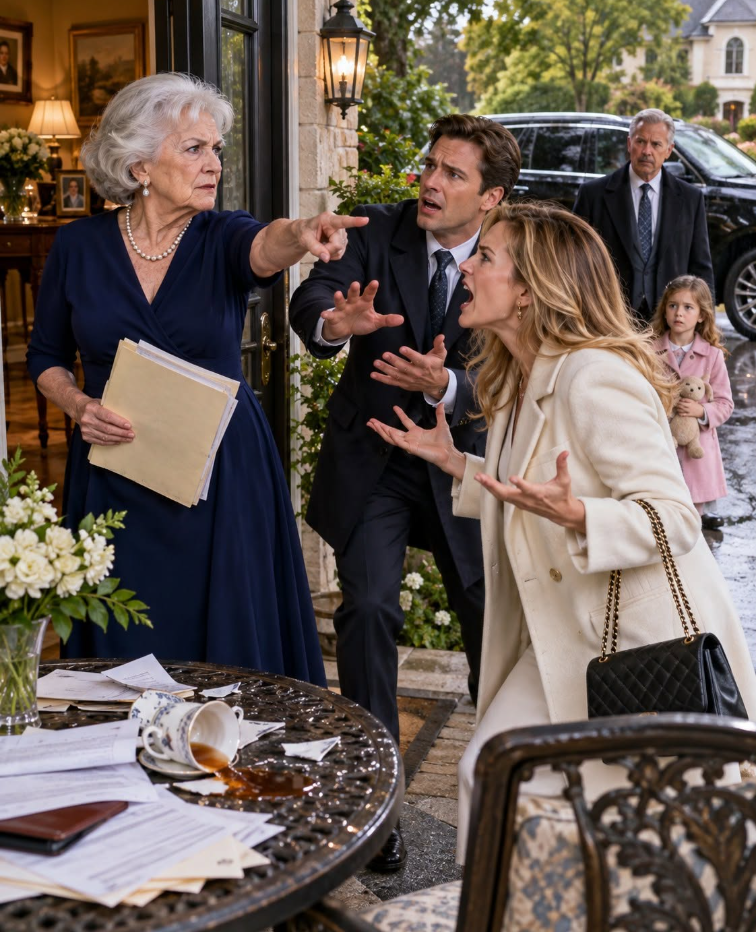
Genevieve stepped out first, wearing a spotless cream-colored coat, her lips pressed into a tight line.
Benjamin climbed out behind her, gripping his phone, his face completely drained of color.
But it was the third person who stepped out of the vehicle…
That made me slowly place my teacup back on the table.
PART 2
The third person was a man I had never seen before.
He was tall and silver-haired, wearing a charcoal overcoat that had clearly cost more than my first car. He carried a brown leather briefcase in one hand and an umbrella in the other, and he held that umbrella over Genevieve, not over my son.
That told me everything I needed to know about who was paying him.
I set my teacup down on its saucer. It made the smallest sound.
A lawyer.
After fifteen years, one canceled dinner, and one morning at the bank, my son had brought a lawyer to my door.
The doorbell rang.
Then it rang again.
Thomas used to say friends press a doorbell once and wait. People who believe you owe them something lean on it.
Genevieve leaned on it.
I smoothed my cardigan and opened the door.
“Good morning,” I said.
“Eleanor.” Genevieve smiled the way she always did, with her lips and nothing else. “May we come in? It’s pouring.”
“It is,” I agreed.
I stepped aside. My mother raised me never to leave people standing in the rain, even people who have come to take something from you.
Benjamin would not look at me.
He stared at the coat hooks, the photographs, anything but his mother’s face.
“Mom,” he said quietly.
That was all.
The man in the overcoat extended his hand. “Mrs. Kelley. Grant Whitaker, Whitaker and Lowe. I’m here on behalf of your son and daughter-in-law.”
I looked at his hand. I shook it, because refusing would have been small, and I had decided on the drive home from the bank that I was done being small.
“On behalf of them,” I repeated. “Regarding what, exactly?”
“Perhaps we could sit down.”
We sat in the living room. Genevieve chose Thomas’s armchair. Of course she did. Mr. Whitaker set his briefcase on my mother’s lace doily and opened it with two sharp clicks.
“Mrs. Kelley,” he began, in the gentle, careful voice people use with hospital patients and small children, “your family is very concerned about you.”
“Are they.”
“Last night and this morning, you made a series of sudden, significant financial changes. One hundred seventy-four authorizations canceled in less than twenty-four hours. Payments that had been in place for years. Mortgage. Insurance. Your granddaughter’s school tuition.” He paused to let that last one land. “Your son received more than forty notifications before breakfast.”
“I imagine he did.”
“Decisions like these, made abruptly and emotionally, late in the evening, can sometimes be a sign of…” He tilted his head sympathetically. “Of cognitive changes. It happens to many people as they get older. There’s no shame in it.”
Genevieve leaned forward. “We just want to make sure you’re protected, Eleanor. You live alone. You’ve been under so much stress since Thomas passed. We love you.”
There it was.
That word, laid on the table like a coupon.
Mr. Whitaker slid a document toward me. “This is a durable power of attorney. It would simply allow Benjamin to help you manage your finances going forward. It’s very standard. If you’d prefer not to sign it voluntarily…” He cleared his throat. “Then, with regret, my clients would have no choice but to petition the court for a capacity evaluation and a possible conservatorship.”
I picked up the document. I put on my reading glasses. And I read every single word of it while three people watched me in silence.
It took four minutes.
When I was finished, I set it down, took off my glasses, and folded them.
“Mr. Whitaker,” I said, “on page three, section four, you’ve given my son the authority to make gifts from my accounts to himself and his spouse without limit. That isn’t standard. That’s a blank check with a bow on it.”
His eyebrows rose half an inch.
“Also,” I went on, “you’ve misspelled my late husband’s name in the recital on page one. It’s Thomas with an H. He was particular about that.”
Genevieve’s smile flickered.
I turned to my son.
“Benjamin. Look at me.”
It took him a long time. When he finally did, I saw something I had not seen in his face since he was nine years old and had broken the neighbor’s window with a baseball and lied about it. Fear. Shame. And underneath it all, a small boy hoping someone would come and fix everything.
“Did you write that text last night?” I asked. “Did you type those words yourself? ‘You weren’t invited. My wife doesn’t want you there.'”
“Mom, it’s not…” He swallowed. “It was complicated.”
“That’s not what I asked.”
The room was so quiet I could hear the refrigerator humming in the kitchen.
“Yes,” he whispered. “I sent it.”
Genevieve put her hand on his knee. “Ben, you don’t have to explain anything. That’s not why we’re here.”
“I think it’s exactly why you’re here,” I said.
Then I stood up, walked to the side table, and lifted the receiver of my landline.
“Who are you calling?” Genevieve asked sharply.
“My attorney,” I said. “You brought yours. It only seems fair that I have mine.”
Wesley Hart was eighty years old, walked with a cane carved from Tennessee walnut, and had been Thomas’s best friend since they were both skinny boys selling newspapers on the same corner in 1956.
He had also spent forty-one years as one of the most respected estate attorneys in the state, and although he had retired, he had never once stopped answering my calls.
“Eleanor,” he said on the second ring. “I was wondering when I’d hear from you.”
“Wesley, I have a lawyer in my living room who would like me to sign away my finances because I’ve apparently lost my mind.”
There was a pause. Then a dry chuckle.
“Put the kettle on,” he said. “I’ll be there in fifteen minutes.”
“Wesley Hart?” Mr. Whitaker said when I hung up. For the first time, his voice lost a little of its polish. “Of Hart, Doyle and Bennett?”
“Formerly,” I said. “He’s retired. But I don’t think he’s forgotten much.”
Genevieve looked at Mr. Whitaker. Mr. Whitaker looked at his briefcase.
I went into the kitchen and put the kettle on.
I made a fresh cup for myself and drank it at the window while the three of them murmured in my living room. It is a strange thing, to hear yourself discussed in your own home like a piece of furniture that has developed a wobble.
Fourteen minutes later, an old burgundy Buick pulled into my driveway.
Wesley came through the front door without knocking, the way he had for fifty years. He kissed my cheek. Then he walked into the living room, leaned both hands on the top of his cane, and looked at Mr. Whitaker the way a grandfather looks at a teenager who has borrowed the car without asking.
“Grant,” he said. “I believe I taught a continuing education seminar you attended in 2009. Ethics in elder law, if I remember correctly.”
Mr. Whitaker’s face went a very particular shade of pink.
“Mr. Hart. It’s good to see you, sir.”
“I’m sure it is.” Wesley lowered himself into a chair with a small grunt. “Now. I understand you’re here to argue that a woman who managed a family household budget for fifty-two years, kept the books for her husband’s hardware store for thirty of them, and just corrected your drafting errors in under five minutes, is no longer capable of handling her own money. Do I have that right?”
“There are legitimate concerns, given the sudden…”
“Grant.” Wesley held up a hand. “An adult woman deciding to stop paying for her grown son’s country club membership is not a symptom. It’s a decision. Those are two very different things, and you know it.”
Nobody said anything.
“Furthermore,” Wesley went on, “you might want to know that nearly all of the Kelley assets are held in the Thomas and Eleanor Kelley Revocable Trust, which Thomas and I drafted together eleven years ago. Eleanor is the sole trustee. I am the successor trustee. Any conservatorship petition would have to go through me, and I promise you, son, I am not in the mood.”
He smiled pleasantly.
“And one more thing. Eleanor had her annual physical three weeks ago with Dr. Patel, who happens to be very thorough. Should you choose to go to court, we’d be delighted to provide those records. I suspect a judge would find them far more persuasive than forty-one bank notifications and some hurt feelings.”
Mr. Whitaker closed his briefcase slowly.
He turned to Genevieve. “Mrs. Kelley,” he said, meaning her, not me, “when you retained me, you told me your mother-in-law had been forgetting to pay her own bills and confusing names and dates.”
Genevieve’s jaw tightened. “She’s been… erratic.”
“She read a nine-page document faster than most of my associates.” He stood and buttoned his coat. “I won’t be proceeding with this. I’ll send you a final invoice for my time.”
He nodded to Wesley. Then, after a moment’s hesitation, he nodded to me.
“Mrs. Kelley. I apologize for the intrusion.”
“Thank you, Mr. Whitaker,” I said. “Drive carefully. The roads get slick near the bridge.”
He left.
Genevieve rose from Thomas’s chair so quickly it rocked back on its legs.
“This isn’t over,” she said.
“Genevieve,” Wesley said mildly, “I’d think very carefully before saying things like that in front of an attorney.”
She grabbed her purse. “Benjamin. We’re leaving.”
My son stood up. For a moment he looked at me, and I thought he was going to say something. His lips parted. His eyes were wet.
Outside, a car horn sounded. Twice. Long and sharp.
He looked toward the door. Then back at me.
“I’m sorry, Mom,” he said, so softly I almost didn’t hear it.
And then he went.
I stood at the window and watched the car back out of my driveway, its tires spitting wet gravel. I watched until it disappeared around the bend by the Hendersons’ mailbox.
Behind me, Wesley cleared his throat.
“Eleanor,” he said gently. “Come sit down. There’s something I’ve been holding for you for a long time.”
He took a yellowed envelope from the inside pocket of his jacket. Across the front, in handwriting I would have known anywhere, in the dark, in my sleep, in any lifetime, were the words:
For Ellie. Open this the day you finally tell our boy no.
My hands began to shake.
“He gave it to me about a year before he passed,” Wesley said quietly. “Right after his first surgery. He made me promise I wouldn’t give it to you until the right day came. He said I’d know it when I saw it.” Wesley smiled sadly. “I’d say a lawyer in your living room qualifies.”
I held the envelope against my chest for a long time before I opened it.
I unfolded the pages.
My dearest Ellie,
If you are reading this, then I’m gone, and something has finally happened that made you stop. I don’t know what it was. I only know it must have hurt, because nothing short of real hurt would ever make you close your purse to one of our children.
I want you to know something first, before anything else. You did not fail him.
We both did this, sweetheart. I was right there beside you. Every time Ben called with a crisis, I was the one who said, “Just this once, Ellie. He’s trying.” Every time he stumbled, we laid down a mattress so he’d never hit the ground. We thought that was love. Some of it was. But a lot of it was fear. Fear that if we let him struggle, he’d stop needing us. Fear that if he stopped needing us, he’d stop loving us.
I’ve been lying in this hospital bed thinking about my father. You remember how hard he was on me. I swore I’d never be that way with my own son. And I wasn’t. But I think I swung so far the other way that I never let Ben find out what he was made of.
A man who’s never been allowed to fall doesn’t know he can stand.
So if you’ve said no, Ellie, I want you to hold that line. Not out of anger. Out of love. The real kind. The kind that trusts him to become who he’s supposed to be.
And please, please, call Serena.
Our girl never asked us for anything. Not once. She worked double shifts through nursing school and never told us how hard it was because she knew we were busy rescuing her brother. I think she learned early that the way to get our attention was to not need it. That breaks my heart. I ran out of time to fix it. You haven’t.
I’ve left a second letter with Wes. It’s for Benjamin. Don’t give it to him when he’s angry, and don’t give it to him in front of his wife. Give it to him when he comes back to you alone. He will, Ellie. He’s a good boy underneath all the noise. He’s just never had to find out.
Now go make yourself tea in the good cups. I know you’ve been saving them. Stop saving things.
I loved you every day of my life, and I’m quite sure I’ll keep doing it after.
Yours, always, Tom
I didn’t realize I was crying until Wesley pressed a folded handkerchief into my hand.
I cried for a long time.
I cried for Thomas, and for the fifty-two years. I cried for my son, who had looked at me like a frightened nine-year-old and then walked out anyway.
And I cried for Serena.
My sweet, quiet, capable girl, whom I had loved with my whole heart and somehow managed to overlook for most of her life.
When I was finally finished, Wesley was still sitting there, patient as an old oak.
“He knew,” I said hoarsely. “All this time. He knew this day would come.”
“He hoped it would,” Wesley corrected. “There’s a difference.”
He placed a second envelope on the coffee table. This one said simply: Ben.
“For when he comes back alone,” Wesley said, standing and reaching for his cane. “Tom was usually right about people. I suspect he’s right about this, too.”
The next four days were the quietest of my life.
Nobody called. Nobody texted. No bank alerts arrived, because there was nothing left for them to alert me about.
At first the silence felt like a punishment.
By the third day, it had started to feel like something else.
Space.
I woke up and realized I had no one’s crisis to solve. I didn’t have to check whether the insurance had cleared or whether Genevieve’s latest “temporary” expense had quietly become a permanent one. I didn’t have to rehearse, in the shower, how to phrase a gentle question about where the money was going without making anyone upset.
I sat on the back porch in Thomas’s old flannel jacket and watched a cardinal argue with a squirrel about the bird feeder, and I laughed out loud, alone, for the first time in longer than I could remember.
And on the fourth evening, I picked up the phone and called my daughter.
Serena answered on the fifth ring, sounding tired and a little alarmed.
“Mom? Is everything okay? Is it your heart?”
That was the first thing she thought. That something must be wrong. Because why else would her mother be calling on a Thursday night?
“My heart’s fine, sweetheart,” I said. “Well. Physically.”
“What happened?”
So I told her.
I told her about the text, the dinner, the bank, the one hundred seventy-four payments. I told her about Mr. Whitaker and his briefcase and the power of attorney. I told her about Wesley.
I did not tell her about her father’s letter. Not yet. Some things are better said face to face.
When I finished, the line was silent for so long that I thought the call had dropped.
“Serena?”
“A hundred and seventy-four,” she said slowly. “Mom. How much money was that? Over the years?”
I told her the number I had seen on Clara’s screen.
She was quiet again.
“I didn’t know,” she said finally. “I mean, I knew you helped him. I didn’t know it was… that.”
“I didn’t want anyone to know,” I admitted. “I suppose I was ashamed. Of him. Of me.”
“Do you know what I paid for my nursing boards?” she asked. Her voice was steady, but there was something underneath it. “Three hundred forty dollars. I put it on a credit card and paid it off at twenty dollars a month for a year and a half. I remember because I had to skip Grandma’s birthday dinner that year to pick up an extra shift.”
My throat closed.
“You never told us.”
“You never asked, Mom.”
It wasn’t cruel. That was the worst part. She said it the way you’d say the sky is blue. A plain fact she had made peace with a long time ago.
“I’m asking now,” I said. “I know it’s late. I know it’s thirty years late. But I’m asking.”
On the other end of the line, I heard my daughter take a breath. Then another.
“I’ve got three days off starting Saturday,” she said. “Do you want me to drive down?”
“More than anything,” I said.
The phone rang again the next morning, early, before I had even put my slippers on.
The number on the screen was Benjamin’s.
My stomach tightened. I answered anyway.
“Hello?”
“Grandma?”
A small voice. High and hopeful and a little breathless, the way children sound when they are doing something they’re not quite sure they’re allowed to do.
“Lily.” My whole body softened. “Good morning, my darling. Are you on Daddy’s phone?”
“He’s in the shower,” she whispered. “I know the code. It’s my birthday.”
Of course it was.
“Grandma, are you mad at me?”
The question hit me square in the chest.
“No, sweetheart. Never. Why would you think that?”
“Because you didn’t come to the dinner. And Mommy said you’re not going to come over anymore. And she said you’re sick in your head and that’s why you’re being mean to Daddy.” A pause. “Are you sick in your head?”
I closed my eyes.
I thought of every word I could say about her mother. Every true, sharp, satisfying thing.
And I said none of them.
“No, Lily. I’m not sick. I’m just fine. Sometimes grown-ups have disagreements, and they need a little time to figure things out. That’s all this is. It’s a grown-up problem. It’s not your problem, and it’s definitely not your fault.”
“Okay.” She sounded unconvinced. “Are you still coming to my recital? I’m a snowflake. I have a sparkly costume.”
The recital. I had bought her the ballet shoes myself in August.
“When is it, sweetheart?”
“The second Saturday in December. At the big school. You promised.”
“Then I’ll be there,” I said. “Front row, if they’ll let me.”
A door opened somewhere on her end. A man’s voice, muffled.
“I have to go,” Lily whispered. “I love you, Grandma. Bye.”
The line went dead.
I sat on the edge of my bed with the phone in my lap, and I waited.
Serena arrived Saturday afternoon in a dusty Subaru with a duffel bag, a bag of groceries, and a potted mum for my front step, because she has always been the kind of person who shows up with something in her hands.
She hugged me in the driveway for a long time.
She was forty-eight now, with gray at her temples and her father’s steady, patient eyes. I made grilled cheese and tomato soup, the way I had when she was little, and we sat at the kitchen table where she had once done her homework.
After lunch, I gave her Thomas’s letter.
She read it once. Then again. Then she folded it carefully and set it on the table and put her hand over her mouth.
“He said that,” she whispered. “He actually said that. About me.”
“He did.”
“I always thought…” She shook her head. “I thought you both just didn’t notice. That I was the easy one, so I was the invisible one.”
“You were the easy one,” I said. “And that should have made us pay more attention to you, not less. I’m so sorry, Serena. I don’t have a better word than that. I’m sorry.”
She reached across the table and took my hand. Her fingers were strong and warm.
“Okay,” she said. “Okay, Mom.”
We sat there together while the afternoon light moved across the kitchen floor.
That evening, the rain came back.
And at 8:40 p.m., there was a knock at the front door.
Not a doorbell. A knock. Soft and uncertain. Three taps, then nothing.
Serena looked at me.
I already knew who it was.
Benjamin stood on my porch in a wet sweatshirt with no umbrella. His hair was plastered to his forehead. He was holding a manila envelope, and he looked like he had not slept in a week.
He was alone.
“Hi, Mom,” he said.
Then his eyes moved past me and landed on his sister, standing in the hallway.
“Serena.” He blinked. “I didn’t know you’d be here.”
“Hi, Ben,” she said.
“Come in before you catch pneumonia,” I said. “Your father would never forgive me.”
He came in. Serena brought him a towel without being asked. He sat at the kitchen table. Serena sat across from him. I sat at the end, in the chair that had been mine for fifty years.
He put the manila envelope on the table and pushed it toward me.
“I went to the bank,” he said. “After… everything. After Mr. Whitaker. I asked for copies of everything you canceled. All one hundred seventy-four.”
I opened the envelope. Inside were the same eight pages Clara had printed for me, with some lines highlighted in yellow.
“The ones in yellow,” Benjamin said, his voice cracking, “I didn’t know about.”
I looked down.
There were a lot of yellow lines.
A business account labeled GVK Interiors LLC. Two credit cards in Genevieve’s name. A luxury car lease. A wine club. A storage unit.
“Forty-one thousand dollars,” Benjamin said. “This year alone. That’s how much of what you were paying I didn’t even know existed. The business account… she told me she was just thinking about starting a design business. I didn’t know it was already set up. I didn’t know you were funding it.”
He pressed the heels of his hands against his eyes.
“I didn’t know, Mom. I swear I didn’t know.”
“But you knew about the rest,” I said quietly.
He lowered his hands. He looked at me.
“Yes,” he said. “I knew about the rest.”
Outside, thunder rolled somewhere far away.
“I got laid off,” he said. “In March. Right after we bought the townhouse. Right after I sent you the brochure. The whole regional office got cut. I’ve been pretending to go to work for seven months.”
Serena drew in a sharp breath.
“Seven months?” I repeated.
“I’d leave every morning in a suit, drive to the library, and eat lunch in my car.” He laughed, but there was nothing funny in it. “Genevieve knew. She said we couldn’t let anyone find out. Not her parents, not our friends, not the club. She said people would talk. She said as long as you kept helping, we’d be fine until I found something.”
“And the dinner?” I asked. “Last Saturday?”
He closed his eyes.
“Her parents were coming. And some people from the club. Someone Genevieve thought might hire me, or invest in her business. I don’t even know anymore. She said you’d ask questions. She said you’d bring up money, or say something about me being home during the day. She said you always made her feel judged.” He opened his eyes. “She told me to text you. She stood next to me while I did it. She told me what to write.”
“And you wrote it.”
“And I wrote it.” His voice broke completely. “Because it was easier than fighting with her. Because it’s always easier. Because my whole life, Mom, whenever something got hard, I just… waited. And somebody fixed it. Usually you. And I told myself that meant I was lucky.” He shook his head. “It doesn’t mean I was lucky. It means I never learned how to do anything hard.”
The kitchen was completely silent.
Then Serena spoke.
“You know,” she said slowly, “I spent thirty years thinking you were the favorite.”
Benjamin looked up at her.
“Turns out,” she said, “you were just the most expensive.”
For one frozen second, nobody moved.
Then Benjamin laughed. A real laugh, wet and cracked and surprised, the first honest sound I had heard out of him in years. And Serena laughed too, and then somehow I was laughing, and the three of us sat at that old kitchen table laughing and crying at the same time while the rain came down outside.
When it passed, I stood up, went to the desk drawer that had belonged to my mother, and took out the envelope marked Ben.
I set it in front of him.
“Your father left this for you,” I said. “Wesley’s been keeping it. Your father said I should give it to you when you came back alone.”
Benjamin stared at the envelope. At his father’s handwriting.
“He knew?” he whispered.
“He hoped,” I said.
Serena and I went into the living room to give him privacy. I sat in Thomas’s armchair. Serena sat on the floor with her back against my knees, the way she used to when she was a teenager and wanted to talk but didn’t want to look at me while she did it.
From the kitchen, after a while, came a sound I had not heard since my son was a little boy.
He was sobbing.
I started to get up. Serena put her hand on my knee.
“Let him,” she said softly. “Just this once, Mom. Let him feel it.”
So I let him.
It was the hardest thing I had ever done.
He showed me the letter later. I’ll only share one part of it, because the rest belongs to him.
Ben, I’ve been watching you your whole life, and I’ve seen something in you your mother and I never let you see in yourself. You’re kind. You’re smart. You’re funny as anything. And you are so much stronger than you’ve ever had to be. I’m sorry we never gave you the chance to find that out. I’m giving it to you now.
Being a man isn’t about having a big house or a nice car or a wife who’s impressed with you. It’s about looking your daughter in the eye and knowing you told her the truth. It’s about standing on your own two feet, even if the floor under them is small.
Go find your floor, son. Build it yourself. I promise you, it’ll hold.
Benjamin slept in his childhood bedroom that night, under the model airplanes that still hung from the ceiling on fishing line.
In the morning, the three of us had breakfast together. Pancakes. Coffee. Serena and Benjamin bickering over the last piece of bacon exactly like they had at ages eight and twelve.
Then Benjamin put his fork down.
“I’m going to tell Genevieve’s parents about the job,” he said. “And the club. And I’m going to put the townhouse on the market.”
“Ben,” I said carefully, “you don’t have to decide everything this morning.”
“Yes, I do,” he said. “If I wait, I’ll talk myself out of it. That’s what I always do.”
He looked at me.
“And I’m not asking you for anything, Mom. Not a dollar. I need you to know that. I’m not here because the money stopped. I’m here because…” He struggled for the words. “Because I sent my mother a text telling her she wasn’t welcome at a dinner she paid for. And I’ve been sick about it ever since. And I don’t want to be that person. I don’t want Lily to grow up and become that person.”
I reached across the table and put my hand over his.
“Then don’t be,” I said.
It did not all get better at once.
Life works slowly. One hard day, then another, then one that’s slightly less hard.
Benjamin went home and told Genevieve everything. He told me later that she screamed at him for two hours and then locked herself in the guest room for two days.
He told her parents about the job. Her father, Richard, a stiff, formal retired dentist, surprised everyone by taking Benjamin out for a beer and admitting he’d once been laid off himself and never told a soul.
The townhouse went on the market in October. Benjamin canceled the club membership himself. He sold the leased car back to the dealership and bought a used Honda with 90,000 miles on it.
In November, he took a job as an operations manager at a regional distribution company. It paid about two-thirds of what he had made before. He called me the day he signed the offer letter.
“It’s not glamorous,” he said.
“Neither was your father’s hardware store,” I said. “It put two children through college and bought this house.”
He was quiet for a second. Then: “Yeah. Yeah, it did.”
Every Sunday after that, he called me. Not to ask for anything. Just to talk. About Lily. About work. About a book he was reading, or a game he’d watched, or something funny a coworker said.
It took me weeks to understand that these were the calls I had always wanted from my son, and never gotten, because he had always been too busy needing something to simply call his mother.
Genevieve came in early December.
She came alone, on a gray Tuesday afternoon, in a plain wool coat rather than the cream-colored one. She didn’t lean on the doorbell. She pressed it once and waited.
I opened the door.
We looked at each other for a long moment.
“May I come in?” she asked.
“Yes,” I said. “You may.”
She did not sit in Thomas’s chair. She sat on the sofa, with her hands folded tightly in her lap, and for the first time since I had known her, she seemed unsure where to look.
I made two cups of tea. In the good china.
She noticed. I saw her notice.
“I hired Mr. Whitaker,” she said, without any warm-up. “It was my idea. Not Ben’s. He didn’t want to. I told him that if he didn’t come with me, I’d take Lily and go to my parents’. So he came.”
I said nothing. I sipped my tea.
“The business account was mine too. And the cards. I told myself I’d pay it all back once the design company got going.” She laughed without humor. “I didn’t have a single client.”
“Why?” I asked. “Not the money. I understand the money. Why the rest of it? The dinner. The text. Why did you work so hard to keep me out?”
She stared into her teacup for so long I thought she wasn’t going to answer.
“When I was eleven,” she said finally, “my father lost his practice. Before he became a dentist, he had a small accounting firm, and a partner stole from it, and we lost everything. The house. The cars. My school. We moved into my aunt’s basement for two years. And every Sunday at church, I watched the other mothers whisper about my mother. I watched her smile at them like nothing was wrong. And I decided that nobody would ever whisper about me like that.”
She looked up at me. Her eyes were red.
“And then I married into your family, and you were so… so kind. So calm. You always seemed to know exactly what to do. And every time you wrote a check, I felt like I was eleven again, living in a basement, getting charity. I think I hated you for it. Not because you did anything wrong. Because you made me feel like I needed you.” She wiped her eyes with the back of her hand. “And I didn’t want Ben’s family seeing you at that dinner and wondering why his mother was paying for everything. I thought if you weren’t in the room, nobody would ask.”
I set my cup down.
I thought about the fourteen-dollar coffee. Your mother makes people uncomfortable. I thought about the lawyer and the briefcase and the words sick in your head, said to a five-year-old girl.
Some part of me wanted to keep every one of those things, the way I had kept the receipts in the folder marked BENJAMIN.
But I thought about Thomas’s letter.
Stop saving things.
“Genevieve,” I said, “I’m not going to pretend that what you did was all right. It wasn’t. You tried to take my independence away from me. You told my granddaughter I was sick. Those things hurt more than any dinner invitation.”
She nodded, her lips pressed together.
“But I also know what it is to be afraid,” I went on. “I spent fifteen years paying for things I shouldn’t have because I was afraid that if I stopped, I’d lose my son. Fear makes people do foolish, unkind things. It made me foolish. It made you unkind.”
She let out a shaky breath.
“So here is what I can offer you,” I said. “I will not pay your bills. Not now, and not in the future. That door is closed, and it’s going to stay closed. But I will love my son, and I will love my granddaughter, and if you let me, I’d like to learn how to love you too. The real version of you. Not the one in the cream coat.”
Genevieve put her face in her hands and cried.
I moved over to the sofa and sat beside her. After a moment, very carefully, I put my arm around her shoulders.
She let me.
We sat that way for a long time.
Before she left, I told her about the one thing I had decided to do with the money that used to flow out of my accounts every month. I had already set it up with Wesley and Clara.
An education trust for Lily. Enough for college and then some. Managed by the bank, with Wesley’s firm overseeing it. Not a single dollar would pass through her parents’ hands. It would be waiting for Lily when she was ready, and it would be hers and only hers.
Genevieve stared at me.
“You’d do that? After everything?”
“I’m not doing it for you,” I said gently. “I’m doing it for her. Every child deserves one grown-up whose love doesn’t come with conditions or invoices.”
At the door, Genevieve turned back.
“Eleanor,” she said. “Thank you. And… I’m sorry. I don’t know if I’ve ever really said that to anyone. I’m sorry.”
“I know,” I said. “I heard you.”
The second Saturday in December, I sat in the front row of the elementary school auditorium in my navy dress.
The creases were gone now. I’d had it pressed.
I wore the pearl earrings Thomas gave me for our fiftieth anniversary.
Serena sat on my left. Wesley sat on my right, grumbling cheerfully about the folding chairs.
Benjamin and Genevieve sat together a few seats down. Not touching. Not quite comfortable. But together. They had started seeing a marriage counselor in November, and Benjamin told me that most sessions were terrible. “Terrible in a useful way,” he’d said.
The lights went down.
And out onto the stage came fourteen five-year-old snowflakes in white tutus and silver sparkles, spinning and bumping into each other and waving at their parents in total defiance of their teacher’s instructions.
Lily was third from the left.
She found me immediately. Her whole face lit up. She stopped dancing entirely, pointed straight at me, and shouted, loud enough for the entire auditorium to hear:
“THAT’S MY GRANDMA! SHE CAME!”
Three hundred people laughed.
I laughed too. And then I was crying, and Serena was crying, and even Wesley was suspiciously dabbing his eyes with his handkerchief. Down the row, I saw Benjamin put his arm around Genevieve’s shoulders, and I saw her lean into him.
Lily went back to spinning, completely unbothered, a small, sparkling, perfect snowflake who had no idea that she had just said the most important sentence I had heard all year.
She came.
Not she paid.
She came.
In January, the townhouse sold.
Benjamin and Genevieve moved into a small rented house with a creaky porch, a yard full of oak leaves, and a kitchen that Genevieve turned into her first real design project. She posted before-and-after photos online, and someone hired her to redo a powder room. She charged a fair price and did it perfectly.
She called me afterward. I think it surprised us both.
“I got paid,” she said. “Real money. For something I actually did.”
“How does it feel?” I asked.
She was quiet for a moment.
“Better than any check anyone ever wrote me,” she said.
In March, exactly one year after that glossy brochure had arrived in my mailbox, an envelope came in Benjamin’s handwriting. Inside was a personal check for two hundred dollars and a note.
Mom — I know it doesn’t make a dent. But I’m going to send this every month until it does. Not because you asked. Because I want Lily to see me do it. Love, Ben.
I thought about it for a long time. Then I called him and told him that I would cash every single check he sent, and that every dollar of it would go straight into Lily’s education trust with a note that said from Daddy.
He didn’t say anything for a while.
“That’s perfect, Mom,” he finally managed. “That’s perfect.”
That spring, I did things I had postponed for fifteen years.
I took the train up the coast with Serena, just the two of us, and we ate lobster rolls on a dock in Maine and talked more in seven days than we had in seven years. She told me about Paul, a history teacher who made her laugh and fixed her gutters without being asked.
I had lunch with Clara, not as a customer but as a friend. “Most women in your position never do what you did,” she told me.
“What did I do?” I asked.
She smiled. “You remembered you were a person.”
With Wesley’s help, I set up a scholarship at the community college in Thomas’s name, for first-generation students working their way through school. The first recipient was Marcus, a nineteen-year-old who worked nights at a grocery warehouse and was studying to become an electrician. His thank-you letter now sits on the mantel beside Thomas’s photograph.
The following October, almost exactly one year after the text that changed everything, I sent out invitations.
Real paper ones. Cream card stock with navy ink. Lily helped me. She drew a small, lopsided flower in the corner of each one and insisted on licking all the envelopes herself, which took a very long time and involved a great deal of commentary about how envelopes tasted.
You are warmly invited to dinner at Eleanor Kelley’s home.
Saturday. 7 p.m.
Everyone is welcome.
I invited Benjamin and Genevieve and Lily. Serena and Paul. Wesley. Clara and her husband. Genevieve’s parents, Richard and Diane. And Marcus, who asked me very seriously on the phone which fork he was supposed to use.
“Whichever one you like,” I told him. “Nobody at my table is going to be judged for their fork.”
On the night of the dinner, I took out every piece of the good china and set out the linen tablecloth my mother had embroidered the year I was born. I put fresh flowers in the center of the table, white roses and eucalyptus, the same flowers Thomas had carried the day we got married.
I put on my navy dress.
I put on the pearl earrings.
I looked at myself in the hallway mirror, a seventy-eight-year-old woman with silver hair and laugh lines and blue veins on the backs of her hands, and for the first time in a very long time, I liked who I saw.
At 6:18 p.m., exactly one year to the minute after the first text, my phone buzzed.
It was a message from Benjamin.
Mom, we’re leaving now. Lily insists on wearing her snowflake costume. I’ve tried. I’ve failed. See you soon. Love you.
I laughed out loud in my empty kitchen.
The kettle clicked on the stove, full this time, steam curling up toward the ceiling. The house smelled of roast chicken and rosemary and fresh bread.
At 6:47 p.m., the first car pulled into the gravel drive.
By 7:00, my home was full.
Richard, the stiff retired dentist, turned out to be a wonderful storyteller and had Marcus laughing so hard he knocked over a water glass.
Nobody judged him for it. Genevieve was the first one up with a napkin.
She had brought a pie.
She had baked it herself. It was apple, and the crust was burnt around the edges, and one side had collapsed slightly in the oven. She set it on my counter with a nervous little laugh.
“It’s not very pretty,” she said.
“It’s perfect,” I told her, and I meant it.
It was the first thing she had ever brought into my house that she hadn’t bought.
Lily, still in her snowflake costume, had made place cards for everyone. Each one had a name in large, wobbly crayon letters and a drawing next to it. Wesley’s had a cane. Serena’s had a stethoscope. Marcus’s had a lightning bolt, “because you do electricity.”
Mine, at the head of the table, said GRANDMA in purple, surrounded by hearts. And underneath it, in smaller letters that Genevieve must have helped her spell, it said:
The best one.
Before dessert, Benjamin stood up and tapped his glass with a spoon.
The table quieted.
His hands were shaking slightly. But he stood straighter than I had ever seen him stand.
“I’m not very good at speeches,” he said. “So I’ll keep this short.”
He looked down at me.
“A year ago tonight, I sent my mother a text message I’ll regret for the rest of my life. I told her she wasn’t welcome at a dinner. A dinner in a house she’d helped pay for, at a table she’d helped buy, with food she’d helped put there.”
The room was completely silent. Genevieve looked down at her plate. Benjamin reached over and took her hand without looking away from me.
“I’d love to say I didn’t mean it. But I did send it. And for a long time, I blamed other people for why I sent it. The truth is, I sent it because I’d spent my whole life believing my mother’s love was something I could spend. Like a credit card with no limit.”
He took a breath.
“She taught me otherwise. The hard way. The way I needed. My dad left me a letter, and he told me to go find my floor and build it myself. So that’s what I’ve been trying to do. It’s a small floor. It’s got a creaky porch and a lot of oak leaves.” A ripple of soft laughter went around the table. “But it’s mine. And it holds.”
He raised his glass.
“To my mother,” he said, his voice breaking. “Who taught me that saying no can be the most loving thing a person ever does. And who, despite everything, still invited me to dinner.”
Everyone raised their glasses.
“To Eleanor.”
“To Grandma!” Lily shouted, standing on her chair, snowflake skirt bouncing, and nearly knocking over the flowers.
I couldn’t speak. I lifted my glass and nodded, and Serena squeezed my hand under the table, and Wesley pretended very hard to be interested in the ceiling.
After dinner, when the dishes were washed and the leftovers wrapped and the guests had drifted out into the cool October night with hugs and promises to do it again soon, I found Lily asleep on Thomas’s armchair.
She was curled up in her snowflake costume, her cheek pressed against the worn leather where her grandfather used to rest his head.
Benjamin came to pick her up. He stood beside me for a moment, looking down at his daughter.
“She’s going to grow up and remember this,” he said quietly. “Not the townhouse. Not the club. This.”
“That’s the idea,” I said.
He lifted her carefully into his arms. She mumbled something in her sleep and wrapped her arms around his neck.
At the door, he turned back.
“Mom?”
“Yes, sweetheart?”
“Thank you for not rescuing me.”
I stood on the porch and watched their car pull out of the driveway, taillights glowing red against the wet gravel, until they disappeared around the bend by the Hendersons’ mailbox.
Then I went back inside.
The house was quiet again, but it was a different kind of quiet now. Not the silence of a woman waiting for the phone to ring with someone else’s emergency. The quiet of a full life, resting for the night.
I made myself one last cup of tea.
In the finest cup I own, the one with the gold rim and hand-painted violets that I had kept wrapped in tissue paper for fifty years, saved for company.
I sat down in Thomas’s chair, still warm from where my granddaughter had slept, and I looked at his photograph on the mantel.
“You were right,” I told him. “About all of it.”
I thought about the folder in my mother’s desk drawer, the one marked BENJAMIN, full of fifteen years of payments.
I realized I didn’t need it anymore.
I had spent so long believing that love was something you proved with receipts. That the more you gave, the more you mattered. That a mother’s worth could be measured in tuition bills and mortgage payments and emergency transfers at midnight.
But love was never the money.
Love was a five-year-old girl shouting across a crowded auditorium. It was a daughter driving four hours with a potted mum on the passenger seat. It was an old friend who kept a letter in his jacket pocket for three years and never once forgot it was there. It was a son standing up at a dinner table with his hands shaking, telling the truth.
It was a burnt apple pie.
The money could buy a townhouse.
It could never buy a seat at the table.
That seat, I finally understood, was never something anyone could give me or take away. It was mine all along. I had simply forgotten that I was allowed to sit in it.
I finished my tea. I rinsed the cup. And I did not wrap it back up in tissue paper.
I set it on the open shelf beside the window, where I would see it first thing every morning.
Because Thomas was right.
Stop saving things.
Life is the company.
And I am finally, gratefully, wonderfully, at home in my own.
If this story touched your heart, share it with someone who needs to hear it: loving someone doesn’t mean paying for everything, and it’s never too late to remember that you matter too.
THE END