At 3:51 on a Friday afternoon, I stood at window 6 of the county probate clerk’s office with 9 minutes until closing and my daughter’s entire future inside a manila envelope.
My blouse was stuck to my back. I’d run from the parking garage in flats that were not made for running, past the metal detector, up to the counter where a clerk with reading glasses on a beaded chain looked at me the way you look at people who arrive at 351 on a Friday.
“Exparte application,” I said. “Judge Mercedes department is expecting it.”
She flipped through the stack. Petition declarations. Exhibits A through K.
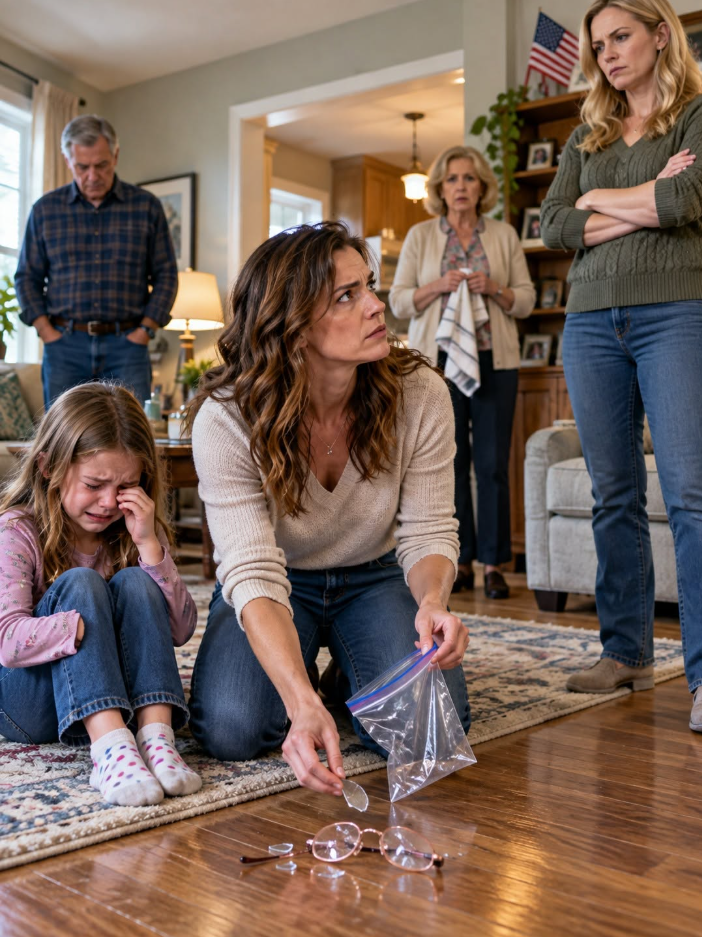
Exhibit F was a photograph of a pair of child’s eyeglasses lying on a hardwood floor. Both lenses cracked. The frame snapped clean at the bridge.
12 days earlier, my sister had crushed those glasses under her heel and told me my seven-year-old daughter needed to learn respect.
She had no idea what she’d actually stepped on. Neither [clears throat] did I at first.
It took one word, one single word my daughter saw on a lit up phone screen to unravel two years of lies my family had built around a dead man’s last wish.
The clerk stamped the first page.
3:53 p.m.
“You’re cutting it close, honey.”
“You have no idea,” I said.
Let me take you back to the Sunday it started.
My name is Aaron. I’m 36, and for the last 11 years, I’ve worked as a property claims adjuster for a regional insurance carrier.
I spend 40 hours a week deciding whether other people’s disasters are documented well enough to be believed. I read receipts for a living. I can smell a padded claim from the parking lot.
I tell you this because it matters later.
My family always treated my job like a punchline. Aaron and her paperwork, right up until my paperwork was the thing standing on their front porch.
My daughter Grace is seven. She was born with a condition that left her legally blind in her left eye. Best corrected vision worse than 2200.
That eye gives her colors and motion, not much else. Her right eye does almost all the work.
And it can only do that work through a specialty prescription lens. High index prism corrected polycarbonate because she’s a kid and kids fall down.
Without her glasses, Grace’s world melts into colored fog. She navigates our hallway at night by trailing her fingertips along the wall.
Her last pair cost $81246.
I know the exact number because I’m me and because the invoice from Dr. Priya Natarajan, her pediatric opthalmologist, 14 years in practice, the woman who taught Grace to say opthalmologist before she could reliably say spaghetti, was still in my file cabinet in a folder labeled Grace. Vision.
My family knew all of this.
My sister Lauren babysat Grace exactly twice in seven years. And both times, I wrote out instructions that began, “Her glasses stay on. This is not optional.”
So the family, my mother runs it.
Not officially. Officially, she just hosts Sunday dinners and forwards chain emails about gratitude.
But every family has a central bank of approval. And my mother is ours.
Lauren has been the preferred borrower since roughly 1994.
Lauren is 39, married to a patient man named Scott, mother to Mason and Brin, and constitutionally incapable of being wrong in a room my mother is standing in.
My father says nothing.
That’s not a figure of speech.
He is a quiet man who spent 30 years fixing HVAC systems and came home every night to a house where the thermostat was set by someone else.
When things get tense, he studies his hands.
And then there was Uncle Ray, my mother’s older brother.
He passed 2 years ago. Heart sudden 68.
Ray was the only adult in that house who spoke to Grace like she was a whole person instead of a situation.
At her sixth birthday, the last one he ever came to, he sat on the floor for a full hour while she walked him through a dragon book page by page.
And when she finished, he said, “Well, now I have to read the whole series.”
And then, because he was Ray, he actually did.
After his funeral, my mother handled the paperwork.
That’s the phrase everyone got.
A few weeks later, over pot roast, she announced to the table, “Ry didn’t leave much. There was nothing for anybody.”
She said it fast. The way you say something you’ve rehearsed.
And then she asked who wanted more potatoes.
I remember a small itch at the back of my mind.
Ray owned his house outright. Ray drove a 15-year-old Buick and bought his slacks at Costco.
Where exactly did not much go?
And I remember telling myself it wasn’t my business.
That’s what you do in my family. You feel the itch and you pass the potatoes.
18 months ago, Lauren remodeled her kitchen. Quartz counters, new cabinets, one of those faucets you wave your hand at.
“He helock,” she said, waving the hand in question.
Around the same time, I started covering Mason and Brin’s travel soccer fees, 900 a season, twice a year, because Lauren was stretched thin, and as my mother put it, family helps family.
Family helps family.
Hold on to that sentence. It’s loadbearing.
It happened at my parents house on a Sunday in October.
We were setting up for dinner. Mom realized the ice maker was broken, and I volunteered to run to the store because leaving that house for 20 minutes is the closest thing to a spa day my family offers.
I bought two bags of ice and a lemonade for grace.
I was gone 20 minutes.
I’ve done the math on those 20 minutes more times than I want to admit.
I came back through the front door and heard it before I saw it.
That specific broken glass sound of a child crying so hard she’s hiccoping.
Grace was on the living room rug, knees pulled up, squinting at shapes she could no longer resolve into people.
Her glasses lay on the hardwood 3 ft away.
Both lenses cracked. frame snapped at the bridge.
And my sister was standing over the wreckage with her arms crossed like a customs agent.
I put the ice down.
Somewhere in me, the adjuster took over. Because the adjuster is who I become when the ground moves.
“What happened?”
“She grabbed my phone,” Lauren said. “She was reading my messages. In this family, we respect people’s privacy.”
I looked at my daughter. 7 years old, 46 lb.
A phone had lit up on the couch cushion next to her, and she had glanced at it. The way every sighted creature on Earth glances at a bright rectangle that suddenly turns on.
“You broke her glasses.”
“I put them where they belonged.”
Beat.
“She needed to learn respect.”
She said it the way you’d report a chore.
I took out the trash.
I taught your disabled child a lesson by destroying the $800 medical device she cannot function without.
My mother came in from the kitchen drying her hands and assessed the scene.
Sobbing half-blind grandchild, shattered lenses, smug daughter, and chose her side in under two seconds.
“Grace needs boundaries. Aaron, we had her scrub the kitchen so she’d remember.”
I want you to sit with that.
They made a legally blind little girl wash dishes she could not see as punishment for a screen lighting up.
Grace’s hands were still pruned from the water.
My father stood in the doorway to the den and he said nothing because my father always says nothing.
Here’s what I didn’t do.
I didn’t scream.
I didn’t cry.
I have 36 years of data on this family and the data is clear.
A scene doesn’t get you justice. It gets you a starring role in the story they tell about you later.
Aaron flew off the handle. You know how she gets.
No, I would not be handing them material.
I picked up the pieces of my daughter’s glasses and sealed them in a ziplockc bag from my mother’s own drawer because I am an adjuster and broken things go in evidence bags.
That’s just how my hands work.
I took Grace’s hand.
I said, “We’re going home, baby.”
And we left.
Past my mother saying my name in that disappointed octave. Past my sister’s crossed arms. Past my silent father.
Out into the driveway where my Honda CRV sat with two bags of ice melting in the back seat.
Grace cried for most of the drive.
Then, worse, she stopped and started apologizing.
She apologized for the phone. She apologized for the glasses, as if her face had attacked my sister’s shoe.
At home, she apologized for needing help finding her toothbrush, which she could not see because it is aqua colored and 4 in long, and her world was fog.
I dug her backup hair out of the junk drawer, an old prescription, two years stale, the ones Dr. Natarajin keeps for emergencies only because the correction is wrong enough now to give her headaches.
Grace put them on and blinked at me through the wrong math and said, “It’s a little better, Mommy.”
Because my daughter had somehow gotten it into her head that her job that night was to make me feel okay.
Something in my chest went very cold and very still.
I sat on the edge of her bed, nightlight on, and I asked the question that changed everything, though I didn’t know it yet.
“Baby, what did you actually see on Aunt Lauren’s phone?”
She twisted her blanket in her fists.
Guilt again.
I hate them for that most of all, I think. For teaching my kid that a reflex is a crime.
“Just one word, mommy. My name was there and a word I don’t [clears throat] know.”
“What word?”
She scrunched up her face the way she does over hard spelling.
“Trust.”
I kept my voice bedtime soft.
I tucked her in. I told her none of this was her fault. Told it to her twice, kissed her forehead, closed the door most of the way like always.
Then I stood in my hallway and stared at the wall.
My daughter’s name, and the word trust on my sister’s phone.
And a grown woman so rattled by a seven-year-old’s glance at that screen that she destroyed the child’s glasses on the spot, then reverse engineered a morality lesson to cover it.
That’s not discipline.
I’ve watched a hundred people lie to me across a 100 kitchen tables about how the fire started.
I know what discipline looks like, and I know what panic looks like.
And panic always, always overreacts.
I told myself it could be anything. A group chat name, an app, autocorrect.
I ran through the innocent explanations the way I run through them for a claimant in descending order of plausibility, and every single one snagged on the same nail.
Only one person in our family had ever put grace and trust in the same sentence.
At 11:40 p.m., I texted Lauren.
“Calm adult. That was way out of line today. Grace can’t function without her glasses, and you know it. Call me tomorrow so we can fix this.”
Her reply came at 11:52.
“You should be teaching her not to snoop instead of coming after me. Honestly, Aaron, I’m the one owed an apology.”
I set the phone face down.
I lay on top of my covers and watched the ceiling until 2:13 a.m. and the itch I’d been ignoring for 2 years.
Ray didn’t leave much. Nothing for anybody who wants potatoes.
Stopped being an itch and became a fact I hadn’t verified yet.
I fell asleep making a list.
Monday morning, 8:31 a.m.
I called the county probate office from my car in the parking lot at work because some calls you can’t make at a desk.
A woman answered, “Deput clerk Ramona Ortiz, Records Division.”
19 years in that basement, she told me later. And nothing surprised her anymore.
I asked whether a will had ever been filed for Raymond J. Kovatch, deceased 2 years ago.
Keys clicked.
“Lodged with the court 31 days after date of death,” she said. “That’s a public record, hun. Anyone can request a copy.”
“Can you tell me anything about what it says?”
More clicking.
A pause that lasted one full lifetime.
“Porover will. Short. Everything he had goes into a trust. Hang on. The Raymond J. Kovatch revocable trust. The will names the beneficiary of the trust estate right on the second page. You want the case number.”
“Who’s the beneficiary?”
My voice came out wrong.
Paper sounds.
“A minor. Grace Cole.”
My daughter.
“Ma’am, you want that case number?”
I did not have paper.
I had a grocery receipt in my cup holder. Two bags of ice, one lemonade, 9:14, and I wrote the case number on the back of it because my hands were shaking too hard to dig for anything better.
I still have that receipt.
You’ll see why.
I sat in my car for a while after that.
There’s a taste adrenaline leaves in your mouth like sucking on a battery.
And I sat there tasting it and doing the thing I would have told any claimant not to do.
I called the suspect.
“Mom, quick question. What did Uncle Ray actually leave when he died?”
The pause on her end was a half second too long.
11 years of recorded claims interviews have taught me exactly how long an honest pause runs, and hers went over.
“Aaron, why on earth are you digging up the dead on a Monday morning?”
“It’s a simple question.”
“There was nothing. I told everyone there was paperwork and there was nothing. Honestly, first Lauren tells me you sent her a nasty text. Now this is this about the glasses because Grace needed—”
I said I had a meeting.
I hung up.
Failed fix number two, if you’re counting.
And I was.
In my job, we have a phrase for when a claimant answers a question you didn’t ask.
Consciousness of the file.
My mother had just told me the paperwork was fine before I ever mentioned paperwork.
That afternoon on my lunch break, I found Michael Harris.
Michael Harris, estate and trust litigation, 22 years.
His conference room on the fourth floor of a building that also housed a Pilates studio smelled like coffee and toner.
He was maybe 60, gray at the temples, with the specific calm of a man who has watched hundreds of families do this to each other and no longer flinches.
Tuesday morning, I sat across from him and laid it all out.
The lodged will, the case number off my grocery receipt, the trust, my daughter’s name, my mother’s two-year-old sentence.
Nothing for anybody.
And because it mattered to me that he understand what these people were, the Ziploc bag with the crushed glasses.
I put it right on his conference table.
He looked at the bag for a moment.
“Tell me about the glasses.”
So, I told him.
Legally blind left eye, specialty lenses, my sister’s heel.
“She needed to learn respect.”
The dishes.
Michael Harris had been taking notes on a yellow legal pad.
And when I got to the dishes, he stopped writing, took off his readers, and rubbed the bridge of his nose.
22 years of trust litigation, and I watched my family manage to be memorable.
Then he explained in the level voice of a man handing me a machine I could actually operate.
How it worked.
When a trust’s creator dies, the successor trustees have legal duties.
In our state, statute requires them to notify beneficiaries within 60 days that the trust exists and that they’re entitled to a copy.
They owe loyalty, disclosure, accounting, every dollar in, every dollar out.
As Grace’s parent and natural guardian, he said, “You have the right to demand the trust instrument and a full accounting on her behalf. So, the first thing we do is send that demand, certified mail, and then we watch what they do because what they do next tells us everything.”
I signed the retainer and put $5,000 on a credit card and it barely registered.
He warned me it might take a while to get answers.
It took one day.
Wednesday, 11:47 a.m.
My phone lit up on my desk at work.
“Harris, are you sitting down?”
“Just say it.”
“Your uncle left your daughter $240,000.”
The claims floor went on around me.
Phones, keyboards, a birthday happening near the microwave.
I couldn’t make a sound.
“243,900 at funding to be precise. The house sale, two CDs, a brokerage account, life insurance, held in trust for Grace until she’s 25 with distributions allowed before that for her health, education, and support. That’s the good news.”
Paper turn.
“Here’s the rest. Your parents were named co-rustees. They had a statutory duty to notify you within 60 days of Ray’s death. I have the complete court file, and I’ve run every database I have. I can’t find one letter, one notice, one accounting, one statement, or one dime that ever reached your side of the family.”
“Two years,” I said.
“Two years,” he said. “Aaron, in 22 years, I’ve seen sloppy trustees, lazy trustees, confused trustees. This doesn’t pattern like confusion. Confused people leave a mess. This is clean. Clean means deliberate.”
I don’t fully remember ending the call.
I remember I was suddenly sitting on the floor of the office kitchen and my friend Dana from Subregation was crouching next to me with a paper cup of water and I was laughing, which frightened her.
And I couldn’t explain that I was laughing because of soccer fees.
Two years of me covering Mason and Brin’s travel soccer because family helps family.
Two years of my mother sighing that grace was a lot to manage.
Building the burden brick by brick while sitting on my daughter’s inheritance.
Two years of Lauren’s quartz countertops and the message that lit up that phone screen on Sunday.
Lauren texting mom. Mom texting Lauren about the trust with my daughter’s name attached.
That’s what my seven-year-old glanced at.
That’s the screen they broke a little girl’s glasses over.
Not privacy.
Evidence.
“What do we do?” I asked Harris that afternoon.
“We’ve demanded the accounting. Next, we petition the court to compel it to remove them as trustees and to sirch charge them. That means personally repay anything that’s missing. And Aaron—”
His voice shifted into a register I’d learned to recognize.
“If this was concealed on purpose and if funds were converted, this can go further than civil court. Fiduciary embezzlement is a crime. I’m not promising that road. I’m telling you it exists.”
“Do all of it,” I said.
Thursday, I took race to Dr. Natarajan.
I needed the replacement order started, but I’ll be honest.
I also needed a room where an adult in authority treated my daughter like something precious.
Dr. Natarajan examined the backup glasses, examined Grace, and got very quiet in a way I’d never seen from her.
“How long has she been in the old prescription?”
“Since Sunday. She’s been getting headaches.”
“She would be.”
She turned to Grace, and her voice went warm.
“You, my friend, have been working incredibly hard. Your eyes are tired because the old glasses make them do extra math.”
Then to me in the hallway, quieter.
“What happened to the current pair?”
I told her all of it.
She needed to learn respect.
Dr. Natar Rajan, 14 years of pediatric opthalmology, looked at me for a long moment and then said, “I’m going to write you a letter.”
She documented everything.
The diagnosis, the acuity numbers, Grace’s functional blindness absent the specialty lens, the developmental risk of leaving a child her age undercorrected.
Two pages, letterhead, signed.
“If anyone, insurance, a court, anyone needs to understand what those glasses are, they can read this.”
The replacement pair, $81,246.
Again, my vision plan denied the claim.
Replacement within 12 months, patient responsibility.
And I paid out of pocket and filed the denial in the folder because by then, the folder had become a living thing I fed daily.
The rush order would still take 10 business days. Specialty lens, outside lab.
Grace wore the wrong math to school every day that week and did not complain once, which broke my heart in a place I didn’t know had survived this long.
Friday, the certified demand letter reached my parents house.
Someone signed for it.
I know because certified mail leaves a trail and trails are my love language.
And then my family did the thing I should have predicted.
The thing entitled, “People always do when the paper starts moving.”
They went to the court of public opinion because it’s the only court where mom picks the jury.
Saturday morning, Lauren posted on Facebook, “No names, all knives. So sad when someone weaponizes their child against family over a misunderstanding. Some of us teach our kids respect and accountability. Praying for certain people’s hearts.”
41 likes.
Three praying hands from women who’ve known me since I was in a car seat.
By Sunday, my phone was a switchboard.
Aunt Patty, mom’s cousin, sweet, permanently uninformed, called to ask, “Didn’t I think Grace would be better off seeing everyone get along?”
My cousin Dererick texted a meme about family being everything.
Here’s what none of them knew.
I don’t argue with narratives.
I document around them.
Every post, text, and voicemail went into a dated folder.
Harris had told me, “They’ll tell the story of a greedy daughter. Don’t answer it. In court, we won’t be telling a story at all. We’ll be holding records.”
Meanwhile, Harris brought in Diane Okafor, CPA, certified fraud examiner.
16 years, half of them spent untangling exactly this species of family trust disaster.
She owned a mug that said, “World’s okayest auditor.”
And she went through the partial records our demand had shaken loose from the trust’s bank like a woman defusing something.
Wednesday of week two.
She walked us through it on speakerphone, and I sat in Harris’s conference room and took the same kind of notes I take at a suspicious fire.
“Trustee compensation,” Okafor said. “Self-paid, $1,600 a month every month for 24 months. That’s $38,400 your parents paid themselves for administering a trust whose beneficiary didn’t know it existed. For context, the entire job here, one custodial account, quarterly statements, is maybe an hour a month.”
My pen stopped.
“There’s a $25,000 dispersement 18 months ago. The transfer memo says family loan. It went to an account belonging to Lauren Ashby. I find no promisory note, no interest, no repayment, and roughly 6,200 in miscellaneous storage administration, a memorial expense that postates the funeral by a year.”
“That’s $69,600,” I said.
“696,” Okafor confirmed, “out of a child’s medical and education trust. And one more thing, you should hear it from me, not a filing. The remaining principle is largely in a $60,000 certificate of deposit. It matures soon. Money is easiest to move on maturity day. If I were you, I’d want to know that date.”
18 months ago.
I looked at that number until it turned into a kitchen.
Quartz counters, the faucet you wave at.
I had waved at my daughter’s inheritance and it had turned on the water.
I went home that night and did something I’d been avoiding because it was the last soft thing left to try.
I called my father’s cell.
Not the house line, his.
And I asked him one time flat out, “Dad, did you know?”
11 seconds of silence.
I counted.
“Your mother handles the finances, Aaron.”
“That’s not what I asked.”
“I have to go. The game’s on.”
He hung up.
My father, ladies and gentlemen.
I sat at my kitchen table and let myself feel the specific grief of it, which is different from anger.
Anger has somewhere to go.
Then, Thursday night, 9:20 p.m., my doorbell rang.
My father stood on my porch in his good jacket, holding a Nike shoe box like it might detonate, and he could not look at me.
“Grace asleep?”
“Since 8:00.”
He nodded.
He stood there and then my silent father did the most talking I have ever heard him do at one time.
“Your mother thinks I don’t pay attention. I pay attention.”
He pushed the shoe box into my hands.
“Bank statements, copies. I’ve been pulling them out of the recycling for 2 years and putting them back like a coward. And there’s a notebook in there. Hers. You should see how she wrote it up.”
The notebook was a 99 cent spiral pad and it was the worst thing in the box.
My mother had been keeping a ledger.
Watched G3 ARS $60.
Snacks for G 18.
Gas.
Took G to school 25 hours.
2 years of it.
Grandmother hours itemized like an invoice.
They weren’t just spending my daughter’s money.
They were building the paperwork to justify it.
A burden file.
Every grace is a lot at every dinner suddenly clicked into place.
They’d been drafting the narrative out loud, road testing it on the family so that if this day ever came, a judge would meet a difficult, expensive child and her exhausted, entitled grandparents.
I do this for a living.
I audit padded claims.
My mother had itemized my daughter.
“Dad, why now?”
He looked at the door behind me where his granddaughter was asleep in headache glasses.
“The CD comes due Monday,” he said. “60,000. Your mother’s been on the phone with the bank about a cashier’s check. She told Lauren it’s for family debts.”
His jaw were.
“And because I don’t want the money, Aaron, I want to stop being the kind of man who says nothing.”
He left without coming inside.
I stood in my doorway holding a shoe box.
And then I called Michael Harris at 9:52 p.m., and he answered on the second ring like a man who’d been expecting the phone to be radioactive.
I told him about the CD.
Monday, the cashier’s check.
Quiet on the line.
Then, “Okay, then we’re not waiting for a regular hearing date. Tomorrow morning, we file the petition, removal, accounting, sirch charge, and we go in exparte for a temporary restraining order, freezing every trust asset before that bank opens Monday. Judges don’t love emergency applications on Fridays. So, we don’t give him a story. We give him a record.”
“Can you be at my office at 7:00?”
“I can be there at 6:00.”
“7,” he said, “is when the coffee is ready.”
Friday, the longest day of my life, and I once spent 9 hours in a crawl space documenting mold.
Harris’s conference room turned into a war room.
Declarations to draft and sign under penalty of herjgery.
Mine, reliving every minute of it in numbered paragraphs.
Okafores with the 696 laid out in tables that could survive cross-examination.
The shoe box scanned page by page into exhibits.
Dr. Natarajin’s office faxed her letter at 2:40 p.m.
Exhibit J.
The time-stamped photograph of the crushed glasses became exhibit F.
The ziplockc bag itself stayed in Harris’s file cabinet.
Chain of custody, his words, and mine.
My babysitter canceled at noon, so my daughter spent Friday afternoon in the small conference room of an estate litigation firm with apple slices and an audio book about dragons, wearing glasses that gave her headaches.
20 ft from a table where six adults were quantifying exactly what her family had done to her.
Every so often, I’d look through the glass wall and she’d wave at my blur because she recognizes my shape even when she can’t find my face.
At 3:22 p.m., the packet was assembled.
Court closed at Forio.
The e-filing system chose that exact window to go down.
Of course it did.
Which is how I ended up personally running a hard copy through downtown, past the metal detector, up to window 6 at 3:51 p.m. with my blouse stuck to my back, which is where you came in.
The clerk stamped it at 3:53.
I drove back to the firm, collected Grace and the remains of her apple slices, and at 4:40, as I buckled her in, Harris called from the courthouse hallway.
Judge D. Alvin Merrced, 26 years on the bench, nine of them running the probate department, had read the application in chambers.
“He granted the TTRO,” Harris said. “Every trust asset is frozen as of now. the CD, the accounts, all of it. Nothing moves. Hearing on the full petition is set six weeks out. The bank gets noticed today. Formal service on your parents goes out through a registered process server early next week.”
A pause, and the first crack of warmth I’d heard from him.
“Aaron, nobody touches that little girl’s money. You got there in time.”
I made it to the parking garage before I fell apart.
Third level in the CRV, both hands on the wheel, and I cried for 11 minutes.
I know because Grace timed me from the back seat and then reported gently.
“That was 11 minutes, Mommy.”
Like a very small project manager.
And I laughed until I cried differently.
The next morning, Saturday, 9:06 a.m., my mother texted me.
“Dinner tomorrow at 5:00. It’s been a hard couple of weeks for everyone. Family heals Aaron. Bring grace she didn’t know yet.”
The freeze was in place, but the process server wouldn’t find them until next week.
She was inviting me to dinner across a fault line only I knew had already slipped.
I looked at that text for a long time.
Then I called Harris and asked one question.
“Is there any legal reason I can’t attend a family dinner and hand my own parents a courtesy copy of a public filing?”
I could hear him deciding whether to talk me out of it.
He didn’t.
“Formal service still has to come from the process server,” he said. “But no, there’s no rule against dinner.”
A beat.
“Bring nothing you can’t afford to leave on the table.”
I replied to my mother.
“I’ll be there.”
I went alone.
Grace stayed with Dana and a stack of dragon books.
Some tables my daughter is never sitting at again.
Sunday 5:00.
Pot roast.
My mother’s good china. The set that comes out when the family needs to look like a family.
Everyone was there.
Mom orchestrating.
Dad carving. Eyes down. One flick of a glance at me when I came in.
He knew what Friday was.
He’d handed me the shoe box that made it possible.
And then eyes down again.
Lauren and Scott, Mason and Brin at the counter with tablets.
Aunt Patty imported as a neutral witness, which told me mom was staging a reconciliation scene with an audience.
I sat.
I passed dishes.
I said the roast was good.
It was actually.
My mother can cook. It’s the only unfalsified thing about her.
20 minutes in, Lauren got expansive, the way she does when she’s decided a room is hers, and steered us.
She couldn’t help it.
Into a speech about kids these days, about respect, about how some parents let children run wild and then act surprised.
Aunt Patty nodded along.
My mother wore her hostess smile.
I reached into my bag and set a thick folder on the table right between the roast and the good china.
Conversation didn’t stop immediately.
That’s the thing about rooms like that.
They’re so sure of their own weather.
It was Aunt Patty who finally said, “What’s that, sweetheart?”
My mother looked at the folder and I watched her smile hold while her eyes didn’t.
“What’s this, Aaron?”
“Uncle Ray left Grace $240,000,” I said. “And all three of you hid it for 2 years. Open the folder. Michael Harris is expecting your call.”
The room did that thing where sound falls out of it.
Scott said, “240—” and stopped and looked at his wife.
And I watched a marriage change mid-sentence.
Lauren went in stages.
That’s what nobody tells you.
The mask doesn’t drop.
It slips.
One lie at a time.
Stage one, scoff.
“This is insane. She’s lying. This is what she does.”
Stage two.
When Aunt Patty, bless her uninformed heart, actually opened the folder and started reading the petition’s first page out loud in her church voice.
“Petition for removal of trustees. Compelled accounting. Search charge.”
Stage three, the pivot to grievance.
“Did you go through my messages? Is that what this is? Because your daughter snooped on my phone and now—”
“Now everyone gets to know what was on it,” I said. “Funny how that worked out.”
And then stage four, the slip.
Lauren voice climbing, pointing at the folder like it had bitten her.
“That money was for family. Ray was our uncle. You don’t get to just—”
She heard it half a second after everyone else did.
That money.
Present tense.
Possessive.
Specific.
In front of Scott, in front of Aunt Patty, in front of my father, who set down the carving knife with a click I will hear for the rest of my life.
Looked at my mother and said the fourth longest sentence of his marriage.
“Read it, Carol.”
My mother had not moved.
Hostess smile long gone.
What was under it was something I’d only ever seen in flashes.
A cold assessing thing doing math.
She tried one last door.
She reached across the table toward my hand, voice pivoting to butter.
“Aaron, sweetheart, you have no idea what caring for this family costs. If you’d just come to me first, we could have—”
“You had 2 years and a legal obligation to come to me,” I said. “You sent chain emails about gratitude instead.”
I stood up.
I’d promised myself one exit line and no scene because scenes are what they eat.
“The trust accounts were frozen by court order on Friday,” I said. “So Monday, when the CD matures and you go in for that cashier’s check for family debts, the bank already knows. A process server will find you this week. Everything else is in the folder.”
I pushed my chair in.
“Dinner was lovely, Mom. Grace says, ‘Hi.’”
Nobody said a word as I left.
For once, in that house, the silence was mine.
You want to know what happened Monday?
Because I did, too.
And I got it from the only mole I’ve ever had inside that marriage.
My mother went to the bank at 10:00 a.m. for the cashier’s check.
My father drove her and then, for the first time in decades of chauffeuring that woman toward her own decisions, he went in and stood in the lobby to watch.
The branch manager took her into a little glass office, and my mother came out 11 minutes later, gray as newsprint, holding nothing.
Frozen means frozen.
Tuesday, a registered process server found my parents at home and Lauren in the parking lot of her gym.
Wednesday, they hired a lawyer, Barry Kesler, a decent, tired estate guy who took one look at Okafor’s tables.
Dr. Natarajin’s letter, my mother’s own spiral notebook, and the notification statute they’d ignored for 2 years and told his clients correctly that this was not a case.
It was a settlement in progress.
6 weeks later, we had our hearing anyway because I wanted an order, not a handshake.
Department 9, a Tuesday, nug.
My family sat on one side of the aisle like a funeral.
Judge Merrced is a courteous man with reading glasses and no visible patience for wasted mornings, and he moved through it like weather.
Trustees removed for breach of fiduciary duty.
My mother and father both because the law does not have a checkbox for he only drove her there.
Search charge ordered $69,600 restored to the trust plus statutory interest plus every dollar of my attorney’s fees secured against my parents house.
Karen Suzuki, a licensed professional fiduciary, 20 plus years, a stranger with a briefcase and no opinions about anyone’s pot roast.
Appointed successor trustee.
The court also ordered Lauren’s $25,000 family loan repaid.
Her wages are garnished a little every month, which means the court’s countertops are now on the world’s most humiliating installment plan.
And the referral Harris had mentioned.
The road past civil court was real.
The file went to the district attorney’s financial crimes unit for review of fiduciary embezzlement.
Months later, the DA declined to file charges, citing full restitution and family circumstances.
I won’t pretend part of me didn’t want more, but there’s a letter in an official file now with my parents’ names on it and the word embezzlement in the subject line, and they know it exists.
And some nights I decide that’s proportionate.
And some nights I just decide it’s what happened.
Consequences found their own levels after that, the way water does.
Aunt Patty told the truth to everyone she’d previously told the rumor to.
Turns out an uninformed heart plus a court filing is an effective broadcast tower.
My mother resigned from her church’s finance committee before anyone could ask her to.
Petitions are public record, and her circle contains at least three women who know how to use a courthouse website.
Scott moved into the apartment over his brother’s garage for a while.
He still takes Mason and Brin to soccer.
I know because I still see the schedule.
I just don’t pay for it anymore.
The night before her small claims date over the glasses at 11:58 p.m., Lauren sent me $81246 on Venmo.
The memo said, “There happy.”
I withdrew the case in the morning.
The memo I kept.
Grace’s new glasses came in on a Thursday.
Doctor Natarajin’s office called the lab twice to push the rush, and her tech made a whole ceremony of the fitting.
The little mirror, the adjustments, the how’s that feel, boss.
I watched my daughter put them on and watched the world snap back into focus behind her eyes.
Watched her find my actual face across the room instead of my blur.
And she said, “There you are, mommy.”
And I had to look at the ceiling for a second.
And the tech pretended to need something from a drawer.
She stopped trailing her fingers along the hallway wall at night.
That was the first thing to come back.
The apologizing took longer.
For months, my daughter said sorry the way other kids say um.
For asking twice. For needing help. For existing at inconvenient volumes.
Her school counselor gave us a trick.
Every time Grace apologized for something that wasn’t a wrong, she got to replace it with a fact.
Sorry became, “I couldn’t see the toothbrush.”
Sorry became, “I need the light on.”
4 months, more or less, before the reflex faded.
I don’t forgive the glasses, but I’ll spend the rest of my life not forgiving the reflex.
She asks about them sometimes.
“Grandma, Aunt Lauren.”
I keep it simple and true.
“They made choices that weren’t safe for you. And my job is to keep you safe. And none of it, none of it was your fault.”
Someday she’ll be old enough for the whole file.
It’ll be there.
I’m an adjuster.
The file is always there.
Epilog Spring.
An envelope comes every quarter now from the office of Karen Suzuki, licensed professional fiduciary, addressed to Grace Cole, a minor co Aaron Cole.
The first accounting showed the restitution landing, principal restored, interest posted, a trust rebuilt to $247,000 and change, growing quietly in boring, beautiful courts supervised instruments.
When it comes, Grace and I sit at the kitchen table and I read the numbers out loud.
And she doesn’t fully understand them yet, and that’s fine.
She understands that Uncle Ray left them for her.
She understands they’re safe.
My father comes over on Saturdays alone.
He and Grace are working through the dragon series.
He actually did read the whole thing back when because Ry shamed him into it.
And now he’s reading it again out loud, doing a very bad dragon voice with total commitment.
He never asks me to talk to my mother.
Her cards arrive on holidays.
Signed, “Love, mom,” full of weather.
I haven’t decided what I owe those cards.
I’ve stopped pretending there’s a deadline.
The grocery receipt is still in my wallet.
Two bags of ice, one lemonade, 9:14, and a probate case number in handwriting that shakes.
I keep it where other people keep photos.
And here’s the thing I turn over at night when the house is quiet and the hallway light is on for a kid who doesn’t need to touch the walls anymore.
My sister crushed a pair of glasses to stop a seven-year-old from seeing one word.
But Ry had already made sure of the only thing that mattered.
He’d put my daughter’s name and that word on paper, in ink, in a file a basement clerk could find, where no heel on earth could reach it.
Trust.
He was the only one in that house who ever understood the word.
Turns out he taught it to the right person.
She reads whole pages now.
Nobody gets to break that.